

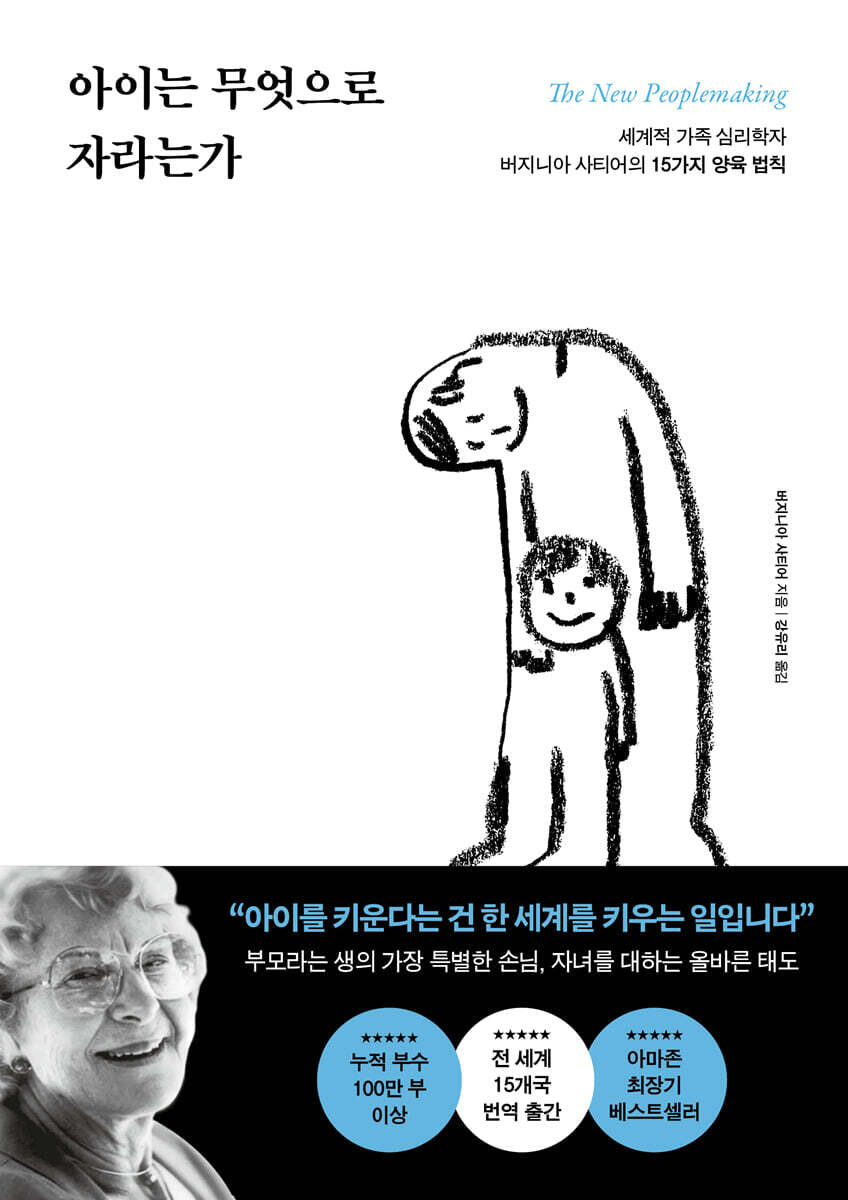
What does a child grow into?
 |
Description
Book Introduction
- A word from MD
-
The Legendary Parenting BibleThe legendary parenting bible written by Virginia Satir, the founder of family counseling, which became the foundation of all child education books.
It highlights the impact of a healthy family environment on a child's self-esteem and independence, and re-examines the value of love and communication.
A must-read for all parents and those who plan to become parents.
January 30, 2024. Baek Jeong-min, PD of Home Life
Virginia Satir's legendary parenting bible
『What Do Children Grow Up To?』 published!
“It’s absurd that no home with children doesn’t have this book.” _Time
* The world's most read parenting bestseller
Virginia Satir, a world-renowned family psychologist and leading expert in family therapy, has published her masterpiece, "The New Peoplemaking," which has sold over one million copies.
This book, which has been highly praised by leading media outlets, child and youth educators, and psychologists, has been translated and published in 15 countries around the world since its first publication in 1988, and has long been an Amazon bestseller, making it a legendary parenting bible.
The author of this book, Virginia Satir, a world-renowned family psychologist and leading expert in family therapy, strongly recommends that all parents establish a firm identity as parents and family when raising their children.
The fact that a good tree can produce good fruit also applies to parenting.
“Behind every problematic child is a problematic family.
If you want to raise your child to be a self-reliant person with high self-esteem, you must first become such a person yourself.
This is the one and only parenting principle.”
In the world of parenting, where all sorts of variables collide, if you haven't respected your child as an individual, if you've raised your child blindly, following trends, and if you've wandered around, unable to clearly distinguish when to give your child freedom and when to exercise control, then it's time to follow the immutable laws of parenting recognized worldwide.
Virginia Satir will provide answers to all those questions.
『What Do Children Grow Up To?』 published!
“It’s absurd that no home with children doesn’t have this book.” _Time
* The world's most read parenting bestseller
Virginia Satir, a world-renowned family psychologist and leading expert in family therapy, has published her masterpiece, "The New Peoplemaking," which has sold over one million copies.
This book, which has been highly praised by leading media outlets, child and youth educators, and psychologists, has been translated and published in 15 countries around the world since its first publication in 1988, and has long been an Amazon bestseller, making it a legendary parenting bible.
The author of this book, Virginia Satir, a world-renowned family psychologist and leading expert in family therapy, strongly recommends that all parents establish a firm identity as parents and family when raising their children.
The fact that a good tree can produce good fruit also applies to parenting.
“Behind every problematic child is a problematic family.
If you want to raise your child to be a self-reliant person with high self-esteem, you must first become such a person yourself.
This is the one and only parenting principle.”
In the world of parenting, where all sorts of variables collide, if you haven't respected your child as an individual, if you've raised your child blindly, following trends, and if you've wandered around, unable to clearly distinguish when to give your child freedom and when to exercise control, then it's time to follow the immutable laws of parenting recognized worldwide.
Virginia Satir will provide answers to all those questions.
- You can preview some of the book's contents.
Preview
index
Prologue: The starting point of everything in the world is the home.
Before we get started: Four Key Elements for Raising Self-Esteeming Children
Part 1: Self-Esteem: A Strong Self Will Make My Family Happy
Chapter 1_ Do you love your family?
Children from troubled families learn helplessness.
Children in nurturing families grow up to be their true selves.
Home is the starting point and final bastion of all things.
Chapter 2_ What's in Your Pot?
A story about self-esteem expressed through a 'pot'
The man with a full pot vs. the man with an empty pot
A child's self-esteem is entirely influenced by his or her family.
Chapter 3: Self-esteem, the source of personal energy
He who loves himself knows how to love others.
Humans are unique yet homogeneous beings.
How to Accept Your Family as They Are
Self-esteem is formed from birth.
Effective ways to boost your child's self-esteem
Chapter 4: A telescope that illuminates me from the inside out
The role of the eight limbs in forming the self
Guidelines for Overall Health
Part 2: Communicate freely without barriers
Chapter 5: Why do we communicate so poorly?
The process by which communication takes place
Practice activities to understand the communication process using the body
Practice activities to understand the communication process using distance and location.
The Core of Communication: Listening and Speaking
Some common pitfalls in communication
Chapter 6: How does self-esteem affect communication?
When words and body send signals separately
Four Types of Lame Communication
Ideal communication style: horizontal
Examples of five types of reactions
Chapter 7: Let's experience miscommunication through role-playing.
Preparing for Role Play
Let's role-play together as a family
Let's acknowledge and accept our own tendencies.
What are the consequences of miscommunication?
Once you understand, you can change.
Chapter 8: Let's Renew Family Rules
Let's get the whole family together and make a list of family rules.
Are there any restrictions on speaking?
Can you express anger?
Can you talk about sexual issues?
Are there any other taboos?
3. Laying the foundation, looking far ahead and being meticulous
Chapter 9: Family, Created by Two Different People Together
What does true love look like?
Do you remember the wishes you had when you got married?
Couples need both similarities and differences.
What is the difference between dating and marriage?
What makes love wither?
Chapter 10: What and How to Teach Your Children: A Family Blueprint
Prepared parents raise happy children.
How to wisely cope with environmental changes after the birth of a child
Things to keep in mind when modeling your parenting style
If you don't lose your sense of humor, you can get through any situation.
Let's look at parents through the eyes of a baby.
Babies learn about the world from the moment they are born.
When implementing a family blueprint, keep three things in mind:
Chapter 11: What Should Be Included in a Family Blueprint?
The learning stages that a person must go through from birth to adulthood
Let's recognize the uniqueness of each child.
Help your child develop a variety of strengths, including physical strength.
The home should be a place where children establish their sexual identity.
Let's create a home where dreams can be fulfilled
The problem of death that no one can avoid
Chapter 12: How should we manage our household?
Let's give our young children enough opportunities to do their part.
Let's use housework as an opportunity to boost self-esteem.
Both time alone and time together are important.
Don't rely on rumors, meet and experience for yourself.
The experience of owning something of your own is very important.
Part 4: Building Relationships, Flexible and Harmonious
Chapter 13: From Birth to Death, What Kind of Life Will We Live?
There are different skills to learn at each stage of life.
We need a new life cycle model based on wholeness.
Chapter 14_ If your child is going through puberty
A child's adolescence is a difficult time for the whole family.
We need encouragement, not control.
Let's also be honest about the fears parents feel.
Support your children's efforts and encourage their willingness to take on challenges.
Let's serve as guides so that our children can grow to their full potential.
Chapter 15: Old Age: Not the End, but a New Beginning
Five Things to Prepare for Old Age
Let's visualize our old age.
Like fine wine, wisdom comes with age.
Let's embrace the changing circumstances as an opportunity for challenge.
Let's set new life goals
Epilogue: The home should be a nest where whole people are raised.
Before we get started: Four Key Elements for Raising Self-Esteeming Children
Part 1: Self-Esteem: A Strong Self Will Make My Family Happy
Chapter 1_ Do you love your family?
Children from troubled families learn helplessness.
Children in nurturing families grow up to be their true selves.
Home is the starting point and final bastion of all things.
Chapter 2_ What's in Your Pot?
A story about self-esteem expressed through a 'pot'
The man with a full pot vs. the man with an empty pot
A child's self-esteem is entirely influenced by his or her family.
Chapter 3: Self-esteem, the source of personal energy
He who loves himself knows how to love others.
Humans are unique yet homogeneous beings.
How to Accept Your Family as They Are
Self-esteem is formed from birth.
Effective ways to boost your child's self-esteem
Chapter 4: A telescope that illuminates me from the inside out
The role of the eight limbs in forming the self
Guidelines for Overall Health
Part 2: Communicate freely without barriers
Chapter 5: Why do we communicate so poorly?
The process by which communication takes place
Practice activities to understand the communication process using the body
Practice activities to understand the communication process using distance and location.
The Core of Communication: Listening and Speaking
Some common pitfalls in communication
Chapter 6: How does self-esteem affect communication?
When words and body send signals separately
Four Types of Lame Communication
Ideal communication style: horizontal
Examples of five types of reactions
Chapter 7: Let's experience miscommunication through role-playing.
Preparing for Role Play
Let's role-play together as a family
Let's acknowledge and accept our own tendencies.
What are the consequences of miscommunication?
Once you understand, you can change.
Chapter 8: Let's Renew Family Rules
Let's get the whole family together and make a list of family rules.
Are there any restrictions on speaking?
Can you express anger?
Can you talk about sexual issues?
Are there any other taboos?
3. Laying the foundation, looking far ahead and being meticulous
Chapter 9: Family, Created by Two Different People Together
What does true love look like?
Do you remember the wishes you had when you got married?
Couples need both similarities and differences.
What is the difference between dating and marriage?
What makes love wither?
Chapter 10: What and How to Teach Your Children: A Family Blueprint
Prepared parents raise happy children.
How to wisely cope with environmental changes after the birth of a child
Things to keep in mind when modeling your parenting style
If you don't lose your sense of humor, you can get through any situation.
Let's look at parents through the eyes of a baby.
Babies learn about the world from the moment they are born.
When implementing a family blueprint, keep three things in mind:
Chapter 11: What Should Be Included in a Family Blueprint?
The learning stages that a person must go through from birth to adulthood
Let's recognize the uniqueness of each child.
Help your child develop a variety of strengths, including physical strength.
The home should be a place where children establish their sexual identity.
Let's create a home where dreams can be fulfilled
The problem of death that no one can avoid
Chapter 12: How should we manage our household?
Let's give our young children enough opportunities to do their part.
Let's use housework as an opportunity to boost self-esteem.
Both time alone and time together are important.
Don't rely on rumors, meet and experience for yourself.
The experience of owning something of your own is very important.
Part 4: Building Relationships, Flexible and Harmonious
Chapter 13: From Birth to Death, What Kind of Life Will We Live?
There are different skills to learn at each stage of life.
We need a new life cycle model based on wholeness.
Chapter 14_ If your child is going through puberty
A child's adolescence is a difficult time for the whole family.
We need encouragement, not control.
Let's also be honest about the fears parents feel.
Support your children's efforts and encourage their willingness to take on challenges.
Let's serve as guides so that our children can grow to their full potential.
Chapter 15: Old Age: Not the End, but a New Beginning
Five Things to Prepare for Old Age
Let's visualize our old age.
Like fine wine, wisdom comes with age.
Let's embrace the changing circumstances as an opportunity for challenge.
Let's set new life goals
Epilogue: The home should be a nest where whole people are raised.
Detailed image
.jpg)
Into the book
Influenced by a dream I had as a child, I became a family psychologist and have met countless families, shared stories and experiences.
I learned a lot through this work and realized that family is a microcosm of the world.
To understand the world, you just have to study each and every assumption.
This is because the power relations, intimacy, autonomy and trust, and communication methods that exist within families are directly applied to the world.
So, if you want to change the world, you have to change your family.
--- p.14
Even people with high self-esteem can become depressed.
But feeling depressed doesn't mean you're worthless or that your feelings of depression don't exist.
Don't transfer your feelings onto someone else.
It's natural to feel depressed sometimes.
There is a big difference between recognizing depression as something to be overcome and letting depression drive you to the point of self-deprecation.
Feeling depressed and not acknowledging it is a form of lying to yourself and others.
Devaluing your emotions in this way is tantamount to devaluing yourself, and only exposes the bottom of the pot even more.
Many things that happen to us are ultimately a result of our attitude.
Because it is an attitude, it can be changed at any time.
--- p.38~39
I've seen many instances where couples, especially, begin to enjoy physical intimacy, and their relationships improve in every way.
The taboo against physical contact explains why so many people have such dull, unsatisfactory, and terrible sex lives.
It also explains why teenagers rush into premature sexual intercourse so quickly.
Feeling the need for physical contact, they believe that the only outlet open to them is sexual intercourse.
Even when we touch hands together, you and I feel the contact differently.
It is important to talk to each other about how the other person's touch feels.
I meant to be a loving touch, but if you feel unkind, I need to know.
It's very common to not know what we look like, what we sound like, or what our touch feels like to someone else, and this leads to unnecessary disappointment and pain in our relationships.
--- p.76~77
I believe that being a parent is the most difficult, complex, worry-provoking, and demanding job in the world.
To do this successfully requires the ultimate in patience, common sense, dedication, humor, skill, love, wisdom, awareness, and knowledge.
At the same time, parenting is one of the most rewarding and joyful roles in that it allows us to serve as role models for new and special individuals to follow.
When your child says with bright eyes, “Mom and Dad are the best in the world!”, doesn’t your heart swell with excitement?
That's why we need a 'family blueprint'.
This means that you need to plan in advance what and how you will teach your child.
--- p.151
I believe that developing self-esteem is the path to becoming your true self.
This is what families should do.
As a family psychologist, I have seen many cases where increasing self-esteem has alleviated negative symptoms and restored health.
Some people think it's too much to expect that everyone in the world can learn how to have high self-esteem.
Some people also disagree with my idea, arguing that current human behavior reflects human nature.
But I disagree.
Because most human behavior is merely the result of education, learning, and imitation, and does not represent human potential.
We need to change our perception of human potential while also having confidence in it.
Each of us can make this change happen.
You have to start from where you are now, but move in the right direction.
The home is a wonderful place where such education and practice can take place.
I learned a lot through this work and realized that family is a microcosm of the world.
To understand the world, you just have to study each and every assumption.
This is because the power relations, intimacy, autonomy and trust, and communication methods that exist within families are directly applied to the world.
So, if you want to change the world, you have to change your family.
--- p.14
Even people with high self-esteem can become depressed.
But feeling depressed doesn't mean you're worthless or that your feelings of depression don't exist.
Don't transfer your feelings onto someone else.
It's natural to feel depressed sometimes.
There is a big difference between recognizing depression as something to be overcome and letting depression drive you to the point of self-deprecation.
Feeling depressed and not acknowledging it is a form of lying to yourself and others.
Devaluing your emotions in this way is tantamount to devaluing yourself, and only exposes the bottom of the pot even more.
Many things that happen to us are ultimately a result of our attitude.
Because it is an attitude, it can be changed at any time.
--- p.38~39
I've seen many instances where couples, especially, begin to enjoy physical intimacy, and their relationships improve in every way.
The taboo against physical contact explains why so many people have such dull, unsatisfactory, and terrible sex lives.
It also explains why teenagers rush into premature sexual intercourse so quickly.
Feeling the need for physical contact, they believe that the only outlet open to them is sexual intercourse.
Even when we touch hands together, you and I feel the contact differently.
It is important to talk to each other about how the other person's touch feels.
I meant to be a loving touch, but if you feel unkind, I need to know.
It's very common to not know what we look like, what we sound like, or what our touch feels like to someone else, and this leads to unnecessary disappointment and pain in our relationships.
--- p.76~77
I believe that being a parent is the most difficult, complex, worry-provoking, and demanding job in the world.
To do this successfully requires the ultimate in patience, common sense, dedication, humor, skill, love, wisdom, awareness, and knowledge.
At the same time, parenting is one of the most rewarding and joyful roles in that it allows us to serve as role models for new and special individuals to follow.
When your child says with bright eyes, “Mom and Dad are the best in the world!”, doesn’t your heart swell with excitement?
That's why we need a 'family blueprint'.
This means that you need to plan in advance what and how you will teach your child.
--- p.151
I believe that developing self-esteem is the path to becoming your true self.
This is what families should do.
As a family psychologist, I have seen many cases where increasing self-esteem has alleviated negative symptoms and restored health.
Some people think it's too much to expect that everyone in the world can learn how to have high self-esteem.
Some people also disagree with my idea, arguing that current human behavior reflects human nature.
But I disagree.
Because most human behavior is merely the result of education, learning, and imitation, and does not represent human potential.
We need to change our perception of human potential while also having confidence in it.
Each of us can make this change happen.
You have to start from where you are now, but move in the right direction.
The home is a wonderful place where such education and practice can take place.
--- p.254
Publisher's Review
“Children always observe their parents.”
The relationship between a couple determines the child's emotions and interpersonal relationships.
If your child is reluctant to express his or her feelings in relationships with friends, has difficulty approaching friends even when he or she wants to hang out with them, and sometimes feels anxious about even small things, you should start by examining the relationship between the couple.
Virginia Satir pointed out that there are so many families where marital relationships are not harmonious that many teenagers often say, “I don’t know how my parents got married in the first place,” and that this has a negative impact on the emotional development of children and the formation of later human relationships.
Unhappiness arises when countless parents try to be good parents but fail to become good couples.
If there is frequent discord and conflict between couples, resulting in tension and anxiety within the family, this will be passed on to the children.
Stress levels rise, emotional instability sets in, and feelings of depression and helplessness begin to creep in.
A child who grows up seeing the unstable relationship between his or her parents, the first relationship he or she encounters after being born, is bound to be awkward when forming relationships with others.
If you have to fight in front of your child for some unavoidable reason, sincerely apologize for it and reassure them by clearly explaining the reason for the conflict and how to resolve it.
Although arguments may arise because each person has different positions and views, we must also let them know that they can ultimately be resolved through conversations that help them understand each other or through affectionate physical contact.
Children are beings who always observe their parents and learn from their behavior even when their parents are not looking.
If you just remember that fact, you will be able to walk on the right path to parenting.
“Parenting isn’t about giving your child what he or she wants.”
The right attitude toward children, the most special guests in life, called parents.
Recently, the disciplinary methods of foreign parents became a hot topic on an entertainment program.
When the child behaved in a way that could cause harm to others, the parent stopped him, and when the spouse tried to comfort the child, the parent firmly replied, “Giving the child everything he wants is not the way to properly love him,” showing the correct parenting philosophy that children are not the property of their parents who must be showered with unconditional affection.
This book, "What Does a Child Grow Up To?" also delves deeply into the "essence" that should be given the highest priority among the numerous parenting methods.
It emphasizes that children should be viewed as 'absolute individuals' regardless of whether the parents gave birth to them or whether they are still children.
“Children should be raised with the perspective that they are the greatest ‘guests’ in the lives of their parents.”
If you want your child to do well in school, you should not force them to study, but help them learn independently. If you want your child to live bravely and boldly, you should first examine the fence called home to see if there are any problems and build a strong and solid foundation.
Perhaps the greatest task for parents is to plant seeds with sincerity and then watch and wait to see what kind of plant they will grow into.
The relationship between a couple determines the child's emotions and interpersonal relationships.
If your child is reluctant to express his or her feelings in relationships with friends, has difficulty approaching friends even when he or she wants to hang out with them, and sometimes feels anxious about even small things, you should start by examining the relationship between the couple.
Virginia Satir pointed out that there are so many families where marital relationships are not harmonious that many teenagers often say, “I don’t know how my parents got married in the first place,” and that this has a negative impact on the emotional development of children and the formation of later human relationships.
Unhappiness arises when countless parents try to be good parents but fail to become good couples.
If there is frequent discord and conflict between couples, resulting in tension and anxiety within the family, this will be passed on to the children.
Stress levels rise, emotional instability sets in, and feelings of depression and helplessness begin to creep in.
A child who grows up seeing the unstable relationship between his or her parents, the first relationship he or she encounters after being born, is bound to be awkward when forming relationships with others.
If you have to fight in front of your child for some unavoidable reason, sincerely apologize for it and reassure them by clearly explaining the reason for the conflict and how to resolve it.
Although arguments may arise because each person has different positions and views, we must also let them know that they can ultimately be resolved through conversations that help them understand each other or through affectionate physical contact.
Children are beings who always observe their parents and learn from their behavior even when their parents are not looking.
If you just remember that fact, you will be able to walk on the right path to parenting.
“Parenting isn’t about giving your child what he or she wants.”
The right attitude toward children, the most special guests in life, called parents.
Recently, the disciplinary methods of foreign parents became a hot topic on an entertainment program.
When the child behaved in a way that could cause harm to others, the parent stopped him, and when the spouse tried to comfort the child, the parent firmly replied, “Giving the child everything he wants is not the way to properly love him,” showing the correct parenting philosophy that children are not the property of their parents who must be showered with unconditional affection.
This book, "What Does a Child Grow Up To?" also delves deeply into the "essence" that should be given the highest priority among the numerous parenting methods.
It emphasizes that children should be viewed as 'absolute individuals' regardless of whether the parents gave birth to them or whether they are still children.
“Children should be raised with the perspective that they are the greatest ‘guests’ in the lives of their parents.”
If you want your child to do well in school, you should not force them to study, but help them learn independently. If you want your child to live bravely and boldly, you should first examine the fence called home to see if there are any problems and build a strong and solid foundation.
Perhaps the greatest task for parents is to plant seeds with sincerity and then watch and wait to see what kind of plant they will grow into.
GOODS SPECIFICS
- Date of issue: December 18, 2023
- Page count, weight, size: 256 pages | 436g | 152*225*20mm
- ISBN13: 9791193506202
- ISBN10: 1193506204
You may also like
카테고리
korean


korean

![ELLE 엘르 스페셜 에디션 A형 : 12월 [2025]](http://librairie.coreenne.fr/cdn/shop/files/b8e27a3de6c9538896439686c6b0e8fb.jpg?v=1766436872&width=3840)


