

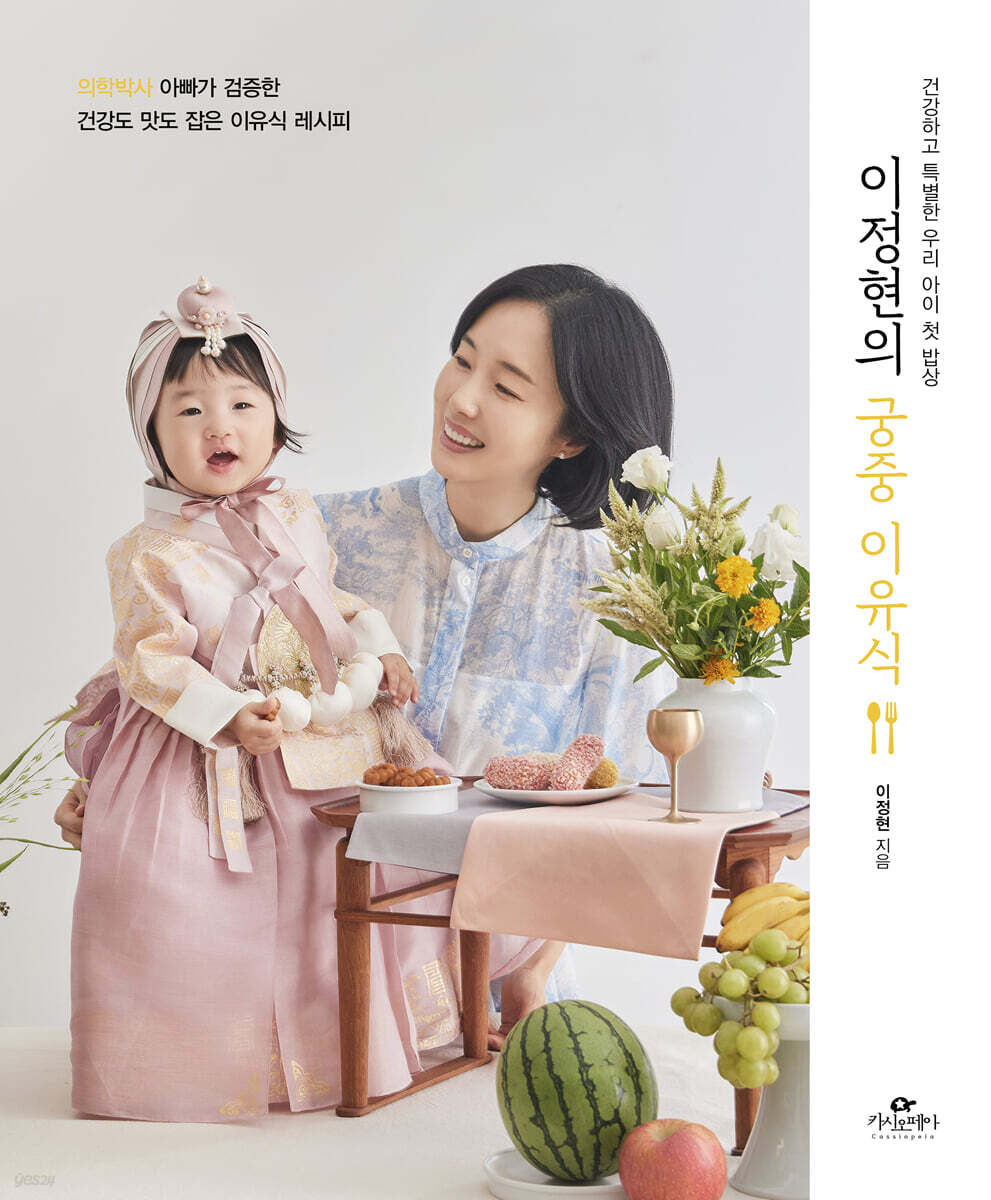
Lee Jung-hyun's royal baby food
 |
Description
Book Introduction
Keep your child's first meal simple and healthy
Everything you need to know about baby food from Lee Jung-hyun!
★ Revealing baby food verified by a father with a doctorate in medicine from Yonsei University and supervised by a professor of food and nutrition at Ewha Womans University
★ Includes 130 easy and simple recipes for baby food and snacks for each stage, as well as baby broth and seasonings.
Lee Jung-hyun, who has been a topic of conversation on every broadcast with her singer, actress, and chef-level cooking skills, has returned as a mother with a baby food book!
Her daughter, Seo-ah, whom she loved so much that she couldn't bear to put her in her eyes, had a hard time drinking breast milk or formula.
She thought during a time of suffering for both the child and the mother.
"I need to supplement the missing nutrients with delicious baby food." While wondering what kind of baby food would be the healthiest and best for her child, she decided to try "Royal Baby Food," made with only nutritious ingredients.
To this end, I studied various royal books on my own and referred to modern materials related to food ingredients to supplement the shortcomings of the old books.
This book is packed with 130 recipes, including baby food and snacks for each stage of the weaning process: early (4-6 months), mid (6-9 months), late (9-10 months), and final stage (12 months and up), as well as broths and baby seasonings that can be used throughout the entire weaning process.
As it is a modern reinterpretation of royal cuisine, it does not compromise on simplicity so that parents raising babies can easily follow it even in their busy daily lives.
My father, a doctor of medicine at Yonsei University, verified the recipe based on modern medicine, and a professor of food and nutrition at Ewha Womans University helped review the recipe to ensure nutritional balance.
One of the reasons why her daughter Seo-ah grew up strong and healthy is probably because of the baby food she made with care, keeping the child's taste and health in mind.
We hope you will personally experience her know-how and meticulousness in making and feeding baby food herself even when there was an all-night shoot.
Everything you need to know about baby food from Lee Jung-hyun!
★ Revealing baby food verified by a father with a doctorate in medicine from Yonsei University and supervised by a professor of food and nutrition at Ewha Womans University
★ Includes 130 easy and simple recipes for baby food and snacks for each stage, as well as baby broth and seasonings.
Lee Jung-hyun, who has been a topic of conversation on every broadcast with her singer, actress, and chef-level cooking skills, has returned as a mother with a baby food book!
Her daughter, Seo-ah, whom she loved so much that she couldn't bear to put her in her eyes, had a hard time drinking breast milk or formula.
She thought during a time of suffering for both the child and the mother.
"I need to supplement the missing nutrients with delicious baby food." While wondering what kind of baby food would be the healthiest and best for her child, she decided to try "Royal Baby Food," made with only nutritious ingredients.
To this end, I studied various royal books on my own and referred to modern materials related to food ingredients to supplement the shortcomings of the old books.
This book is packed with 130 recipes, including baby food and snacks for each stage of the weaning process: early (4-6 months), mid (6-9 months), late (9-10 months), and final stage (12 months and up), as well as broths and baby seasonings that can be used throughout the entire weaning process.
As it is a modern reinterpretation of royal cuisine, it does not compromise on simplicity so that parents raising babies can easily follow it even in their busy daily lives.
My father, a doctor of medicine at Yonsei University, verified the recipe based on modern medicine, and a professor of food and nutrition at Ewha Womans University helped review the recipe to ensure nutritional balance.
One of the reasons why her daughter Seo-ah grew up strong and healthy is probably because of the baby food she made with care, keeping the child's taste and health in mind.
We hope you will personally experience her know-how and meticulousness in making and feeding baby food herself even when there was an all-night shoot.
- You can preview some of the book's contents.
Preview
index
Entering
* Please prepare for our baby's hygiene 030
* This is how I used baby food tools 032
* How to Clean and Break in Cookware 038
* Learn about seasonal ingredients 042
* Find out about food compatibility 044
* Simple measuring with paper cups and spoons 048
* Check the concentration of baby food at each period at a glance 050
* Please read before starting solid food 052
Lee Jeong-hyeon's broth and baby seasoning
Beef Broth 058
Anchovy and kelp broth 060
Anchovy, kelp, and dried shrimp broth 062
Vegetable broth 064
Goji berry broth 066
Chicken broth 068
Clam and kelp broth 070
Gomtang broth 072
Baby Flavor Powder (Natural Seasoning) 074
Baby Salt 076
Baby Soy Sauce 078
Baby Doenjang 080
Baby Tomato Ketchup 082
Baby Tomato Kimchi 084
Baby Baek Kimchi 086
Early weaning food
* Main ingredients of baby food recorded in 『Jeongjoji』: Early 090
Stage 1 early weaning food
* Characteristics of Stage 1 baby food 094
Rice porridge 096
Rice Quinoa 098
Rice Mu-mi-eum 100
Rice and Potato Rice Cake 102
Rice Cabbage Miso Soup 104
Rice Cucumber Soup 106
Rice lettuce soup 108
Rice and Mushroom Soup 110
Rice and Broccoli Soup 112
Rice, Broccoli, and Onion Soup 114
Rice and Pumpkin Rice Cake 116
Stage 2 early weaning
* Characteristics of Stage 2 Early Weaning Food 118
Beef Quinoa Soup 120g
Beef, Seaweed, and Tofu Porridge 122
Beef Spinach Sesame Porridge 124
Beef and Beetroot Soybean Paste 126
Beef, Potato, and Broccoli Porridge 128
Beef, Zucchini, and Carrot Porridge 130
Beef and Shiitake Mushroom Porridge 132
Beef, Tofu, and Perilla Seed Porridge 134
Beef, Kale, and Apple Porridge 136
Beef, Pumpkin, and Apple Porridge 138
Early weaning snacks
Tteokppong 142
Super Easy Cheesecake 144
Bread and Milk Porridge 146
Apple puree 148
Pear Puree 150
Sweet potato puree 152
Banana Puree 154
Broccoli Sweet Potato Puree 156
Asparagus Potato Puree 158
3 types of fruit milk puree 160
Plain yogurt and puree 162
mid-term weaning food
* Main ingredients of baby food recorded in 『Jeongjoji』: Middle period 166
Stage 1 mid-term weaning food
* Characteristics of Stage 1 mid-term weaning food 168
Chicken, Broccoli, and Mushroom Porridge 172
Beef, Cauliflower, and Sweet Potato Porridge 174
Chicken, Pumpkin, Olive Oil 176
Beef, Pumpkin, and Broccoli Porridge 178
Daegu squid and onion porridge 180
Chicken, Potato, Garlic, and Broccoli Porridge 182
Beef, lotus root, and carrot porridge 184
Chicken, Egg, and Spinach Porridge 186
Duck, Pumpkin, and Chive Porridge 188
Daegu Shrimp and Cabbage Porridge 190
Stage 2 mid-term weaning food
* Features of Stage 2 mid-term weaning food 192
Pork, Onion, and Mushroom Porridge 194
Beef and Shiitake Mushroom Porridge 196
Chicken, Onion, Milk, and Basil Porridge 198
Daegu red bean curd porridge 200
Pork, Onion, and Bokbunja Porridge 202
Beef, Tomato, Cheese, and Basil Porridge 204
Beef, Beet, and Broccoli Porridge 206
Chicken, Bok Choy, Sweet Potato, Onion, and Thyme Porridge 208
Beef, Tofu, Onion, Carrot, and Garlic Porridge 210
Daegu Shrimp Porridge 212
mid-term baby food snacks
Baked Butter Banana 216
Yuzu Madeleine 218
Pumpkin Bread 220
Peanut Butter Sandwich 222
Vegetable Sticks 224
Soy milk 226
later baby food
* Main ingredients of baby food recorded in 『Jeongjoji』: Later 230
later baby food
* Characteristics of later baby food 232
Potato, Cabbage, Beef, and Rice 236
Salmon, Potato, and Spinach Rice 238
Daegu Shrimp Mujinbap 240
Chicken, Tofu, Carrot, and Broccoli Rice 242
Beef, Octopus, and Chive Rice 244
Shrimp Broccoli and Pumpkin Rice 246
Beef Rice Balls and Egg Yolk Rice Balls 248
Shrimp and Egg Rice Ball 250
Beef and Bean Sprout Rice 252
Nurungji and soy sauce bulgogi 254
Pork Bulgogi Stew with Quinoa Rice and Tofu 256
Beef Soup and Quinoa Rice 258
Beef Cream Risotto 260
Steamed Potatoes and Sirloin 262
Tofu, Vegetable, and Egg Pancake 264
Late baby food
Soft tofu stew, grilled fish, and baby tomato kimchi 268
Soybean paste stew, grilled mackerel, steamed egg, and bean sprout salad 270
Beef and Abalone Soup, Stir-fried Broccoli and Shrimp, and Baby White Kimchi 272
Egg Soup, Stir-fried Beef, Bamboo Shoots, and Mushrooms, and Baby White Kimchi 274
Daegu radish soup, pork donggeurangttaeng, and baby white kimchi 276
Daegu radish soup, beef donggeurangttaeng, and spinach side dish 278
Late baby food snacks
Chicken Breast Chicken 282
Pancake 284
Egg Avocado Sandwich 286
Potato Cheese Croquette 288
Bacon Mini Hotdogs and Baby Tomato Ketchup 290
French Toast 292
Pork and Apple Puree 294
Cheese Macaroni 296
Completed baby food
* Main ingredients of baby food recorded in 『Jeongjoji』: 300 won
Completed baby food
* Features of complete baby food 302
Beef, Beet, and Mushroom Rice in a Pot 304
Chicken Breast, Shiitake Mushroom, and Paprika Rice in a Pot 306
Whitefish, Clam, and Chive Rice in a Pot 308
Bolognese Pasta 310
Anchovy and Zucchini Noodles 312
Beef Vegetable Tofu Curry 314
Shrimp and Abalone Cream Pasta 316
Vongole Pasta 318
Mama's Pasta 320
Kongguksu 322
Shrimp and Egg Fried Rice 324
Beef, Abalone, and Broccoli Fried Rice 326
Land War 328
Zucchini, Carrot, and Vegetable Noodles with Creamy Chicken Sauce 330
Chicken Breast and Broccoli Stir-Fried Noodles 332
Steamed Crab and Quinoa Rice 334
A special and simple dinner with baby
Salmon Steak, Butter Spinach, and Potato Slush 338
Beef Steak, Butter Spinach, and Potato Slush 340
Pork cutlet, butter spinach, and potato slush 342
Chicken Steak, Butter Spinach, and Potato Slush 344
special baby food
Baby food when sick
Chicken porridge 348
Glutinous rice quinoa 350g
Glutinous rice quinoa pear porridge 352
Potato Milk Soup 354
Sweet Potato Milk Soup 356
Pumpkin Milk Soup 358
Glutinous Rice Quinoa Pumpkin Porridge 360
Baby food when constipated
Beef and Beet Porridge 362
Beef, Cabbage, and Kohlrabi Porridge 364
* 366 when the baby food intake is at a plateau
I want to ask Dr. Seo-ah's father, Part 372
Dr. Seo-ah's Dad's Orthopedic Clinic 376
Reviewer's Note 380
Appendix_Physical Development Standards 382
* Please prepare for our baby's hygiene 030
* This is how I used baby food tools 032
* How to Clean and Break in Cookware 038
* Learn about seasonal ingredients 042
* Find out about food compatibility 044
* Simple measuring with paper cups and spoons 048
* Check the concentration of baby food at each period at a glance 050
* Please read before starting solid food 052
Lee Jeong-hyeon's broth and baby seasoning
Beef Broth 058
Anchovy and kelp broth 060
Anchovy, kelp, and dried shrimp broth 062
Vegetable broth 064
Goji berry broth 066
Chicken broth 068
Clam and kelp broth 070
Gomtang broth 072
Baby Flavor Powder (Natural Seasoning) 074
Baby Salt 076
Baby Soy Sauce 078
Baby Doenjang 080
Baby Tomato Ketchup 082
Baby Tomato Kimchi 084
Baby Baek Kimchi 086
Early weaning food
* Main ingredients of baby food recorded in 『Jeongjoji』: Early 090
Stage 1 early weaning food
* Characteristics of Stage 1 baby food 094
Rice porridge 096
Rice Quinoa 098
Rice Mu-mi-eum 100
Rice and Potato Rice Cake 102
Rice Cabbage Miso Soup 104
Rice Cucumber Soup 106
Rice lettuce soup 108
Rice and Mushroom Soup 110
Rice and Broccoli Soup 112
Rice, Broccoli, and Onion Soup 114
Rice and Pumpkin Rice Cake 116
Stage 2 early weaning
* Characteristics of Stage 2 Early Weaning Food 118
Beef Quinoa Soup 120g
Beef, Seaweed, and Tofu Porridge 122
Beef Spinach Sesame Porridge 124
Beef and Beetroot Soybean Paste 126
Beef, Potato, and Broccoli Porridge 128
Beef, Zucchini, and Carrot Porridge 130
Beef and Shiitake Mushroom Porridge 132
Beef, Tofu, and Perilla Seed Porridge 134
Beef, Kale, and Apple Porridge 136
Beef, Pumpkin, and Apple Porridge 138
Early weaning snacks
Tteokppong 142
Super Easy Cheesecake 144
Bread and Milk Porridge 146
Apple puree 148
Pear Puree 150
Sweet potato puree 152
Banana Puree 154
Broccoli Sweet Potato Puree 156
Asparagus Potato Puree 158
3 types of fruit milk puree 160
Plain yogurt and puree 162
mid-term weaning food
* Main ingredients of baby food recorded in 『Jeongjoji』: Middle period 166
Stage 1 mid-term weaning food
* Characteristics of Stage 1 mid-term weaning food 168
Chicken, Broccoli, and Mushroom Porridge 172
Beef, Cauliflower, and Sweet Potato Porridge 174
Chicken, Pumpkin, Olive Oil 176
Beef, Pumpkin, and Broccoli Porridge 178
Daegu squid and onion porridge 180
Chicken, Potato, Garlic, and Broccoli Porridge 182
Beef, lotus root, and carrot porridge 184
Chicken, Egg, and Spinach Porridge 186
Duck, Pumpkin, and Chive Porridge 188
Daegu Shrimp and Cabbage Porridge 190
Stage 2 mid-term weaning food
* Features of Stage 2 mid-term weaning food 192
Pork, Onion, and Mushroom Porridge 194
Beef and Shiitake Mushroom Porridge 196
Chicken, Onion, Milk, and Basil Porridge 198
Daegu red bean curd porridge 200
Pork, Onion, and Bokbunja Porridge 202
Beef, Tomato, Cheese, and Basil Porridge 204
Beef, Beet, and Broccoli Porridge 206
Chicken, Bok Choy, Sweet Potato, Onion, and Thyme Porridge 208
Beef, Tofu, Onion, Carrot, and Garlic Porridge 210
Daegu Shrimp Porridge 212
mid-term baby food snacks
Baked Butter Banana 216
Yuzu Madeleine 218
Pumpkin Bread 220
Peanut Butter Sandwich 222
Vegetable Sticks 224
Soy milk 226
later baby food
* Main ingredients of baby food recorded in 『Jeongjoji』: Later 230
later baby food
* Characteristics of later baby food 232
Potato, Cabbage, Beef, and Rice 236
Salmon, Potato, and Spinach Rice 238
Daegu Shrimp Mujinbap 240
Chicken, Tofu, Carrot, and Broccoli Rice 242
Beef, Octopus, and Chive Rice 244
Shrimp Broccoli and Pumpkin Rice 246
Beef Rice Balls and Egg Yolk Rice Balls 248
Shrimp and Egg Rice Ball 250
Beef and Bean Sprout Rice 252
Nurungji and soy sauce bulgogi 254
Pork Bulgogi Stew with Quinoa Rice and Tofu 256
Beef Soup and Quinoa Rice 258
Beef Cream Risotto 260
Steamed Potatoes and Sirloin 262
Tofu, Vegetable, and Egg Pancake 264
Late baby food
Soft tofu stew, grilled fish, and baby tomato kimchi 268
Soybean paste stew, grilled mackerel, steamed egg, and bean sprout salad 270
Beef and Abalone Soup, Stir-fried Broccoli and Shrimp, and Baby White Kimchi 272
Egg Soup, Stir-fried Beef, Bamboo Shoots, and Mushrooms, and Baby White Kimchi 274
Daegu radish soup, pork donggeurangttaeng, and baby white kimchi 276
Daegu radish soup, beef donggeurangttaeng, and spinach side dish 278
Late baby food snacks
Chicken Breast Chicken 282
Pancake 284
Egg Avocado Sandwich 286
Potato Cheese Croquette 288
Bacon Mini Hotdogs and Baby Tomato Ketchup 290
French Toast 292
Pork and Apple Puree 294
Cheese Macaroni 296
Completed baby food
* Main ingredients of baby food recorded in 『Jeongjoji』: 300 won
Completed baby food
* Features of complete baby food 302
Beef, Beet, and Mushroom Rice in a Pot 304
Chicken Breast, Shiitake Mushroom, and Paprika Rice in a Pot 306
Whitefish, Clam, and Chive Rice in a Pot 308
Bolognese Pasta 310
Anchovy and Zucchini Noodles 312
Beef Vegetable Tofu Curry 314
Shrimp and Abalone Cream Pasta 316
Vongole Pasta 318
Mama's Pasta 320
Kongguksu 322
Shrimp and Egg Fried Rice 324
Beef, Abalone, and Broccoli Fried Rice 326
Land War 328
Zucchini, Carrot, and Vegetable Noodles with Creamy Chicken Sauce 330
Chicken Breast and Broccoli Stir-Fried Noodles 332
Steamed Crab and Quinoa Rice 334
A special and simple dinner with baby
Salmon Steak, Butter Spinach, and Potato Slush 338
Beef Steak, Butter Spinach, and Potato Slush 340
Pork cutlet, butter spinach, and potato slush 342
Chicken Steak, Butter Spinach, and Potato Slush 344
special baby food
Baby food when sick
Chicken porridge 348
Glutinous rice quinoa 350g
Glutinous rice quinoa pear porridge 352
Potato Milk Soup 354
Sweet Potato Milk Soup 356
Pumpkin Milk Soup 358
Glutinous Rice Quinoa Pumpkin Porridge 360
Baby food when constipated
Beef and Beet Porridge 362
Beef, Cabbage, and Kohlrabi Porridge 364
* 366 when the baby food intake is at a plateau
I want to ask Dr. Seo-ah's father, Part 372
Dr. Seo-ah's Dad's Orthopedic Clinic 376
Reviewer's Note 380
Appendix_Physical Development Standards 382
Detailed image

Into the book
Don't worry if you don't have the vegetables listed in the recipe ingredients; just substitute them whenever you need them.
For example, if you don't have bok choy, substitute with spinach, and if you don't have spinach, substitute with bok choy or arugula.
Or, if you have one or more other vegetables, you can leave them out.
Don't get too hung up on the vegetables in this book; feel free to substitute them with whatever vegetables you have at home.
However, check the ingredient compatibility and cook using vegetables you have at home.
The same goes for protein foods such as meat and fish.
Please carefully consider what you can feed in the early, middle, and late stages and then cook accordingly.
---p.53
I was so excited at the thought of finally being able to feed our Seo-ah.
It was really hard for Seo-ah because she was a baby who didn't drink formula.
'Now, both Seo-ah and Mom will be happy and full without suffering,' she thought, and diligently made baby food with good ingredients.
Luckily, Seo-ah opened her mouth wide like a baby bird and ate it eagerly.
Oh my goodness, he even whined for more.
I can't tell you how happy I was the moment I fed Seo-ah baby food.
---p.94
Most of the baby food books in our country say to remove the stems and skins, introduce allergens like pork, eggs, and shrimp as late as possible, and try garlic, green onions, and other herbs only after they are fully cooked.
However, after reading foreign baby food books, I found that foreign babies consume all the ingredients starting at 6 months.
In countries like Europe, herbs are widely used in all baby food preparations.
Deal and time too.
They say that the more tastes a baby experiences, the better it is for their brain development.
So, I also tried all the ingredients and herbs one by one starting when Seo-ah was 6 months old.
The flavor deepened and the nutrition increased, and I can't even begin to describe how much Seo-ah's mouth enjoyed it.
However, for children with food allergies, we recommend starting with the later stages.
---pp.168~169
After reading the reviews, making baby food has become much easier.
I can't tell you how convenient it is to not have to grind the rice in a blender since you can just use plain rice.
Now, I can eat rice, soup, and side dishes like adults, and even try making my own baby food, even though it's a mess all around. I can't tell you how excited I am.
When Seo-ah picked up a fork and spoon and ate rice on her own, she almost cried.
Are all mothers like me?
---p.232
I can't tell you how happy I am that it's become easier for the whole family to eat out since we switched to regular meals.
Seo-ah really liked it because she could eat regular rice and side dishes with a little seasoning.
Seoa, who was a baby who didn't eat well, started eating snacks really well after completing the feeding period.
He started having bowel movements three times a day and his weight started to increase.
When I made my favorite pasta dish for Seo-ah, but made it a little less spicy, she ate it and screamed at how delicious it was.
Now, let your baby taste your favorite dishes, seasoned to a milder flavor.
Both baby and mother become happy.
---p.302
Seo-ah also reached a plateau in her diet.
I think it started when I was 6 months old.
The plateau came at intervals of 3-4 days for about two months.
There were days when I only ate one meal a day, and I was so upset.
After much research, I found and tried many methods and overcame the plateau.
Fortunately, because of this method, I have always been above average in infant and toddler checkups.
For example, if you don't have bok choy, substitute with spinach, and if you don't have spinach, substitute with bok choy or arugula.
Or, if you have one or more other vegetables, you can leave them out.
Don't get too hung up on the vegetables in this book; feel free to substitute them with whatever vegetables you have at home.
However, check the ingredient compatibility and cook using vegetables you have at home.
The same goes for protein foods such as meat and fish.
Please carefully consider what you can feed in the early, middle, and late stages and then cook accordingly.
---p.53
I was so excited at the thought of finally being able to feed our Seo-ah.
It was really hard for Seo-ah because she was a baby who didn't drink formula.
'Now, both Seo-ah and Mom will be happy and full without suffering,' she thought, and diligently made baby food with good ingredients.
Luckily, Seo-ah opened her mouth wide like a baby bird and ate it eagerly.
Oh my goodness, he even whined for more.
I can't tell you how happy I was the moment I fed Seo-ah baby food.
---p.94
Most of the baby food books in our country say to remove the stems and skins, introduce allergens like pork, eggs, and shrimp as late as possible, and try garlic, green onions, and other herbs only after they are fully cooked.
However, after reading foreign baby food books, I found that foreign babies consume all the ingredients starting at 6 months.
In countries like Europe, herbs are widely used in all baby food preparations.
Deal and time too.
They say that the more tastes a baby experiences, the better it is for their brain development.
So, I also tried all the ingredients and herbs one by one starting when Seo-ah was 6 months old.
The flavor deepened and the nutrition increased, and I can't even begin to describe how much Seo-ah's mouth enjoyed it.
However, for children with food allergies, we recommend starting with the later stages.
---pp.168~169
After reading the reviews, making baby food has become much easier.
I can't tell you how convenient it is to not have to grind the rice in a blender since you can just use plain rice.
Now, I can eat rice, soup, and side dishes like adults, and even try making my own baby food, even though it's a mess all around. I can't tell you how excited I am.
When Seo-ah picked up a fork and spoon and ate rice on her own, she almost cried.
Are all mothers like me?
---p.232
I can't tell you how happy I am that it's become easier for the whole family to eat out since we switched to regular meals.
Seo-ah really liked it because she could eat regular rice and side dishes with a little seasoning.
Seoa, who was a baby who didn't eat well, started eating snacks really well after completing the feeding period.
He started having bowel movements three times a day and his weight started to increase.
When I made my favorite pasta dish for Seo-ah, but made it a little less spicy, she ate it and screamed at how delicious it was.
Now, let your baby taste your favorite dishes, seasoned to a milder flavor.
Both baby and mother become happy.
---p.302
Seo-ah also reached a plateau in her diet.
I think it started when I was 6 months old.
The plateau came at intervals of 3-4 days for about two months.
There were days when I only ate one meal a day, and I was so upset.
After much research, I found and tried many methods and overcame the plateau.
Fortunately, because of this method, I have always been above average in infant and toddler checkups.
---p.366
Publisher's Review
The most special gift a parent can give their child: royal baby food.
Weaning is not only a process that helps a child's development, but it is also a process that fosters proper eating habits without picky eating by gradually exposing the child to the texture and taste of various ingredients.
In that respect, borrowing from the 'royal cuisine', which used only nutritious ingredients to prepare a variety of dishes, is the healthiest and most effective way to provide baby food.
She began to study royal cuisine on her own in order to incorporate it into baby food.
In addition, various modern food material materials and foreign books were also referenced.
The royal family pondered over what ingredients were used in baby food, what their effects were, and how to cook it to make it more delicious.
After countless trials and errors, she finally came up with her own recipe that allows her to confidently say, “It’s delicious if you make it like this!” and “It’s healthy if you make it like this!”
My father, a doctor of medicine at Yonsei University, medically verified it
Recipe supervised by a professor in the Department of Food and Nutrition at Ewha Womans University
The secret to making healthy baby food that your baby will enjoy is simple.
The goal is to assess your baby's development while maintaining basic nutritional standards.
This seemingly easy method is also one of the reasons why making baby food is difficult.
This is because it is a matter directly related to the child's growth, such as whether it is right to feed this at this time and how much to feed.
Her husband, a doctor, verified the recipe based on modern medicine, understanding the concerns of parents entering the unknown world of baby food.
Thanks to this, it provides more accurate and rich information by season and food ingredient.
We also covered the basic medical knowledge you need to know while raising a child.
Additionally, a professor from Ewha Womans University's Department of Food and Nutrition helped review the recipe, ensuring nutritional balance.
As a 'scientific baby food book based on the latest medical knowledge' written by experts in both fields, it helps parents feed their children healthy baby food.
The same heart and sincerity that Lee Jung-hyun used to feed her daughter
Includes 130 recipes for baby food, snacks, broths, and seasonings for each stage of development, from early to mid-late stages.
Mothers worry every time they make baby food.
What ingredients to use and what combination to feed the baby, what to give to a baby who suddenly won't eat solid food, what to make when you want to treat a special meal once in a while, what recipe is good for a sick child, what to feed when the child is constipated, etc... The entire process of making solid food is full of uncertainty.
This book introduces a total of 130 recipes, including recipes for early, middle, late, and final stages of weaning, as well as snacks that are good to feed at each stage, broths that can be used in adult cooking, and how to make seasonings such as baby salt, soy sauce, and soybean paste that will healthily stimulate your baby's appetite.
Furthermore, rather than being confined to the concept of 'royalty,' we also introduce a variety of Western baby foods that parents and babies can enjoy together, reflecting modern food culture trends.
It will be of great help to parents who want to raise their babies to be stronger and to parents who are upset because their babies do not eat solid food.
Weaning is not only a process that helps a child's development, but it is also a process that fosters proper eating habits without picky eating by gradually exposing the child to the texture and taste of various ingredients.
In that respect, borrowing from the 'royal cuisine', which used only nutritious ingredients to prepare a variety of dishes, is the healthiest and most effective way to provide baby food.
She began to study royal cuisine on her own in order to incorporate it into baby food.
In addition, various modern food material materials and foreign books were also referenced.
The royal family pondered over what ingredients were used in baby food, what their effects were, and how to cook it to make it more delicious.
After countless trials and errors, she finally came up with her own recipe that allows her to confidently say, “It’s delicious if you make it like this!” and “It’s healthy if you make it like this!”
My father, a doctor of medicine at Yonsei University, medically verified it
Recipe supervised by a professor in the Department of Food and Nutrition at Ewha Womans University
The secret to making healthy baby food that your baby will enjoy is simple.
The goal is to assess your baby's development while maintaining basic nutritional standards.
This seemingly easy method is also one of the reasons why making baby food is difficult.
This is because it is a matter directly related to the child's growth, such as whether it is right to feed this at this time and how much to feed.
Her husband, a doctor, verified the recipe based on modern medicine, understanding the concerns of parents entering the unknown world of baby food.
Thanks to this, it provides more accurate and rich information by season and food ingredient.
We also covered the basic medical knowledge you need to know while raising a child.
Additionally, a professor from Ewha Womans University's Department of Food and Nutrition helped review the recipe, ensuring nutritional balance.
As a 'scientific baby food book based on the latest medical knowledge' written by experts in both fields, it helps parents feed their children healthy baby food.
The same heart and sincerity that Lee Jung-hyun used to feed her daughter
Includes 130 recipes for baby food, snacks, broths, and seasonings for each stage of development, from early to mid-late stages.
Mothers worry every time they make baby food.
What ingredients to use and what combination to feed the baby, what to give to a baby who suddenly won't eat solid food, what to make when you want to treat a special meal once in a while, what recipe is good for a sick child, what to feed when the child is constipated, etc... The entire process of making solid food is full of uncertainty.
This book introduces a total of 130 recipes, including recipes for early, middle, late, and final stages of weaning, as well as snacks that are good to feed at each stage, broths that can be used in adult cooking, and how to make seasonings such as baby salt, soy sauce, and soybean paste that will healthily stimulate your baby's appetite.
Furthermore, rather than being confined to the concept of 'royalty,' we also introduce a variety of Western baby foods that parents and babies can enjoy together, reflecting modern food culture trends.
It will be of great help to parents who want to raise their babies to be stronger and to parents who are upset because their babies do not eat solid food.
GOODS SPECIFICS
- Date of issue: August 18, 2023
- Page count, weight, size: 384 pages | 912g | 190*230*24mm
- ISBN13: 9791168271371
- ISBN10: 1168271371
You may also like
카테고리
korean


korean

![ELLE 엘르 스페셜 에디션 A형 : 12월 [2025]](http://librairie.coreenne.fr/cdn/shop/files/b8e27a3de6c9538896439686c6b0e8fb.jpg?v=1766436872&width=3840)


