

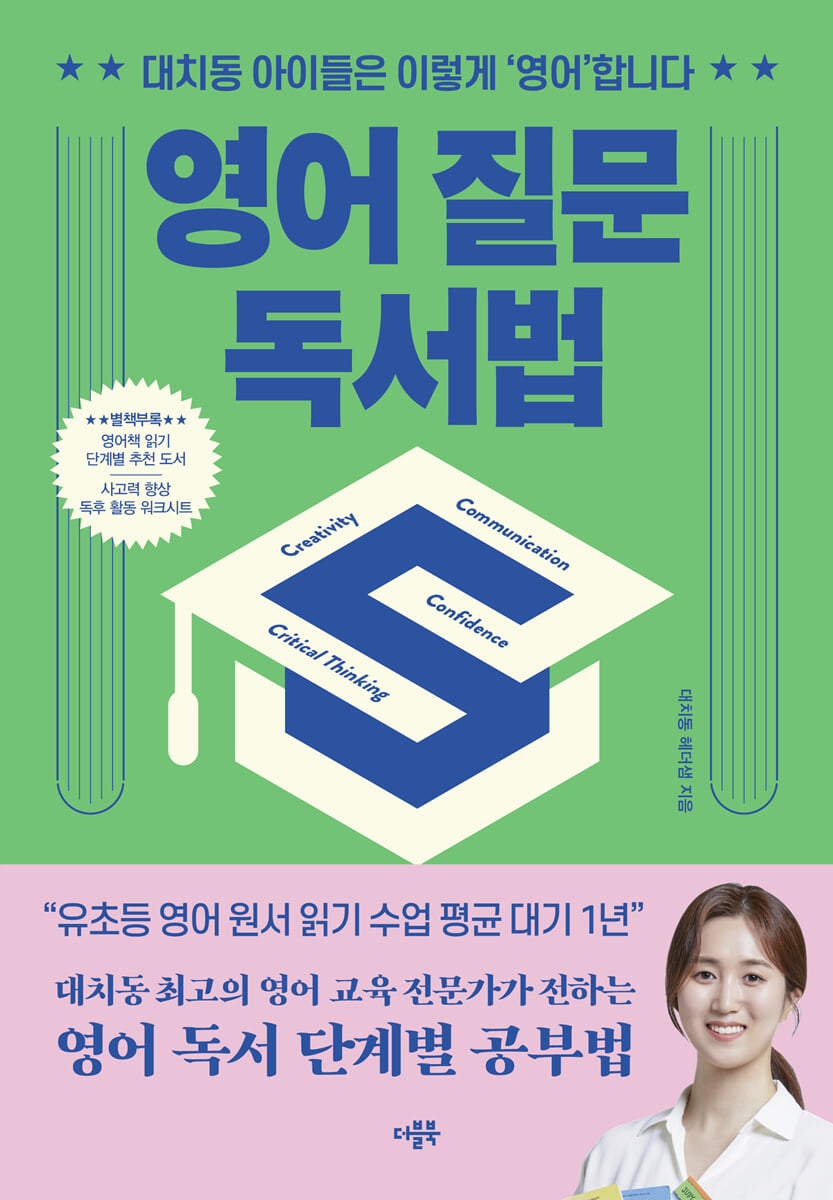
English Question Reading Method
 |
Description
Book Introduction
The average wait time for elementary school English reading classes is one year. The best English education expert in Daechi-dong Step-by-step English reading study method Although there are more and more children who begin studying English at a young age through English kindergartens and English libraries, the reality is that when they advance to higher level schools, they are too busy with schoolwork and academy assignments to even think about learning English to build background knowledge and develop critical thinking skills. The author, who has worked for many years as a specialized English reading instructor in Daechi-dong, the number one school district in Korea, has realized through experience and research gained in the classroom that English reading and questioning reading study methods are the most effective English learning methods in Korea's educational environment where exposure to English is limited. The 'English Question Reading Method' doesn't just help you build your English skills; it also enhances your reading comprehension and literacy skills, helping you advance to higher levels of education, increase the number of subjects you can take, and remain steadfast even when the college entrance exam system changes. This book contains a roadmap for practical English question reading methods that even parents who are not proficient in English can implement, and will serve as a proper guide for many parents who are struggling to determine the direction of English education. |
- You can preview some of the book's contents.
Preview
index
Prologue_ English Question Reading to Develop the Power to Understand and Think About Text
Chapter 1: Why Read in English?
The power to see the future comes from reading.
Studying English in Korea
The most effective way to learn English: reading
Chapter 2: Preparing to Read in English
Things to know before reading English books
Choosing the right book
Reading Coaching by Aptitude
Understanding Your Child's Learning Sense
Creating an English Learning Roadmap
English Reading: Just Be Careful of This
Chapter 3: A 4-Step Roadmap to Mastering English Reading
A Roadmap to Mastering English Reading
When to start learning English
Reading Picture Books
Getting Started with Phonics Before Reading Leaders
Reading Readers
Reading a Chapter Book
Reading a novel
Additional Notes on Reading in English
Chapter 4: Complete English Reading with Questions
Children who hesitate to ask questions
What makes a good question?
Reading a book with questions
Questions are the beginning of a conversation
Read the book and ask questions 1 Ask questions about the content
Reading a Book and Asking Questions 2 Thinking Questions
Reading and Asking Questions 3 Leaders Reading and Asking Questions
Reading and Asking Questions 4: Introduction to Chapter Books Reading and Asking Questions
Reading and Asking Questions 5 Chapter Books: Reading and Asking Questions
Read and Ask Questions 6 Chapter Books (Mid-to-Late Part) Read and Ask Questions
Chapter 7: Reading and Asking Questions, Second Half of the Novel
Reading and Asking Questions 8 Reading and Asking Questions about Non-Fiction Books
When questions feel overwhelming, remember this:
Chapter 5: Step-by-Step English Writing
Why should I write?
Leaders' Writing
Beginner and Intermediate Chapter Book Writing
Essay writing
Take your essay writing to the next level
How to overcome an English writing slump
Chapter 6: Mom's English Worries: Let's Solve Them All
Q1.
Is there a secret to being good at English like a mom?
Q2.
If parents don't speak English, can they teach their children?
Q3.
The cost of English education is a burden.
Q4.
My parents don't know the original English books. What criteria should they use to select books?
Q5.
My child likes English, but has an aversion to books.
Q6.
Can parents teach phonics?
Q7.
It's difficult to lead a family as I'm a working mom.
Do I have to ask questions after reading a book?
Q8.
Do I need to study vocabulary separately to read books?
Q9.
I'm in lower elementary school. Is it too late to start learning English?
Q10.
Do I need to read books even in the upper elementary grades?
Q11.
Can going to an English library help me develop a reading habit?
Q12.
What criteria should I use when choosing an English academy?
Q13.
How much should I give to my school homework?
Q14.
How can I overcome burnout when learning English?
Epilogue
supplement
1.
Recommended books for reading English books step by step
2.
How to Use the Post-Reading Activity Worksheet to Improve Thinking Skills
Chapter 1: Why Read in English?
The power to see the future comes from reading.
Studying English in Korea
The most effective way to learn English: reading
Chapter 2: Preparing to Read in English
Things to know before reading English books
Choosing the right book
Reading Coaching by Aptitude
Understanding Your Child's Learning Sense
Creating an English Learning Roadmap
English Reading: Just Be Careful of This
Chapter 3: A 4-Step Roadmap to Mastering English Reading
A Roadmap to Mastering English Reading
When to start learning English
Reading Picture Books
Getting Started with Phonics Before Reading Leaders
Reading Readers
Reading a Chapter Book
Reading a novel
Additional Notes on Reading in English
Chapter 4: Complete English Reading with Questions
Children who hesitate to ask questions
What makes a good question?
Reading a book with questions
Questions are the beginning of a conversation
Read the book and ask questions 1 Ask questions about the content
Reading a Book and Asking Questions 2 Thinking Questions
Reading and Asking Questions 3 Leaders Reading and Asking Questions
Reading and Asking Questions 4: Introduction to Chapter Books Reading and Asking Questions
Reading and Asking Questions 5 Chapter Books: Reading and Asking Questions
Read and Ask Questions 6 Chapter Books (Mid-to-Late Part) Read and Ask Questions
Chapter 7: Reading and Asking Questions, Second Half of the Novel
Reading and Asking Questions 8 Reading and Asking Questions about Non-Fiction Books
When questions feel overwhelming, remember this:
Chapter 5: Step-by-Step English Writing
Why should I write?
Leaders' Writing
Beginner and Intermediate Chapter Book Writing
Essay writing
Take your essay writing to the next level
How to overcome an English writing slump
Chapter 6: Mom's English Worries: Let's Solve Them All
Q1.
Is there a secret to being good at English like a mom?
Q2.
If parents don't speak English, can they teach their children?
Q3.
The cost of English education is a burden.
Q4.
My parents don't know the original English books. What criteria should they use to select books?
Q5.
My child likes English, but has an aversion to books.
Q6.
Can parents teach phonics?
Q7.
It's difficult to lead a family as I'm a working mom.
Do I have to ask questions after reading a book?
Q8.
Do I need to study vocabulary separately to read books?
Q9.
I'm in lower elementary school. Is it too late to start learning English?
Q10.
Do I need to read books even in the upper elementary grades?
Q11.
Can going to an English library help me develop a reading habit?
Q12.
What criteria should I use when choosing an English academy?
Q13.
How much should I give to my school homework?
Q14.
How can I overcome burnout when learning English?
Epilogue
supplement
1.
Recommended books for reading English books step by step
2.
How to Use the Post-Reading Activity Worksheet to Improve Thinking Skills
Detailed image

Into the book
As interest in learning English grows, we are receiving many inquiries about English kindergartens and language training programs that allow children to begin learning English from a young age.
Because I think that if you have enough exposure to English, learning will be easier.
That's true.
The reason why we naturally think of the word 'water' as 'water' is because we have heard it so many times.
I have seen and heard it hundreds, thousands of times, and tasted it and felt it myself.
It's similar to the principle that a child needs to hear the word 'mom' more than ten thousand times before saying it for the first time.
However, in reality, exposure to English educationally and culturally is limited.
That is why reading in English is the most efficient and effective way.
Reading is about becoming familiar with English words by seeing them, reading them out loud, and hearing them.
When you are naturally exposed to English words, you may find yourself 'feeling' familiar with them even if you haven't memorized them yet or don't know them well.
This experience will be of great help when studying vocabulary later.
The recent boom in English reading is not a simple phenomenon.
I believe that interest is growing through word of mouth, as parents, teachers, and students have long recognized the effectiveness and importance of reading English books and have been practicing it. Their abilities have been proven.
There is absolutely no reason not to try it.
---From "The Most Effective Study Method: Reading English"
After teaching for many years, I have come to the conclusion that the timing of English education is 'different for each child.'
The numbers and timing that experts talk about are just average concepts.
It is difficult to pinpoint a specific time period because children's language development varies and parents' educational views and values must also be taken into consideration.
Still, there are some guidelines that can be offered.
English is not necessarily taught at age 3 if language development is slow, there is confusion between English and Korean, or parents do not have the time to focus on teaching their children.
As children grow, their brains develop and the speed at which they can accept and understand things certainly increases.
Even if you start learning English in the early elementary grades, when your child has established his or her native language and is comfortable using the language, he or she can still build up skills just as well as a child who started earlier.
Conversely, if you start learning English early, focus on being consistent.
Even if they attended an English kindergarten, I often saw children who reduced their exposure to English after entering elementary school and focused on other subjects, eventually having to relearn the English they had learned.
This is why you should not give up reading English until you have a solid foundation in English.
If you start learning English in the upper grades of elementary school, it is true that it is more difficult to acquire a new language than in the lower grades due to the language system as well as the child's emotions, school life, and adolescence.
Also, if children begin reading English in the upper grades, the content of the English books they have to read may feel monotonous or childish compared to their mental age.
So it becomes difficult for children to find books that they are interested in reading.
However, from a long-term perspective, it is important to not give up and continue because English is a language that you will need to learn not only for the CSAT but also for your entire life.
---From "When to Start Learning English"
When conducting reading classes, there are parents who consider reading level important.
It seems that stories about what kind of score a friend is reading make parents anxious.
However, reading levels do not help with English reading.
What matters is whether the reading is qualitative and how much the child is absorbed in the book and reads independently.
Reading is not something you just read a lot when you're young; it's an activity that can be your companion throughout your life.
The time when children can enjoy the many benefits of this activity is when they are growing up.
I hope that you can successfully overcome the difficult chapter book period through appropriate and correct English reading coaching at the right time.
---From "Additional Notes on Reading English"
Why should we ask questions? What are the benefits of asking questions? Scientifically, it's said that when we ask questions, our brains become activated and a chemical called serotonin is released.
This process is where questions act as a catalyst to activate the brain, allowing new neurons to bond and move toward finding solutions to problems.
In 『Question Intelligence』(Isaac Yu, 2017), the research results on the effect of questions on thinking ability are described in detail.
The point is that questions have a very positive impact on understanding the concept of the problem and applying the principles to solve the problem.
This is closely related to metacognition.
This is because metacognition is the ability to distinguish between what you know and what you don't know, and the will to learn what you don't know.
For example, students who studied by asking questions on their own showed significantly higher levels of understanding and averaged 20 points higher test scores than students who studied by reviewing.
The act of reflecting on what you have learned through questioning not only increases your awareness of what you know and don't know, but also helps you fill in your shortcomings.
---From "Children Who Hesitate to Ask Questions"
If you've encountered various ideas through books and expressed your own thoughts through questions, now is the time to write them down.
The reason why you should write it down is simple.
Because when I write down my thoughts, I can objectify them.
What is said evaporates, but what is written remains.
So, you can organize your thoughts and revise them by rewriting what you exchanged through questions.
However, you should not overuse English writing.
English writing is meant to develop children's ability to actively and diversely express their thoughts, but if they don't yet have the thinking muscles, writing itself can be a difficult task.
Many parents think that attending an academy will significantly improve their children's English writing skills, but the opposite is true.
At the academy, students write by topic, but they only provide grammatical corrections. It is up to the student to review and restudy the mistakes so that they can use them.
Although it is possible to rewrite mistakes, that alone is not enough to improve your writing skills.
This is because the amount used is significantly small.
What should be your priority is not writing, but reading, thinking, and experiencing.
It's never too late to start writing in English by gaining direct and indirect experience.
Writing in English is easier than you think.
The more ideas you have, the easier it is to write.
Because anyone can write it by simply adding English formatting to their ideas.
Conversely, if you have nothing to say or no thoughts, your writing will not improve even if you have English skills.
So, before starting to write in English, you should encourage your child to have various conversations with books.
Because I think that if you have enough exposure to English, learning will be easier.
That's true.
The reason why we naturally think of the word 'water' as 'water' is because we have heard it so many times.
I have seen and heard it hundreds, thousands of times, and tasted it and felt it myself.
It's similar to the principle that a child needs to hear the word 'mom' more than ten thousand times before saying it for the first time.
However, in reality, exposure to English educationally and culturally is limited.
That is why reading in English is the most efficient and effective way.
Reading is about becoming familiar with English words by seeing them, reading them out loud, and hearing them.
When you are naturally exposed to English words, you may find yourself 'feeling' familiar with them even if you haven't memorized them yet or don't know them well.
This experience will be of great help when studying vocabulary later.
The recent boom in English reading is not a simple phenomenon.
I believe that interest is growing through word of mouth, as parents, teachers, and students have long recognized the effectiveness and importance of reading English books and have been practicing it. Their abilities have been proven.
There is absolutely no reason not to try it.
---From "The Most Effective Study Method: Reading English"
After teaching for many years, I have come to the conclusion that the timing of English education is 'different for each child.'
The numbers and timing that experts talk about are just average concepts.
It is difficult to pinpoint a specific time period because children's language development varies and parents' educational views and values must also be taken into consideration.
Still, there are some guidelines that can be offered.
English is not necessarily taught at age 3 if language development is slow, there is confusion between English and Korean, or parents do not have the time to focus on teaching their children.
As children grow, their brains develop and the speed at which they can accept and understand things certainly increases.
Even if you start learning English in the early elementary grades, when your child has established his or her native language and is comfortable using the language, he or she can still build up skills just as well as a child who started earlier.
Conversely, if you start learning English early, focus on being consistent.
Even if they attended an English kindergarten, I often saw children who reduced their exposure to English after entering elementary school and focused on other subjects, eventually having to relearn the English they had learned.
This is why you should not give up reading English until you have a solid foundation in English.
If you start learning English in the upper grades of elementary school, it is true that it is more difficult to acquire a new language than in the lower grades due to the language system as well as the child's emotions, school life, and adolescence.
Also, if children begin reading English in the upper grades, the content of the English books they have to read may feel monotonous or childish compared to their mental age.
So it becomes difficult for children to find books that they are interested in reading.
However, from a long-term perspective, it is important to not give up and continue because English is a language that you will need to learn not only for the CSAT but also for your entire life.
---From "When to Start Learning English"
When conducting reading classes, there are parents who consider reading level important.
It seems that stories about what kind of score a friend is reading make parents anxious.
However, reading levels do not help with English reading.
What matters is whether the reading is qualitative and how much the child is absorbed in the book and reads independently.
Reading is not something you just read a lot when you're young; it's an activity that can be your companion throughout your life.
The time when children can enjoy the many benefits of this activity is when they are growing up.
I hope that you can successfully overcome the difficult chapter book period through appropriate and correct English reading coaching at the right time.
---From "Additional Notes on Reading English"
Why should we ask questions? What are the benefits of asking questions? Scientifically, it's said that when we ask questions, our brains become activated and a chemical called serotonin is released.
This process is where questions act as a catalyst to activate the brain, allowing new neurons to bond and move toward finding solutions to problems.
In 『Question Intelligence』(Isaac Yu, 2017), the research results on the effect of questions on thinking ability are described in detail.
The point is that questions have a very positive impact on understanding the concept of the problem and applying the principles to solve the problem.
This is closely related to metacognition.
This is because metacognition is the ability to distinguish between what you know and what you don't know, and the will to learn what you don't know.
For example, students who studied by asking questions on their own showed significantly higher levels of understanding and averaged 20 points higher test scores than students who studied by reviewing.
The act of reflecting on what you have learned through questioning not only increases your awareness of what you know and don't know, but also helps you fill in your shortcomings.
---From "Children Who Hesitate to Ask Questions"
If you've encountered various ideas through books and expressed your own thoughts through questions, now is the time to write them down.
The reason why you should write it down is simple.
Because when I write down my thoughts, I can objectify them.
What is said evaporates, but what is written remains.
So, you can organize your thoughts and revise them by rewriting what you exchanged through questions.
However, you should not overuse English writing.
English writing is meant to develop children's ability to actively and diversely express their thoughts, but if they don't yet have the thinking muscles, writing itself can be a difficult task.
Many parents think that attending an academy will significantly improve their children's English writing skills, but the opposite is true.
At the academy, students write by topic, but they only provide grammatical corrections. It is up to the student to review and restudy the mistakes so that they can use them.
Although it is possible to rewrite mistakes, that alone is not enough to improve your writing skills.
This is because the amount used is significantly small.
What should be your priority is not writing, but reading, thinking, and experiencing.
It's never too late to start writing in English by gaining direct and indirect experience.
Writing in English is easier than you think.
The more ideas you have, the easier it is to write.
Because anyone can write it by simply adding English formatting to their ideas.
Conversely, if you have nothing to say or no thoughts, your writing will not improve even if you have English skills.
So, before starting to write in English, you should encourage your child to have various conversations with books.
---From "Why Should I Write?"
Publisher's Review
Instead of private education, now it's mom's English reading!
English Question Reading Method to Develop the Power to Understand and Think About Text
As interest in learning English grows, interest in English kindergartens and language training programs that allow children to begin learning English from a young age is also increasing.
This is because parents expect that learning will be easier if their children have sufficient exposure to English.
In a reality where it's not easy to achieve a high score on the CSAT even if you diligently study English classes in middle and high school, the ability to understand the context of English texts through consistent reading is becoming more important than ever.
Moreover, even after receiving 10 years of formal English education, not many adults can say they are confident in speaking and writing in English.
I've studied English so diligently, but why do I always feel stuck? Why do I have to relearn it every time? Learning English shouldn't simply be about doing well on the CSAT or memorizing textbooks to get good grades. It should be about developing English skills you can use throughout your life, even after you graduate.
The author, who has been researching and teaching effective English reading in Daechi-dong, the number one school district in Korea, has been thinking about an efficient English study method that will help parents and children maintain interest until the end and help them prepare for the entrance exam, and says that the English Question Reading Method is the only answer.
This is because by developing the ability to think for yourself through reading in English and developing a solid reading comprehension and a sense of English, you can see the significant effect of improving your literacy skills.
Heather Sam, an expert in early childhood English education, shares her thoughts.
A 4-Step Roadmap for English Reading That Even Idiot Moms Can Put Into Practice Right Away
The author, who has been consulting on parent education for elementary school children's English learning through 'Mother's Academy', has seen many parents feel lost about how to start English education, and rely solely on private education because they lack confidence in English and are unable to teach their children directly. This led him to think about English education that both parents and children can enjoy.
And I realized that the English Question Reading Method was the solution, as it not only improved my English skills but also helped me develop reading habits that would last a lifetime.
This book presents a four-step roadmap to mastering English reading.
It is divided into a stage where children are exposed to English entirely through their parents, a stage where they gradually reduce their dependence on English and learn English on their own, and a stage where they become completely independent from their parents and develop their English skills.
Stage 1, 'Reading Picture Books', is a time to expose children to the new sounds and systems of English, and to open their hearts to English through communication with parents.
Step 2, ‘Reading with Leaders’ guides parents and children through the process of reading a book together.
Stage 3, 'Chapter Book Reading', is the stage where independent reading has reached 70-80%. This is the stage where children who are hesitant to try unfamiliar books or have difficulty concentrating on reading are encouraged to read with their parents and then gradually learn to read independently.
Stage 4, 'Novel Reading', is the stage where children not only read books on their own, but also develop their own distinct tastes and evaluate books. From this point on, they learn and digest content in English rather than just studying.
It can be seen as the final independent stage of English.
In this way, it provides detailed information and features for each stage, as well as guidance on what to watch out for while reading, how to read efficiently, and recommended books, making it a strong supporter for parents who want to improve their children's English skills without private tutoring.
It's not just studying, it's real English!
Complete the English question reading method
Everything about listening, reading, speaking, and writing!
Having taught children preparing for entrance exams at prestigious English kindergartens and international schools for many years, the author has seen many children grow by gradually building their skills through age-appropriate reading.
On the other hand, I met many children who attended famous English kindergartens and academies, but had flaws here and there in their skills.
There were instances where they knew difficult, advanced vocabulary but did not know any beginner English words, and instances where they could write English essays but the writing lacked context and logic.
Through them, I pondered a method of learning English that would allow students to independently develop their skills by unleashing their potential without being confined by the framework of exams, and I found the way in the English Question Reading Method.
Rather than simply accepting what the author has written, 'questions' help us 'train our thinking' to think about why the author used such expressions and how this situation arose.
This book introduces the use of 'content questions', which are questions about the content of the book, and 'thinking questions', which are questions that develop thinking by using materials, topics, and conversations in the book.
In line with the 4-step roadmap for English reading, we've compiled a variety of example questions that even parents who don't know English well can easily use, so that parents and children can develop and share their thoughts together after reading the book.
Additionally, it presents English writing step by step to help children objectify their own thoughts through reading English questions, and guides them on what characteristics to show at each step and how to guide children to write.
It guides you through the process of turning a single line into a paragraph, and a paragraph into an essay with the basic structure of introduction, body, and conclusion, so you can achieve successful English writing even with just your mother's method.
Furthermore, it will share mothers' various concerns about English education, and will serve as a guide for smart mothers' English education by including appendices such as 'Recommended English Books for Each Stage of Reading' and 'How to Use the Post-Reading Activity Worksheet to Improve Thinking Skills'.
English Question Reading Method to Develop the Power to Understand and Think About Text
As interest in learning English grows, interest in English kindergartens and language training programs that allow children to begin learning English from a young age is also increasing.
This is because parents expect that learning will be easier if their children have sufficient exposure to English.
In a reality where it's not easy to achieve a high score on the CSAT even if you diligently study English classes in middle and high school, the ability to understand the context of English texts through consistent reading is becoming more important than ever.
Moreover, even after receiving 10 years of formal English education, not many adults can say they are confident in speaking and writing in English.
I've studied English so diligently, but why do I always feel stuck? Why do I have to relearn it every time? Learning English shouldn't simply be about doing well on the CSAT or memorizing textbooks to get good grades. It should be about developing English skills you can use throughout your life, even after you graduate.
The author, who has been researching and teaching effective English reading in Daechi-dong, the number one school district in Korea, has been thinking about an efficient English study method that will help parents and children maintain interest until the end and help them prepare for the entrance exam, and says that the English Question Reading Method is the only answer.
This is because by developing the ability to think for yourself through reading in English and developing a solid reading comprehension and a sense of English, you can see the significant effect of improving your literacy skills.
Heather Sam, an expert in early childhood English education, shares her thoughts.
A 4-Step Roadmap for English Reading That Even Idiot Moms Can Put Into Practice Right Away
The author, who has been consulting on parent education for elementary school children's English learning through 'Mother's Academy', has seen many parents feel lost about how to start English education, and rely solely on private education because they lack confidence in English and are unable to teach their children directly. This led him to think about English education that both parents and children can enjoy.
And I realized that the English Question Reading Method was the solution, as it not only improved my English skills but also helped me develop reading habits that would last a lifetime.
This book presents a four-step roadmap to mastering English reading.
It is divided into a stage where children are exposed to English entirely through their parents, a stage where they gradually reduce their dependence on English and learn English on their own, and a stage where they become completely independent from their parents and develop their English skills.
Stage 1, 'Reading Picture Books', is a time to expose children to the new sounds and systems of English, and to open their hearts to English through communication with parents.
Step 2, ‘Reading with Leaders’ guides parents and children through the process of reading a book together.
Stage 3, 'Chapter Book Reading', is the stage where independent reading has reached 70-80%. This is the stage where children who are hesitant to try unfamiliar books or have difficulty concentrating on reading are encouraged to read with their parents and then gradually learn to read independently.
Stage 4, 'Novel Reading', is the stage where children not only read books on their own, but also develop their own distinct tastes and evaluate books. From this point on, they learn and digest content in English rather than just studying.
It can be seen as the final independent stage of English.
In this way, it provides detailed information and features for each stage, as well as guidance on what to watch out for while reading, how to read efficiently, and recommended books, making it a strong supporter for parents who want to improve their children's English skills without private tutoring.
It's not just studying, it's real English!
Complete the English question reading method
Everything about listening, reading, speaking, and writing!
Having taught children preparing for entrance exams at prestigious English kindergartens and international schools for many years, the author has seen many children grow by gradually building their skills through age-appropriate reading.
On the other hand, I met many children who attended famous English kindergartens and academies, but had flaws here and there in their skills.
There were instances where they knew difficult, advanced vocabulary but did not know any beginner English words, and instances where they could write English essays but the writing lacked context and logic.
Through them, I pondered a method of learning English that would allow students to independently develop their skills by unleashing their potential without being confined by the framework of exams, and I found the way in the English Question Reading Method.
Rather than simply accepting what the author has written, 'questions' help us 'train our thinking' to think about why the author used such expressions and how this situation arose.
This book introduces the use of 'content questions', which are questions about the content of the book, and 'thinking questions', which are questions that develop thinking by using materials, topics, and conversations in the book.
In line with the 4-step roadmap for English reading, we've compiled a variety of example questions that even parents who don't know English well can easily use, so that parents and children can develop and share their thoughts together after reading the book.
Additionally, it presents English writing step by step to help children objectify their own thoughts through reading English questions, and guides them on what characteristics to show at each step and how to guide children to write.
It guides you through the process of turning a single line into a paragraph, and a paragraph into an essay with the basic structure of introduction, body, and conclusion, so you can achieve successful English writing even with just your mother's method.
Furthermore, it will share mothers' various concerns about English education, and will serve as a guide for smart mothers' English education by including appendices such as 'Recommended English Books for Each Stage of Reading' and 'How to Use the Post-Reading Activity Worksheet to Improve Thinking Skills'.
GOODS SPECIFICS
- Date of issue: August 10, 2023
- Page count, weight, size: 252 pages | 414g | 145*210*16mm
- ISBN13: 9791193153055
- ISBN10: 1193153050
You may also like
카테고리
korean


korean

![ELLE 엘르 스페셜 에디션 A형 : 12월 [2025]](http://librairie.coreenne.fr/cdn/shop/files/b8e27a3de6c9538896439686c6b0e8fb.jpg?v=1766436872&width=3840)


