

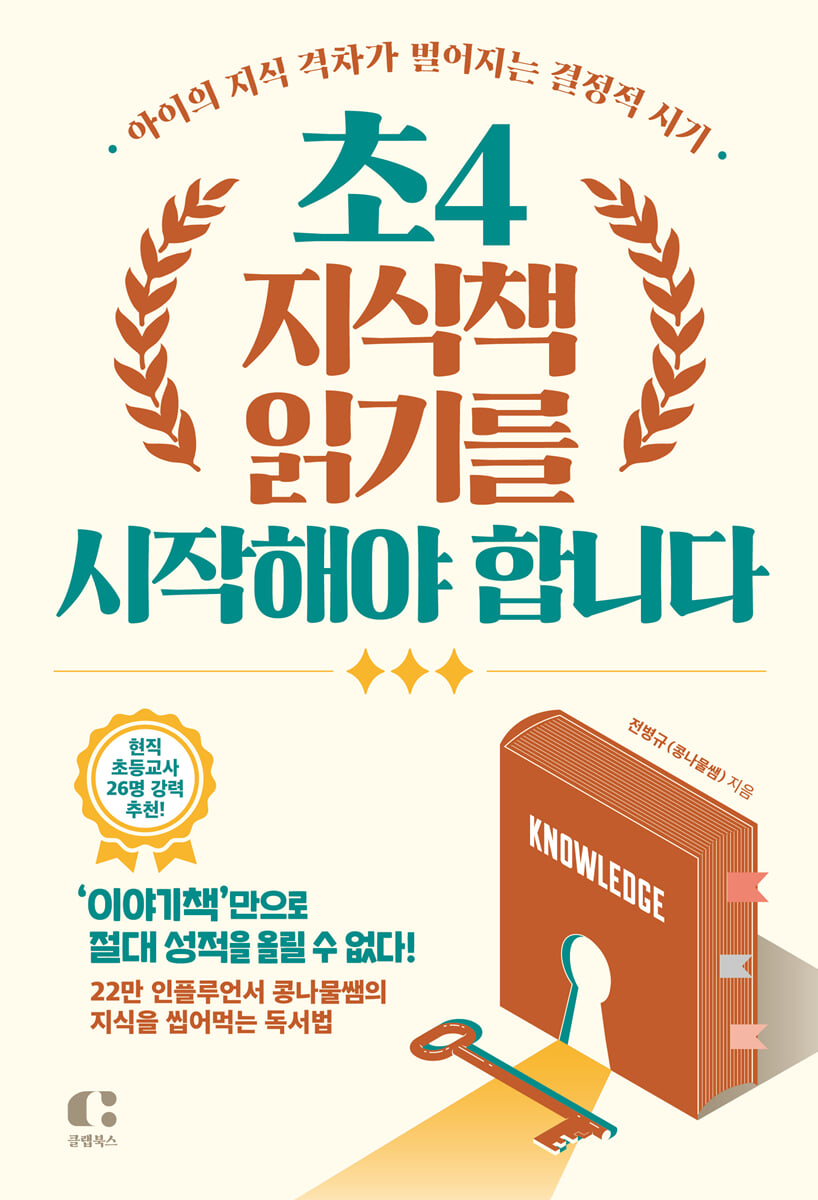
4th graders should start reading knowledge books.
 |
Description
Book Introduction
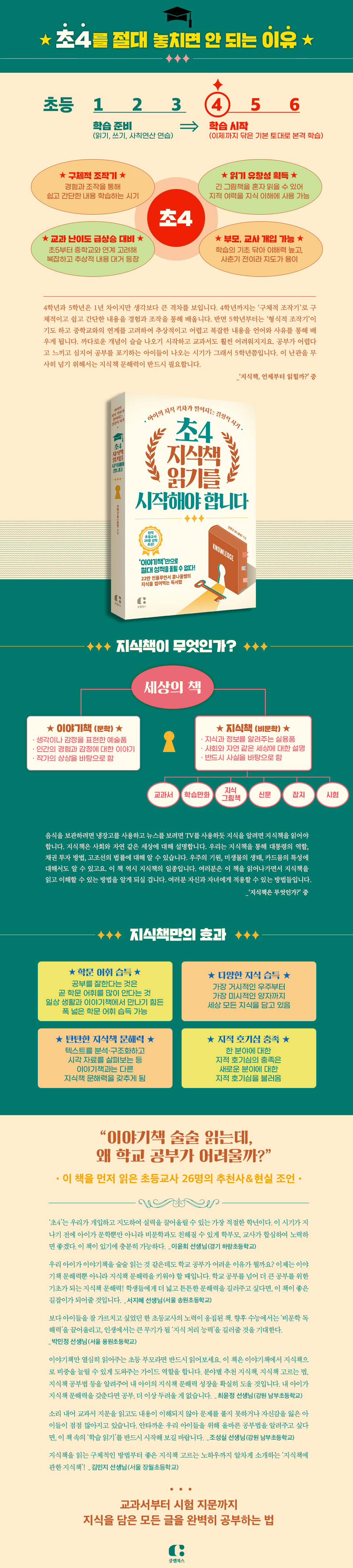
★★ New book from literacy expert 'Kongnamul Teacher' ★★ Literacy: A Weapon to Devour the World's Knowledge To strengthen 'vocabulary + background knowledge' Be sure to start reading knowledge books before 4th grade! A child with a rich vocabulary and background knowledge who can easily understand and confidently solve any subject or problem, versus a child with a poor vocabulary and background knowledge who, as they advance in grade and the difficulty of the subject increases, cannot even approach the problem and just wanders around. Where does this difference come from? Author Jeon Byeong-gyu, also known as 'Kongnamul Teacher', an elementary education expert and literacy expert, says that this difference is clearly the difference in 'knowledge book literacy.' The author emphasizes that while many parents are now aware of the importance of literacy, it is 'literacy in knowledge books' that is directly linked to academic performance. By reading "knowledge books," which are a general term for all writings containing knowledge, you can increase your academic vocabulary that you can never acquire from "story books," build background knowledge in the relevant field, and improve your literacy skills. This way, studying your subjects will naturally become fun and easy. Being good at studying means knowing a lot of academic vocabulary, and a solid background knowledge provides the capacity to understand and absorb new knowledge. In particular, it is emphasized that reading knowledge books should begin no later than 4th grade. '4th grade' is the starting point of transition from lower grades to upper grades in elementary school, and it is the time when full-fledged academic studies begin based on the reading, writing, and arithmetic operations learned so far. This is why it is essential to learn the methods in the book before reaching the fifth grade, when textbooks become much more difficult and some children even give up on studying. Furthermore, it provides clear answers to questions such as, "Are textbooks enough?", "What are the respective effects of storybooks and knowledge books?", "What is the difference between listening and reading?", and "How can I effectively read test passages?", based on extensive field experience and theoretical research. |
- You can preview some of the book's contents.
Preview
index
If you have the knowledge and literacy skills of a recommended book
Studying, there's nothing to fear anymore
There is no answer to studying by listening to the introduction.
Part 1.
A must-read book of knowledge
Chapter 1.
Knowledge book literacy
Why is 'why' important?
? What is a book of knowledge?
Storybooks and Knowledge Books | Types of Knowledge Books
Why is knowledge book literacy important?
Low literacy and crime rates | An era of exploding knowledge |
Knowledge Literacy: Making Anything Possible
Why storybooks alone aren't enough
The Balance of Storybooks and Knowledge Books | The Effects of Knowledge Books
Why textbooks alone are not enough
The Importance of Textbooks | Are Textbooks Enough? | The Limitations of Textbooks |
The Golden Balance of Textbooks and Knowledge Books
Chapter 2.
At the latest, read knowledge books by the 4th grade.
I have to start
? When will books of knowledge be read?
Based on '2nd grade'|How to bring forward the timing|
Why You Should Start at 4th Grade at the Latest | If You Reject Knowledge Books Too Much
? How to choose a knowledge book?
Is it engaging? | Is it helpful for understanding? | Is the content accurate?
How to quickly check your vocabulary level
Five Finger Rule
? Understanding storybooks and other knowledge books
Text Effects | Types of Styles | Pros and Cons of Each Style
* Recommended knowledge books by field *
“Start right now with this book!”
Picture Books | General | Humanities and Social Sciences | Mathematics and Science
Chapter 3.
Extracting knowledge one by one
To read
? The process of recognizing, understanding, and mastering knowledge
How the Brain Learns Knowledge | Knowledge Recognition |
Understanding Knowledge | Mastering Knowledge | The Secret to Successful Learning
Why are knowledge books more difficult than storybooks?
Differences in background knowledge | Differences in vocabulary | Differences in structure
? A surefire way to improve your knowledge book literacy
Increasing Access to Knowledge Books | Mastering Comprehension Strategies
Literacy-centered education through 'learning reading'
Worker Education and Elite Education | Explanation-Based Education and Activity-Based Education |
Literacy-centered education is the answer.
Part 2.
This is how to read a book of knowledge
Chapter 4.
As a book of knowledge
Think and organize
Connecting knowledge and life
Discovering Knowledge in Life | Connecting Knowledge to Life
? Expand your background knowledge
Activate background knowledge | Add background knowledge
? Raising word awareness
The Matthew Effect on Vocabulary | Wordplay | Talking About Words | Checking Words
? Acquiring vocabulary
The Need for Lexical Inference Strategies | Context-Based Inference | Morphological Analysis Inference
? Learning vocabulary
Analyzing Chinese Characters | The Right Way to Learn Chinese Characters | Vocabulary Categorization
? View visual aids
Step 4: Practice Observing Visual Materials
? Analyzing text
Separating Perception and Understanding | Representing with Shapes or Symbols | Text Analysis Examples |
Advantages of Text Analytics
? Structuring text
The Need for Text Structuring | Structuring the Entire Book | Structure of the Main Text | Text Structuring Practice
? Organize with a graphic organizer
Types of Graphic Organizers | How to Use Graphic Organizers | The Effects of Graphic Organizers
Chapter 5.
As a book of knowledge
Ask, answer, and write
? Ask a question
Learning is Connection | Three Factual Questions | Things to Consider When Asking Factual Questions
? Ask a question
Keyword Questioning | Practicing Reflective Questions | Things to Consider When Asking Reflective Questions
? Doing Havruta
The Best Reading Method: Havruta | The Four Stages of Havruta | Things to Consider During Havruta
? Take note
The Difference Between Note-taking, Note-taking, and Writing | The Effects of Note-taking | How to Take Notes
? Write a note
Why Seoul National University Students Take Notes | Writing in an Easy-to-Distinguish Way |
Writing systematically | Writing that makes it easy to understand the content
? Writing
Writing is Order | Writing for Learning, Writing for Learning |
How to Write a Study Guide | Things to Consider When Writing a Study Guide
Chapter 6.
As a book of knowledge
Study properly
? Studying knowledge picture books
Before Reading | During Reading | After Reading
? Studying educational comics
Before Reading | During Reading | After Reading
? Studying Korean language test passages
Before Reading | During Reading | After Reading
? Studying math textbooks
Reading | After Reading
? Studying social and scientific knowledge books
Before Reading | During Reading | After Reading
Studying, there's nothing to fear anymore
There is no answer to studying by listening to the introduction.
Part 1.
A must-read book of knowledge
Chapter 1.
Knowledge book literacy
Why is 'why' important?
? What is a book of knowledge?
Storybooks and Knowledge Books | Types of Knowledge Books
Why is knowledge book literacy important?
Low literacy and crime rates | An era of exploding knowledge |
Knowledge Literacy: Making Anything Possible
Why storybooks alone aren't enough
The Balance of Storybooks and Knowledge Books | The Effects of Knowledge Books
Why textbooks alone are not enough
The Importance of Textbooks | Are Textbooks Enough? | The Limitations of Textbooks |
The Golden Balance of Textbooks and Knowledge Books
Chapter 2.
At the latest, read knowledge books by the 4th grade.
I have to start
? When will books of knowledge be read?
Based on '2nd grade'|How to bring forward the timing|
Why You Should Start at 4th Grade at the Latest | If You Reject Knowledge Books Too Much
? How to choose a knowledge book?
Is it engaging? | Is it helpful for understanding? | Is the content accurate?
How to quickly check your vocabulary level
Five Finger Rule
? Understanding storybooks and other knowledge books
Text Effects | Types of Styles | Pros and Cons of Each Style
* Recommended knowledge books by field *
“Start right now with this book!”
Picture Books | General | Humanities and Social Sciences | Mathematics and Science
Chapter 3.
Extracting knowledge one by one
To read
? The process of recognizing, understanding, and mastering knowledge
How the Brain Learns Knowledge | Knowledge Recognition |
Understanding Knowledge | Mastering Knowledge | The Secret to Successful Learning
Why are knowledge books more difficult than storybooks?
Differences in background knowledge | Differences in vocabulary | Differences in structure
? A surefire way to improve your knowledge book literacy
Increasing Access to Knowledge Books | Mastering Comprehension Strategies
Literacy-centered education through 'learning reading'
Worker Education and Elite Education | Explanation-Based Education and Activity-Based Education |
Literacy-centered education is the answer.
Part 2.
This is how to read a book of knowledge
Chapter 4.
As a book of knowledge
Think and organize
Connecting knowledge and life
Discovering Knowledge in Life | Connecting Knowledge to Life
? Expand your background knowledge
Activate background knowledge | Add background knowledge
? Raising word awareness
The Matthew Effect on Vocabulary | Wordplay | Talking About Words | Checking Words
? Acquiring vocabulary
The Need for Lexical Inference Strategies | Context-Based Inference | Morphological Analysis Inference
? Learning vocabulary
Analyzing Chinese Characters | The Right Way to Learn Chinese Characters | Vocabulary Categorization
? View visual aids
Step 4: Practice Observing Visual Materials
? Analyzing text
Separating Perception and Understanding | Representing with Shapes or Symbols | Text Analysis Examples |
Advantages of Text Analytics
? Structuring text
The Need for Text Structuring | Structuring the Entire Book | Structure of the Main Text | Text Structuring Practice
? Organize with a graphic organizer
Types of Graphic Organizers | How to Use Graphic Organizers | The Effects of Graphic Organizers
Chapter 5.
As a book of knowledge
Ask, answer, and write
? Ask a question
Learning is Connection | Three Factual Questions | Things to Consider When Asking Factual Questions
? Ask a question
Keyword Questioning | Practicing Reflective Questions | Things to Consider When Asking Reflective Questions
? Doing Havruta
The Best Reading Method: Havruta | The Four Stages of Havruta | Things to Consider During Havruta
? Take note
The Difference Between Note-taking, Note-taking, and Writing | The Effects of Note-taking | How to Take Notes
? Write a note
Why Seoul National University Students Take Notes | Writing in an Easy-to-Distinguish Way |
Writing systematically | Writing that makes it easy to understand the content
? Writing
Writing is Order | Writing for Learning, Writing for Learning |
How to Write a Study Guide | Things to Consider When Writing a Study Guide
Chapter 6.
As a book of knowledge
Study properly
? Studying knowledge picture books
Before Reading | During Reading | After Reading
? Studying educational comics
Before Reading | During Reading | After Reading
? Studying Korean language test passages
Before Reading | During Reading | After Reading
? Studying math textbooks
Reading | After Reading
? Studying social and scientific knowledge books
Before Reading | During Reading | After Reading
Detailed image
Into the book
Starting in the 4th grade of elementary school, learning begins in earnest.
I have learned all the basics, including reading and writing to some extent, and division among the four basic operations.
There is no need to teach them how to hold a pencil anymore, no need to teach them Korean, and no need to teach them the multiplication tables.
All you have to do is study properly based on the basics you have learned so far.
And that's not all.
Now, he understands well enough to have a conversation, but he still has the innocence of a younger child, so he listens well to his parents and teachers.
Third graders still sometimes have trouble understanding what's being said, and fifth graders are starting to gradually stop listening to adults, but fourth graders aren't like that.
So, it is a good grade to start learning in earnest more than ever.
---From "There is no answer to studying by listening"
We live in an age where anything is possible if you have the literacy skills to read books.
The world is overflowing with knowledge.
Even in a small country like ours, dozens of books are published every day, and even more knowledge is uploaded to Google and Naver.
All this knowledge can be utilized if you have knowledge book literacy.
For those who have the knowledge and literacy to read books, the Internet, a sea of information, becomes a space filled with all possibilities.
If there's anything I want to do or know, I can always find, access, and utilize it.
Without knowledge book literacy, you won't be able to utilize all of this properly.
---From "Why is knowledge book literacy important?"
Studying solely by selling textbooks while neglecting reading is bound to lead to problems due to the limitations of textbooks.
And when that accumulates over a decade or more, the shortfall can become more significant than expected.
This is especially true in a situation where the abolition of the CSAT is continuously discussed and the IB International Baccalaureate curriculum is mentioned.
Beyond grades, broader study is necessary for a larger purpose beyond grades.
---From "Why Textbooks Alone Are Insufficient"
It's easy to read books that are far below your level.
Just put the book in like a washing machine and press the 'read' button, and you will get a clear 'understanding'.
But the general literacy process is different.
Simply reading it doesn't give you a pure understanding.
In this case, it is closer to hand washing than washing in a washing machine.
You need to find the parts that are difficult to understand and rub them in.
Literacy in knowledge books is a little more difficult than this.
You must learn knowledge as well as understand the text.
So, knowledge book literacy is similar to boiling laundry after hand washing.
Contamination that has penetrated deep into the laundry cannot be removed by hand washing alone and must be removed by boiling.
Knowledge deeply embedded in texts cannot be sufficiently learned through general literacy alone.
So, you should read books like you would boil laundry.
---From “The Process of Recognizing, Understanding, and Mastering Knowledge”
Why do children find knowledge books more difficult? It's because of the human-scale difference between knowledge books and storybooks.
Human scale means being physically and mentally suitable for humans.
If it is a size that fits the human body or can be encountered on a daily basis, it is human scale.
A raft, a hut, a cat, and pebbles are examples of human scale.
Conversely, if it is not a size that fits the human body or is difficult to access on a daily basis, it is not human scale.
So aircraft carriers, skyscrapers, bacteria, and ultrafine dust are not on a human scale.
The human scale is comfortable and easy to use because it is physically and mentally suitable for humans and is familiar to them.
It's the opposite of human scale.
---From "Why Knowledge Books Are More Difficult Than Storybooks"
If your child is in second grade or higher, I recommend that they spend time studying with knowledge books.
It is not simply reading a book of knowledge, but reading it with the mindset of studying the book of knowledge.
Of course, you should read it so that you can actually study, not just have that mindset.
Let's call this type of reading 'Read to learn.'
Learning reading is reading for learning.
You don't read for fun or to learn how to read.
Also, it is not something you just read through without knowing whether you know it or not.
Reading is to learn and study the knowledge contained in the book.
---From "A Surefire Way to Improve Literacy"
Activating background knowledge is the process of awakening background knowledge that is dormant in your mind.
It's about recalling knowledge that you already have but aren't currently recalling.
We have a lot of knowledge in our heads.
But at this moment, we are not aware of that knowledge.
The knowledge in our heads lies dormant and awakens when properly stimulated.
Then it comes to our mind and we become aware of it.
It's like a photo saved on your smartphone.
You have a lot of photos stored on your smartphone, but not all of them are currently on the screen.
If you go into the album and touch it, it will appear on the screen.
This is exactly what background knowledge activation is all about.
It means touching the knowledge that is dormant in your head but not called out.
---From "Expanding Background Knowledge"
Children who know a lot of vocabulary understand text well.
Children who understand text well read more.
Children who read more are exposed to more vocabulary and consequently know more vocabulary.
And this brings us back to the beginning to understand the text better.
The opposite phenomenon also occurs.
Children with smaller vocabularies have less ability to understand written text and therefore do not read well.
As a result, the vocabulary you encounter decreases and your vocabulary deficiency becomes more serious.
This is also the beginning, and things are getting worse.
So, for children's literacy, we need to turn the Matthew effect of vocabulary into a virtuous cycle.
Let's look at three ways to do this now.
It is about raising word awareness, acquiring vocabulary, and learning vocabulary.
---From "Raising Word Awareness"
The Korean language test texts should be read in a different way than when reading a general knowledge book.
Because there is a time limit on the Korean language test.
In general learning reading situations, there is no time limit, so reading deeply is the most important, but in the Korean language test, reading accurately within a limited time is important.
So reading skills become even more important.
From now on, we will learn what skills we should use when reading Korean language test passages.
The Korean language test text we will be looking at this time is the 2010 National Unified Academic Achievement Test for first-year middle school students.
… (omitted) … If an unfamiliar word appears at the beginning of a sentence, you should pay attention to that word.
Because it is likely to be a core concept.
Coltan is marked with a square.
Tantalum is also an unfamiliar word, so it is marked with a box.
They say that refining coltan produces tantalum, so I'll connect them with arrows.
---From "Studying Korean Language Test Texts"
Educational comics are books that incorporate learning elements into comics that children like.
It is loved by parents and children alike because it allows them to study while having fun reading.
However, the problem is that children often only watch cartoons and do not learn anything.
We read the fun and funny parts over and over again, but we don't read the actual learning parts properly.
This problem must be solved in order to properly utilize educational comics.
I have learned all the basics, including reading and writing to some extent, and division among the four basic operations.
There is no need to teach them how to hold a pencil anymore, no need to teach them Korean, and no need to teach them the multiplication tables.
All you have to do is study properly based on the basics you have learned so far.
And that's not all.
Now, he understands well enough to have a conversation, but he still has the innocence of a younger child, so he listens well to his parents and teachers.
Third graders still sometimes have trouble understanding what's being said, and fifth graders are starting to gradually stop listening to adults, but fourth graders aren't like that.
So, it is a good grade to start learning in earnest more than ever.
---From "There is no answer to studying by listening"
We live in an age where anything is possible if you have the literacy skills to read books.
The world is overflowing with knowledge.
Even in a small country like ours, dozens of books are published every day, and even more knowledge is uploaded to Google and Naver.
All this knowledge can be utilized if you have knowledge book literacy.
For those who have the knowledge and literacy to read books, the Internet, a sea of information, becomes a space filled with all possibilities.
If there's anything I want to do or know, I can always find, access, and utilize it.
Without knowledge book literacy, you won't be able to utilize all of this properly.
---From "Why is knowledge book literacy important?"
Studying solely by selling textbooks while neglecting reading is bound to lead to problems due to the limitations of textbooks.
And when that accumulates over a decade or more, the shortfall can become more significant than expected.
This is especially true in a situation where the abolition of the CSAT is continuously discussed and the IB International Baccalaureate curriculum is mentioned.
Beyond grades, broader study is necessary for a larger purpose beyond grades.
---From "Why Textbooks Alone Are Insufficient"
It's easy to read books that are far below your level.
Just put the book in like a washing machine and press the 'read' button, and you will get a clear 'understanding'.
But the general literacy process is different.
Simply reading it doesn't give you a pure understanding.
In this case, it is closer to hand washing than washing in a washing machine.
You need to find the parts that are difficult to understand and rub them in.
Literacy in knowledge books is a little more difficult than this.
You must learn knowledge as well as understand the text.
So, knowledge book literacy is similar to boiling laundry after hand washing.
Contamination that has penetrated deep into the laundry cannot be removed by hand washing alone and must be removed by boiling.
Knowledge deeply embedded in texts cannot be sufficiently learned through general literacy alone.
So, you should read books like you would boil laundry.
---From “The Process of Recognizing, Understanding, and Mastering Knowledge”
Why do children find knowledge books more difficult? It's because of the human-scale difference between knowledge books and storybooks.
Human scale means being physically and mentally suitable for humans.
If it is a size that fits the human body or can be encountered on a daily basis, it is human scale.
A raft, a hut, a cat, and pebbles are examples of human scale.
Conversely, if it is not a size that fits the human body or is difficult to access on a daily basis, it is not human scale.
So aircraft carriers, skyscrapers, bacteria, and ultrafine dust are not on a human scale.
The human scale is comfortable and easy to use because it is physically and mentally suitable for humans and is familiar to them.
It's the opposite of human scale.
---From "Why Knowledge Books Are More Difficult Than Storybooks"
If your child is in second grade or higher, I recommend that they spend time studying with knowledge books.
It is not simply reading a book of knowledge, but reading it with the mindset of studying the book of knowledge.
Of course, you should read it so that you can actually study, not just have that mindset.
Let's call this type of reading 'Read to learn.'
Learning reading is reading for learning.
You don't read for fun or to learn how to read.
Also, it is not something you just read through without knowing whether you know it or not.
Reading is to learn and study the knowledge contained in the book.
---From "A Surefire Way to Improve Literacy"
Activating background knowledge is the process of awakening background knowledge that is dormant in your mind.
It's about recalling knowledge that you already have but aren't currently recalling.
We have a lot of knowledge in our heads.
But at this moment, we are not aware of that knowledge.
The knowledge in our heads lies dormant and awakens when properly stimulated.
Then it comes to our mind and we become aware of it.
It's like a photo saved on your smartphone.
You have a lot of photos stored on your smartphone, but not all of them are currently on the screen.
If you go into the album and touch it, it will appear on the screen.
This is exactly what background knowledge activation is all about.
It means touching the knowledge that is dormant in your head but not called out.
---From "Expanding Background Knowledge"
Children who know a lot of vocabulary understand text well.
Children who understand text well read more.
Children who read more are exposed to more vocabulary and consequently know more vocabulary.
And this brings us back to the beginning to understand the text better.
The opposite phenomenon also occurs.
Children with smaller vocabularies have less ability to understand written text and therefore do not read well.
As a result, the vocabulary you encounter decreases and your vocabulary deficiency becomes more serious.
This is also the beginning, and things are getting worse.
So, for children's literacy, we need to turn the Matthew effect of vocabulary into a virtuous cycle.
Let's look at three ways to do this now.
It is about raising word awareness, acquiring vocabulary, and learning vocabulary.
---From "Raising Word Awareness"
The Korean language test texts should be read in a different way than when reading a general knowledge book.
Because there is a time limit on the Korean language test.
In general learning reading situations, there is no time limit, so reading deeply is the most important, but in the Korean language test, reading accurately within a limited time is important.
So reading skills become even more important.
From now on, we will learn what skills we should use when reading Korean language test passages.
The Korean language test text we will be looking at this time is the 2010 National Unified Academic Achievement Test for first-year middle school students.
… (omitted) … If an unfamiliar word appears at the beginning of a sentence, you should pay attention to that word.
Because it is likely to be a core concept.
Coltan is marked with a square.
Tantalum is also an unfamiliar word, so it is marked with a box.
They say that refining coltan produces tantalum, so I'll connect them with arrows.
---From "Studying Korean Language Test Texts"
Educational comics are books that incorporate learning elements into comics that children like.
It is loved by parents and children alike because it allows them to study while having fun reading.
However, the problem is that children often only watch cartoons and do not learn anything.
We read the fun and funny parts over and over again, but we don't read the actual learning parts properly.
This problem must be solved in order to properly utilize educational comics.
---From "Studying Educational Comics"
Publisher's Review
You can't improve your grades with just 'storybooks'!
How to Improve "Knowledge Literacy," the Foundation of All Subjects
The books of the world can be broadly divided into ‘story books (literature)’ and ‘knowledge books (non-literature)’.
A storybook is a work of art that uses language to express human thoughts and emotions.
If art is the art of images and music is the art of sounds, then literature is the art of language.
On the other hand, knowledge books are practical items that provide knowledge and information.
Just as we use a refrigerator to store food and a TV to watch the news, we must use books to acquire knowledge.
Knowledge books explain the world, such as society and nature.
Through the book of knowledge, we can learn about the role of the president, how to invest in bonds, and the laws of Gojoseon.
This book is also a type of knowledge book, and by reading this book, you will definitely learn how to develop literacy skills to read and understand knowledge books.
Although 'literacy' has emerged as an important topic in education, the author points out that 'storybook literacy' alone has limitations.
Of course, for a child to enjoy reading, it is necessary to start with a storybook that has the element of ‘fun.’
However, only by acquiring the 'knowledge literacy' to digest and utilize knowledge can we prepare for this era of new knowledge and be competitive in all fields.
Textbooks are also a representative type of knowledge book.
Textbooks for Korean, math, social studies, science, and all other subjects contain the core knowledge of each subject.
If you have the "knowledge book literacy" to deeply understand these books and use them properly, studying the textbooks will not be that difficult.
The author provides detailed and friendly guidance through specific examples and cases on when to start reading knowledge books, how to choose them, the correct way to read them, and even effective ways to study with them.
Why does it become difficult if you miss the crucial period of 4th grade?
Sharp, realistic advice from an elementary education expert
Reading knowledge books can be started from the second semester of the second grade in elementary school, and should begin no later than the first semester of the fourth grade.
If a child can read a long picture book out loud with some comfort and naturalness, he or she can be considered to have achieved 'reading fluency'.
As you gain reading fluency, you no longer need to expend as much effort reading aloud, freeing up your energy to comprehend knowledge.
Before you acquire fluency, it is virtually impossible to read a book of knowledge due to lack of intellectual capacity.
Even if reading knowledge books is a bit late, the reason why you should not miss the '4th grade' is because of the special nature of the 5th and 6th grades.
Although there is only a one-year difference between 4th and 5th grade, the gap is bigger than you might think.
Up to the 4th grade, students learn specific, easy, and simple content through experience and manipulation, known as the 'concrete operational stage'.
On the other hand, from the 5th grade onwards, it is also the 'formal operational stage' and, considering the connection with middle school, abstract, difficult and complex content is learned through language and reasoning.
That's why around the fifth grade, difficult concepts start to appear in textbooks, and some children even give up on studying.
To overcome this challenge, knowledge book literacy is essential.
Children who can read textbooks and understand them on their own will not feel this difficulty and will overcome it easily.
Another reason why reading knowledge books should begin in the 4th grade is that it becomes increasingly difficult for parents or teachers to intervene after the 5th grade.
One thing the author has discovered over the years of teaching fifth graders is that children change significantly during the summer break of their fifth grade year.
As puberty begins, children who used to follow their parents' words as if it were law can easily change into children who reject them.
If parents intervene and guide their children to start reading knowledge books in 4th grade, when guidance is still easy, the effect can be greatly increased.
Am I not diligent enough? Am I lacking time to study?
Misconceptions and Truths About the Process of Acquiring New Knowledge
Often, when a child has difficulty understanding new knowledge, parents tend to misunderstand that it is because they are not diligent enough or do not have enough time to study.
Saying things like, “If you don’t understand, just memorize it,” “Just put it in your head,” or “Sit down” are also based on this misunderstanding.
However, the process by which the brain learns new knowledge does not simply involve putting a load of knowledge into a warehouse called the head.
So, diligently transferring knowledge into your head or increasing study time will not lead to good results.
This book helps you accurately understand the process of 'recognition-understanding-mastery' through which the brain learns knowledge, and helps you study in a way that suits this process.
For example, the stage of 'recognition' of knowledge is similar to a blind date when comparing a man and a woman meeting, and the 'target knowledge' that we want to learn is likened to a fish, and the 'net of knowledge' to a net, making it easy to understand through a simple diagram.
To learn more target knowledge, the size of the net must be large (background knowledge), the net must be dense (vocabulary), and appropriate movement must be made (comprehension strategy).
The 'understanding' stage of knowledge is likened to a full-fledged encounter, and the 'mastery' stage to marriage, and the process and method of making knowledge completely mine are explained in detail.
This book covers all the effective ways to read knowledge books, enabling you to fully absorb and effectively utilize all the knowledge, from textbooks to exam passages.
In fact, it is difficult for children who are good at studying to explain why they are good at studying, and it is difficult for children who are not good at studying to realize what they are missing.
By learning through this book how to effectively read, take notes, and organize textbooks, how to expand vocabulary and background knowledge, and how to read, analyze, and find answers to exam passages, anyone will be able to find a shortcut to successful study.
How to Improve "Knowledge Literacy," the Foundation of All Subjects
The books of the world can be broadly divided into ‘story books (literature)’ and ‘knowledge books (non-literature)’.
A storybook is a work of art that uses language to express human thoughts and emotions.
If art is the art of images and music is the art of sounds, then literature is the art of language.
On the other hand, knowledge books are practical items that provide knowledge and information.
Just as we use a refrigerator to store food and a TV to watch the news, we must use books to acquire knowledge.
Knowledge books explain the world, such as society and nature.
Through the book of knowledge, we can learn about the role of the president, how to invest in bonds, and the laws of Gojoseon.
This book is also a type of knowledge book, and by reading this book, you will definitely learn how to develop literacy skills to read and understand knowledge books.
Although 'literacy' has emerged as an important topic in education, the author points out that 'storybook literacy' alone has limitations.
Of course, for a child to enjoy reading, it is necessary to start with a storybook that has the element of ‘fun.’
However, only by acquiring the 'knowledge literacy' to digest and utilize knowledge can we prepare for this era of new knowledge and be competitive in all fields.
Textbooks are also a representative type of knowledge book.
Textbooks for Korean, math, social studies, science, and all other subjects contain the core knowledge of each subject.
If you have the "knowledge book literacy" to deeply understand these books and use them properly, studying the textbooks will not be that difficult.
The author provides detailed and friendly guidance through specific examples and cases on when to start reading knowledge books, how to choose them, the correct way to read them, and even effective ways to study with them.
Why does it become difficult if you miss the crucial period of 4th grade?
Sharp, realistic advice from an elementary education expert
Reading knowledge books can be started from the second semester of the second grade in elementary school, and should begin no later than the first semester of the fourth grade.
If a child can read a long picture book out loud with some comfort and naturalness, he or she can be considered to have achieved 'reading fluency'.
As you gain reading fluency, you no longer need to expend as much effort reading aloud, freeing up your energy to comprehend knowledge.
Before you acquire fluency, it is virtually impossible to read a book of knowledge due to lack of intellectual capacity.
Even if reading knowledge books is a bit late, the reason why you should not miss the '4th grade' is because of the special nature of the 5th and 6th grades.
Although there is only a one-year difference between 4th and 5th grade, the gap is bigger than you might think.
Up to the 4th grade, students learn specific, easy, and simple content through experience and manipulation, known as the 'concrete operational stage'.
On the other hand, from the 5th grade onwards, it is also the 'formal operational stage' and, considering the connection with middle school, abstract, difficult and complex content is learned through language and reasoning.
That's why around the fifth grade, difficult concepts start to appear in textbooks, and some children even give up on studying.
To overcome this challenge, knowledge book literacy is essential.
Children who can read textbooks and understand them on their own will not feel this difficulty and will overcome it easily.
Another reason why reading knowledge books should begin in the 4th grade is that it becomes increasingly difficult for parents or teachers to intervene after the 5th grade.
One thing the author has discovered over the years of teaching fifth graders is that children change significantly during the summer break of their fifth grade year.
As puberty begins, children who used to follow their parents' words as if it were law can easily change into children who reject them.
If parents intervene and guide their children to start reading knowledge books in 4th grade, when guidance is still easy, the effect can be greatly increased.
Am I not diligent enough? Am I lacking time to study?
Misconceptions and Truths About the Process of Acquiring New Knowledge
Often, when a child has difficulty understanding new knowledge, parents tend to misunderstand that it is because they are not diligent enough or do not have enough time to study.
Saying things like, “If you don’t understand, just memorize it,” “Just put it in your head,” or “Sit down” are also based on this misunderstanding.
However, the process by which the brain learns new knowledge does not simply involve putting a load of knowledge into a warehouse called the head.
So, diligently transferring knowledge into your head or increasing study time will not lead to good results.
This book helps you accurately understand the process of 'recognition-understanding-mastery' through which the brain learns knowledge, and helps you study in a way that suits this process.
For example, the stage of 'recognition' of knowledge is similar to a blind date when comparing a man and a woman meeting, and the 'target knowledge' that we want to learn is likened to a fish, and the 'net of knowledge' to a net, making it easy to understand through a simple diagram.
To learn more target knowledge, the size of the net must be large (background knowledge), the net must be dense (vocabulary), and appropriate movement must be made (comprehension strategy).
The 'understanding' stage of knowledge is likened to a full-fledged encounter, and the 'mastery' stage to marriage, and the process and method of making knowledge completely mine are explained in detail.
This book covers all the effective ways to read knowledge books, enabling you to fully absorb and effectively utilize all the knowledge, from textbooks to exam passages.
In fact, it is difficult for children who are good at studying to explain why they are good at studying, and it is difficult for children who are not good at studying to realize what they are missing.
By learning through this book how to effectively read, take notes, and organize textbooks, how to expand vocabulary and background knowledge, and how to read, analyze, and find answers to exam passages, anyone will be able to find a shortcut to successful study.
GOODS SPECIFICS
- Date of issue: June 21, 2023
- Page count, weight, size: 328 pages | 562g | 150*220*20mm
- ISBN13: 9791198060570
- ISBN10: 1198060573
You may also like
카테고리
korean


korean

![ELLE 엘르 스페셜 에디션 A형 : 12월 [2025]](http://librairie.coreenne.fr/cdn/shop/files/b8e27a3de6c9538896439686c6b0e8fb.jpg?v=1766436872&width=3840)


