

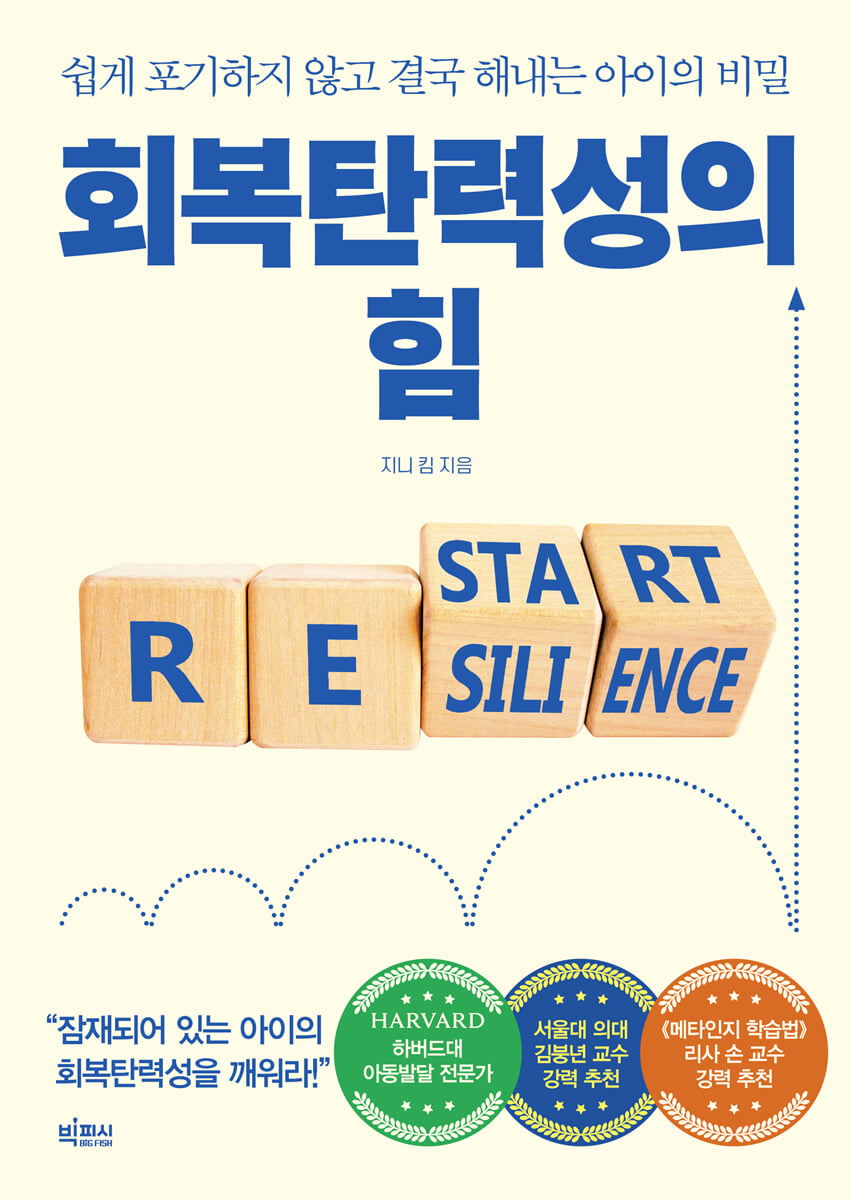
The Power of Resilience
 |
Description
Book Introduction
- A word from MD
-
The secret of children who study well and are happyDr. Jini Kim, a child development expert, conducted a 20-year study and found that Harvard University students had unusually high resilience scores.
Even children born with a silver spoon in their mouth cannot avoid moments of frustration.
At this time, children with high resilience overcome failure and grow to the next level.
June 7, 2023. Shin Eun-ji, PD of Home Life
Life skills parents must develop before their children turn 10
“A child’s happiness and learning ability ultimately depend on resilience.”
What is the difference between children who give up easily and those who ultimately succeed? Dr. Jeanie Kim, a child development expert and educator, discovered through a project she conducted while studying at Harvard University and through her experience with tens of thousands of children in American educational settings over 20 years: children who excel in learning and are happy all share a common trait: high resilience.
These children persevered through difficult problems with the attitude of “It’s okay to make mistakes, just try again,” and did not give in to frustration even when the results were not good.
In this book, the author emphasizes that resilience is something we are all born with and can be cultivated by anyone through repetition and practice from an early age. He also provides specific guidance on how to instill resilience resources such as positivity, self-confidence, and self-regulation in children's lives.
“A child’s happiness and learning ability ultimately depend on resilience.”
What is the difference between children who give up easily and those who ultimately succeed? Dr. Jeanie Kim, a child development expert and educator, discovered through a project she conducted while studying at Harvard University and through her experience with tens of thousands of children in American educational settings over 20 years: children who excel in learning and are happy all share a common trait: high resilience.
These children persevered through difficult problems with the attitude of “It’s okay to make mistakes, just try again,” and did not give in to frustration even when the results were not good.
In this book, the author emphasizes that resilience is something we are all born with and can be cultivated by anyone through repetition and practice from an early age. He also provides specific guidance on how to instill resilience resources such as positivity, self-confidence, and self-regulation in children's lives.
- You can preview some of the book's contents.
Preview
index
Prologue: Awakening Your Child's Latent Resilience
Part 1.
Resilience that builds mental fortitude in our children
Chapter 1.
Harvard students have high resilience scores.
Children react differently to similar challenges.
The power to navigate an uncertain and anxious future
Studying depends on AQ, not IQ.
Everyone has a vessel of resilience.
Chapter 2.
Frustration that even children born with a silver spoon in their mouths cannot avoid
Myself: Frustration from developmental imbalances
Home: Difficulties due to parenting style
Society: Conflicts and anxiety arising from new environments and relationships
The hardships faced by children growing up in Korean society
Chapter 3.
5 Characteristics of Highly Resilient Children
Innate Temperament: Traits That Boost Resilience
Self-Esteem: How You Perceive Yourself
Interpersonal Relationships: The Power to Overcome Everyday Challenges Together
Communication Skills: The Art of Conversation to Overcome Crisis
Coping skills: How you respond to challenges
Part 2.
How to Unleash Your Child's Latent Resilience
Chapter 4.
Building Unbreakable Mental Strength
Practice expressing gratitude through words and actions
Build a habit by keeping a gratitude journal
Give the gift of delayed gratification
Raise your child to recognize and respect differences.
Positive thinking brings gratitude
Chapter 5.
Developing the power to trust and respect myself
Keys to Self-Esteem Development in Early Childhood
Build your confidence with compliments
Wise Parent Reward System
Give them a chance to try it themselves
Let's teach you how to fail 'well'
Chapter 6.
Developing self-regulation skills to manage body, mind, and spirit
How to deal with different situations?
Body Control: Controlling your body, breathing, and voice
Cognitive control: recognizing situations and coming up with solutions
Emotion Regulation: Recognizing and Regulating Emotions
Emotion Regulation Programs in American Schools
Chapter 7.
Developing the ability to connect resilience to life
Connecting with Others: The Goal of Resilience is Sociality
Connecting with Study: Motivation and Goal Setting
Connecting with Movement: Learning Through Play
Connect with Yourself: Know Yourself and Enjoy Life
Part 1.
Resilience that builds mental fortitude in our children
Chapter 1.
Harvard students have high resilience scores.
Children react differently to similar challenges.
The power to navigate an uncertain and anxious future
Studying depends on AQ, not IQ.
Everyone has a vessel of resilience.
Chapter 2.
Frustration that even children born with a silver spoon in their mouths cannot avoid
Myself: Frustration from developmental imbalances
Home: Difficulties due to parenting style
Society: Conflicts and anxiety arising from new environments and relationships
The hardships faced by children growing up in Korean society
Chapter 3.
5 Characteristics of Highly Resilient Children
Innate Temperament: Traits That Boost Resilience
Self-Esteem: How You Perceive Yourself
Interpersonal Relationships: The Power to Overcome Everyday Challenges Together
Communication Skills: The Art of Conversation to Overcome Crisis
Coping skills: How you respond to challenges
Part 2.
How to Unleash Your Child's Latent Resilience
Chapter 4.
Building Unbreakable Mental Strength
Practice expressing gratitude through words and actions
Build a habit by keeping a gratitude journal
Give the gift of delayed gratification
Raise your child to recognize and respect differences.
Positive thinking brings gratitude
Chapter 5.
Developing the power to trust and respect myself
Keys to Self-Esteem Development in Early Childhood
Build your confidence with compliments
Wise Parent Reward System
Give them a chance to try it themselves
Let's teach you how to fail 'well'
Chapter 6.
Developing self-regulation skills to manage body, mind, and spirit
How to deal with different situations?
Body Control: Controlling your body, breathing, and voice
Cognitive control: recognizing situations and coming up with solutions
Emotion Regulation: Recognizing and Regulating Emotions
Emotion Regulation Programs in American Schools
Chapter 7.
Developing the ability to connect resilience to life
Connecting with Others: The Goal of Resilience is Sociality
Connecting with Study: Motivation and Goal Setting
Connecting with Movement: Learning Through Play
Connect with Yourself: Know Yourself and Enjoy Life
Detailed image

Into the book
Children with high resilience scores are more likely to excel academically and lead successful lives outside of school.
If you look at the lives of successful people in any field, you'll find that they have one thing in common: they overcame their own adversities.
The strength to endure obscurity before becoming a famous actor, sports players who overcome injuries and slumps to reach the top, leaders who use failed business experiences as a foundation for innovation…
People who never give up, constantly move forward, and achieve progress always possess resilience.
---From "Studying Depends on AQ, Not IQ"
Respect is one of the resources for resilience.
When a child feels respected, he or she can love himself or herself and overcome difficulties with that strength.
To have an open conversation with your child, you should not suppress or limit their expression because they are young, but rather ask them what they think, listen attentively, and respect their opinions.
Additionally, democratic parenting styles enhance self-esteem, self-efficacy, independence, and social skills, which are resources for resilience.
---From "Family: Difficulties Caused by Parenting Style"
Self-esteem is not something that can be instilled by parents and fostered through short-term efforts.
Self-esteem begins with feeling your worth recognized and that you are valuable, and only then does it improve when you feel competent based on your accomplishments.
Children who have developed self-confidence, self-efficacy, self-affirmation, and self-love through experiences of achievement are able to take risks and take on challenges because they have the confidence that "if they try, they can do it," and they are able to show the perseverance to try again even after failure.
---From "Self-Esteem: How You Perceive Yourself"
Rather than giving your child what he wants right away, give him the opportunity to work hard to achieve it.
In other words, use this as a good opportunity to practice delaying gratification.
You can also use a reward system where your child sets step-by-step goals that he or she can achieve while delaying gratification, and then gets what he or she wants when he or she reaches those goals.
Through this, the child learns that effort is necessary to achieve something, and gains positive experiences about effort.
---From "Give the Gift of Delayed Desire"
Psychologist Professor Daniel Goleman said that training the brain to increase positivity can increase resilience.
And it is said that the happier you are, the more active the left frontal lobe of your brain becomes.
The left frontal lobe of our brain is activated when we feel positive emotions, while the right frontal lobe is activated when we feel negative emotions.
In other words, repeating gratitude activates the positivity in the brain, which is like feeding resilience.
---From "Positive Thinking Brings Gratitude"
Teaching how to fail is not easy.
Instinctively, we tend to be there to support our children when they are having a hard time.
But if you hold on too tightly and keep catching your child before they even fall, they won't learn how to fall safely.
If you fall again, you won't know how to get up again.
Children who are perfectionists or extremely fearful of mistakes especially need to practice failing.
---From "Let's Teach How to Fail 'Well'"
When I can't get back up on my own with my own internal resources, I can get help from my social relationships.
You don't have to overcome difficulties alone.
When I am deeply and firmly connected to my community and the people around me, I can rely on them, help them, overcome difficulties, and move forward.
You probably know how much strength it gives to have someone by your side when times are tough.
If you look at the lives of successful people in any field, you'll find that they have one thing in common: they overcame their own adversities.
The strength to endure obscurity before becoming a famous actor, sports players who overcome injuries and slumps to reach the top, leaders who use failed business experiences as a foundation for innovation…
People who never give up, constantly move forward, and achieve progress always possess resilience.
---From "Studying Depends on AQ, Not IQ"
Respect is one of the resources for resilience.
When a child feels respected, he or she can love himself or herself and overcome difficulties with that strength.
To have an open conversation with your child, you should not suppress or limit their expression because they are young, but rather ask them what they think, listen attentively, and respect their opinions.
Additionally, democratic parenting styles enhance self-esteem, self-efficacy, independence, and social skills, which are resources for resilience.
---From "Family: Difficulties Caused by Parenting Style"
Self-esteem is not something that can be instilled by parents and fostered through short-term efforts.
Self-esteem begins with feeling your worth recognized and that you are valuable, and only then does it improve when you feel competent based on your accomplishments.
Children who have developed self-confidence, self-efficacy, self-affirmation, and self-love through experiences of achievement are able to take risks and take on challenges because they have the confidence that "if they try, they can do it," and they are able to show the perseverance to try again even after failure.
---From "Self-Esteem: How You Perceive Yourself"
Rather than giving your child what he wants right away, give him the opportunity to work hard to achieve it.
In other words, use this as a good opportunity to practice delaying gratification.
You can also use a reward system where your child sets step-by-step goals that he or she can achieve while delaying gratification, and then gets what he or she wants when he or she reaches those goals.
Through this, the child learns that effort is necessary to achieve something, and gains positive experiences about effort.
---From "Give the Gift of Delayed Desire"
Psychologist Professor Daniel Goleman said that training the brain to increase positivity can increase resilience.
And it is said that the happier you are, the more active the left frontal lobe of your brain becomes.
The left frontal lobe of our brain is activated when we feel positive emotions, while the right frontal lobe is activated when we feel negative emotions.
In other words, repeating gratitude activates the positivity in the brain, which is like feeding resilience.
---From "Positive Thinking Brings Gratitude"
Teaching how to fail is not easy.
Instinctively, we tend to be there to support our children when they are having a hard time.
But if you hold on too tightly and keep catching your child before they even fall, they won't learn how to fall safely.
If you fall again, you won't know how to get up again.
Children who are perfectionists or extremely fearful of mistakes especially need to practice failing.
---From "Let's Teach How to Fail 'Well'"
When I can't get back up on my own with my own internal resources, I can get help from my social relationships.
You don't have to overcome difficulties alone.
When I am deeply and firmly connected to my community and the people around me, I can rely on them, help them, overcome difficulties, and move forward.
You probably know how much strength it gives to have someone by your side when times are tough.
---From "Connecting with Others: The Goal of Resilience is Sociality"
Publisher's Review
Harvard University's Resilience Class for Parents
“The ability most necessary for a child’s survival is not studying,
“It is the courage to try again without fear of failure.”
The scale and nature of adversity a child will encounter throughout his or her life varies, and the difficulties a child experiences continue to evolve as he or she grows.
Since parents cannot do or prevent everything for their children, and they cannot know when, where, or how big life's adversities will be, parents must cultivate the ability to flexibly deal with life's difficulties on their own.
If we teach children from a young age how to develop resilience, the mental strength to believe that they can do well if they try again even if they make mistakes, and to grow through failure, they will be able to move forward toward a happy life regardless of the difficulties in life.
Dr. Jeanie Kim, a child development expert and educator, discovered through a project she conducted while attending Harvard University and through her 20-plus years of working with tens of thousands of children in American educational settings that children who excel in learning and are happy all have one thing in common: high resilience.
In this book, the author states that “it is easier to raise a child to be strong than to change a weak adult to be strong,” and introduces in detail methods to instill in children the resources of resilience such as positivity, self-confidence, and self-regulation from an early age.
How to Unleash Your Child's Latent Resilience
Even in wealthy environments, some children are easily frustrated and angry, while others grow up in slums but maintain a sense of humor and good relationships with their friends.
While some children get annoyed and throw away crayons that break while coloring, others look at the situation positively and say that it would be nice to melt the broken crayons and make dinosaur crayons.
Part 1 of this book presents a variety of cases of children the author has met in various schools across the United States over the past 20 years. It explains the differences between children with good resilience and those without, why resilience is important, and how resilience is inherent within children.
In Part 2, we will provide basic methods that parents can easily practice to develop the five factors that determine a child's resilience introduced in Part 1, organized into the ABC method.
We will further explore how to connect your child's resilience resources to interpersonal relationships, studies, and yourself.
By the time the book is finished, parents will have a clear understanding of how important parenting and education are to provide children with as many experiences as possible to navigate through various challenges on their own, rather than simply easing them of the hardships in their lives.
Children who are truly good at studying have high resilience.
It is often thought that children who study well are smart.
However, just because you have excellent cognitive abilities such as memorization or comprehension, it does not mean you can study well.
The ability to endure various difficulties that arise during the study process is essential.
You must be able to persevere through seemingly insurmountable problems, overcome frustration when your efforts don't yield results, and overcome the pressure of being evaluated by grades or scores.
This strength comes from resilience.
Do you easily give up when a problem is difficult? Do you avoid new tasks? Do you vent your emotions by yelling when things don't go your way? Do you easily become discouraged and remain so for days on end? This book includes a checklist to assess your child's resilience level.
If your child has a low resilience score, before you nag them to study, try practicing resilience-boosting exercises on a regular basis, following Dr. Jini Kim's guidance.
Even if a child is currently doing well in school, if their resilience index is low, it will be difficult for that to translate into college and social life.
If you want your child to develop healthy social skills, strong mental muscles, and outstanding learning abilities, you must make resilience a central focus of your parenting from now on.
“The ability most necessary for a child’s survival is not studying,
“It is the courage to try again without fear of failure.”
The scale and nature of adversity a child will encounter throughout his or her life varies, and the difficulties a child experiences continue to evolve as he or she grows.
Since parents cannot do or prevent everything for their children, and they cannot know when, where, or how big life's adversities will be, parents must cultivate the ability to flexibly deal with life's difficulties on their own.
If we teach children from a young age how to develop resilience, the mental strength to believe that they can do well if they try again even if they make mistakes, and to grow through failure, they will be able to move forward toward a happy life regardless of the difficulties in life.
Dr. Jeanie Kim, a child development expert and educator, discovered through a project she conducted while attending Harvard University and through her 20-plus years of working with tens of thousands of children in American educational settings that children who excel in learning and are happy all have one thing in common: high resilience.
In this book, the author states that “it is easier to raise a child to be strong than to change a weak adult to be strong,” and introduces in detail methods to instill in children the resources of resilience such as positivity, self-confidence, and self-regulation from an early age.
How to Unleash Your Child's Latent Resilience
Even in wealthy environments, some children are easily frustrated and angry, while others grow up in slums but maintain a sense of humor and good relationships with their friends.
While some children get annoyed and throw away crayons that break while coloring, others look at the situation positively and say that it would be nice to melt the broken crayons and make dinosaur crayons.
Part 1 of this book presents a variety of cases of children the author has met in various schools across the United States over the past 20 years. It explains the differences between children with good resilience and those without, why resilience is important, and how resilience is inherent within children.
In Part 2, we will provide basic methods that parents can easily practice to develop the five factors that determine a child's resilience introduced in Part 1, organized into the ABC method.
We will further explore how to connect your child's resilience resources to interpersonal relationships, studies, and yourself.
By the time the book is finished, parents will have a clear understanding of how important parenting and education are to provide children with as many experiences as possible to navigate through various challenges on their own, rather than simply easing them of the hardships in their lives.
Children who are truly good at studying have high resilience.
It is often thought that children who study well are smart.
However, just because you have excellent cognitive abilities such as memorization or comprehension, it does not mean you can study well.
The ability to endure various difficulties that arise during the study process is essential.
You must be able to persevere through seemingly insurmountable problems, overcome frustration when your efforts don't yield results, and overcome the pressure of being evaluated by grades or scores.
This strength comes from resilience.
Do you easily give up when a problem is difficult? Do you avoid new tasks? Do you vent your emotions by yelling when things don't go your way? Do you easily become discouraged and remain so for days on end? This book includes a checklist to assess your child's resilience level.
If your child has a low resilience score, before you nag them to study, try practicing resilience-boosting exercises on a regular basis, following Dr. Jini Kim's guidance.
Even if a child is currently doing well in school, if their resilience index is low, it will be difficult for that to translate into college and social life.
If you want your child to develop healthy social skills, strong mental muscles, and outstanding learning abilities, you must make resilience a central focus of your parenting from now on.
GOODS SPECIFICS
- Date of issue: June 15, 2023
- Page count, weight, size: 296 pages | 416g | 148*210*18mm
- ISBN13: 9791191825978
- ISBN10: 1191825973
You may also like
카테고리
korean


korean

![GQ KOREA Mark (Monthly): December [2025]](http://librairie.coreenne.fr/cdn/shop/files/8ef265dbbfbf186523ed75ba7319009d.jpg?v=1765340328&width=3840)


