

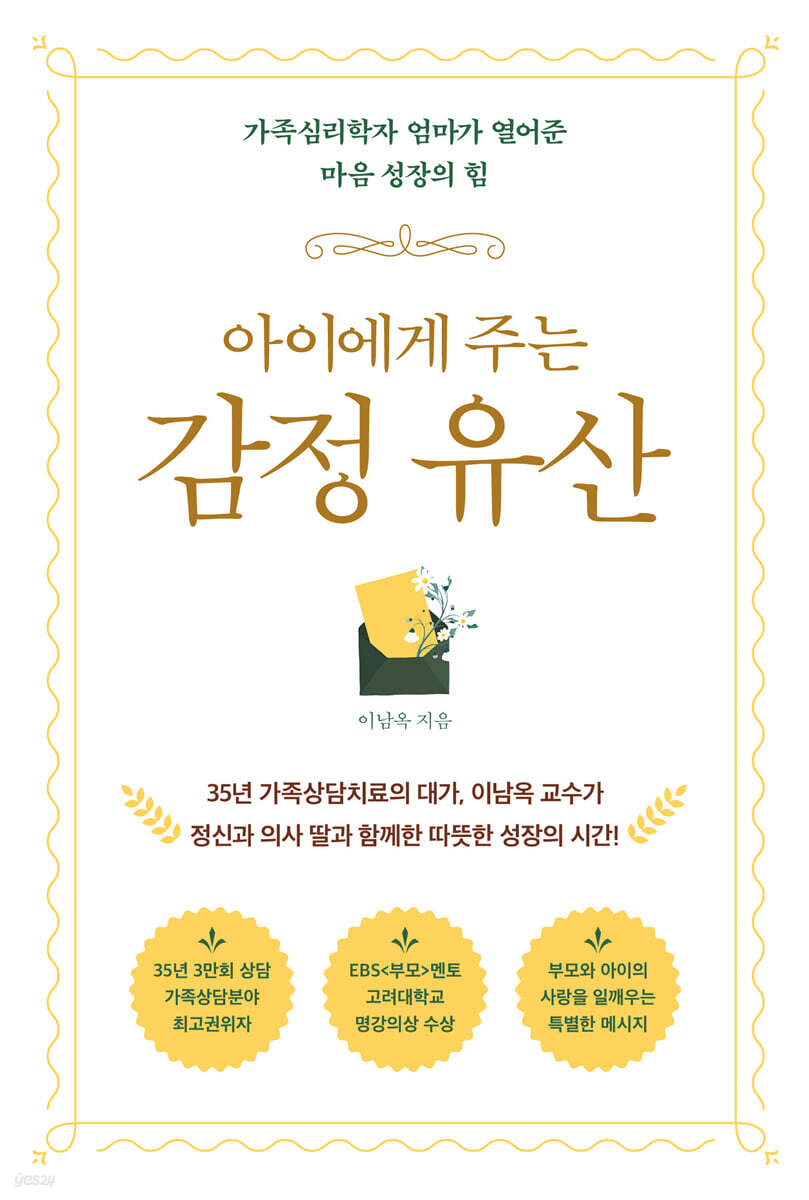
Emotional Legacy to Children
 |
Description
Book Introduction
- A word from MD
-
What should parents give their children?Leaving a stable emotional legacy for our children is just as important as passing on assets or academic qualifications. Professor Nam-ok Lee, an EBS mentor and expert in family counseling with 35 years of experience, shares her approach to family communication, fostering respect and positivity, which she has practiced while raising her own daughter.
February 10, 2023. Shin Eun-ji, PD of Home Life
Professor Nam-Ok Lee, a leading expert in family counseling with 35 years of experience, shares insights gained while raising her daughter, who later became a psychiatrist, and thoughts gained from conducting over 30,000 family counseling sessions. She shares what she considers the most powerful asset and precious value a parent can impart to their child.
What is the most important thing a parent can impart to their child? This book explores the fundamental power of parents to help children discover opportunities for growth amidst failure and hardship, choose their own path, and grow into adults with inner strength. It explores the process of finding the answer, exploring the process of parents discovering the fundamental power of parenting to help children love themselves for who they are.
It also offers specific directions for empathetic dialogue that can help children discover and develop the best within them. Through the process of rediscovering the strength of family with our children, which we have been missing, we gain new insights into human growth.
The author conveys the values of life built together with children through his uniquely warm and affectionate perspective, including how parents should view their children's frustrations, emotional dialogue that reads their hidden hearts, daily rituals that add strength to life, how to overcome past wounds and build healthy relationships with children, and the choice of "self" to go out into the world.
What is the most important thing a parent can impart to their child? This book explores the fundamental power of parents to help children discover opportunities for growth amidst failure and hardship, choose their own path, and grow into adults with inner strength. It explores the process of finding the answer, exploring the process of parents discovering the fundamental power of parenting to help children love themselves for who they are.
It also offers specific directions for empathetic dialogue that can help children discover and develop the best within them. Through the process of rediscovering the strength of family with our children, which we have been missing, we gain new insights into human growth.
The author conveys the values of life built together with children through his uniquely warm and affectionate perspective, including how parents should view their children's frustrations, emotional dialogue that reads their hidden hearts, daily rituals that add strength to life, how to overcome past wounds and build healthy relationships with children, and the choice of "self" to go out into the world.
- You can preview some of the book's contents.
Preview
index
Opening remarks
A shining legacy between my parents and me, and between me and my child
PART 1 Respecting the Child as He Is
The power of positivity for children
Infinite recognition of existence, the myth of birth
Three elements in the story
Another positivity, the family myth
Self-prophecy to tell a child
The desire for growth that breathes within a child
The Beginning of Faith, Positive Transformation Method
Respect, recognition, and love
Relationship with children account book
PART 2 In the midst of frustration and failure
Enduring together
Between Korea and Germany
worst test score
To face an uncomfortable situation
Parents' Challenges
Each child's own meaning of life
Enlightenment of this moment
Looking at the other side of frustration
PART 3 Our Own Ritual, Connecting Emotions
Languages of Emotions
Emotions and skinship
Before going to bed, a daily ritual
Memories I want to give to my child
The power of emotional connection
What's more important than discipline
Positive change in speech
The most effective conversation is one that conveys sincerity.
PART 4: Build Healthy Relationships
About the relationship that led to family
Don't look at me from the child
Why What You Want to Avoid Becomes Your Whole Life
A problem that was never solved
The wounds I give to my child without knowing it
Counseling process to understand myself
Id parents, superego parents
Understanding my relationship patterns
PART 5 Emotional Independence and Moving Forward
The meaning of emotional independence
In search of my own identity
About desirable differentiation
Love is not conditional
The best thing I've ever done in the world
So that the child can find his own way
As our love lasts forever
The love I learned is a word of gratitude
A shining legacy between my parents and me, and between me and my child
PART 1 Respecting the Child as He Is
The power of positivity for children
Infinite recognition of existence, the myth of birth
Three elements in the story
Another positivity, the family myth
Self-prophecy to tell a child
The desire for growth that breathes within a child
The Beginning of Faith, Positive Transformation Method
Respect, recognition, and love
Relationship with children account book
PART 2 In the midst of frustration and failure
Enduring together
Between Korea and Germany
worst test score
To face an uncomfortable situation
Parents' Challenges
Each child's own meaning of life
Enlightenment of this moment
Looking at the other side of frustration
PART 3 Our Own Ritual, Connecting Emotions
Languages of Emotions
Emotions and skinship
Before going to bed, a daily ritual
Memories I want to give to my child
The power of emotional connection
What's more important than discipline
Positive change in speech
The most effective conversation is one that conveys sincerity.
PART 4: Build Healthy Relationships
About the relationship that led to family
Don't look at me from the child
Why What You Want to Avoid Becomes Your Whole Life
A problem that was never solved
The wounds I give to my child without knowing it
Counseling process to understand myself
Id parents, superego parents
Understanding my relationship patterns
PART 5 Emotional Independence and Moving Forward
The meaning of emotional independence
In search of my own identity
About desirable differentiation
Love is not conditional
The best thing I've ever done in the world
So that the child can find his own way
As our love lasts forever
The love I learned is a word of gratitude
Detailed image
Into the book
Someone said, “You have the power to do that.
are you okay.
This kind of voice of faith that tells me, “You’re doing well enough now,” gives me strength and courage even after I become an adult, no matter how old I become.
-Page 22
In the birth myth, there is affirmation, respect, and affection for the child's very existence.
There is a story here and the specialness of the words is infused into it.
I always emphasize the importance of language, which I realized while studying psychology and doing counseling.
Language must have three elements in any context.
These are respect, beauty, and usefulness.
So, the birth myth must be a story that respects the child's very existence and must be a beautiful story.
And at the same time, there has to be a utility that can be empowered within it.
---p.28
There are bound to be twists and turns in life.
So that's what I do.
When an unexpected crisis arises, you just have to respond, modify, and supplement accordingly.
Then life becomes a little easier.
So I always tell my child the same thing.
No matter what choice you make, there is no life without difficulties, so the path you choose is the best path.
---p.50
There's something my mother always says.
When our mother catches a cold, we worry.
Then my mother said, “You catch a cold to get better.
Then you will become healthier.”
that's right.
After you experience it and get through it, better things come.
---p.85
Each child is born with a talent that is needed in this world and a meaning to life.
Among many children, there are some who excel in their studies, and there are also some who lack in studies but have very well-rounded personalities.
Rather than being disappointed because it doesn't live up to expectations, you can just accept that this child was born to live this life leisurely.
---p.86
You should never suppress those feelings, but rather go through the process of acknowledging and expressing them.
“Oh my, that’s so frustrating, I could cry.” Then, at that moment, my emotions become more confident.
---p.108
Even when I was young, I remember my father applying beautifully colored persimmons to me in the fall, giving me neatly arranged new clothes for the New Year, and never forgetting to celebrate Christmas. Even after decades have passed, I still remember these things.
It's the little, small things, like a little card with the words "I love you" written on it.
I wanted to give those things to my child too.
---p.120
Because speaking is something that happens frequently in our daily lives, we need to use positive language, and even if we make up our minds to do so, it is not easy to change.
In times like these, it's a good idea to figure out what words you use most often.
You need to record yourself for a certain period of time or make an effort to look back on your day and organize what you say when you do your most frequent actions, when you eat, when you are angry, when things go wrong, or when you ask your child for something.
---p.132
I hope that guilt doesn't make my child a bad child, a pitiful child.
It was something I always thought about while raising a child.
Parents' perspectives are important.
Words and facial expressions come out through eye contact.
If a child doesn't think of himself that way, and his parents continue to react that way, he will inevitably become smaller.
There is no need to feel too sorry for the child, nor to resent the reality that cannot be fulfilled.
We are all placed in a relative life.
are you okay.
This kind of voice of faith that tells me, “You’re doing well enough now,” gives me strength and courage even after I become an adult, no matter how old I become.
-Page 22
In the birth myth, there is affirmation, respect, and affection for the child's very existence.
There is a story here and the specialness of the words is infused into it.
I always emphasize the importance of language, which I realized while studying psychology and doing counseling.
Language must have three elements in any context.
These are respect, beauty, and usefulness.
So, the birth myth must be a story that respects the child's very existence and must be a beautiful story.
And at the same time, there has to be a utility that can be empowered within it.
---p.28
There are bound to be twists and turns in life.
So that's what I do.
When an unexpected crisis arises, you just have to respond, modify, and supplement accordingly.
Then life becomes a little easier.
So I always tell my child the same thing.
No matter what choice you make, there is no life without difficulties, so the path you choose is the best path.
---p.50
There's something my mother always says.
When our mother catches a cold, we worry.
Then my mother said, “You catch a cold to get better.
Then you will become healthier.”
that's right.
After you experience it and get through it, better things come.
---p.85
Each child is born with a talent that is needed in this world and a meaning to life.
Among many children, there are some who excel in their studies, and there are also some who lack in studies but have very well-rounded personalities.
Rather than being disappointed because it doesn't live up to expectations, you can just accept that this child was born to live this life leisurely.
---p.86
You should never suppress those feelings, but rather go through the process of acknowledging and expressing them.
“Oh my, that’s so frustrating, I could cry.” Then, at that moment, my emotions become more confident.
---p.108
Even when I was young, I remember my father applying beautifully colored persimmons to me in the fall, giving me neatly arranged new clothes for the New Year, and never forgetting to celebrate Christmas. Even after decades have passed, I still remember these things.
It's the little, small things, like a little card with the words "I love you" written on it.
I wanted to give those things to my child too.
---p.120
Because speaking is something that happens frequently in our daily lives, we need to use positive language, and even if we make up our minds to do so, it is not easy to change.
In times like these, it's a good idea to figure out what words you use most often.
You need to record yourself for a certain period of time or make an effort to look back on your day and organize what you say when you do your most frequent actions, when you eat, when you are angry, when things go wrong, or when you ask your child for something.
---p.132
I hope that guilt doesn't make my child a bad child, a pitiful child.
It was something I always thought about while raising a child.
Parents' perspectives are important.
Words and facial expressions come out through eye contact.
If a child doesn't think of himself that way, and his parents continue to react that way, he will inevitably become smaller.
There is no need to feel too sorry for the child, nor to resent the reality that cannot be fulfilled.
We are all placed in a relative life.
---p.208
Publisher's Review
What should parents give their children!
What parents give to their children
Your most powerful and valuable asset!
Professor Nam-ok Lee, the nation's leading authority in the field of family counseling,
A touching story of growth with a psychiatrist's daughter!
What changes occurred within the child through heart-to-heart conversations during the child's growth process?
How can parents help their children connect meaningfully with the world through their desires and aspirations?
Also, what can parents do for their children to avoid passing on their wounds to them?
The author, drawing on the emotional legacy he received from his parents, passed on a positive outlook to his children. He also used this as a source of nourishment for countless people he met through counseling, carefully soothing their wounds, riddled with pain, anger, and anxiety, and leading them to new discoveries.
After a deep wish, I created a birth myth for my daughter and told her new stories every night at bedtime to strengthen her emotions.
He helped a child who didn't know what kind of vessel was inside his heart dream his own story, and while reading his emotions at the crossroads of various choices, he supported him to find his own solution and find his own direction in life.
In particular, the parts where the author passes on to his children the emotional strength he received from his parents, such as “a person who always believes in me” and “a heart that supports me in any situation,” are deeply moving.
“So that children can live freely and confidently
“Everything about reading emotions, shining with respect, positivity, and empathy!”
The insights this book provides into child development are meaningful from various perspectives.
First, parents should actively utilize 'birth myths', 'family myths', and 'self-prophecies' to lay the foundation for their children to feel comfortable with their own existence.
By positively accepting their roots, children feel confident and secure in their own existence.
The author's stories, such as "How to find abundance in the lack I experienced while studying abroad in Germany," "My grandfather's message that protects me in difficult times," and "Holiday and Christmas rituals," remind us of the emotional connection between parents and me, and between me and my child.
The book also highlights the power of reading a child's mind in everyday life.
Emotion reading shines even brighter when a child is in a negative situation rather than a positive one.
It is about reading and objectifying the complex emotions entangled within you, and giving you the power to properly face those emotions.
Children who travel between Korea and Germany and experience the education and culture of both countries face challenges and difficulties, both big and small, such as cultural differences, peer conflicts, and relationship problems, and grow stronger and achieve their dreams.
“We make the mistake of thinking of children by adult standards.
But a child has so much more growth potential and wisdom inside of him than an adult.
In a way, there is nothing to touch.
Children are not beings that need to be guided and corrected by adults.
At that time, I realized once again the importance of respecting a child for who he or she is.” - From the text
“EBS 『Parents』 Mentor,
“Winner of Korea University’s Lecture Award!”
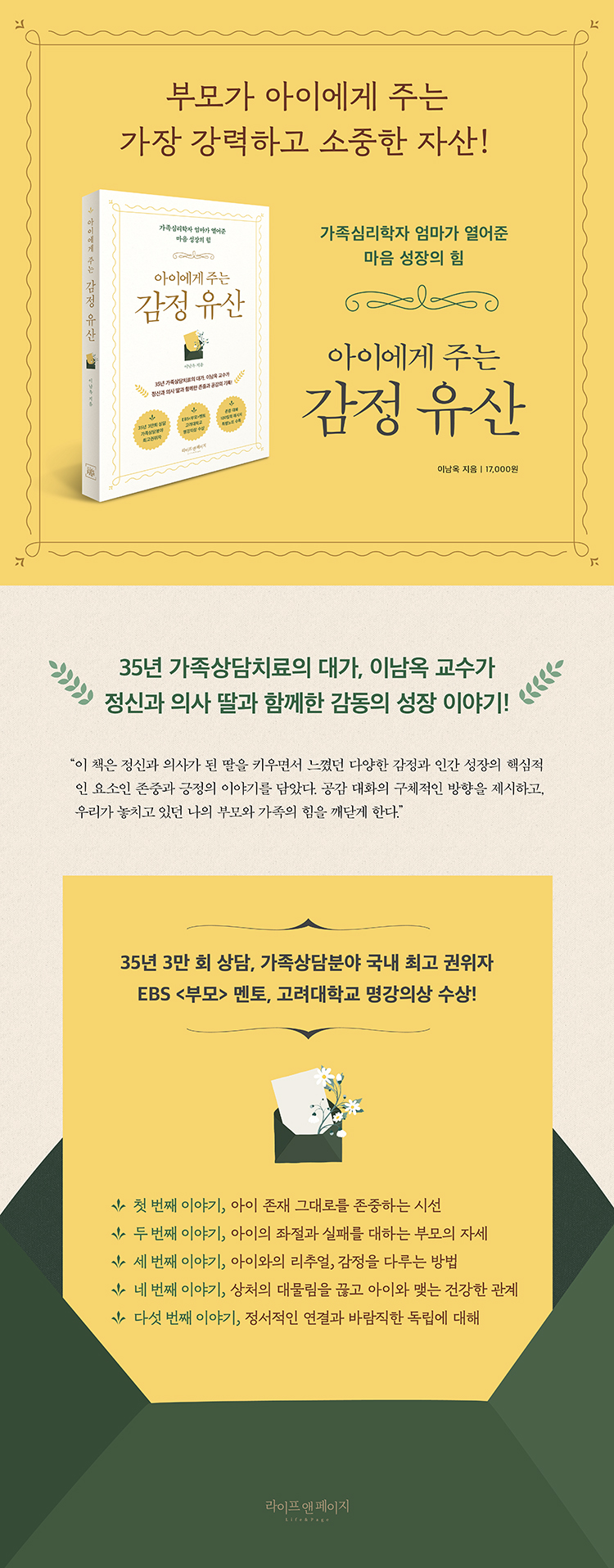
The first story, 'Respecting a Child's Existence as It Is', contains the author's growth process and counseling experience, along with the methods and effects of 'affirmation and empathy' that respect a child's existence as it is.
The second story, "In Frustration and Failure," talks about the attitude of parents who, when faced with a crisis or trial for their child, should change their perspective to an opportunity for greater growth rather than despair.
The third story, 'Our Own Ritual, Connecting Emotions', covers how to read a child's various emotions, how to deal with emotions in daily life, and how to communicate with your child emotionally through skinship and bedtime rituals.
The fourth story, "To Build Healthy Relationships," tells the story of clients who are trying to overcome the wounds they received from their parents and restore their relationships with their children.
The fifth story, 'Emotional Independence and Moving Forward,' talks about a desirable parent-child relationship that allows for comfortable connection and letting go, and ultimately suggests the direction parents and children should take.
A child should be free in the arms of his parents, and the strength to step out into the world should be independent.
What kind of person do parents want their children to grow up to be?
A child who does not crumble even in trials due to his or her infinite positivity about his or her own existence, and whose desire for growth within him or her shines throughout his or her long life.
The true heartfelt wishes of these parents and the wisdom of life, born from long experience, are fully contained in “The Emotional Legacy for Children.”
What parents give to their children
Your most powerful and valuable asset!
Professor Nam-ok Lee, the nation's leading authority in the field of family counseling,
A touching story of growth with a psychiatrist's daughter!
What changes occurred within the child through heart-to-heart conversations during the child's growth process?
How can parents help their children connect meaningfully with the world through their desires and aspirations?
Also, what can parents do for their children to avoid passing on their wounds to them?
The author, drawing on the emotional legacy he received from his parents, passed on a positive outlook to his children. He also used this as a source of nourishment for countless people he met through counseling, carefully soothing their wounds, riddled with pain, anger, and anxiety, and leading them to new discoveries.
After a deep wish, I created a birth myth for my daughter and told her new stories every night at bedtime to strengthen her emotions.
He helped a child who didn't know what kind of vessel was inside his heart dream his own story, and while reading his emotions at the crossroads of various choices, he supported him to find his own solution and find his own direction in life.
In particular, the parts where the author passes on to his children the emotional strength he received from his parents, such as “a person who always believes in me” and “a heart that supports me in any situation,” are deeply moving.
“So that children can live freely and confidently
“Everything about reading emotions, shining with respect, positivity, and empathy!”
The insights this book provides into child development are meaningful from various perspectives.
First, parents should actively utilize 'birth myths', 'family myths', and 'self-prophecies' to lay the foundation for their children to feel comfortable with their own existence.
By positively accepting their roots, children feel confident and secure in their own existence.
The author's stories, such as "How to find abundance in the lack I experienced while studying abroad in Germany," "My grandfather's message that protects me in difficult times," and "Holiday and Christmas rituals," remind us of the emotional connection between parents and me, and between me and my child.
The book also highlights the power of reading a child's mind in everyday life.
Emotion reading shines even brighter when a child is in a negative situation rather than a positive one.
It is about reading and objectifying the complex emotions entangled within you, and giving you the power to properly face those emotions.
Children who travel between Korea and Germany and experience the education and culture of both countries face challenges and difficulties, both big and small, such as cultural differences, peer conflicts, and relationship problems, and grow stronger and achieve their dreams.
“We make the mistake of thinking of children by adult standards.
But a child has so much more growth potential and wisdom inside of him than an adult.
In a way, there is nothing to touch.
Children are not beings that need to be guided and corrected by adults.
At that time, I realized once again the importance of respecting a child for who he or she is.” - From the text
“EBS 『Parents』 Mentor,
“Winner of Korea University’s Lecture Award!”
The first story, 'Respecting a Child's Existence as It Is', contains the author's growth process and counseling experience, along with the methods and effects of 'affirmation and empathy' that respect a child's existence as it is.
The second story, "In Frustration and Failure," talks about the attitude of parents who, when faced with a crisis or trial for their child, should change their perspective to an opportunity for greater growth rather than despair.
The third story, 'Our Own Ritual, Connecting Emotions', covers how to read a child's various emotions, how to deal with emotions in daily life, and how to communicate with your child emotionally through skinship and bedtime rituals.
The fourth story, "To Build Healthy Relationships," tells the story of clients who are trying to overcome the wounds they received from their parents and restore their relationships with their children.
The fifth story, 'Emotional Independence and Moving Forward,' talks about a desirable parent-child relationship that allows for comfortable connection and letting go, and ultimately suggests the direction parents and children should take.
A child should be free in the arms of his parents, and the strength to step out into the world should be independent.
What kind of person do parents want their children to grow up to be?
A child who does not crumble even in trials due to his or her infinite positivity about his or her own existence, and whose desire for growth within him or her shines throughout his or her long life.
The true heartfelt wishes of these parents and the wisdom of life, born from long experience, are fully contained in “The Emotional Legacy for Children.”
GOODS SPECIFICS
- Date of issue: February 6, 2023
- Page count, weight, size: 224 pages | 428g | 135*195*23mm
- ISBN13: 9791191462173
- ISBN10: 119146217X
You may also like
카테고리
korean


korean

![GQ KOREA Mark (Monthly): December [2025]](http://librairie.coreenne.fr/cdn/shop/files/8ef265dbbfbf186523ed75ba7319009d.jpg?v=1765340328&width=3840)


