

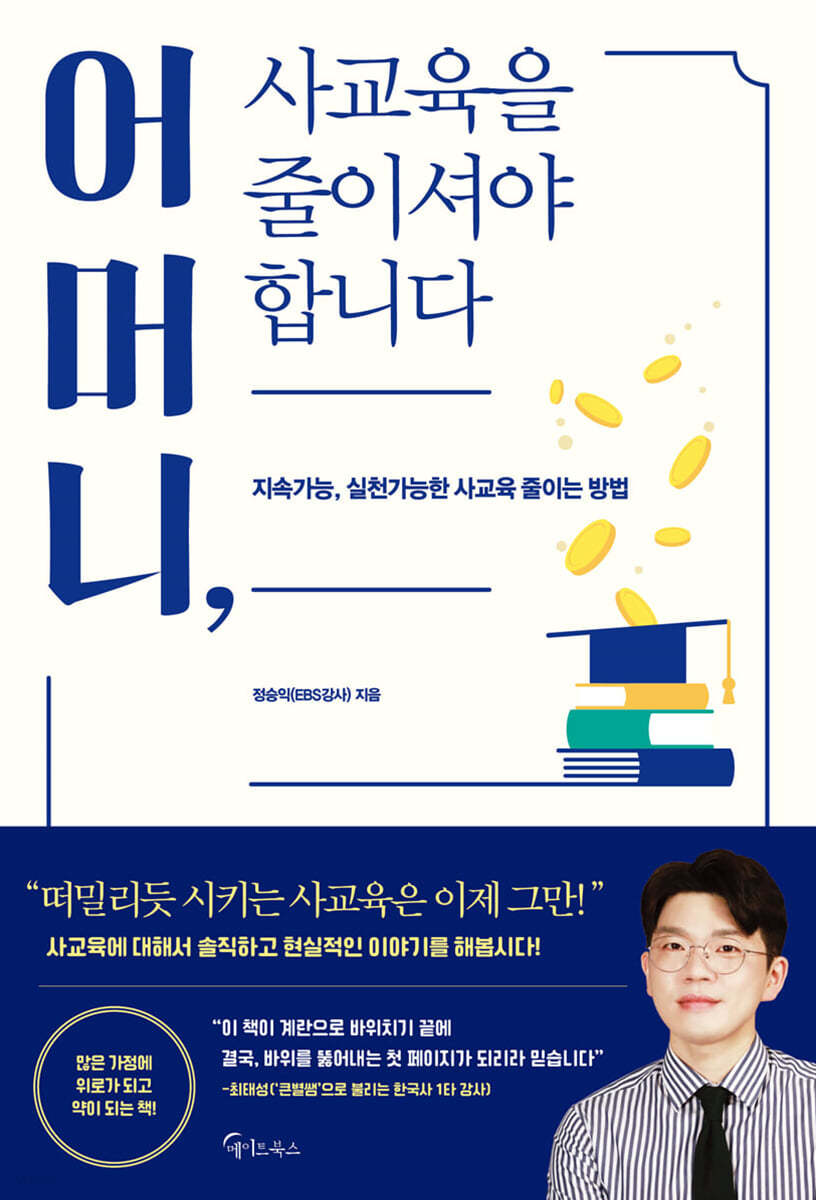
Mother, you need to reduce private education.
 |
Description
Book Introduction
Before sending your child to private tutoring without any thought due to anxiety and frustration A book that tells you what parents and children can do! It is true that parents in Korea spend a lot of money on private education for their children without even preparing for their own old age. People are unable to reduce their private education expenses for reasons such as anxiety and lack of trust in public education. Can private education truly be reduced? Teacher Jeong Seung-ik, who speaks almost daily about the sad reality of our education system on his YouTube channel with 100,000 dedicated subscribers, uses this book, an essay on child education, to urge parents to stay focused. The private education diagnosis method of Mr. Jeong Seung-ik, a true teacher recognized by teachers, provides direct help to the real lives of the majority of ordinary parents and students. In this book, the author does not say things like, “Private education is bad, so we should definitely stop doing it.” Rather, it talks about the ‘essence of education’ that must be considered before private education. This is because private education is only one of the factors that influence educational outcomes, but by no means everything. Rather than obsessing over the exaggerated results of prestigious universities, parents should educate their children in a way that they believe is closer to the essence. Parents must stick to the principles and essence of their thinking and focus on the ‘process’ rather than the ‘result’. Even if parents cannot control the 'results', they can control the 'process' as they wish. In that sense, the author talks about what parents and children can do during the 12 years of elementary, middle, and high school in this book. The author points out that the majority of parents in South Korea who rely on private education have more feelings of anxiety than confidence. This book provides specific guidelines to parents who, despite being aware of the ills of private education, are unable to escape it due to the anxiety of choosing a path not taken by the majority. The author urges that even when providing private education, it should be done with confidence rather than anxiety. If you order your child to do this and that out of anxiety without any subjectivity, private education will not be effective and you will lose money. It is also a warm and sympathetic book that suggests ways to help parents who feel burdened by the monthly private education costs but cannot help but send their children to school. This book will also be of great help in devising realistic ways to implement the decision to reduce private education. The book is full of content that will make you think deeply about not only the issue of private education, but also how we can ultimately raise our children well. Parents who have often wavered while raising their children for 12 years of elementary, middle, and high school will be able to continue their education with conviction and philosophy through this book. |
- You can preview some of the book's contents.
Preview
index
Entering _ Stop the private education that pushes you to do things out of anxiety!
Part 1: Why Private Education Should Be Reduced
Private education will continue, but it needs to be considered.
Reason 1: Reduce Private Education: Money and Retirement Planning
Reason 2: We Need to Reduce Private Education - The Reality of Seoul's Prestigious Universities
Reason 3: We Need to Reduce Private Education - Income Gap
4 Reasons Why We Need to Reduce Private Education - The Dilemma of the Lower Class
5 Reasons Why Private Education Should Be Reduced - Self-Initiative
6 Reasons Why We Need to Reduce Private Education - Study Emotions
7 Reasons Why Private Education Should Be Reduced - The Responsibility of the Older Generation
8 Reasons Why We Need to Reduce Private Education - For a Better Future
Part 2: How to Reduce Private Education│Parents' Practices│
Children are not raised, they grow up on their own.
Parenting Mindset 1 - The Purpose of Parenting
Parenting Mindset 2 - A Legacy for Your Children
Parenting Mindset 3 - Parents with Philosophy
Parenting Mindset #4 - I Love You Unconditionally
Parent Training 1 - Parents Studying in the Living Room
Parenting Lesson 2: Listening to Your Child's Complete Statement
Parenting Lesson 3: Parents Who Leverage Failure
Parent Training 4 - Moral Parenting
Parenting Training 5 - Becoming a Pro Parent
Part 3: How to Reduce Private Education│Student Practices│
Why on earth do we study?
How to Study Well 1 - Know Thyself
How to Study Well 2 - Setting a Study Goal
How to Study Well 3 - Develop a Can-Do Mindset
How to Study Well 4 - Developing a Mindset That Overcomes Failure
How to Study Well 5 - Change Your Environment
How to Study Well 6 - Create Small Successes
How to Study Well 7 - Make Studying a Habit
How to Study Well 8 - Study with Immersion
How to Study Well 9 - Beating Smartphones and Games
10 Ways to Study Well - Study Skills
Coming out _ I hope it will be a medicine and comfort to many families!
Part 1: Why Private Education Should Be Reduced
Private education will continue, but it needs to be considered.
Reason 1: Reduce Private Education: Money and Retirement Planning
Reason 2: We Need to Reduce Private Education - The Reality of Seoul's Prestigious Universities
Reason 3: We Need to Reduce Private Education - Income Gap
4 Reasons Why We Need to Reduce Private Education - The Dilemma of the Lower Class
5 Reasons Why Private Education Should Be Reduced - Self-Initiative
6 Reasons Why We Need to Reduce Private Education - Study Emotions
7 Reasons Why Private Education Should Be Reduced - The Responsibility of the Older Generation
8 Reasons Why We Need to Reduce Private Education - For a Better Future
Part 2: How to Reduce Private Education│Parents' Practices│
Children are not raised, they grow up on their own.
Parenting Mindset 1 - The Purpose of Parenting
Parenting Mindset 2 - A Legacy for Your Children
Parenting Mindset 3 - Parents with Philosophy
Parenting Mindset #4 - I Love You Unconditionally
Parent Training 1 - Parents Studying in the Living Room
Parenting Lesson 2: Listening to Your Child's Complete Statement
Parenting Lesson 3: Parents Who Leverage Failure
Parent Training 4 - Moral Parenting
Parenting Training 5 - Becoming a Pro Parent
Part 3: How to Reduce Private Education│Student Practices│
Why on earth do we study?
How to Study Well 1 - Know Thyself
How to Study Well 2 - Setting a Study Goal
How to Study Well 3 - Develop a Can-Do Mindset
How to Study Well 4 - Developing a Mindset That Overcomes Failure
How to Study Well 5 - Change Your Environment
How to Study Well 6 - Create Small Successes
How to Study Well 7 - Make Studying a Habit
How to Study Well 8 - Study with Immersion
How to Study Well 9 - Beating Smartphones and Games
10 Ways to Study Well - Study Skills
Coming out _ I hope it will be a medicine and comfort to many families!
Detailed image

Into the book
The interesting thing about education is that there are so many variables that influence outcomes that it's difficult to pinpoint exactly which ones are responsible for the outcome.
As children spend 12 years in elementary, middle, and high school, countless things influence their 12-year journey, including their parents, home environment, genetic factors, relationships with friends, school, teachers, textbooks, lectures, and academies.
But among all those factors, there is something called 'essence'.
---p.21
Popular academies in an area have some common characteristics.
Even if you pay tuition, you can't go to the academy.
The garden is already full and there will be people waiting.
These academies require you to pass a test provided by the academy in order to enroll in the academy.
I want to go to an academy because my math skills are lacking, but I can't go because I can't pass the academy's test.
Most popular academies have a ‘pre-enrollment test.’
Parents must think about why these tests exist from the perspective of their children's educational needs.
---p.68
Those in the lower and middle ranks 'depend' on academies, while those in the upper ranks 'use' academies.
This difference is crucial.
The top students do not rely on academies, but use them as needed.
You can save time by using academies when preparing for your internal exams, and you can fill in any missing concepts at academies while preparing for the CSAT.
Top students know exactly what they are lacking and only use academies when they need to improve on it.
Relying on academies for reasons such as being anxious or not being able to study on your own is definitely not the best option.
---p.72
The goal of elementary English education is to 'build interest and confidence' rather than reading a lot of original English books, speaking English fluently, and prioritizing middle school studies.
If you forget this goal and do things that are not appropriate for your child's level, if you emphasize only speed without properly learning the concepts, which causes learning loss, or if you force your child to study without considering their emotions, their motivation to study will be ruined.
---p.85
We now live in a world thoroughly dominated by a paradigm in which grades are directly evaluated as ability.
You can't deny reality.
But children should be happier than they are now.
Because they never chose to be born into this world, nor did they choose to compete fiercely within this system.
We must protect our children at home so that they can be happy, even if it is only out of regret for having them face a competitive society.
---p.95
When your child is a preschooler, you can raise him or her as you wish, feeding and dressing him or her.
Parents can raise their children as they wish while being with them 24 hours a day.
But as soon as children start kindergarten, the time they spend with their parents begins to decrease.
Children create their own world as they meet different people and gain experiences away from their parents.
When planning a child's education, it is merely a 'misconception' for parents to think that they will raise their child in the way they want.
---p.113
There are also families where each member plays separately during normal times and studies together only during exam periods.
But if, unlike usual, mom or dad only studies with their children during exam periods, wouldn't the children feel watched? If parents, who usually rest comfortably, stick close to their children late into the night, wouldn't that be considered surveillance? Feeling watched is definitely not conducive to studying.
Since mom and dad are by your side, you can't help but study, but studying because you're told to do it isn't a pleasant feeling.
Living room study is effective when parents actually read and actually study.
---p.152
Professor Lisa Son describes the process of self-assessing the quality and quantity of one's knowledge as "monitoring."
After monitoring yourself in this way, setting a learning direction based on this is control.
Through monitoring and control, children successfully lead their own learning.
And when a child fails, he or she must figure out for himself or herself whether the failure was due to monitoring or control.
---p.167
We see in the news and in the social pages of newspapers that going to a prestigious university and gaining social fame and money is not everything in life.
Even those who have achieved great social wealth and fame can be ruined in an instant by immoral acts.
Even though we see such incidents with our own eyes, we only force our children to study.
A child's morality is as important to his or her independence and achievement as his or her academics.
---p.175
To be a professional parent, you must be able to speak appropriately to your children and demonstrate a positive attitude in any situation.
I think the moment when this breaks down the most is when the parents themselves are physically and mentally exhausted.
When parents have major concerns in their lives, or when they are sick, they can't act like professionals.
But as we live, troublesome things happen every day.
That's why I recommend '10,000 steps a day' for parents.
---p.182
You can ask others for advice, but you should not let others make this important decision for you.
However, you may be anxious about whether you can make good decisions on your own.
Then you have to be smart yourself.
To make the best decisions, you need to read books diligently, read newspapers regularly, and look around the world diligently to become smart.
---p.198
If you really want to study well, you need to look inside yourself rather than just focusing on the books on your desk.
Many people in the world live their lives pursuing different goals.
Opportunity comes only to those who are prepared.
To have the motivation to study properly, you must consistently take an interest in your own life and seriously consider what studying means to you.
---p.217
Behind every success we see, there is inevitably failure.
Because through failure we become stronger and move towards success.
If you study alone, there will inevitably be trial and error.
You don't have any study habits, and making plans won't be easy.
Sometimes you make unreasonable plans, and sometimes things don't go as planned due to lack of will.
But while we take all of this for granted, we must learn and grow through our failures.
---p.230
It is said that 47% of our actions occur as habits.
About half of the actions we perform each day are performed automatically and unconsciously.
But we don't spend more than half of our day in a daze.
I am clearly thinking and working diligently accordingly.
Just because our actions are automatic doesn't mean they happen without thought.
Our actions are triggered by signals we receive from our environment.
---p.237
You can remember what you've learned longer by talking about it with a friend or explaining it to a friend.
Even if you don't have friends, you can still use the 'teaching technique'.
You can proceed by writing the content on a blank sheet of paper and explaining the concepts you have learned to a virtual subject.
In this process, I come across concepts that I completely understand and that I find confusing.
As children spend 12 years in elementary, middle, and high school, countless things influence their 12-year journey, including their parents, home environment, genetic factors, relationships with friends, school, teachers, textbooks, lectures, and academies.
But among all those factors, there is something called 'essence'.
---p.21
Popular academies in an area have some common characteristics.
Even if you pay tuition, you can't go to the academy.
The garden is already full and there will be people waiting.
These academies require you to pass a test provided by the academy in order to enroll in the academy.
I want to go to an academy because my math skills are lacking, but I can't go because I can't pass the academy's test.
Most popular academies have a ‘pre-enrollment test.’
Parents must think about why these tests exist from the perspective of their children's educational needs.
---p.68
Those in the lower and middle ranks 'depend' on academies, while those in the upper ranks 'use' academies.
This difference is crucial.
The top students do not rely on academies, but use them as needed.
You can save time by using academies when preparing for your internal exams, and you can fill in any missing concepts at academies while preparing for the CSAT.
Top students know exactly what they are lacking and only use academies when they need to improve on it.
Relying on academies for reasons such as being anxious or not being able to study on your own is definitely not the best option.
---p.72
The goal of elementary English education is to 'build interest and confidence' rather than reading a lot of original English books, speaking English fluently, and prioritizing middle school studies.
If you forget this goal and do things that are not appropriate for your child's level, if you emphasize only speed without properly learning the concepts, which causes learning loss, or if you force your child to study without considering their emotions, their motivation to study will be ruined.
---p.85
We now live in a world thoroughly dominated by a paradigm in which grades are directly evaluated as ability.
You can't deny reality.
But children should be happier than they are now.
Because they never chose to be born into this world, nor did they choose to compete fiercely within this system.
We must protect our children at home so that they can be happy, even if it is only out of regret for having them face a competitive society.
---p.95
When your child is a preschooler, you can raise him or her as you wish, feeding and dressing him or her.
Parents can raise their children as they wish while being with them 24 hours a day.
But as soon as children start kindergarten, the time they spend with their parents begins to decrease.
Children create their own world as they meet different people and gain experiences away from their parents.
When planning a child's education, it is merely a 'misconception' for parents to think that they will raise their child in the way they want.
---p.113
There are also families where each member plays separately during normal times and studies together only during exam periods.
But if, unlike usual, mom or dad only studies with their children during exam periods, wouldn't the children feel watched? If parents, who usually rest comfortably, stick close to their children late into the night, wouldn't that be considered surveillance? Feeling watched is definitely not conducive to studying.
Since mom and dad are by your side, you can't help but study, but studying because you're told to do it isn't a pleasant feeling.
Living room study is effective when parents actually read and actually study.
---p.152
Professor Lisa Son describes the process of self-assessing the quality and quantity of one's knowledge as "monitoring."
After monitoring yourself in this way, setting a learning direction based on this is control.
Through monitoring and control, children successfully lead their own learning.
And when a child fails, he or she must figure out for himself or herself whether the failure was due to monitoring or control.
---p.167
We see in the news and in the social pages of newspapers that going to a prestigious university and gaining social fame and money is not everything in life.
Even those who have achieved great social wealth and fame can be ruined in an instant by immoral acts.
Even though we see such incidents with our own eyes, we only force our children to study.
A child's morality is as important to his or her independence and achievement as his or her academics.
---p.175
To be a professional parent, you must be able to speak appropriately to your children and demonstrate a positive attitude in any situation.
I think the moment when this breaks down the most is when the parents themselves are physically and mentally exhausted.
When parents have major concerns in their lives, or when they are sick, they can't act like professionals.
But as we live, troublesome things happen every day.
That's why I recommend '10,000 steps a day' for parents.
---p.182
You can ask others for advice, but you should not let others make this important decision for you.
However, you may be anxious about whether you can make good decisions on your own.
Then you have to be smart yourself.
To make the best decisions, you need to read books diligently, read newspapers regularly, and look around the world diligently to become smart.
---p.198
If you really want to study well, you need to look inside yourself rather than just focusing on the books on your desk.
Many people in the world live their lives pursuing different goals.
Opportunity comes only to those who are prepared.
To have the motivation to study properly, you must consistently take an interest in your own life and seriously consider what studying means to you.
---p.217
Behind every success we see, there is inevitably failure.
Because through failure we become stronger and move towards success.
If you study alone, there will inevitably be trial and error.
You don't have any study habits, and making plans won't be easy.
Sometimes you make unreasonable plans, and sometimes things don't go as planned due to lack of will.
But while we take all of this for granted, we must learn and grow through our failures.
---p.230
It is said that 47% of our actions occur as habits.
About half of the actions we perform each day are performed automatically and unconsciously.
But we don't spend more than half of our day in a daze.
I am clearly thinking and working diligently accordingly.
Just because our actions are automatic doesn't mean they happen without thought.
Our actions are triggered by signals we receive from our environment.
---p.237
You can remember what you've learned longer by talking about it with a friend or explaining it to a friend.
Even if you don't have friends, you can still use the 'teaching technique'.
You can proceed by writing the content on a blank sheet of paper and explaining the concepts you have learned to a virtual subject.
In this process, I come across concepts that I completely understand and that I find confusing.
---p.292
Publisher's Review
You can't be the best by 'being told to'!
A clear solution to escape the dilemma of private education costs!
There are 30 children in a class, but only 3 follow the teacher's instructions.
The remaining twelve are just wasting time in the classroom.
These children clearly received advanced learning through private tutoring from elementary school, so why are these results so striking? The author argues that the driving force behind a child's academic success is not private tutoring, but their ability to learn independently.
Therefore, rather than blindly sending children to private academies, the author repeatedly urges parents to first think about what they and their children can do at home before providing private education.
If you pour private education into a child who has no will to study, it is much more likely to have the opposite effect than to achieve the desired results.
In other words, a child's academic achievement is not achieved simply by their parents taking good care of them, nor by sending them to a good academy. Studying must be meaningful to the child, they must be able to find and study on their own without being told to do so, and they must be able to endure even when things are difficult.
Only then can students achieve their desired goals through study.
The author suggests that parents consider how they can help their children develop these mindsets and habits while they are still young, and presents realistic and specific methods in this book.
This book is divided into three parts.
Part 1 raises fundamental questions about the nature and limitations of private education.
Parents need to seriously consider whether they should continue to increase their children's private education, investing significant amounts of money that will not even prepare them for their own retirement.
Part 2 discusses the essentials of parenting that parents need to focus on to stay centered.
Rather than forcing children to receive private education out of anxiety, we teach parents how they can grow happily together with their children.
Finally, Part 3 introduces things that teenage students must know and practice.
It's not that I studied hard but didn't get good grades, it's that I just haven't studied properly yet.
To study well, you need to know how to study.
Studying is not something only a select few can do; anyone can do well if they put in the effort.
If children develop the habit of studying on their own through Part 3, private education will naturally become a choice rather than a necessity.
In 2023, amidst a global economic downturn, prices and interest rates are expected to rise further, requiring households to prepare more robustly.
To do so, we must remove the bubbles in private education and the bubbles in our perception of it, and seriously reconsider the essence of education, the happiness of children, and what true education is.
In these times, this book, filled with Professor Jeong Seung-ik's multifaceted insights, will serve as the ultimate guide for parents concerned about private education.
A clear solution to escape the dilemma of private education costs!
There are 30 children in a class, but only 3 follow the teacher's instructions.
The remaining twelve are just wasting time in the classroom.
These children clearly received advanced learning through private tutoring from elementary school, so why are these results so striking? The author argues that the driving force behind a child's academic success is not private tutoring, but their ability to learn independently.
Therefore, rather than blindly sending children to private academies, the author repeatedly urges parents to first think about what they and their children can do at home before providing private education.
If you pour private education into a child who has no will to study, it is much more likely to have the opposite effect than to achieve the desired results.
In other words, a child's academic achievement is not achieved simply by their parents taking good care of them, nor by sending them to a good academy. Studying must be meaningful to the child, they must be able to find and study on their own without being told to do so, and they must be able to endure even when things are difficult.
Only then can students achieve their desired goals through study.
The author suggests that parents consider how they can help their children develop these mindsets and habits while they are still young, and presents realistic and specific methods in this book.
This book is divided into three parts.
Part 1 raises fundamental questions about the nature and limitations of private education.
Parents need to seriously consider whether they should continue to increase their children's private education, investing significant amounts of money that will not even prepare them for their own retirement.
Part 2 discusses the essentials of parenting that parents need to focus on to stay centered.
Rather than forcing children to receive private education out of anxiety, we teach parents how they can grow happily together with their children.
Finally, Part 3 introduces things that teenage students must know and practice.
It's not that I studied hard but didn't get good grades, it's that I just haven't studied properly yet.
To study well, you need to know how to study.
Studying is not something only a select few can do; anyone can do well if they put in the effort.
If children develop the habit of studying on their own through Part 3, private education will naturally become a choice rather than a necessity.
In 2023, amidst a global economic downturn, prices and interest rates are expected to rise further, requiring households to prepare more robustly.
To do so, we must remove the bubbles in private education and the bubbles in our perception of it, and seriously reconsider the essence of education, the happiness of children, and what true education is.
In these times, this book, filled with Professor Jeong Seung-ik's multifaceted insights, will serve as the ultimate guide for parents concerned about private education.
GOODS SPECIFICS
- Date of issue: January 17, 2023
- Page count, weight, size: 304 pages | 470g | 153*225*20mm
- ISBN13: 9791160023909
- ISBN10: 1160023905
You may also like
카테고리
korean


korean

![GQ KOREA Mark (Monthly): December [2025]](http://librairie.coreenne.fr/cdn/shop/files/8ef265dbbfbf186523ed75ba7319009d.jpg?v=1765340328&width=3840)


