

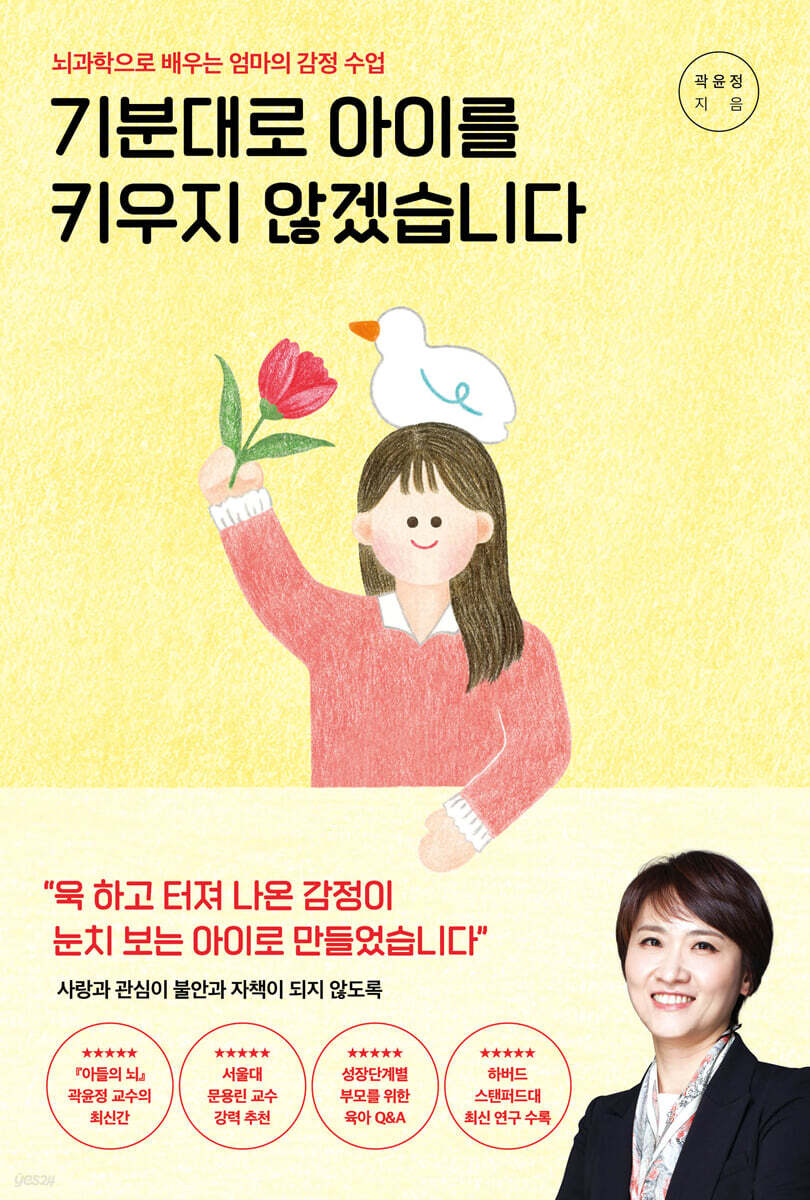
I won't raise my child according to my mood.
 |
Description
Book Introduction
- A word from MD
-
If you want to raise your children with reason rather than emotionBestseller 『The Son's Brain』: Brain science parenting method by Professor Kwak Yun-jeong.
When parents practice emotional parenting, the parents only remember their intentions, and the children only remember the parents' attitudes.
This book explains the developmental process of the infant/toddler brain and presents three key solutions to prevent parenting difficulties.
Let's not miss the golden time that determines our children's emotions.
November 29, 2022. Shin Eun-ji, PD of Home Life
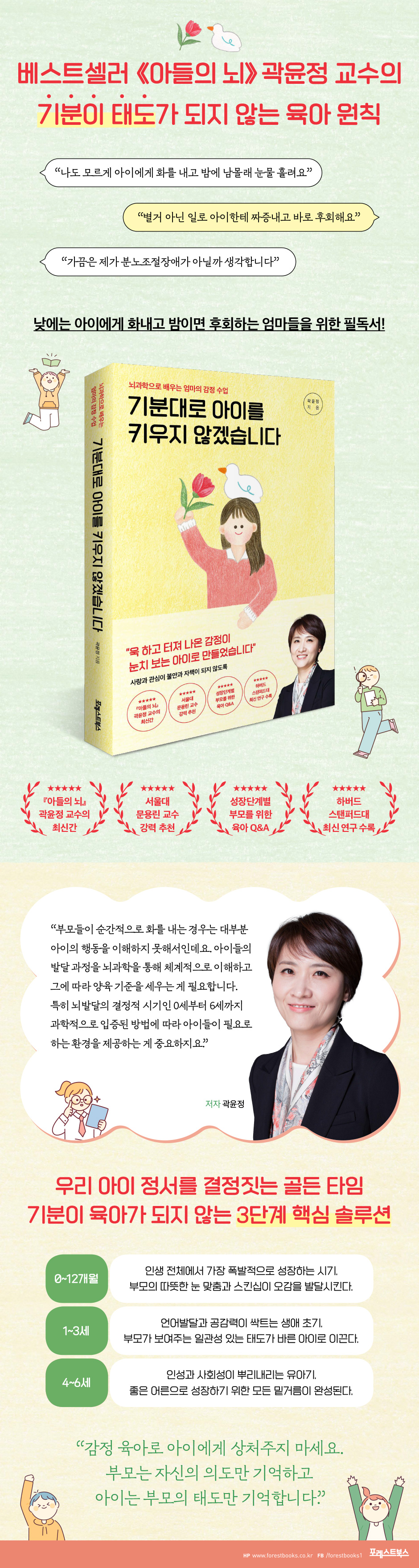
"The outburst of emotion made me a very perceptive child."
Bestselling book on child education, “The Son’s Brain,” by Professor Kwak Yun-jeong
Parenting Principles That Don't Let Your Mood Be Your Attitude
★★★★★ Bestseller 『The Son's Brain』, Professor Kwak Yun-jeong's latest book
★★★★★ Recommended books by Seoul National University Professor Moon Yong-rin
★★★★★ Parenting Q&A for Parents by Growth Stage
★★★★★ Includes the latest research from Harvard and Stanford
Young children do not have a developed ability to understand their own state, mood, or emotions.
The abilities we need to live, such as cognition, emotion, and language, are not formed at birth, but sprout, grow, and bear fruit through parental upbringing.
Therefore, the principles and values that parents used to raise their children become the standards that determine the child's cognition and emotions.
Professor Kwak Yoon-jeong, author of "The Son's Brain," a long-time bestseller in the field of child education, and one of the best parenting mentors in Korea who helps parents solve their concerns through various broadcasts and lectures, including the EBS documentary prime "Children's Emotional Intelligence," discovered that most of the reasons parents have difficulty raising children are due to "emotions."
The cause of conflict between parents and children is that the love for the child is not properly conveyed because it is buried in the parents' momentary emotions.
Professor Kwak believed that if we could systematically understand children's development through brain science and establish appropriate parenting standards and principles, then the love and care for children would not be left behind as self-reproach and regret for mothers.
And, he has completed a book titled “I Will Not Raise a Child According to My Feelings” by easily explaining the brain science theories that can help parents manage their emotions up to the age of 6, which is a critical period for brain development.
This book is based on brain science research and contains information on how parents can understand their children and what kind of parenting and education their children want and need.
Rather than parenting inconsistently and repeatedly based on momentary moods, we build a solid foundation for children to lead healthy and happy lives by learning what their brains like and desire based on scientifically proven brain development.
It also provides detailed explanations of children's characteristics, physiological responses, and levels of thinking and judgment according to the stage of brain development, and provides warm advice on parenting and learning methods that parents are curious about.
There are no parents who do not love their children.
To love someone is to accurately understand and accept their desires and actions.
Professor Kwak Yun-jeong's solid and wise advice will serve as a great foundation for truly loving and respecting your child.
Bestselling book on child education, “The Son’s Brain,” by Professor Kwak Yun-jeong
Parenting Principles That Don't Let Your Mood Be Your Attitude
★★★★★ Bestseller 『The Son's Brain』, Professor Kwak Yun-jeong's latest book
★★★★★ Recommended books by Seoul National University Professor Moon Yong-rin
★★★★★ Parenting Q&A for Parents by Growth Stage
★★★★★ Includes the latest research from Harvard and Stanford
Young children do not have a developed ability to understand their own state, mood, or emotions.
The abilities we need to live, such as cognition, emotion, and language, are not formed at birth, but sprout, grow, and bear fruit through parental upbringing.
Therefore, the principles and values that parents used to raise their children become the standards that determine the child's cognition and emotions.
Professor Kwak Yoon-jeong, author of "The Son's Brain," a long-time bestseller in the field of child education, and one of the best parenting mentors in Korea who helps parents solve their concerns through various broadcasts and lectures, including the EBS documentary prime "Children's Emotional Intelligence," discovered that most of the reasons parents have difficulty raising children are due to "emotions."
The cause of conflict between parents and children is that the love for the child is not properly conveyed because it is buried in the parents' momentary emotions.
Professor Kwak believed that if we could systematically understand children's development through brain science and establish appropriate parenting standards and principles, then the love and care for children would not be left behind as self-reproach and regret for mothers.
And, he has completed a book titled “I Will Not Raise a Child According to My Feelings” by easily explaining the brain science theories that can help parents manage their emotions up to the age of 6, which is a critical period for brain development.
This book is based on brain science research and contains information on how parents can understand their children and what kind of parenting and education their children want and need.
Rather than parenting inconsistently and repeatedly based on momentary moods, we build a solid foundation for children to lead healthy and happy lives by learning what their brains like and desire based on scientifically proven brain development.
It also provides detailed explanations of children's characteristics, physiological responses, and levels of thinking and judgment according to the stage of brain development, and provides warm advice on parenting and learning methods that parents are curious about.
There are no parents who do not love their children.
To love someone is to accurately understand and accept their desires and actions.
Professor Kwak Yun-jeong's solid and wise advice will serve as a great foundation for truly loving and respecting your child.
- You can preview some of the book's contents.
Preview
index
Recommended Articles · If you are treating your child according to your mood
Part 1 · 7 Parenting Principles That Don't Let Your Mood Be Your Attitude
There's a reason for a child's behavior.
What Went Wrong with My Child? | Why Brain Study is Necessary for Parenting | Where the Mind is Made | What if the Brainstem is Damaged? | Why Did the Snake Eat Its Baby? | You're Not a Gorilla
Understanding the Child's Brain
The CEO of Our Body | The Frontal Lobe, Making Humans Human | The Temporal Lobe, Listening and Speaking | The Parietal Lobe, "Catch Me!" | Eyes in the Back of Your Head
Parents' feelings shape their children's emotions.
From Earthworm to Human | Why 10 Years? | Children Who Feed on Their Parents' Moods | Senses Are Intelligence, Too
Establish principles appropriate for brain development
Synapses are key | Get the timing right | Emotions drive learning | Acknowledge differences
Don't miss the absolute timing
Genetics or Environment? | Ginny Wilde, The Unfortunate Discovery | There's a Time for Everything
Believe in the power of potential
The Brain's Infinite Plasticity | How We Get Smarter
Change your parenting style every three years.
Parenting is like exercise | Separately and Together
Part 2 · How a Mother's Attitude Shapes Her Child's Mood 2·2·2 Parenting Method
Chapter 1 · 0-12 months: Your baby knows everything, just not expressing it.
Explosive growth period
The Meaning of 1.5 Kilograms | Electricity and Myelination
The five senses begin to open
I'm ready, but I can't do it on my own yet | A year of miracles | See, hear, and feel
The true meaning behind tears
Newborn Stress | If you want to raise your child smartly
The Science of Sleep
Why do people sleep? | While the baby is sleeping
The development of EQ has already begun!
Seven Hearts | What is your child's emotional intelligence score? | The Key to Opening the Heart
Chapter 2 · Ages 1-3: Consistent Parental Attitude Leads to Well-Being Children
Children who remember their mother's mistakes
The Age of Absorbing Everything Like a Sponge | The Brain of a Child Without a Filter | Toddler Video Syndrome
The power of the dinner table
Food for Raising Children, Food for the Heart | Is there a way to help my child eat well?
Time to learn about myself
My Mom and I Are Different | The Illusion of Not Knowing When You're Young | The Emotional Muscles That Protect You
Positive Discipline Methods for Managing the Moods of Mothers and Children
Emotional Contagion | The Four Types of Attachment | How to Build Secure Attachment Relationships
To raise a child who speaks well
The 1% Difference | Become Your Child's Language Mirror | Misconceptions About Learning English | Parenting Learning Method
A child who knows how to empathize is happy.
Follow Mom | Learn from the Mirror | Are Mothers and Babies Compatible?
Chapter 3 · Ages 4-6: The development made during this period will last a child's entire life.
The Key to Success and Happiness: Character and Sociality
The Brain Region That Determines Personality | The Sprouts of Success Begin at Age 4
A forest of thoughts that grows with words
The Magical Language Acquisition Device | Keep or Cut | Why Kids Learn English So Fast
To grow the vessel of the mind
Shadow Syndrome | Habit of Conscience
A mother's greed ruins her child.
Hyperactivity Disorder | The Trap of Good Deeds | The Secrets of the Playground | One Thing Parents Should Pass on to Their Children
Epilogue · If I had known then what I know now
Part 1 · 7 Parenting Principles That Don't Let Your Mood Be Your Attitude
There's a reason for a child's behavior.
What Went Wrong with My Child? | Why Brain Study is Necessary for Parenting | Where the Mind is Made | What if the Brainstem is Damaged? | Why Did the Snake Eat Its Baby? | You're Not a Gorilla
Understanding the Child's Brain
The CEO of Our Body | The Frontal Lobe, Making Humans Human | The Temporal Lobe, Listening and Speaking | The Parietal Lobe, "Catch Me!" | Eyes in the Back of Your Head
Parents' feelings shape their children's emotions.
From Earthworm to Human | Why 10 Years? | Children Who Feed on Their Parents' Moods | Senses Are Intelligence, Too
Establish principles appropriate for brain development
Synapses are key | Get the timing right | Emotions drive learning | Acknowledge differences
Don't miss the absolute timing
Genetics or Environment? | Ginny Wilde, The Unfortunate Discovery | There's a Time for Everything
Believe in the power of potential
The Brain's Infinite Plasticity | How We Get Smarter
Change your parenting style every three years.
Parenting is like exercise | Separately and Together
Part 2 · How a Mother's Attitude Shapes Her Child's Mood 2·2·2 Parenting Method
Chapter 1 · 0-12 months: Your baby knows everything, just not expressing it.
Explosive growth period
The Meaning of 1.5 Kilograms | Electricity and Myelination
The five senses begin to open
I'm ready, but I can't do it on my own yet | A year of miracles | See, hear, and feel
The true meaning behind tears
Newborn Stress | If you want to raise your child smartly
The Science of Sleep
Why do people sleep? | While the baby is sleeping
The development of EQ has already begun!
Seven Hearts | What is your child's emotional intelligence score? | The Key to Opening the Heart
Chapter 2 · Ages 1-3: Consistent Parental Attitude Leads to Well-Being Children
Children who remember their mother's mistakes
The Age of Absorbing Everything Like a Sponge | The Brain of a Child Without a Filter | Toddler Video Syndrome
The power of the dinner table
Food for Raising Children, Food for the Heart | Is there a way to help my child eat well?
Time to learn about myself
My Mom and I Are Different | The Illusion of Not Knowing When You're Young | The Emotional Muscles That Protect You
Positive Discipline Methods for Managing the Moods of Mothers and Children
Emotional Contagion | The Four Types of Attachment | How to Build Secure Attachment Relationships
To raise a child who speaks well
The 1% Difference | Become Your Child's Language Mirror | Misconceptions About Learning English | Parenting Learning Method
A child who knows how to empathize is happy.
Follow Mom | Learn from the Mirror | Are Mothers and Babies Compatible?
Chapter 3 · Ages 4-6: The development made during this period will last a child's entire life.
The Key to Success and Happiness: Character and Sociality
The Brain Region That Determines Personality | The Sprouts of Success Begin at Age 4
A forest of thoughts that grows with words
The Magical Language Acquisition Device | Keep or Cut | Why Kids Learn English So Fast
To grow the vessel of the mind
Shadow Syndrome | Habit of Conscience
A mother's greed ruins her child.
Hyperactivity Disorder | The Trap of Good Deeds | The Secrets of the Playground | One Thing Parents Should Pass on to Their Children
Epilogue · If I had known then what I know now
Detailed image
Into the book
When raising children, you often worry about whether your child is behind in development compared to other children or whether there is a problem.
So, contrary to the love you feel for your child, you may become angry or anxious and not know what to do.
This feeling will only grow stronger as we cannot clearly see what changes and developmental characteristics emerge as our children grow.
At times like these, learning about your child's brain development can help alleviate some of your anxiety, frustration, and curiosity.
---pp.16-17
Mothers talk to their babies while making eye contact, caressing their faces, and looking at them with loving eyes.
In this process, the mother conveys her emotions to the baby.
At this time, the baby hears and processes the nuances of emotion contained in the mother's words through the right temporal lobe, which memorizes emotional information and further causes the baby to feel positive emotions, which in turn causes the release of pleasure hormones and neurotransmitters.
Conversely, what happens when a mother and baby share negative emotions? If a mother, exhausted and irritated, loses control of her emotions and yells or lashes out in front of the baby, the baby immediately experiences stress and releases the stress hormone cortisol.
Cortisol, a stress hormone, is associated with negative moods, but it can also negatively impact memory by weakening the function of the hippocampus, the memory center.
---p.50
I'd like to introduce a very important experiment related to the development of a baby's sense of touch.
This is a monkey attachment experiment by psychologist Harry Harlow.
Through this experiment, he developed important theories about human tactile development and attachment.
I showed them a wire monkey doll with a bottle attached to it and a monkey doll made of soft fur.
Interestingly, the baby monkey, while being held by a furry monkey doll, stuck its head out and sucked from the bottle of a wire monkey doll.
Although he did suck from the wire monkey's bottle to satisfy his hunger, he was more attached to the warm, soft furry monkey.
As in this experiment, touch and physical contact are very important to animals.
It's the same for humans.
Attachment formation has a significant impact on how babies develop interpersonal relationships as they grow.
It is said that if you form a secure and affectionate attachment relationship as a child, you will form similar attachment relationships with other people, but if you form an unstable and unaffectionate relationship as a child, you may form unstable relationships as an adult.
Therefore, we must pay special attention to forming and establishing a stable attachment relationship, which is the baby's first human relationship.
---pp.111-112
Sometimes, when a baby is deprived of emotional interaction with their caregivers or parents, or more precisely, warm and healthy interaction or care, they may show facility syndrome.
The term "institutional syndrome" was coined after World War II when studying the symptoms observed in orphans who survived the war.
This is a problem that occurs in children who do not receive their mother's love or care during the first year of life, and can cause mental and health problems, functional disorders, and in severe cases, death.
According to researchers, no matter how physically comfortable a child is or how nutritious their diet is, if they don't feel emotionally connected early in life, they will have difficulty developing normally.
This is a concept that allows us to understand how important emotional connection and interaction with parents or caregivers are to a child during the first year of life.
Once brain cells are damaged or destroyed, they are difficult to recover or regenerate.
If parents' love and emotions, which act as fertilizer and water, are not provided during the critical period when the flower should bloom, the limbic system will wither.
Eventually, the baby may not be able to properly feel emotions later on, or the development of other organs related to emotions may also stop.
---p.150
Positive discipline can be seen as a parenting method that respects and cooperates with children according to their level.
When I see my toddler engaging in risky behavior, I sometimes get angry or punish them without realizing it.
Then, parents or caregivers enter a vicious cycle of self-blame and regret.
Positive discipline was proposed to break this cycle.
The principle of positive discipline is not to direct or command.
Even if they are young children, express yourself with words of encouragement rather than directives, and wait for your child to choose his or her own behavior.
For example, instead of saying, “Get dressed quickly because we have to go out!” say, “What do we need to do before we go out?” and instead of saying, “Put away the toys you played with!” ask, “Now that we’re done playing, what do we need to do?”
---pp.216-217
When we feel stressed, we usually feel negative emotions accompanying it.
When we feel anxious, angry, or afraid, we become stressed, and when we are stressed, these negative emotions arise.
Of course, if stress occurs over a short period of time, it can actually be energizing, but if it becomes chronic and long-term, it can leave you feeling helpless and frustrated.
The severity of the stress is even greater when the person experiencing it is a child.
Because infants do not have experience or know how to cope with stress.
When adults feel upset or irritated, they use their own methods to relieve it.
You can forget by meeting a friend and chatting, exercising, or having a drink.
However, young children do not know how to relieve stress on their own, so they just cry, throw tantrums, or show symptoms physically.
Ultimately, persistent stress puts the limbic system, especially the amygdala, into a state of negative emotion and damages the prefrontal cortex.
Damage to the prefrontal cortex can cause problems with understanding one's own emotions and empathizing with the emotions of others, which can even damage one's character and morality.
So, contrary to the love you feel for your child, you may become angry or anxious and not know what to do.
This feeling will only grow stronger as we cannot clearly see what changes and developmental characteristics emerge as our children grow.
At times like these, learning about your child's brain development can help alleviate some of your anxiety, frustration, and curiosity.
---pp.16-17
Mothers talk to their babies while making eye contact, caressing their faces, and looking at them with loving eyes.
In this process, the mother conveys her emotions to the baby.
At this time, the baby hears and processes the nuances of emotion contained in the mother's words through the right temporal lobe, which memorizes emotional information and further causes the baby to feel positive emotions, which in turn causes the release of pleasure hormones and neurotransmitters.
Conversely, what happens when a mother and baby share negative emotions? If a mother, exhausted and irritated, loses control of her emotions and yells or lashes out in front of the baby, the baby immediately experiences stress and releases the stress hormone cortisol.
Cortisol, a stress hormone, is associated with negative moods, but it can also negatively impact memory by weakening the function of the hippocampus, the memory center.
---p.50
I'd like to introduce a very important experiment related to the development of a baby's sense of touch.
This is a monkey attachment experiment by psychologist Harry Harlow.
Through this experiment, he developed important theories about human tactile development and attachment.
I showed them a wire monkey doll with a bottle attached to it and a monkey doll made of soft fur.
Interestingly, the baby monkey, while being held by a furry monkey doll, stuck its head out and sucked from the bottle of a wire monkey doll.
Although he did suck from the wire monkey's bottle to satisfy his hunger, he was more attached to the warm, soft furry monkey.
As in this experiment, touch and physical contact are very important to animals.
It's the same for humans.
Attachment formation has a significant impact on how babies develop interpersonal relationships as they grow.
It is said that if you form a secure and affectionate attachment relationship as a child, you will form similar attachment relationships with other people, but if you form an unstable and unaffectionate relationship as a child, you may form unstable relationships as an adult.
Therefore, we must pay special attention to forming and establishing a stable attachment relationship, which is the baby's first human relationship.
---pp.111-112
Sometimes, when a baby is deprived of emotional interaction with their caregivers or parents, or more precisely, warm and healthy interaction or care, they may show facility syndrome.
The term "institutional syndrome" was coined after World War II when studying the symptoms observed in orphans who survived the war.
This is a problem that occurs in children who do not receive their mother's love or care during the first year of life, and can cause mental and health problems, functional disorders, and in severe cases, death.
According to researchers, no matter how physically comfortable a child is or how nutritious their diet is, if they don't feel emotionally connected early in life, they will have difficulty developing normally.
This is a concept that allows us to understand how important emotional connection and interaction with parents or caregivers are to a child during the first year of life.
Once brain cells are damaged or destroyed, they are difficult to recover or regenerate.
If parents' love and emotions, which act as fertilizer and water, are not provided during the critical period when the flower should bloom, the limbic system will wither.
Eventually, the baby may not be able to properly feel emotions later on, or the development of other organs related to emotions may also stop.
---p.150
Positive discipline can be seen as a parenting method that respects and cooperates with children according to their level.
When I see my toddler engaging in risky behavior, I sometimes get angry or punish them without realizing it.
Then, parents or caregivers enter a vicious cycle of self-blame and regret.
Positive discipline was proposed to break this cycle.
The principle of positive discipline is not to direct or command.
Even if they are young children, express yourself with words of encouragement rather than directives, and wait for your child to choose his or her own behavior.
For example, instead of saying, “Get dressed quickly because we have to go out!” say, “What do we need to do before we go out?” and instead of saying, “Put away the toys you played with!” ask, “Now that we’re done playing, what do we need to do?”
---pp.216-217
When we feel stressed, we usually feel negative emotions accompanying it.
When we feel anxious, angry, or afraid, we become stressed, and when we are stressed, these negative emotions arise.
Of course, if stress occurs over a short period of time, it can actually be energizing, but if it becomes chronic and long-term, it can leave you feeling helpless and frustrated.
The severity of the stress is even greater when the person experiencing it is a child.
Because infants do not have experience or know how to cope with stress.
When adults feel upset or irritated, they use their own methods to relieve it.
You can forget by meeting a friend and chatting, exercising, or having a drink.
However, young children do not know how to relieve stress on their own, so they just cry, throw tantrums, or show symptoms physically.
Ultimately, persistent stress puts the limbic system, especially the amygdala, into a state of negative emotion and damages the prefrontal cortex.
Damage to the prefrontal cortex can cause problems with understanding one's own emotions and empathizing with the emotions of others, which can even damage one's character and morality.
---pp.324-325
Publisher's Review
“Don’t you act like a child in front of the child?”
A must-read for mothers who get angry at their children during the day and reflect on themselves at night!
“I yelled at my child without realizing it and regretted it all night.”, “Is there some kind of medicine that can help me not get angry at my child?”, “I’m not good at being a good mother.”, “Sometimes when I get angry at my child and yell at him, I wonder if I have intermittent explosive disorder.” When you listen to the concerns of parents raising children, there is one thing in common.
It means that you are not able to properly control your emotions, which hurts your child and you regret it.
It's easy to think that it can't be helped because it's the first time being a mother and parents are human too, but for children whose cognitive and emotional development is not yet fully developed, even a parent's small mistake can leave a big scar.
Professor Kwak Yun-jeong, author of the best-selling book “The Son’s Brain” and an educational psychologist for over 30 years, finds the answer to these parents’ concerns in the “brain.”
The reason parents easily get angry and yell at their children is because they don't understand their children's behavior. If they can closely understand their children's characteristics, level of thinking, and emotional state at each stage of development based on brain science, they can raise their children with a more mature attitude.
Professor Kwak provides a detailed account of the developmental process from 0 to 6 years of age, a crucial period for brain development, while also providing practical information, such as Q&A on parenting that Korean parents are curious about and brain activities that parents and children can do together, to help parents escape self-reproach and regret.
Don't take lightly what your child says, "Why does Mom get angry whenever she sees me?" or "Does Dad hate me?"
Good parenting is not about giving children what they want, but about providing them with what they need accurately and unwaveringly.
The golden time that determines our children's emotions
3 Key Steps to Help Parents Stay Mood
“Parents’ emotions before the age of 12 determine the child’s entire life!”
A smart and warm-hearted child.
Isn't this the kind of person every Korean parent wants their child to be? So, what should parents do to ensure balanced cognitive and emotional development?
This is where this book comes in handy.
Professor Kwak Yun-jeong, who has applied the brain development theory of David Walsh, a renowned American psychologist and brain development consultant, to the field of child education in Korea, emphasizes that it is most important to accurately understand and create the parenting environment that children need, adding the following.
“Critical periods for children’s brain development vary depending on the area.
Until the age of 3, emotions develop rapidly, and from the age of 3 to 6, the frontal lobe, which controls thinking and judgment, develops rapidly, and after the age of 6, language development explodes.
Therefore, if you want to develop cognitive, emotional, and language skills evenly, you need to understand the brain's critical period.”
In addition, the wrong parenting style of parents during childhood has a huge impact on the child's growth process. The experiences received from caregivers during childhood are transmitted to the brain cells, and when a similar experience occurs later, the information is exchanged through the synapses that were formed before, thereby recalling related memories.
Therefore, if you have many enjoyable experiences as a child and grow up feeling comfortable and in a comfortable emotional state, you will have positive emotions and feelings when forming relationships with other people later on.
Ultimately, the experiences children have with their parents during childhood are crucial to how emotionally and cognitively stable they grow up to be.
There are probably no parents who do not love their children.
But parenting isn't just about love and attention.
Words like, “Because I love you,” or “I want you to do well” are just belated excuses.
Let's remember.
Parents only remember their intentions, and children only remember their parents' attitudes.
A must-read for mothers who get angry at their children during the day and reflect on themselves at night!
“I yelled at my child without realizing it and regretted it all night.”, “Is there some kind of medicine that can help me not get angry at my child?”, “I’m not good at being a good mother.”, “Sometimes when I get angry at my child and yell at him, I wonder if I have intermittent explosive disorder.” When you listen to the concerns of parents raising children, there is one thing in common.
It means that you are not able to properly control your emotions, which hurts your child and you regret it.
It's easy to think that it can't be helped because it's the first time being a mother and parents are human too, but for children whose cognitive and emotional development is not yet fully developed, even a parent's small mistake can leave a big scar.
Professor Kwak Yun-jeong, author of the best-selling book “The Son’s Brain” and an educational psychologist for over 30 years, finds the answer to these parents’ concerns in the “brain.”
The reason parents easily get angry and yell at their children is because they don't understand their children's behavior. If they can closely understand their children's characteristics, level of thinking, and emotional state at each stage of development based on brain science, they can raise their children with a more mature attitude.
Professor Kwak provides a detailed account of the developmental process from 0 to 6 years of age, a crucial period for brain development, while also providing practical information, such as Q&A on parenting that Korean parents are curious about and brain activities that parents and children can do together, to help parents escape self-reproach and regret.
Don't take lightly what your child says, "Why does Mom get angry whenever she sees me?" or "Does Dad hate me?"
Good parenting is not about giving children what they want, but about providing them with what they need accurately and unwaveringly.
The golden time that determines our children's emotions
3 Key Steps to Help Parents Stay Mood
“Parents’ emotions before the age of 12 determine the child’s entire life!”
A smart and warm-hearted child.
Isn't this the kind of person every Korean parent wants their child to be? So, what should parents do to ensure balanced cognitive and emotional development?
This is where this book comes in handy.
Professor Kwak Yun-jeong, who has applied the brain development theory of David Walsh, a renowned American psychologist and brain development consultant, to the field of child education in Korea, emphasizes that it is most important to accurately understand and create the parenting environment that children need, adding the following.
“Critical periods for children’s brain development vary depending on the area.
Until the age of 3, emotions develop rapidly, and from the age of 3 to 6, the frontal lobe, which controls thinking and judgment, develops rapidly, and after the age of 6, language development explodes.
Therefore, if you want to develop cognitive, emotional, and language skills evenly, you need to understand the brain's critical period.”
In addition, the wrong parenting style of parents during childhood has a huge impact on the child's growth process. The experiences received from caregivers during childhood are transmitted to the brain cells, and when a similar experience occurs later, the information is exchanged through the synapses that were formed before, thereby recalling related memories.
Therefore, if you have many enjoyable experiences as a child and grow up feeling comfortable and in a comfortable emotional state, you will have positive emotions and feelings when forming relationships with other people later on.
Ultimately, the experiences children have with their parents during childhood are crucial to how emotionally and cognitively stable they grow up to be.
There are probably no parents who do not love their children.
But parenting isn't just about love and attention.
Words like, “Because I love you,” or “I want you to do well” are just belated excuses.
Let's remember.
Parents only remember their intentions, and children only remember their parents' attitudes.
GOODS SPECIFICS
- Publication date: November 23, 2022
- Page count, weight, size: 352 pages | 632g | 152*225*26mm
- ISBN13: 9791192625096
- ISBN10: 1192625099
You may also like
카테고리
korean


korean

![GQ KOREA Mark (Monthly): December [2025]](http://librairie.coreenne.fr/cdn/shop/files/8ef265dbbfbf186523ed75ba7319009d.jpg?v=1765340328&width=3840)


