

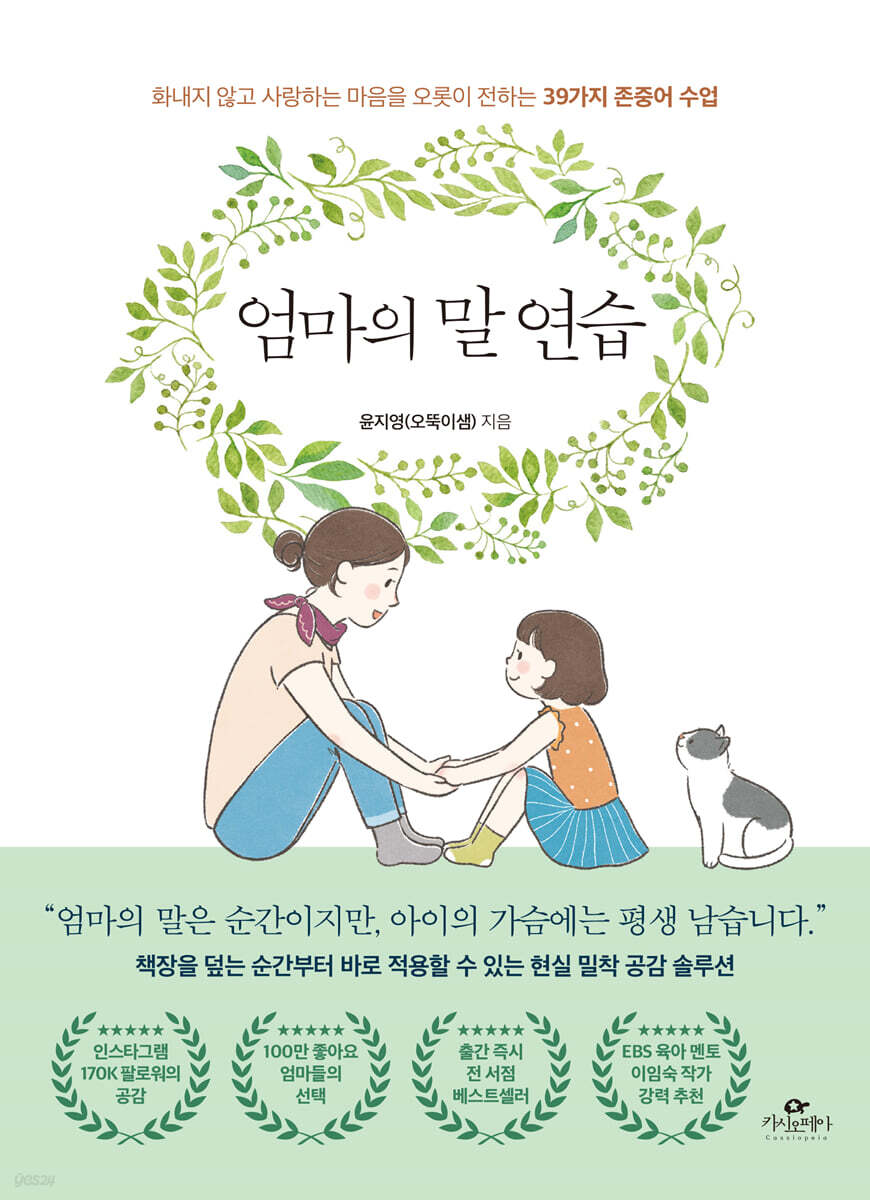
Mom's speech practice
 |
Description
Book Introduction
- A word from MD
-
Words that will remain in a child's heart for a lifetimeA book for parents who unknowingly say things they don't mean and then regret it.
It contains 39 expressions that respect, acknowledge, and affirm a child's personality.
Let's read along with the parenting experience of a mother who has been an elementary school teacher for 17 years and practice conversation methods that can respect our children.
September 27, 2022. Shin Eun-ji, PD of Home Life
“A mother’s words last for a moment, but they remain in a child’s heart for a lifetime.”
170K Instagram followers, 1 million likes, moms' choice
"Elementary Self-Esteem Class" by author Jiyoung Yoon, a mother's prescription
When asked what is the most precious thing in the world, people say 'love'.
If you ask what is the most noble of them all, you will say 'parents' love for their children'.
Because a parent's love for their child is unconditional, unrestricted, and has no expiration date.
That's not wrong.
However, the reality for mothers raising children is a little different.
He's a kid you wouldn't mind putting in your eye, but when you set the table for him, he knocks over everything, when you take off his clothes, he throws them all over the place, and when you try to invite friends over, he fights over his toys.
They make up all kinds of excuses because they don't want to do their homework, and if you send them to expensive academies, they say they don't want to go.
To such a child, a mother often spits out angry words rather than whispering words of love.
"I told you not to do that! Are you really not going to listen? Get out! Get out and live as you please!"
The child quickly becomes discouraged by his mother's words.
And Mom falls into regret.
I didn't mean to hurt you... ... .
The new book, "Mom's Speech Practice," by Jiyoung Yoon, author of the best-selling "Elementary Self-Esteem Class," is a book for mothers who unknowingly say things they don't mean and then regret it.
Author Jiyoung Yoon, an elementary school teacher and mother of two, has researched and analyzed what words hurt children and what “words of respect” help build children’s self-esteem, based on her own trial and error experiences while raising children, and compiled them into a book.
In particular, this book contains solutions and various examples to correct bad speaking habits, so even those who are not good at speaking can naturally learn to speak respectfully by reading along.
Children feel love and learn how to live in the world through their parents' words.
Let's reflect on whether we said anything hurtful to our beloved child today.
And let's learn how to convey sincerity by reading "Mom's Word Practice."
This book will be of great help in raising children who are strong and have high self-esteem.
170K Instagram followers, 1 million likes, moms' choice
"Elementary Self-Esteem Class" by author Jiyoung Yoon, a mother's prescription
When asked what is the most precious thing in the world, people say 'love'.
If you ask what is the most noble of them all, you will say 'parents' love for their children'.
Because a parent's love for their child is unconditional, unrestricted, and has no expiration date.
That's not wrong.
However, the reality for mothers raising children is a little different.
He's a kid you wouldn't mind putting in your eye, but when you set the table for him, he knocks over everything, when you take off his clothes, he throws them all over the place, and when you try to invite friends over, he fights over his toys.
They make up all kinds of excuses because they don't want to do their homework, and if you send them to expensive academies, they say they don't want to go.
To such a child, a mother often spits out angry words rather than whispering words of love.
"I told you not to do that! Are you really not going to listen? Get out! Get out and live as you please!"
The child quickly becomes discouraged by his mother's words.
And Mom falls into regret.
I didn't mean to hurt you... ... .
The new book, "Mom's Speech Practice," by Jiyoung Yoon, author of the best-selling "Elementary Self-Esteem Class," is a book for mothers who unknowingly say things they don't mean and then regret it.
Author Jiyoung Yoon, an elementary school teacher and mother of two, has researched and analyzed what words hurt children and what “words of respect” help build children’s self-esteem, based on her own trial and error experiences while raising children, and compiled them into a book.
In particular, this book contains solutions and various examples to correct bad speaking habits, so even those who are not good at speaking can naturally learn to speak respectfully by reading along.
Children feel love and learn how to live in the world through their parents' words.
Let's reflect on whether we said anything hurtful to our beloved child today.
And let's learn how to convey sincerity by reading "Mom's Word Practice."
This book will be of great help in raising children who are strong and have high self-esteem.
- You can preview some of the book's contents.
Preview
index
As we talk about the prologue, I see children getting hurt.
[Theory] 3 Respectful Words to Make Your Child Smile
One step, words of recognition that lead to emotional connection
1-1.
What's hot? It's not hot at all! (Negative) → It's hot.
I'll cool it down more.
(I admit the feeling)
1-2.
Don't eat at night! (Forbidden) → Want to eat? How about eating it tomorrow afternoon? (Admit the desire)
1-3.
Don't cry! Stop crying! (oppression) → It's okay to cry.
(Emotional recognition)
1-4.
I'm not talking back! (snub) → I understand you're curious.
(I admit the thought)
Two Steps, Positive Words That Open Your Heart
2-1.
Why are you so moody? (Judgment) → Have you changed your mind? (Positive understanding)
2-2.
If you do this, you'll become a loser! (Threat) → It gets easier as you keep doing it.
(solace)
2-3.
Are you leaving your socks anywhere again? (Interrogation) → It's because I'm not used to it.
(positive interpretation)
2-4.
Always, always like this! (amplification) → From now on, do it like this.
(request)
2-5.
Erase and rewrite! (Pointing) → You finished your homework.
awesome.
(encouragement)
Three Steps, Affectionate Words That Fully Convey Love
3-1.
Say 'I was wrong'! (Instruction) → If you know you did something wrong, hug Mom.
(proposal)
3-2.
Don't make Dad angry! (Forbidden) → In times like this, please wait a moment.
(request)
3-3.
If you're done eating, clean up! (Command) → Could you bring me the number of dishes? (Request)
3-4.
Would you feel good or bad? (interrogation) → How do you think you would feel? (question)
3-5.
What do you want me to do? There's no way! (annoyed) → There are things even moms can't solve.
(explanation)
[Practical] 5 Speech Practices to Change Your Child's Habits
One Step, Practice Daily Life Speech
1-1.
Instead of urging a child who is having a hard time getting to school to “get dressed quickly!”
1-2.
Instead of scolding a slow-moving child by saying, “Why are you so slow?”
1-3.
Instead of warning a child who has difficulty eating, “Don’t spill anything and eat!”
1-4.
Instead of suppressing a child who frequently fights by saying, “Stop fighting! Stop talking!”
1-5.
Instead of saying insincere words like “You live in the playground!” to a child who doesn’t listen to his mother,
1-6.
Instead of telling a child who won't sleep, "Go to sleep!"
Two Steps, Character Education Speaking Practice
2-1.
Instead of criticizing a child who doesn't yield by saying, "Why are you so selfish?"
2-2.
Instead of telling a child who doesn't say hello, "You need to say hello more politely!"
2-3.
Instead of scolding a child who often loses things by saying, “How many times is this?”
2-4.
Instead of giving a child who is causing trouble a vague prohibition like “Don’t hurt others!”
2-5.
Instead of giving a command to a child who is not following the rules, “Get down! I’ll wait behind you!”
2-6.
Instead of urging a child who doesn't apologize, "Apologize quickly! Make up!"
Three Steps, Practice Your Study Habits
3-1.
Instead of feeling guilty and asking your child, “Are you studying for Mom?” because you have a lot of homework,
3-2.
Instead of comparing a child who says studying is difficult by saying, “You’re not the only one having a hard time!”
3-3.
Instead of criticizing a child who wants to play first by asking, “Why don’t you keep your promise?”
3-4.
Instead of forcing a child who refuses to go to school by saying, “Even if you don’t like it, you have to do it for 6 months!”
Four Steps, Relationship Building Practice
4-1.
Instead of empathizing with a child who has been cut off and saying, “Don’t play with him either!”
4-2.
Instead of threatening a child who is being rude to his friend with, “If you keep doing this, you’ll end up being bullied!”
4-3.
Instead of intervening by asking a child who is being ignored by his friends, “What is his name?”
4-4.
Instead of blaming a child who feels lonely among friends by saying, “It’s all Mom’s fault…”
4-5.
Instead of saying disparagingly, “What’s wrong with him?” to a child who wasn’t invited to a birthday party,
Five Steps, Practice Your Communication Skills
5-1.
Instead of saying something sharp like, “You can’t say anything else like that!” to a child who hurts his mother,
5-2.
Instead of saying something embarrassing like “Don’t you understand what I’m saying?” to a child who is acting without thinking,
5-3 Instead of prohibiting a child who blindly imitates new words by saying, “You shouldn’t say things like that!”
5-4.
“I hate the sight of a child who is always on his phone all day.”
Instead of the anger of “Get out!”
Epilogue Holding my beloved child tightly in my arms
Appendix: Three Words of Respect at a Glance
[Theory] 3 Respectful Words to Make Your Child Smile
One step, words of recognition that lead to emotional connection
1-1.
What's hot? It's not hot at all! (Negative) → It's hot.
I'll cool it down more.
(I admit the feeling)
1-2.
Don't eat at night! (Forbidden) → Want to eat? How about eating it tomorrow afternoon? (Admit the desire)
1-3.
Don't cry! Stop crying! (oppression) → It's okay to cry.
(Emotional recognition)
1-4.
I'm not talking back! (snub) → I understand you're curious.
(I admit the thought)
Two Steps, Positive Words That Open Your Heart
2-1.
Why are you so moody? (Judgment) → Have you changed your mind? (Positive understanding)
2-2.
If you do this, you'll become a loser! (Threat) → It gets easier as you keep doing it.
(solace)
2-3.
Are you leaving your socks anywhere again? (Interrogation) → It's because I'm not used to it.
(positive interpretation)
2-4.
Always, always like this! (amplification) → From now on, do it like this.
(request)
2-5.
Erase and rewrite! (Pointing) → You finished your homework.
awesome.
(encouragement)
Three Steps, Affectionate Words That Fully Convey Love
3-1.
Say 'I was wrong'! (Instruction) → If you know you did something wrong, hug Mom.
(proposal)
3-2.
Don't make Dad angry! (Forbidden) → In times like this, please wait a moment.
(request)
3-3.
If you're done eating, clean up! (Command) → Could you bring me the number of dishes? (Request)
3-4.
Would you feel good or bad? (interrogation) → How do you think you would feel? (question)
3-5.
What do you want me to do? There's no way! (annoyed) → There are things even moms can't solve.
(explanation)
[Practical] 5 Speech Practices to Change Your Child's Habits
One Step, Practice Daily Life Speech
1-1.
Instead of urging a child who is having a hard time getting to school to “get dressed quickly!”
1-2.
Instead of scolding a slow-moving child by saying, “Why are you so slow?”
1-3.
Instead of warning a child who has difficulty eating, “Don’t spill anything and eat!”
1-4.
Instead of suppressing a child who frequently fights by saying, “Stop fighting! Stop talking!”
1-5.
Instead of saying insincere words like “You live in the playground!” to a child who doesn’t listen to his mother,
1-6.
Instead of telling a child who won't sleep, "Go to sleep!"
Two Steps, Character Education Speaking Practice
2-1.
Instead of criticizing a child who doesn't yield by saying, "Why are you so selfish?"
2-2.
Instead of telling a child who doesn't say hello, "You need to say hello more politely!"
2-3.
Instead of scolding a child who often loses things by saying, “How many times is this?”
2-4.
Instead of giving a child who is causing trouble a vague prohibition like “Don’t hurt others!”
2-5.
Instead of giving a command to a child who is not following the rules, “Get down! I’ll wait behind you!”
2-6.
Instead of urging a child who doesn't apologize, "Apologize quickly! Make up!"
Three Steps, Practice Your Study Habits
3-1.
Instead of feeling guilty and asking your child, “Are you studying for Mom?” because you have a lot of homework,
3-2.
Instead of comparing a child who says studying is difficult by saying, “You’re not the only one having a hard time!”
3-3.
Instead of criticizing a child who wants to play first by asking, “Why don’t you keep your promise?”
3-4.
Instead of forcing a child who refuses to go to school by saying, “Even if you don’t like it, you have to do it for 6 months!”
Four Steps, Relationship Building Practice
4-1.
Instead of empathizing with a child who has been cut off and saying, “Don’t play with him either!”
4-2.
Instead of threatening a child who is being rude to his friend with, “If you keep doing this, you’ll end up being bullied!”
4-3.
Instead of intervening by asking a child who is being ignored by his friends, “What is his name?”
4-4.
Instead of blaming a child who feels lonely among friends by saying, “It’s all Mom’s fault…”
4-5.
Instead of saying disparagingly, “What’s wrong with him?” to a child who wasn’t invited to a birthday party,
Five Steps, Practice Your Communication Skills
5-1.
Instead of saying something sharp like, “You can’t say anything else like that!” to a child who hurts his mother,
5-2.
Instead of saying something embarrassing like “Don’t you understand what I’m saying?” to a child who is acting without thinking,
5-3 Instead of prohibiting a child who blindly imitates new words by saying, “You shouldn’t say things like that!”
5-4.
“I hate the sight of a child who is always on his phone all day.”
Instead of the anger of “Get out!”
Epilogue Holding my beloved child tightly in my arms
Appendix: Three Words of Respect at a Glance
Detailed image

Into the book
Looking back on my speaking habits, I realized that my language warehouse was filled with instructions, confirmations, prohibitions, and commands.
I also realized that I was repeating to my child the same things that had hurt me as a child.
I thought, "Oh no."
I was worried about how I could convey my feelings to my child without repeating the same mistakes.
There was no right answer, but there were definitely words that expressed the feelings a little more gently and prettily.
Most of the words I found like that, like a treasure hunt, were words of acceptance, positive words, and affectionate words.
It was something I hadn't heard but wanted to hear, something I wanted to say to my child but couldn't.
Those words were 'language of respect' that respected the child and made the child feel respected.
---p.9 From “Prologue: Looking at children who get hurt the more we talk”
If you scare them by saying they will be bullied, stupid, or a pig, their behavior may improve in the short term.
But the effect is temporary.
Just scaring a child doesn't clearly explain why they shouldn't do that behavior.
It's okay to be scared once or twice, but if a child is continuously exposed to threatening words, he or she may start to ignore what his or her parents say.
Conversely, you may feel unnecessary fear and dread over trivial things.
Children learn about the world through their parents.
Depending on what our parents show us and what they say, we may view the world positively or with fear and anxiety.
This is why we need positive words from our parents.
Parents' positive words will build up within the child and become a solid foundation that will support the child throughout his or her life.
---p.55~56 From "Two Steps in Theory, Positive Words that Open Your Heart"
When communication between parents and children is not smooth, and when children do not listen to their parents, a double bind message often appears.
A child who receives contradictory messages is very confused.
I'm anxious because I can't decide what to do.
If you said something you didn't mean in a fit of anger, you need to go through the process of conveying your true feelings once again.
You can't take back what's been said, but you can take back what's been said.
If you explain that you didn't mean it, the child will understand and feel relieved.
Only then will the child come out of his confusion and run to grab his mom and dad's hands.
---p.127~128 From "One Step at a Time, Practical Speaking Practice for Everyday Life"
There are things you have to do even if you don't like them, and life is not about doing only what you want to do.
The world doesn't wait as kindly as mom and dad, nor does it understand our mistakes.
Living in this world that is not easy like this, there are many times when I get tired and want to give up.
Yet, when we listen to the stories of those who stand up again, challenge themselves, and move forward, we see that behind them are parents who support them reliably.
I have had experiences where my parents respected and understood me by asking for my opinion, waiting for me, and working together to find solutions.
If you want to raise a child who is strong-willed and perseveres through difficult times and steadily follows his or her own path, please remember this.
That a child's strength to get back on his feet comes from respect.
And that respect is an emotional foundation that can never be achieved through coercion, threats, obligations, or taking things for granted.
---p.185~186 From "Three Steps to Practical Study, Study Habits and Speaking Practice"
Few people speak consciously.
Most people do it out of habit.
And to change the direction of the inertia called habit, constant practice is required.
As I was writing this book, I had only one thing in mind.
'I hope this book will be of some help to readers in developing good speaking habits.'
I hope that through books, we can reflect on and improve the words that we have made familiar to our children in our daily lives and the words that come out naturally.
I hope that we can take one step closer to our children with words of recognition, two steps closer with words of affirmation, and three steps closer with words of affection.
I also realized that I was repeating to my child the same things that had hurt me as a child.
I thought, "Oh no."
I was worried about how I could convey my feelings to my child without repeating the same mistakes.
There was no right answer, but there were definitely words that expressed the feelings a little more gently and prettily.
Most of the words I found like that, like a treasure hunt, were words of acceptance, positive words, and affectionate words.
It was something I hadn't heard but wanted to hear, something I wanted to say to my child but couldn't.
Those words were 'language of respect' that respected the child and made the child feel respected.
---p.9 From “Prologue: Looking at children who get hurt the more we talk”
If you scare them by saying they will be bullied, stupid, or a pig, their behavior may improve in the short term.
But the effect is temporary.
Just scaring a child doesn't clearly explain why they shouldn't do that behavior.
It's okay to be scared once or twice, but if a child is continuously exposed to threatening words, he or she may start to ignore what his or her parents say.
Conversely, you may feel unnecessary fear and dread over trivial things.
Children learn about the world through their parents.
Depending on what our parents show us and what they say, we may view the world positively or with fear and anxiety.
This is why we need positive words from our parents.
Parents' positive words will build up within the child and become a solid foundation that will support the child throughout his or her life.
---p.55~56 From "Two Steps in Theory, Positive Words that Open Your Heart"
When communication between parents and children is not smooth, and when children do not listen to their parents, a double bind message often appears.
A child who receives contradictory messages is very confused.
I'm anxious because I can't decide what to do.
If you said something you didn't mean in a fit of anger, you need to go through the process of conveying your true feelings once again.
You can't take back what's been said, but you can take back what's been said.
If you explain that you didn't mean it, the child will understand and feel relieved.
Only then will the child come out of his confusion and run to grab his mom and dad's hands.
---p.127~128 From "One Step at a Time, Practical Speaking Practice for Everyday Life"
There are things you have to do even if you don't like them, and life is not about doing only what you want to do.
The world doesn't wait as kindly as mom and dad, nor does it understand our mistakes.
Living in this world that is not easy like this, there are many times when I get tired and want to give up.
Yet, when we listen to the stories of those who stand up again, challenge themselves, and move forward, we see that behind them are parents who support them reliably.
I have had experiences where my parents respected and understood me by asking for my opinion, waiting for me, and working together to find solutions.
If you want to raise a child who is strong-willed and perseveres through difficult times and steadily follows his or her own path, please remember this.
That a child's strength to get back on his feet comes from respect.
And that respect is an emotional foundation that can never be achieved through coercion, threats, obligations, or taking things for granted.
---p.185~186 From "Three Steps to Practical Study, Study Habits and Speaking Practice"
Few people speak consciously.
Most people do it out of habit.
And to change the direction of the inertia called habit, constant practice is required.
As I was writing this book, I had only one thing in mind.
'I hope this book will be of some help to readers in developing good speaking habits.'
I hope that through books, we can reflect on and improve the words that we have made familiar to our children in our daily lives and the words that come out naturally.
I hope that we can take one step closer to our children with words of recognition, two steps closer with words of affirmation, and three steps closer with words of affection.
---p.236 From "Epilogue: Holding the Beloved Child Tightly in My Arms"
Publisher's Review
“A child is hurt by the words of his beloved mother!”
39 Mom's Speech Practices for Raising Smiling, Cheerful, and Self-Esteem-Having Children
To every parent, a child is the most lovable being in the world.
The way you eat is pretty, the way you sleep is pretty, and even the way you do your business is pretty.
Our children are the most precious beings in the world.
But are we really speaking to our children with such kindness and affection? Are we perhaps using harsh or sarcastic language to sap their self-esteem?
To a child, parents are a huge world and a strong tree that they can trust and rely on.
Learn about the world by running, resting, and studying to your heart's content under the tree.
But what if that tree spews harsh words, frightens, annoys, and makes us watch our step? Will our beloved child truly feel that love?
A mother's words are the first tool to convey love to her child.
It is the best tool to convey your feelings without distortion, even without light, no matter how far away, or without money.
Let's think back.
Whether the tool has become a weapon that can injure the child.
“Nothing is more important than a mother’s words when it comes to conveying her love.”
Ottuk-i-sam's mom's prescription that touched the hearts of 170,000 Instagram followers.
One day, Ottuk-sam, a mother of two and a veteran elementary school teacher, realized that not all love and concern for children translates into words of love.
I brought this up because I clearly hoped things would work out, but seeing the children getting hurt and discouraged made me realize that something was wrong.
So I wrote down what I say to my children directly.
"Do it quickly." (Instruction)
“Did you do your homework?” (check)
“Stop crying.” (Forbidden)
“Put things back where they belong.” (Command)
I didn't realize it when I was talking, but when I actually wrote it down, I realized that Ottuk's language warehouse was filled with instructions, confirmations, prohibitions, and orders.
Even as an adult, I realized that I was saying the same things that had hurt me when I heard them as a child.
From then on, Ottuk-i-sam began to look for words that could express his feelings more gently and beautifully.
The words of respect (words of recognition, positive words, and kind words) that were discovered in this way began to be widely shared through social media, and after requests from 170,000 Instagram followers, this book was published.
“Just by changing the way a mother speaks, her child’s life can change!”
Mom's Talk Practice STEP 5: Present the situation → Analyze → Solution → Empathize → Change
From disconnection to communication, "Words of Respect" heal wounds and awaken the joy of consideration.
There is no parent who speaks perfectly to their child without making any mistakes.
And most of the words that hurt children are unconscious errors.
Most parents repeat the same mistake.
This book was written to objectively examine the incorrect speaking habits we unconsciously use and to suggest ways to improve them.
The greatest strength of this book is that it realistically presents the conversations that mothers, fathers, and children have in real life, and clearly identifies the problems hidden within them.
It explains common mistakes that occur at the dinner table, on the playground, and at school, and suggests solutions to them, leading to practical change for parents.
The warm and emotional illustrations inserted here and there are enough to stimulate mom and dad's will to change.
Specifically, in the [Theory section], we will examine the types and functions of words of recognition that allow for emotional connection with children, positive words that open children's hearts, and affectionate words that fully convey mom and dad's love.
[Practical Edition] covers daily life, character education, and study habits.
Take time to practice using respectful language that can be used in real-life situations, such as building relationships and communicating.
A child grows up eating the love of his mother and father.
And love is conveyed to the child through words.
When that love takes root within a child, they can grow into children with high self-esteem who laugh easily, are cheerful, creative, and considerate of others.
We are not late either.
How about becoming a mother or father who knows how to fully convey love to their children, starting now?
39 Mom's Speech Practices for Raising Smiling, Cheerful, and Self-Esteem-Having Children
To every parent, a child is the most lovable being in the world.
The way you eat is pretty, the way you sleep is pretty, and even the way you do your business is pretty.
Our children are the most precious beings in the world.
But are we really speaking to our children with such kindness and affection? Are we perhaps using harsh or sarcastic language to sap their self-esteem?
To a child, parents are a huge world and a strong tree that they can trust and rely on.
Learn about the world by running, resting, and studying to your heart's content under the tree.
But what if that tree spews harsh words, frightens, annoys, and makes us watch our step? Will our beloved child truly feel that love?
A mother's words are the first tool to convey love to her child.
It is the best tool to convey your feelings without distortion, even without light, no matter how far away, or without money.
Let's think back.
Whether the tool has become a weapon that can injure the child.
“Nothing is more important than a mother’s words when it comes to conveying her love.”
Ottuk-i-sam's mom's prescription that touched the hearts of 170,000 Instagram followers.
One day, Ottuk-sam, a mother of two and a veteran elementary school teacher, realized that not all love and concern for children translates into words of love.
I brought this up because I clearly hoped things would work out, but seeing the children getting hurt and discouraged made me realize that something was wrong.
So I wrote down what I say to my children directly.
"Do it quickly." (Instruction)
“Did you do your homework?” (check)
“Stop crying.” (Forbidden)
“Put things back where they belong.” (Command)
I didn't realize it when I was talking, but when I actually wrote it down, I realized that Ottuk's language warehouse was filled with instructions, confirmations, prohibitions, and orders.
Even as an adult, I realized that I was saying the same things that had hurt me when I heard them as a child.
From then on, Ottuk-i-sam began to look for words that could express his feelings more gently and beautifully.
The words of respect (words of recognition, positive words, and kind words) that were discovered in this way began to be widely shared through social media, and after requests from 170,000 Instagram followers, this book was published.
“Just by changing the way a mother speaks, her child’s life can change!”
Mom's Talk Practice STEP 5: Present the situation → Analyze → Solution → Empathize → Change
From disconnection to communication, "Words of Respect" heal wounds and awaken the joy of consideration.
There is no parent who speaks perfectly to their child without making any mistakes.
And most of the words that hurt children are unconscious errors.
Most parents repeat the same mistake.
This book was written to objectively examine the incorrect speaking habits we unconsciously use and to suggest ways to improve them.
The greatest strength of this book is that it realistically presents the conversations that mothers, fathers, and children have in real life, and clearly identifies the problems hidden within them.
It explains common mistakes that occur at the dinner table, on the playground, and at school, and suggests solutions to them, leading to practical change for parents.
The warm and emotional illustrations inserted here and there are enough to stimulate mom and dad's will to change.
Specifically, in the [Theory section], we will examine the types and functions of words of recognition that allow for emotional connection with children, positive words that open children's hearts, and affectionate words that fully convey mom and dad's love.
[Practical Edition] covers daily life, character education, and study habits.
Take time to practice using respectful language that can be used in real-life situations, such as building relationships and communicating.
A child grows up eating the love of his mother and father.
And love is conveyed to the child through words.
When that love takes root within a child, they can grow into children with high self-esteem who laugh easily, are cheerful, creative, and considerate of others.
We are not late either.
How about becoming a mother or father who knows how to fully convey love to their children, starting now?
GOODS SPECIFICS
- Publication date: September 22, 2022
- Page count, weight, size: 242 pages | 324g | 145*200*15mm
- ISBN13: 9791168270749
- ISBN10: 116827074X
You may also like
카테고리
korean


korean

![ELLE 엘르 스페셜 에디션 A형 : 12월 [2025]](http://librairie.coreenne.fr/cdn/shop/files/b8e27a3de6c9538896439686c6b0e8fb.jpg?v=1766436872&width=3840)


