

Literacy Kindergarten
 |
Description
Book Introduction
EBS Hot Topic Program
Joint project with Seoul National University's Child Language Cognition Lab
“Develop literacy skills through play, making it easy and fun for children from infants to early elementary school students.”
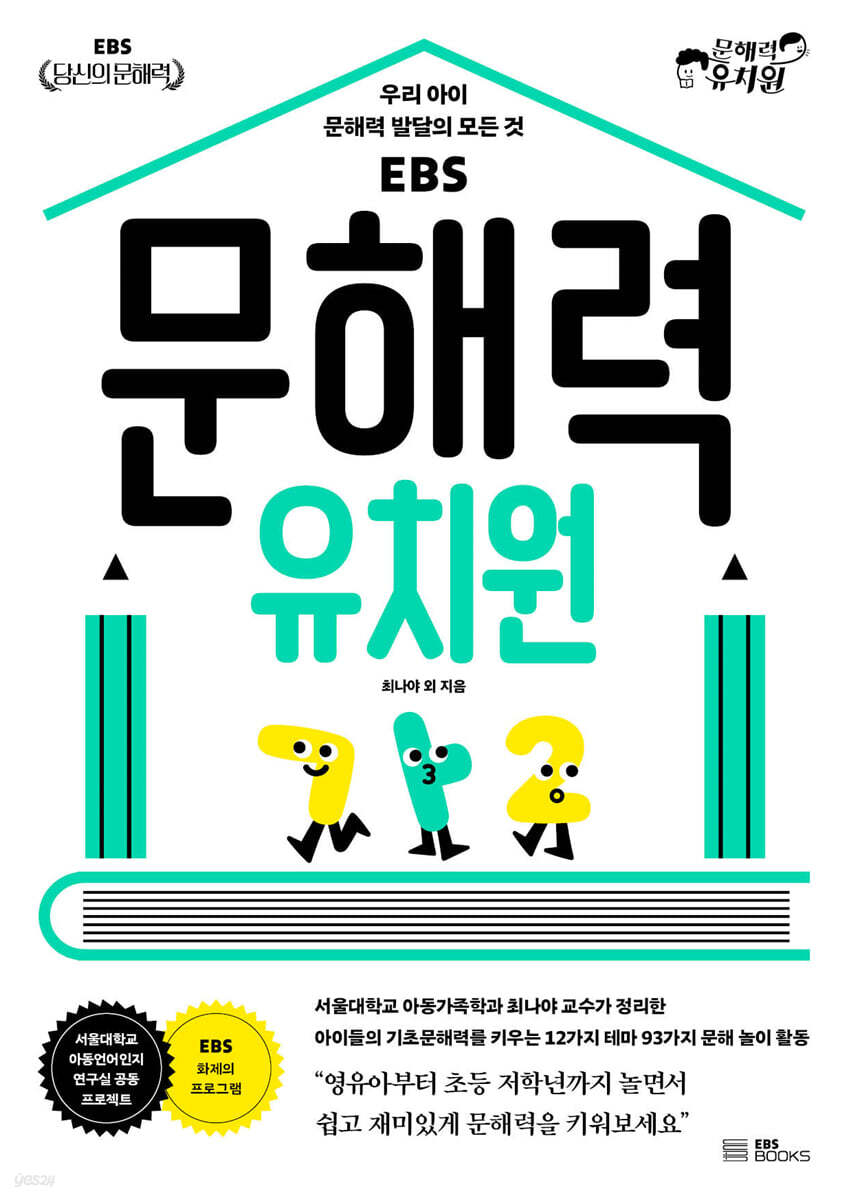
『Literacy Kindergarten』, a basic literacy development program developed and organized by Professor Na-ya Choi of EBS's 『Literacy Kindergarten』 and the Seoul National University Child Language Cognition Lab, contains everything about children's literacy learning.
It helps children and parents take the first step toward developing their thinking and study skills through 12 themes that allow them to read, write, think, create stories, and develop their thinking muscles together, and 93 literacy activities that increase their understanding of letters and writing and develop their reading and writing skills.
From toddlers who don't know how to read to those who are just beginning to learn Korean, this book contains learning methods that allow children to have fun and actively participate in literacy activities for each situation.
Based on the latest academic papers and research results from domestic and international academic circles on literacy, early childhood education, and media literacy, it presents standards for literacy learning.
Joint project with Seoul National University's Child Language Cognition Lab
“Develop literacy skills through play, making it easy and fun for children from infants to early elementary school students.”
『Literacy Kindergarten』, a basic literacy development program developed and organized by Professor Na-ya Choi of EBS's 『Literacy Kindergarten』 and the Seoul National University Child Language Cognition Lab, contains everything about children's literacy learning.
It helps children and parents take the first step toward developing their thinking and study skills through 12 themes that allow them to read, write, think, create stories, and develop their thinking muscles together, and 93 literacy activities that increase their understanding of letters and writing and develop their reading and writing skills.
From toddlers who don't know how to read to those who are just beginning to learn Korean, this book contains learning methods that allow children to have fun and actively participate in literacy activities for each situation.
Based on the latest academic papers and research results from domestic and international academic circles on literacy, early childhood education, and media literacy, it presents standards for literacy learning.
- You can preview some of the book's contents.
Preview
index
introduction
1.
Basic literacy skills for young children
The Seeds, Roots, and Sprouts of Literacy
Expressive Literacy vs. Conventional Literacy
Six Key Elements of Early Childhood Literacy
A balanced literacy approach
2.
Name: Start with your name
The Dangers of Conventional Literacy Instruction
My name, a subject for reading and writing
How do I write my name on a map?
Literacy Activities
1. Create a new name with your parents' names
2. Come up with a funny nickname
3. Write your name with your butt
4 My Delicious Name
5. Write your name with rainbow salt
6. Create a Secret Name Tag
7 Write your name on the ziplock bag
8 Playcones, draw names with flour
9 My precious name
10 Fruit Name Bingo Game
11. Create a graph of our family names
Parents reading picture books together.
Reading the cover and insert of a picture book
3.
Digital Media: Literacy on the Screen
Is the media a boon or a bane for literacy?
Digital Media Usage Status
Problems with digital media use
Essential Media Usage Rules
Cultivating Media Literacy
Literacy Activities
1 How much do you use digital devices?
2 Media Use Rules Meeting
3 Change e-books as you like
4. Electronic pen is a thinking pencil
5 The story I'm telling
6. Adding picture text to e-books
7 E-books we make
Parents reading picture books together.
Using e-books
4.
Environmental Printing: The Whole World is Letters
Are study guides the best option?
Why Environmental Prints Make Great Literacy Tools
How to teach literacy using environmentally friendly materials?
Literacy Activities
1. Find the sign by taking a picture walk
2 Speed Card Game
3 My Favorite Candy Names Wall
4. Create an environmental print photo album
5 Hunting for the letters on our neighborhood signboard
6 Write down the names of the foods you are buying
7. Making a sign for our house
Parents reading picture books together.
Picture walk
5.
Wordless Picture Books: You Can Read the Pictures Too
Why does my child hate reading?
What is a 'wordless picture book'?
The Effects of Wordless Picture Books
How to use wordless picture books?
Literacy Activities
1 Picture books to read with your body
2 Write the sound in the picture
3 List the story order
4 Splash Splash Boots Song
5 Creating My Story
6 The ending we draw
7 The story I create
8. Drawing a Water Drop Mind Map
Parents reading picture books together.
The story I create
6.
Playground: Letters Encountered Outside
Go outside to improve your literacy!
Benefits of Outdoor Literacy Activities
How to conduct outdoor literacy activities?
The Important Role of Fathers in Outdoor Literacy Activities
Literacy Activities
1 Consonants and Vowels of the Playground
2 Spray Letter Cleaning Game
3. Make letters with leaf sensory trays
4 Letters decorated with natural objects
5 Write and draw with water and paint
6. A collection book made from natural materials
7. Naming the Tree
Parents reading picture books together.
Reading picture books outside the home
7.
Gross Motor Skills: Writing with Your Body
Is physical activity the enemy of literacy?
The power of physical activity to sharpen your study skills
How can we use large muscle groups for literacy activities?
Literacy Activities
1. While dancing happily, transform into letters
2 Spider Web Maze Exploration
3 letter sports day
4 Guess the word written with buttocks
5. Alphabet Card Race
Letter Matching Game with 6 Block Run
7. Climb up to the big letters and make a squeaking sound
Parents reading picture books together.
Reading picture books with your body
8.
Grocery Shopping: The Mart is Full of Words
Why Vocabulary is Important in Early Childhood
Parental Interactions That Build Vocabulary in Toddlers
Mart, a learning space filled with vocabulary
How can we interact to develop vocabulary in toddlers?
Literacy Activities
1 Food Name Stepping Stones
2 Writing and drawing with chocolate
3 Market Play
4 My grocery shopping list
5 Go to the mart and do some shopping
Word detective appears in 6 Mart
7 Organizing Our Refrigerator
Parents reading picture books together.
Developing vocabulary by reading picture books
9.
Cooking: Delicious Literacy
Cooking and Early Childhood Development
Where cooking and literacy meet
How can we promote literacy through cooking?
Literacy Activities
1 Picture Book Riddle
Cooking with 2 letter blocks
3. How to Make Cookie Bibimbap
4. Writing with vegetable juice
5. Stamp the vegetable letters
6 Sweet and Sour Fruit Dishes
7 I love you, Chef Onigiri
Recommended post-reading activities using picture books
Parents reading picture books together.
Picture Book Post-Reading Activity 1: Cooking-Based Post-Reading Activity
10.
Toys: Fingers are Magicians
Why fine motor development is important in infancy
Development of fine motor skills and pencil holding
How can we help develop fine motor skills?
How to teach pencil holding?
Literacy Activities
Building a model with 1 block
Drawing with 2 letter blocks
3. Guess the letters in the box
4 letter alkkagi
5. Frog Race
6 Ping Pong Ball Hangul Game
7 Tape Spider Web Play
8. Create letters with fingerprints
9 Letters reflected in the mirror
Developing fine motor skills in everyday life
Parents reading picture books together.
Picture Book Post-Reading Activity 2: Reading and Playing
11.
Library: The library is a playground
A magical space to develop literacy
Enjoying the library with your child
Let's play library at home
Literacy Activities
1. Telling a secret story
2 Author Signing Event Play
3 Our children's librarian
4 List of my favorite picture books
5 Story Trains Made in Sequence
6 The little book I make
7 Borrowing and returning books from the library
Parents reading picture books together.
Various genres of picture books
12.
Alphabet Book: The Hidden Secrets of Hangul
Will I be able to read well if I learn Korean?
What matters is the sound value of the letters
The effects of reading mother's books
Using a mother's book
Literacy Activities
1. Reading a picture book while singing a song
2 Train play with word blocks and models
3 Train game with memo pads
4 The dictionary we create
5 Colored Paper Letters
6 Discover the secrets of Hangul
7. Making the "Our Family GND Book"
8 Letters, Sounds and Games
9 My Name Sound Game
Parents reading picture books together.
How to use the mother's book
13.
Restaurant: Menu when you're hungry
Experience is the best textbook
Script context for developing literacy, restaurant
Building Literacy Through Restaurants
Literacy Activities
1. "Worried Restaurant": Creating a Restaurant Menu
2 The cake I decorate
3 Decorating our dinner table
4 Restaurant Play
5 Introducing my food
6. Create an invitation
7 Go to a restaurant and order
Parents reading picture books together.
Reading minds through picture books
References
Appendix 1.
Alphabet sound value card
Appendix 2.
Symbol Recognition Card
1.
Basic literacy skills for young children
The Seeds, Roots, and Sprouts of Literacy
Expressive Literacy vs. Conventional Literacy
Six Key Elements of Early Childhood Literacy
A balanced literacy approach
2.
Name: Start with your name
The Dangers of Conventional Literacy Instruction
My name, a subject for reading and writing
How do I write my name on a map?
Literacy Activities
1. Create a new name with your parents' names
2. Come up with a funny nickname
3. Write your name with your butt
4 My Delicious Name
5. Write your name with rainbow salt
6. Create a Secret Name Tag
7 Write your name on the ziplock bag
8 Playcones, draw names with flour
9 My precious name
10 Fruit Name Bingo Game
11. Create a graph of our family names
Parents reading picture books together.
Reading the cover and insert of a picture book
3.
Digital Media: Literacy on the Screen
Is the media a boon or a bane for literacy?
Digital Media Usage Status
Problems with digital media use
Essential Media Usage Rules
Cultivating Media Literacy
Literacy Activities
1 How much do you use digital devices?
2 Media Use Rules Meeting
3 Change e-books as you like
4. Electronic pen is a thinking pencil
5 The story I'm telling
6. Adding picture text to e-books
7 E-books we make
Parents reading picture books together.
Using e-books
4.
Environmental Printing: The Whole World is Letters
Are study guides the best option?
Why Environmental Prints Make Great Literacy Tools
How to teach literacy using environmentally friendly materials?
Literacy Activities
1. Find the sign by taking a picture walk
2 Speed Card Game
3 My Favorite Candy Names Wall
4. Create an environmental print photo album
5 Hunting for the letters on our neighborhood signboard
6 Write down the names of the foods you are buying
7. Making a sign for our house
Parents reading picture books together.
Picture walk
5.
Wordless Picture Books: You Can Read the Pictures Too
Why does my child hate reading?
What is a 'wordless picture book'?
The Effects of Wordless Picture Books
How to use wordless picture books?
Literacy Activities
1 Picture books to read with your body
2 Write the sound in the picture
3 List the story order
4 Splash Splash Boots Song
5 Creating My Story
6 The ending we draw
7 The story I create
8. Drawing a Water Drop Mind Map
Parents reading picture books together.
The story I create
6.
Playground: Letters Encountered Outside
Go outside to improve your literacy!
Benefits of Outdoor Literacy Activities
How to conduct outdoor literacy activities?
The Important Role of Fathers in Outdoor Literacy Activities
Literacy Activities
1 Consonants and Vowels of the Playground
2 Spray Letter Cleaning Game
3. Make letters with leaf sensory trays
4 Letters decorated with natural objects
5 Write and draw with water and paint
6. A collection book made from natural materials
7. Naming the Tree
Parents reading picture books together.
Reading picture books outside the home
7.
Gross Motor Skills: Writing with Your Body
Is physical activity the enemy of literacy?
The power of physical activity to sharpen your study skills
How can we use large muscle groups for literacy activities?
Literacy Activities
1. While dancing happily, transform into letters
2 Spider Web Maze Exploration
3 letter sports day
4 Guess the word written with buttocks
5. Alphabet Card Race
Letter Matching Game with 6 Block Run
7. Climb up to the big letters and make a squeaking sound
Parents reading picture books together.
Reading picture books with your body
8.
Grocery Shopping: The Mart is Full of Words
Why Vocabulary is Important in Early Childhood
Parental Interactions That Build Vocabulary in Toddlers
Mart, a learning space filled with vocabulary
How can we interact to develop vocabulary in toddlers?
Literacy Activities
1 Food Name Stepping Stones
2 Writing and drawing with chocolate
3 Market Play
4 My grocery shopping list
5 Go to the mart and do some shopping
Word detective appears in 6 Mart
7 Organizing Our Refrigerator
Parents reading picture books together.
Developing vocabulary by reading picture books
9.
Cooking: Delicious Literacy
Cooking and Early Childhood Development
Where cooking and literacy meet
How can we promote literacy through cooking?
Literacy Activities
1 Picture Book Riddle
Cooking with 2 letter blocks
3. How to Make Cookie Bibimbap
4. Writing with vegetable juice
5. Stamp the vegetable letters
6 Sweet and Sour Fruit Dishes
7 I love you, Chef Onigiri
Recommended post-reading activities using picture books
Parents reading picture books together.
Picture Book Post-Reading Activity 1: Cooking-Based Post-Reading Activity
10.
Toys: Fingers are Magicians
Why fine motor development is important in infancy
Development of fine motor skills and pencil holding
How can we help develop fine motor skills?
How to teach pencil holding?
Literacy Activities
Building a model with 1 block
Drawing with 2 letter blocks
3. Guess the letters in the box
4 letter alkkagi
5. Frog Race
6 Ping Pong Ball Hangul Game
7 Tape Spider Web Play
8. Create letters with fingerprints
9 Letters reflected in the mirror
Developing fine motor skills in everyday life
Parents reading picture books together.
Picture Book Post-Reading Activity 2: Reading and Playing
11.
Library: The library is a playground
A magical space to develop literacy
Enjoying the library with your child
Let's play library at home
Literacy Activities
1. Telling a secret story
2 Author Signing Event Play
3 Our children's librarian
4 List of my favorite picture books
5 Story Trains Made in Sequence
6 The little book I make
7 Borrowing and returning books from the library
Parents reading picture books together.
Various genres of picture books
12.
Alphabet Book: The Hidden Secrets of Hangul
Will I be able to read well if I learn Korean?
What matters is the sound value of the letters
The effects of reading mother's books
Using a mother's book
Literacy Activities
1. Reading a picture book while singing a song
2 Train play with word blocks and models
3 Train game with memo pads
4 The dictionary we create
5 Colored Paper Letters
6 Discover the secrets of Hangul
7. Making the "Our Family GND Book"
8 Letters, Sounds and Games
9 My Name Sound Game
Parents reading picture books together.
How to use the mother's book
13.
Restaurant: Menu when you're hungry
Experience is the best textbook
Script context for developing literacy, restaurant
Building Literacy Through Restaurants
Literacy Activities
1. "Worried Restaurant": Creating a Restaurant Menu
2 The cake I decorate
3 Decorating our dinner table
4 Restaurant Play
5 Introducing my food
6. Create an invitation
7 Go to a restaurant and order
Parents reading picture books together.
Reading minds through picture books
References
Appendix 1.
Alphabet sound value card
Appendix 2.
Symbol Recognition Card
Detailed image

Into the book
What is the right kind of parental support for a child's literacy development? Do adults, with decades of experience, really know the answer? We were all children once, but we don't remember our childhoods well.
I don't even remember how I learned Korean.
And parents, who have become accustomed to the adult perspective, find it difficult to interact with their children and teach them literacy.
So, we often get swayed by what people around us say and blindly follow along out of anxiety.
Moreover, under the pretext of doing it for the child, the child's mind and development are often put on the back burner.
In this book, we hope you will discover when, how, and what kind of help you can provide to develop your child's literacy skills.
---From the "Preface"
There has been much debate in academic circles about 'how' to introduce children to the world of letters.
It was a phenomenon that was sometimes referred to as the literacy war for decades.
This is because if we try to follow the guidance of adults by emphasizing the values of letters and sounds, the child will lose interest and it is not effective, and if we try to follow the child's interest by reading books and singing songs, the literacy ability will decline.
The literacy instruction approach that was born from these concerns is the 'balanced literacy approach.'
The idea is to not miss out on either the child's interests or literacy education.
By examining the process of developing a balanced literacy approach, we will learn what a balanced literacy approach is and how to put it into practice.
---「Chapter 1.
From “Basic Literacy for Young Children”
A fun game that uses your child's "name" as a subject is a great starting point for literacy instruction.
By using 'names', children can become familiar with letters in a fun way that suits their level.
Additionally, ‘writing through play’ becomes possible naturally.
Many scholars have emphasized the importance of name-writing activities in early childhood and have introduced them as effective activities that can be taught in early childhood education institutions. 8 For example, in kindergartens and daycare centers, one ‘name of the week’ is selected each week, and children look at the letters in their friends’ names together and think of words that start with each letter.
---「Chapter 2.
Name: From "Start with a name"
Since early childhood is a time to prepare for the ability to learn well later on, it is more important than anything else to build a brain that can learn well through regular physical activity and exercise.
Numerous studies have shown that physical activity improves cognitive function, and the neurobiological mechanisms that make this possible are continually being uncovered.
When people move, their heart rate increases, which in turn activates the brain by increasing the flow of oxygen and blood to the areas of the brain responsible for memory and learning. 4 Additionally, proteins called neurotrophins and neurotransmitters like dopamine, which are released during physical activity, improve the efficiency of neurological processes in the brain, enhancing cognitive function.
No matter how good the stimulation is given to a child, if the brain is not activated, the effect will be reduced.
---「Chapter 7.
From "Large Muscles: Writing with the Body"
Even if your child doesn't like books very much, participating in the library's reading program can help them like books.
there is.
It is said that children who did not like books gradually became closer to books as they participated in library programs.
Experiencing library programs at home has been shown to increase children's literacy behaviors and parent-child literacy interactions.
And after participating in the program, children's school readiness, print motivation and recognition, phonological awareness, vocabulary, and story comprehension also improved.
Parents also grow as they see librarians reading picture books to children or interacting with picture books in various ways through library programs.
---「Chapter 11.
Library: From "The Library is a Playground"
Young children, in particular, learn best in real, living contexts.
I wake up in the morning, greet my parents, wash, get dressed, get in the car, go to school, go about my day according to my schedule, and when it's mealtime, I say "I'll eat well" and eat after saying thank you. On weekends, I go out to meet my relatives and eat out.
These repetitive routines may not seem like much, but through these repetitive, everyday events, children learn the knowledge essential for navigating the world, and through this, they acquire literacy skills.
Because learning opportunities are always close to us.
I don't even remember how I learned Korean.
And parents, who have become accustomed to the adult perspective, find it difficult to interact with their children and teach them literacy.
So, we often get swayed by what people around us say and blindly follow along out of anxiety.
Moreover, under the pretext of doing it for the child, the child's mind and development are often put on the back burner.
In this book, we hope you will discover when, how, and what kind of help you can provide to develop your child's literacy skills.
---From the "Preface"
There has been much debate in academic circles about 'how' to introduce children to the world of letters.
It was a phenomenon that was sometimes referred to as the literacy war for decades.
This is because if we try to follow the guidance of adults by emphasizing the values of letters and sounds, the child will lose interest and it is not effective, and if we try to follow the child's interest by reading books and singing songs, the literacy ability will decline.
The literacy instruction approach that was born from these concerns is the 'balanced literacy approach.'
The idea is to not miss out on either the child's interests or literacy education.
By examining the process of developing a balanced literacy approach, we will learn what a balanced literacy approach is and how to put it into practice.
---「Chapter 1.
From “Basic Literacy for Young Children”
A fun game that uses your child's "name" as a subject is a great starting point for literacy instruction.
By using 'names', children can become familiar with letters in a fun way that suits their level.
Additionally, ‘writing through play’ becomes possible naturally.
Many scholars have emphasized the importance of name-writing activities in early childhood and have introduced them as effective activities that can be taught in early childhood education institutions. 8 For example, in kindergartens and daycare centers, one ‘name of the week’ is selected each week, and children look at the letters in their friends’ names together and think of words that start with each letter.
---「Chapter 2.
Name: From "Start with a name"
Since early childhood is a time to prepare for the ability to learn well later on, it is more important than anything else to build a brain that can learn well through regular physical activity and exercise.
Numerous studies have shown that physical activity improves cognitive function, and the neurobiological mechanisms that make this possible are continually being uncovered.
When people move, their heart rate increases, which in turn activates the brain by increasing the flow of oxygen and blood to the areas of the brain responsible for memory and learning. 4 Additionally, proteins called neurotrophins and neurotransmitters like dopamine, which are released during physical activity, improve the efficiency of neurological processes in the brain, enhancing cognitive function.
No matter how good the stimulation is given to a child, if the brain is not activated, the effect will be reduced.
---「Chapter 7.
From "Large Muscles: Writing with the Body"
Even if your child doesn't like books very much, participating in the library's reading program can help them like books.
there is.
It is said that children who did not like books gradually became closer to books as they participated in library programs.
Experiencing library programs at home has been shown to increase children's literacy behaviors and parent-child literacy interactions.
And after participating in the program, children's school readiness, print motivation and recognition, phonological awareness, vocabulary, and story comprehension also improved.
Parents also grow as they see librarians reading picture books to children or interacting with picture books in various ways through library programs.
---「Chapter 11.
Library: From "The Library is a Playground"
Young children, in particular, learn best in real, living contexts.
I wake up in the morning, greet my parents, wash, get dressed, get in the car, go to school, go about my day according to my schedule, and when it's mealtime, I say "I'll eat well" and eat after saying thank you. On weekends, I go out to meet my relatives and eat out.
These repetitive routines may not seem like much, but through these repetitive, everyday events, children learn the knowledge essential for navigating the world, and through this, they acquire literacy skills.
Because learning opportunities are always close to us.
---「Chapter 13.
Restaurant: From the menu when you're hungry
Restaurant: From the menu when you're hungry
Publisher's Review
Our Child's First Literacy Class
Don't miss this sensitive period for literacy development.
Meet the basic literacy development program developed and organized by Professor Na-ya Choi of EBS's "Literacy Kindergarten" and the Seoul National University Children's Language Cognition Lab in book form.
From toddlers who can't read to those who have just started learning Korean, it introduces learning methods that allow children to have fun and actively participate in literacy activities in each situation, as well as the latest domestic and international theories and research on literacy that were not covered in detail on TV, making it a worthy standard for literacy learning.
Everything you need to know about literacy learning for parents and children, from infants to early elementary school students.
"Learning only occurs when children have fun and actively participate in literacy activities."
The primary target of literacy learning, from the age of 3 to the lower grades of elementary school, is the period of learning natural literacy behaviors as part of the growth process through emergent literacy, and then learning standardized reading and writing behaviors through conventional literacy.
Depending on how you spend this time, your ability to acquire knowledge, ranging from language skills to understanding of society, will change.
The authors state that “the seed of literacy begins in the mother’s womb and takes root in the earth after the baby is born.”
If parents do not pay attention to their child's curiosity and five senses, the child may miss the important period when he or she needs to develop literacy skills.
93 Literacy Play Activities in 12 Themes to Develop Children's Basic Literacy Skills
“Let them learn about the world through their five senses and express their thoughts.”
In "Literacy Kindergarten," parents and children can work together to develop their thinking muscles by reading, writing, thinking, creating stories, and developing 12 themes, as well as 93 literacy activities that enhance understanding of letters and writing and develop reading and writing skills.
Each chapter includes a theoretical background on literacy learning, along with a variety of picture books that encourage children to understand the context of the story through imagination and to expect interactive literacy skills through reading the books together with their parents.
Twelve themed reading and post-reading activities explore new approaches to reading.
In particular, the 93 literacy play activities that practice balanced literacy learning, breaking away from conventional literacy learning, can be easily learned even by children who do not know letters.
Don't miss this sensitive period for literacy development.
Meet the basic literacy development program developed and organized by Professor Na-ya Choi of EBS's "Literacy Kindergarten" and the Seoul National University Children's Language Cognition Lab in book form.
From toddlers who can't read to those who have just started learning Korean, it introduces learning methods that allow children to have fun and actively participate in literacy activities in each situation, as well as the latest domestic and international theories and research on literacy that were not covered in detail on TV, making it a worthy standard for literacy learning.
Everything you need to know about literacy learning for parents and children, from infants to early elementary school students.
"Learning only occurs when children have fun and actively participate in literacy activities."
The primary target of literacy learning, from the age of 3 to the lower grades of elementary school, is the period of learning natural literacy behaviors as part of the growth process through emergent literacy, and then learning standardized reading and writing behaviors through conventional literacy.
Depending on how you spend this time, your ability to acquire knowledge, ranging from language skills to understanding of society, will change.
The authors state that “the seed of literacy begins in the mother’s womb and takes root in the earth after the baby is born.”
If parents do not pay attention to their child's curiosity and five senses, the child may miss the important period when he or she needs to develop literacy skills.
93 Literacy Play Activities in 12 Themes to Develop Children's Basic Literacy Skills
“Let them learn about the world through their five senses and express their thoughts.”
In "Literacy Kindergarten," parents and children can work together to develop their thinking muscles by reading, writing, thinking, creating stories, and developing 12 themes, as well as 93 literacy activities that enhance understanding of letters and writing and develop reading and writing skills.
Each chapter includes a theoretical background on literacy learning, along with a variety of picture books that encourage children to understand the context of the story through imagination and to expect interactive literacy skills through reading the books together with their parents.
Twelve themed reading and post-reading activities explore new approaches to reading.
In particular, the 93 literacy play activities that practice balanced literacy learning, breaking away from conventional literacy learning, can be easily learned even by children who do not know letters.
GOODS SPECIFICS
- Publication date: July 15, 2022
- Page count, weight, size: 428 pages | 1,410g | 210*297*20mm
- ISBN13: 9788954762854
- ISBN10: 8954762859
You may also like
카테고리
korean


korean

![ELLE 엘르 스페셜 에디션 A형 : 12월 [2025]](http://librairie.coreenne.fr/cdn/shop/files/b8e27a3de6c9538896439686c6b0e8fb.jpg?v=1766436872&width=3840)


