

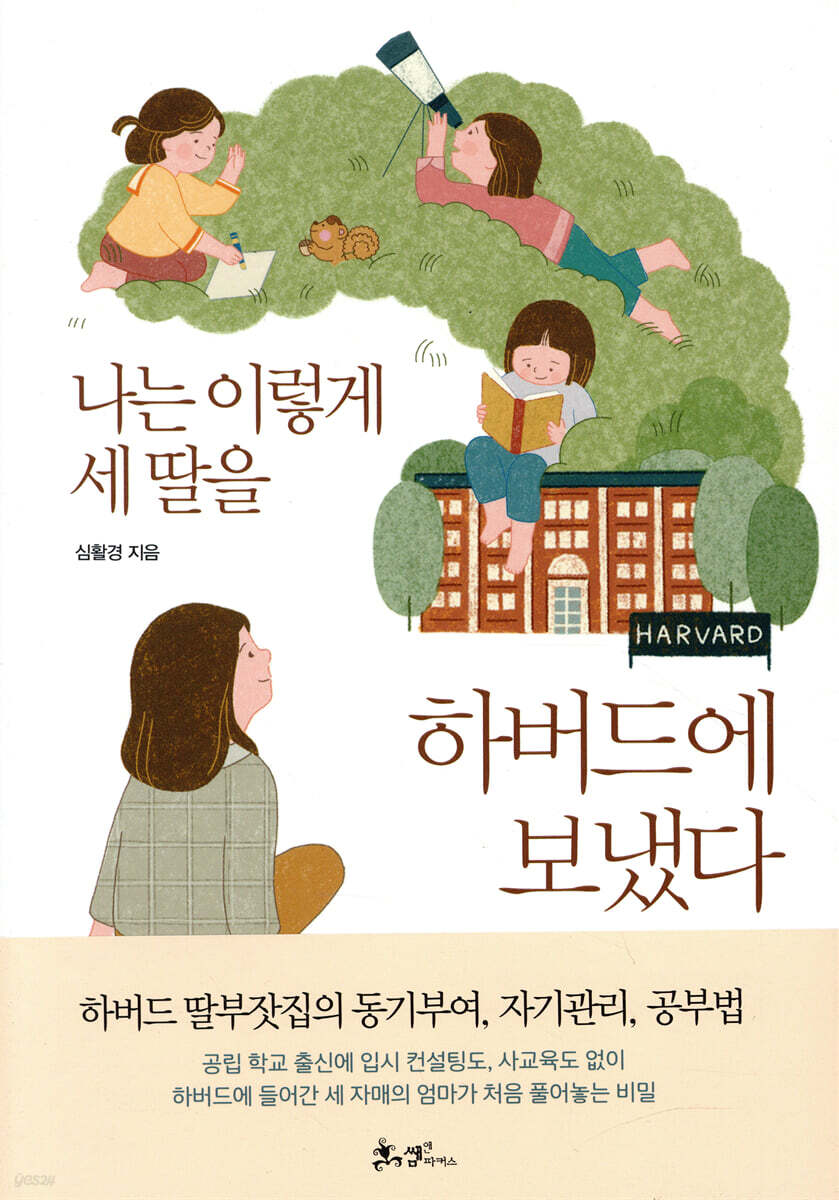
This is how I sent my three daughters to Harvard.
 |
Description
Book Introduction
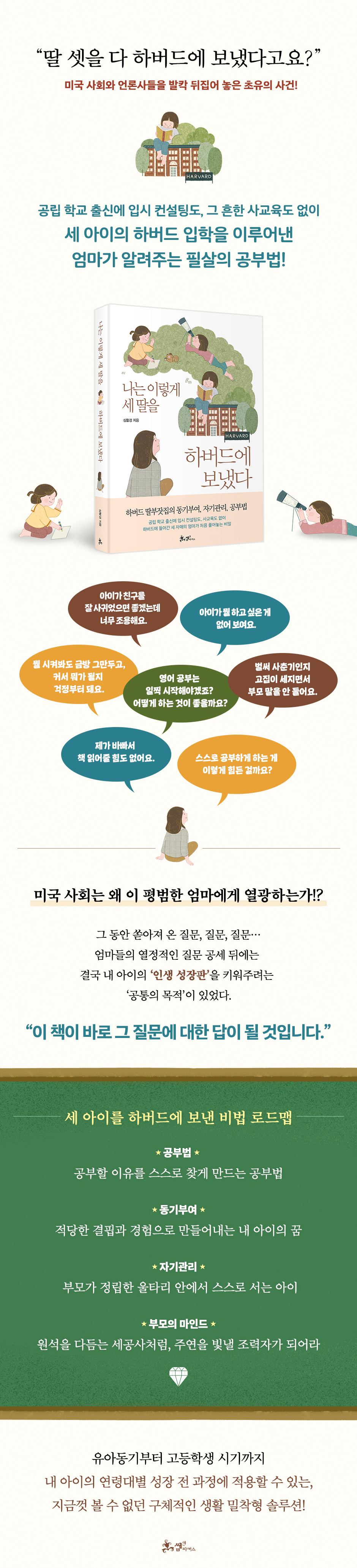
A mother who sent her three daughters to Harvard speaks for the first time
Children's touching growth process and special know-how!
Stimulate my child's 'life growth plate' that is still open
The Harvard Daughter's Secret to Growing Up in a Flash: Revealed
The three sisters, who neither graduated from a prestigious private high school nor received private education, became a hot topic for confidently overcoming the high threshold of Harvard, a top university where talented people from all over the world gather, through their own abilities.
"This is how I sent my three daughters to Harvard" is based on the touching story of growth of the three sisters Hye-min, Hye-eun, and Hye-seong. It generously contains everything from the special study methods, motivation, and self-management of the three sisters to achieve their goals despite the difficult circumstances.
Just as the author says that discovering hidden seeds in children makes them excited and thrilled, all parents who come across this book will also experience the joy of discovering hidden seeds in their children.
I also have no doubt that by following the solutions in this book one by one, I will soon be able to enjoy the thrill of my child's seed growing and bearing great fruit.
Children's touching growth process and special know-how!
Stimulate my child's 'life growth plate' that is still open
The Harvard Daughter's Secret to Growing Up in a Flash: Revealed
The three sisters, who neither graduated from a prestigious private high school nor received private education, became a hot topic for confidently overcoming the high threshold of Harvard, a top university where talented people from all over the world gather, through their own abilities.
"This is how I sent my three daughters to Harvard" is based on the touching story of growth of the three sisters Hye-min, Hye-eun, and Hye-seong. It generously contains everything from the special study methods, motivation, and self-management of the three sisters to achieve their goals despite the difficult circumstances.
Just as the author says that discovering hidden seeds in children makes them excited and thrilled, all parents who come across this book will also experience the joy of discovering hidden seeds in their children.
I also have no doubt that by following the solutions in this book one by one, I will soon be able to enjoy the thrill of my child's seed growing and bearing great fruit.
- You can preview some of the book's contents.
Preview
index
Prologue_ You sent all three of your daughters to Harvard?
PART 1
Awaken the Giant Within Your Child: Parenting Attitudes
1.
Discoverer: Parents are the first to discover a child's talent.
2.
Observer: Understand the child's characteristics and respect their pace.
3.
Observer: A step ahead opens up opportunities for children.
4.
The person who verifies: Objectively understands the child's current condition.
5.
Supporters: Parents' absolute support creates a positive self-image.
6.
Narrator: We design and realize the child's dream together.
7.
The Happiness Giver: Catch the Moment Your Child is Happy
PART 2
Drawing the Blueprint of Your Child's Life Together: Early Childhood
1.
Respond carefully and individually to your child's signals.
2.
Let them realize how beautiful they are
3.
Teach them how heavy the price of lying is.
4.
No matter how great the freedom, it always needs a clear fence.
5.
The reason I only bought two snacks for my three daughters
6.
A child with strong roots and identity will not be shaken.
7.
Raise your child to be able to discern right from wrong and practice good deeds.
PART 3
The choices you make today will shape your future 10 years from now: Elementary School
1.
The best way to get your kids to study on their own while playing
2.
How to Use the Weekend to Establish Your Child's Identity
3.
Why I Didn't Teach English Before I Started School
4.
How to Live Together in America, the Melting Pot of Ethnicity
5.
When wrestling with a child, keep this in mind.
6.
Dad and Mom Should Always Be 'One Team'
7. When and to what extent should TV, games, and smartphones be allowed?
PART 4
Multiply Your Possibilities and Potential: Middle School
1.
What I Gained by Giving Up My Smartphone
2.
Why we must experience both unity and diversity
3.
How to wisely overcome the arduous mountain of adolescence
4.
Five Ways to Keep Your Child's Passion and Dreams Sustained
5.
Don't make me a frog in a well who only knows how to study.
6.
Raise your child to be creative and free.
7.
The Secret to a Satisfying Vacation for Both Parents and Kids
PART 5
Raise leaders who will change and lead the world: High school years
1.
First, Hye-min's story: A child who forged her own path
2.
Second, Hye-eun's story: A unique child who loved writing.
3.
Third Comet's Story: A Child Whose Hands and Feet Were Faster Than His Words
PART 6
Opening the second chapter of life
: The Harvard Story of Three Daughters
1.
What Parents and Children Learn Through College Admission
2.
Why Harvard is called the best university
3.
The path chosen by Hye-min and Hye-eun, who graduated from Harvard
Epilogue: Every child in the world has their own potential.
PART 1
Awaken the Giant Within Your Child: Parenting Attitudes
1.
Discoverer: Parents are the first to discover a child's talent.
2.
Observer: Understand the child's characteristics and respect their pace.
3.
Observer: A step ahead opens up opportunities for children.
4.
The person who verifies: Objectively understands the child's current condition.
5.
Supporters: Parents' absolute support creates a positive self-image.
6.
Narrator: We design and realize the child's dream together.
7.
The Happiness Giver: Catch the Moment Your Child is Happy
PART 2
Drawing the Blueprint of Your Child's Life Together: Early Childhood
1.
Respond carefully and individually to your child's signals.
2.
Let them realize how beautiful they are
3.
Teach them how heavy the price of lying is.
4.
No matter how great the freedom, it always needs a clear fence.
5.
The reason I only bought two snacks for my three daughters
6.
A child with strong roots and identity will not be shaken.
7.
Raise your child to be able to discern right from wrong and practice good deeds.
PART 3
The choices you make today will shape your future 10 years from now: Elementary School
1.
The best way to get your kids to study on their own while playing
2.
How to Use the Weekend to Establish Your Child's Identity
3.
Why I Didn't Teach English Before I Started School
4.
How to Live Together in America, the Melting Pot of Ethnicity
5.
When wrestling with a child, keep this in mind.
6.
Dad and Mom Should Always Be 'One Team'
7. When and to what extent should TV, games, and smartphones be allowed?
PART 4
Multiply Your Possibilities and Potential: Middle School
1.
What I Gained by Giving Up My Smartphone
2.
Why we must experience both unity and diversity
3.
How to wisely overcome the arduous mountain of adolescence
4.
Five Ways to Keep Your Child's Passion and Dreams Sustained
5.
Don't make me a frog in a well who only knows how to study.
6.
Raise your child to be creative and free.
7.
The Secret to a Satisfying Vacation for Both Parents and Kids
PART 5
Raise leaders who will change and lead the world: High school years
1.
First, Hye-min's story: A child who forged her own path
2.
Second, Hye-eun's story: A unique child who loved writing.
3.
Third Comet's Story: A Child Whose Hands and Feet Were Faster Than His Words
PART 6
Opening the second chapter of life
: The Harvard Story of Three Daughters
1.
What Parents and Children Learn Through College Admission
2.
Why Harvard is called the best university
3.
The path chosen by Hye-min and Hye-eun, who graduated from Harvard
Epilogue: Every child in the world has their own potential.
Detailed image
Into the book
As my second and third children all entered Harvard, everyone I met wanted to know the secret to getting them into Harvard.
“Who did all my daughters resemble to become like that?” My wife and I always gave the same answer.
“It doesn’t resemble us, it’s a mutation.” No one was satisfied with this answer.
Instead of nodding, he asked another question.
“One could be a mutation….
Not all three are mutants, right?
There seems to be some 'Harvard DNA' in it.
“Please tell me.” Hearing this, I started to think, ‘Is there really Harvard DNA in our family?’
I wrote this book to answer that question.
I eventually discovered that our family's upbringing was in our DNA, sending all three of our daughters to Harvard.
I hope that by knowing specifically what that DNA is, I can help all mothers raising children in some way.
I hope this book will be an opportunity for all our precious children to discover and awaken the great giant within themselves.
---p.10 From the Prologue “You sent all three of your daughters to Harvard?”
Parents are the first people to discover their child's talents.
Parents, the first people a child meets after birth, are the ones who spend the most time with the child and share the most physical contact.
Children grow by getting to know each other through countless interactions.
Parents of more than one child will agree that the time it takes to understand your child is much shorter when raising a second or third child than when raising your first.
Having raised three children myself, I've developed my own way of getting to know them.
To get to know the child, we gave them various stimuli and understood the child through their responses.
While I was with my child, I tried not to take my eyes off him for even a moment and constantly thought of ways to stimulate his five senses.
Although these efforts made parenting difficult, I think they were much more positive in terms of the child's development.
This is because the child's range of experiences expands due to the stimulation provided by parents.
If we were to use a computer analogy, we could say that this is 'increasing storage capacity'.
Computers with small storage capacity will eventually become unable to store any more files.
Since a child's capacity is small, teaching them this and that hastily can have the opposite effect.
When you're young, you should focus on building up your capacity.
To achieve this, we must create experiences through continuous interaction using the five senses in various ways.
The more diverse your child's stimuli are, the easier it will be to discover their potential and creativity.
During this process, parents should carefully observe their child's interests and concerns.
---pp.25-26 From “PART 1 “Awaken the Giant Sleeping Within Your Child: Parents’ Attitudes”
I thought that pre-learning only dampened a child's curiosity and motivation to study.
Rather than taking private tutoring to prepare for difficult studies in advance, I focused on attending school classes.
By seeing friends who are better than me, I felt my own shortcomings and wanted to improve further.
It is important to encourage students to take an active approach to their studies rather than passively learning, and to let them tell you for themselves what they want to know more about.
Rather than just sending your child to an academy, if your child develops a thirst for learning, studying will come naturally.
(…)
Motivation comes from lack, and motivation becomes the driving force that gives you the will and the desire to try and do anything on your own.
In this process, you can also feel the joy of accomplishment.
Therefore, a certain degree of deprivation is essential in parenting.
Rather than worrying about what to do for your child, it is wiser to worry about what not to do.
I put this into practice.
They were parents who thought hard about how they could avoid doing it and how they could prevent their children from feeling uncomfortable.
---pp.149-151 From 「PART 2 “Let’s draw the outline of your child’s life together: Early childhood”」
To prepare for the SAT, many students attend cram schools, take private tutoring, and invest most of their time in studying during high school.
I've even seen cases where children are sent to private academies starting in middle school.
What we need to keep in mind is that high school is a time to develop and further develop the talents discovered in elementary and middle school, and to produce results accordingly, as part of the process of becoming a giant.
How inefficient it is to waste time preparing for college entrance exams at such a time and expend energy that could be used for other things.
Aren't elementary school years the time for studying overflowing? But how can we get elementary school students to sit still and study? Is this even possible? Is it okay to just sit and study during this active and creative period? Many questions arise.
But to get to the point, it is possible.
However, a change in parents' thinking is necessary.
It is right that elementary school children should play.
You should feel happy by doing fun things.
The funny thing is, you can do it for a long time, you can do it even when people tell you not to, and you can even do it secretly.
Here is the answer.
All you have to do is make the object that your child finds fun into something to study.
I didn't even know it was studying, but I did it because it was fun, but when I found out, I was creating a situation where it was studying.
It's great for children to have fun doing things they enjoy, and it's great for parents to be able to study without stressing their children out.
---pp.173-174 From 「PART 3 “Choices made today will change the future 10 years from now: Elementary school years”」
One piece of advice I would give is that parents should not go to bed before their children do.
Staying up with your children until they finish studying or homework and go to bed gives them a sense of security and no room to think about other things.
This is also something that requires the devotion of parents.
If these things become a daily habit, children can grow up to be self-disciplined.
Even if parents put in a lot of effort to help their children develop a certain level of self-control, they cannot live without their smartphones unless they make the decision themselves.
There are clearly limits to what parents can force and physically prevent.
I think that the time when a child can make decisions on his or her own is until middle school.
If your child shows an unwillingness to compromise with you about a smartphone even after entering high school, it's better to just buy one.
Forcing a grown child to stop something without their own decision will only worsen the relationship between the parents.
Coercive control has more to lose than to gain.
It is important for parents to guide their children to form a philosophy and values that they can choose for themselves while attending elementary and middle school.
---pp.235-236 From 「PART 4 “Double Your Possibilities and Potential: Middle School Years”」
Hyemin said that she was shocked by the reality of how difficult it is to get into college, as she researched her desired major early on in middle school and also looked into target universities, but the acceptance rate for those schools was less than 10%.
I was surprised by the lower-than-expected pass rate.
Instead, thanks to that, I was able to quickly make a realistic decision about going to college.
The sooner a child can recognize reality on their own, the more concretely they can plan and strategize for college admission in advance.
(…)
As Hyemin got older, she worked harder to find areas where she needed help, and she accomplished everything she could, both inside and outside of school.
Ultimately, Hye-min's thorough time management, self-management, quick awareness of the reality of college admission, and planning and implementing activities that could be done both inside and outside of school were the secrets to achieving her goals.
---pp.289-291 From 「PART 5 “Raise children to become leaders who will change and lead the world: High school years”」
When a child goes far away to college, it means independence from their parents.
It's not that my children leave me, it's that I become independent from them.
When a child is born, the role of parents in that child's life is great.
As children grow up, the role of parents should gradually diminish.
Then, when the time comes for my child to go to college, I have to prepare to leave my child's life.
College is a time in a child's life when they leave and become independent.
First, the parents must leave their children, so that the children can leave without worrying about their parents.
If parents are unable to leave and hold their children back, they will not be able to fully express their own will.
“Who did all my daughters resemble to become like that?” My wife and I always gave the same answer.
“It doesn’t resemble us, it’s a mutation.” No one was satisfied with this answer.
Instead of nodding, he asked another question.
“One could be a mutation….
Not all three are mutants, right?
There seems to be some 'Harvard DNA' in it.
“Please tell me.” Hearing this, I started to think, ‘Is there really Harvard DNA in our family?’
I wrote this book to answer that question.
I eventually discovered that our family's upbringing was in our DNA, sending all three of our daughters to Harvard.
I hope that by knowing specifically what that DNA is, I can help all mothers raising children in some way.
I hope this book will be an opportunity for all our precious children to discover and awaken the great giant within themselves.
---p.10 From the Prologue “You sent all three of your daughters to Harvard?”
Parents are the first people to discover their child's talents.
Parents, the first people a child meets after birth, are the ones who spend the most time with the child and share the most physical contact.
Children grow by getting to know each other through countless interactions.
Parents of more than one child will agree that the time it takes to understand your child is much shorter when raising a second or third child than when raising your first.
Having raised three children myself, I've developed my own way of getting to know them.
To get to know the child, we gave them various stimuli and understood the child through their responses.
While I was with my child, I tried not to take my eyes off him for even a moment and constantly thought of ways to stimulate his five senses.
Although these efforts made parenting difficult, I think they were much more positive in terms of the child's development.
This is because the child's range of experiences expands due to the stimulation provided by parents.
If we were to use a computer analogy, we could say that this is 'increasing storage capacity'.
Computers with small storage capacity will eventually become unable to store any more files.
Since a child's capacity is small, teaching them this and that hastily can have the opposite effect.
When you're young, you should focus on building up your capacity.
To achieve this, we must create experiences through continuous interaction using the five senses in various ways.
The more diverse your child's stimuli are, the easier it will be to discover their potential and creativity.
During this process, parents should carefully observe their child's interests and concerns.
---pp.25-26 From “PART 1 “Awaken the Giant Sleeping Within Your Child: Parents’ Attitudes”
I thought that pre-learning only dampened a child's curiosity and motivation to study.
Rather than taking private tutoring to prepare for difficult studies in advance, I focused on attending school classes.
By seeing friends who are better than me, I felt my own shortcomings and wanted to improve further.
It is important to encourage students to take an active approach to their studies rather than passively learning, and to let them tell you for themselves what they want to know more about.
Rather than just sending your child to an academy, if your child develops a thirst for learning, studying will come naturally.
(…)
Motivation comes from lack, and motivation becomes the driving force that gives you the will and the desire to try and do anything on your own.
In this process, you can also feel the joy of accomplishment.
Therefore, a certain degree of deprivation is essential in parenting.
Rather than worrying about what to do for your child, it is wiser to worry about what not to do.
I put this into practice.
They were parents who thought hard about how they could avoid doing it and how they could prevent their children from feeling uncomfortable.
---pp.149-151 From 「PART 2 “Let’s draw the outline of your child’s life together: Early childhood”」
To prepare for the SAT, many students attend cram schools, take private tutoring, and invest most of their time in studying during high school.
I've even seen cases where children are sent to private academies starting in middle school.
What we need to keep in mind is that high school is a time to develop and further develop the talents discovered in elementary and middle school, and to produce results accordingly, as part of the process of becoming a giant.
How inefficient it is to waste time preparing for college entrance exams at such a time and expend energy that could be used for other things.
Aren't elementary school years the time for studying overflowing? But how can we get elementary school students to sit still and study? Is this even possible? Is it okay to just sit and study during this active and creative period? Many questions arise.
But to get to the point, it is possible.
However, a change in parents' thinking is necessary.
It is right that elementary school children should play.
You should feel happy by doing fun things.
The funny thing is, you can do it for a long time, you can do it even when people tell you not to, and you can even do it secretly.
Here is the answer.
All you have to do is make the object that your child finds fun into something to study.
I didn't even know it was studying, but I did it because it was fun, but when I found out, I was creating a situation where it was studying.
It's great for children to have fun doing things they enjoy, and it's great for parents to be able to study without stressing their children out.
---pp.173-174 From 「PART 3 “Choices made today will change the future 10 years from now: Elementary school years”」
One piece of advice I would give is that parents should not go to bed before their children do.
Staying up with your children until they finish studying or homework and go to bed gives them a sense of security and no room to think about other things.
This is also something that requires the devotion of parents.
If these things become a daily habit, children can grow up to be self-disciplined.
Even if parents put in a lot of effort to help their children develop a certain level of self-control, they cannot live without their smartphones unless they make the decision themselves.
There are clearly limits to what parents can force and physically prevent.
I think that the time when a child can make decisions on his or her own is until middle school.
If your child shows an unwillingness to compromise with you about a smartphone even after entering high school, it's better to just buy one.
Forcing a grown child to stop something without their own decision will only worsen the relationship between the parents.
Coercive control has more to lose than to gain.
It is important for parents to guide their children to form a philosophy and values that they can choose for themselves while attending elementary and middle school.
---pp.235-236 From 「PART 4 “Double Your Possibilities and Potential: Middle School Years”」
Hyemin said that she was shocked by the reality of how difficult it is to get into college, as she researched her desired major early on in middle school and also looked into target universities, but the acceptance rate for those schools was less than 10%.
I was surprised by the lower-than-expected pass rate.
Instead, thanks to that, I was able to quickly make a realistic decision about going to college.
The sooner a child can recognize reality on their own, the more concretely they can plan and strategize for college admission in advance.
(…)
As Hyemin got older, she worked harder to find areas where she needed help, and she accomplished everything she could, both inside and outside of school.
Ultimately, Hye-min's thorough time management, self-management, quick awareness of the reality of college admission, and planning and implementing activities that could be done both inside and outside of school were the secrets to achieving her goals.
---pp.289-291 From 「PART 5 “Raise children to become leaders who will change and lead the world: High school years”」
When a child goes far away to college, it means independence from their parents.
It's not that my children leave me, it's that I become independent from them.
When a child is born, the role of parents in that child's life is great.
As children grow up, the role of parents should gradually diminish.
Then, when the time comes for my child to go to college, I have to prepare to leave my child's life.
College is a time in a child's life when they leave and become independent.
First, the parents must leave their children, so that the children can leave without worrying about their parents.
If parents are unable to leave and hold their children back, they will not be able to fully express their own will.
---pp.353-354 From 「PART 6 “Opening the Second Chapter of Life: The Harvard Story”」
Publisher's Review
“You sent all three of your daughters to Harvard?”
Countless questions, questions, questions that have been pouring in over the years…
The first time a mother from a wealthy Harvard family speaks freely
The touching story of the growth of three daughters and their special know-how!
Stimulate my child's 'life growth plate' that is still open
The Harvard Daughter's Secret to Growing Up in a Flash: Revealed
In 2012, an article came out in the United States about a family from a high school who had been accepted to Harvard University, a feat that only happens once every few years.
The main character was Jihye Eun, the second daughter of Sim Hwal-gyeong, the author of “This is how I sent my three daughters to Harvard.”
When Ji Hye-min, my older sister by four years, was accepted to Harvard two years ago, it was only a small event in the Korean community, but when two families from the same family were accepted to Harvard in succession, the Korean community in the United States became abuzz.
At the time, the article expressed anticipation, saying, “If Hyeseong, who is currently a middle school student, is admitted to Harvard, she could set a record for three sisters being admitted.”
Seven years later, in 2019, as the old saying goes, “Words become seeds,” an article came out about my third daughter, Ji-Hye Seong, being accepted to Harvard early.
It was the moment when the legend of the 'Three Harvard Sisters' was born.
Author Shim Hwal-kyung says that since her eldest daughter was accepted to Harvard, she has been bombarded with questions from people around her asking her secret.
That's understandable, because he didn't attend a prestigious private high school, didn't even dream of getting admission consulting, and didn't receive any private tutoring. Yet, he confidently passed the high threshold of Harvard, the world's top university where the best talents gather, through his own abilities.
At the time, all I could say was, “They’re mutants,” but when the third and fourth daughters entered Harvard, people praised the mother who had three daughters, saying, “There must be a special secret.”
In “This is How I Sent My Three Daughters to Harvard,” the author humbly describes herself as “extremely ordinary, with nothing special about me.”
But he had a talent for “discovering the hidden treasures within a child.”
As I watched my three daughters grow up beautifully and find their own paths, I came to realize that I wanted to help them discover their responsibility and mission toward their children, and to offer some small help to those who are looking for ways to become better parents.
That feeling became the driving force behind writing this book.
"This is how I sent my three daughters to Harvard" is based on the touching story of growth of the three sisters Hye-min, Hye-eun, and Hye-seong. It generously contains everything from the special study methods, motivation, and self-management of the three sisters to achieve their goals despite the difficult circumstances.
Therefore, if you are a parent who believes in your child's potential and wants to give them a better tomorrow, read the messages in this book without fail and put them into practice.
You will witness your child's growth plate being stimulated and growing beyond recognition.
The attitude of parents that will awaken the ‘giant sleeping within the child’
Early childhood, when we must draw the blueprint of our lives,
Elementary school, which will determine the future 10 years from now, and middle school, which will double the possibilities and potential.
And until high school, when you set up strategies and tactics to achieve your goals.
Applicable to all stages of my child's growth according to age group.
A concrete, life-oriented solution never seen before
After getting married, the author, Sim Hwal-gyeong, immigrated to the United States with her husband, who had become a late-blooming international student.
Even though it wasn't easy to adapt to a new environment, let alone the language, he observed the children closely and responded sensitively and supported them according to their individual characteristics.
This maturity, knowledge, and know-how as a senior mother are fully reflected in 'Part 1', which talks about 'parental attitudes', and 'Part 2', which deals with 'parenting and education methods for young children'.
As numerous books and media emphasize, the elementary school years have a profound impact on a child's development.
The experiences, attitudes, and studies of the author Sim Hwal-gyeong's three daughters during their elementary school years also became seeds that later bore fruit in the form of their acceptance into Harvard.
'Part 3' contains specific guidelines that must be taught at this time when the foundation for serious study must be laid, such as 'studying while playing' and 'foreign language learning methods'.
We also offer practical solutions, such as how to deal with the power struggles that arise with children who grow differently every day, and media education, which is becoming increasingly important.
Part 4, which covers the middle school years, a crucial period for multiplying a child's potential and possibilities, while also overcoming the arduous mountain of adolescence, reveals the secret to killing two birds with one stone: developing a child's "ability" and "mind control."
Also, in 'Part 5', we show the three sisters with three different personalities running towards their goals, and we generously reveal strategies and tactics for college entrance, such as how to complete a unique growth story that is different from others, motivation, self-management, and study methods that allowed them to enter the world's best universities without private education.
In the final 'Part 6', author Shim Hwal-kyung introduces the story of her three daughters' experiences at Harvard, the world's best university, the fierce competition among the world's top talents, and the continuous challenges they face toward their dreams. She hopes that the parents and children who read this book will dream bigger dreams.
"This is how I sent my three daughters to Harvard" fully reflects the author's expertise in actively giving lectures on child education and parenting.
The author, who has listened to the concerns of countless parents, empathized with them, and offered advice without sparing any effort, conveys his message warmly, as if he were conversing with each and every reader.
Just as the author says that discovering hidden seeds in children makes them excited and thrilled, all parents who come across this book will also experience the joy of discovering hidden seeds in their children.
I also have no doubt that by following the solutions in this book one by one, I will soon be able to enjoy the thrill of my child's seed growing and bearing great fruit.
Countless questions, questions, questions that have been pouring in over the years…
The first time a mother from a wealthy Harvard family speaks freely
The touching story of the growth of three daughters and their special know-how!
Stimulate my child's 'life growth plate' that is still open
The Harvard Daughter's Secret to Growing Up in a Flash: Revealed
In 2012, an article came out in the United States about a family from a high school who had been accepted to Harvard University, a feat that only happens once every few years.
The main character was Jihye Eun, the second daughter of Sim Hwal-gyeong, the author of “This is how I sent my three daughters to Harvard.”
When Ji Hye-min, my older sister by four years, was accepted to Harvard two years ago, it was only a small event in the Korean community, but when two families from the same family were accepted to Harvard in succession, the Korean community in the United States became abuzz.
At the time, the article expressed anticipation, saying, “If Hyeseong, who is currently a middle school student, is admitted to Harvard, she could set a record for three sisters being admitted.”
Seven years later, in 2019, as the old saying goes, “Words become seeds,” an article came out about my third daughter, Ji-Hye Seong, being accepted to Harvard early.
It was the moment when the legend of the 'Three Harvard Sisters' was born.
Author Shim Hwal-kyung says that since her eldest daughter was accepted to Harvard, she has been bombarded with questions from people around her asking her secret.
That's understandable, because he didn't attend a prestigious private high school, didn't even dream of getting admission consulting, and didn't receive any private tutoring. Yet, he confidently passed the high threshold of Harvard, the world's top university where the best talents gather, through his own abilities.
At the time, all I could say was, “They’re mutants,” but when the third and fourth daughters entered Harvard, people praised the mother who had three daughters, saying, “There must be a special secret.”
In “This is How I Sent My Three Daughters to Harvard,” the author humbly describes herself as “extremely ordinary, with nothing special about me.”
But he had a talent for “discovering the hidden treasures within a child.”
As I watched my three daughters grow up beautifully and find their own paths, I came to realize that I wanted to help them discover their responsibility and mission toward their children, and to offer some small help to those who are looking for ways to become better parents.
That feeling became the driving force behind writing this book.
"This is how I sent my three daughters to Harvard" is based on the touching story of growth of the three sisters Hye-min, Hye-eun, and Hye-seong. It generously contains everything from the special study methods, motivation, and self-management of the three sisters to achieve their goals despite the difficult circumstances.
Therefore, if you are a parent who believes in your child's potential and wants to give them a better tomorrow, read the messages in this book without fail and put them into practice.
You will witness your child's growth plate being stimulated and growing beyond recognition.
The attitude of parents that will awaken the ‘giant sleeping within the child’
Early childhood, when we must draw the blueprint of our lives,
Elementary school, which will determine the future 10 years from now, and middle school, which will double the possibilities and potential.
And until high school, when you set up strategies and tactics to achieve your goals.
Applicable to all stages of my child's growth according to age group.
A concrete, life-oriented solution never seen before
After getting married, the author, Sim Hwal-gyeong, immigrated to the United States with her husband, who had become a late-blooming international student.
Even though it wasn't easy to adapt to a new environment, let alone the language, he observed the children closely and responded sensitively and supported them according to their individual characteristics.
This maturity, knowledge, and know-how as a senior mother are fully reflected in 'Part 1', which talks about 'parental attitudes', and 'Part 2', which deals with 'parenting and education methods for young children'.
As numerous books and media emphasize, the elementary school years have a profound impact on a child's development.
The experiences, attitudes, and studies of the author Sim Hwal-gyeong's three daughters during their elementary school years also became seeds that later bore fruit in the form of their acceptance into Harvard.
'Part 3' contains specific guidelines that must be taught at this time when the foundation for serious study must be laid, such as 'studying while playing' and 'foreign language learning methods'.
We also offer practical solutions, such as how to deal with the power struggles that arise with children who grow differently every day, and media education, which is becoming increasingly important.
Part 4, which covers the middle school years, a crucial period for multiplying a child's potential and possibilities, while also overcoming the arduous mountain of adolescence, reveals the secret to killing two birds with one stone: developing a child's "ability" and "mind control."
Also, in 'Part 5', we show the three sisters with three different personalities running towards their goals, and we generously reveal strategies and tactics for college entrance, such as how to complete a unique growth story that is different from others, motivation, self-management, and study methods that allowed them to enter the world's best universities without private education.
In the final 'Part 6', author Shim Hwal-kyung introduces the story of her three daughters' experiences at Harvard, the world's best university, the fierce competition among the world's top talents, and the continuous challenges they face toward their dreams. She hopes that the parents and children who read this book will dream bigger dreams.
"This is how I sent my three daughters to Harvard" fully reflects the author's expertise in actively giving lectures on child education and parenting.
The author, who has listened to the concerns of countless parents, empathized with them, and offered advice without sparing any effort, conveys his message warmly, as if he were conversing with each and every reader.
Just as the author says that discovering hidden seeds in children makes them excited and thrilled, all parents who come across this book will also experience the joy of discovering hidden seeds in their children.
I also have no doubt that by following the solutions in this book one by one, I will soon be able to enjoy the thrill of my child's seed growing and bearing great fruit.
GOODS SPECIFICS
- Publication date: July 23, 2022
- Page count, weight, size: 384 pages | 630g | 148*210*23mm
- ISBN13: 9791165345488
- ISBN10: 116534548X
You may also like
카테고리
korean


korean

![GQ KOREA Mark (Monthly): December [2025]](http://librairie.coreenne.fr/cdn/shop/files/8ef265dbbfbf186523ed75ba7319009d.jpg?v=1765340328&width=3840)


