

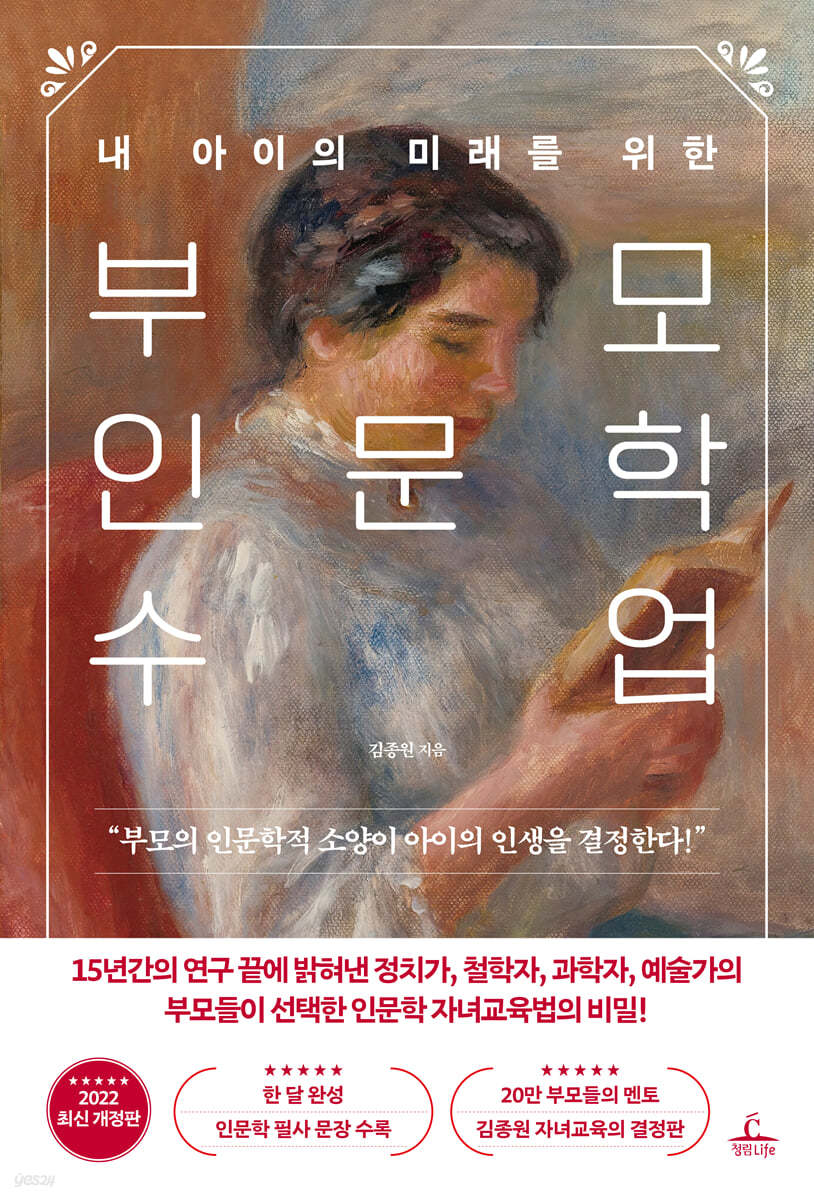
Parent Humanities Class
 |
Description
Book Introduction
“How can I help my child have a better life than I did?”
“What should parents learn to develop their children’s potential?”
After 15 years of research, the politicians, philosophers, scientists, and artists have been revealed.
The secret to humanities-based child education chosen by parents!
★★★《Parenting Humanities Class》2022 Latest Revised Edition★★★
★★★One-month completion of humanities manuscripts included★★★
★★★Kim Jong-won, the mentor of 200,000 parents, the definitive guide to child education★★★
Parents worry about what to teach their children.
I often reflect on my own words and actions, and even try to understand my child's psychological state.
These diligent efforts are filled with a fervent desire to raise children well.
Author Kim Jong-won, a humanities education mentor to countless parents, has spent a long time researching the lives of great philosophers, politicians, and artists, as well as the philosophies of the parents who raised them.
And finally, we discovered the enormous impact that parents' attitudes toward the humanities and their basic knowledge have on their children's lives.
What's even more surprising is that the factor that had the greatest impact on children's academic performance was not the amount of time they invested in studying, the number of books they read, or their IQ, but rather the "humanistic literacy of their parents."
In this book, the author has strived to explain the fundamental humanistic principles of child education in popular language.
By looking into the educational philosophies of parents who raised some of the greatest intellectuals in human history, including Goethe, Einstein, Nietzsche, and Shin Saimdang, we can help parents find the right answer to the question, "What should parents teach their children?"
It also includes in detail their unique study methods, thinking methods, and writing secrets that led and advanced the times.
The newly revised edition of "Humanities for Parents" includes "Humanities Life Sentences," which the author, as a mentor for 200,000 parents in humanities education, has compiled over a long period of time and personally applied to life.
I hope that by copying one page a day for 30 days, I can develop a solid parenting philosophy.
By carefully examining the included 'Parent Education Points', you will also learn how to apply author Kim Jong-won's deep insights to real life.
“What should parents learn to develop their children’s potential?”
After 15 years of research, the politicians, philosophers, scientists, and artists have been revealed.
The secret to humanities-based child education chosen by parents!
★★★《Parenting Humanities Class》2022 Latest Revised Edition★★★
★★★One-month completion of humanities manuscripts included★★★
★★★Kim Jong-won, the mentor of 200,000 parents, the definitive guide to child education★★★
Parents worry about what to teach their children.
I often reflect on my own words and actions, and even try to understand my child's psychological state.
These diligent efforts are filled with a fervent desire to raise children well.
Author Kim Jong-won, a humanities education mentor to countless parents, has spent a long time researching the lives of great philosophers, politicians, and artists, as well as the philosophies of the parents who raised them.
And finally, we discovered the enormous impact that parents' attitudes toward the humanities and their basic knowledge have on their children's lives.
What's even more surprising is that the factor that had the greatest impact on children's academic performance was not the amount of time they invested in studying, the number of books they read, or their IQ, but rather the "humanistic literacy of their parents."
In this book, the author has strived to explain the fundamental humanistic principles of child education in popular language.
By looking into the educational philosophies of parents who raised some of the greatest intellectuals in human history, including Goethe, Einstein, Nietzsche, and Shin Saimdang, we can help parents find the right answer to the question, "What should parents teach their children?"
It also includes in detail their unique study methods, thinking methods, and writing secrets that led and advanced the times.
The newly revised edition of "Humanities for Parents" includes "Humanities Life Sentences," which the author, as a mentor for 200,000 parents in humanities education, has compiled over a long period of time and personally applied to life.
I hope that by copying one page a day for 30 days, I can develop a solid parenting philosophy.
By carefully examining the included 'Parent Education Points', you will also learn how to apply author Kim Jong-won's deep insights to real life.
- You can preview some of the book's contents.
Preview
index
Preface to the Revised Edition
Prologue_For parents who can't seem to solve their children's education problems
Part 1: Self-cultivation: A dignified child with a straight center
Chapter 1: Where Does the Power to Protect Me Come From?
Goethe, who had everything, had only one thing missing.
Why is the world a peaceful place with a receiver?
1 Humanities Handwritten Notes on Creating a Parenting Philosophy
Conditions of a prestigious family
A child who chooses the right path in any situation
2 Humanities Handwritten Notes on Creating a Parenting Philosophy
The Secret of a Child Who Walks His Own Path Without Wandering
3 Humanities Handwritten Notes on Creating a Parenting Philosophy
Chapter 2: The Power of Time Alone with Your Child
Where does 'interference' begin and where does 'intervention' end?
Be yourself, remember who you are
4 Humanities Handwritten Notes on Creating a Parenting Philosophy
A Consciousness Training Method to Brighten Your Alone Time
The imitative brain, the creative brain
If you lose your heart, you lose everything.
5 Humanities Handwritten Notes on Creating a Parenting Philosophy
How to Raise a Strong Child Who Can Stand Firm in the World
6 Humanities Handwritten Notes on Creating a Parenting Philosophy
Part 2: The Family: A Minimum Education in the Humanities and Classics for Parents
Chapter 1: The World's Most Perfect Educational Conditions
To you who does the most wonderful thing in the world
How a child becomes a demon
7 Humanities Handwritten Notes on Creating a Parenting Philosophy
Seven Steps to Healing Writing for Parents
Ten Guidelines for Completing Your Humanities Studies
8 Humanities Handwritten Notes on Creating a Parenting Philosophy
How to Raise a Classy Child
Four Teachings That Perfected Shin Saimdang's Elegance
9 Humanities Handwritten Notes on Creating a Parenting Philosophy
Couples need to join forces
10 Humanities Notebooks for Creating a Parenting Philosophy
Chapter 2: Growing Children, Stopping Children
A child who goes astray, anxious parents
The first step to raising a growing child
11 Humanities Handwritten Notes on Creating a Parenting Philosophy
The Secret of a Child Who Learns on Their Own
A word that raised the greatest philosopher
12 Humanities Handwritten Notes on Creating a Parenting Philosophy
The art of conversation that reaches a child's heart
The Art of Wise Advice That Changes Children
13 Humanities Handwritten Notes on Creating a Parenting Philosophy
Kant's Time Management Method for Doubling Your Life
14 Humanities Handwritten Notes on Creating a Parenting Philosophy
How to Write to Boost Your Creativity
15 Humanities Handwritten Notes on Creating a Parenting Philosophy
Part 3: Governing the Nation: The Qualities of a Child Leading an Era Where Thought is Capital
Chapter 1: How to Raise a Child Who Grows Through Reflection
The limits of your thinking are the limits of your life.
The power of thought that made Gauss great
16 Humanities Handwritten Notes on Creating a Parenting Philosophy
The Secret of Einstein's Imagination
Four Ways to Add Reason to Emotion
17 Humanities Handwritten Notes on Creating a Parenting Philosophy
Chapter 2: Study Methods of Talents Leading the Era of Collective Intelligence
Conditions for a child to grow without stopping to think
Living the life of an intellectual
18 Humanities Handwritten Notes on Creating a Parenting Philosophy
Five Teachings of Socrates That Guided an Ordinary Child to the Path of Intellect
The perspectives needed to live an intellectual life
19 Humanities Handwritten Notes on Creating a Parenting Philosophy
Wittgenstein's Thinking Method for Parents
20 Humanities Handwritten Notes on Creating a Parenting Philosophy
Five Ways to Apply Wittgenstein's Way of Thinking to Your Child
The Amazing Technique of Raising Your Child's Intellectual Level
21 Humanities Handwritten Notes on Creating a Parenting Philosophy
Part 4: Peace in the World: A Question Encapsulating Thousands of Years of Wisdom That Governed the World
Chapter 1: The Classic Questioning Method That Transcends Time and Place and Changes Children's Lives
How to Find the Great Question That Will Change Your Child's Life
The child with a thousand eyes and a thousand hearts
22 Humanities Handwritten Notes on Creating a Parenting Philosophy
Building a Questioning Brain that Unlocks All Your Child's Possibilities
Socratic questioning
23 Humanities Handwritten Notes on Creating a Parenting Philosophy
Question-Based Character Education That Will Change Your Child's Life
Intelligent reading method completed with questions
24 Humanities Handwritten Notes on Creating a Parenting Philosophy
A thoughtful walk that awakens the child's great inner self
25 Humanities Handwritten Notes on Creating a Parenting Philosophy
Chapter 2: Growing into a Unique Being Unaffected by the Trends of the Times
A play method that helps children grow into people who can define their own self-worth.
How to Raise a Child Who Knows How to Communicate with the World
26 Humanities Handwritten Notes on Creating a Parenting Philosophy
The power to bring simple ideas to life
27 Humanities Handwritten Notes on Creating a Parenting Philosophy
A playful way to cultivate the poet's perspective
28 Humanities Handwritten Notes on Creating a Parenting Philosophy
The most moral child is the greatest child.
29 Humanities Handwritten Notes on Creating a Parenting Philosophy
Tolstoy's Four Teachings for Raising Moral Practicing Leaders
30 Humanities Handwritten Notes on Creating a Parenting Philosophy
Epilogue: Love the Process of Thinking and Learning
Prologue_For parents who can't seem to solve their children's education problems
Part 1: Self-cultivation: A dignified child with a straight center
Chapter 1: Where Does the Power to Protect Me Come From?
Goethe, who had everything, had only one thing missing.
Why is the world a peaceful place with a receiver?
1 Humanities Handwritten Notes on Creating a Parenting Philosophy
Conditions of a prestigious family
A child who chooses the right path in any situation
2 Humanities Handwritten Notes on Creating a Parenting Philosophy
The Secret of a Child Who Walks His Own Path Without Wandering
3 Humanities Handwritten Notes on Creating a Parenting Philosophy
Chapter 2: The Power of Time Alone with Your Child
Where does 'interference' begin and where does 'intervention' end?
Be yourself, remember who you are
4 Humanities Handwritten Notes on Creating a Parenting Philosophy
A Consciousness Training Method to Brighten Your Alone Time
The imitative brain, the creative brain
If you lose your heart, you lose everything.
5 Humanities Handwritten Notes on Creating a Parenting Philosophy
How to Raise a Strong Child Who Can Stand Firm in the World
6 Humanities Handwritten Notes on Creating a Parenting Philosophy
Part 2: The Family: A Minimum Education in the Humanities and Classics for Parents
Chapter 1: The World's Most Perfect Educational Conditions
To you who does the most wonderful thing in the world
How a child becomes a demon
7 Humanities Handwritten Notes on Creating a Parenting Philosophy
Seven Steps to Healing Writing for Parents
Ten Guidelines for Completing Your Humanities Studies
8 Humanities Handwritten Notes on Creating a Parenting Philosophy
How to Raise a Classy Child
Four Teachings That Perfected Shin Saimdang's Elegance
9 Humanities Handwritten Notes on Creating a Parenting Philosophy
Couples need to join forces
10 Humanities Notebooks for Creating a Parenting Philosophy
Chapter 2: Growing Children, Stopping Children
A child who goes astray, anxious parents
The first step to raising a growing child
11 Humanities Handwritten Notes on Creating a Parenting Philosophy
The Secret of a Child Who Learns on Their Own
A word that raised the greatest philosopher
12 Humanities Handwritten Notes on Creating a Parenting Philosophy
The art of conversation that reaches a child's heart
The Art of Wise Advice That Changes Children
13 Humanities Handwritten Notes on Creating a Parenting Philosophy
Kant's Time Management Method for Doubling Your Life
14 Humanities Handwritten Notes on Creating a Parenting Philosophy
How to Write to Boost Your Creativity
15 Humanities Handwritten Notes on Creating a Parenting Philosophy
Part 3: Governing the Nation: The Qualities of a Child Leading an Era Where Thought is Capital
Chapter 1: How to Raise a Child Who Grows Through Reflection
The limits of your thinking are the limits of your life.
The power of thought that made Gauss great
16 Humanities Handwritten Notes on Creating a Parenting Philosophy
The Secret of Einstein's Imagination
Four Ways to Add Reason to Emotion
17 Humanities Handwritten Notes on Creating a Parenting Philosophy
Chapter 2: Study Methods of Talents Leading the Era of Collective Intelligence
Conditions for a child to grow without stopping to think
Living the life of an intellectual
18 Humanities Handwritten Notes on Creating a Parenting Philosophy
Five Teachings of Socrates That Guided an Ordinary Child to the Path of Intellect
The perspectives needed to live an intellectual life
19 Humanities Handwritten Notes on Creating a Parenting Philosophy
Wittgenstein's Thinking Method for Parents
20 Humanities Handwritten Notes on Creating a Parenting Philosophy
Five Ways to Apply Wittgenstein's Way of Thinking to Your Child
The Amazing Technique of Raising Your Child's Intellectual Level
21 Humanities Handwritten Notes on Creating a Parenting Philosophy
Part 4: Peace in the World: A Question Encapsulating Thousands of Years of Wisdom That Governed the World
Chapter 1: The Classic Questioning Method That Transcends Time and Place and Changes Children's Lives
How to Find the Great Question That Will Change Your Child's Life
The child with a thousand eyes and a thousand hearts
22 Humanities Handwritten Notes on Creating a Parenting Philosophy
Building a Questioning Brain that Unlocks All Your Child's Possibilities
Socratic questioning
23 Humanities Handwritten Notes on Creating a Parenting Philosophy
Question-Based Character Education That Will Change Your Child's Life
Intelligent reading method completed with questions
24 Humanities Handwritten Notes on Creating a Parenting Philosophy
A thoughtful walk that awakens the child's great inner self
25 Humanities Handwritten Notes on Creating a Parenting Philosophy
Chapter 2: Growing into a Unique Being Unaffected by the Trends of the Times
A play method that helps children grow into people who can define their own self-worth.
How to Raise a Child Who Knows How to Communicate with the World
26 Humanities Handwritten Notes on Creating a Parenting Philosophy
The power to bring simple ideas to life
27 Humanities Handwritten Notes on Creating a Parenting Philosophy
A playful way to cultivate the poet's perspective
28 Humanities Handwritten Notes on Creating a Parenting Philosophy
The most moral child is the greatest child.
29 Humanities Handwritten Notes on Creating a Parenting Philosophy
Tolstoy's Four Teachings for Raising Moral Practicing Leaders
30 Humanities Handwritten Notes on Creating a Parenting Philosophy
Epilogue: Love the Process of Thinking and Learning
Detailed image

Into the book
I would like to introduce a very interesting article that appeared in the daily newspaper Le Figaro.
The results of an experiment on “What has the greatest impact on students’ academic performance?” were unexpected.
It wasn't the total amount of time invested in studying, the number and types of books read, or even my IQ.
Surprisingly, the thing that had the greatest impact on academic performance was the ‘parents’ attitude and basic knowledge’ toward humanities such as philosophy, classics, and art, which are emphasized in ‘Parents’ Humanities Class.’
--- p.
13 From the "Prologue"
In children's education, the simultaneity of 'the value of receiving and the world being at peace' is even more important.
Both children and parents should cultivate their bodies and minds and be able to manage their households in an orderly manner.
Rather than children alone being the ones to receive and bring peace to the world, children and parents should stand together at the center of the world.
That is the path this book aims to take, and its goal is to create a strong and great family that will never be shaken under any circumstances.
--- p.
29 From “Why is the world a peaceful place with a receiver’s value?”
People have something called 'level of consciousness'.
I've been doing a lot of research over the past eight years, and recently I discovered that almost every respectable person I know actually works on raising their level of consciousness every day.
They knew the great truth that 'the level of consciousness determines a person's life'.
The level of consciousness I am talking about here is not the level of living or the level of environment.
It is the level of thinking and acting.
Just as words come together to form a book, small levels of thinking and acting come together to form life.
People who have the habit of carelessly throwing trash in the mountains or spitting on the ground will ultimately not be able to live above their level.
The reason why you can't meet an opportunity no matter how hard you try is because you are not at the level to meet an opportunity.
--- p.
68 From “A Consciousness Level Training Method to Make Your Alone Time Shine”
A child grows as much as his parents imagine.
That's why parental education is necessary.
Anyone can become a parent, but no one is born a parent.
A person born as a 'woman' and a 'man' gets married, has a child, and takes on the role of 'parent'.
There are times when parents need to study too.
As always, if you miss the opportunity, all that's left is regret.
It's just a consolation that the moment you regret something is the quickest.
If you don't ask the best question at the best time, the best moment will never come again.
--- p.
96 From "To You Who Does the Coolest Thing in the World"
Gauss lived with the constant question of 'why' and tried to find the answer at every moment.
It's not that he achieved great things simply because he was smart.
If you want your child to reach the level of 9th Dan, like Gauss, you must always keep this question in your heart.
'How can I help my child better understand difficulties and pain?' 'How can I discover my child's talents?' 'How can I get him to observe more?' 'Is my interference hindering his observation?' Of course, the questions I have posed can have a positive effect on children, but the best way is for parents to create questions for their children themselves.
--- p.
205 From “The Power of Thought That Made Gauss Great”
Don't teach children, let them experience it.
There is a crucial difference hidden between the words 'teach' and 'experience'.
‘Teach’ is spoon-fed, while ‘experience’ is self-directed.
If you want to raise a child with a thousand eyes and a thousand hearts, you have to experience everything firsthand.
This is because the 'intuition' that helps us overcome human limitations can ultimately be gained through experience.
--- p.
280 From “The Child with a Thousand Eyes and a Heart”
Buying a good book for a child is like buying a good cane for a blind person.
It is not enough to just read the books your parents bought you.
No, simple reading doesn't change anything even if you repeat it thousands of times.
These days, even elementary school students read humanities classics.
People who don't know much about it may think that they are very smart because they read that difficult book, but in reality, many children only read the words and do not absorb the content at all.
Unfortunately, they are growing up to be 'idiots who only read'.
To escape from that swamp of unhappiness, we must practice "intelligent reading," which involves repeatedly asking small questions about certain events while reading a book, thereby helping us discover the big questions that will inspire us to attain enlightenment.
The results of an experiment on “What has the greatest impact on students’ academic performance?” were unexpected.
It wasn't the total amount of time invested in studying, the number and types of books read, or even my IQ.
Surprisingly, the thing that had the greatest impact on academic performance was the ‘parents’ attitude and basic knowledge’ toward humanities such as philosophy, classics, and art, which are emphasized in ‘Parents’ Humanities Class.’
--- p.
13 From the "Prologue"
In children's education, the simultaneity of 'the value of receiving and the world being at peace' is even more important.
Both children and parents should cultivate their bodies and minds and be able to manage their households in an orderly manner.
Rather than children alone being the ones to receive and bring peace to the world, children and parents should stand together at the center of the world.
That is the path this book aims to take, and its goal is to create a strong and great family that will never be shaken under any circumstances.
--- p.
29 From “Why is the world a peaceful place with a receiver’s value?”
People have something called 'level of consciousness'.
I've been doing a lot of research over the past eight years, and recently I discovered that almost every respectable person I know actually works on raising their level of consciousness every day.
They knew the great truth that 'the level of consciousness determines a person's life'.
The level of consciousness I am talking about here is not the level of living or the level of environment.
It is the level of thinking and acting.
Just as words come together to form a book, small levels of thinking and acting come together to form life.
People who have the habit of carelessly throwing trash in the mountains or spitting on the ground will ultimately not be able to live above their level.
The reason why you can't meet an opportunity no matter how hard you try is because you are not at the level to meet an opportunity.
--- p.
68 From “A Consciousness Level Training Method to Make Your Alone Time Shine”
A child grows as much as his parents imagine.
That's why parental education is necessary.
Anyone can become a parent, but no one is born a parent.
A person born as a 'woman' and a 'man' gets married, has a child, and takes on the role of 'parent'.
There are times when parents need to study too.
As always, if you miss the opportunity, all that's left is regret.
It's just a consolation that the moment you regret something is the quickest.
If you don't ask the best question at the best time, the best moment will never come again.
--- p.
96 From "To You Who Does the Coolest Thing in the World"
Gauss lived with the constant question of 'why' and tried to find the answer at every moment.
It's not that he achieved great things simply because he was smart.
If you want your child to reach the level of 9th Dan, like Gauss, you must always keep this question in your heart.
'How can I help my child better understand difficulties and pain?' 'How can I discover my child's talents?' 'How can I get him to observe more?' 'Is my interference hindering his observation?' Of course, the questions I have posed can have a positive effect on children, but the best way is for parents to create questions for their children themselves.
--- p.
205 From “The Power of Thought That Made Gauss Great”
Don't teach children, let them experience it.
There is a crucial difference hidden between the words 'teach' and 'experience'.
‘Teach’ is spoon-fed, while ‘experience’ is self-directed.
If you want to raise a child with a thousand eyes and a thousand hearts, you have to experience everything firsthand.
This is because the 'intuition' that helps us overcome human limitations can ultimately be gained through experience.
--- p.
280 From “The Child with a Thousand Eyes and a Heart”
Buying a good book for a child is like buying a good cane for a blind person.
It is not enough to just read the books your parents bought you.
No, simple reading doesn't change anything even if you repeat it thousands of times.
These days, even elementary school students read humanities classics.
People who don't know much about it may think that they are very smart because they read that difficult book, but in reality, many children only read the words and do not absorb the content at all.
Unfortunately, they are growing up to be 'idiots who only read'.
To escape from that swamp of unhappiness, we must practice "intelligent reading," which involves repeatedly asking small questions about certain events while reading a book, thereby helping us discover the big questions that will inspire us to attain enlightenment.
--- p.
312 From “Intelligent Reading Method Completed with Questions”
312 From “Intelligent Reading Method Completed with Questions”
Publisher's Review
“All a child’s problems begin with their parents.
“The sum of the parents’ problems is the child’s reality!”
During a lecture, the author asked 100 parents of high school students what they would most like to do if they could go back to the way they were before marriage.
And I expected answers like, "I want to take more time before getting married," "I want to do what I've always dreamed of," or "I don't want to get married."
But the vast majority gave answers that were completely unexpected.
“This time, I want to get married and really raise my children properly.” This answer contains the regret of not being able to raise my children properly, as well as the wish to educate them properly.
So how can we help our children live better lives than they do now? What should parents learn to raise happier children?
Many parents recommend books to their children.
But if your child is just reading like a machine without any background knowledge, you are raising your precious child to be someone who cannot think.
We must educate students to be able to think for themselves even after reading just one line.
That is the beginning of true reading and humanities.
American author Robert Fulghum said:
“Don’t worry about your children not listening, worry about them always watching you.” It’s a self-evident truth that children can learn only when their parents show them in their daily lives, but putting it into practice is always difficult.
Because parents cannot clearly explain the reason.
Before parents tell their children to study, they must first understand the reason for studying, and before forcing them to read and write without thinking, they must first show them how to read and think.
The author talks about the 'level of consciousness' in the book, and most of the humanities masters who seek solutions to children's problems have never stopped their lifelong efforts to raise the level of consciousness.
The level of consciousness the author is talking about is not the level of the living environment.
It refers to the level of thinking and acting.
Just as words come together to form a book, everyday moments of thought and action come together to form a person's life.
A person who has the habit of littering or spitting on the floor cannot live above that standard of living.
Therefore, in order to raise a child's level of consciousness, we need education and consideration that can fundamentally change the way they think, rather than a makeshift educational method.
A child with dignity and a straight mind forges his own path!
A special "humanities class" for parents struggling with their children's education.
The humanities giants featured in this book are individuals who have made remarkable achievements in various fields and demonstrated the highest level of consciousness achievable in human history.
The author does not simply list their study methods, thinking methods, and conversation methods, but also suggests specific ways to become like them.
Because if you can observe, contemplate, and practice the world like the greatest intellectuals, the results will naturally follow.
The author organized this vast amount of information into four themes: ‘receiving, governing, governing the country, and bringing peace to the world.’
First, we will tell you about the lives of the greats and the educational philosophy of the parents who raised them.
Vivid and interesting examples, such as a grandmother's words that unlocked Nietzsche's potential and the reason why Goethe, a genius, failed to educate his own children, provide parents with an opportunity to examine and reflect on the direction of their children's education.
John F.
When Kennedy was young, his mother would drive her children for hours to visit historic sites.
More important than her boldness in driving there and her extensive knowledge of history was her teaching method.
I always adhered to two principles: ‘show the same situation repeatedly’ and ‘ask different questions each time.’
She always drove with her child to observe the object herself, and when she returned home, she asked him in great detail what he saw and what he thought.
The teaching methods we learn through these specific examples are not only not easily forgotten, but also provide us with deep insight.
The best education begins with the parents' mindset.
A solid 'parenting philosophy' that can be completed in one month through humanities sentence transcription!
Jean-Jacques Rousseau, a philosopher, educator, novelist, and composer, said, “True education consists not in instruction but in practice.
Therefore, to provide proper education, only one teacher is needed.
“It is you, the child’s parent,” he said.
Parents are the best teachers for children to realize the infinite possibilities of life that lie before them.
“Why should I study hard?”, “Why should I go to an academy?”, “What motivates us to study on our own?”, “What is education?” We must continue to ask ourselves these questions and think about them intensely.
The best way to find the best parenting method for your child is to ask these questions directly and find the answers within them.
If you love your child more than anyone else and believe in their potential, it's time for you to step forward.
The goal of "Parents' Humanities Class" is not to immediately apply a few episodes from humanities masters and see results in a short period of time.
This book helps parents discover a personal philosophy that will remain unshaken in any situation.
Over the past five years, there has been a flood of vivid testimonies from parents who say this book laid the foundation for their children's education.
This revised edition includes new "Humanities Sentences that Create a Parenting Philosophy" that can be copied one page a day for a month, similar to the method used in the best-selling child education book, "Humanities in One Line a Day for Children."
This sentence is even more valuable because it has been personally contemplated and practiced by author Kim Jong-won over the past 20 years, and has been applied effectively in hundreds of lectures and daily life.
I hope to transcribe and read humanities texts and instill the contents of the books into my own life philosophy.
“The sum of the parents’ problems is the child’s reality!”
During a lecture, the author asked 100 parents of high school students what they would most like to do if they could go back to the way they were before marriage.
And I expected answers like, "I want to take more time before getting married," "I want to do what I've always dreamed of," or "I don't want to get married."
But the vast majority gave answers that were completely unexpected.
“This time, I want to get married and really raise my children properly.” This answer contains the regret of not being able to raise my children properly, as well as the wish to educate them properly.
So how can we help our children live better lives than they do now? What should parents learn to raise happier children?
Many parents recommend books to their children.
But if your child is just reading like a machine without any background knowledge, you are raising your precious child to be someone who cannot think.
We must educate students to be able to think for themselves even after reading just one line.
That is the beginning of true reading and humanities.
American author Robert Fulghum said:
“Don’t worry about your children not listening, worry about them always watching you.” It’s a self-evident truth that children can learn only when their parents show them in their daily lives, but putting it into practice is always difficult.
Because parents cannot clearly explain the reason.
Before parents tell their children to study, they must first understand the reason for studying, and before forcing them to read and write without thinking, they must first show them how to read and think.
The author talks about the 'level of consciousness' in the book, and most of the humanities masters who seek solutions to children's problems have never stopped their lifelong efforts to raise the level of consciousness.
The level of consciousness the author is talking about is not the level of the living environment.
It refers to the level of thinking and acting.
Just as words come together to form a book, everyday moments of thought and action come together to form a person's life.
A person who has the habit of littering or spitting on the floor cannot live above that standard of living.
Therefore, in order to raise a child's level of consciousness, we need education and consideration that can fundamentally change the way they think, rather than a makeshift educational method.
A child with dignity and a straight mind forges his own path!
A special "humanities class" for parents struggling with their children's education.
The humanities giants featured in this book are individuals who have made remarkable achievements in various fields and demonstrated the highest level of consciousness achievable in human history.
The author does not simply list their study methods, thinking methods, and conversation methods, but also suggests specific ways to become like them.
Because if you can observe, contemplate, and practice the world like the greatest intellectuals, the results will naturally follow.
The author organized this vast amount of information into four themes: ‘receiving, governing, governing the country, and bringing peace to the world.’
First, we will tell you about the lives of the greats and the educational philosophy of the parents who raised them.
Vivid and interesting examples, such as a grandmother's words that unlocked Nietzsche's potential and the reason why Goethe, a genius, failed to educate his own children, provide parents with an opportunity to examine and reflect on the direction of their children's education.
John F.
When Kennedy was young, his mother would drive her children for hours to visit historic sites.
More important than her boldness in driving there and her extensive knowledge of history was her teaching method.
I always adhered to two principles: ‘show the same situation repeatedly’ and ‘ask different questions each time.’
She always drove with her child to observe the object herself, and when she returned home, she asked him in great detail what he saw and what he thought.
The teaching methods we learn through these specific examples are not only not easily forgotten, but also provide us with deep insight.
The best education begins with the parents' mindset.
A solid 'parenting philosophy' that can be completed in one month through humanities sentence transcription!
Jean-Jacques Rousseau, a philosopher, educator, novelist, and composer, said, “True education consists not in instruction but in practice.
Therefore, to provide proper education, only one teacher is needed.
“It is you, the child’s parent,” he said.
Parents are the best teachers for children to realize the infinite possibilities of life that lie before them.
“Why should I study hard?”, “Why should I go to an academy?”, “What motivates us to study on our own?”, “What is education?” We must continue to ask ourselves these questions and think about them intensely.
The best way to find the best parenting method for your child is to ask these questions directly and find the answers within them.
If you love your child more than anyone else and believe in their potential, it's time for you to step forward.
The goal of "Parents' Humanities Class" is not to immediately apply a few episodes from humanities masters and see results in a short period of time.
This book helps parents discover a personal philosophy that will remain unshaken in any situation.
Over the past five years, there has been a flood of vivid testimonies from parents who say this book laid the foundation for their children's education.
This revised edition includes new "Humanities Sentences that Create a Parenting Philosophy" that can be copied one page a day for a month, similar to the method used in the best-selling child education book, "Humanities in One Line a Day for Children."
This sentence is even more valuable because it has been personally contemplated and practiced by author Kim Jong-won over the past 20 years, and has been applied effectively in hundreds of lectures and daily life.
I hope to transcribe and read humanities texts and instill the contents of the books into my own life philosophy.
GOODS SPECIFICS
- Publication date: July 27, 2022
- Page count, weight, size: 368 pages | 650g | 152*223*23mm
- ISBN13: 9791197914324
- ISBN10: 1197914323
You may also like
카테고리
korean


korean

![ELLE 엘르 스페셜 에디션 A형 : 12월 [2025]](http://librairie.coreenne.fr/cdn/shop/files/b8e27a3de6c9538896439686c6b0e8fb.jpg?v=1766436872&width=3840)


