

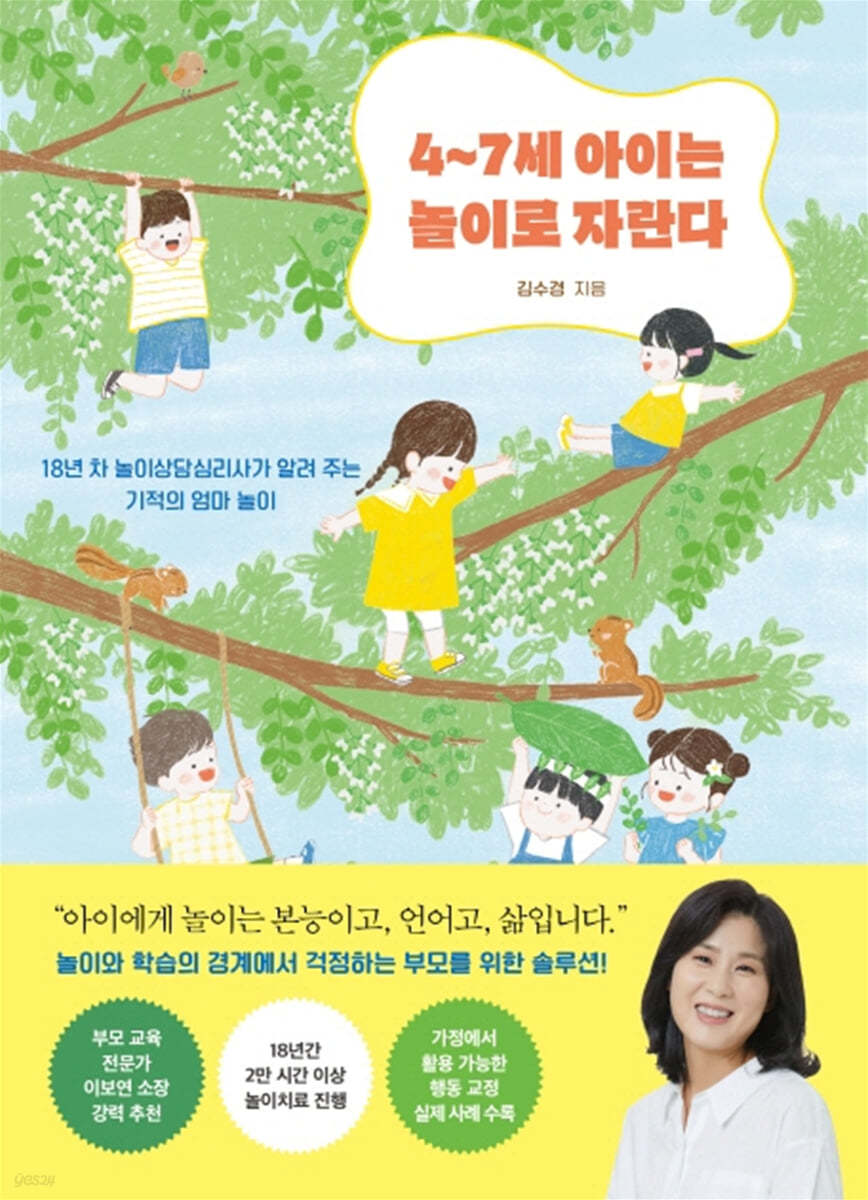
Children aged 4 to 7 grow through play.
 |
Description
Book Introduction
- A word from MD
-
How to Play Well with Your ChildCorrect play methods introduced by Kim Soo-kyung, a play counselor with 18 years of experience.
Most parents are tired because they don't know how much and how to play with their children, and children are tired because their parents don't play with them as much as they want.
A clear guide that can be used directly in everyday life with children, from how to properly play with children to solutions to problems.
July 5, 2022. Kim Joo-ri, PD of Home Life
“Even if you stick around 24 hours a day, you wouldn’t know
“My child’s inner thoughts began to become clear through ‘play’!”
★Highly recommended by Lee Bo-yeon, director of the Child and Family Counseling Center, a parent education expert★
★Over 20,000 hours of play therapy over 18 years★
★Includes behavior correction methods that can be used at home★
Every parent is a playmate for their child.
But are you really playing "properly" with your child? Even while playing, you're constantly distracted by the buzzing of KakaoTalk messages on your phone. Why does it feel like only 30 minutes have passed after a long day of playtime? The kid next door seems to be playing well on his own, but why does your child keep getting irritated during playtime? In most families, parents struggle because they don't know how much or how to play with their children, and children struggle because their parents don't play as much as they want.
Play is children's instinct, language, and life.
In particular, the age range of 4 to 7 is an important period when ‘real play’ begins, in which children begin to express and learn their thoughts and emotions through play.
If you look closely at how your child plays at this time, you can see what problems he or she has beyond his or her mind, temperament, and personality.
How a child interacts and plays with their parents can either promote their development or exacerbate behavioral problems.
This book goes beyond simply introducing play methods; it also helps parents examine and improve the play they normally do at home.
The author, who has spent over 20,000 hours over 18 years providing counseling and play therapy to parents and children, introduces proper play and conversation methods through everyday examples.
It also provides specific solutions to problems encountered in play situations.
This book is a friendly guide that offers warm courage and clear advice to parents who find playing with their children the most difficult thing in the world.
“My child’s inner thoughts began to become clear through ‘play’!”
★Highly recommended by Lee Bo-yeon, director of the Child and Family Counseling Center, a parent education expert★
★Over 20,000 hours of play therapy over 18 years★
★Includes behavior correction methods that can be used at home★
Every parent is a playmate for their child.
But are you really playing "properly" with your child? Even while playing, you're constantly distracted by the buzzing of KakaoTalk messages on your phone. Why does it feel like only 30 minutes have passed after a long day of playtime? The kid next door seems to be playing well on his own, but why does your child keep getting irritated during playtime? In most families, parents struggle because they don't know how much or how to play with their children, and children struggle because their parents don't play as much as they want.
Play is children's instinct, language, and life.
In particular, the age range of 4 to 7 is an important period when ‘real play’ begins, in which children begin to express and learn their thoughts and emotions through play.
If you look closely at how your child plays at this time, you can see what problems he or she has beyond his or her mind, temperament, and personality.
How a child interacts and plays with their parents can either promote their development or exacerbate behavioral problems.
This book goes beyond simply introducing play methods; it also helps parents examine and improve the play they normally do at home.
The author, who has spent over 20,000 hours over 18 years providing counseling and play therapy to parents and children, introduces proper play and conversation methods through everyday examples.
It also provides specific solutions to problems encountered in play situations.
This book is a friendly guide that offers warm courage and clear advice to parents who find playing with their children the most difficult thing in the world.
- You can preview some of the book's contents.
Preview
index
Recommendations: Lively stories from mothers who dream of a happy, playful parenting style.
Prologue: "Play" from a mother with 18 years of experience as a play counselor.
Part 1: Ages 4-7: Growing Up Through Play
Wait! Before we begin: Ages 4-7: The Critical Play Period
Chapter 01 Do I really have to play with you?
Can't you just play by yourself?
Should I do the worksheets before playing?
Why can't I get immersed when playing with my child?
How much should I play with it?
Did you have to travel far to play?
Can we understand a child's mind through play?
Chapter 02 Mom's Worries at Play: What Should I Do in This Situation?
A child who plays with a variety of toys in a distracting manner
A child who repeats similar games over and over again
A child who hands over play control to his mother
A child who specifies all the roles and actions of play
A child who gets annoyed when his younger sibling interferes with his play
A child whose roles are fixed when playing with siblings
A child who hurts others while playing
Chapter 03 Expanding Play: How do you play with friends?
Do you really need time to play with friends?
How to develop social skills in an only child?
What role should parents play at the playground?
What do you do when three people are playing and one person gets left out?
What if you have a hard time keeping up with your friends' play?
What if you just want to play the way you want?
When is it difficult to join in on your friends' play?
Part 2 4~7 years old, what do they do for fun?
Wait! Before we begin: Six types of play that expand your child's world.
Role-playing to help develop first-hand empathy and expand thinking
Why is role-playing important?
Let's not fall into the trap of trying to teach a lesson!
Don't rush the child and just let the child play.
Let's expand the play by using various language expressions!
Block play, which develops the second creativity and spatial perception ability
What's good about block play?
What if the blocks fall down and the child gets upset?
Connecting from block building to role-playing
Developing conflict situations to fit the play context
A board game that develops emotional regulation and problem-solving skills
Board games, do I really need to play them?
Gently restrict and warmly encourage
No fouls or cheating
Make one game a little more complicated!
The fourth is art play, which helps with emotional stability and emotional expression.
Is art play sufficient even in kindergarten?
Can you express your emotions with balloons?
Have fun playing with supplies that are easily available around you.
I can see the child's heart in the picture.
Fifth, physical play to help regulate the body and release energy
Let's have fun with our bodies!
Is outdoor physical play always good for active children?
Two birds with one stone: games that help you focus and control your impulses.
Physical exercises that anyone can easily follow
Sixth, nature play that fosters imagination and observation skills
All natural objects are toys?
Feel the new vitality with your five senses
Have fun and stay cool in the heat
Enjoy the colorful autumn leaves and cool breeze.
Don't be cooped up, have fun outside too.
Epilogue: Parents must be healthy in mind and body to continue playing with their children.
Prologue: "Play" from a mother with 18 years of experience as a play counselor.
Part 1: Ages 4-7: Growing Up Through Play
Wait! Before we begin: Ages 4-7: The Critical Play Period
Chapter 01 Do I really have to play with you?
Can't you just play by yourself?
Should I do the worksheets before playing?
Why can't I get immersed when playing with my child?
How much should I play with it?
Did you have to travel far to play?
Can we understand a child's mind through play?
Chapter 02 Mom's Worries at Play: What Should I Do in This Situation?
A child who plays with a variety of toys in a distracting manner
A child who repeats similar games over and over again
A child who hands over play control to his mother
A child who specifies all the roles and actions of play
A child who gets annoyed when his younger sibling interferes with his play
A child whose roles are fixed when playing with siblings
A child who hurts others while playing
Chapter 03 Expanding Play: How do you play with friends?
Do you really need time to play with friends?
How to develop social skills in an only child?
What role should parents play at the playground?
What do you do when three people are playing and one person gets left out?
What if you have a hard time keeping up with your friends' play?
What if you just want to play the way you want?
When is it difficult to join in on your friends' play?
Part 2 4~7 years old, what do they do for fun?
Wait! Before we begin: Six types of play that expand your child's world.
Role-playing to help develop first-hand empathy and expand thinking
Why is role-playing important?
Let's not fall into the trap of trying to teach a lesson!
Don't rush the child and just let the child play.
Let's expand the play by using various language expressions!
Block play, which develops the second creativity and spatial perception ability
What's good about block play?
What if the blocks fall down and the child gets upset?
Connecting from block building to role-playing
Developing conflict situations to fit the play context
A board game that develops emotional regulation and problem-solving skills
Board games, do I really need to play them?
Gently restrict and warmly encourage
No fouls or cheating
Make one game a little more complicated!
The fourth is art play, which helps with emotional stability and emotional expression.
Is art play sufficient even in kindergarten?
Can you express your emotions with balloons?
Have fun playing with supplies that are easily available around you.
I can see the child's heart in the picture.
Fifth, physical play to help regulate the body and release energy
Let's have fun with our bodies!
Is outdoor physical play always good for active children?
Two birds with one stone: games that help you focus and control your impulses.
Physical exercises that anyone can easily follow
Sixth, nature play that fosters imagination and observation skills
All natural objects are toys?
Feel the new vitality with your five senses
Have fun and stay cool in the heat
Enjoy the colorful autumn leaves and cool breeze.
Don't be cooped up, have fun outside too.
Epilogue: Parents must be healthy in mind and body to continue playing with their children.
Detailed image

Into the book
From the time my daughter turned three, we went to the playground frequently.
Then I started to look closely at the children and mothers playing at the playground.
"That child's difficulties could be resolved with just a little help in that situation, but Mom doesn't seem to know." "That child seems to need a lot of interaction with Mom." Seeing the various mothers and children at the playground filled me with pity.
And a year later, as a mother of one child, not a counselor, I started having honest conversations with many mothers at the playground.
At that time, I saw the real concerns of mothers with children aged 4 to 7 and the reality of childcare.
If I were to describe the mother and child I often saw in the counseling room as 'half', I felt like I was facing the whole picture by confirming the other half that was hidden.
--- p.
9 「Prologue.
From “Play” by a mother who has been a play counselor for 18 years
For a child, play is an instinct, a language, and life.
Parents, on the other hand, are not like that.
So, in order to truly communicate with their children, parents must also learn how to play one by one.
Of course, it may be awkward and difficult at first.
But just having the mindset to learn to play is already the first step.
As those steps accumulate one by one, at some point you will feel that playing with your child becomes enjoyable and that you are communicating emotionally.
Now let's walk that path together.
--- p.
43 From "Chapter 01 Do I have to play with you?"
When children and their mothers play together, try to make sure that the children are on the same side.
Then the children unite and play together.
It's okay for mom to act as a stepping stone.
For example, if two children play the roles of Peter Pan and Wendy, the mother can play as Tinker Bell and connect the two.
It's hard for a mother to always join in on her children's play, but when children's play choices and roles are fixed, it's a good idea for a mother to play with her children and balance the play.
In this way, they learn not only how to interact with each other but also how to resolve conflicts, and their brotherly bond becomes stronger.
--- p.
100 From “Chapter 02 Mom’s Worries in Play: What Should I Do in This Situation?”
The playground is a meeting place.
Here, parents sometimes rest and hear parenting information from other mothers.
You may even find a neighboring mom with whom you can share your heart.
But we often miss the moment when we need to teach our children how to deal with conflict situations.
This does not mean that you should follow your child around and interfere with his or her every move.
This means that you should watch and observe your child frequently while talking to the neighboring mother or while taking a short break by sitting on a bench.
Many parents are not very interested in their children's play and do not intervene much because they think that playgrounds are just places for children to let loose.
In fact, playgrounds are the best places to learn social skills because they bring together children of all ages, genders, and personalities to play.
--- p.
121 From “Chapter 03 Expanding Play: How do you play with friends?”
When we role-play, we often outpace the child's play at some point.
In doing so, we end up making the mistake of creating the content of the play rather than encouraging the child to play.
When playing with a child, the child creates the content of the play, and the parent just stays in the play and responds.
To use a cooking analogy, parents would sprinkle salt or sugar on the food their children made to make it more delicious.
--- p.
167 “First.
From “Role Playing: Helping to Improve Empathy and Expand Thinking”
To raise children who are willing to try again without being fixated on failure, parents must encourage their children's play process and respond flexibly to frustrating situations.
When a block your child is building starts to wobble, instead of immediately telling them to "fix it," ask them what to do about the situation.
If the blocks fall down and your child cries and gets upset, read your child's feelings and wait a moment for them to calm down.
Because the child also needs time to accept this situation and process his emotions.
At this time, if the mother quickly consoles the child by saying that it is okay and rebuilds the broken blocks by herself in an attempt to resolve the child's upset feelings, it will not help the child develop self-control.
Even if the blocks fall down, you must always praise the child for the effort or effort they put into playing.
Children grow through a lot of trial and error while playing.
I hope parents will recognize this and encourage and support their children.
Then I started to look closely at the children and mothers playing at the playground.
"That child's difficulties could be resolved with just a little help in that situation, but Mom doesn't seem to know." "That child seems to need a lot of interaction with Mom." Seeing the various mothers and children at the playground filled me with pity.
And a year later, as a mother of one child, not a counselor, I started having honest conversations with many mothers at the playground.
At that time, I saw the real concerns of mothers with children aged 4 to 7 and the reality of childcare.
If I were to describe the mother and child I often saw in the counseling room as 'half', I felt like I was facing the whole picture by confirming the other half that was hidden.
--- p.
9 「Prologue.
From “Play” by a mother who has been a play counselor for 18 years
For a child, play is an instinct, a language, and life.
Parents, on the other hand, are not like that.
So, in order to truly communicate with their children, parents must also learn how to play one by one.
Of course, it may be awkward and difficult at first.
But just having the mindset to learn to play is already the first step.
As those steps accumulate one by one, at some point you will feel that playing with your child becomes enjoyable and that you are communicating emotionally.
Now let's walk that path together.
--- p.
43 From "Chapter 01 Do I have to play with you?"
When children and their mothers play together, try to make sure that the children are on the same side.
Then the children unite and play together.
It's okay for mom to act as a stepping stone.
For example, if two children play the roles of Peter Pan and Wendy, the mother can play as Tinker Bell and connect the two.
It's hard for a mother to always join in on her children's play, but when children's play choices and roles are fixed, it's a good idea for a mother to play with her children and balance the play.
In this way, they learn not only how to interact with each other but also how to resolve conflicts, and their brotherly bond becomes stronger.
--- p.
100 From “Chapter 02 Mom’s Worries in Play: What Should I Do in This Situation?”
The playground is a meeting place.
Here, parents sometimes rest and hear parenting information from other mothers.
You may even find a neighboring mom with whom you can share your heart.
But we often miss the moment when we need to teach our children how to deal with conflict situations.
This does not mean that you should follow your child around and interfere with his or her every move.
This means that you should watch and observe your child frequently while talking to the neighboring mother or while taking a short break by sitting on a bench.
Many parents are not very interested in their children's play and do not intervene much because they think that playgrounds are just places for children to let loose.
In fact, playgrounds are the best places to learn social skills because they bring together children of all ages, genders, and personalities to play.
--- p.
121 From “Chapter 03 Expanding Play: How do you play with friends?”
When we role-play, we often outpace the child's play at some point.
In doing so, we end up making the mistake of creating the content of the play rather than encouraging the child to play.
When playing with a child, the child creates the content of the play, and the parent just stays in the play and responds.
To use a cooking analogy, parents would sprinkle salt or sugar on the food their children made to make it more delicious.
--- p.
167 “First.
From “Role Playing: Helping to Improve Empathy and Expand Thinking”
To raise children who are willing to try again without being fixated on failure, parents must encourage their children's play process and respond flexibly to frustrating situations.
When a block your child is building starts to wobble, instead of immediately telling them to "fix it," ask them what to do about the situation.
If the blocks fall down and your child cries and gets upset, read your child's feelings and wait a moment for them to calm down.
Because the child also needs time to accept this situation and process his emotions.
At this time, if the mother quickly consoles the child by saying that it is okay and rebuilds the broken blocks by herself in an attempt to resolve the child's upset feelings, it will not help the child develop self-control.
Even if the blocks fall down, you must always praise the child for the effort or effort they put into playing.
Children grow through a lot of trial and error while playing.
I hope parents will recognize this and encourage and support their children.
--- p.
183 “Second.
From “Block play that develops creativity and spatial perception”
183 “Second.
From “Block play that develops creativity and spatial perception”
Publisher's Review
“For a child, play is an instinct, a language, and life.”
Over 18 years, I have provided counseling and play therapy to countless parents and children for over 20,000 hours.
Miraculous Mom Play from a Play Counselor
“Am I playing properly right now?”
“Why is it so hard to play with a child?”
In an era where ‘play’ has become the basis of child-rearing.
Many parents are aware of the importance of play and that children grow through play, but they don't know why or how to play.
Parents often have misconceptions about play.
I think you should go to a nice place and play with your child all day.
However, the most important thing in play is not where and how much you play with your child, but how well you make eye contact and communicate with your child while playing.
How a child interacts and plays with their parents can either promote their development or exacerbate behavioral problems.
The author, who has met countless mothers and children for 18 years, empathized with their difficulties, and conducted play therapy and counseling, says that through 'play', one can not only look into a child's inner thoughts but also give wings to the child's growth and development.
In particular, as a play counselor and mother of one child, she has gone beyond the counseling room and gone directly to the playground, an actual childcare site, to share her play know-how with parents who are lost and do not know how to play with their children while co-parenting with many families.
"Children aged 4 to 7 grow through play" introduces the correct way for parents and children to play and communicate through examples easily found at home.
Additionally, we have created a ‘Parent Checklist’ to help you check your child’s usual play habits and find toys and play methods that are perfect for your child’s personality and temperament.
We provide warm and clear advice to parents who are concerned about their child's play style and how to help them grow better through play.
Solutions for parents concerned about the boundaries between play and learning.
A mother's play textbook that nurtures children's minds and study skills!
Ages 4 to 7 are a period of explosive growth in a child's cognition, emotions, sociality, language, and body.
For children aged 4 to 7, who are in the preoperational stage, study and play cannot be separated.
Rather, through diverse and rich play, children learn all the core competencies that develop their minds and learning abilities, such as cognitive ability, observation skills, emotional control skills, empathy skills, problem-solving skills, and language skills.
This is why play is more important than anything else for children aged 4 to 7.
This book is divided into two parts.
Part 1 covers the vivid reality of parenting for parents who find it difficult to play with their children, misunderstandings about play, and the importance of play, centered around case studies.
You can find clear solutions for your child's play behavior, which is burdensome to go to the counseling room and uncomfortable to just ignore.
In Part 2, the play enjoyed by children aged 4 to 7 is divided into six types: role play, block play, board games, art play, physical play, and nature play, and the interaction methods for each type of play are explained in detail.
You can learn fun and simple games to play with your children at home.
The more children play, the better they grow.
A child's world expands through enjoyable play with their parents.
This book, written by a counselor and a mother, is a must-read for parenting that helps parents improve their children's social and emotional development, language, physical and cognitive development, and even behavioral problems by guiding them to play appropriately with their children.
Mothers who dream of happy playful parenting
A vivid story sent to this book
“I believe this book will guide parents who may be inexperienced at parenting but have the greatest love for their children on the path to happiness.” - Mother of Hajun, Yuchan, and Yeseo
"I'm so grateful to the teacher who suddenly appeared before me and guided me on the right path when I had so many worries and concerns about raising a child." - Hyunseong's mother
“This book is filled with the teacher’s warm gaze toward the children and her joy at their growth.” - Kyungho’s mother
“This book is full of things I’ve always wondered about, such as how to have fun with your child with just one balloon, and how to spend time laughing and giggling with your child. I’m already looking forward to it.” - Seowon’s mother
“I, who had a harder time playing with my child than feeding and clothing him, believe that through this book I can become a wonderful mother who plays well with him.” - Sejun’s mother
“I hope the warmth of the teacher who generously shared her parenting know-how with me will be conveyed to the readers.” - Eunseong and Hayoon’s mother
Over 18 years, I have provided counseling and play therapy to countless parents and children for over 20,000 hours.
Miraculous Mom Play from a Play Counselor
“Am I playing properly right now?”
“Why is it so hard to play with a child?”
In an era where ‘play’ has become the basis of child-rearing.
Many parents are aware of the importance of play and that children grow through play, but they don't know why or how to play.
Parents often have misconceptions about play.
I think you should go to a nice place and play with your child all day.
However, the most important thing in play is not where and how much you play with your child, but how well you make eye contact and communicate with your child while playing.
How a child interacts and plays with their parents can either promote their development or exacerbate behavioral problems.
The author, who has met countless mothers and children for 18 years, empathized with their difficulties, and conducted play therapy and counseling, says that through 'play', one can not only look into a child's inner thoughts but also give wings to the child's growth and development.
In particular, as a play counselor and mother of one child, she has gone beyond the counseling room and gone directly to the playground, an actual childcare site, to share her play know-how with parents who are lost and do not know how to play with their children while co-parenting with many families.
"Children aged 4 to 7 grow through play" introduces the correct way for parents and children to play and communicate through examples easily found at home.
Additionally, we have created a ‘Parent Checklist’ to help you check your child’s usual play habits and find toys and play methods that are perfect for your child’s personality and temperament.
We provide warm and clear advice to parents who are concerned about their child's play style and how to help them grow better through play.
Solutions for parents concerned about the boundaries between play and learning.
A mother's play textbook that nurtures children's minds and study skills!
Ages 4 to 7 are a period of explosive growth in a child's cognition, emotions, sociality, language, and body.
For children aged 4 to 7, who are in the preoperational stage, study and play cannot be separated.
Rather, through diverse and rich play, children learn all the core competencies that develop their minds and learning abilities, such as cognitive ability, observation skills, emotional control skills, empathy skills, problem-solving skills, and language skills.
This is why play is more important than anything else for children aged 4 to 7.
This book is divided into two parts.
Part 1 covers the vivid reality of parenting for parents who find it difficult to play with their children, misunderstandings about play, and the importance of play, centered around case studies.
You can find clear solutions for your child's play behavior, which is burdensome to go to the counseling room and uncomfortable to just ignore.
In Part 2, the play enjoyed by children aged 4 to 7 is divided into six types: role play, block play, board games, art play, physical play, and nature play, and the interaction methods for each type of play are explained in detail.
You can learn fun and simple games to play with your children at home.
The more children play, the better they grow.
A child's world expands through enjoyable play with their parents.
This book, written by a counselor and a mother, is a must-read for parenting that helps parents improve their children's social and emotional development, language, physical and cognitive development, and even behavioral problems by guiding them to play appropriately with their children.
Mothers who dream of happy playful parenting
A vivid story sent to this book
“I believe this book will guide parents who may be inexperienced at parenting but have the greatest love for their children on the path to happiness.” - Mother of Hajun, Yuchan, and Yeseo
"I'm so grateful to the teacher who suddenly appeared before me and guided me on the right path when I had so many worries and concerns about raising a child." - Hyunseong's mother
“This book is filled with the teacher’s warm gaze toward the children and her joy at their growth.” - Kyungho’s mother
“This book is full of things I’ve always wondered about, such as how to have fun with your child with just one balloon, and how to spend time laughing and giggling with your child. I’m already looking forward to it.” - Seowon’s mother
“I, who had a harder time playing with my child than feeding and clothing him, believe that through this book I can become a wonderful mother who plays well with him.” - Sejun’s mother
“I hope the warmth of the teacher who generously shared her parenting know-how with me will be conveyed to the readers.” - Eunseong and Hayoon’s mother
GOODS SPECIFICS
- Publication date: June 23, 2022
- Page count, weight, size: 280 pages | 492g | 152*210*17mm
- ISBN13: 9791130691244
- ISBN10: 1130691241
You may also like
카테고리
korean


korean

![GQ KOREA Mark (Monthly): December [2025]](http://librairie.coreenne.fr/cdn/shop/files/8ef265dbbfbf186523ed75ba7319009d.jpg?v=1765340328&width=3840)


