

A child who is good at math, a child who is good at math
 |
Description
Book Introduction
How to Use Math as a Weapon to Expand Your Child's Life Choices
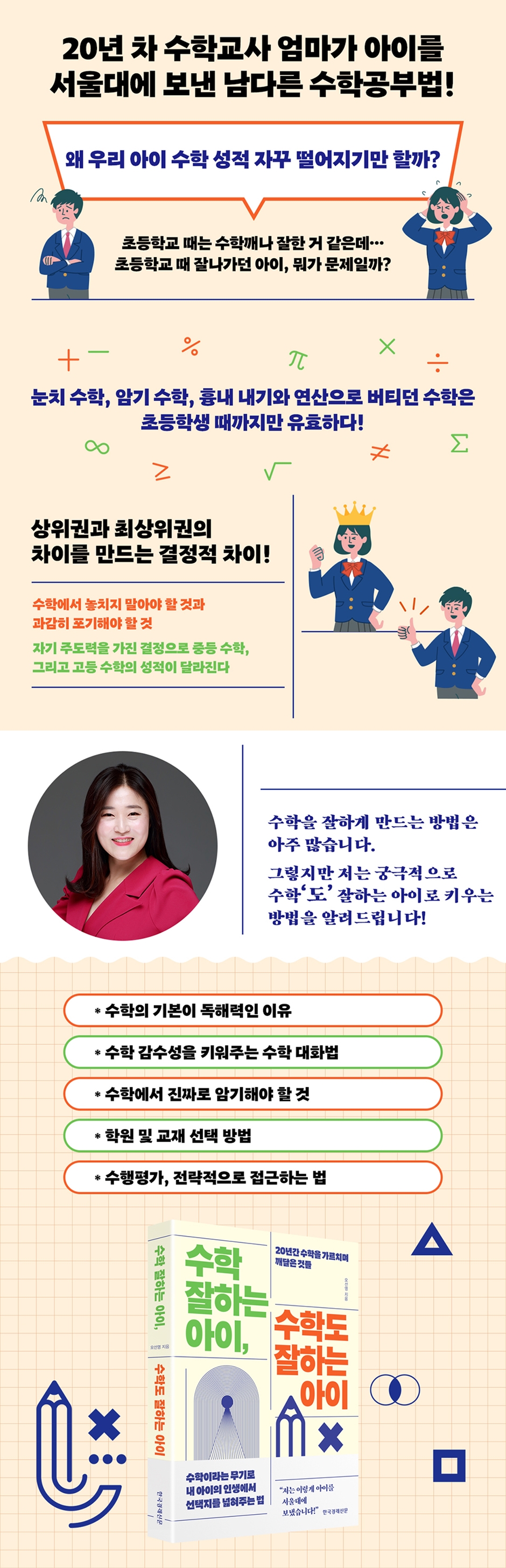
Math by sight and memorization are only effective until elementary school.
Break away from mathematics that relies on imitation and calculation and pursue more than mathematics!
“This is how I sent my child to Seoul National University!”
The author, who has worked as a math teacher for over 20 years and met and taught countless students, says that teaching math to students was easy.
But when I ask myself whether the students were learning well, I feel unsure.
The author says that it was while raising his own child that he began to see students from their perspective.
In the world of raising children, where things don't always go as planned, I realized that willpower alone doesn't guarantee success.
That is precisely why I wrote the book, “A Child Good at Math, A Child Good at Math.”
With my background as a math teacher, I wanted to teach children how to do well in math, how to improve their math grades, how to avoid becoming math dropouts, and at the same time, I wanted to teach them how to make the most important decisions in their lives.
The story is a result of mixing my background as a math teacher and my background as a mother of a child who entered the College of Liberal Arts at Seoul National University in 2022.
Although the story unfolds through the lens of mathematics, the main theme is the desirable role of parents in raising happy children.
As a parent raising a child, I know that studying, especially math, is a very urgent topic right now, so I tried to find a balance between the two.
In particular, parents who have children who struggle with math or want to improve their math skills but are confused about where they went wrong or where to start will find the practical methods introduced in this book helpful.
Ultimately, what every parent wants is for their child to live a life where they are satisfied with the choices they have made for themselves.
Unhappy studies can never make a child happy.
This is why self-direction is important.
The author honestly shows the process of finding self-direction and fostering self-direction in children, and encourages them to pursue more than just math grades.
For our children living in the age of mathematics, mathematical skills can be a powerful weapon that broadens their life choices, and this book will teach them how to do so.
Math by sight and memorization are only effective until elementary school.
Break away from mathematics that relies on imitation and calculation and pursue more than mathematics!
“This is how I sent my child to Seoul National University!”
The author, who has worked as a math teacher for over 20 years and met and taught countless students, says that teaching math to students was easy.
But when I ask myself whether the students were learning well, I feel unsure.
The author says that it was while raising his own child that he began to see students from their perspective.
In the world of raising children, where things don't always go as planned, I realized that willpower alone doesn't guarantee success.
That is precisely why I wrote the book, “A Child Good at Math, A Child Good at Math.”
With my background as a math teacher, I wanted to teach children how to do well in math, how to improve their math grades, how to avoid becoming math dropouts, and at the same time, I wanted to teach them how to make the most important decisions in their lives.
The story is a result of mixing my background as a math teacher and my background as a mother of a child who entered the College of Liberal Arts at Seoul National University in 2022.
Although the story unfolds through the lens of mathematics, the main theme is the desirable role of parents in raising happy children.
As a parent raising a child, I know that studying, especially math, is a very urgent topic right now, so I tried to find a balance between the two.
In particular, parents who have children who struggle with math or want to improve their math skills but are confused about where they went wrong or where to start will find the practical methods introduced in this book helpful.
Ultimately, what every parent wants is for their child to live a life where they are satisfied with the choices they have made for themselves.
Unhappy studies can never make a child happy.
This is why self-direction is important.
The author honestly shows the process of finding self-direction and fostering self-direction in children, and encourages them to pursue more than just math grades.
For our children living in the age of mathematics, mathematical skills can be a powerful weapon that broadens their life choices, and this book will teach them how to do so.
- You can preview some of the book's contents.
Preview
index
Prologue: Things That Don't Change Even If You're Good at Math
Chapter 1: Why Do Math Grades Keep Falling?
1.
Children living in the age of mathematics
Why is math getting harder? | A society where math feeds us | Math is a time-consuming monster
2.
What's the problem with a child who was doing well in elementary school?
In elementary math, understanding the concepts and correct answers are separate. | When is it possible to learn by sight? | Are operations important for all children? | The crucial difference between elementary and middle school math. | The crucial difference between middle school and high school math.
3.
Mathematics education that nurtures students who drop out of math
Why are there so few mothers' guides to math? | A game of wits that begins in first grade | Parents and children caught in the academy dilemma | Mathematical thinking is ultimately about problem-solving.
4.
Life becomes easier if you're good at math.
Math is even more important for liberal arts students | What is the true purpose of math? | Why the world is focusing on math.
* Parenting Class_What Kind of Parent Am I?
Chapter 2: What to Don't Miss and What to Let Go of in Elementary Mathematics
1.
The foundation of mathematics is reading comprehension, not calculation.
Will Reading Math Fairy Tales Improve Your Math? | Why Long Problems Feel Difficult | Math Can Improve Reading Comprehension
2.
Confidence in math is skill.
Even a sense of closeness is okay! | The power of positive feedback and praise | Children who don't fear failure succeed | Solve only one problem a day | Be careful with academy level tests!
3.
Above all, it is important not to hate math.
This is the goal of elementary math! | Math conversations that foster mathematical sensitivity | The negative effects of praise | Having your own principles will keep you from falling behind.
4.
The thing you should stay away from the most: impatience
The Final Sprint Matters | Surrender to the River of Time | Why You Need to Learn to Learn
* Parenting Class: Two Common Mistakes Smart Parents Make
Chapter 3: Secondary Math: It's Not Too Late
1.
How can I get better at middle school math?
Post-learning is more important than pre-learning | Does solving more problems improve math grades? | What you really need to memorize in math | Slow Math: Give it a try!
2.
The difference between the top and the bottom
Children who do things because they're told to, and children who do things because they want to | Separate reality from ideals | The secret to self-management for top-tier children
3.
It's too early to become a water blisters
Am I good at math? | A great time to study math | Middle school grades are generally unreliable.
* Parenting Class_Becoming an Unwavering Parent
Chapter 4: The Correlation Between Self-Direction and Mathematics
1.
Is it possible to study on your own?
The Difference Between Self-Directed Learning and Self-Study | Get Your Child's Heart Beating First | Find Real-World Role Models Instead of Chasing Vague Dreams | A Self-Managing Attitude
2.
Effort is quality over quantity.
Just because you like something doesn't mean you're good at it | Focus on your strengths | Manage your Achilles heel | Become a parent who asks questions, not dictates.
3.
Success or failure is my choice.
The first step to overcoming failure is self-reflection | You need to practice becoming numb to failure | When you accidentally get a question you know wrong
4.
Private education and self-directed learning
Studying is a specialty | Why money shouldn't solve education | Are academies the enemy of self-directed learning? | How should I choose a good academy?
* Parenting Class_It's better to have insufficient parents than to have too many parents.
Chapter 5: How to Raise a Math-Savvy Child
1.
If grades are your goal, you won't get far.
Observe and observe again | Start with what you love | Have the courage to grow differently | Focus on a single principle
2.
Raise your child to love math.
Blessed are those who persevere | Success comes before new challenges | How to excel at what you love
3.
Studying math, try this from now on!
Emergency Remedies for Lacking Basics | Adolescent Rebellion is a Good Math Resource | Which Math Textbook Should You Choose? | Examples of Using Answer Sheets
4.
Becoming a child who is good at math
Try to reduce your study time | Stimulate your brain with one-minute table of contents reading | Make the most of the crucial vacation period | Avoid the temptation of blind pre-studying
5.
The magic string that connects skills to scores
Use your teacher more than your answer sheet | Even test questions need a good first impression | Prepare for the real test with image training | Overcome test anxiety like this | Approach performance assessments strategically
* Parenting Class_How to Converse with Dignity
Epilogue_Isn't he already such a good kid?
Chapter 1: Why Do Math Grades Keep Falling?
1.
Children living in the age of mathematics
Why is math getting harder? | A society where math feeds us | Math is a time-consuming monster
2.
What's the problem with a child who was doing well in elementary school?
In elementary math, understanding the concepts and correct answers are separate. | When is it possible to learn by sight? | Are operations important for all children? | The crucial difference between elementary and middle school math. | The crucial difference between middle school and high school math.
3.
Mathematics education that nurtures students who drop out of math
Why are there so few mothers' guides to math? | A game of wits that begins in first grade | Parents and children caught in the academy dilemma | Mathematical thinking is ultimately about problem-solving.
4.
Life becomes easier if you're good at math.
Math is even more important for liberal arts students | What is the true purpose of math? | Why the world is focusing on math.
* Parenting Class_What Kind of Parent Am I?
Chapter 2: What to Don't Miss and What to Let Go of in Elementary Mathematics
1.
The foundation of mathematics is reading comprehension, not calculation.
Will Reading Math Fairy Tales Improve Your Math? | Why Long Problems Feel Difficult | Math Can Improve Reading Comprehension
2.
Confidence in math is skill.
Even a sense of closeness is okay! | The power of positive feedback and praise | Children who don't fear failure succeed | Solve only one problem a day | Be careful with academy level tests!
3.
Above all, it is important not to hate math.
This is the goal of elementary math! | Math conversations that foster mathematical sensitivity | The negative effects of praise | Having your own principles will keep you from falling behind.
4.
The thing you should stay away from the most: impatience
The Final Sprint Matters | Surrender to the River of Time | Why You Need to Learn to Learn
* Parenting Class: Two Common Mistakes Smart Parents Make
Chapter 3: Secondary Math: It's Not Too Late
1.
How can I get better at middle school math?
Post-learning is more important than pre-learning | Does solving more problems improve math grades? | What you really need to memorize in math | Slow Math: Give it a try!
2.
The difference between the top and the bottom
Children who do things because they're told to, and children who do things because they want to | Separate reality from ideals | The secret to self-management for top-tier children
3.
It's too early to become a water blisters
Am I good at math? | A great time to study math | Middle school grades are generally unreliable.
* Parenting Class_Becoming an Unwavering Parent
Chapter 4: The Correlation Between Self-Direction and Mathematics
1.
Is it possible to study on your own?
The Difference Between Self-Directed Learning and Self-Study | Get Your Child's Heart Beating First | Find Real-World Role Models Instead of Chasing Vague Dreams | A Self-Managing Attitude
2.
Effort is quality over quantity.
Just because you like something doesn't mean you're good at it | Focus on your strengths | Manage your Achilles heel | Become a parent who asks questions, not dictates.
3.
Success or failure is my choice.
The first step to overcoming failure is self-reflection | You need to practice becoming numb to failure | When you accidentally get a question you know wrong
4.
Private education and self-directed learning
Studying is a specialty | Why money shouldn't solve education | Are academies the enemy of self-directed learning? | How should I choose a good academy?
* Parenting Class_It's better to have insufficient parents than to have too many parents.
Chapter 5: How to Raise a Math-Savvy Child
1.
If grades are your goal, you won't get far.
Observe and observe again | Start with what you love | Have the courage to grow differently | Focus on a single principle
2.
Raise your child to love math.
Blessed are those who persevere | Success comes before new challenges | How to excel at what you love
3.
Studying math, try this from now on!
Emergency Remedies for Lacking Basics | Adolescent Rebellion is a Good Math Resource | Which Math Textbook Should You Choose? | Examples of Using Answer Sheets
4.
Becoming a child who is good at math
Try to reduce your study time | Stimulate your brain with one-minute table of contents reading | Make the most of the crucial vacation period | Avoid the temptation of blind pre-studying
5.
The magic string that connects skills to scores
Use your teacher more than your answer sheet | Even test questions need a good first impression | Prepare for the real test with image training | Overcome test anxiety like this | Approach performance assessments strategically
* Parenting Class_How to Converse with Dignity
Epilogue_Isn't he already such a good kid?
Detailed image
Into the book
It was while raising my own children that I began to see students from their perspective.
Watching my child grow through infancy and childhood reminded me of my tadpole days that I had forgotten about, and through raising my child, who did not always go my way, I realized that not everything can be achieved through willpower alone.
--- p.
6 From the "Prologue"
In elementary school, bright children are bound to achieve excellent results in all subjects.
However, among these students, some often find math difficult as they advance in grade level.
It's a shame that I missed the opportunity to study math properly and understand the concepts because my true math skills were overshadowed by my intelligence.
Also, children who seem to be somewhat delayed may suffer more damage.
This is because the stigma of a child being “bad at math” is attached to them by adults who cannot wait for the time difference that occurs due to their immaturity.
--- p.
28 From “A Time When Studying Through Intuition Is Possible”
A technique that frequently appears when solving math problems is 'finding patterns'.
This type of conversation can give you a vague idea of what regularity is, and this experience will be very helpful in your future studies of mathematics.
This is also a way to develop a child's mathematical sensitivity.
A child who can express a phenomenon in mathematical language and continue a conversation using it is more likely to be good at math later in life, but above all, he or she will not become a student who hates math.
--- p.
87 From “Mathematics Conversations That Develop Mathematical Sensitivity”
Unless we are going to study math only until middle school and then quit, it is right that we make an effort to like math not only in elementary school but also in middle school.
I've seen countless middle school students mistake math for simply plugging numbers into memorized formulas, and they easily become complacent about the decent math scores they get from doing so.
Conversely, if your scores are poor, you may think you have no talent for math and give up early.
In middle school, what matters is not your math grades, but how you study math.
And we must not forget that it is never too late to start over.
--- p.
140 From "Middle School Grades Are Generally Unreliable"
When a child begins to struggle with math, you should give them more opportunities to get the right answer than to get it wrong.
Considering that math is a subject that does not tolerate even the slightest mistake, getting a perfect score is not easy from the beginning.
Conversely, when you get everything right, it has the effect of greatly increasing your confidence.
If your child is discouraged by math, it's a good idea to choose a textbook that's one level below their level so they can gain a lot of experience with success.
A worksheet filled with circles rather than a worksheet filled with dashes will encourage your child and give him confidence that he will be able to do well in the future.
--- p.
219 From “Successful experience comes before new challenges”
So, how should we read a math problem for the first time? We should read it without any emotion.
In order to fundamentally block out my emotions or feelings from interfering with the problem, I must look at the problem with pure eyes.
You should not underestimate a problem as easy after a quick glance, or give up on a problem as difficult before even trying.
Just as you need to talk to someone to determine whether they are a good person or not, the most important thing when first encountering a problem is not to be swayed by first impressions.
Watching my child grow through infancy and childhood reminded me of my tadpole days that I had forgotten about, and through raising my child, who did not always go my way, I realized that not everything can be achieved through willpower alone.
--- p.
6 From the "Prologue"
In elementary school, bright children are bound to achieve excellent results in all subjects.
However, among these students, some often find math difficult as they advance in grade level.
It's a shame that I missed the opportunity to study math properly and understand the concepts because my true math skills were overshadowed by my intelligence.
Also, children who seem to be somewhat delayed may suffer more damage.
This is because the stigma of a child being “bad at math” is attached to them by adults who cannot wait for the time difference that occurs due to their immaturity.
--- p.
28 From “A Time When Studying Through Intuition Is Possible”
A technique that frequently appears when solving math problems is 'finding patterns'.
This type of conversation can give you a vague idea of what regularity is, and this experience will be very helpful in your future studies of mathematics.
This is also a way to develop a child's mathematical sensitivity.
A child who can express a phenomenon in mathematical language and continue a conversation using it is more likely to be good at math later in life, but above all, he or she will not become a student who hates math.
--- p.
87 From “Mathematics Conversations That Develop Mathematical Sensitivity”
Unless we are going to study math only until middle school and then quit, it is right that we make an effort to like math not only in elementary school but also in middle school.
I've seen countless middle school students mistake math for simply plugging numbers into memorized formulas, and they easily become complacent about the decent math scores they get from doing so.
Conversely, if your scores are poor, you may think you have no talent for math and give up early.
In middle school, what matters is not your math grades, but how you study math.
And we must not forget that it is never too late to start over.
--- p.
140 From "Middle School Grades Are Generally Unreliable"
When a child begins to struggle with math, you should give them more opportunities to get the right answer than to get it wrong.
Considering that math is a subject that does not tolerate even the slightest mistake, getting a perfect score is not easy from the beginning.
Conversely, when you get everything right, it has the effect of greatly increasing your confidence.
If your child is discouraged by math, it's a good idea to choose a textbook that's one level below their level so they can gain a lot of experience with success.
A worksheet filled with circles rather than a worksheet filled with dashes will encourage your child and give him confidence that he will be able to do well in the future.
--- p.
219 From “Successful experience comes before new challenges”
So, how should we read a math problem for the first time? We should read it without any emotion.
In order to fundamentally block out my emotions or feelings from interfering with the problem, I must look at the problem with pure eyes.
You should not underestimate a problem as easy after a quick glance, or give up on a problem as difficult before even trying.
Just as you need to talk to someone to determine whether they are a good person or not, the most important thing when first encountering a problem is not to be swayed by first impressions.
--- p.
253 From “Test questions should also make a good first impression”
253 From “Test questions should also make a good first impression”
Publisher's Review
Why study math in an age where math dropouts are on the rise
The math skills of our country's students can be said to be among the best in the world.
However, the author says that when he comes across articles like this, he wonders how many children have come to hate math in order to select students with such outstanding math skills.
Not all students need to be good at math, but math is becoming unnecessarily difficult.
Among the major subjects, mathematics has the largest gap in academic achievement, and is a representative subject where educational inflation and polarization are worsening.
Why do our children have to study math, which is so difficult?
Mathematics is a representative discipline of logic, and the process of studying mathematics itself is the best tool for developing logical and problem-solving skills.
Math problems and the big and small problems we encounter in life are certainly different, but there are many similarities in the ways we solve them.
Problem solving is the activity of finding the optimal method by making the most of the given conditions.
A good problem solver can identify given conditions and focus on how to utilize them to achieve what he or she wants.
This is why we need a mathematical mindset and why we should study mathematics.
What to Don't Miss and What to Let Go of in Math
The period when children are bad at math is mostly middle school.
This is because elementary mathematics is more dependent on language skills than mathematical thinking skills, and the mathematical concepts themselves are intuitive.
Therefore, if you have language skills and a certain level of intuition, you can easily understand mathematics.
Elementary school students who are good at math are often more mature than their peers, but this is often due to their ability to make judgments rather than differences in ability.
It is possible to survive through imitation, intuition, and calculation.
However, secondary mathematics involves the task of mathematically defining and structuring the facts learned in elementary mathematics.
This is the crucial difference between elementary and secondary mathematics.
Mathematics begins to change from numbers to a discipline.
So, the period when the most blisters occur is during the third year of middle school.
Starting from advanced mathematics, problems that can only be solved by knowing various facts in addition to formulas appear. This is the very reason why students who gave up on mathematics in the third year of middle school end up taking the path of irreversible giving up after becoming high school students.
Because advanced mathematics requires comprehensive thinking to solve problems, it is important to have a solid foundation in mathematics in middle school.
This is the crucial difference between middle school and high school mathematics, and it is also what makes the difference between the top and the bottom.
Reactive learning is better than proactive learning, slow math is better than fast math, and qualitative math is better than quantitative math.
Our country's mathematics curriculum has a step structure.
That is why if your basics are weak, it is difficult to climb the next step, but on the other hand, if your skills are excellent, it is easy to climb the steps.
This is why retroactive learning is more effective than prior learning.
If you do a thorough study at the end of each unit, it will become a prerequisite.
Math isn't a speed race, and until middle school, it's easier to be good at math than to like it.
This means that with some practice, it is not difficult to get good scores.
But liking math is a different matter.
Unless you are going to study math only until middle school and then quit, it is right to make an effort to like math whether in elementary or middle school.
The most important principle in studying mathematics is to 'cherish the fish you catch.'
Solving and grading problems is like fishing to catch the wrong ones. You need to treasure the wrong ones you caught and use them properly to study real math to improve your skills.
Above all, it is most important that the child does not hate math, so it is important to constantly build the child's confidence and not to let go of the parent's impatience. This is the most basic of basics.
Self-directed learning to raise children who are good at math
The only thing parents have more than their children is age and experience.
Considering that experience is also a product of age, the only thing parents have more than their children is age.
Despite this, most parents are busy teaching, pointing out, and advising their children.
The best technique to make a child disobedient, dissatisfied with their studies, or dislike math is nagging.
The author says:
What I have realized from teaching math to children for over 20 years is that while it is possible to raise a child who is good at math through intuition and memorization, it is not easy to raise a child who is good at math, which will become a weapon in their life.
This is because it is not limited to just getting good grades in math, but rather is achieved through a process in which children think about and choose the things they need to decide in their lives.
Based on her own stories from her childhood, as a teacher, and as a mother, the author kindly shares what it means to be a parent and how to raise a child who loves and excels at math.
This book also shows that, just like children, parents can change their children's lives by leading a life of self-direction.
The math skills of our country's students can be said to be among the best in the world.
However, the author says that when he comes across articles like this, he wonders how many children have come to hate math in order to select students with such outstanding math skills.
Not all students need to be good at math, but math is becoming unnecessarily difficult.
Among the major subjects, mathematics has the largest gap in academic achievement, and is a representative subject where educational inflation and polarization are worsening.
Why do our children have to study math, which is so difficult?
Mathematics is a representative discipline of logic, and the process of studying mathematics itself is the best tool for developing logical and problem-solving skills.
Math problems and the big and small problems we encounter in life are certainly different, but there are many similarities in the ways we solve them.
Problem solving is the activity of finding the optimal method by making the most of the given conditions.
A good problem solver can identify given conditions and focus on how to utilize them to achieve what he or she wants.
This is why we need a mathematical mindset and why we should study mathematics.
What to Don't Miss and What to Let Go of in Math
The period when children are bad at math is mostly middle school.
This is because elementary mathematics is more dependent on language skills than mathematical thinking skills, and the mathematical concepts themselves are intuitive.
Therefore, if you have language skills and a certain level of intuition, you can easily understand mathematics.
Elementary school students who are good at math are often more mature than their peers, but this is often due to their ability to make judgments rather than differences in ability.
It is possible to survive through imitation, intuition, and calculation.
However, secondary mathematics involves the task of mathematically defining and structuring the facts learned in elementary mathematics.
This is the crucial difference between elementary and secondary mathematics.
Mathematics begins to change from numbers to a discipline.
So, the period when the most blisters occur is during the third year of middle school.
Starting from advanced mathematics, problems that can only be solved by knowing various facts in addition to formulas appear. This is the very reason why students who gave up on mathematics in the third year of middle school end up taking the path of irreversible giving up after becoming high school students.
Because advanced mathematics requires comprehensive thinking to solve problems, it is important to have a solid foundation in mathematics in middle school.
This is the crucial difference between middle school and high school mathematics, and it is also what makes the difference between the top and the bottom.
Reactive learning is better than proactive learning, slow math is better than fast math, and qualitative math is better than quantitative math.
Our country's mathematics curriculum has a step structure.
That is why if your basics are weak, it is difficult to climb the next step, but on the other hand, if your skills are excellent, it is easy to climb the steps.
This is why retroactive learning is more effective than prior learning.
If you do a thorough study at the end of each unit, it will become a prerequisite.
Math isn't a speed race, and until middle school, it's easier to be good at math than to like it.
This means that with some practice, it is not difficult to get good scores.
But liking math is a different matter.
Unless you are going to study math only until middle school and then quit, it is right to make an effort to like math whether in elementary or middle school.
The most important principle in studying mathematics is to 'cherish the fish you catch.'
Solving and grading problems is like fishing to catch the wrong ones. You need to treasure the wrong ones you caught and use them properly to study real math to improve your skills.
Above all, it is most important that the child does not hate math, so it is important to constantly build the child's confidence and not to let go of the parent's impatience. This is the most basic of basics.
Self-directed learning to raise children who are good at math
The only thing parents have more than their children is age and experience.
Considering that experience is also a product of age, the only thing parents have more than their children is age.
Despite this, most parents are busy teaching, pointing out, and advising their children.
The best technique to make a child disobedient, dissatisfied with their studies, or dislike math is nagging.
The author says:
What I have realized from teaching math to children for over 20 years is that while it is possible to raise a child who is good at math through intuition and memorization, it is not easy to raise a child who is good at math, which will become a weapon in their life.
This is because it is not limited to just getting good grades in math, but rather is achieved through a process in which children think about and choose the things they need to decide in their lives.
Based on her own stories from her childhood, as a teacher, and as a mother, the author kindly shares what it means to be a parent and how to raise a child who loves and excels at math.
This book also shows that, just like children, parents can change their children's lives by leading a life of self-direction.
GOODS SPECIFICS
- Date of issue: May 12, 2022
- Page count, weight, size: 276 pages | 474g | 150*210*18mm
- ISBN13: 9788947548199
- ISBN10: 8947548197
You may also like
카테고리
korean


korean

![ELLE 엘르 스페셜 에디션 A형 : 12월 [2025]](http://librairie.coreenne.fr/cdn/shop/files/b8e27a3de6c9538896439686c6b0e8fb.jpg?v=1766436872&width=3840)


