

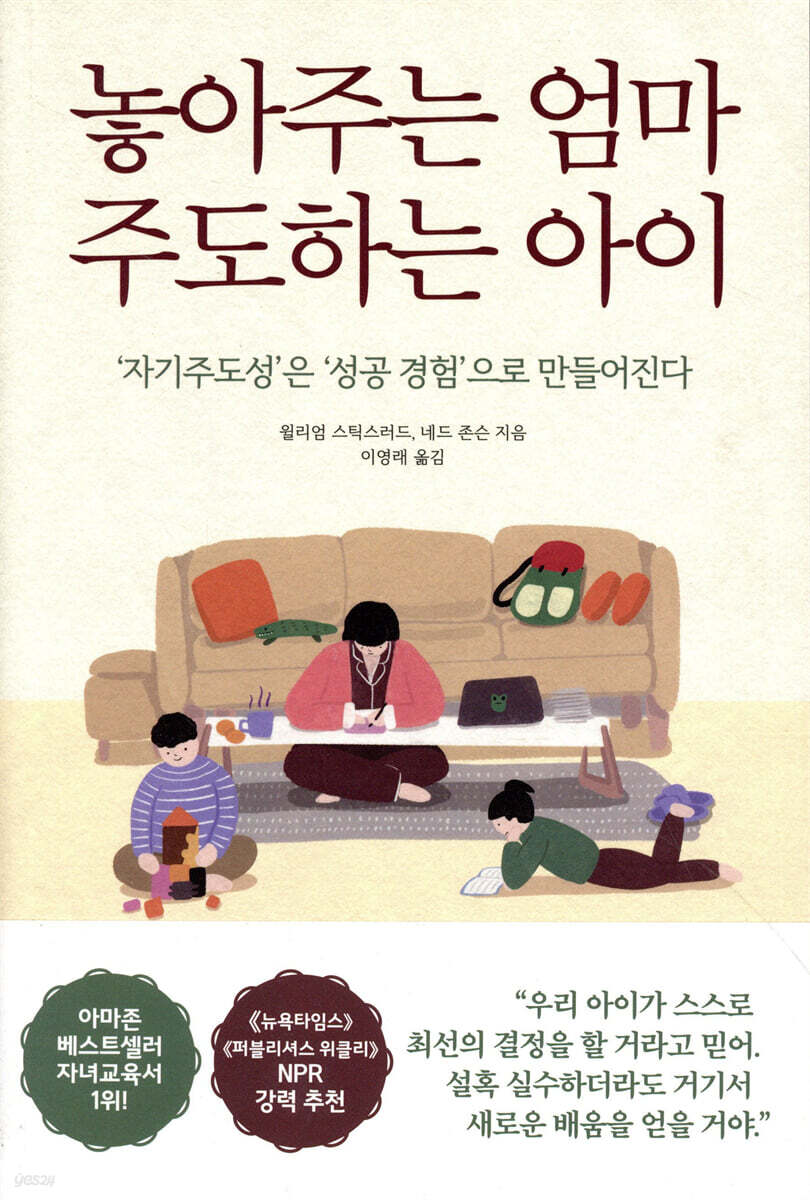
A child who leads a mother who lets go
 |
Description
Book Introduction
“Instead of being overprotective, your mother
I will help you become brave.
“Because that’s much better.”
How can we awaken our children's inner passion and potential?
Two experts have joined forces to answer a question that concerns every parent.
They are Ned Johnson, who has been at the forefront of the American private education industry, guiding children in college admissions for over 30 years, and Dr. William Stixrud, who has helped children with anxiety and learning and behavioral disorders.
Ned's research came from a performance science and technology perspective, while Dr. William's was from a brain development perspective, both of whom had helped countless children, and their respective research findings were remarkably aligned.
The key to a successful life is 'self-direction', or 'a sense of control over one's life', which is the ability to lead one's own life.
So how can we develop the power to lead our own lives, a sense of control over our lives?
The two authors' answer is simpler than you might think.
It's about accumulating 'success experiences' - learning from small attempts, successes, and sometimes failures.
If our children ever have to stand on their own, it may not be an exaggeration to say that what they really need is a sense of control over their lives, built through successful experiences.
This book, which has already been proven in both theory and practice as the #1 book in its Amazon category, is a new bible that is essential in an era marked by excessive parenting.
I will help you become brave.
“Because that’s much better.”
How can we awaken our children's inner passion and potential?
Two experts have joined forces to answer a question that concerns every parent.
They are Ned Johnson, who has been at the forefront of the American private education industry, guiding children in college admissions for over 30 years, and Dr. William Stixrud, who has helped children with anxiety and learning and behavioral disorders.
Ned's research came from a performance science and technology perspective, while Dr. William's was from a brain development perspective, both of whom had helped countless children, and their respective research findings were remarkably aligned.
The key to a successful life is 'self-direction', or 'a sense of control over one's life', which is the ability to lead one's own life.
So how can we develop the power to lead our own lives, a sense of control over our lives?
The two authors' answer is simpler than you might think.
It's about accumulating 'success experiences' - learning from small attempts, successes, and sometimes failures.
If our children ever have to stand on their own, it may not be an exaggeration to say that what they really need is a sense of control over their lives, built through successful experiences.
This book, which has already been proven in both theory and practice as the #1 book in its Amazon category, is a new bible that is essential in an era marked by excessive parenting.
- You can preview some of the book's contents.
Preview
index
Introduction _ Why is a sense of control over one's life so important?
1.
First, understand your child's stress and anxiety.
Stress: You Can't Eliminate It, But You Can Use It! | Neuroscience Explains Stress | Stress, Anxiety, and Depression | The Importance of Stress Management | We Should Prepare for Life, Not College Entrance Exams | What to Do Tonight
2.
“I love you too much to fight over homework.”
Homework Wars | Why the Brain Loves the Advisor Model | "But..." Challenges of Being an Advisor | Frequently Asked Questions | Remember the Big Picture | What to Do Tonight
3.
Through these experiences, children develop self-directedness.
What "It's your decision" doesn't mean | 6 reasons to trust your child | Principles and methods for each age | Frequently asked questions | What to do tonight
4.
When you manage anxiety, your child makes choices.
Is anxiety inherited? | Children imitate their parents' stress and calmness | How to become an anxiety-free being | Frequently asked questions | Adopt an attitude of nonjudgmental acceptance | What to do tonight
5.
What makes a child move on his own?
How to Help Your Child Develop Intrinsic Motivation | What Makes Us tick? | The Brains of Parents and Teenagers Are Very Different | From Self-Saboteurs to Perfectionists: The Challenges of Motivation | What to Do Tonight
6.
Doing nothing creates a healthy brain.
Quiet Time Turns Children into "Thinking Humans" | Meditation Restores Balance and Vitality to the Brain | Frequently Asked Questions | What to Do Tonight
7.
Sleep deprivation is a "bomb" that wreaks havoc on your emotions, learning, and body.
Sleep is the foundation of a home | The healing power of sleep | Frequently asked questions | What to do tonight
8.
Children with high self-control also do well in school.
Engage them | Reduce stress and pressure about studying | Encourage but don't force homework | Teach when kids are ready | Test appropriately | How to increase your sense of control in school | What to do tonight
9.
How to Win in the Smartphone War
The Double-Edged Sword of Technology | The Unintended Harms of Technology | Advice for Taming the Beast of Technology | Frequently Asked Questions | Another Cultural Shift | What to Do Tonight
10.
6-Step Brain and Body Training for Life, Not College Entrance Exams
Exercise 1: Setting Clear Goals | Exercise 2: Paying Attention to Your Brain's Signals | Exercise 3: Practicing Thinking of Second Options | Exercise 4: Looking at Yourself with a Warm Eye | Exercise 5: Reframing Problems | Exercise 6: Physical Activity and Play | What to Do Tonight
11.
Fostering Autonomy in Children with Learning Disabilities, ADHD, and ASD
Learning Disabilities | ADHD | ASD | Things to Do Tonight
12.
That path is not the only answer
The key is finding your strengths | Shatter the shared delusion | Peter | Ben | Lachlan | Melody | "But..." Questions about other paths
Coming out _ What kind of feelings does the child want to have from his parents?
1.
First, understand your child's stress and anxiety.
Stress: You Can't Eliminate It, But You Can Use It! | Neuroscience Explains Stress | Stress, Anxiety, and Depression | The Importance of Stress Management | We Should Prepare for Life, Not College Entrance Exams | What to Do Tonight
2.
“I love you too much to fight over homework.”
Homework Wars | Why the Brain Loves the Advisor Model | "But..." Challenges of Being an Advisor | Frequently Asked Questions | Remember the Big Picture | What to Do Tonight
3.
Through these experiences, children develop self-directedness.
What "It's your decision" doesn't mean | 6 reasons to trust your child | Principles and methods for each age | Frequently asked questions | What to do tonight
4.
When you manage anxiety, your child makes choices.
Is anxiety inherited? | Children imitate their parents' stress and calmness | How to become an anxiety-free being | Frequently asked questions | Adopt an attitude of nonjudgmental acceptance | What to do tonight
5.
What makes a child move on his own?
How to Help Your Child Develop Intrinsic Motivation | What Makes Us tick? | The Brains of Parents and Teenagers Are Very Different | From Self-Saboteurs to Perfectionists: The Challenges of Motivation | What to Do Tonight
6.
Doing nothing creates a healthy brain.
Quiet Time Turns Children into "Thinking Humans" | Meditation Restores Balance and Vitality to the Brain | Frequently Asked Questions | What to Do Tonight
7.
Sleep deprivation is a "bomb" that wreaks havoc on your emotions, learning, and body.
Sleep is the foundation of a home | The healing power of sleep | Frequently asked questions | What to do tonight
8.
Children with high self-control also do well in school.
Engage them | Reduce stress and pressure about studying | Encourage but don't force homework | Teach when kids are ready | Test appropriately | How to increase your sense of control in school | What to do tonight
9.
How to Win in the Smartphone War
The Double-Edged Sword of Technology | The Unintended Harms of Technology | Advice for Taming the Beast of Technology | Frequently Asked Questions | Another Cultural Shift | What to Do Tonight
10.
6-Step Brain and Body Training for Life, Not College Entrance Exams
Exercise 1: Setting Clear Goals | Exercise 2: Paying Attention to Your Brain's Signals | Exercise 3: Practicing Thinking of Second Options | Exercise 4: Looking at Yourself with a Warm Eye | Exercise 5: Reframing Problems | Exercise 6: Physical Activity and Play | What to Do Tonight
11.
Fostering Autonomy in Children with Learning Disabilities, ADHD, and ASD
Learning Disabilities | ADHD | ASD | Things to Do Tonight
12.
That path is not the only answer
The key is finding your strengths | Shatter the shared delusion | Peter | Ben | Lachlan | Melody | "But..." Questions about other paths
Coming out _ What kind of feelings does the child want to have from his parents?
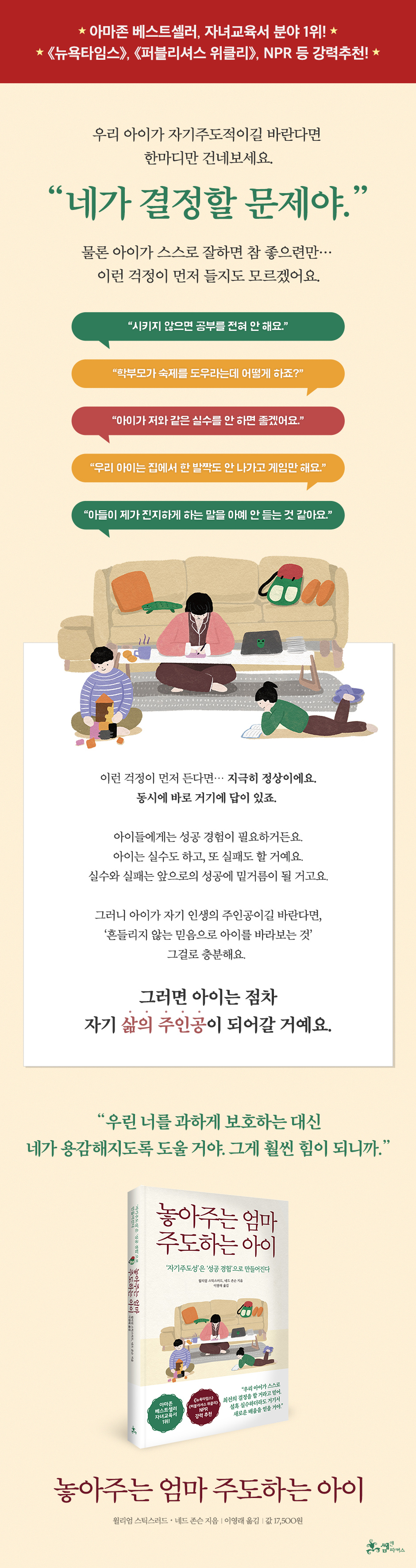
Detailed image
Into the book
If children are continuously protected in an environment that causes anxiety, they become more anxious.
So, rather than avoiding stress, children should learn how to cope with stress and develop stress tolerance.
If you think you can control stress, your brain will be more flexible when you later encounter situations that are actually out of your control.
It's a kind of immunity that develops.
--- p.
26 From “First, Understand Your Child’s Stress and Anxiety”
"How can we trust our children to take responsibility for their learning? They're still young." This is true to some extent.
This is because the child's judgment is still developing.
At the same time, the answer is right there.
Children need a developmental process.
And development happens when we are given more responsibility than we can handle.
--- p.
52 From "I Love You Too Much to Fight Over Homework"
It may be hard to accept, but it's really hard for parents to know what's best for their children.
Because we don't know what kind of person the child wants to become.
Often times, a complete failure turns into an unexpected blessing.
There are many paths to success, and sometimes you have to get lost to find the right path.
--- p.
75 From “Children feel self-directed through these experiences”
Children don't need perfect parents.
Children just need strong parents.
When parents are overly stressed, worried, and angry, their children become anxious too.
This is not as difficult as you might think.
It's enough just to not be flustered by your child's behavior.
A recent study found that managing parents' own stress is far more effective than pouring love and affection into parenting.
--- p.
94 From “Managing Anxiety Makes Children Make Their Own Choices”
The most important thing in childhood is to develop the brain into the shape they want to be.
Do you want a brain that's constantly plagued by stress and fatigue, prone to anxiety and depression? Or do you want a brain that's happy, resilient, and efficient? Encourage your child to reflect on their values and what truly matters to them, and consider whether these thoughts are leading them in the right direction.
--- p.
141 From “What Makes a Child Move on His Own?”
Anxiety is felt not only by parents but also by children.
Even before children begin formal education, they are subjected to a standard of comparison.
This idea is based on the false premise that prior learning leads to better results.
Despite clear evidence that learning to read at age 7 is more effective and that the benefits of early reading quickly fade, we are still hesitant to teach children to read at age 5.
--- p.
192 From “Children with high self-control also do well in school”
Technology can be overwhelming, confusing, and even frustrating.
But technology also presents a tremendous opportunity.
Electronic devices should be thought of as beasts that, if properly tamed, can bring joy and possibility to our lives.
If children can find a way to tame the beast, they will gain powerful strength that will last them for many years.
The method depends on whether you can teach your child 'responsibility'.
--- p.
204 From “How to Win in the Smartphone War”
This is also the reason why there are many children with ADHD who have chronic procrastination.
This is because the prefrontal cortex must mature and allow children to do things they previously struggled with. Parents of children with ADHD should encourage their children to be patient with themselves.
This encouragement is a message of hope and confidence to the child, while also promoting a growth mindset.
--- p.
257 From “Fostering Autonomy in Children with Learning Disabilities, ADHD, and ASD”
It is not the subject of this book to argue that money and success are not the same.
Although there is a close relationship between income and personal happiness, the correlation is much stronger when income is very low.
Even when financial security is achieved to a certain degree, or indeed to a fairly low level, the correlation between income and happiness decreases.
I'm not saying it's okay if you can't make money.
It's important for children to make thoughtful decisions about what's truly important to them.
So, rather than avoiding stress, children should learn how to cope with stress and develop stress tolerance.
If you think you can control stress, your brain will be more flexible when you later encounter situations that are actually out of your control.
It's a kind of immunity that develops.
--- p.
26 From “First, Understand Your Child’s Stress and Anxiety”
"How can we trust our children to take responsibility for their learning? They're still young." This is true to some extent.
This is because the child's judgment is still developing.
At the same time, the answer is right there.
Children need a developmental process.
And development happens when we are given more responsibility than we can handle.
--- p.
52 From "I Love You Too Much to Fight Over Homework"
It may be hard to accept, but it's really hard for parents to know what's best for their children.
Because we don't know what kind of person the child wants to become.
Often times, a complete failure turns into an unexpected blessing.
There are many paths to success, and sometimes you have to get lost to find the right path.
--- p.
75 From “Children feel self-directed through these experiences”
Children don't need perfect parents.
Children just need strong parents.
When parents are overly stressed, worried, and angry, their children become anxious too.
This is not as difficult as you might think.
It's enough just to not be flustered by your child's behavior.
A recent study found that managing parents' own stress is far more effective than pouring love and affection into parenting.
--- p.
94 From “Managing Anxiety Makes Children Make Their Own Choices”
The most important thing in childhood is to develop the brain into the shape they want to be.
Do you want a brain that's constantly plagued by stress and fatigue, prone to anxiety and depression? Or do you want a brain that's happy, resilient, and efficient? Encourage your child to reflect on their values and what truly matters to them, and consider whether these thoughts are leading them in the right direction.
--- p.
141 From “What Makes a Child Move on His Own?”
Anxiety is felt not only by parents but also by children.
Even before children begin formal education, they are subjected to a standard of comparison.
This idea is based on the false premise that prior learning leads to better results.
Despite clear evidence that learning to read at age 7 is more effective and that the benefits of early reading quickly fade, we are still hesitant to teach children to read at age 5.
--- p.
192 From “Children with high self-control also do well in school”
Technology can be overwhelming, confusing, and even frustrating.
But technology also presents a tremendous opportunity.
Electronic devices should be thought of as beasts that, if properly tamed, can bring joy and possibility to our lives.
If children can find a way to tame the beast, they will gain powerful strength that will last them for many years.
The method depends on whether you can teach your child 'responsibility'.
--- p.
204 From “How to Win in the Smartphone War”
This is also the reason why there are many children with ADHD who have chronic procrastination.
This is because the prefrontal cortex must mature and allow children to do things they previously struggled with. Parents of children with ADHD should encourage their children to be patient with themselves.
This encouragement is a message of hope and confidence to the child, while also promoting a growth mindset.
--- p.
257 From “Fostering Autonomy in Children with Learning Disabilities, ADHD, and ASD”
It is not the subject of this book to argue that money and success are not the same.
Although there is a close relationship between income and personal happiness, the correlation is much stronger when income is very low.
Even when financial security is achieved to a certain degree, or indeed to a fairly low level, the correlation between income and happiness decreases.
I'm not saying it's okay if you can't make money.
It's important for children to make thoughtful decisions about what's truly important to them.
--- p.
282 From "That Path Is Not the Only Answer"
282 From "That Path Is Not the Only Answer"
Publisher's Review
Overheated competition, addiction to games and social media, anxiety and stress…
What does a struggling child really need?
Amazon's #1 best-selling parenting book!
Highly recommended by The New York Times, Publisher's Weekly, and NPR!
The "Self-Directed" Parenting Bible: A Need in an Era of "Over-Parenting"
The Fourth Industrial Revolution, AI technology, the metaverse, NFTs… I can't believe how quickly the world is changing.
In this age of constant technology and change, I worry that my child might fall behind.
To ease this worry a little, I read any book I can find, but I only feel a brief moment of peace when I read it.
As I close the last page of the book, it's hard to hide the honest question: "Will this method really work for my child?"
So, as parents, we ask ourselves what we can really do for our children.
Faced with this question, two experts joined forces.
They are Ned Johnson, who has been at the forefront of the American private education industry, guiding children in college admissions for over 30 years, and Dr. William Stixrud, who has helped children with anxiety and learning and behavioral disorders.
Ned's research came from a performance science and technology perspective, while Dr. William's was from a brain development perspective, both of whom had helped countless children, and their respective research findings were remarkably aligned.
The key to a successful life is 'self-direction', or 'a sense of control over one's life', which is the ability to lead one's own life.
Just as teachers can teach, coaches can coach, and college counselors can explain admission requirements, no matter how the world changes, so too do parents have a role to play.
This book teaches you how to help your child develop self-direction and a sense of control over their life, which are essential parental roles for them.
Even if my child is a little different, and even if the world changes, the role of parents that children truly need will not change.
This book, which has already been proven in both theory and practice as the #1 book in its Amazon category, is a new bible that is essential in an era marked by excessive parenting.
Parents want their children to succeed, and success requires practice.
Just like riding a bike, you have to fall down a few times.
Every parent wants their child to succeed without falling or getting frustrated.
Even with the world becoming more complex by the day, it's natural for parents to worry that their children might make a single mistake and suffer a huge setback.
But if you think about it a little differently, you may also worry about how long you will be able to embrace and protect your child.
Because sooner or later, there will come a time when a child must stand alone on the stage of the world.
Therefore, the role of parents should not be limited to protecting their children.
We must foster ‘self-initiative’ in children so that they can solve problems on their own.
Think back to the first time you rode a bike.
When you first ride a bicycle, it is enough to attach training wheels to both sides of the rear wheel and just pedal.
Of course, you can't ride a bike with training wheels your whole life.
If you make up your mind and take off the training wheels, everyone will fall, contrary to your will.
By falling down like that over and over again, you correct your bad posture, learn the trick, and gradually succeed in moving forward.
The same goes for our lives.
From a young age, we must accumulate 'experiences of success' through constant trial and error, success, and learning from occasional failures.
Only by accumulating successful experiences that allow you to learn new things without fearing the mistakes that may come in front of you, and even if you make mistakes, can you gradually grow into an adult who can solve big problems based on 'self-direction', or 'a sense of control over life.'
A simple spell for a magical child transformation
“It’s your decision.”
The magic formula that kickstarts this little "success experience" is "It's your decision."
The meaning behind these simple and easy words is 'I trust you will make the best decision.
Even if you make a mistake, you will learn something new from it.'
These words have a warm power to change a child's life.
I understand what you're saying, but if you're worried about whether your child will actually be able to do that or change, that worry is perfectly valid.
A child's first judgments and actions will be a mess.
Even after that, the child will make mistakes and sometimes fail.
Isn't it natural to fall over when you first take off the training wheels?
However, the experience of those mistakes and failures becomes the foundation for future success.
Just like the many times you fall down, it all comes together to make the bicycle move forward.
So, there is only one thing that a mother needs.
Looking at the child with unshakable faith.
Then your child will gradually learn how to succeed in life.
What does a struggling child really need?
Amazon's #1 best-selling parenting book!
Highly recommended by The New York Times, Publisher's Weekly, and NPR!
The "Self-Directed" Parenting Bible: A Need in an Era of "Over-Parenting"
The Fourth Industrial Revolution, AI technology, the metaverse, NFTs… I can't believe how quickly the world is changing.
In this age of constant technology and change, I worry that my child might fall behind.
To ease this worry a little, I read any book I can find, but I only feel a brief moment of peace when I read it.
As I close the last page of the book, it's hard to hide the honest question: "Will this method really work for my child?"
So, as parents, we ask ourselves what we can really do for our children.
Faced with this question, two experts joined forces.
They are Ned Johnson, who has been at the forefront of the American private education industry, guiding children in college admissions for over 30 years, and Dr. William Stixrud, who has helped children with anxiety and learning and behavioral disorders.
Ned's research came from a performance science and technology perspective, while Dr. William's was from a brain development perspective, both of whom had helped countless children, and their respective research findings were remarkably aligned.
The key to a successful life is 'self-direction', or 'a sense of control over one's life', which is the ability to lead one's own life.
Just as teachers can teach, coaches can coach, and college counselors can explain admission requirements, no matter how the world changes, so too do parents have a role to play.
This book teaches you how to help your child develop self-direction and a sense of control over their life, which are essential parental roles for them.
Even if my child is a little different, and even if the world changes, the role of parents that children truly need will not change.
This book, which has already been proven in both theory and practice as the #1 book in its Amazon category, is a new bible that is essential in an era marked by excessive parenting.
Parents want their children to succeed, and success requires practice.
Just like riding a bike, you have to fall down a few times.
Every parent wants their child to succeed without falling or getting frustrated.
Even with the world becoming more complex by the day, it's natural for parents to worry that their children might make a single mistake and suffer a huge setback.
But if you think about it a little differently, you may also worry about how long you will be able to embrace and protect your child.
Because sooner or later, there will come a time when a child must stand alone on the stage of the world.
Therefore, the role of parents should not be limited to protecting their children.
We must foster ‘self-initiative’ in children so that they can solve problems on their own.
Think back to the first time you rode a bike.
When you first ride a bicycle, it is enough to attach training wheels to both sides of the rear wheel and just pedal.
Of course, you can't ride a bike with training wheels your whole life.
If you make up your mind and take off the training wheels, everyone will fall, contrary to your will.
By falling down like that over and over again, you correct your bad posture, learn the trick, and gradually succeed in moving forward.
The same goes for our lives.
From a young age, we must accumulate 'experiences of success' through constant trial and error, success, and learning from occasional failures.
Only by accumulating successful experiences that allow you to learn new things without fearing the mistakes that may come in front of you, and even if you make mistakes, can you gradually grow into an adult who can solve big problems based on 'self-direction', or 'a sense of control over life.'
A simple spell for a magical child transformation
“It’s your decision.”
The magic formula that kickstarts this little "success experience" is "It's your decision."
The meaning behind these simple and easy words is 'I trust you will make the best decision.
Even if you make a mistake, you will learn something new from it.'
These words have a warm power to change a child's life.
I understand what you're saying, but if you're worried about whether your child will actually be able to do that or change, that worry is perfectly valid.
A child's first judgments and actions will be a mess.
Even after that, the child will make mistakes and sometimes fail.
Isn't it natural to fall over when you first take off the training wheels?
However, the experience of those mistakes and failures becomes the foundation for future success.
Just like the many times you fall down, it all comes together to make the bicycle move forward.
So, there is only one thing that a mother needs.
Looking at the child with unshakable faith.
Then your child will gradually learn how to succeed in life.
GOODS SPECIFICS
- Date of issue: March 2, 2022
- Page count, weight, size: 288 pages | 524g | 152*250*18mm
- ISBN13: 9791165344719
- ISBN10: 1165344718
You may also like
카테고리
korean


korean

![ELLE 엘르 스페셜 에디션 A형 : 12월 [2025]](http://librairie.coreenne.fr/cdn/shop/files/b8e27a3de6c9538896439686c6b0e8fb.jpg?v=1766436872&width=3840)


