

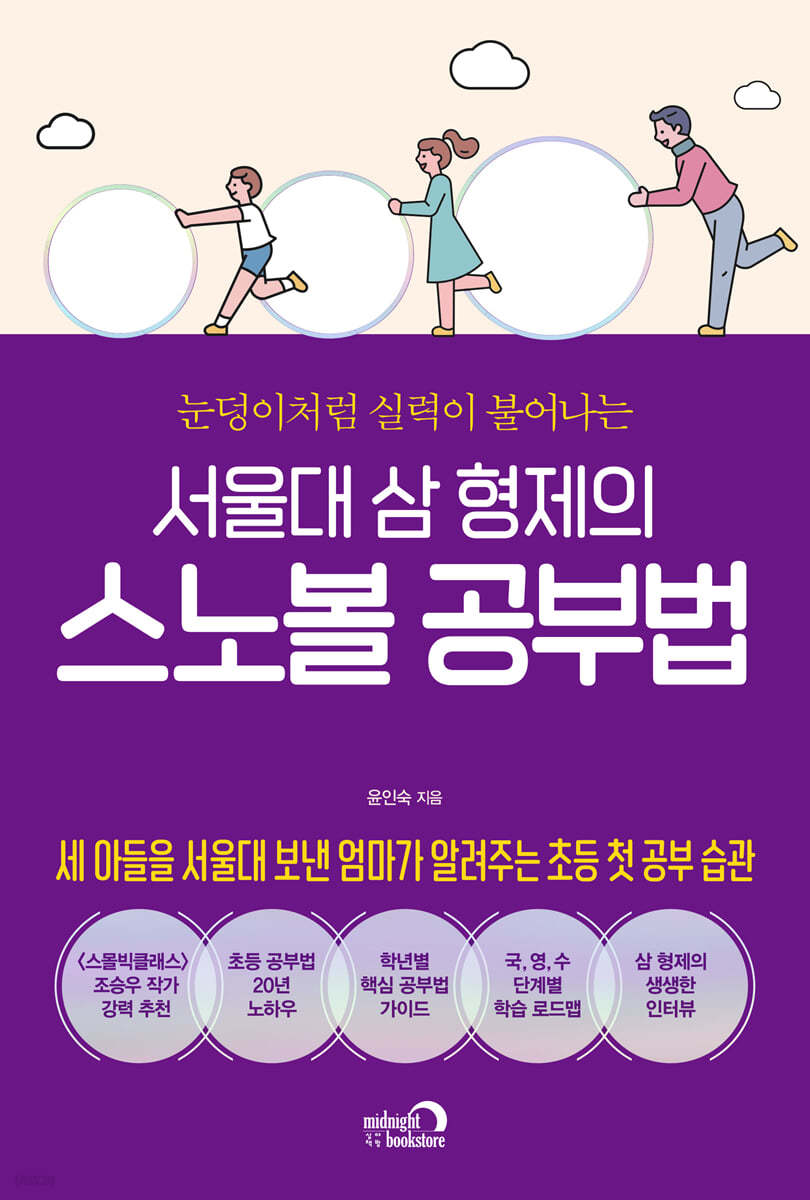
The Snowball Study Method of the Three Seoul National University Brothers
 |
Description
Book Introduction
“Start with small but solid study habits. “The child’s skills will grow like a snowball.” It brought explosive buzz to the city A cheerful and wise story of a mother who sent her three children to Seoul National University The Snowball Study Method Revealed After the interview video titled “The Secret to Child Education of a Mother Who Sent Three Siblings to Seoul National University” was released on the YouTube channel [Small Big Class], it quickly surpassed 650,000 views. This book, which was published due to the constant requests from parents, received a lot of attention even before its publication because it systematically organized the 'First Study Habits of the Three Seoul National University Brothers' so that anyone can easily follow them. The author, who sent all three of his sons to Seoul National University, says the question he was asked most frequently was, "Were your children smart from a young age? Did your parents also graduate from good universities?" However, the parents were very ordinary people, and the children were not much different from other children until elementary school. As a result of developing good study habits in elementary school, he continued to study consistently and achieved the best results in middle school and high school. If parents instill in their children the habit of studying and the ability to study at the right time, their children's studies will naturally follow suit and their skills will grow like a snowball. This book is packed with the special educational principles I have strived to uphold while raising my three sons, as well as the know-how I have gained in the field while running an academy for over 10 years. The reason she wrote the book is clear. I wanted to document my teaching methods so that children could achieve their dreams and achieve good grades without having to study in an area with a good school district or receive expensive private tutoring, as long as they have good study habits and a good mindset. Experience the Snowball study method, which starts with small habits and delivers increasingly outstanding results over time. The more a child studies, the more he or she will gain a sense of accomplishment rather than inferiority, and confidence rather than frustration. |
- You can preview some of the book's contents.
Preview
index
Prologue | Raising Three Brothers in the Name of Mother
Part 1: Making a Child's Bowl
Chapter 1: Character and Lifestyle
01 Parents are their children's mirrors.
02 Character comes before study.
03 Let me tell you what to do and what not to do.
04 Make sure to follow small rules first.
05 What should I do with a stubborn child?
Chapter 2 Positive Thinking
01 Words have the power to create results.
02 Positive words build confidence.
03 Children who grow up eating praise
04 How a Mother's Conversation Helps Raise a Child with High Self-Esteem
Chapter 3 Relationships and Bonds
01 Let's inspire with actions rather than words.
02 Express your feelings through a letter
03 To improve brotherly love
04 Build a bond by creating a family newspaper.
05 Child education is a two-wheeled train of strictness and kindness.
Interview with the three brothers
Part 2: Snowballing - Building Study Habits
Chapter 1: Understanding the Big Picture of Studying
01 Can I study well if I try hard even if I am not naturally gifted?
02 Developing study skills through proper study habits
Chapter 2: Small Practices to Help You Study
01 Why Top Students Say They Focused on Textbooks
02 How should I attend school classes?
03 Note-taking review method to make the class your own
04 Study a little bit each day, making a plan
05 Three Secrets to Improving Your Child's Concentration
06 Study method using a notebook that saves time and makes memorization easier
07 Lessons learned while teaching incorrect answers
Interview with the three brothers
Part 3: Rolling the Snowball - Practicing Self-Directed Learning
Chapter 1: The Meaning of Self-Directed Learning
01 The Meaning of True Self-Directed Learning
02 Self-directed learning is not something you learn alone.
Chapter 2: A Practical Roadmap for Ultimate Self-Directed Learning
Step 1: You must have a desire to study.
If you make a two-step plan, the path will appear.
Things change when you have no choice but to practice the three steps.
Completed when there is 4-step feedback
Interview with the three brothers
Part 4: Study Methods for Each Subject, Looking 10 Years Ahead
Chapter 1: How to Study Math
01 Why do children hate math?
02 Mathematics is all about the basics
03 Math is all about steps
04 Raising children accustomed to deep thinking
05 Writing the solution process is the core of logical thinking.
06 Neglecting to study incorrect answers is like pouring water into a bottomless pit.
07 It has to be repeated to become completely mine.
08 Adding competition to math doubles the fun.
Chapter 2: How to Study English
01 When and how should I start studying English?
02 Practical English vs.
Entrance exam English
03 When is it best to start using Phoenix?
04 [Listening] Open your ears to your favorite videos
05 [Speaking] Let's get the words flowing in context.
06 [Reading] Reading as Fun as Play
07 [Writing] Learn sentences based on patterns and write an English diary.
08 How to study vocabulary effectively
09 Understand the framework and learn grammar while writing.
10. Master reading comprehension through both intensive and extensive reading.
Chapter 3: How to Study Korean
01 The most important study during elementary school is Korean language.
02 Grade-by-Grade Reading Instruction Guide
03 How can I make my child love books?
04 Reading habits that develop speaking and writing skills
05 3 Ways to Build Your Child's Vocabulary
06 Studying Korean with Textbooks
07 Mom is the best Korean teacher
Interview with the three brothers
Part 5: What I Want to Say to Worried Young Mothers
Chapter 1 Private Education/Study
01 Do I really have to send my child to an academy?
02 Criteria and considerations when choosing an academy
03 Which is better, an academy or private tutoring?
04 Should I move because of private education and school districts?
Chapter 2 Lifestyle/Relationships/Communication
01 A child who uses his smartphone and plays games too much
02 Things you should never do in raising your children
03 The most difficult moment while raising children
04 Lessons from the Story of the Sun and the Wind
Interview with the three brothers
Epilogue | Looking Back, I'm Grateful for Everything
Part 1: Making a Child's Bowl
Chapter 1: Character and Lifestyle
01 Parents are their children's mirrors.
02 Character comes before study.
03 Let me tell you what to do and what not to do.
04 Make sure to follow small rules first.
05 What should I do with a stubborn child?
Chapter 2 Positive Thinking
01 Words have the power to create results.
02 Positive words build confidence.
03 Children who grow up eating praise
04 How a Mother's Conversation Helps Raise a Child with High Self-Esteem
Chapter 3 Relationships and Bonds
01 Let's inspire with actions rather than words.
02 Express your feelings through a letter
03 To improve brotherly love
04 Build a bond by creating a family newspaper.
05 Child education is a two-wheeled train of strictness and kindness.
Interview with the three brothers
Part 2: Snowballing - Building Study Habits
Chapter 1: Understanding the Big Picture of Studying
01 Can I study well if I try hard even if I am not naturally gifted?
02 Developing study skills through proper study habits
Chapter 2: Small Practices to Help You Study
01 Why Top Students Say They Focused on Textbooks
02 How should I attend school classes?
03 Note-taking review method to make the class your own
04 Study a little bit each day, making a plan
05 Three Secrets to Improving Your Child's Concentration
06 Study method using a notebook that saves time and makes memorization easier
07 Lessons learned while teaching incorrect answers
Interview with the three brothers
Part 3: Rolling the Snowball - Practicing Self-Directed Learning
Chapter 1: The Meaning of Self-Directed Learning
01 The Meaning of True Self-Directed Learning
02 Self-directed learning is not something you learn alone.
Chapter 2: A Practical Roadmap for Ultimate Self-Directed Learning
Step 1: You must have a desire to study.
If you make a two-step plan, the path will appear.
Things change when you have no choice but to practice the three steps.
Completed when there is 4-step feedback
Interview with the three brothers
Part 4: Study Methods for Each Subject, Looking 10 Years Ahead
Chapter 1: How to Study Math
01 Why do children hate math?
02 Mathematics is all about the basics
03 Math is all about steps
04 Raising children accustomed to deep thinking
05 Writing the solution process is the core of logical thinking.
06 Neglecting to study incorrect answers is like pouring water into a bottomless pit.
07 It has to be repeated to become completely mine.
08 Adding competition to math doubles the fun.
Chapter 2: How to Study English
01 When and how should I start studying English?
02 Practical English vs.
Entrance exam English
03 When is it best to start using Phoenix?
04 [Listening] Open your ears to your favorite videos
05 [Speaking] Let's get the words flowing in context.
06 [Reading] Reading as Fun as Play
07 [Writing] Learn sentences based on patterns and write an English diary.
08 How to study vocabulary effectively
09 Understand the framework and learn grammar while writing.
10. Master reading comprehension through both intensive and extensive reading.
Chapter 3: How to Study Korean
01 The most important study during elementary school is Korean language.
02 Grade-by-Grade Reading Instruction Guide
03 How can I make my child love books?
04 Reading habits that develop speaking and writing skills
05 3 Ways to Build Your Child's Vocabulary
06 Studying Korean with Textbooks
07 Mom is the best Korean teacher
Interview with the three brothers
Part 5: What I Want to Say to Worried Young Mothers
Chapter 1 Private Education/Study
01 Do I really have to send my child to an academy?
02 Criteria and considerations when choosing an academy
03 Which is better, an academy or private tutoring?
04 Should I move because of private education and school districts?
Chapter 2 Lifestyle/Relationships/Communication
01 A child who uses his smartphone and plays games too much
02 Things you should never do in raising your children
03 The most difficult moment while raising children
04 Lessons from the Story of the Sun and the Wind
Interview with the three brothers
Epilogue | Looking Back, I'm Grateful for Everything
Detailed image

Into the book
Children see their own bowls as bigger or smaller depending on what their parents say to them.
Rather than saying negative things like, “What are you going to be like when you grow up?”, let’s say positive, encouraging, and hopeful words.
The more positive words a child hears, the more he or she will see his or her own potential and grow into someone who can achieve greater things than his or her parents expected.
--- p.
40 From “Part 1, Chapter 2: Positive Thinking”
During elementary school, it is difficult for children to figure out how to study on their own, so the right approach is to actively intervene and then focus on helping children take the initiative once the habit is fully established.
We often see cases of middle and high school students who have not developed study habits and have great difficulty studying and have low self-esteem.
I sincerely hope that all children develop good study habits from a young age so that they can spread their wings and venture out into the world without much difficulty in their studies.
--- p.
118 From “Lessons Learned While Teaching Review of Wrong Answers in Part 2, Chapter 2”
When children don't put in enough effort, they often not only lose interest in studying, but they also don't feel the need to study.
In cases like this, it is helpful to find a study method that the child will find a little more interesting, or to explain why studying is necessary from the child's perspective, at least to a level that the child can understand intellectually, even if it may not resonate deeply with them.
--- p.
166 From “Part 3, Chapter 2: A Practical Roadmap for the Best Self-Directed Learning”
The error notebook is not simply a place to copy down the problems and solution processes.
If you write it like this, it will be difficult to use it properly when reviewing.
The mistake notebook is created to record key concepts, ideas, and the development of solutions that I didn't know, and to look at them again to recall them.
Therefore, rather than just writing down the solution process, you should 'mark the parts you were stuck on or concepts you didn't know at a glance with a colored pen or highlighter and make separate notes of important content' during the solution process.
--- p.
207 From “Part 4, Chapter 1: How to Study Math”
Looking at the courses our children took, it seems that rather than consistently sending them to academies, we always paid attention to which method would be most helpful to the child at that point in time.
And that method was at some point having them do homework, at some point sending them to a private academy, at some point taking supplementary lessons from school teachers, and at some point taking online lectures.
Moreover, the problem of choosing a study method was not a matter of choosing only one method among several, but rather a matter of mixing and matching methods appropriately to suit one's needs.
Rather than saying negative things like, “What are you going to be like when you grow up?”, let’s say positive, encouraging, and hopeful words.
The more positive words a child hears, the more he or she will see his or her own potential and grow into someone who can achieve greater things than his or her parents expected.
--- p.
40 From “Part 1, Chapter 2: Positive Thinking”
During elementary school, it is difficult for children to figure out how to study on their own, so the right approach is to actively intervene and then focus on helping children take the initiative once the habit is fully established.
We often see cases of middle and high school students who have not developed study habits and have great difficulty studying and have low self-esteem.
I sincerely hope that all children develop good study habits from a young age so that they can spread their wings and venture out into the world without much difficulty in their studies.
--- p.
118 From “Lessons Learned While Teaching Review of Wrong Answers in Part 2, Chapter 2”
When children don't put in enough effort, they often not only lose interest in studying, but they also don't feel the need to study.
In cases like this, it is helpful to find a study method that the child will find a little more interesting, or to explain why studying is necessary from the child's perspective, at least to a level that the child can understand intellectually, even if it may not resonate deeply with them.
--- p.
166 From “Part 3, Chapter 2: A Practical Roadmap for the Best Self-Directed Learning”
The error notebook is not simply a place to copy down the problems and solution processes.
If you write it like this, it will be difficult to use it properly when reviewing.
The mistake notebook is created to record key concepts, ideas, and the development of solutions that I didn't know, and to look at them again to recall them.
Therefore, rather than just writing down the solution process, you should 'mark the parts you were stuck on or concepts you didn't know at a glance with a colored pen or highlighter and make separate notes of important content' during the solution process.
--- p.
207 From “Part 4, Chapter 1: How to Study Math”
Looking at the courses our children took, it seems that rather than consistently sending them to academies, we always paid attention to which method would be most helpful to the child at that point in time.
And that method was at some point having them do homework, at some point sending them to a private academy, at some point taking supplementary lessons from school teachers, and at some point taking online lectures.
Moreover, the problem of choosing a study method was not a matter of choosing only one method among several, but rather a matter of mixing and matching methods appropriately to suit one's needs.
--- p.
296 From “Part 5, Chapter 1, Private Education/Study”
296 From “Part 5, Chapter 1, Private Education/Study”
Publisher's Review
“The power to see things through on one’s own comes from a child’s self-esteem!”
Practical mentoring for mothers at the starting point of developing lifelong study habits.
Parents do not raise their children to keep them in their arms forever, but to let them go out into the world and fulfill their roles.
Children must live in the vast world of society, interacting with diverse people.
The most important thing in it is to become a person who believes in and loves himself.
Sufficient parental love is essential for a child to grow into a self-respecting being who loves himself.
If parents love a child because he or she is good at studying, handsome, or smart, the child may feel that the parents love him or her for a specific aspect of himself or herself, rather than for who he or she is.
Then, it is difficult to grow into an adult who knows how to love himself and not lose confidence in any situation.
The author says that if parents provide sufficient love and establish two major frameworks, 'character and habits,' children can grow well according to their own individuality.
The key is to focus on establishing good living habits when your child is young, and to help them clearly distinguish between study time and play time so they can study without too much stress.
If your character and lifestyle are correct, you will rarely have problems in your daily life or in your studies.
This book contains various examples of parents' sincerity and efforts to make their children's hearts stable and strong, such as stories of parents encouraging their children with warm letters whenever they were having a hard time, stories of building a strong bond by making a family newspaper, stories of parents cherishing gifts given by their children for a long time, and stories of parents being there for their children so that they would not feel left out or lonely while studying.
It also introduces ways to develop good habits starting with following small rules, how to effectively praise children using stickers, and how to foster positive thinking habits and attitudes in children. It provides essential thoughts and effective methods to parents who want to raise children who are 'children who take the initiative in what they are supposed to do and have high self-esteem.'
“Studying becomes easier if you create habits!”
The Seoul National University trio unveiled their first "Elementary School Study Habits Roadmap."
There is a golden time for a child's studies.
This means that there is a 'right time' to develop study habits in your child.
If you don't develop study habits in a timely manner, studying will become increasingly painful as you advance in grade level, and even if you eventually realize the need for studying, you will waste a lot of time trying to find an effective study method.
The most important thing here is for parents to instill study habits in their children during elementary school.
This book explains studying using the analogy of ‘making a snowman.’
When making a snowman, if you don't pack the snow tightly, it won't roll well and will appear to grow a little bigger but will quickly break.
Likewise, studying habits must be formed from a young age.
When you are young, you should tightly ball up your eyes, and as you advance in grades, you should roll the ball up and your skills will grow like a snowball.
The 'Seoul National University Three Brothers' Study Habit Roadmap' was created to systematize this theory and make it practical.
It is divided into 'preschool/lower elementary school/upper elementary school/middle and high school' and provides specific guidance on what to focus on for each period, how much parents should intervene in their children's studies, and what kind of help they should provide, helping them draw a big picture of studies.
In addition, it provides information on small habits that can have big effects, such as how to increase a child's concentration, note-taking, reviewing wrong answers, and studying using a notebook. In addition, the three brothers from Seoul National University revealed their own efficient study methods, how to manage their mentality while studying, how to study for exams without leaving any gaps, and how to reduce trial and error while studying, through an interview, adding a sense of depth and realism to the message they want to convey.
It's difficult for a child to develop good study habits overnight, but if parents understand the path they need to take and guide their children to implement easy methods that are right for them, their children's worries and problems related to studying can be drastically reduced.
In an era where children spend more time studying alone, self-directed learning is more important than ever. This book will guide you into a new world of study!
Practical mentoring for mothers at the starting point of developing lifelong study habits.
Parents do not raise their children to keep them in their arms forever, but to let them go out into the world and fulfill their roles.
Children must live in the vast world of society, interacting with diverse people.
The most important thing in it is to become a person who believes in and loves himself.
Sufficient parental love is essential for a child to grow into a self-respecting being who loves himself.
If parents love a child because he or she is good at studying, handsome, or smart, the child may feel that the parents love him or her for a specific aspect of himself or herself, rather than for who he or she is.
Then, it is difficult to grow into an adult who knows how to love himself and not lose confidence in any situation.
The author says that if parents provide sufficient love and establish two major frameworks, 'character and habits,' children can grow well according to their own individuality.
The key is to focus on establishing good living habits when your child is young, and to help them clearly distinguish between study time and play time so they can study without too much stress.
If your character and lifestyle are correct, you will rarely have problems in your daily life or in your studies.
This book contains various examples of parents' sincerity and efforts to make their children's hearts stable and strong, such as stories of parents encouraging their children with warm letters whenever they were having a hard time, stories of building a strong bond by making a family newspaper, stories of parents cherishing gifts given by their children for a long time, and stories of parents being there for their children so that they would not feel left out or lonely while studying.
It also introduces ways to develop good habits starting with following small rules, how to effectively praise children using stickers, and how to foster positive thinking habits and attitudes in children. It provides essential thoughts and effective methods to parents who want to raise children who are 'children who take the initiative in what they are supposed to do and have high self-esteem.'
“Studying becomes easier if you create habits!”
The Seoul National University trio unveiled their first "Elementary School Study Habits Roadmap."
There is a golden time for a child's studies.
This means that there is a 'right time' to develop study habits in your child.
If you don't develop study habits in a timely manner, studying will become increasingly painful as you advance in grade level, and even if you eventually realize the need for studying, you will waste a lot of time trying to find an effective study method.
The most important thing here is for parents to instill study habits in their children during elementary school.
This book explains studying using the analogy of ‘making a snowman.’
When making a snowman, if you don't pack the snow tightly, it won't roll well and will appear to grow a little bigger but will quickly break.
Likewise, studying habits must be formed from a young age.
When you are young, you should tightly ball up your eyes, and as you advance in grades, you should roll the ball up and your skills will grow like a snowball.
The 'Seoul National University Three Brothers' Study Habit Roadmap' was created to systematize this theory and make it practical.
It is divided into 'preschool/lower elementary school/upper elementary school/middle and high school' and provides specific guidance on what to focus on for each period, how much parents should intervene in their children's studies, and what kind of help they should provide, helping them draw a big picture of studies.
In addition, it provides information on small habits that can have big effects, such as how to increase a child's concentration, note-taking, reviewing wrong answers, and studying using a notebook. In addition, the three brothers from Seoul National University revealed their own efficient study methods, how to manage their mentality while studying, how to study for exams without leaving any gaps, and how to reduce trial and error while studying, through an interview, adding a sense of depth and realism to the message they want to convey.
It's difficult for a child to develop good study habits overnight, but if parents understand the path they need to take and guide their children to implement easy methods that are right for them, their children's worries and problems related to studying can be drastically reduced.
In an era where children spend more time studying alone, self-directed learning is more important than ever. This book will guide you into a new world of study!
GOODS SPECIFICS
- Date of issue: March 3, 2022
- Page count, weight, size: 336 pages | 532g | 145*215*20mm
- ISBN13: 9791158732363
- ISBN10: 1158732368
You may also like
카테고리
korean


korean

![ELLE 엘르 스페셜 에디션 A형 : 12월 [2025]](http://librairie.coreenne.fr/cdn/shop/files/b8e27a3de6c9538896439686c6b0e8fb.jpg?v=1766436872&width=3840)


