

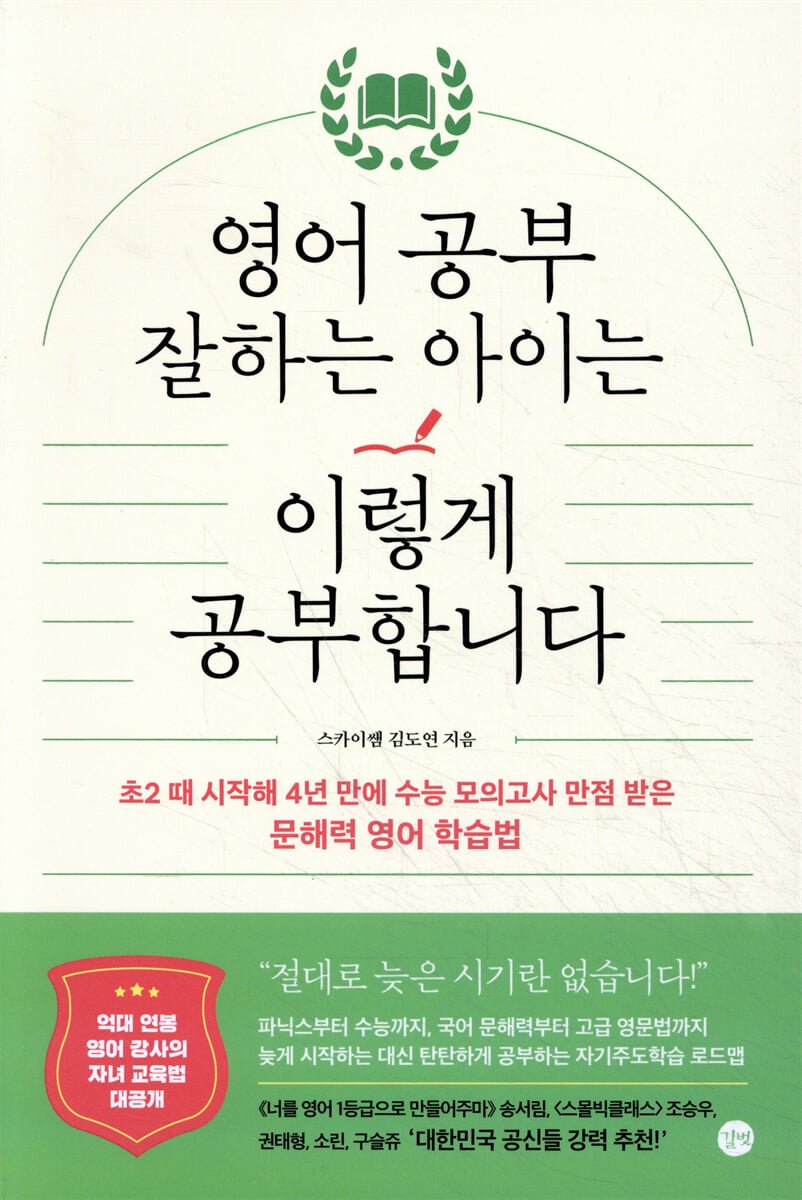
This is how children who are good at English study
 |
Description
Book Introduction
- A word from MD
- A learning method implemented by Sky Teacher Kim Do-yeon, an English education expert, and her child, Haengbok! A roadmap for raising children who are self-directed learners in all subjects, beyond English.
"What if I miss the golden time for my child's English education?" Let's start the 5-step curriculum with Sky Teacher, who firmly answers, "It's never too late for your child to study."
It's never too late for a child to study.
A first-grade child who cried whenever English was mentioned received a perfect score on the English section of the CSAT mock exam in sixth grade!
A proper English education curriculum from Sky Teacher, an English instructor with a salary in the hundreds of millions.
If you are a parent in Korea, you must have heard this at least once.
'If you want your child to be good at English, you need to create an English environment from an early age.
You need to consistently read English nursery rhymes and storybooks.
This way, your child can learn English naturally, as if it were his or her native language.'
However, there are children who cry, get irritated, and show negative reactions even when they see English videos or songs, even if they are just over one year old.
In this case, many parents feel guilty.
"Did I start too hastily?" "Am I approaching this wrong because I don't speak English well?" "Is it because I didn't read the storybook properly?" "What if I missed the golden opportunity?"
I worry that if I hurriedly search through mom cafes and send my child to an English kindergarten or English academy, my child will fall behind.
English is said to be the subject that is most difficult to get a grade in these days, as all children are good at it.
Sky Teacher's book, "This is how children who are good at studying English study," tells parents to rest assured that "it is never too late to start studying English."
Sky Teacher is an English education expert who has taught English to hundreds of children in Seoul for 12 years.
As an English education expert, many people misunderstand that I must have taught my children English well since they were young, but in reality, my child, Haengbok, was raised by his grandmother because I was busy with my work at the academy.
As a private academy instructor with a salary in the hundreds of millions and as the head of an English academy, I worked tirelessly. When my daughter, Haengbok, was 7 years old, she was taken by her grandmother to a local academy and developed an aversion to English. She would cover her ears and cry even when she heard English children's songs.
Due to overworking myself for a long time while running a private academy, my health deteriorated and I lost my voice. Also, my spouse changed jobs and I had to move, so I made the decision.
"It's time to take care of myself and my child." That's how Happy started memorizing the alphabet together during the winter break of her first year of elementary school, when she was 9 years old. Four years later, in her sixth year of elementary school, she completed the English section of the mock college entrance exam in just 47 minutes and received a perfect score.
"This is how children who are good at studying English study" is a book that contains a learning roadmap that guides children to become "self-directed learners" of all subjects, not just English, directly implemented by Sky Teacher, an English education expert, and Haengbok Lee, a child.
It contains the know-how to lead a first grader who would cover his ears and cry at the mere sound of English to become a science prodigy with no private tutoring, as well as a perfect score on the English section of the college entrance exam in the sixth grade.
It covers a five-step curriculum tailored to the child's skill development, from literacy development, dream goal setting, English reading, listening, speaking, and writing coaching.
A first-grade child who cried whenever English was mentioned received a perfect score on the English section of the CSAT mock exam in sixth grade!
A proper English education curriculum from Sky Teacher, an English instructor with a salary in the hundreds of millions.
If you are a parent in Korea, you must have heard this at least once.
'If you want your child to be good at English, you need to create an English environment from an early age.
You need to consistently read English nursery rhymes and storybooks.
This way, your child can learn English naturally, as if it were his or her native language.'
However, there are children who cry, get irritated, and show negative reactions even when they see English videos or songs, even if they are just over one year old.
In this case, many parents feel guilty.
"Did I start too hastily?" "Am I approaching this wrong because I don't speak English well?" "Is it because I didn't read the storybook properly?" "What if I missed the golden opportunity?"
I worry that if I hurriedly search through mom cafes and send my child to an English kindergarten or English academy, my child will fall behind.
English is said to be the subject that is most difficult to get a grade in these days, as all children are good at it.
Sky Teacher's book, "This is how children who are good at studying English study," tells parents to rest assured that "it is never too late to start studying English."
Sky Teacher is an English education expert who has taught English to hundreds of children in Seoul for 12 years.
As an English education expert, many people misunderstand that I must have taught my children English well since they were young, but in reality, my child, Haengbok, was raised by his grandmother because I was busy with my work at the academy.
As a private academy instructor with a salary in the hundreds of millions and as the head of an English academy, I worked tirelessly. When my daughter, Haengbok, was 7 years old, she was taken by her grandmother to a local academy and developed an aversion to English. She would cover her ears and cry even when she heard English children's songs.
Due to overworking myself for a long time while running a private academy, my health deteriorated and I lost my voice. Also, my spouse changed jobs and I had to move, so I made the decision.
"It's time to take care of myself and my child." That's how Happy started memorizing the alphabet together during the winter break of her first year of elementary school, when she was 9 years old. Four years later, in her sixth year of elementary school, she completed the English section of the mock college entrance exam in just 47 minutes and received a perfect score.
"This is how children who are good at studying English study" is a book that contains a learning roadmap that guides children to become "self-directed learners" of all subjects, not just English, directly implemented by Sky Teacher, an English education expert, and Haengbok Lee, a child.
It contains the know-how to lead a first grader who would cover his ears and cry at the mere sound of English to become a science prodigy with no private tutoring, as well as a perfect score on the English section of the college entrance exam in the sixth grade.
It covers a five-step curriculum tailored to the child's skill development, from literacy development, dream goal setting, English reading, listening, speaking, and writing coaching.
- You can preview some of the book's contents.
Preview
index
Recommendation
prolog.
A second-grader who had a fear of English achieved a perfect score on the CSAT mock exam after four years.
Part 1.
How a child with a strong aversion to English can now speak English fluently
Chapter 1.
Why I Speak English Like My Mom
01 Winter break of first grade, Haengbok, who has a weak constitution and aversion to English, begins learning English.
02 Aversion to English is more serious and more common than you think.
03 How well should my child speak English?
Chapter 2.
Korean literacy is English proficiency and all other skills.
01 The elementary education secrets of a mother who scored perfect on the CSAT and a SKY early graduate
02 Why I Wasn't Impatient to Start Learning English Late
03 Did Haengbok only get a perfect score in English? His Korean literacy and grades across all subjects were excellent.
Chapter 3.
Mom's Mark (Mom's Help Mark) Increases Your Chances of Success in English!
01 Consider also the Mom's Help Table English, which provides some outside help.
02 What are the advantages of Mom's English (Mom's Help)?
03 Which of the four English learning styles does my child fall into?
Chapter 4.
Prerequisites for Mom's English Education (Mom's Help)
01 The subject of study is the child, not the parents.
02 Why You Don't Need to Be Afraid of Mom's English
03 Parental confidence and perseverance lead to success in Mom's English.
Part 2.
A 5-step curriculum that achieved a perfect score on the English section of the CSAT in just 4 years.
Step 0.
Warming up for Mom's English
01 The Secret to a Successful Parenting Style: Become Close to Your Child First
02 English warm-up exercises to improve English study efficiency
03 Building a foundation for English and preventing English aversion
04 Establishing study and reading habits before learning English
05 7 Study and Reading Habits for Mom's English
06 Setting English Education Philosophy and Goals
07 'Mom's English' and 20 'Mom's Help English'
Step 1.
[0-6 months] Learn phonics 4 times a week
01 [Literacy Reading Method] Read Two Books a Day
02 [Dreams, Goals, and English] Understanding the Need for English Through Your Environment
03 Early English Education: Is the Sooner the Better?
04 Is it good to learn Phoenix?
05 [Phoenix Learning Step 1] Learning the Alphabet
06 [Phoenix Learning Steps 2+3] Learning Short and Long Vowels
07 [Phoenix Learning Steps 4+5] Learning Consecutive Consonants and Letter Combinations
[A one-volume phonics textbook ideal for children and parents who are starting to learn English late in life]
08 How to Find the Lexile Index of an English Book
09 How to Find the AR Index of an English Original Book
[Step 1.
[Progress chart and study method at a glance]
Step 2.
[7 months to 1 year and 4 months] Learn elementary-level English three times a week.
01 [Literacy Reading Method] Read a Lot! Building a Foundation for Picture Book Reading and Extended Reading
02 [Dreams, Goals, and English] Learn about the humanities approach to English and careers.
03 Korean vs. Foreign Textbooks
04 Elementary Reading Materials Appropriate for Your Child's Level: Read Smartly
05 Elementary Reading Textbooks: Making Them Yours
06 Easy Elementary Listening
07 Isn't learning grammar too fast?
08 Very light introduction to elementary grammar
09 Prepare for video English classes
[Step 2.
[Progress chart and study method at a glance]
Step 3.
[1 year 5 months to 2 years 2 months] Learn intermediate-level English three times a week
01 [Literacy Reading Method] Reading thick books by subject area through extended reading
02 [Dreams, Goals, and English] First, set your dreams and goals and work towards them.
03 Textbook Selection Methods and Tips
04 Master key sentences and leap ahead in middle school reading.
05 See the effect of repetition with extended listening in Step 2
06 Mastering Middle School Level Grammar Cleverly
07 How to Use Video English Lessons Properly and Save Money
08 Prepare for an English diary and extensive reading of English original texts
[Step 3.
[Progress chart and study method at a glance]
Step 4.
[2 years 3 months to 3 years] Learn English at a middle or high school level/in original form three times a week
01 [Literacy Reading Method] Read several series of novels and develop a favorite author.
02 [Dreams, Goals, and English] Creating Instrumental Motivation with Dreams
03 Adapting to the long, original text by solving it twice
04 Preparing for Listening in Original Format
05 Master middle school level grammar cleverly
06 Successfully Adapting to the Online English Library
07 If you have good Korean literacy, will it be easy to read English books?
08 Use your child's interests to get them excited about reading English books.
[Step 4.
[Progress chart and study method at a glance]
Step 5.
[3 years 1 month to 3 years 10 months] Learn advanced-level/TOEFL-style English three times a week
01 [Literacy Reading Method] Balancing Storybooks and Knowledge Books
02 [Dreams, Goals, and English] Create a Dream Board and Set Specific Goals for Your Dreams
03 Read and transcribe long TOEFL-style texts by subject.
04 Why use the original text-based intensive listening textbook and have students read original English texts?
05 Now's the Time! TOEFL-style Long-Term Listening for a Smooth Post-College Success
06 Mastering Middle School Grammar Cleverly
07 Expand your range of genres and read a wide range of original English books.
08 Preparing for the Writing and Speaking Contest
[Step 5.
[Progress chart and study method at a glance]
Part 3.
English Roadmap After Scoring Perfect Scores on the CSAT Mock Exam
01 Literacy Reading Methods & Dreams and Goals, Including Adult Books
02 Let's learn 'Children's English' through self-directed learning.
03 Prepare thoroughly for your school grades and the CSAT in advance.
04 How to Use Intermediate-Advanced TOEFL Textbooks and Original English Textbooks for Adults to Think in English
05 Study Plan for Part 3
Epilogue.
It's never too late to start studying
[Appendix Table of Contents]
01.
How to read phonics words
02.
Reading & Listening Textbook Level Table
03.
Selected sentences to improve reading comprehension skills in Level 2 Reading
04.
Selected sentences to improve reading comprehension skills in Level 3
05.
Selected sentences to improve reading comprehension skills in Level 4
06.
Special lecture on relative pronouns
07.
15 Skills to Improve Your Listening Skills
08.
5-paragraph English essay example
prolog.
A second-grader who had a fear of English achieved a perfect score on the CSAT mock exam after four years.
Part 1.
How a child with a strong aversion to English can now speak English fluently
Chapter 1.
Why I Speak English Like My Mom
01 Winter break of first grade, Haengbok, who has a weak constitution and aversion to English, begins learning English.
02 Aversion to English is more serious and more common than you think.
03 How well should my child speak English?
Chapter 2.
Korean literacy is English proficiency and all other skills.
01 The elementary education secrets of a mother who scored perfect on the CSAT and a SKY early graduate
02 Why I Wasn't Impatient to Start Learning English Late
03 Did Haengbok only get a perfect score in English? His Korean literacy and grades across all subjects were excellent.
Chapter 3.
Mom's Mark (Mom's Help Mark) Increases Your Chances of Success in English!
01 Consider also the Mom's Help Table English, which provides some outside help.
02 What are the advantages of Mom's English (Mom's Help)?
03 Which of the four English learning styles does my child fall into?
Chapter 4.
Prerequisites for Mom's English Education (Mom's Help)
01 The subject of study is the child, not the parents.
02 Why You Don't Need to Be Afraid of Mom's English
03 Parental confidence and perseverance lead to success in Mom's English.
Part 2.
A 5-step curriculum that achieved a perfect score on the English section of the CSAT in just 4 years.
Step 0.
Warming up for Mom's English
01 The Secret to a Successful Parenting Style: Become Close to Your Child First
02 English warm-up exercises to improve English study efficiency
03 Building a foundation for English and preventing English aversion
04 Establishing study and reading habits before learning English
05 7 Study and Reading Habits for Mom's English
06 Setting English Education Philosophy and Goals
07 'Mom's English' and 20 'Mom's Help English'
Step 1.
[0-6 months] Learn phonics 4 times a week
01 [Literacy Reading Method] Read Two Books a Day
02 [Dreams, Goals, and English] Understanding the Need for English Through Your Environment
03 Early English Education: Is the Sooner the Better?
04 Is it good to learn Phoenix?
05 [Phoenix Learning Step 1] Learning the Alphabet
06 [Phoenix Learning Steps 2+3] Learning Short and Long Vowels
07 [Phoenix Learning Steps 4+5] Learning Consecutive Consonants and Letter Combinations
[A one-volume phonics textbook ideal for children and parents who are starting to learn English late in life]
08 How to Find the Lexile Index of an English Book
09 How to Find the AR Index of an English Original Book
[Step 1.
[Progress chart and study method at a glance]
Step 2.
[7 months to 1 year and 4 months] Learn elementary-level English three times a week.
01 [Literacy Reading Method] Read a Lot! Building a Foundation for Picture Book Reading and Extended Reading
02 [Dreams, Goals, and English] Learn about the humanities approach to English and careers.
03 Korean vs. Foreign Textbooks
04 Elementary Reading Materials Appropriate for Your Child's Level: Read Smartly
05 Elementary Reading Textbooks: Making Them Yours
06 Easy Elementary Listening
07 Isn't learning grammar too fast?
08 Very light introduction to elementary grammar
09 Prepare for video English classes
[Step 2.
[Progress chart and study method at a glance]
Step 3.
[1 year 5 months to 2 years 2 months] Learn intermediate-level English three times a week
01 [Literacy Reading Method] Reading thick books by subject area through extended reading
02 [Dreams, Goals, and English] First, set your dreams and goals and work towards them.
03 Textbook Selection Methods and Tips
04 Master key sentences and leap ahead in middle school reading.
05 See the effect of repetition with extended listening in Step 2
06 Mastering Middle School Level Grammar Cleverly
07 How to Use Video English Lessons Properly and Save Money
08 Prepare for an English diary and extensive reading of English original texts
[Step 3.
[Progress chart and study method at a glance]
Step 4.
[2 years 3 months to 3 years] Learn English at a middle or high school level/in original form three times a week
01 [Literacy Reading Method] Read several series of novels and develop a favorite author.
02 [Dreams, Goals, and English] Creating Instrumental Motivation with Dreams
03 Adapting to the long, original text by solving it twice
04 Preparing for Listening in Original Format
05 Master middle school level grammar cleverly
06 Successfully Adapting to the Online English Library
07 If you have good Korean literacy, will it be easy to read English books?
08 Use your child's interests to get them excited about reading English books.
[Step 4.
[Progress chart and study method at a glance]
Step 5.
[3 years 1 month to 3 years 10 months] Learn advanced-level/TOEFL-style English three times a week
01 [Literacy Reading Method] Balancing Storybooks and Knowledge Books
02 [Dreams, Goals, and English] Create a Dream Board and Set Specific Goals for Your Dreams
03 Read and transcribe long TOEFL-style texts by subject.
04 Why use the original text-based intensive listening textbook and have students read original English texts?
05 Now's the Time! TOEFL-style Long-Term Listening for a Smooth Post-College Success
06 Mastering Middle School Grammar Cleverly
07 Expand your range of genres and read a wide range of original English books.
08 Preparing for the Writing and Speaking Contest
[Step 5.
[Progress chart and study method at a glance]
Part 3.
English Roadmap After Scoring Perfect Scores on the CSAT Mock Exam
01 Literacy Reading Methods & Dreams and Goals, Including Adult Books
02 Let's learn 'Children's English' through self-directed learning.
03 Prepare thoroughly for your school grades and the CSAT in advance.
04 How to Use Intermediate-Advanced TOEFL Textbooks and Original English Textbooks for Adults to Think in English
05 Study Plan for Part 3
Epilogue.
It's never too late to start studying
[Appendix Table of Contents]
01.
How to read phonics words
02.
Reading & Listening Textbook Level Table
03.
Selected sentences to improve reading comprehension skills in Level 2 Reading
04.
Selected sentences to improve reading comprehension skills in Level 3
05.
Selected sentences to improve reading comprehension skills in Level 4
06.
Special lecture on relative pronouns
07.
15 Skills to Improve Your Listening Skills
08.
5-paragraph English essay example
Detailed image
.jpg)
Into the book
Until the first grade of elementary school, Haengbok was a child who had such a strong aversion to English that he would cover his ears and cry whenever he heard an English song.
At the time, I was an English academy instructor with a salary in the hundreds of millions, so I was so busy that I couldn't even think about exposing my child to English or providing early English education.
However, Haengbok's maternal grandmother, who had been taking care of Haengbok in my place, said, "I'm worried because he doesn't even know the alphabet properly even though he's seven years old," and sent him to an English academy for a few months without any plan. This actually led to Haengbok's strong rejection of English.
--- p.
8
I have met many children who developed their potential by reading in Korean and then showed their prowess in English after elementary school.
There was a child who started studying English later than others, but his skills continued to improve, catching up with the level of children in his grade after 1-2 years, and reaching the top level after 2-3 years.
For this reason, I focused on improving my Korean language skills and taught English in a timely manner.
--- p.
44
This book will help you coach your child's English learning in at least three ways.
The 'Mom's English' that I did, the 'Mom's Help English' that fills in the gaps in studying at the academy, and another 'Mom's Help English' that replaces only the parts that moms are not good at with video lectures or private tutoring.
Video lectures are great for saving time because you can only hear the questions you got wrong, and private lessons allow you to request specific topics from your teacher.
If you are not confident in your English skills, help your child learn English successfully with 'Mom's Help English', which provides some outside help.
--- p.
54
It would be ideal if your child excelled in all areas of English (reading, listening, grammar, writing, and speaking), but there may be areas that they particularly struggle with.
Children with a science-type brain structure are good at grammar and structural analysis, but have poor linguistic sense.
On the other hand, children with a liberal arts brain structure have good language skills but have difficulty with grammar and structural analysis.
If you use Mom's English, you can adjust the speed and amount of study to suit your child's characteristics.
--- p.
59
Children's personalities vary greatly.
However, if you look closely, there are common tendencies that can be used to categorize children into types.
My Mom's English method uses textbooks and improves English skills by absorbing learned sentences and words. Therefore, I divide children's learning styles into four types based on their ability to 'understand' the textbook content and their ability to 'memorize' sentences and words.
--- p.
61
Happiness is also of this type.
Since I am the type of person who forgets easily even after memorizing, I made sure to consistently listen to audio files and read notes to organize them.
We also made it a point to have a review week or review day every 4 to 6 weeks and had them repeat the learning.
Any child who develops a memorization method that suits them and develops their memorization skills while also improving their Korean language skills will gain confidence in English and enjoy it more.
--- p.
64
According to the second language acquisition hypothesis, Mom's English with Haengbok started by improving the relationship.
Haengbok was a child who had aversion to English, so he needed to lower his emotional barrier and become psychologically stable enough to effectively learn English. To do that, the most urgent task was to make him like me.
If my child likes me as a coach, the emotional filter will be lowered and my mother's English will lead to success.
--- pp.
89~90
There are many people who focus on English language learning for their children through original English books rather than English textbooks.
Of course, reading English original texts is also necessary.
My child also read English books consistently.
But our children who are taking the test also need to study English textbooks.
English textbooks are tools designed for learning, and only by developing a strong learning attitude can you effectively use them to achieve extraordinary results.
Learning attitude is linked to study habits, and study habits can be captured in a study schedule or study list.
Ultimately, my mom's English method is more effective when you develop the right learning attitude and study habits.
And even if you develop study habits, if you lose the habit of reading, it's difficult to expect dramatic improvements in your English skills.
In fact, the biggest reason I had Haengbok use a study schedule or study list was to 'develop a reading habit.'
--- p.
102
The alphabet t sounds similar to the Korean consonant 'ㅌ', but the pitch of the sound produced in Korean and English is different, so they cannot be said to be the same sound.
So, it is not a good idea to add explanations that substitute English for Korean in order to help the child.
If your child says, “b sounds like b,” explain, “b sounds similar to b, but the sound is different in English and Korean.”
Then the child will wonder how it is different and will listen more carefully.
--- p.
158
In Mom's English Level 0 'English Warm-up', we helped children understand the people, society, and culture of English-speaking countries.
And in step 1, we learned about history.
After reading books like 『English Inside and Out』(Han Hak-seong, Chae Ryun) and 『English Stories Embracing World History』(Philip Gooden, Honey Wise), I taught Haengbok about the history of English.
At that time, Haengbok was very interested in our country's history, so he was also interested in the history of English.
Once your child learns about the history of English, their perspective on the language will change.
We will approach English not simply as an academic discipline, but as a humanities discipline steeped in history and culture.
--- p.
206
I will explain the principles and literacy of how to accept English as English.
I divide the way I accept English into two main categories.
First, you have to accept English as English and understand the meaning.
It refers to the process of imagining, visualizing, and accepting abstract things in one's head.
The second is to understand, infer, organize, and summarize the information you have obtained until the end of the text.
I use the meaning I have grasped as ingredients to cook it well in my head and recreate it into a dish that suits me.
What is needed in this process is Korean literacy.
At the time, I was an English academy instructor with a salary in the hundreds of millions, so I was so busy that I couldn't even think about exposing my child to English or providing early English education.
However, Haengbok's maternal grandmother, who had been taking care of Haengbok in my place, said, "I'm worried because he doesn't even know the alphabet properly even though he's seven years old," and sent him to an English academy for a few months without any plan. This actually led to Haengbok's strong rejection of English.
--- p.
8
I have met many children who developed their potential by reading in Korean and then showed their prowess in English after elementary school.
There was a child who started studying English later than others, but his skills continued to improve, catching up with the level of children in his grade after 1-2 years, and reaching the top level after 2-3 years.
For this reason, I focused on improving my Korean language skills and taught English in a timely manner.
--- p.
44
This book will help you coach your child's English learning in at least three ways.
The 'Mom's English' that I did, the 'Mom's Help English' that fills in the gaps in studying at the academy, and another 'Mom's Help English' that replaces only the parts that moms are not good at with video lectures or private tutoring.
Video lectures are great for saving time because you can only hear the questions you got wrong, and private lessons allow you to request specific topics from your teacher.
If you are not confident in your English skills, help your child learn English successfully with 'Mom's Help English', which provides some outside help.
--- p.
54
It would be ideal if your child excelled in all areas of English (reading, listening, grammar, writing, and speaking), but there may be areas that they particularly struggle with.
Children with a science-type brain structure are good at grammar and structural analysis, but have poor linguistic sense.
On the other hand, children with a liberal arts brain structure have good language skills but have difficulty with grammar and structural analysis.
If you use Mom's English, you can adjust the speed and amount of study to suit your child's characteristics.
--- p.
59
Children's personalities vary greatly.
However, if you look closely, there are common tendencies that can be used to categorize children into types.
My Mom's English method uses textbooks and improves English skills by absorbing learned sentences and words. Therefore, I divide children's learning styles into four types based on their ability to 'understand' the textbook content and their ability to 'memorize' sentences and words.
--- p.
61
Happiness is also of this type.
Since I am the type of person who forgets easily even after memorizing, I made sure to consistently listen to audio files and read notes to organize them.
We also made it a point to have a review week or review day every 4 to 6 weeks and had them repeat the learning.
Any child who develops a memorization method that suits them and develops their memorization skills while also improving their Korean language skills will gain confidence in English and enjoy it more.
--- p.
64
According to the second language acquisition hypothesis, Mom's English with Haengbok started by improving the relationship.
Haengbok was a child who had aversion to English, so he needed to lower his emotional barrier and become psychologically stable enough to effectively learn English. To do that, the most urgent task was to make him like me.
If my child likes me as a coach, the emotional filter will be lowered and my mother's English will lead to success.
--- pp.
89~90
There are many people who focus on English language learning for their children through original English books rather than English textbooks.
Of course, reading English original texts is also necessary.
My child also read English books consistently.
But our children who are taking the test also need to study English textbooks.
English textbooks are tools designed for learning, and only by developing a strong learning attitude can you effectively use them to achieve extraordinary results.
Learning attitude is linked to study habits, and study habits can be captured in a study schedule or study list.
Ultimately, my mom's English method is more effective when you develop the right learning attitude and study habits.
And even if you develop study habits, if you lose the habit of reading, it's difficult to expect dramatic improvements in your English skills.
In fact, the biggest reason I had Haengbok use a study schedule or study list was to 'develop a reading habit.'
--- p.
102
The alphabet t sounds similar to the Korean consonant 'ㅌ', but the pitch of the sound produced in Korean and English is different, so they cannot be said to be the same sound.
So, it is not a good idea to add explanations that substitute English for Korean in order to help the child.
If your child says, “b sounds like b,” explain, “b sounds similar to b, but the sound is different in English and Korean.”
Then the child will wonder how it is different and will listen more carefully.
--- p.
158
In Mom's English Level 0 'English Warm-up', we helped children understand the people, society, and culture of English-speaking countries.
And in step 1, we learned about history.
After reading books like 『English Inside and Out』(Han Hak-seong, Chae Ryun) and 『English Stories Embracing World History』(Philip Gooden, Honey Wise), I taught Haengbok about the history of English.
At that time, Haengbok was very interested in our country's history, so he was also interested in the history of English.
Once your child learns about the history of English, their perspective on the language will change.
We will approach English not simply as an academic discipline, but as a humanities discipline steeped in history and culture.
--- p.
206
I will explain the principles and literacy of how to accept English as English.
I divide the way I accept English into two main categories.
First, you have to accept English as English and understand the meaning.
It refers to the process of imagining, visualizing, and accepting abstract things in one's head.
The second is to understand, infer, organize, and summarize the information you have obtained until the end of the text.
I use the meaning I have grasped as ingredients to cook it well in my head and recreate it into a dish that suits me.
What is needed in this process is Korean literacy.
--- p.
225
225
Publisher's Review
"My goal is to be a child who excels in all subjects, not just English."
No to 3 hours of immersive English a day!
A literacy English learning method that prioritizes reading Korean books over English books.
It is an amazing achievement that an elementary school student solved a college entrance exam problem that even high school students have to solve under time pressure in just 47 minutes and received a perfect score.
So, did Haengbok focus solely on English for all four years? No.
Haengbok is creating his future by dreaming of becoming a scientist.
Haengbok, who was slow to learn English and math, was selected as a science prodigy in the 4th grade of elementary school without any private tutoring and entered a gifted center where he has been attending for 4 years. He is currently receiving grades close to perfect perfection in all subjects at a private middle school that is equivalent to a special-purpose middle school in Seoul.
I plan every day and study on my own with the goal of getting into a science high school.
For Haengbok, English is just one of many enjoyable, self-directed studies.
How can these results be achieved? The secret lies in Sky Teacher's educational philosophy.
Teaching many children at academies has taught me that the greatest influence on academic performance in all subjects, including English, is Korean literacy.
Even if a child with high literacy skills is not good at English, their grades improve rapidly once they build a solid foundation.
However, children with low literacy skills, no matter how young they were exposed to English, at some point their English skills stagnate.
So, we made improving Haengbok's literacy a top priority.
Another issue that needed to be addressed was Haengbok's aversion to English.
I studied various papers to find ways to reduce the aversion to English and make studying enjoyable for my child who strongly rejects English and cries.
Based on Sky Teacher's educational philosophy, Haengbok read Korean storybooks with his mother every day and engaged in 'book chats.'
And in order to reduce Haengbok's aversion to English, I helped him become interested in the countries of England and the United States, read English signs on cans or signs together, or quietly read English storybooks next to him while he was reading Korean books, and worked behind the scenes to get him interested in English on his own.
As my child began to become curious about English, I began exposing him to English three times a week for about 30 minutes, and gradually increased the time.
Why didn't Sky Teacher choose immersive English education? There are two reasons.
One reason is that Haengbok's physical strength was so weak that he had very little time to study compared to other children.
Another reason is that I didn't want my child to be good only at English.
I hope that Haengbok will find his true interests and future dreams and focus on studying to achieve them.
And I hoped English would be one of the tools to help with that.
A 5-step learning curriculum that focuses on solid study instead of starting late.
A self-directed learning roadmap that leads to learning all subjects in English.
With the goal of 'giving wings to children's dreams through English', Sky Teacher decided to coach English rather than teach it.
Rather than teaching English directly, I took a step back and helped them learn on their own.
The first thing Sky Teacher did was to encourage the child's will to study on his own, purchase textbooks sold on the market according to the child's interest and ability, set the daily study amount, suggest study methods, create a schedule together, and check if the child understood well after completing the study.
"This is how children who are good at studying English study" contains a five-step curriculum tailored to the development of children's skills, including literacy development, dream goal setting, English reading, listening, speaking, and writing coaching methods.
The biggest feature of this book is that as the level progresses, the initiative in studying is gradually transferred to the child and he or she is led to self-directed learning.
As a result, Haengbok attends a gifted education center without receiving any private tutoring, and is learning all subjects independently.
A solid motivational education method that I can use as a parent of my own child.
“The most surprising thing is that it maximizes the effect by considering the child’s emotions.
“It’s a special learning method.”
Song Seo-rim, author of "I'll Make You a Level 1 in English," recommended this book, saying, "The most surprising thing about this book is its special learning method that maximizes effectiveness by taking into consideration the child's emotions."
Seungwoo Cho, CEO of Small Big Class, said of this book, "It will show you a way to kill three birds with one stone: learning, relationships, and the child's subjectivity, without losing the relationship with the child in the name of learning."
If you want your child to not struggle with English and to focus on other subjects and fly towards their dreams, you will find the way in this book.
[What's special about Sky Teacher's curriculum]
First, it is a study method that emphasizes learning all subjects, not just English.
Second, it helps build a foundation for learning by covering the five-step reading method to develop literacy.
Third, by studying 1 hour a day, 2-3 times a week, you can secure time to study other subjects.
Fourth, we provide a curriculum that takes into account not only the CSAT but also post-university life.
Fifth, it is an effective teaching method that contains the know-how of an English education expert who has taught hundreds of people for 12 years.
Sixth, it is a coaching method that fosters self-directed learning ability through a learning method based on a study plan.
Seventh, it contains emotional learning methods to help children overcome their aversion to studying and improve their ability to study.
Eighth, it is a virtuous cycle study method that motivates children by helping them find their own reasons for studying.
Ninth, we covered how to utilize academies, private tutoring, and video lectures to avoid failure even if parents are not good at English.
No to 3 hours of immersive English a day!
A literacy English learning method that prioritizes reading Korean books over English books.
It is an amazing achievement that an elementary school student solved a college entrance exam problem that even high school students have to solve under time pressure in just 47 minutes and received a perfect score.
So, did Haengbok focus solely on English for all four years? No.
Haengbok is creating his future by dreaming of becoming a scientist.
Haengbok, who was slow to learn English and math, was selected as a science prodigy in the 4th grade of elementary school without any private tutoring and entered a gifted center where he has been attending for 4 years. He is currently receiving grades close to perfect perfection in all subjects at a private middle school that is equivalent to a special-purpose middle school in Seoul.
I plan every day and study on my own with the goal of getting into a science high school.
For Haengbok, English is just one of many enjoyable, self-directed studies.
How can these results be achieved? The secret lies in Sky Teacher's educational philosophy.
Teaching many children at academies has taught me that the greatest influence on academic performance in all subjects, including English, is Korean literacy.
Even if a child with high literacy skills is not good at English, their grades improve rapidly once they build a solid foundation.
However, children with low literacy skills, no matter how young they were exposed to English, at some point their English skills stagnate.
So, we made improving Haengbok's literacy a top priority.
Another issue that needed to be addressed was Haengbok's aversion to English.
I studied various papers to find ways to reduce the aversion to English and make studying enjoyable for my child who strongly rejects English and cries.
Based on Sky Teacher's educational philosophy, Haengbok read Korean storybooks with his mother every day and engaged in 'book chats.'
And in order to reduce Haengbok's aversion to English, I helped him become interested in the countries of England and the United States, read English signs on cans or signs together, or quietly read English storybooks next to him while he was reading Korean books, and worked behind the scenes to get him interested in English on his own.
As my child began to become curious about English, I began exposing him to English three times a week for about 30 minutes, and gradually increased the time.
Why didn't Sky Teacher choose immersive English education? There are two reasons.
One reason is that Haengbok's physical strength was so weak that he had very little time to study compared to other children.
Another reason is that I didn't want my child to be good only at English.
I hope that Haengbok will find his true interests and future dreams and focus on studying to achieve them.
And I hoped English would be one of the tools to help with that.
A 5-step learning curriculum that focuses on solid study instead of starting late.
A self-directed learning roadmap that leads to learning all subjects in English.
With the goal of 'giving wings to children's dreams through English', Sky Teacher decided to coach English rather than teach it.
Rather than teaching English directly, I took a step back and helped them learn on their own.
The first thing Sky Teacher did was to encourage the child's will to study on his own, purchase textbooks sold on the market according to the child's interest and ability, set the daily study amount, suggest study methods, create a schedule together, and check if the child understood well after completing the study.
"This is how children who are good at studying English study" contains a five-step curriculum tailored to the development of children's skills, including literacy development, dream goal setting, English reading, listening, speaking, and writing coaching methods.
The biggest feature of this book is that as the level progresses, the initiative in studying is gradually transferred to the child and he or she is led to self-directed learning.
As a result, Haengbok attends a gifted education center without receiving any private tutoring, and is learning all subjects independently.
A solid motivational education method that I can use as a parent of my own child.
“The most surprising thing is that it maximizes the effect by considering the child’s emotions.
“It’s a special learning method.”
Song Seo-rim, author of "I'll Make You a Level 1 in English," recommended this book, saying, "The most surprising thing about this book is its special learning method that maximizes effectiveness by taking into consideration the child's emotions."
Seungwoo Cho, CEO of Small Big Class, said of this book, "It will show you a way to kill three birds with one stone: learning, relationships, and the child's subjectivity, without losing the relationship with the child in the name of learning."
If you want your child to not struggle with English and to focus on other subjects and fly towards their dreams, you will find the way in this book.
[What's special about Sky Teacher's curriculum]
First, it is a study method that emphasizes learning all subjects, not just English.
Second, it helps build a foundation for learning by covering the five-step reading method to develop literacy.
Third, by studying 1 hour a day, 2-3 times a week, you can secure time to study other subjects.
Fourth, we provide a curriculum that takes into account not only the CSAT but also post-university life.
Fifth, it is an effective teaching method that contains the know-how of an English education expert who has taught hundreds of people for 12 years.
Sixth, it is a coaching method that fosters self-directed learning ability through a learning method based on a study plan.
Seventh, it contains emotional learning methods to help children overcome their aversion to studying and improve their ability to study.
Eighth, it is a virtuous cycle study method that motivates children by helping them find their own reasons for studying.
Ninth, we covered how to utilize academies, private tutoring, and video lectures to avoid failure even if parents are not good at English.
GOODS SPECIFICS
- Publication date: December 10, 2021
- Page count, weight, size: 540 pages | 812g | 152*225*23mm
- ISBN13: 9791165218058
- ISBN10: 1165218054
You may also like
카테고리
korean


korean

![ELLE 엘르 스페셜 에디션 A형 : 12월 [2025]](http://librairie.coreenne.fr/cdn/shop/files/b8e27a3de6c9538896439686c6b0e8fb.jpg?v=1766436872&width=3840)


