

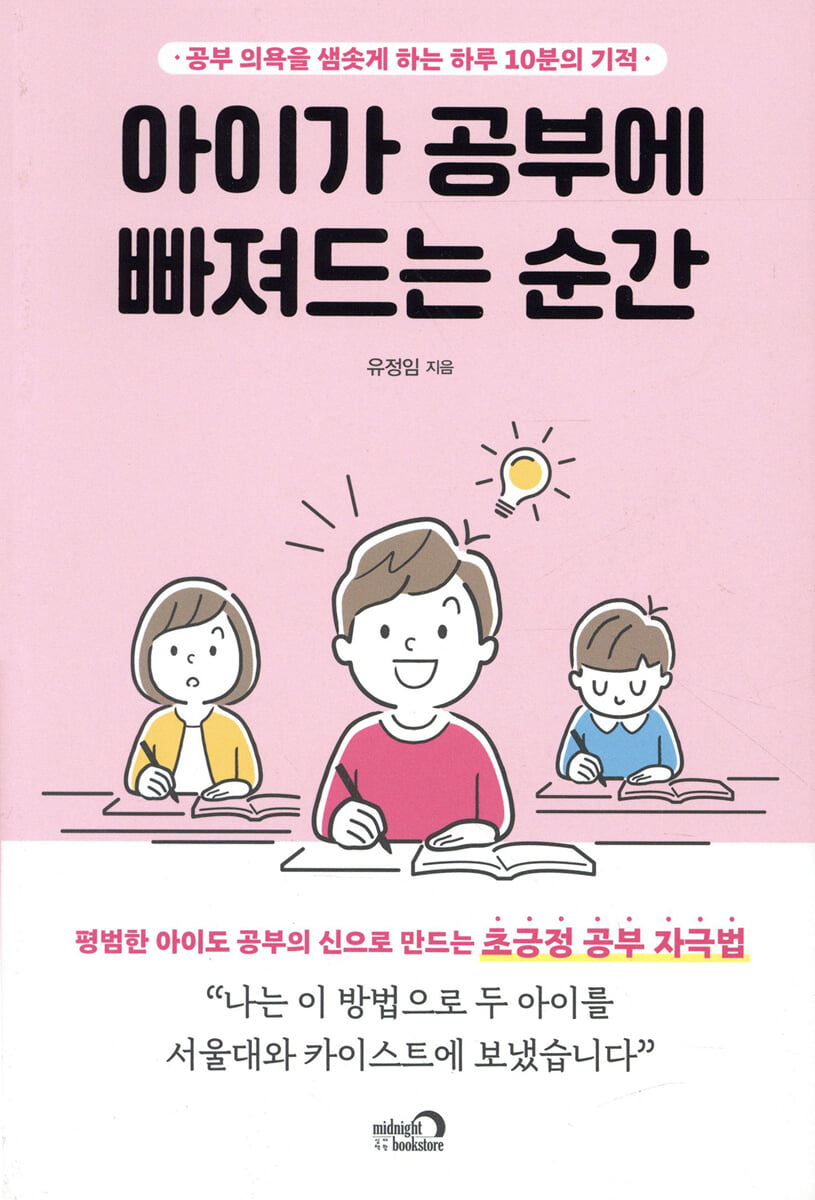
The moment a child becomes absorbed in studying
 |
Description
Book Introduction
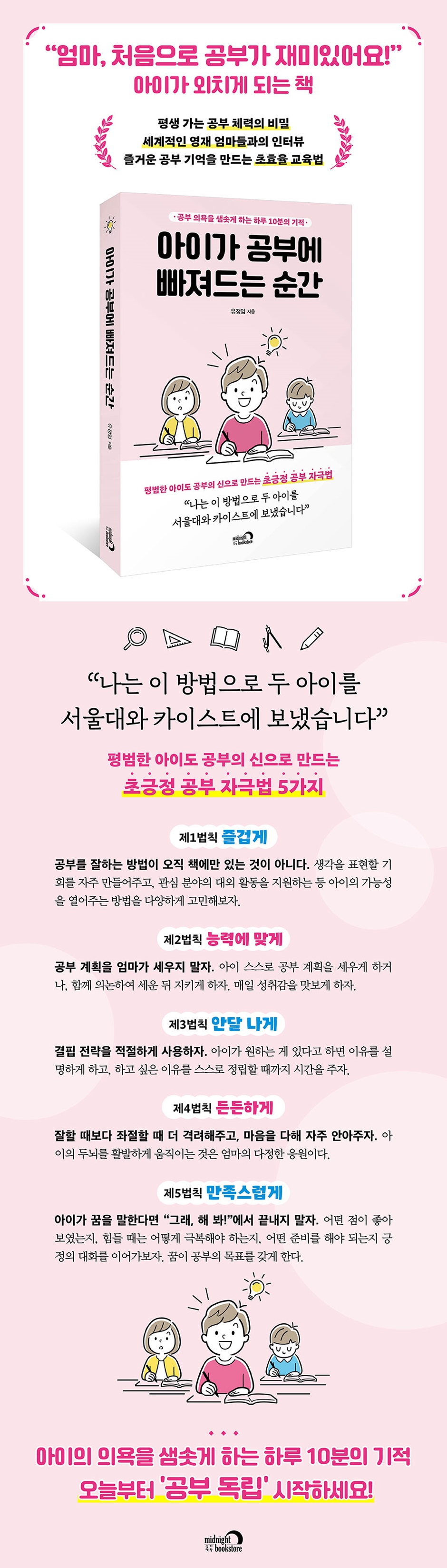
“I sent my two children to Seoul National University and KAIST this way.” The secret to stimulating children's motivation to study and the "self-immersion method" that works for all children. This book contains the core know-how and secrets to sending two children to prestigious universities, revealed through intensive interviews with gifted mothers across the country and in-depth interviews with countless experts and mothers who have succeeded in raising their children at educational sites around the world, including Harvard and MIT. This book completely overturns conventional wisdom about how to maximize a child's potential and the learning environment they need. It offers a fresh alternative based on a differentiated perspective and a wealth of proven case studies. For a long time, we have seen children who achieved the top 1% in academic performance and applauded their intelligence and tireless effort. However, the author claims that when he travels around the country giving lectures and asks children who suddenly become good at subjects they had no interest in, they all say, “I didn’t know I had that ability.” Surprisingly, what determines interest in studying and grades is not the difference between 'will and talent', but the 'study environment'. How well do you know your child's abilities? Only by properly identifying their abilities can you help them develop them. Ability grows as much as you believe in it, and your grades grow as much as your ability grows. "The Moment Your Child Falls in Love with Studying" contains 50 practical tips on how to create an environment where your child wants to study and how to draw out their inner motivation. The moment a mother practices for 10 minutes a day, the child will say that studying is the easiest. |
- You can preview some of the book's contents.
Preview
index
prolog
Chapter 1: Developing Your Child's Potential, a Surprisingly Easy Thing to Miss
01 Giftedness nurtured through skinship
02 Don't miss a moment with this Grain Recorder
03 Child's temperament and mother's temperament
04 How can I get people to read books they hate to read?
05 If you take advantage of your weaknesses, they become many times more advantageous.
06 Let your child dream of becoming the best in his or her desired field.
07 Speaking skills are developed through thinking habits.
08 Writing skills nurtured by mothers
09 Advice from a World-Class Coding Expert
10 Things Gifted Mothers Have in Common
Chapter 2: Super-positive study motivation techniques that will boost your motivation
01 Let's gradually change our perception of studying.
02. A Day to Recharge and Relieve Study Fatigue
03 Experience a sense of accomplishment with a plan tailored to your abilities.
04 If you don't study at school, you won't study at the academy either.
05 How to Use Every Corner of the Library
06 Subscribe to the magazine for children
07 Enjoyable English Reading Method in Atlanta, USA
08 A 10-minute difference makes a miracle
09 Once you have a goal, start studying.
10 Ask before you teach.
Chapter 3: The Secret to Lifelong Study Stamina
01 Study habits fostered by friendship
02 The key to mastering math is not prior knowledge.
03 How important is English grammar?
04 How much private education should I provide?
05 The fruits of learning raised with positivity
06 Just because you hate books doesn't mean you can't study.
07 KAIST is sky blue!
08 Seoul National University and Comics Mania
09 The foundation of study is physical strength.
10 The One Secret to Maintaining First Place
Chapter 4: How can we communicate to make our children happy?
01 Moderate deficiency leads to achievement.
02 Consistent parenting helps children develop their talents.
03 Let's look at the child objectively.
04 Empathize with your child at his or her eye level.
05 You have to let go of my hand to let me walk on my own.
06 The fine line between communication and non-communication
07 How much time should I allow my child to play games?
08 A comfortable home atmosphere creates a strong mentality.
09 How to prevent side effects of smartphones
10 Open various communication channels
Chapter 5: What's More Important Than Grades in a Child's Life
01 The child's vessel created by the parent's philosophy
02 Excessive abundance spoils children.
03 We are all precious in our parents' arms.
04 If parents prioritize saving face, it ruins education.
05 Small ideas make special children.
06 It's even scarier when you resemble your parents.
07 The magic that opens the teacher's heart
08 The mother is not the master of the child's life.
09 How to Turn Your Child's Dream into Reality
10 Children who will soon leave us
Chapter 1: Developing Your Child's Potential, a Surprisingly Easy Thing to Miss
01 Giftedness nurtured through skinship
02 Don't miss a moment with this Grain Recorder
03 Child's temperament and mother's temperament
04 How can I get people to read books they hate to read?
05 If you take advantage of your weaknesses, they become many times more advantageous.
06 Let your child dream of becoming the best in his or her desired field.
07 Speaking skills are developed through thinking habits.
08 Writing skills nurtured by mothers
09 Advice from a World-Class Coding Expert
10 Things Gifted Mothers Have in Common
Chapter 2: Super-positive study motivation techniques that will boost your motivation
01 Let's gradually change our perception of studying.
02. A Day to Recharge and Relieve Study Fatigue
03 Experience a sense of accomplishment with a plan tailored to your abilities.
04 If you don't study at school, you won't study at the academy either.
05 How to Use Every Corner of the Library
06 Subscribe to the magazine for children
07 Enjoyable English Reading Method in Atlanta, USA
08 A 10-minute difference makes a miracle
09 Once you have a goal, start studying.
10 Ask before you teach.
Chapter 3: The Secret to Lifelong Study Stamina
01 Study habits fostered by friendship
02 The key to mastering math is not prior knowledge.
03 How important is English grammar?
04 How much private education should I provide?
05 The fruits of learning raised with positivity
06 Just because you hate books doesn't mean you can't study.
07 KAIST is sky blue!
08 Seoul National University and Comics Mania
09 The foundation of study is physical strength.
10 The One Secret to Maintaining First Place
Chapter 4: How can we communicate to make our children happy?
01 Moderate deficiency leads to achievement.
02 Consistent parenting helps children develop their talents.
03 Let's look at the child objectively.
04 Empathize with your child at his or her eye level.
05 You have to let go of my hand to let me walk on my own.
06 The fine line between communication and non-communication
07 How much time should I allow my child to play games?
08 A comfortable home atmosphere creates a strong mentality.
09 How to prevent side effects of smartphones
10 Open various communication channels
Chapter 5: What's More Important Than Grades in a Child's Life
01 The child's vessel created by the parent's philosophy
02 Excessive abundance spoils children.
03 We are all precious in our parents' arms.
04 If parents prioritize saving face, it ruins education.
05 Small ideas make special children.
06 It's even scarier when you resemble your parents.
07 The magic that opens the teacher's heart
08 The mother is not the master of the child's life.
09 How to Turn Your Child's Dream into Reality
10 Children who will soon leave us
Detailed image
Into the book
Books should be perceived as toys that allow us to enjoy leisure time.
You can sit on it, use it as a tray when you're in a hurry, and kick it when you trip over it.
We may be so afraid of damaging books that we keep them neatly tucked away on our desks, instilling in our children the idea that books are precious.
Remember! Books are meant for consumption, not display.
--- p.32 From “Chapter 1: Developing Your Child’s Potential That’s Surprisingly Easy to Miss”
In this age of change where we cannot live according to our own ideas, let us first give our children their own goals.
This is something that is desperately needed.
Rather than telling children what to do, let them have their own 'daily goals, monthly goals, and yearly goals.'
Let's give ourselves time to think about what we're good at and what we want to do.
You have to think to have a goal, and only when you have a goal can you make a specific plan of action.
--- p.117 From “Chapter 2: Super-positive study stimulation methods that will boost your motivation”
When interviewing mothers who raised their children well, the parenting tip I always heard was to have a super positive mindset.
It is not an exaggeration to say that a child grows up eating his mother's support.
A depressed mother, a mother who gets tired easily, a mother who gets irritated easily, a mother who gets angry easily, a mother who doesn't care at all.
Let's imagine.
How does it feel? A mother who smiles a lot, speaks affectionately, shows concern, encourages, gets down to eye level, hugs, encourages, and praises.
Just reading the words makes my heart come alive.
--- p.156 From “Chapter 3: The Secret of Lifelong Study Stamina”
The computer was placed on a desk in a space on the veranda side of the living room.
While the adults watched TV in the living room, the children enjoyed playing games on one side.
The living room was always bustling with people playing games, watching TV, and communicating in the open space.
Each person tried to stay in their room without any communication problems.
We each used our own space when we had things to do, but we usually did many things together in the common space called the living room.
Even now, when I think about it, I think that was a really good thing.
So the children had no particular boundaries about their rooms.
The door to the children's room was always open, except when they were concentrating on studying for exams.
--- p.232 From Chapter 4, “How can we communicate to make our children happy?”
There's a difference between saving for something you really want and just saving money.
If you have a goal amount and something you absolutely want, you'll be more willing to resist the urge to just spend the money.
Having dreams and goals is what gives you motivation.
Even if it is an imaginary expectation that is difficult to achieve, it is a valuable experience to turn it into a realistic situation and achieve it, even if only in a small way, rather than just keeping it as a dream.
You can sit on it, use it as a tray when you're in a hurry, and kick it when you trip over it.
We may be so afraid of damaging books that we keep them neatly tucked away on our desks, instilling in our children the idea that books are precious.
Remember! Books are meant for consumption, not display.
--- p.32 From “Chapter 1: Developing Your Child’s Potential That’s Surprisingly Easy to Miss”
In this age of change where we cannot live according to our own ideas, let us first give our children their own goals.
This is something that is desperately needed.
Rather than telling children what to do, let them have their own 'daily goals, monthly goals, and yearly goals.'
Let's give ourselves time to think about what we're good at and what we want to do.
You have to think to have a goal, and only when you have a goal can you make a specific plan of action.
--- p.117 From “Chapter 2: Super-positive study stimulation methods that will boost your motivation”
When interviewing mothers who raised their children well, the parenting tip I always heard was to have a super positive mindset.
It is not an exaggeration to say that a child grows up eating his mother's support.
A depressed mother, a mother who gets tired easily, a mother who gets irritated easily, a mother who gets angry easily, a mother who doesn't care at all.
Let's imagine.
How does it feel? A mother who smiles a lot, speaks affectionately, shows concern, encourages, gets down to eye level, hugs, encourages, and praises.
Just reading the words makes my heart come alive.
--- p.156 From “Chapter 3: The Secret of Lifelong Study Stamina”
The computer was placed on a desk in a space on the veranda side of the living room.
While the adults watched TV in the living room, the children enjoyed playing games on one side.
The living room was always bustling with people playing games, watching TV, and communicating in the open space.
Each person tried to stay in their room without any communication problems.
We each used our own space when we had things to do, but we usually did many things together in the common space called the living room.
Even now, when I think about it, I think that was a really good thing.
So the children had no particular boundaries about their rooms.
The door to the children's room was always open, except when they were concentrating on studying for exams.
--- p.232 From Chapter 4, “How can we communicate to make our children happy?”
There's a difference between saving for something you really want and just saving money.
If you have a goal amount and something you absolutely want, you'll be more willing to resist the urge to just spend the money.
Having dreams and goals is what gives you motivation.
Even if it is an imaginary expectation that is difficult to achieve, it is a valuable experience to turn it into a realistic situation and achieve it, even if only in a small way, rather than just keeping it as a dream.
--- p.291 From “Chapter 5: What’s More Important Than Grades in a Child’s Life”
Publisher's Review
“Success is determined by ‘environment,’ not ‘intelligence and will.’”
Pay attention to the "Super Positive Study Stimulation Method" that creates enjoyable study memories.
Even though they say the world has changed, for children in South Korea, studying is an inevitable obstacle that must be overcome regardless of talent.
However, the reality is that mothers struggle to get their children to sit at their desks and collapse, while children make a pained expression just by hearing the word "study," such as doing something else while solving workbooks, putting off homework until it's too late at night, or putting off work while immersed in YouTube.
If your child can have happy memories of studying, their daily life will change.
This book is filled with stories of how a mother gave her child a sense of accomplishment by creating a schedule that suited his or her ability, how she turned a child's weaknesses into strengths, how she consistently subscribed to magazines in the field his or her child liked, how she filled the trip to the library with happy memories to help him or her get closer to books, and how she created and utilized a day to relieve the fatigue of studying and recharge. It is filled with experiences and know-how that made learning time shine even brighter with a mother's small ideas.
In addition, it includes specific examples of how to foster learning habits and attitudes, as well as how to lead to achievement through appropriate deficiencies and how to empathize with the child at their level, so that it can be utilized in various ways according to the characteristics of each child.
“Once a child has a goal, he or she begins to study.”
The Miracle of 10 Minutes a Day That Helps Children Discover Their Own Potential
It will be 10 to 15 years before a child truly begins to live his or her own life.
If parents want to give advice from their children's perspective, they have to go back 20 years.
If you add these periods together, there is a difference of more than 30 years.
In a world that changes so rapidly every day, it is scary to give advice to a child's life with such a huge gap.
How can we judge a child's world, which we have never experienced, based on our own experience and tell them which jobs are good and which are bad?
The author says that if you want your child to study well, you must first actively help them find things they want to do.
Because having something you want to do gives you motivation, and that motivation gives you a goal to study.
Before teaching them 'what kind of dreams are good', it is a method to first ask them 'have you ever thought about dreams'.
It doesn't end with simply asking and listening to a child's dreams.
Positive conversations can continue endlessly, asking what the child needs to prepare to achieve their dreams, what aspects of the child fit well, what aspects of the child seemed good, whether the process will be difficult, and how to overcome it when it is.
If you spend 10 minutes a day asking and answering questions with your child, your child will be able to make his or her own study plan.
The goal of this book is not to raise children to be ‘number one’ or ‘like someone else.’
We encourage children to develop by competing with 'yesterday's me' rather than 'someone else', and by making them realize that the most precious ability lives within them, we open the way for them to achieve their dreams in their own way.
This book will not only help you develop study habits, but will also help you bring out your child's greatest potential and limitless abilities.
Pay attention to the "Super Positive Study Stimulation Method" that creates enjoyable study memories.
Even though they say the world has changed, for children in South Korea, studying is an inevitable obstacle that must be overcome regardless of talent.
However, the reality is that mothers struggle to get their children to sit at their desks and collapse, while children make a pained expression just by hearing the word "study," such as doing something else while solving workbooks, putting off homework until it's too late at night, or putting off work while immersed in YouTube.
If your child can have happy memories of studying, their daily life will change.
This book is filled with stories of how a mother gave her child a sense of accomplishment by creating a schedule that suited his or her ability, how she turned a child's weaknesses into strengths, how she consistently subscribed to magazines in the field his or her child liked, how she filled the trip to the library with happy memories to help him or her get closer to books, and how she created and utilized a day to relieve the fatigue of studying and recharge. It is filled with experiences and know-how that made learning time shine even brighter with a mother's small ideas.
In addition, it includes specific examples of how to foster learning habits and attitudes, as well as how to lead to achievement through appropriate deficiencies and how to empathize with the child at their level, so that it can be utilized in various ways according to the characteristics of each child.
“Once a child has a goal, he or she begins to study.”
The Miracle of 10 Minutes a Day That Helps Children Discover Their Own Potential
It will be 10 to 15 years before a child truly begins to live his or her own life.
If parents want to give advice from their children's perspective, they have to go back 20 years.
If you add these periods together, there is a difference of more than 30 years.
In a world that changes so rapidly every day, it is scary to give advice to a child's life with such a huge gap.
How can we judge a child's world, which we have never experienced, based on our own experience and tell them which jobs are good and which are bad?
The author says that if you want your child to study well, you must first actively help them find things they want to do.
Because having something you want to do gives you motivation, and that motivation gives you a goal to study.
Before teaching them 'what kind of dreams are good', it is a method to first ask them 'have you ever thought about dreams'.
It doesn't end with simply asking and listening to a child's dreams.
Positive conversations can continue endlessly, asking what the child needs to prepare to achieve their dreams, what aspects of the child fit well, what aspects of the child seemed good, whether the process will be difficult, and how to overcome it when it is.
If you spend 10 minutes a day asking and answering questions with your child, your child will be able to make his or her own study plan.
The goal of this book is not to raise children to be ‘number one’ or ‘like someone else.’
We encourage children to develop by competing with 'yesterday's me' rather than 'someone else', and by making them realize that the most precious ability lives within them, we open the way for them to achieve their dreams in their own way.
This book will not only help you develop study habits, but will also help you bring out your child's greatest potential and limitless abilities.
GOODS SPECIFICS
- Publication date: November 22, 2021
- Page count, weight, size: 300 pages | 478g | 145*215*18mm
- ISBN13: 9791158732202
- ISBN10: 1158732201
You may also like
카테고리
korean


korean

![GQ KOREA Mark (Monthly): December [2025]](http://librairie.coreenne.fr/cdn/shop/files/8ef265dbbfbf186523ed75ba7319009d.jpg?v=1765340328&width=3840)


