

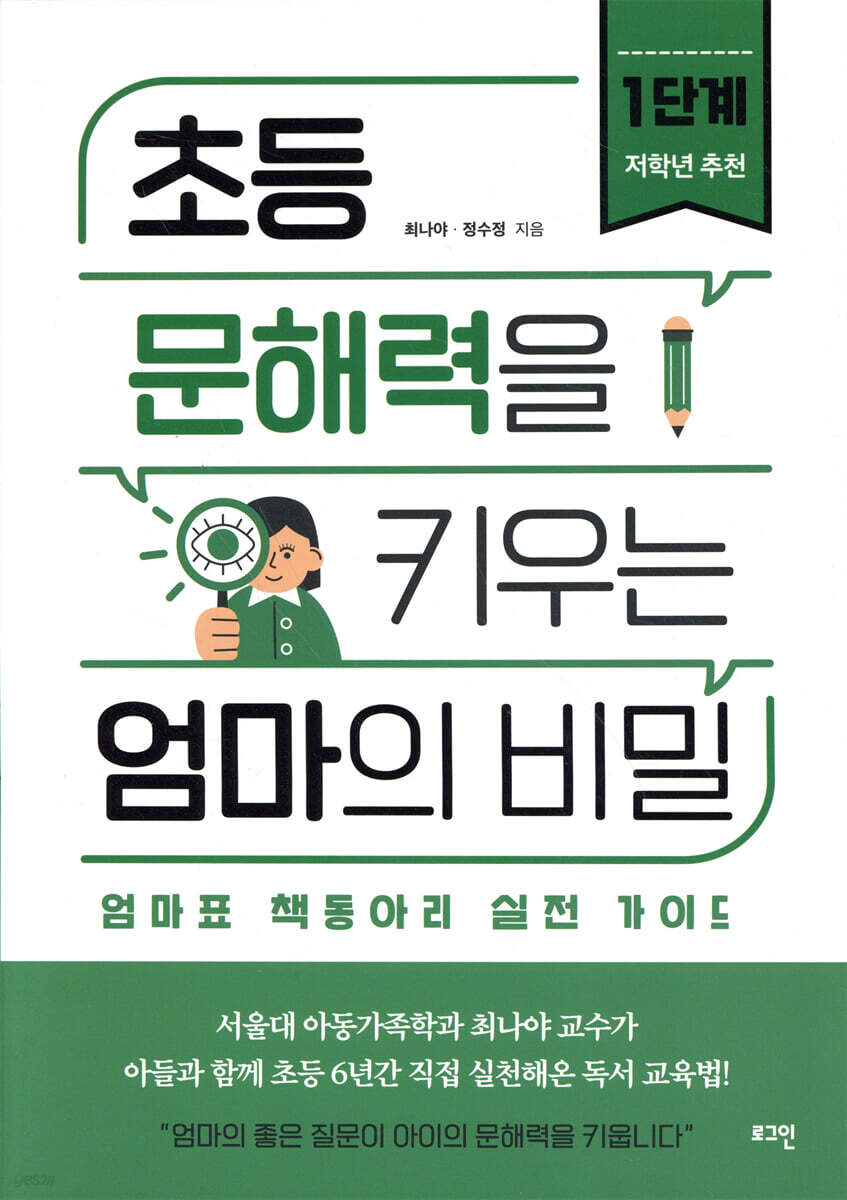
Mom's Secret to Developing Elementary Literacy: Step 1
 |
Description
Book Introduction
EBS "Your Literacy" and "Literacy Kindergarten"
Professor Choi Na-ya of the Department of Child and Family Studies at Seoul National University
Elementary literacy reading method that I have been practicing with my son since he was in elementary school for 6 years and still practice to this day.
This book introduces the literacy reading method that Professor Choi Na-ya, who focused the entire Republic of Korea on literacy through EBS's "Your Literacy," has practiced with her son for six years as a mother to help him develop his literacy.
After the program aired, Professor Choi Na-ya, who was in charge of the program's research, received a flood of inquiries.
There were many questions about how to develop literacy skills in elementary school students, and there was a lot of interest in how Professor Choi Na-ya, as a mother, developed her children's literacy skills.
Therefore, “The Secret of a Mother Who Develops Elementary Literacy” can be said to be a book that contains answers to these questions based on Professor Choi Na-ya’s real-life experiences.
Professor Choi Na-ya's secret to developing elementary literacy skills can be summarized into three main points.
The first is for mothers to ask their children 'good questions', the second is to form a 'book club' to provide a place for children to read and discuss books with friends, and the last and most important thing is to consistently do these two things.
This book contains practical, specific methods for putting these three secrets into practice.
For parents who have read numerous books on reading education but still find it difficult to apply them in real life, Professor Choi Na-ya provides reading activity sheets that she herself created and used, and not only shows a variety of specific examples of questions, but also provides a workbook that can be used right away with children.
It also provides helpful guidance on how to start a book club, boosting mothers' confidence.
Professor Choi Na-ya, a busier mother than anyone else, has been participating in a book club with her children's friends since they were in their 6th year of elementary school and are now in their 2nd year of middle school.
If this activity didn't improve literacy and wasn't fun, we wouldn't have spent so much time on it.
And I wouldn't have recommended it so actively.
Literacy cannot be developed in a short period of time.
Don't be impatient, just start with this book.
This book, the first in a series planned to be produced in three volumes, contains reading activities for elementary school students in the lower grades.
There are recommended grade levels for each stage, but the level of difficulty felt varies depending on the child's level, so you can use it according to your child's literacy level or interest.
Professor Choi Na-ya of the Department of Child and Family Studies at Seoul National University
Elementary literacy reading method that I have been practicing with my son since he was in elementary school for 6 years and still practice to this day.
This book introduces the literacy reading method that Professor Choi Na-ya, who focused the entire Republic of Korea on literacy through EBS's "Your Literacy," has practiced with her son for six years as a mother to help him develop his literacy.
After the program aired, Professor Choi Na-ya, who was in charge of the program's research, received a flood of inquiries.
There were many questions about how to develop literacy skills in elementary school students, and there was a lot of interest in how Professor Choi Na-ya, as a mother, developed her children's literacy skills.
Therefore, “The Secret of a Mother Who Develops Elementary Literacy” can be said to be a book that contains answers to these questions based on Professor Choi Na-ya’s real-life experiences.
Professor Choi Na-ya's secret to developing elementary literacy skills can be summarized into three main points.
The first is for mothers to ask their children 'good questions', the second is to form a 'book club' to provide a place for children to read and discuss books with friends, and the last and most important thing is to consistently do these two things.
This book contains practical, specific methods for putting these three secrets into practice.
For parents who have read numerous books on reading education but still find it difficult to apply them in real life, Professor Choi Na-ya provides reading activity sheets that she herself created and used, and not only shows a variety of specific examples of questions, but also provides a workbook that can be used right away with children.
It also provides helpful guidance on how to start a book club, boosting mothers' confidence.
Professor Choi Na-ya, a busier mother than anyone else, has been participating in a book club with her children's friends since they were in their 6th year of elementary school and are now in their 2nd year of middle school.
If this activity didn't improve literacy and wasn't fun, we wouldn't have spent so much time on it.
And I wouldn't have recommended it so actively.
Literacy cannot be developed in a short period of time.
Don't be impatient, just start with this book.
This book, the first in a series planned to be produced in three volumes, contains reading activities for elementary school students in the lower grades.
There are recommended grade levels for each stage, but the level of difficulty felt varies depending on the child's level, so you can use it according to your child's literacy level or interest.
- You can preview some of the book's contents.
Preview
index
To begin with
The sixth year of elementary school: a sensitive period for literacy development.
For moms and kids who are tired of reading lists
Chapter 1.
Developing elementary literacy through mom-led book clubs
The Secret to Improving Literacy in First and Second Grades
Building Reading Motivation | Starting with Picture Books | Teaching Vocabulary | Using Graphic Organizers |
Guiding Writing Activity Sheets | Using the Elementary School Library
Why Mom's Book Club?
Is private reading tutoring really necessary? | The Benefits of Book Clubs: Moms Grow Together Through Conversation |
The secret to being able to run a book club for 6 years
Mom's Book Club: What should we do and how?
Starting a Book Club: Who Should We Join? | Choosing Books: What Should We Read? |
Mom Reads First: What's the Point of This Book? | Create an Activity Sheet: What Questions Should I Ask? |
Leading a Book Club: What Do We Do Together? | The Role of a Book Club Leader Mom: How Do We Proceed?
Chapter 2.
Mom's Book Club Activities to Develop Elementary Literacy
How to Use Reading Activity Sheets
Book Club Activities for First Graders
Story Pocket Story | Veronica, You Are Special | Good Brothers | Red Bean Porridge Granny and the Tiger |
The Cat and the Boots | The Bachelor Who Became the Prime Minister's Son-in-Law with a Grain of Millet | A Dangerous Book | Let's Fight Again Tomorrow! |
The Yellow Bucket | The Bomb-Headed Man and the Strange Pharmacy | Singing Fu, Operation Urine Revenge |
Jjajangmyeon, Jjamppong, and Tangsuyuk | My Kind of School | Minpin | Mouse Lady and Cat Man |
Queen of the Waterfall | Mongmong the Book-Reading Puppy | Tuesday's Toad | Annoying Room | Thank you, teacher
Book Club Activities for Second Graders
The Boy Who Carries the Bag | The Book-Eating Fox and the Story-Treasuring Thief | The Bad Kids' List | Mr. Nice Fox |
Shadow Thief | The Wizard of Oz | How to Eat Ramen Deliciously | Two Magic Sugar Pieces |
Romeo and Juliet | Camellia | Writing Time | If That's You | 3 Years in the Library |
The Money Party | The Adventures of Tom Sawyer | Save the School with Magic Multiplication Tables! |
The King Thief Hozenplotz | Perko's Magic Paint | The Lion Who Went to School | The Goblin Sneaks
The sixth year of elementary school: a sensitive period for literacy development.
For moms and kids who are tired of reading lists
Chapter 1.
Developing elementary literacy through mom-led book clubs
The Secret to Improving Literacy in First and Second Grades
Building Reading Motivation | Starting with Picture Books | Teaching Vocabulary | Using Graphic Organizers |
Guiding Writing Activity Sheets | Using the Elementary School Library
Why Mom's Book Club?
Is private reading tutoring really necessary? | The Benefits of Book Clubs: Moms Grow Together Through Conversation |
The secret to being able to run a book club for 6 years
Mom's Book Club: What should we do and how?
Starting a Book Club: Who Should We Join? | Choosing Books: What Should We Read? |
Mom Reads First: What's the Point of This Book? | Create an Activity Sheet: What Questions Should I Ask? |
Leading a Book Club: What Do We Do Together? | The Role of a Book Club Leader Mom: How Do We Proceed?
Chapter 2.
Mom's Book Club Activities to Develop Elementary Literacy
How to Use Reading Activity Sheets
Book Club Activities for First Graders
Story Pocket Story | Veronica, You Are Special | Good Brothers | Red Bean Porridge Granny and the Tiger |
The Cat and the Boots | The Bachelor Who Became the Prime Minister's Son-in-Law with a Grain of Millet | A Dangerous Book | Let's Fight Again Tomorrow! |
The Yellow Bucket | The Bomb-Headed Man and the Strange Pharmacy | Singing Fu, Operation Urine Revenge |
Jjajangmyeon, Jjamppong, and Tangsuyuk | My Kind of School | Minpin | Mouse Lady and Cat Man |
Queen of the Waterfall | Mongmong the Book-Reading Puppy | Tuesday's Toad | Annoying Room | Thank you, teacher
Book Club Activities for Second Graders
The Boy Who Carries the Bag | The Book-Eating Fox and the Story-Treasuring Thief | The Bad Kids' List | Mr. Nice Fox |
Shadow Thief | The Wizard of Oz | How to Eat Ramen Deliciously | Two Magic Sugar Pieces |
Romeo and Juliet | Camellia | Writing Time | If That's You | 3 Years in the Library |
The Money Party | The Adventures of Tom Sawyer | Save the School with Magic Multiplication Tables! |
The King Thief Hozenplotz | Perko's Magic Paint | The Lion Who Went to School | The Goblin Sneaks
Detailed image

Publisher's Review
A mother who is a professor at Seoul National University and a mother who has been an elementary school librarian for 20 years
The first of the 6th grade elementary school reading project!
“Your Literacy,” which aired on EBS in March 2021, focused the attention of Korean parents on “literacy.”
The fact that elementary, middle, and high school students are lacking literacy skills and that the number of students who can read but cannot understand the textbook content and thus cannot keep up with school classes has been a great shock to many people.
Literacy is considered the foundation of all learning and one of the essential competencies for future talent.
The good news is that literacy is not something you are born with; it can be developed through learning.
Another fortunate thing is that mothers can sufficiently develop elementary school children's literacy skills.
Choi Na-ya, a professor at Seoul National University and a mother of one, who appeared on “Your Literacy,” says that parents can sufficiently improve their children’s literacy skills simply by reading books with their children and discussing the content of the books, rather than spending expensive private reading and writing tutoring.
This is a statement that comes from Professor Choi Na-ya's own experience of rejecting the offer of a private reading and writing tutoring group and participating in a 'book club' with her own child for six years of elementary school and even now, when she is in the second year of middle school.
"A Mother's Secret to Developing Elementary Literacy" contains the entire story of Professor Choi Na-ya's book club activities with her son for six years of elementary school.
As this is a long-term project that has been ongoing for six years, the book will be published in three volumes. This book is the first level that focuses on the most basic skills, and is suitable for lower grade elementary school students.
Mom's first secret to developing elementary literacy skills,
Open-ended questions that lead to endless thoughts
Among the homeschooling methods that many parents are trying, 'book parenting' is by far the most popular.
Book-based parenting is primarily practiced during infancy and toddlerhood, but if you want to continue this approach with your elementary school-aged children, you need to approach it differently than you would during infancy and toddlerhood.
If you want to develop literacy skills through book parenting, you need to go beyond just reading books; you also need to ask 'good questions.'
Instead of asking questions that only allow for short answers that are merely fact-checking, you need to ask open-ended, expansive questions that allow for any answer and encourage thought to flow in order to develop your child's literacy and thinking skills.
Although mothers who have read books related to reading education already know this, they often feel at a loss as to what to ask and how to ask it when they actually try to ask their children questions.
This book, "Mom's Secret to Developing Elementary Literacy," doesn't just show one or two examples; it shows hundreds of cases through actual reading activity sheets.
Therefore, it is of practical help to mothers who have given up on teaching their children to read.
Even beginners in reading education can easily develop their children's literacy skills by providing explanations of the purpose and intent of the questions, as well as the teaching method.
As you engage in conversations using reading activity sheets that Professor Choi Na-ya herself created and actually used, you will gradually come to understand what questions to ask your child.
Mom's second secret to developing elementary literacy skills.
Share diverse ideas with friends through the 'Book Club'
Professor Choi Na-ya and librarian Jeong Su-jeong strongly recommend a book club as a way to improve elementary school children's literacy skills.
A book club can be formed just with a mother and child, but it is more effective if the child's friends participate as well.
If you only teach reading to your own child, it's easy for the mother to unilaterally force or indoctrinate the child with answers, and it's easy to become emotional about the child's words and actions, which can leave a grudge between the two.
On the other hand, when you are with your child's friends, you will inevitably have different thoughts on the same question.
By sharing each other's thoughts like this, literacy skills are naturally improved, the breadth of thinking is broadened, and self-esteem is fostered by being able to acknowledge each other's differences and express one's own opinions.
『Mom's Secret to Developing Elementary Literacy』 contains Professor Choi Na-ya's method of running a book club, which even mothers unfamiliar with book clubs can easily start.
I have been running a book club with my children for 8 years and have included the know-how I have acquired through trial and error.
Don't be intimidated by the word "book club."
Since you can't grow if you don't start, let's just start.
You will soon realize the power of a book club.
Mom's third secret to developing elementary literacy skills.
A 'promise' that must be kept consistently once every two weeks
You can't expect your child's literacy skills to improve significantly with just a few reading activities.
Unfortunately, literacy doesn't develop overnight.
Only consistent reading and engaging in fun post-reading activities can develop and maintain literacy skills.
Professor Choi Na-ya, who has been running a book club with her children for eight years, cites "a schedule that is faithfully followed like a promise" as one of the secrets to her consistency.
For book club activities to continue on a regular basis and not just be a one-time event, both the child and the parents need to have a comfortable schedule.
This book contains reading activity sheets that can be used for a total of 20 book club activities per year for each grade level.
If you simply calculate it, it means that we meet once every two weeks.
It would be great if we could read books every day or every week and get together to discuss them, but realistically, it's nearly impossible, and if we're not careful, children might start to dislike reading, and mothers can easily get tired.
Rather than being too ambitious and giving up quickly because you get tired, like a dragon head and a snake tail, the key to growing literacy is to have a mindset of "a long road ahead of you" and to keep going steadily and regularly without being impatient.
Professor Choi Na-ya also participates in the book club once every two weeks without any difficulty.
Let's have a book club meeting with your child's friends every two weeks.
In the blink of an eye, a semester and a year will have passed.
And in the meantime, your child's literacy skills will have grown significantly.
Lower elementary school students
The secret to literacy growth is undoubtedly picture books.
Literacy, which determines a person's life, depends on how they spend their six years in elementary school.
Especially in the lower grades of elementary school, children's interest in reading decreases dramatically as they face the task of adapting to school life and books that are mainly composed of letters.
Therefore, Professor Choi Na-ya says that picture books should be actively utilized so that children at this age do not lose interest in books.
Picture books are effective in developing an eye for reading both text and pictures, and are especially good for practicing reading aloud.
This is because fluent reading speeds up literacy development as the energy needed to recognize letters can be used to understand the content.
The activity books introduced in the book were personally selected by Professor Choi Na-ya, taking into account children's interests, reading motivation level, developmental level, and curriculum.
In addition, Dr. Jeong Su-jeong, a child studies teacher and librarian who has worked as an elementary school librarian for over 20 years, has introduced a variety of books that are good to read together by topic and author, adding to the 'pleasure of choosing books.'
This is a special list carefully selected to help children escape the trap of recommended books and required reading, and to find books that they will enjoy reading. Let's help children choose books they want to read on their own and engage in additional reading activities.
If you miss the first and second grades of elementary school, the literacy gap will widen to a point where it will be difficult to catch up in a short period of time.
Mothers who are new to reading education and have read countless books on reading education but are at a loss as to how to actually apply them will be able to find specific and practical hints in this book.
Also, if you don't have time to make your own activity sheets, you can help your child develop literacy skills with the activity sheets in the book that Professor Choi Na-ya has carefully created.
As you read and discuss the same books with your child, your child's literacy skills will increase, as will their emotional satisfaction and bond with you.
Is there anything more valuable than conversations shared through books? Let's boost your child's literacy with a mom-friendly book club.
The first of the 6th grade elementary school reading project!
“Your Literacy,” which aired on EBS in March 2021, focused the attention of Korean parents on “literacy.”
The fact that elementary, middle, and high school students are lacking literacy skills and that the number of students who can read but cannot understand the textbook content and thus cannot keep up with school classes has been a great shock to many people.
Literacy is considered the foundation of all learning and one of the essential competencies for future talent.
The good news is that literacy is not something you are born with; it can be developed through learning.
Another fortunate thing is that mothers can sufficiently develop elementary school children's literacy skills.
Choi Na-ya, a professor at Seoul National University and a mother of one, who appeared on “Your Literacy,” says that parents can sufficiently improve their children’s literacy skills simply by reading books with their children and discussing the content of the books, rather than spending expensive private reading and writing tutoring.
This is a statement that comes from Professor Choi Na-ya's own experience of rejecting the offer of a private reading and writing tutoring group and participating in a 'book club' with her own child for six years of elementary school and even now, when she is in the second year of middle school.
"A Mother's Secret to Developing Elementary Literacy" contains the entire story of Professor Choi Na-ya's book club activities with her son for six years of elementary school.
As this is a long-term project that has been ongoing for six years, the book will be published in three volumes. This book is the first level that focuses on the most basic skills, and is suitable for lower grade elementary school students.
Mom's first secret to developing elementary literacy skills,
Open-ended questions that lead to endless thoughts
Among the homeschooling methods that many parents are trying, 'book parenting' is by far the most popular.
Book-based parenting is primarily practiced during infancy and toddlerhood, but if you want to continue this approach with your elementary school-aged children, you need to approach it differently than you would during infancy and toddlerhood.
If you want to develop literacy skills through book parenting, you need to go beyond just reading books; you also need to ask 'good questions.'
Instead of asking questions that only allow for short answers that are merely fact-checking, you need to ask open-ended, expansive questions that allow for any answer and encourage thought to flow in order to develop your child's literacy and thinking skills.
Although mothers who have read books related to reading education already know this, they often feel at a loss as to what to ask and how to ask it when they actually try to ask their children questions.
This book, "Mom's Secret to Developing Elementary Literacy," doesn't just show one or two examples; it shows hundreds of cases through actual reading activity sheets.
Therefore, it is of practical help to mothers who have given up on teaching their children to read.
Even beginners in reading education can easily develop their children's literacy skills by providing explanations of the purpose and intent of the questions, as well as the teaching method.
As you engage in conversations using reading activity sheets that Professor Choi Na-ya herself created and actually used, you will gradually come to understand what questions to ask your child.
Mom's second secret to developing elementary literacy skills.
Share diverse ideas with friends through the 'Book Club'
Professor Choi Na-ya and librarian Jeong Su-jeong strongly recommend a book club as a way to improve elementary school children's literacy skills.
A book club can be formed just with a mother and child, but it is more effective if the child's friends participate as well.
If you only teach reading to your own child, it's easy for the mother to unilaterally force or indoctrinate the child with answers, and it's easy to become emotional about the child's words and actions, which can leave a grudge between the two.
On the other hand, when you are with your child's friends, you will inevitably have different thoughts on the same question.
By sharing each other's thoughts like this, literacy skills are naturally improved, the breadth of thinking is broadened, and self-esteem is fostered by being able to acknowledge each other's differences and express one's own opinions.
『Mom's Secret to Developing Elementary Literacy』 contains Professor Choi Na-ya's method of running a book club, which even mothers unfamiliar with book clubs can easily start.
I have been running a book club with my children for 8 years and have included the know-how I have acquired through trial and error.
Don't be intimidated by the word "book club."
Since you can't grow if you don't start, let's just start.
You will soon realize the power of a book club.
Mom's third secret to developing elementary literacy skills.
A 'promise' that must be kept consistently once every two weeks
You can't expect your child's literacy skills to improve significantly with just a few reading activities.
Unfortunately, literacy doesn't develop overnight.
Only consistent reading and engaging in fun post-reading activities can develop and maintain literacy skills.
Professor Choi Na-ya, who has been running a book club with her children for eight years, cites "a schedule that is faithfully followed like a promise" as one of the secrets to her consistency.
For book club activities to continue on a regular basis and not just be a one-time event, both the child and the parents need to have a comfortable schedule.
This book contains reading activity sheets that can be used for a total of 20 book club activities per year for each grade level.
If you simply calculate it, it means that we meet once every two weeks.
It would be great if we could read books every day or every week and get together to discuss them, but realistically, it's nearly impossible, and if we're not careful, children might start to dislike reading, and mothers can easily get tired.
Rather than being too ambitious and giving up quickly because you get tired, like a dragon head and a snake tail, the key to growing literacy is to have a mindset of "a long road ahead of you" and to keep going steadily and regularly without being impatient.
Professor Choi Na-ya also participates in the book club once every two weeks without any difficulty.
Let's have a book club meeting with your child's friends every two weeks.
In the blink of an eye, a semester and a year will have passed.
And in the meantime, your child's literacy skills will have grown significantly.
Lower elementary school students
The secret to literacy growth is undoubtedly picture books.
Literacy, which determines a person's life, depends on how they spend their six years in elementary school.
Especially in the lower grades of elementary school, children's interest in reading decreases dramatically as they face the task of adapting to school life and books that are mainly composed of letters.
Therefore, Professor Choi Na-ya says that picture books should be actively utilized so that children at this age do not lose interest in books.
Picture books are effective in developing an eye for reading both text and pictures, and are especially good for practicing reading aloud.
This is because fluent reading speeds up literacy development as the energy needed to recognize letters can be used to understand the content.
The activity books introduced in the book were personally selected by Professor Choi Na-ya, taking into account children's interests, reading motivation level, developmental level, and curriculum.
In addition, Dr. Jeong Su-jeong, a child studies teacher and librarian who has worked as an elementary school librarian for over 20 years, has introduced a variety of books that are good to read together by topic and author, adding to the 'pleasure of choosing books.'
This is a special list carefully selected to help children escape the trap of recommended books and required reading, and to find books that they will enjoy reading. Let's help children choose books they want to read on their own and engage in additional reading activities.
If you miss the first and second grades of elementary school, the literacy gap will widen to a point where it will be difficult to catch up in a short period of time.
Mothers who are new to reading education and have read countless books on reading education but are at a loss as to how to actually apply them will be able to find specific and practical hints in this book.
Also, if you don't have time to make your own activity sheets, you can help your child develop literacy skills with the activity sheets in the book that Professor Choi Na-ya has carefully created.
As you read and discuss the same books with your child, your child's literacy skills will increase, as will their emotional satisfaction and bond with you.
Is there anything more valuable than conversations shared through books? Let's boost your child's literacy with a mom-friendly book club.
GOODS SPECIFICS
- Publication date: October 25, 2021
- Page count, weight, size: 368 pages | 1,220g | 210*297*23mm
- ISBN13: 9791166373848
- ISBN10: 1166373843
You may also like
카테고리
korean


korean

![ELLE 엘르 스페셜 에디션 A형 : 12월 [2025]](http://librairie.coreenne.fr/cdn/shop/files/b8e27a3de6c9538896439686c6b0e8fb.jpg?v=1766436872&width=3840)


