

Son's brain
 |
Description
Book Introduction
“A son’s brain is different from his mother’s.”
Even after he died and came back to life, his mother couldn't understand the great adventure of a son's mind!
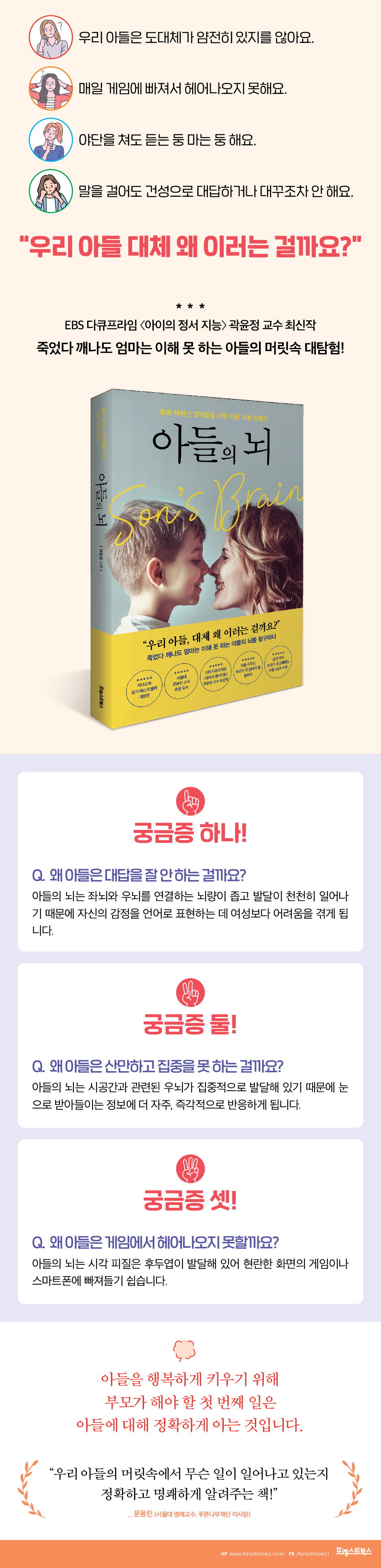
There are countless stories of sons causing trouble: making a mess of the house in the blink of an eye, jumping around at random and breaking limbs, getting distracted and completely forgetting things when asked to run errands, and getting so absorbed in games that they don't do what they should be doing.
Every time that happens, mothers raising sons say this.
“I just can’t understand why he’s doing that!”
Mothers scold, comfort, and annoy their sons, and eventually end up blaming themselves, asking, "What did I do wrong? Did I raise my son wrong?"
Although they love their son very much, they do not have accurate knowledge of his nature, so they misunderstand his actions, create conflicts, and even experience difficulties in communication.
This book is a revised edition of "The Son's Brain," which has been a long-term bestseller in child education for many years. It is the latest work by Professor Kwak Yun-jeong, who is considered one of the best parenting mentors in Korea, solving parents' concerns through various broadcasts and lectures, including EBS Documentary Prime.
Professor Kwak applies brain science, which has been actively researched over the past several decades, to parenting. He clearly and easily explains what is happening in a son's brain and why he behaves strangely, so that a mother, a woman, can accurately understand and accept her son, a man.
It also suggests age-appropriate parenting, conversation, and study methods tailored to the brain development stage, and provides solutions to key questions Korean parents have while raising their sons, thereby helping both parents and sons develop a free and happy relationship.
Truly understanding someone begins with knowing exactly what their desires and thoughts are.
If parents can understand and accept the objective characteristics of their son's brain, it will not only enable smooth communication but also greatly contribute to their son's positive development.
Even after he died and came back to life, his mother couldn't understand the great adventure of a son's mind!
There are countless stories of sons causing trouble: making a mess of the house in the blink of an eye, jumping around at random and breaking limbs, getting distracted and completely forgetting things when asked to run errands, and getting so absorbed in games that they don't do what they should be doing.
Every time that happens, mothers raising sons say this.
“I just can’t understand why he’s doing that!”
Mothers scold, comfort, and annoy their sons, and eventually end up blaming themselves, asking, "What did I do wrong? Did I raise my son wrong?"
Although they love their son very much, they do not have accurate knowledge of his nature, so they misunderstand his actions, create conflicts, and even experience difficulties in communication.
This book is a revised edition of "The Son's Brain," which has been a long-term bestseller in child education for many years. It is the latest work by Professor Kwak Yun-jeong, who is considered one of the best parenting mentors in Korea, solving parents' concerns through various broadcasts and lectures, including EBS Documentary Prime.
Professor Kwak applies brain science, which has been actively researched over the past several decades, to parenting. He clearly and easily explains what is happening in a son's brain and why he behaves strangely, so that a mother, a woman, can accurately understand and accept her son, a man.
It also suggests age-appropriate parenting, conversation, and study methods tailored to the brain development stage, and provides solutions to key questions Korean parents have while raising their sons, thereby helping both parents and sons develop a free and happy relationship.
Truly understanding someone begins with knowing exactly what their desires and thoughts are.
If parents can understand and accept the objective characteristics of their son's brain, it will not only enable smooth communication but also greatly contribute to their son's positive development.
- You can preview some of the book's contents.
Preview
index
Prologue: A mother who is frustrated because of her son, and a son who is unspeakably wronged.
Part 1 - The Brain of a Son That Parents Don't Know
Chapter 01 Answer, Son's Brain
The Brain's Explosive Growth Process | Why Age 10 Matters | Emotional Stability is Key to Brain Development
Chapter 02 Remember the Critical Moment
Will You Raise Your Child as a Wolf Boy? | Remember the Critical Period | The Four Stages of Brain Development
Chapter 03 The Three Musketeers in Our Head: Life, Emotions, and Reason
The brainstem, the controller of life | Fight or flight | The limbic system, the controller of emotions | The hippocampus knows | The cerebral cortex, the controller of control | The frontal lobe is the key | The temporal lobe, the magician of language | Attention, my body, the parietal lobe | There are eyes in the back of my head, the occipital lobe
Chapter 04: The 3rd Month of Pregnancy Determines Your Son's Brain
What Makes a Son | The Culprit: Testosterone
I'm curious about this too! Can you tell your testosterone level from the length of your fingers?
Chapter 05 Why is my son so clueless?
The Brain of a Needy Son | The Right Brain is Powerful | The Silent Son, There's a Reason
This is also curious! What would happen if there was no corpus callosum?
Chapter 06 Don't Talk to Your Son While He's Reading
Reading emotions is difficult | What is multitasking | Once it's broken, it never comes back
Chapter 07 Why Cars Are Better Than Dolls
Math and science are definitely for boys! | Map viewing, directions, and exercise mastery
Chapter 08 Blessed are the waiting mothers
The blue teddy bear is useless | Put it in the front seat
I'm also curious! Is my son's brain more masculine or feminine?
Parenting Guidelines for Parents of Sons
Part 2 - Managing Your Toddler's Brain
Chapter 01 A Son is a Son
Why I Can't Read | Men and Testosterone
Chapter 02 Stay still, please!
Need space | Things over people
I'm curious about this too! Son, you're inherently weak.
Chapter 03 The Importance of Attachment
I like rag moms | The closer you are, the smarter you become.
I'm also curious! What attachment style does my son have?
Chapter 04 Why do mothers raising sons have loud voices?
A mother is frustrated with her son's silence. He doesn't listen at all.
Chapter 05 How to Talk Without Raising Your Voice
Make eye contact and keep it short | Seeing is believing | Patience is sweet
Chapter 06 Eating is Power
Essential Nutrients: The 3 Major Nutrients | 3 Nutrients You Can't Ignore
This is also curious! Why childhood obesity is dangerous.
Chapter 07 Sleep is the best medicine
Sleep Habits Affect Learning Ability | Developing Sleep Habits for the Future
I'm curious about this too! Everything is new for the broken hippocampus.
Chapter 08 What Makes My Son's Brain Sick
Children also get stressed | Keep smartphones as far away as possible
How to Play with Your Toddler Son
Parenting Guidelines for Toddler Sons
| Q&A | Raising a Son is So Hard! - Toddler Edition -
Part 3 - Raising My Elementary School Son Well
Chapter 01 Elementary Cruelty
The Classroom's Unruliness | Inferiority Complex: A Hinderment to Growth
I'm also curious! What is the relationship between parental type and son's characteristics?
Chapter 02 Overcoming the Cruelty of Elementary School
Boost your energy with the Pygmalion Effect | Supplement your serotonin | Feed your child well and get plenty of sleep
I'm curious about this too! A practical guide to living life that will boost your son's spirit.
Chapter 03 The Brain Needs Exercise Too
Get to know the playground | Sweat builds character
Chapter 04 A son who is good at sports is also good at studying.
Natural Supplements, Exercise | Exercise and Study Are Best Friends | Trees and Forests Are Great Stimulants
Chapter 05 The Temptation of Games, Needing a Mother's Hand
A society that encourages gaming | The poison that says men can do that | Aggression is a son's instinct
Chapter 06: The Natural Enemy of Your Son's Brain: Games
A Needle Thief Becomes a Cattle Thief | Smartphones: A Double-Edged Sword
I'm curious about this too! Is my son addicted to gaming and smartphones?
Chapter 07 Play with your child's body
Nature is Your Best Friend | Family Rules for a Healthy Brain
I'm curious about this too! A smart way to save your son's brain from gaming.
Chapter 08 Studying is also a habit
A son who loves visual stimulation | Actions speak louder than words | Why he risks his life to win
Chapter 09: Taming Your Wild Brain for Studying
I Need a Mentor | Just 3 Weeks | 30-Minute Pattern Study Method
I'm curious about this too! What kind of parent am I?
Parenting Guidelines for Elementary School Sons
| Q&A | Raising a Son is So Hard! - Childhood Edition -
Part 4 - The Brain of an Adolescent Son Caught in the Storm
Chapter 01 The Time Bomb of Adolescent Brain
The Unexpected Boy | The Fatal Consequences of Mistakes
Chapter 02 The central control unit is under construction
Phineas Gage Syndrome | Emotions are the final word.
Chapter 03 In adolescence, short sincerity is effective.
Don't Trigger Aggression Hormones | Set Rules and Punishments
I'm curious about this too! Conversation rules for my teenage son.
Chapter 04 Don't Preach About Adolescent Love
Is my son, who is obsessed with women, normal? | Falling in love is perfectly natural.
Chapter 05 How to Talk About Sex?
The Three Elements of Love | Let's Teach Sex Like Math
I'm curious about this too! An inconvenient truth, but necessary knowledge.
Chapter 06 Emotional Control Ability Determines the Future
The Marshmallow Story | Three-Year-Old Habits Last Until Eighty | Self-Control Disorder | How to Deal with Rebellion | Healing Mental Illness
I'm also curious about this! How is oppositional defiant disorder diagnosed?
Chapter 07 Raising an Empathetic Man
Set short-term goals | Demonstrate how to be a good adult
Chapter 08: The Road to Healthy Youth: Overcoming the Storm
What to Feed | Let's Boldly Turn Off the Lights | Protect Physical Education Time
I'm also curious about this! What's disturbing my son's sleep?
Chapter 09 For Our Happy Son
Let's Beat Stress! | How to Overcome Stress to Grow into a Healthy Man
Parenting Guidelines for Teenage Sons
| Q&A | Raising a Son is So Hard! - Puberty Edition -
Part 1 - The Brain of a Son That Parents Don't Know
Chapter 01 Answer, Son's Brain
The Brain's Explosive Growth Process | Why Age 10 Matters | Emotional Stability is Key to Brain Development
Chapter 02 Remember the Critical Moment
Will You Raise Your Child as a Wolf Boy? | Remember the Critical Period | The Four Stages of Brain Development
Chapter 03 The Three Musketeers in Our Head: Life, Emotions, and Reason
The brainstem, the controller of life | Fight or flight | The limbic system, the controller of emotions | The hippocampus knows | The cerebral cortex, the controller of control | The frontal lobe is the key | The temporal lobe, the magician of language | Attention, my body, the parietal lobe | There are eyes in the back of my head, the occipital lobe
Chapter 04: The 3rd Month of Pregnancy Determines Your Son's Brain
What Makes a Son | The Culprit: Testosterone
I'm curious about this too! Can you tell your testosterone level from the length of your fingers?
Chapter 05 Why is my son so clueless?
The Brain of a Needy Son | The Right Brain is Powerful | The Silent Son, There's a Reason
This is also curious! What would happen if there was no corpus callosum?
Chapter 06 Don't Talk to Your Son While He's Reading
Reading emotions is difficult | What is multitasking | Once it's broken, it never comes back
Chapter 07 Why Cars Are Better Than Dolls
Math and science are definitely for boys! | Map viewing, directions, and exercise mastery
Chapter 08 Blessed are the waiting mothers
The blue teddy bear is useless | Put it in the front seat
I'm also curious! Is my son's brain more masculine or feminine?
Parenting Guidelines for Parents of Sons
Part 2 - Managing Your Toddler's Brain
Chapter 01 A Son is a Son
Why I Can't Read | Men and Testosterone
Chapter 02 Stay still, please!
Need space | Things over people
I'm curious about this too! Son, you're inherently weak.
Chapter 03 The Importance of Attachment
I like rag moms | The closer you are, the smarter you become.
I'm also curious! What attachment style does my son have?
Chapter 04 Why do mothers raising sons have loud voices?
A mother is frustrated with her son's silence. He doesn't listen at all.
Chapter 05 How to Talk Without Raising Your Voice
Make eye contact and keep it short | Seeing is believing | Patience is sweet
Chapter 06 Eating is Power
Essential Nutrients: The 3 Major Nutrients | 3 Nutrients You Can't Ignore
This is also curious! Why childhood obesity is dangerous.
Chapter 07 Sleep is the best medicine
Sleep Habits Affect Learning Ability | Developing Sleep Habits for the Future
I'm curious about this too! Everything is new for the broken hippocampus.
Chapter 08 What Makes My Son's Brain Sick
Children also get stressed | Keep smartphones as far away as possible
How to Play with Your Toddler Son
Parenting Guidelines for Toddler Sons
| Q&A | Raising a Son is So Hard! - Toddler Edition -
Part 3 - Raising My Elementary School Son Well
Chapter 01 Elementary Cruelty
The Classroom's Unruliness | Inferiority Complex: A Hinderment to Growth
I'm also curious! What is the relationship between parental type and son's characteristics?
Chapter 02 Overcoming the Cruelty of Elementary School
Boost your energy with the Pygmalion Effect | Supplement your serotonin | Feed your child well and get plenty of sleep
I'm curious about this too! A practical guide to living life that will boost your son's spirit.
Chapter 03 The Brain Needs Exercise Too
Get to know the playground | Sweat builds character
Chapter 04 A son who is good at sports is also good at studying.
Natural Supplements, Exercise | Exercise and Study Are Best Friends | Trees and Forests Are Great Stimulants
Chapter 05 The Temptation of Games, Needing a Mother's Hand
A society that encourages gaming | The poison that says men can do that | Aggression is a son's instinct
Chapter 06: The Natural Enemy of Your Son's Brain: Games
A Needle Thief Becomes a Cattle Thief | Smartphones: A Double-Edged Sword
I'm curious about this too! Is my son addicted to gaming and smartphones?
Chapter 07 Play with your child's body
Nature is Your Best Friend | Family Rules for a Healthy Brain
I'm curious about this too! A smart way to save your son's brain from gaming.
Chapter 08 Studying is also a habit
A son who loves visual stimulation | Actions speak louder than words | Why he risks his life to win
Chapter 09: Taming Your Wild Brain for Studying
I Need a Mentor | Just 3 Weeks | 30-Minute Pattern Study Method
I'm curious about this too! What kind of parent am I?
Parenting Guidelines for Elementary School Sons
| Q&A | Raising a Son is So Hard! - Childhood Edition -
Part 4 - The Brain of an Adolescent Son Caught in the Storm
Chapter 01 The Time Bomb of Adolescent Brain
The Unexpected Boy | The Fatal Consequences of Mistakes
Chapter 02 The central control unit is under construction
Phineas Gage Syndrome | Emotions are the final word.
Chapter 03 In adolescence, short sincerity is effective.
Don't Trigger Aggression Hormones | Set Rules and Punishments
I'm curious about this too! Conversation rules for my teenage son.
Chapter 04 Don't Preach About Adolescent Love
Is my son, who is obsessed with women, normal? | Falling in love is perfectly natural.
Chapter 05 How to Talk About Sex?
The Three Elements of Love | Let's Teach Sex Like Math
I'm curious about this too! An inconvenient truth, but necessary knowledge.
Chapter 06 Emotional Control Ability Determines the Future
The Marshmallow Story | Three-Year-Old Habits Last Until Eighty | Self-Control Disorder | How to Deal with Rebellion | Healing Mental Illness
I'm also curious about this! How is oppositional defiant disorder diagnosed?
Chapter 07 Raising an Empathetic Man
Set short-term goals | Demonstrate how to be a good adult
Chapter 08: The Road to Healthy Youth: Overcoming the Storm
What to Feed | Let's Boldly Turn Off the Lights | Protect Physical Education Time
I'm also curious about this! What's disturbing my son's sleep?
Chapter 09 For Our Happy Son
Let's Beat Stress! | How to Overcome Stress to Grow into a Healthy Man
Parenting Guidelines for Teenage Sons
| Q&A | Raising a Son is So Hard! - Puberty Edition -
Detailed image
Into the book
Because a son is a different gender than his female mother, it can feel like he has no way of understanding what she is thinking.
In the case of a daughter, the scope of empathy expands as she recalls her own childhood and realizes, "Oh, I thought that too when I was her age."
However, because my son is a boy, it is difficult for me as a mother to understand, feel confused about, and sympathize with my son's behavior.
It is true that men and women grow differently emotionally, just as they are biologically different.
For various reasons, mothers raising sons feel trapped in a maze of parental and maternal roles as their sons grow up.
Fortunately, there is a hint here that may help us understand a little bit about our son.
This is because the recent research results that we have learned through the advancement of science and technology to observe and study the brain are telling us stories that can be of some help to parents, especially mothers, in understanding their sons.
You might find it boring, saying, "What a complicated brain!" But understanding what we're born with can make your relationship with your son much easier.
--- pp.20-21
One of the common findings of many scientists interested in male and female brain development is that from the time of conception, boys develop the right brain and girls the left brain.
This can be seen in the thickness of the cerebral cortex, which means that a thicker cerebral cortex has a larger volume due to the formation of many synapses between brain cells.
The part of the cerebral cortex that is large in volume and has densely packed synapses demonstrates considerable ability. It is said that the cerebral cortex on the right side of the brain is thicker in sons, and on the left side of the brain in daughters.
The right brain is associated with artistic imagination, plays a role in understanding things in an integrated and comprehensive manner, and is good at processing information about spatial and three-dimensional objects.
The left brain is associated with the ability to handle language fluently and is characterized by analytical and logical thinking.
In particular, the son's right brain is significantly developed in spatial perception and spatial reasoning abilities such as mechanics, geography, map reading, and measurement.
Since we can't measure the abilities of an unborn fetus, we compare the abilities of children. Of the millions of participants in the U.S. Geography Fair, 45 times more boys than girls make it to the finals.
--- pp.53-54
As a son grows up, the reason a mother and her son clash is because the characteristics of his brain become more evident.
It is really difficult for a son to infer and guess his mother's feelings and thoughts.
Think about it.
I'm struggling to focus on my own feelings, so how can I possibly look into and understand my mother's heart? I know she's upset because she tells me, but it's difficult for me, as a son, to truly understand her specific feelings and emotions.
And above all, because the left brain is not very powerful, if the mother does not speak very loudly and strongly, the son will not be able to pay attention to what she is saying.
It's a really strange thing for a mother to do.
I am aware of my son's emotional state, why he is upset, and even that something feels off.
What a mother needs at this time is not nagging, but understanding her son's brain.
Rather than trying to fix the characteristics and abilities of your son's brain, it is important to understand and acknowledge them.
--- pp.74-75
There are two reasons why a son's brain and a daughter's brain are so distinctly different. The first is the difference in the corpus callosum.
As I mentioned earlier, the corpus callosum is a bundle of nerve cells that acts as a passageway connecting the right and left brains, and acts as a bridge for exchanging information between the right and left brains.
The leading researcher who discovered the difference in brain volume between sons and daughters is Dr. Laurie Allen, a brain scientist at UCLA.
Dr. Allen used X-rays to examine the brain structures of men and women, and found that the male corpus callosum was only about a third as large as the female corpus callosum.
For this reason, sons tend to develop reading skills later than daughters.
The left brain is responsible for recognizing and understanding the symbols called Hangul, while the right brain is responsible for composing Hangul symbols into sounds and matching them.
These two roles combine to produce reading ability, but sons with smaller corpus callosums are slower than daughters at processing and exchanging information between the left and right brains, so they are slower at reading.
--- pp.86-87
Since men have evolved to hunt since primitive times, their brains also show developmental characteristics suited to hunting.
So, they react more immediately to the sounds of animals or objects than to the soft voices of people, and their vision develops more than their hearing because they have to continuously search for prey.
This is also why the voices of mothers raising sons continue to grow louder.
Normally, a son's brain has a hard time focusing on auditory stimuli, so he doesn't react much unless the sound is quite loud.
Accurately understanding the tendencies and characteristics of your son's brain is essential to guiding and directing his studies.
--- pp.210-211
Over time, the son grows from a baby, to a boy, to a teenager, to a young man, and then to an adult.
Although it is a natural and expected stage, the most dramatic change occurs during adolescence.
Your teenage son has grown so much that it feels like he is no longer your child.
But unfortunately, although he is physically an adult, his brain is still immature and cannot control itself, and he occasionally releases testosterone, which makes his parents suffer.
During childhood, testosterone is secreted about once or twice a day, but during puberty, it increases rapidly to about five to seven times a day.
In addition, the amount secreted at one time also increases.
So, the blood testosterone concentration of adolescent boys is said to be ten times higher than that of children.
The biggest reason why a son who was always well-behaved loses his temper over trivial things, starts swearing, and swings his fists is the increase in testosterone levels.
--- pp.241-242
The term "middle school syndrome" has become popular lately.
It is an expression representing the peak of puberty, which is characterized by emotional changes and rebellious behavior.
Perhaps that's why teenagers in puberty sometimes act as if they have a free pass when they misbehave, saying, "Well, I'm old enough to do that."
The reason these thoughts and actions are dangerous is because the brain remembers patterns of thought and action.
To put it more precisely, it means that because the brain cells in the prefrontal cortex, which is the center of emotional regulation, do not have the opportunity to learn this, there is a high possibility that the ability to regulate emotions will decline in later life.
The ability to regulate and control emotions is something that can be developed.
The important point is that there is an appropriate and effective time to develop and educate these abilities, and this is the critical period.
Unfortunately, areas of the brain that miss critical periods are difficult to recover.
Since the ability to regulate and control emotions is governed by the prefrontal cortex, which develops the latest, it can be said that adolescence, a time of the most emotional changes, is paradoxically a crucial time to practice regulating and controlling emotions.
In the case of a daughter, the scope of empathy expands as she recalls her own childhood and realizes, "Oh, I thought that too when I was her age."
However, because my son is a boy, it is difficult for me as a mother to understand, feel confused about, and sympathize with my son's behavior.
It is true that men and women grow differently emotionally, just as they are biologically different.
For various reasons, mothers raising sons feel trapped in a maze of parental and maternal roles as their sons grow up.
Fortunately, there is a hint here that may help us understand a little bit about our son.
This is because the recent research results that we have learned through the advancement of science and technology to observe and study the brain are telling us stories that can be of some help to parents, especially mothers, in understanding their sons.
You might find it boring, saying, "What a complicated brain!" But understanding what we're born with can make your relationship with your son much easier.
--- pp.20-21
One of the common findings of many scientists interested in male and female brain development is that from the time of conception, boys develop the right brain and girls the left brain.
This can be seen in the thickness of the cerebral cortex, which means that a thicker cerebral cortex has a larger volume due to the formation of many synapses between brain cells.
The part of the cerebral cortex that is large in volume and has densely packed synapses demonstrates considerable ability. It is said that the cerebral cortex on the right side of the brain is thicker in sons, and on the left side of the brain in daughters.
The right brain is associated with artistic imagination, plays a role in understanding things in an integrated and comprehensive manner, and is good at processing information about spatial and three-dimensional objects.
The left brain is associated with the ability to handle language fluently and is characterized by analytical and logical thinking.
In particular, the son's right brain is significantly developed in spatial perception and spatial reasoning abilities such as mechanics, geography, map reading, and measurement.
Since we can't measure the abilities of an unborn fetus, we compare the abilities of children. Of the millions of participants in the U.S. Geography Fair, 45 times more boys than girls make it to the finals.
--- pp.53-54
As a son grows up, the reason a mother and her son clash is because the characteristics of his brain become more evident.
It is really difficult for a son to infer and guess his mother's feelings and thoughts.
Think about it.
I'm struggling to focus on my own feelings, so how can I possibly look into and understand my mother's heart? I know she's upset because she tells me, but it's difficult for me, as a son, to truly understand her specific feelings and emotions.
And above all, because the left brain is not very powerful, if the mother does not speak very loudly and strongly, the son will not be able to pay attention to what she is saying.
It's a really strange thing for a mother to do.
I am aware of my son's emotional state, why he is upset, and even that something feels off.
What a mother needs at this time is not nagging, but understanding her son's brain.
Rather than trying to fix the characteristics and abilities of your son's brain, it is important to understand and acknowledge them.
--- pp.74-75
There are two reasons why a son's brain and a daughter's brain are so distinctly different. The first is the difference in the corpus callosum.
As I mentioned earlier, the corpus callosum is a bundle of nerve cells that acts as a passageway connecting the right and left brains, and acts as a bridge for exchanging information between the right and left brains.
The leading researcher who discovered the difference in brain volume between sons and daughters is Dr. Laurie Allen, a brain scientist at UCLA.
Dr. Allen used X-rays to examine the brain structures of men and women, and found that the male corpus callosum was only about a third as large as the female corpus callosum.
For this reason, sons tend to develop reading skills later than daughters.
The left brain is responsible for recognizing and understanding the symbols called Hangul, while the right brain is responsible for composing Hangul symbols into sounds and matching them.
These two roles combine to produce reading ability, but sons with smaller corpus callosums are slower than daughters at processing and exchanging information between the left and right brains, so they are slower at reading.
--- pp.86-87
Since men have evolved to hunt since primitive times, their brains also show developmental characteristics suited to hunting.
So, they react more immediately to the sounds of animals or objects than to the soft voices of people, and their vision develops more than their hearing because they have to continuously search for prey.
This is also why the voices of mothers raising sons continue to grow louder.
Normally, a son's brain has a hard time focusing on auditory stimuli, so he doesn't react much unless the sound is quite loud.
Accurately understanding the tendencies and characteristics of your son's brain is essential to guiding and directing his studies.
--- pp.210-211
Over time, the son grows from a baby, to a boy, to a teenager, to a young man, and then to an adult.
Although it is a natural and expected stage, the most dramatic change occurs during adolescence.
Your teenage son has grown so much that it feels like he is no longer your child.
But unfortunately, although he is physically an adult, his brain is still immature and cannot control itself, and he occasionally releases testosterone, which makes his parents suffer.
During childhood, testosterone is secreted about once or twice a day, but during puberty, it increases rapidly to about five to seven times a day.
In addition, the amount secreted at one time also increases.
So, the blood testosterone concentration of adolescent boys is said to be ten times higher than that of children.
The biggest reason why a son who was always well-behaved loses his temper over trivial things, starts swearing, and swings his fists is the increase in testosterone levels.
--- pp.241-242
The term "middle school syndrome" has become popular lately.
It is an expression representing the peak of puberty, which is characterized by emotional changes and rebellious behavior.
Perhaps that's why teenagers in puberty sometimes act as if they have a free pass when they misbehave, saying, "Well, I'm old enough to do that."
The reason these thoughts and actions are dangerous is because the brain remembers patterns of thought and action.
To put it more precisely, it means that because the brain cells in the prefrontal cortex, which is the center of emotional regulation, do not have the opportunity to learn this, there is a high possibility that the ability to regulate emotions will decline in later life.
The ability to regulate and control emotions is something that can be developed.
The important point is that there is an appropriate and effective time to develop and educate these abilities, and this is the critical period.
Unfortunately, areas of the brain that miss critical periods are difficult to recover.
Since the ability to regulate and control emotions is governed by the prefrontal cortex, which develops the latest, it can be said that adolescence, a time of the most emotional changes, is paradoxically a crucial time to practice regulating and controlling emotions.
--- p.279
Publisher's Review
“To truly love your son
“It starts with knowing and accepting your son accurately.”
The power of brain science to reduce misunderstandings and conflicts and foster understanding and respect.
When I listen to the complaints of parents raising sons, there are several common themes.
“He’s always absorbed in games or his smartphone,” “He never talks about what happened at school,” “He gets angry over trivial things,” “No matter how much I discipline him, he doesn’t listen.” Sometimes, mothers scold, try to comfort, or try to endure, but as their sons’ incomprehensible behaviors keep repeating, these are the thoughts they think.
“Why is my son acting like this?”
Professor Kwak Yoon-jeong, who received her master's and doctoral degrees in emotional intelligence from Seoul National University and has been recognized as Korea's best parenting mentor through her communication with parents through broadcasts such as EBS DocuPrime and lectures, believes that most of the conflicts experienced by parents who visit her counseling center stem from a lack of understanding of the essential characteristics that children are born with.
In particular, in a reality where mothers, who are women, are responsible for most of the child-rearing, we realized that the conflicts that arise from not properly understanding the nature of male sons are serious. So, we introduced the brain development theory of David Walsh, a renowned American psychological counselor and brain development counselor, to the education of children in Korea, and completed this book, “The Son’s Brain.”
Professor Kwak Yun-jeong says this in this book:
“Many parents consider genuine love for their children to be the best parenting method.
However, truly loving your son begins with knowing and accepting him accurately.” This means that more important than endless interest and love for your child is clearly understanding the child’s innate characteristics and applying a parenting method that suits them.
The best way to reduce misunderstandings and increase understanding and respect between parents and sons is to understand and accept their sons' true nature without prejudice.
“What is going on in our son’s head?
"A book that provides accurate and clear information!" _Moon Yong-rin (Professor Emeritus, Seoul National University, Chairman of the Blue Tree Foundation)
Tailored parenting, communication, and study methods for sons from birth to puberty
If you go to a kindergarten, you can find children who get up from their seats, wander around, and do other things while the teacher is talking.
But what's surprising is that the majority of these children are boys.
Why do girls sit quietly and listen to the teacher, but boys have trouble concentrating and act distracted?
Professor Kwak Yun-jeong, the author of this book, who applied brain development research, which is actively being studied in advanced countries such as the U.S. and France, to child education and scientifically discovered the causes of her son's thoughts and behaviors, explains, "Because the right hemisphere of my son's brain, which is related to space and time, is intensively developed, it is easy for him to be distracted by the various environments he sees rather than what the teacher says."
Therefore, in the case of my son, using visual aids such as tables and graphs is effective in increasing the learning effect.
If you can accurately understand the characteristics of your son's brain and apply them to your parenting, you will be able to recognize thoughts and behaviors that you previously thought were weaknesses as new strengths.
If you're frustrated because you can't figure out what your son is thinking, if you're frustrated because of his incomprehensible behavior, you absolutely need to pick up this book.
As Seoul National University Professor Yong-Rin Moon praised this book, saying, “This book accurately and clearly tells us what is going on in our son’s head.” This book can be the best link for understanding and accepting your son’s thoughts and actions as they are, and further, for accepting him as a complete person and communicating healthily.
Top 3 Questions Korean Parents Ask About Their Sons!
“My son, why on earth are you doing this?”
Q.
I get angry over trivial things
A.
Emotions arise in the limbic system of the brain, and when women experience emotions, they send that information to the cerebral cortex.
Emotions move to a place where they can judge information and control it appropriately.
But in men, emotional information travels to the brainstem.
The brainstem is designed to receive and process information immediately to sustain life, so when we are nagged or feel wronged, we become angry and display aggressive behavior.
Q.
He doesn't say anything at all.
A.
Men have difficulty expressing their emotions in words because the corpus callosum, which connects the left and right hemispheres of the brain, is narrower and develops more slowly than the female brain.
This does not mean that brain development related to emotions has not occurred, so parents should help their sons express their emotions honestly.
Q.
I'm so addicted to my smartphone that I can't get out.
A.
My son's brain has a developed occipital lobe, which is the visual cortex, so he is good at focusing on visual stimuli.
So, it is easier for me to get addicted to flashy screen games or smartphones than my daughter.
Excessive smartphone use can lead to cognitive problems, including decreased concentration and attention, so parents need to exercise appropriate control.
“It starts with knowing and accepting your son accurately.”
The power of brain science to reduce misunderstandings and conflicts and foster understanding and respect.
When I listen to the complaints of parents raising sons, there are several common themes.
“He’s always absorbed in games or his smartphone,” “He never talks about what happened at school,” “He gets angry over trivial things,” “No matter how much I discipline him, he doesn’t listen.” Sometimes, mothers scold, try to comfort, or try to endure, but as their sons’ incomprehensible behaviors keep repeating, these are the thoughts they think.
“Why is my son acting like this?”
Professor Kwak Yoon-jeong, who received her master's and doctoral degrees in emotional intelligence from Seoul National University and has been recognized as Korea's best parenting mentor through her communication with parents through broadcasts such as EBS DocuPrime and lectures, believes that most of the conflicts experienced by parents who visit her counseling center stem from a lack of understanding of the essential characteristics that children are born with.
In particular, in a reality where mothers, who are women, are responsible for most of the child-rearing, we realized that the conflicts that arise from not properly understanding the nature of male sons are serious. So, we introduced the brain development theory of David Walsh, a renowned American psychological counselor and brain development counselor, to the education of children in Korea, and completed this book, “The Son’s Brain.”
Professor Kwak Yun-jeong says this in this book:
“Many parents consider genuine love for their children to be the best parenting method.
However, truly loving your son begins with knowing and accepting him accurately.” This means that more important than endless interest and love for your child is clearly understanding the child’s innate characteristics and applying a parenting method that suits them.
The best way to reduce misunderstandings and increase understanding and respect between parents and sons is to understand and accept their sons' true nature without prejudice.
“What is going on in our son’s head?
"A book that provides accurate and clear information!" _Moon Yong-rin (Professor Emeritus, Seoul National University, Chairman of the Blue Tree Foundation)
Tailored parenting, communication, and study methods for sons from birth to puberty
If you go to a kindergarten, you can find children who get up from their seats, wander around, and do other things while the teacher is talking.
But what's surprising is that the majority of these children are boys.
Why do girls sit quietly and listen to the teacher, but boys have trouble concentrating and act distracted?
Professor Kwak Yun-jeong, the author of this book, who applied brain development research, which is actively being studied in advanced countries such as the U.S. and France, to child education and scientifically discovered the causes of her son's thoughts and behaviors, explains, "Because the right hemisphere of my son's brain, which is related to space and time, is intensively developed, it is easy for him to be distracted by the various environments he sees rather than what the teacher says."
Therefore, in the case of my son, using visual aids such as tables and graphs is effective in increasing the learning effect.
If you can accurately understand the characteristics of your son's brain and apply them to your parenting, you will be able to recognize thoughts and behaviors that you previously thought were weaknesses as new strengths.
If you're frustrated because you can't figure out what your son is thinking, if you're frustrated because of his incomprehensible behavior, you absolutely need to pick up this book.
As Seoul National University Professor Yong-Rin Moon praised this book, saying, “This book accurately and clearly tells us what is going on in our son’s head.” This book can be the best link for understanding and accepting your son’s thoughts and actions as they are, and further, for accepting him as a complete person and communicating healthily.
Top 3 Questions Korean Parents Ask About Their Sons!
“My son, why on earth are you doing this?”
Q.
I get angry over trivial things
A.
Emotions arise in the limbic system of the brain, and when women experience emotions, they send that information to the cerebral cortex.
Emotions move to a place where they can judge information and control it appropriately.
But in men, emotional information travels to the brainstem.
The brainstem is designed to receive and process information immediately to sustain life, so when we are nagged or feel wronged, we become angry and display aggressive behavior.
Q.
He doesn't say anything at all.
A.
Men have difficulty expressing their emotions in words because the corpus callosum, which connects the left and right hemispheres of the brain, is narrower and develops more slowly than the female brain.
This does not mean that brain development related to emotions has not occurred, so parents should help their sons express their emotions honestly.
Q.
I'm so addicted to my smartphone that I can't get out.
A.
My son's brain has a developed occipital lobe, which is the visual cortex, so he is good at focusing on visual stimuli.
So, it is easier for me to get addicted to flashy screen games or smartphones than my daughter.
Excessive smartphone use can lead to cognitive problems, including decreased concentration and attention, so parents need to exercise appropriate control.
GOODS SPECIFICS
- Publication date: October 6, 2021
- Page count, weight, size: 320 pages | 566g | 152*210*20mm
- ISBN13: 9791191347456
- ISBN10: 1191347451
You may also like
카테고리
korean


korean

![ELLE 엘르 스페셜 에디션 A형 : 12월 [2025]](http://librairie.coreenne.fr/cdn/shop/files/b8e27a3de6c9538896439686c6b0e8fb.jpg?v=1766436872&width=3840)


