

EBS Your Literacy
 |
Description
Book Introduction
EBS's popular program "Your Literacy" is now available as a book! The most obvious asset I can give myself right now is The greatest gift parents can give their children is literacy! The EBS special program "Your Literacy," which aired in six episodes in March 2021, has been made into a book. "Your Literacy" has become a hot topic among people of all ages, including students, workers, and parents, by revealing the shocking reality of literacy in Korea through a discussion of the essential nature of literacy that has never been properly discussed before. Even after the broadcast, there was continued interest with inquiries about follow-up programs and book publications. 《EBS Your Literacy》 covers literacy from infants to adults. We explore why literacy is important and how it impacts our lives, not only in school and college, but also in our ability to perform well in the workplace. We examine the current state of literacy gaps across age groups—infant, school-age, and adolescence—analyze the problems, and propose solutions to improve literacy through practical problem-solving. Through picture book reading aloud classes, elementary reading catch-up classes, middle school vocabulary improvement classes, and the book blindness eradication project, the process of children's efforts and teachers and parents' support actually improving their literacy skills is vividly recorded. We also added 'Reading Picture Books and Playing with Words', which can be of practical help to parents who want to help their children develop literacy skills at home. We have included an 'Adult Literacy Test' with explanations and a 'List of Learning Tools for Third Grade Middle School Students' to enhance its usefulness. |
- You can preview some of the book's contents.
Preview
index
Planning Article | Why Your Literacy Matters Now
Author's Note | For parents who want to help their children develop literacy skills
Chapter 1: Why Focus on Literacy Now
Literacy is future competitiveness and power.
Literacy Changes a Child's Future
Literacy is not destiny, it's effort.
# How is your literacy?
Chapter 2: Laying a Solid Foundation for Literacy in Early Childhood
Before learning letters, you must first become familiar with them.
Literacy begins with understanding sound values.
Reading aloud to improve literacy
Reading to Children: Interaction is Key
# Playing with words while reading picture books
Chapter 3: School Age: The Golden Time to Close the Literacy Gap
Illiterate children I met in an elementary school classroom
Early intervention is the answer to the elementary literacy gap.
Let's approach reading difficulties with individualized education.
Changes brought about by 'Reading Catch-up' classes
Chapter 4: Adolescence: Studying Easier with a Larger Vocabulary
Is the vocabulary level of teenagers okay?
Children who are distancing themselves from textbooks due to dyslexia
The Impact of Vocabulary on Academic Achievement
A vocabulary learning method that makes studying fun
Chapter 5: Digital Kids: Discovering the Joy of Reading
Children exposed to digital technology 24 hours a day
Children increasingly moving away from books
Why You Should Read Books in the Digital Age
Digital Kids' Book Blindness Eradication Project
Appendix List of Learning Tools for Third-Year Middle School Students
Author's Note | For parents who want to help their children develop literacy skills
Chapter 1: Why Focus on Literacy Now
Literacy is future competitiveness and power.
Literacy Changes a Child's Future
Literacy is not destiny, it's effort.
# How is your literacy?
Chapter 2: Laying a Solid Foundation for Literacy in Early Childhood
Before learning letters, you must first become familiar with them.
Literacy begins with understanding sound values.
Reading aloud to improve literacy
Reading to Children: Interaction is Key
# Playing with words while reading picture books
Chapter 3: School Age: The Golden Time to Close the Literacy Gap
Illiterate children I met in an elementary school classroom
Early intervention is the answer to the elementary literacy gap.
Let's approach reading difficulties with individualized education.
Changes brought about by 'Reading Catch-up' classes
Chapter 4: Adolescence: Studying Easier with a Larger Vocabulary
Is the vocabulary level of teenagers okay?
Children who are distancing themselves from textbooks due to dyslexia
The Impact of Vocabulary on Academic Achievement
A vocabulary learning method that makes studying fun
Chapter 5: Digital Kids: Discovering the Joy of Reading
Children exposed to digital technology 24 hours a day
Children increasingly moving away from books
Why You Should Read Books in the Digital Age
Digital Kids' Book Blindness Eradication Project
Appendix List of Learning Tools for Third-Year Middle School Students
Detailed image
Into the book
In a report published in February 2018, researchers at the Literacy Foundation also found that people in areas with low literacy levels tend to have lower incomes and more health problems.
The life expectancy of boys living in areas with low literacy was 64 years and 90.1 years, respectively, a difference of 26 years.
The researchers emphasized that raising literacy levels is a way to improve quality of life and reduce inequality.
--- From Chapter 1, “Why We Should Pay Attention to Literacy Now”
In addition to Yeonwoo, Jiwoo, Hayoon, and Yejun, most children showed significant growth in both story comprehension and phonological awareness through the 12-week 'Read Aloud' project.
It is encouraging to know that just by reading to your child briefly every day and playing word games with him or her, parents can achieve these results.
The children have proven that if they are given a lot of stimulation during this period when the roots of literacy are strong, they can definitely achieve noticeable growth.
--- From “Chapter 2: Laying a Solid Foundation for Literacy in Infants and Toddlers”
The biggest risk of missing the golden time for literacy development is falling into a vicious cycle.
This is because low literacy levels lead to lost learning opportunities and a decrease in motivation to learn.
This, in turn, results in a decrease in the amount of reading.
Then, children give up and say, “I can’t read,” and lose their will to study.
--- From "Chapter 3: School Age: The Golden Time to Close the Literacy Gap"
In the 'vocabulary diagnostic test' conducted on third-year middle school students, only 9% of children scored over 88 points, meaning they could understand the detailed contents of the textbook and study on their own.
The story is that only one in ten people can understand textbook content without help from others.
The remaining 91 percent were in a situation where they could not understand the contents of the textbook without someone's help.
The surprising fact is that 11 percent of children received scores below 43 points, meaning they had no understanding of the content even after reading the textbook.
--- From "Chapter 4 Adolescence: Studying becomes easier as vocabulary increases"
Choosing the books you want to read yourself is the most important act in fostering a positive perception of reading.
It is also something that must be done with the utmost priority.
To experience the joy of reading, you need to choose books that you want to read and that are appropriate for your level.
But in reality, these two most basic things are often ignored.
This is because there is a deeply rooted misconception that books are only meaningful if they provide lessons, increase knowledge, or are recommended reading.
Children who cannot choose or read books with ease cannot possibly know the true joy of reading.
The life expectancy of boys living in areas with low literacy was 64 years and 90.1 years, respectively, a difference of 26 years.
The researchers emphasized that raising literacy levels is a way to improve quality of life and reduce inequality.
--- From Chapter 1, “Why We Should Pay Attention to Literacy Now”
In addition to Yeonwoo, Jiwoo, Hayoon, and Yejun, most children showed significant growth in both story comprehension and phonological awareness through the 12-week 'Read Aloud' project.
It is encouraging to know that just by reading to your child briefly every day and playing word games with him or her, parents can achieve these results.
The children have proven that if they are given a lot of stimulation during this period when the roots of literacy are strong, they can definitely achieve noticeable growth.
--- From “Chapter 2: Laying a Solid Foundation for Literacy in Infants and Toddlers”
The biggest risk of missing the golden time for literacy development is falling into a vicious cycle.
This is because low literacy levels lead to lost learning opportunities and a decrease in motivation to learn.
This, in turn, results in a decrease in the amount of reading.
Then, children give up and say, “I can’t read,” and lose their will to study.
--- From "Chapter 3: School Age: The Golden Time to Close the Literacy Gap"
In the 'vocabulary diagnostic test' conducted on third-year middle school students, only 9% of children scored over 88 points, meaning they could understand the detailed contents of the textbook and study on their own.
The story is that only one in ten people can understand textbook content without help from others.
The remaining 91 percent were in a situation where they could not understand the contents of the textbook without someone's help.
The surprising fact is that 11 percent of children received scores below 43 points, meaning they had no understanding of the content even after reading the textbook.
--- From "Chapter 4 Adolescence: Studying becomes easier as vocabulary increases"
Choosing the books you want to read yourself is the most important act in fostering a positive perception of reading.
It is also something that must be done with the utmost priority.
To experience the joy of reading, you need to choose books that you want to read and that are appropriate for your level.
But in reality, these two most basic things are often ignored.
This is because there is a deeply rooted misconception that books are only meaningful if they provide lessons, increase knowledge, or are recommended reading.
Children who cannot choose or read books with ease cannot possibly know the true joy of reading.
--- From Chapter 5, “Digital Kids: Discovering the Joy of Reading”
Publisher's Review
The literacy crisis in children has shocked parents in South Korea!
Children who cannot understand the content even after reading the textbook.
Children who cannot follow the class because they do not understand the teacher's explanations,
What is the real reason why children hate studying and even lose confidence?
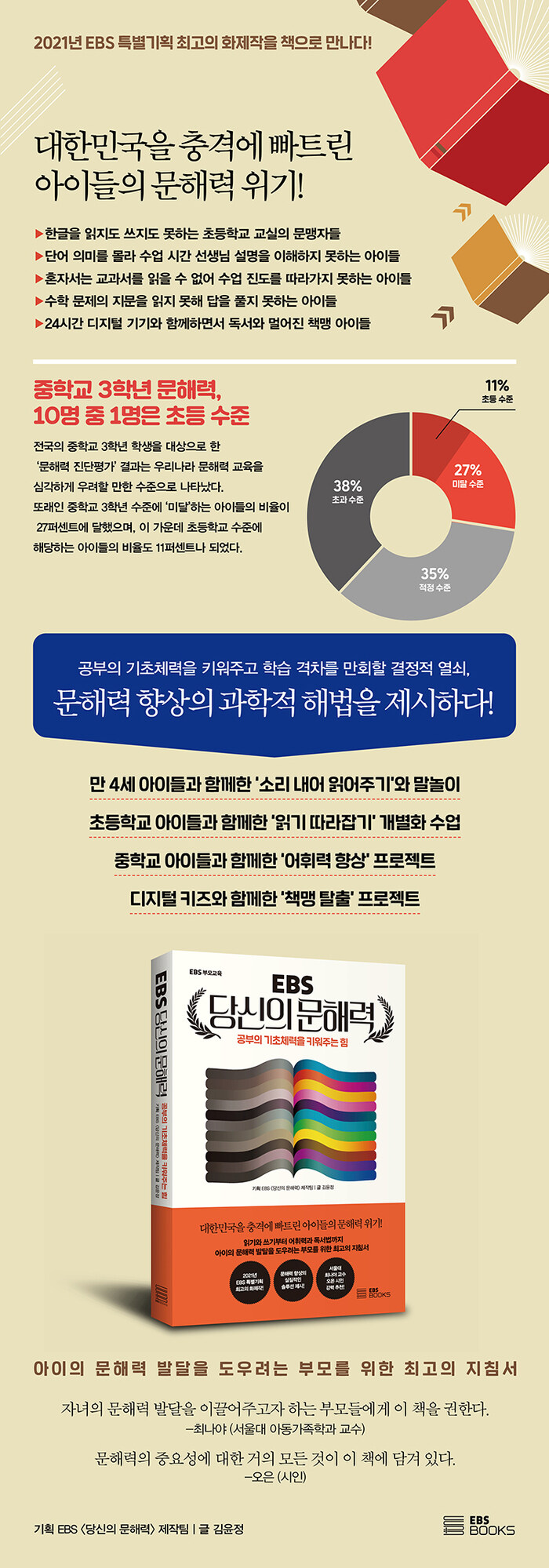
The results of a 'literacy diagnostic test' conducted on 2,405 third-year middle school students nationwide showed that 3 out of 10 students were 'below' the level of their peers in the third year of middle school.
A more serious problem was that 11 percent of children were at the elementary school level.
And that wasn't all.
A 'vocabulary diagnostic assessment' conducted on third-year middle school students revealed that 9 out of 10 children were unable to understand textbook content without help due to a lack of vocabulary.
The literacy gap is also significant in elementary school classrooms.
In a diagnostic assessment of 'early literacy' conducted on 93 first graders in elementary school, more than two out of ten children remained at the 'below basic' level.
In a situation where online, non-face-to-face classes are being held due to COVID-19, children with lower literacy levels are experiencing greater learning losses and are more difficult to recover from.
Teachers in the field are deeply concerned about the learning gap among first and second grade elementary school students who are forced to take online classes alone due to various environmental factors.
The decline in children's literacy is more serious because it is not just a temporary difficulty but can lead to a vicious cycle.
If you don't understand the course material or the teacher's explanations, you will lose interest in class, and as a result, you will not be able to keep up with the progress, which will lower your confidence in studying.
When you lack confidence, you lose motivation to learn and don't even try to study again.
From reading and writing to vocabulary and reading techniques
The ultimate guide for parents looking to help their children develop literacy skills.
The key to building a foundation for studying and bridging the learning gap.
We present practical and scientific solutions to improve literacy!
When children say, “I don’t want to study!” most parents sigh or scold them.
However, children may want to study but may not know how to do so.
Children who do not have age-appropriate literacy skills have difficulty studying in all subjects, including Korean.
Because literacy is the foundation of all learning and the most important tool.
"EBS Your Literacy" examines the current state of literacy gaps across age groups—infant, school-age, and adolescence—analyzes the problems, and presents solutions to improve literacy through practical problem-solving.
First of all, the early childhood period is the time when the roots of literacy grow and sprout, and it is important for parents to create a literacy-friendly environment by reading books aloud to their children.
It is also important to make them familiar with the Korean language and to provide access to books anytime, anywhere.
The results of a 12-week "read aloud" project, in which parents read aloud to their children a little bit every day, were surprising.
All 23 children who participated showed significant growth in their phonological awareness skills as well as their ability to understand stories.
Above all, it is most encouraging that children who used to hate reading books are now enjoying reading time.
Next, during the elementary school years, we need to focus on ‘reading skills.’
In elementary schools in Korea, Korean language education is conducted under the assumption that children will enter school knowing how to read.
As a result, children who cannot read or who cannot understand the meaning of the letters they read are left behind from the start.
Experts consider the second grade of elementary school to be the 'golden time for literacy development' because reading for serious learning begins in the third grade.
Therefore, reading ability levels should be checked by the second grade of elementary school at the latest, and separate reading education should be provided to children who fall below the average level.
What is unfortunate is that the public education system has yet to make any systematic attempts to help children who are lagging behind in literacy.
Next, I met some middle school kids.
It was social studies, history, and English class, but the teachers were explaining the meanings of words in the textbook, so we couldn't make any progress.
In particular, there were many children who could not properly understand what they learned in class because they did not know the 'learning tool words', which are vocabulary essential for understanding textbook content.
We were able to confirm that vocabulary has an absolute impact on academic achievement in middle school children.
We conducted a ‘vocabulary improvement project’ with children who received low scores on the ‘vocabulary diagnostic assessment.’
Before explaining the subject matter in class, I explained key vocabulary first, and the children began to understand the teacher's explanation and became interested in the class.
Through various types of vocabulary classes, the children studied about 300 words over 10 weeks, and not only did their understanding of the lessons increase, but their confidence in studying also grew significantly.
Chapter 5 of the book depicts children who have become 'book blind' and do not read books because they are always on digital devices such as computers and smartphones 24 hours a day.
By revealing through experiments on prefrontal cortex activation that 'reading' is closely related to the development of cognitive abilities, we explained why the ability to read and understand text is necessary even in the digital age.
Children who had not read a single book since elementary school began to enjoy reading after the 'Book Blindness Escape Project'.
Like other children who participated in literacy experiments and projects, these children demonstrated that they can develop their literacy skills with appropriate education and opportunities.
Your literacy depends on your present!
Literacy is the most crucial ability that can change a child's future.
In the future, more power will be concentrated in the hands of those who have high literacy skills.
As poet Oh Eun wrote in her recommendation, “EBS Your Literacy” contains “almost everything about the importance of literacy.”
Above all, the low illiteracy rate in our country brings to the surface the issue of literacy, which has “never been properly discussed and was close to a non-existent problem.”
It shows how not knowing the meaning of 'three days' or 'tentative title' affects our lives, and helps us understand the real reason why children hate studying and find it difficult.
It also raises the question of why the public education system should actively pursue literacy education.
In the 'Planning Note', the PD who co-planned the program said, "I feel that literacy is declining at an incredibly fast rate," and "The fear I felt as a production PD while covering literacy for over two years is actually greater than I thought."
Rather than ending with a crisis diagnosis, the book also offers positive hope, saying, “Accurately recognizing the problem and its importance through this book can be the beginning of improvement.”
And finally, the last thing he added was this:
“The greatest characteristic of literacy is that anyone can possess it.
If you work hard consistently, literacy will definitely come to you.
“Your literacy is still changing and growing.”
Literacy is a fundamental and core asset and ability that we need in all aspects of our lives.
It even affects things that improve the quality of life, such as health and economic income.
But the most important thing is that 'literacy is not destiny, it is effort.'
In other words, literacy is an ability that anyone can have with proper education and training.
This is what the results of training conducted around the world to help illiterate people show.
Now we ask our children, our workers, and our parents:
“How is your literacy?”
Children who cannot understand the content even after reading the textbook.
Children who cannot follow the class because they do not understand the teacher's explanations,
What is the real reason why children hate studying and even lose confidence?
The results of a 'literacy diagnostic test' conducted on 2,405 third-year middle school students nationwide showed that 3 out of 10 students were 'below' the level of their peers in the third year of middle school.
A more serious problem was that 11 percent of children were at the elementary school level.
And that wasn't all.
A 'vocabulary diagnostic assessment' conducted on third-year middle school students revealed that 9 out of 10 children were unable to understand textbook content without help due to a lack of vocabulary.
The literacy gap is also significant in elementary school classrooms.
In a diagnostic assessment of 'early literacy' conducted on 93 first graders in elementary school, more than two out of ten children remained at the 'below basic' level.
In a situation where online, non-face-to-face classes are being held due to COVID-19, children with lower literacy levels are experiencing greater learning losses and are more difficult to recover from.
Teachers in the field are deeply concerned about the learning gap among first and second grade elementary school students who are forced to take online classes alone due to various environmental factors.
The decline in children's literacy is more serious because it is not just a temporary difficulty but can lead to a vicious cycle.
If you don't understand the course material or the teacher's explanations, you will lose interest in class, and as a result, you will not be able to keep up with the progress, which will lower your confidence in studying.
When you lack confidence, you lose motivation to learn and don't even try to study again.
From reading and writing to vocabulary and reading techniques
The ultimate guide for parents looking to help their children develop literacy skills.
The key to building a foundation for studying and bridging the learning gap.
We present practical and scientific solutions to improve literacy!
When children say, “I don’t want to study!” most parents sigh or scold them.
However, children may want to study but may not know how to do so.
Children who do not have age-appropriate literacy skills have difficulty studying in all subjects, including Korean.
Because literacy is the foundation of all learning and the most important tool.
"EBS Your Literacy" examines the current state of literacy gaps across age groups—infant, school-age, and adolescence—analyzes the problems, and presents solutions to improve literacy through practical problem-solving.
First of all, the early childhood period is the time when the roots of literacy grow and sprout, and it is important for parents to create a literacy-friendly environment by reading books aloud to their children.
It is also important to make them familiar with the Korean language and to provide access to books anytime, anywhere.
The results of a 12-week "read aloud" project, in which parents read aloud to their children a little bit every day, were surprising.
All 23 children who participated showed significant growth in their phonological awareness skills as well as their ability to understand stories.
Above all, it is most encouraging that children who used to hate reading books are now enjoying reading time.
Next, during the elementary school years, we need to focus on ‘reading skills.’
In elementary schools in Korea, Korean language education is conducted under the assumption that children will enter school knowing how to read.
As a result, children who cannot read or who cannot understand the meaning of the letters they read are left behind from the start.
Experts consider the second grade of elementary school to be the 'golden time for literacy development' because reading for serious learning begins in the third grade.
Therefore, reading ability levels should be checked by the second grade of elementary school at the latest, and separate reading education should be provided to children who fall below the average level.
What is unfortunate is that the public education system has yet to make any systematic attempts to help children who are lagging behind in literacy.
Next, I met some middle school kids.
It was social studies, history, and English class, but the teachers were explaining the meanings of words in the textbook, so we couldn't make any progress.
In particular, there were many children who could not properly understand what they learned in class because they did not know the 'learning tool words', which are vocabulary essential for understanding textbook content.
We were able to confirm that vocabulary has an absolute impact on academic achievement in middle school children.
We conducted a ‘vocabulary improvement project’ with children who received low scores on the ‘vocabulary diagnostic assessment.’
Before explaining the subject matter in class, I explained key vocabulary first, and the children began to understand the teacher's explanation and became interested in the class.
Through various types of vocabulary classes, the children studied about 300 words over 10 weeks, and not only did their understanding of the lessons increase, but their confidence in studying also grew significantly.
Chapter 5 of the book depicts children who have become 'book blind' and do not read books because they are always on digital devices such as computers and smartphones 24 hours a day.
By revealing through experiments on prefrontal cortex activation that 'reading' is closely related to the development of cognitive abilities, we explained why the ability to read and understand text is necessary even in the digital age.
Children who had not read a single book since elementary school began to enjoy reading after the 'Book Blindness Escape Project'.
Like other children who participated in literacy experiments and projects, these children demonstrated that they can develop their literacy skills with appropriate education and opportunities.
Your literacy depends on your present!
Literacy is the most crucial ability that can change a child's future.
In the future, more power will be concentrated in the hands of those who have high literacy skills.
As poet Oh Eun wrote in her recommendation, “EBS Your Literacy” contains “almost everything about the importance of literacy.”
Above all, the low illiteracy rate in our country brings to the surface the issue of literacy, which has “never been properly discussed and was close to a non-existent problem.”
It shows how not knowing the meaning of 'three days' or 'tentative title' affects our lives, and helps us understand the real reason why children hate studying and find it difficult.
It also raises the question of why the public education system should actively pursue literacy education.
In the 'Planning Note', the PD who co-planned the program said, "I feel that literacy is declining at an incredibly fast rate," and "The fear I felt as a production PD while covering literacy for over two years is actually greater than I thought."
Rather than ending with a crisis diagnosis, the book also offers positive hope, saying, “Accurately recognizing the problem and its importance through this book can be the beginning of improvement.”
And finally, the last thing he added was this:
“The greatest characteristic of literacy is that anyone can possess it.
If you work hard consistently, literacy will definitely come to you.
“Your literacy is still changing and growing.”
Literacy is a fundamental and core asset and ability that we need in all aspects of our lives.
It even affects things that improve the quality of life, such as health and economic income.
But the most important thing is that 'literacy is not destiny, it is effort.'
In other words, literacy is an ability that anyone can have with proper education and training.
This is what the results of training conducted around the world to help illiterate people show.
Now we ask our children, our workers, and our parents:
“How is your literacy?”
GOODS SPECIFICS
- Date of issue: August 20, 2021
- Page count, weight, size: 296 pages | 385g | 145*210*23mm
- ISBN13: 9788954759335
- ISBN10: 8954759335
You may also like
카테고리
korean


korean

![ELLE 엘르 스페셜 에디션 A형 : 12월 [2025]](http://librairie.coreenne.fr/cdn/shop/files/b8e27a3de6c9538896439686c6b0e8fb.jpg?v=1766436872&width=3840)


