

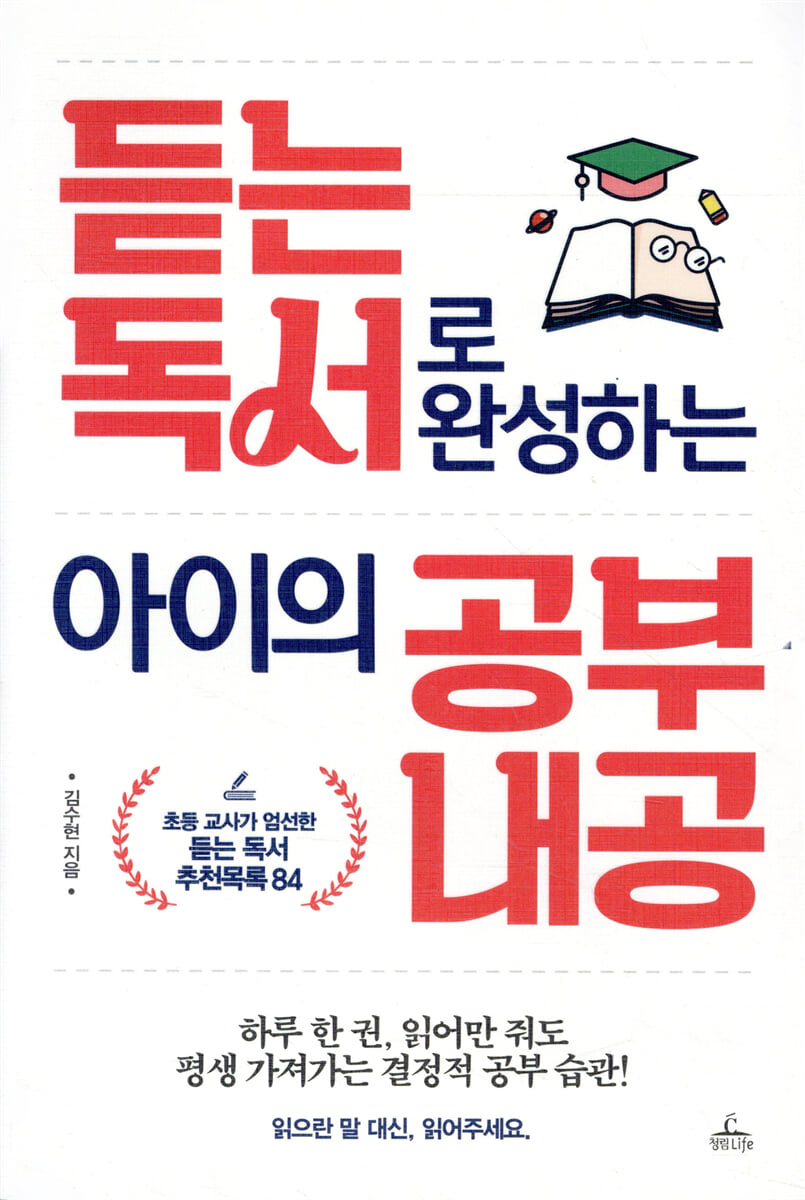
A child's study skills are completed through listening and reading.
 |
Description
Book Introduction
If you read one book a day, you will have it for life. Crucial study habits! Children who have long since lost their desire to read books end up in a vicious cycle of avoiding books because they hate them. The author, a current elementary school teacher, found the answer in ‘listening reading.’ Some parents may wonder what effect reading to a child who has already become an independent reader has, but the amazing benefits of listening to books apply to all children. Listening is necessary for children who cannot read, children who are just beginning to read independently, and older children who are good readers on their own. Reading books out loud is the most effective way to enhance the 'pleasure of reading' through the 'pleasure of listening'. Reading to children is not like 'pouring water into a bottomless pit', but 'getting your clothes wet in a drizzle'. |
- You can preview some of the book's contents.
Preview
index
Part 01 Children who need 'listening reading' rather than 'reading reading'
Never underestimate the power of listening to reading.
Time to focus on the book | Listening and reading | Providing ample opportunities to listen | Listening reading develops comprehension and concentration
Why should I read to you when you can read on your own?
Fearing Descriptive Questions | Books Were a Clear Joy for Children | Children Who Dislike Reading | The Surefire Way to Restore the Joy of Reading
Does listening to books stimulate interest in books?
Motivational Factors | Pros and Cons of Praise Stickers | What Makes Reading Difficult | What Makes Reading Fun
What is my child's reading attitude score?
Our country's children's reading attitudes | Creating desirable reading attitudes
Is it because I'm a boy that I hate books?
First reason: Prejudice | Second reason: Preference | Third reason: Reader | Fourth reason: Reading method and habits
Part 02 The most reliable way to develop creativity, imagination, sociality, and character
You can develop empathy
Why Empathy Matters | The Power of Parental Reading | Setting Simple Goals
Do you want your child to grow up well?
The Important Role of Reading | Popular Children, Good Children | The Process of Creating a Good Heart | How to Instill a Good Heart
Reading gives wings to imagination
Children's imagination | A healthy imagination built through study | The power to restore purity
Remind me that you love me
The Temperature of Language Used with Children | Parents' Speaking Habits Learned Through Listening | Warm-Temperature Language Developed Through Listening
There are books that are especially fun to read together.
1 vs 4 vs 20 | Friends are capable helpers
Part 03 Lifelong study habits created through listening and reading
Just listening can help you develop your reading skills?
Reading to Children | Children's Reading Abilities | The Power of Picture Books
Why should I listen carefully?
Fluency in Language | To develop expressive language skills | Listening is the key to speaking | The easiest listening training
Listening to reading gives you the opportunity to speak for yourself.
Acknowledging each other's differences | Distinguishing emotions through listening and reading | Recognizing various emotions | Sharing my emotions with friends
Are there children who have trouble reading?
Struggling Readers in the Classroom | Parental Attention and Reading | Children Who Take Notes on What They Hear | Tips for Struggling Readers
How is gifted reading different?
Reading Tendencies of Gifted Children | Self-Directed Reading | The Impact of Metacognitive Abilities on Learning | Reading Metacognitive Abilities
Does your child say he or she doesn't understand what you're saying?
Communication Determines School Adaptability | Reading and Vocabulary | How to Build Vocabulary Before School | Parents' Broad Vocabulary | Vocabulary: A Guide to Learning | Discovering New Vocabulary
Part 04 A Shortcut to Listening Reading
Why are books you choose yourself more interesting?
Choosing Your Own Books to Read | Attitudes toward Books Your Child Chooses | Children Choosing Their Own Books to Read | The Blind Spots of Recommended Books
Is there a way to improve presentation skills?
An experience of free conversation | A lively post-reading activity | A time for beautiful conversation
Is it okay if I read it out loud?
Different Reading Styles | How Children Read | The Magic of Reading Aloud
When they refuse to listen, tell them a story.
If your reading comprehension is lacking, read: Old Tales | The Two Faces of Traditional Fairy Tales | Even the Same Traditional Fairy Tales Are Different | Traditional Fairy Tales and World Masterpieces
Would it be okay if I just read it briefly?
Still, careful reading is essential | Reading independence and careful reading | Another way to read
It's okay to just pick out the parts you like and read them.
The right to selectively read | The starting point of study, excerpt reading | The right to excerpt reading | A special way to read knowledge information picture books | The chain of ideas connected to books
How do you create a space that makes reading enjoyable?
Places to Read | Reading at a Cafe | Reading Before Bed | The Charm of Outdoor Reading
Are television and smartphones distracting from reading?
Factors that hinder reading | Reading books and watching television | Children holding smartphones
Can I allow educational comics?
Prejudice Against Educational Comics | Things to Consider When Reading Educational Comics
How do you transition naturally from picture books to paperbacks?
The temptation of private education | Picture books and elementary school literature | Even if you level up with elementary school literature, you will continue to read through listening.
Never underestimate the power of listening to reading.
Time to focus on the book | Listening and reading | Providing ample opportunities to listen | Listening reading develops comprehension and concentration
Why should I read to you when you can read on your own?
Fearing Descriptive Questions | Books Were a Clear Joy for Children | Children Who Dislike Reading | The Surefire Way to Restore the Joy of Reading
Does listening to books stimulate interest in books?
Motivational Factors | Pros and Cons of Praise Stickers | What Makes Reading Difficult | What Makes Reading Fun
What is my child's reading attitude score?
Our country's children's reading attitudes | Creating desirable reading attitudes
Is it because I'm a boy that I hate books?
First reason: Prejudice | Second reason: Preference | Third reason: Reader | Fourth reason: Reading method and habits
Part 02 The most reliable way to develop creativity, imagination, sociality, and character
You can develop empathy
Why Empathy Matters | The Power of Parental Reading | Setting Simple Goals
Do you want your child to grow up well?
The Important Role of Reading | Popular Children, Good Children | The Process of Creating a Good Heart | How to Instill a Good Heart
Reading gives wings to imagination
Children's imagination | A healthy imagination built through study | The power to restore purity
Remind me that you love me
The Temperature of Language Used with Children | Parents' Speaking Habits Learned Through Listening | Warm-Temperature Language Developed Through Listening
There are books that are especially fun to read together.
1 vs 4 vs 20 | Friends are capable helpers
Part 03 Lifelong study habits created through listening and reading
Just listening can help you develop your reading skills?
Reading to Children | Children's Reading Abilities | The Power of Picture Books
Why should I listen carefully?
Fluency in Language | To develop expressive language skills | Listening is the key to speaking | The easiest listening training
Listening to reading gives you the opportunity to speak for yourself.
Acknowledging each other's differences | Distinguishing emotions through listening and reading | Recognizing various emotions | Sharing my emotions with friends
Are there children who have trouble reading?
Struggling Readers in the Classroom | Parental Attention and Reading | Children Who Take Notes on What They Hear | Tips for Struggling Readers
How is gifted reading different?
Reading Tendencies of Gifted Children | Self-Directed Reading | The Impact of Metacognitive Abilities on Learning | Reading Metacognitive Abilities
Does your child say he or she doesn't understand what you're saying?
Communication Determines School Adaptability | Reading and Vocabulary | How to Build Vocabulary Before School | Parents' Broad Vocabulary | Vocabulary: A Guide to Learning | Discovering New Vocabulary
Part 04 A Shortcut to Listening Reading
Why are books you choose yourself more interesting?
Choosing Your Own Books to Read | Attitudes toward Books Your Child Chooses | Children Choosing Their Own Books to Read | The Blind Spots of Recommended Books
Is there a way to improve presentation skills?
An experience of free conversation | A lively post-reading activity | A time for beautiful conversation
Is it okay if I read it out loud?
Different Reading Styles | How Children Read | The Magic of Reading Aloud
When they refuse to listen, tell them a story.
If your reading comprehension is lacking, read: Old Tales | The Two Faces of Traditional Fairy Tales | Even the Same Traditional Fairy Tales Are Different | Traditional Fairy Tales and World Masterpieces
Would it be okay if I just read it briefly?
Still, careful reading is essential | Reading independence and careful reading | Another way to read
It's okay to just pick out the parts you like and read them.
The right to selectively read | The starting point of study, excerpt reading | The right to excerpt reading | A special way to read knowledge information picture books | The chain of ideas connected to books
How do you create a space that makes reading enjoyable?
Places to Read | Reading at a Cafe | Reading Before Bed | The Charm of Outdoor Reading
Are television and smartphones distracting from reading?
Factors that hinder reading | Reading books and watching television | Children holding smartphones
Can I allow educational comics?
Prejudice Against Educational Comics | Things to Consider When Reading Educational Comics
How do you transition naturally from picture books to paperbacks?
The temptation of private education | Picture books and elementary school literature | Even if you level up with elementary school literature, you will continue to read through listening.
Detailed image
.jpg)
Into the book
Listening skills have a 'transfer effect' that improves not only your ability to understand but also your ability to speak.
When you listen, you can take in a variety of information, and you develop the will to use this information as nourishment to form thoughts and opinions and express them in words.
And this is the first step to building up your study skills.
Therefore, rather than forcing a child who is afraid of speaking to speak loudly, it is much more effective to provide them with ample opportunities to listen and help them gradually begin to speak on their own based on what they have heard.
-Page 21
We've consistently taught our children how to read, and they're now capable of reading independently. Why don't they want to read? Unfortunately, it's because we haven't taught them to "want to read."
It's because we taught our children how to read so diligently, but we failed to maintain and develop the child's original desire to read.
Perhaps focusing solely on how to read books may have actually broken the child's heart.
-Page 34
After finishing physical education on the playground with the first graders, I returned to the classroom and asked, “How was the playground play today?”
Most children answer like this:
“It was good!” When asked again what was so good about it, the children respond like this.
“Don’t you know?” “Just~” “Everything~~~!”
These are answers that come from children's emotions not yet being differentiated, and their inability to understand the source and depth of their emotions and why they are feeling that way.
But this kind of emotion
There are children who are particularly good at expressing their thoughts with appropriate words, as they know a lot of different types and are good at it.
“Teacher, the reason I liked it was because
“I'm so proud of myself for jumping rope for the first time in PE today! That was great!”
These children are those with excellent 'expressive language skills' as mentioned earlier.
Even though they spent the same amount of time in physical education, these children were able to express their feelings and situations in more specific ways, both verbally and in writing.
Besides, he is good at keeping a diary.
The secret to these children's expressive language skills is 'picture books' and 'listening reading.'
-Page 189
In schools, there are far more children who do not like books than children who do.
Unfortunately, numerous studies have already proven that the gap widens as students advance in grade level.
Therefore, parents and teachers must constantly research ways to arouse interest in children who dislike books, asking, "How can I make this child like books?"
This is by no means an easy task, but it is certainly worth it.
When you listen, you can take in a variety of information, and you develop the will to use this information as nourishment to form thoughts and opinions and express them in words.
And this is the first step to building up your study skills.
Therefore, rather than forcing a child who is afraid of speaking to speak loudly, it is much more effective to provide them with ample opportunities to listen and help them gradually begin to speak on their own based on what they have heard.
-Page 21
We've consistently taught our children how to read, and they're now capable of reading independently. Why don't they want to read? Unfortunately, it's because we haven't taught them to "want to read."
It's because we taught our children how to read so diligently, but we failed to maintain and develop the child's original desire to read.
Perhaps focusing solely on how to read books may have actually broken the child's heart.
-Page 34
After finishing physical education on the playground with the first graders, I returned to the classroom and asked, “How was the playground play today?”
Most children answer like this:
“It was good!” When asked again what was so good about it, the children respond like this.
“Don’t you know?” “Just~” “Everything~~~!”
These are answers that come from children's emotions not yet being differentiated, and their inability to understand the source and depth of their emotions and why they are feeling that way.
But this kind of emotion
There are children who are particularly good at expressing their thoughts with appropriate words, as they know a lot of different types and are good at it.
“Teacher, the reason I liked it was because
“I'm so proud of myself for jumping rope for the first time in PE today! That was great!”
These children are those with excellent 'expressive language skills' as mentioned earlier.
Even though they spent the same amount of time in physical education, these children were able to express their feelings and situations in more specific ways, both verbally and in writing.
Besides, he is good at keeping a diary.
The secret to these children's expressive language skills is 'picture books' and 'listening reading.'
-Page 189
In schools, there are far more children who do not like books than children who do.
Unfortunately, numerous studies have already proven that the gap widens as students advance in grade level.
Therefore, parents and teachers must constantly research ways to arouse interest in children who dislike books, asking, "How can I make this child like books?"
This is by no means an easy task, but it is certainly worth it.
-Page 380
Publisher's Review
The most reliable way to build up study skills
Only by mastering all four areas—listening, reading, speaking, and writing—can you develop language fluency, which is the foundation of your study skills.
However, it is often misunderstood that being fluent in a language means being good at 'speaking'.
Among the parents invited to open classes, only those interested in how much their children presented during class are interested.
“Teacher, why doesn’t my child ever raise his hand?”
“Teacher, why can’t my child answer the questions accurately?”
“Teacher, why is my child hesitant to express his thoughts like other children?”
There is absolutely no reason to worry about not being able to speak well.
Because listening is more important than speaking.
If you can't 'listen', not only speaking, but also writing and reading become difficult.
I hope you'll be more interested in how well your child listens to others than in how much they speak.
Don't forget that you can steadily build up your study skills just by listening to reading.
84 Recommended Reading Lists Curated by Elementary School Teachers
You may want to encourage your child to read aloud, but you may be at a loss as to what books to read and how to read them.
For such parents, we introduce picture books from various fields.
I have selected and included the books that were most effective (responsive) among the books I read to my children in the classroom and to my two daughters at home.
We've included a whopping 84 meaningful books, including books that will expand your imagination, books that will develop your vocabulary, books that are good to read while discussing, and books that will nurture your character.
I hope all children will enjoy 'listening' to these books with their parents' voices.
Only by mastering all four areas—listening, reading, speaking, and writing—can you develop language fluency, which is the foundation of your study skills.
However, it is often misunderstood that being fluent in a language means being good at 'speaking'.
Among the parents invited to open classes, only those interested in how much their children presented during class are interested.
“Teacher, why doesn’t my child ever raise his hand?”
“Teacher, why can’t my child answer the questions accurately?”
“Teacher, why is my child hesitant to express his thoughts like other children?”
There is absolutely no reason to worry about not being able to speak well.
Because listening is more important than speaking.
If you can't 'listen', not only speaking, but also writing and reading become difficult.
I hope you'll be more interested in how well your child listens to others than in how much they speak.
Don't forget that you can steadily build up your study skills just by listening to reading.
84 Recommended Reading Lists Curated by Elementary School Teachers
You may want to encourage your child to read aloud, but you may be at a loss as to what books to read and how to read them.
For such parents, we introduce picture books from various fields.
I have selected and included the books that were most effective (responsive) among the books I read to my children in the classroom and to my two daughters at home.
We've included a whopping 84 meaningful books, including books that will expand your imagination, books that will develop your vocabulary, books that are good to read while discussing, and books that will nurture your character.
I hope all children will enjoy 'listening' to these books with their parents' voices.
GOODS SPECIFICS
- Date of issue: May 10, 2019
- Page count, weight, size: 388 pages | 690g | 152*224*30mm
- ISBN13: 9791188700400
- ISBN10: 1188700405
You may also like
카테고리
korean


korean

![GQ KOREA Mark (Monthly): December [2025]](http://librairie.coreenne.fr/cdn/shop/files/8ef265dbbfbf186523ed75ba7319009d.jpg?v=1765340328&width=3840)


