

Just follow American English pronunciation
 |
Description
Book Introduction
When your ears are pierced, your mouth opens!
If your pronunciation changes, your conversation will explode!
The English pronunciation bible with 26 years of tradition, now completely new and more powerful, with the latest revision.
"I just followed along, and it sounded like a native speaker!" "Once I opened my mouth, my listening score went up!"
I know the words, but why can't I hear native speakers? I can form sentences, but why can't I get the words out?
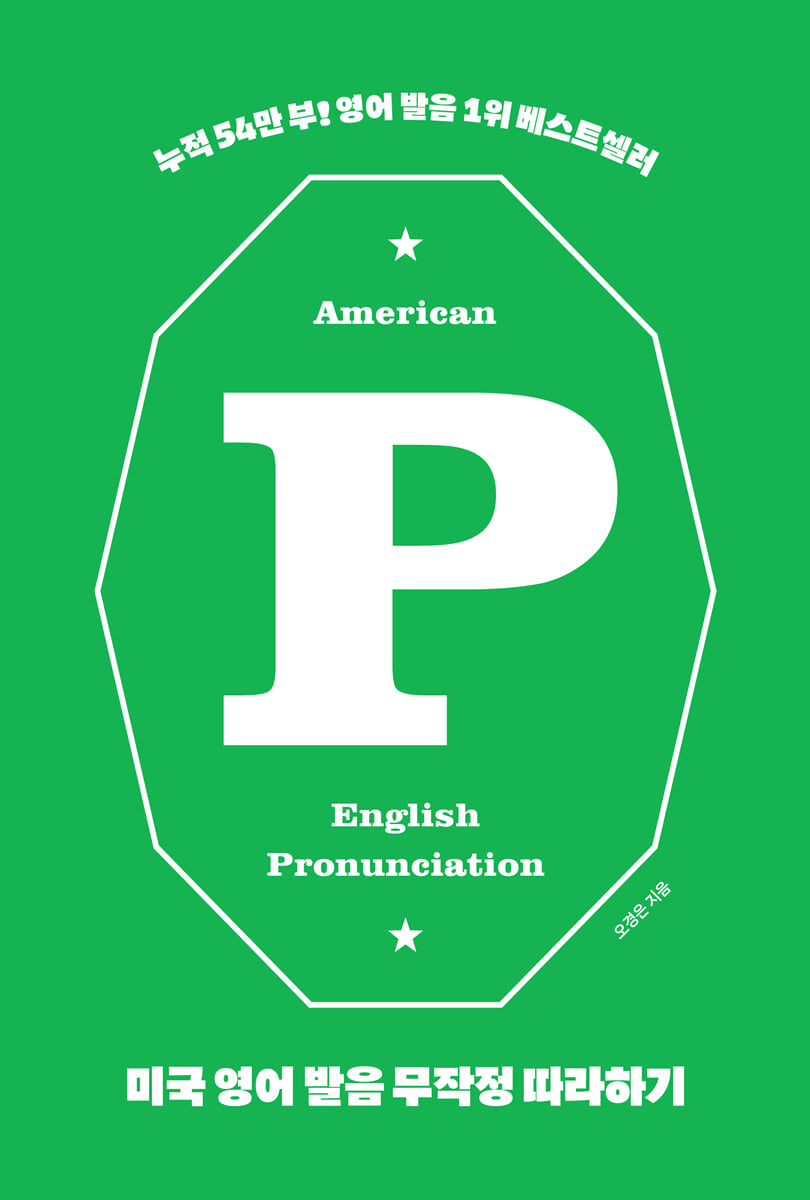
With a cumulative circulation of 540,000 copies over 26 years, "Just Follow American English Pronunciation," the #1 English pronunciation guide, has returned with a fully revised edition! First published in 1999, it has become a bible of English pronunciation, offering countless English learners their first "experience of hearing English." This practical training guide will help you master English sounds with a "Korean mouth."
The '8 Rules of T Pronunciation' has been completely reorganized to provide more systematic theories and more realistic examples so that you can train step-by-step the key elements of perfecting American English sounds, such as stress, liaison, intonation, and sentence rhythm.
Why can't I understand English and get stuck? It's not because I don't know the words, but because I haven't properly learned the sounds.
“When your mouth opens, your ears open, and when your ears open, your mouth opens.” This book is the original “sound-centered English learning method” that opens listening and speaking simultaneously.
You don't need to know complicated pronunciation symbols.
Lipstick drawings, native speaker MP3s, and even Korean spelling that sounds like a native speaker when read directly! Even beginners can easily follow along.
Numerous reader reviews prove this, saying, "It was written in Korean, so I read it as is, and it sounded exactly like a native speaker's pronunciation."
This book will surely prove effective for both beginners and intermediate learners struggling with listening. Even in the age of AI, what remains irreplaceable is the "sense of sound" trained through the human mouth.
The fastest way to improve your English pronunciation, start now with this book.
If your pronunciation changes, your conversation will explode!
The English pronunciation bible with 26 years of tradition, now completely new and more powerful, with the latest revision.
"I just followed along, and it sounded like a native speaker!" "Once I opened my mouth, my listening score went up!"
I know the words, but why can't I hear native speakers? I can form sentences, but why can't I get the words out?
With a cumulative circulation of 540,000 copies over 26 years, "Just Follow American English Pronunciation," the #1 English pronunciation guide, has returned with a fully revised edition! First published in 1999, it has become a bible of English pronunciation, offering countless English learners their first "experience of hearing English." This practical training guide will help you master English sounds with a "Korean mouth."
The '8 Rules of T Pronunciation' has been completely reorganized to provide more systematic theories and more realistic examples so that you can train step-by-step the key elements of perfecting American English sounds, such as stress, liaison, intonation, and sentence rhythm.
Why can't I understand English and get stuck? It's not because I don't know the words, but because I haven't properly learned the sounds.
“When your mouth opens, your ears open, and when your ears open, your mouth opens.” This book is the original “sound-centered English learning method” that opens listening and speaking simultaneously.
You don't need to know complicated pronunciation symbols.
Lipstick drawings, native speaker MP3s, and even Korean spelling that sounds like a native speaker when read directly! Even beginners can easily follow along.
Numerous reader reviews prove this, saying, "It was written in Korean, so I read it as is, and it sounded exactly like a native speaker's pronunciation."
This book will surely prove effective for both beginners and intermediate learners struggling with listening. Even in the age of AI, what remains irreplaceable is the "sense of sound" trained through the human mouth.
The fastest way to improve your English pronunciation, start now with this book.
- You can preview some of the book's contents.
Preview
index
Part 1: American English Pronunciation Orientation
1 | Why English Pronunciation Matters | 2 | How to Start Pronunciation | 3 | Why Is English Pronunciation So Difficult? | 4 | The Rhythm of English: The Key to Conquering Listening and Speaking Skills | 5 | The Standard for Accurate American Pronunciation | Dictionary Pronunciation Symbols vs. Actual American Pronunciation | Training Methods for Accurate English Pronunciation
Practice Test 1
Part 2: American English Pronunciation Basics: Knowing the T Pronunciation Alone Will Help You Hear 70% of English
01 | T-Rule 1: Pronunciation of the letter t
02 | T-Rule 2: Flap t Pronunciation
03 | T-Rule 3: Nasal Release t
04 | T-Law 4: Sound t fed to n (no audible release)
05 | T-Law 5: Silent t
06 | T-Rule 6: Glottalized t
07 | T-Rule 7: The t[t?] of tr pronounced as 'chu'
08 | T-Law 8: Silent t after s
Practice Test 2
Part 3 Expanding Your American English Pronunciation: The ABCs of American English Pronunciation for Fluent Conversation
09 | Sound of pulling the mouth to the sides [æ]
10 | Neither 'ㅂ' nor 'ㅃ' [b]
11 | Pronunciation made by the initial sound c [k]
12 | Transforming Sound [d] 1: Classic [d]
13 | Transforming sound [d] 2: Rolling d (flap d)
14 | Transforming sound [d] 3: [d?]/[d?] of dr, the middle sound between 'du' and 'ju'
15 | Three pronunciations of e 1: stressed e [e]
16 | Three pronunciations of e 2: e [ei]
17 | Three pronunciations of e 3: The silent e at the end of words
18 | [f] blowing a strong wind
19 | Three pronunciations of g 1: A thicker sound than 'ㄱ', g [g]
20 | Three pronunciations of g 2: g [d?] starting from [d] and connected to [?]
21 | Three pronunciations of g 3: -ng [ŋ] pronunciation
22 | Audible h and inaudible h
23 | The middle pronunciation i [?], which is neither 'ee' nor 'ee'
24 | Distinguishing between [d?] and [?]
25 | Pronunciation of k [k] similar to the Korean 'ㅋ'
Practice Test 3
26 | Two [l] pronunciations: initial sound [l] and final sound [l]
27 | [m] and [n] pronounced with a nasal sound
28 | o [ou] pronounced as 'oh-u'
29 | o [?ː], not 'oh' or 'ah'
30 | The sound of wind blowing through the lips p [p]
31 | qu-, pronouncing two vowels sequentially
32 | Rolling sound r: Initial sound [(으)r] and final sound [?]
33 | s [s] pronounced as 'ㅅ' or 'ㅆ'
34 | s that induces a sound
Practice Test 4
35 | th Pronunciation 1: Voiceless th [θ]
36 | th Pronunciation 2: Voiced th [ð]
37 | u [uː] / [juː] pronounced as 'u' or '(i)yuu'
38 | u [?] / [?] with a sound close to 'eo'
39 | When you vibrate your vocal cords in the [f] pronunciation, you pronounce [v]
40 | w(h) [w] to make a diphthong
41 | Three pronunciations of ex-: [eks], [iks], [igz]
42 | y- [j] to make a diphthong
43 | Sound like a phone vibrating [z]
Practice Test 5
Part 4 Perfecting American English Pronunciation: Stress and Rhythm for Natural Native English
44 | Linking 1: When a word ending in a consonant meets a word beginning with a vowel
45 | Linked sounds 2: When a word ending with [-t/d] and a word beginning with a vowel meet
46 | Consonant 3: When the same consonant appears consecutively
47 | Contraction 1: Contractions of auxiliary verbs and the verb "be"
48 | Abbreviation 2: When the auxiliary verb and the negative not meet
49 | Word Stress 1: Stress in Two-Syllable Words
50 | Word Stress 2: Stress in Three-Syllable Words
51 | Word Stress 3: Stress in Four-Syllable Words
52 | Sentence Rhythm 1: Emphasis
53 | Sentence Rhythm 2: Weak Words
54 | Sentence Rhythm 3: Intonation
Practice Test 6
1 | Why English Pronunciation Matters | 2 | How to Start Pronunciation | 3 | Why Is English Pronunciation So Difficult? | 4 | The Rhythm of English: The Key to Conquering Listening and Speaking Skills | 5 | The Standard for Accurate American Pronunciation | Dictionary Pronunciation Symbols vs. Actual American Pronunciation | Training Methods for Accurate English Pronunciation
Practice Test 1
Part 2: American English Pronunciation Basics: Knowing the T Pronunciation Alone Will Help You Hear 70% of English
01 | T-Rule 1: Pronunciation of the letter t
02 | T-Rule 2: Flap t Pronunciation
03 | T-Rule 3: Nasal Release t
04 | T-Law 4: Sound t fed to n (no audible release)
05 | T-Law 5: Silent t
06 | T-Rule 6: Glottalized t
07 | T-Rule 7: The t[t?] of tr pronounced as 'chu'
08 | T-Law 8: Silent t after s
Practice Test 2
Part 3 Expanding Your American English Pronunciation: The ABCs of American English Pronunciation for Fluent Conversation
09 | Sound of pulling the mouth to the sides [æ]
10 | Neither 'ㅂ' nor 'ㅃ' [b]
11 | Pronunciation made by the initial sound c [k]
12 | Transforming Sound [d] 1: Classic [d]
13 | Transforming sound [d] 2: Rolling d (flap d)
14 | Transforming sound [d] 3: [d?]/[d?] of dr, the middle sound between 'du' and 'ju'
15 | Three pronunciations of e 1: stressed e [e]
16 | Three pronunciations of e 2: e [ei]
17 | Three pronunciations of e 3: The silent e at the end of words
18 | [f] blowing a strong wind
19 | Three pronunciations of g 1: A thicker sound than 'ㄱ', g [g]
20 | Three pronunciations of g 2: g [d?] starting from [d] and connected to [?]
21 | Three pronunciations of g 3: -ng [ŋ] pronunciation
22 | Audible h and inaudible h
23 | The middle pronunciation i [?], which is neither 'ee' nor 'ee'
24 | Distinguishing between [d?] and [?]
25 | Pronunciation of k [k] similar to the Korean 'ㅋ'
Practice Test 3
26 | Two [l] pronunciations: initial sound [l] and final sound [l]
27 | [m] and [n] pronounced with a nasal sound
28 | o [ou] pronounced as 'oh-u'
29 | o [?ː], not 'oh' or 'ah'
30 | The sound of wind blowing through the lips p [p]
31 | qu-, pronouncing two vowels sequentially
32 | Rolling sound r: Initial sound [(으)r] and final sound [?]
33 | s [s] pronounced as 'ㅅ' or 'ㅆ'
34 | s that induces a sound
Practice Test 4
35 | th Pronunciation 1: Voiceless th [θ]
36 | th Pronunciation 2: Voiced th [ð]
37 | u [uː] / [juː] pronounced as 'u' or '(i)yuu'
38 | u [?] / [?] with a sound close to 'eo'
39 | When you vibrate your vocal cords in the [f] pronunciation, you pronounce [v]
40 | w(h) [w] to make a diphthong
41 | Three pronunciations of ex-: [eks], [iks], [igz]
42 | y- [j] to make a diphthong
43 | Sound like a phone vibrating [z]
Practice Test 5
Part 4 Perfecting American English Pronunciation: Stress and Rhythm for Natural Native English
44 | Linking 1: When a word ending in a consonant meets a word beginning with a vowel
45 | Linked sounds 2: When a word ending with [-t/d] and a word beginning with a vowel meet
46 | Consonant 3: When the same consonant appears consecutively
47 | Contraction 1: Contractions of auxiliary verbs and the verb "be"
48 | Abbreviation 2: When the auxiliary verb and the negative not meet
49 | Word Stress 1: Stress in Two-Syllable Words
50 | Word Stress 2: Stress in Three-Syllable Words
51 | Word Stress 3: Stress in Four-Syllable Words
52 | Sentence Rhythm 1: Emphasis
53 | Sentence Rhythm 2: Weak Words
54 | Sentence Rhythm 3: Intonation
Practice Test 6
Detailed image

Publisher's Review
“Why can’t I speak like a native speaker?” The answer is in this book.
More accurate than AI, more natural than a native speaker!
Pronouncing sounds “correctly” is the starting point of listening and speaking.
- Ph.D. in Linguistics, Professor Jinyoung Tak of the Department of English Data Convergence at Sejong University -
An English pronunciation book perfect for Koreans.
As a native Korean, I also didn't know where to start with pronunciation.
This book helped me get started.
- English education expert, language YouTuber Park Se-jin (Sejin Teacher) -
* This book is a completely revised edition of 『Just Follow American English Pronunciation』, published in 2015.
In line with the revision period and readers' needs, pronunciation theory has been made more systematic, and examples have been organized with the latest content so that they can be applied directly to real-life conversations.
Pronunciation is the beginning of English and the starting point of conversation. Now, let's start practicing speaking with your mouth.
This is a pronunciation training book that teaches you how to master sounds and acquire rhythm. See the principles of English pronunciation with your eyes, learn them with your ears, and practice them with your mouth. As your pronunciation improves, your speaking and listening skills will also improve.
Pronunciation at a glance
No more complicated theories or boring explanations! Intuitive illustrations and concise, clear explanations that hit the nail on the head help you grasp the principles of pronunciation at a glance.
Learn English pronunciation easily with explanations that are easy to understand and visualize!
Vocabulary training
Practice the words you learned earlier, including the pronunciation, with native speaker mp3s.
Not only are there pronunciation symbols, but there are also Korean notations that are closest to the pronunciation of native speakers, so anyone can easily follow along.
Now myself
It's time to pronounce it with feeling!
* FAQ
We've compiled a FAQ of pronunciations that Koreans often make mistakes and get confused about, so you can reduce mistakes and achieve a clear pronunciation.
Conversation training
The true goal of pronunciation practice is to hear and speak English naturally! Develop a practical sense of the language through sentences recorded by native speakers at a natural pace, and learn essential conversational tips.
Confidence in English conversation begins with accurate pronunciation!
Pronunciation points
Here are some essential points for perfect pronunciation! We've compiled pronunciation tips for sentences and conversations.
A small but important difference, take note here!
Practice Test
Completely organize and internalize what you've learned so far! Listen to the audio and solve the problems. You can check expressions, translations, and key vocabulary in the answer section, making it a perfect study resource.
How to Double Your Use of Free MP3 Files
1.
Listen to the audio file only: Sound comes before words! English pronunciation starts with listening.
First, listen to the MP3 file to familiarize yourself with the pronunciation we'll cover in this lesson.
It's time to feel the natural sensation of pronunciation.
2.
Follow along while reading: Now it's time to learn letters and sounds together.
Make sure to master the American pronunciation by reading with your eyes, listening with your ears, and repeating with your mouth while looking at the book.
We've designed it so that you can practice your pronunciation without the inconvenience of having to pause, leaving enough time to follow along between words and sentences.
Practice using your eyes, ears, and mouth until the pronunciation becomes second nature!
More accurate than AI, more natural than a native speaker!
Pronouncing sounds “correctly” is the starting point of listening and speaking.
- Ph.D. in Linguistics, Professor Jinyoung Tak of the Department of English Data Convergence at Sejong University -
An English pronunciation book perfect for Koreans.
As a native Korean, I also didn't know where to start with pronunciation.
This book helped me get started.
- English education expert, language YouTuber Park Se-jin (Sejin Teacher) -
* This book is a completely revised edition of 『Just Follow American English Pronunciation』, published in 2015.
In line with the revision period and readers' needs, pronunciation theory has been made more systematic, and examples have been organized with the latest content so that they can be applied directly to real-life conversations.
Pronunciation is the beginning of English and the starting point of conversation. Now, let's start practicing speaking with your mouth.
This is a pronunciation training book that teaches you how to master sounds and acquire rhythm. See the principles of English pronunciation with your eyes, learn them with your ears, and practice them with your mouth. As your pronunciation improves, your speaking and listening skills will also improve.
Pronunciation at a glance
No more complicated theories or boring explanations! Intuitive illustrations and concise, clear explanations that hit the nail on the head help you grasp the principles of pronunciation at a glance.
Learn English pronunciation easily with explanations that are easy to understand and visualize!
Vocabulary training
Practice the words you learned earlier, including the pronunciation, with native speaker mp3s.
Not only are there pronunciation symbols, but there are also Korean notations that are closest to the pronunciation of native speakers, so anyone can easily follow along.
Now myself
It's time to pronounce it with feeling!
* FAQ
We've compiled a FAQ of pronunciations that Koreans often make mistakes and get confused about, so you can reduce mistakes and achieve a clear pronunciation.
Conversation training
The true goal of pronunciation practice is to hear and speak English naturally! Develop a practical sense of the language through sentences recorded by native speakers at a natural pace, and learn essential conversational tips.
Confidence in English conversation begins with accurate pronunciation!
Pronunciation points
Here are some essential points for perfect pronunciation! We've compiled pronunciation tips for sentences and conversations.
A small but important difference, take note here!
Practice Test
Completely organize and internalize what you've learned so far! Listen to the audio and solve the problems. You can check expressions, translations, and key vocabulary in the answer section, making it a perfect study resource.
How to Double Your Use of Free MP3 Files
1.
Listen to the audio file only: Sound comes before words! English pronunciation starts with listening.
First, listen to the MP3 file to familiarize yourself with the pronunciation we'll cover in this lesson.
It's time to feel the natural sensation of pronunciation.
2.
Follow along while reading: Now it's time to learn letters and sounds together.
Make sure to master the American pronunciation by reading with your eyes, listening with your ears, and repeating with your mouth while looking at the book.
We've designed it so that you can practice your pronunciation without the inconvenience of having to pause, leaving enough time to follow along between words and sentences.
Practice using your eyes, ears, and mouth until the pronunciation becomes second nature!
GOODS SPECIFICS
- Date of issue: September 1, 2025
- Page count, weight, size: 352 pages | 530g | 152*224*15mm
- ISBN13: 9791140714322
- ISBN10: 1140714325
You may also like
카테고리
korean


korean

![GQ KOREA Mark (Monthly): December [2025]](http://librairie.coreenne.fr/cdn/shop/files/8ef265dbbfbf186523ed75ba7319009d.jpg?v=1765340328&width=3840)


