

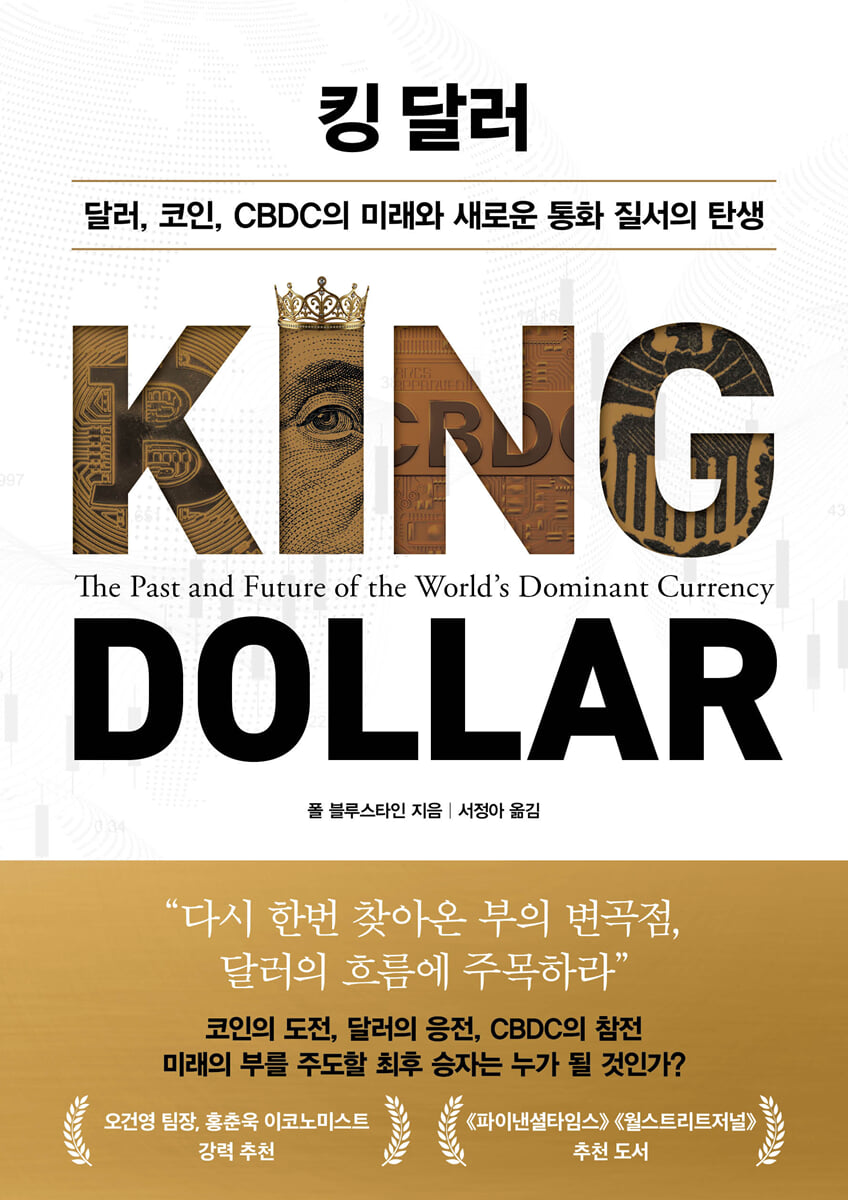
King Dollar
 |
Description
Book Introduction
- A word from MD
-
The increasingly solidifying dollar hegemonyThe dollar's recent movements have been unusual.
Still, American economic journalist Paul Bluestein says the dollar will still have the upper hand in the global currency war.
This book delves deeply into how the dollar's hegemony, which has dominated international foreign exchange transactions, trade, and financial markets, was formed and maintained.
August 5, 2025. Economics and Management PD Oh Da-eun
If you know the flow of dollars, you can see the future of wealth!
Uncovering the recurring cycle of dollar hegemony
The One Book That Will Clear the World Economy of Uncertainty
★ Strongly recommended by Shinhan Bank Team Leader Oh Geon-young and Economist Hong Chun-wook ★
★ Recommended books by the Financial Times and the Wall Street Journal ★
Today, the world economy is going through the 'Warring States Period of Currency.'
The Fed's high-interest rate policy and Trump's high tariff pressure are intertwining, leading to a strong dollar, while the BRICS-led de-dollarization movement is also gaining momentum.
Bitcoin is showing its presence more than ever, hitting new highs every day, and the Trump administration's second term appears to be openly promoting stablecoins.
China's CBDC, pioneered by the United States, is ushering in a new era for digital currency.
Can the dollar hegemony be maintained in this situation?
Paul Bluestein, author of "The King Dollar," predicts that the dollar will emerge as the "ultimate winner" of the currency war, despite challenges both large and small.
Bluestein, who worked for Forbes, the Wall Street Journal, and the Washington Post for over 40 years and received the Gerald Loeb Award, the highest honor in economic journalism, and is currently a researcher at the Center for Strategic and International Studies (CSIS), illuminates the full picture of dollar hegemony with a broad perspective encompassing the global economy and political situation.
What truly sustains the dollar's hegemony? Why are attempts to de-dollarize the yuan, yen, and euro destined to fail? Are Bitcoin, stablecoins, and CBDCs the dollar's rivals or its servants? How will the dollar transform the world? This book seeks answers to these questions that cut to the heart of monetary order, revealing the recurring cycle of dollar hegemony, where even short-term weakness converges into long-term strength.
As an intimate observer of the White House, Congress, the Federal Reserve, the Treasury, and Wall Street, the author has collected testimony from high-ranking officials from around the world who shape monetary policy behind the veil of numbers and statistics, and analyzed key documents with limited public access. This fascinating journey into the pulse of the dollar's hegemony is guided by the author.
Above all, it is surprising that the more the world economy is in turmoil, the more the demand for dollars skyrockets.
If you're curious about the "thread of wealth" that will help you navigate this age of uncertainty, jump on the dollar's wave of discovery as this book unfolds.
You will gain both a broad perspective on the modern international monetary system and competitive investment insights.
Uncovering the recurring cycle of dollar hegemony
The One Book That Will Clear the World Economy of Uncertainty
★ Strongly recommended by Shinhan Bank Team Leader Oh Geon-young and Economist Hong Chun-wook ★
★ Recommended books by the Financial Times and the Wall Street Journal ★
Today, the world economy is going through the 'Warring States Period of Currency.'
The Fed's high-interest rate policy and Trump's high tariff pressure are intertwining, leading to a strong dollar, while the BRICS-led de-dollarization movement is also gaining momentum.
Bitcoin is showing its presence more than ever, hitting new highs every day, and the Trump administration's second term appears to be openly promoting stablecoins.
China's CBDC, pioneered by the United States, is ushering in a new era for digital currency.
Can the dollar hegemony be maintained in this situation?
Paul Bluestein, author of "The King Dollar," predicts that the dollar will emerge as the "ultimate winner" of the currency war, despite challenges both large and small.
Bluestein, who worked for Forbes, the Wall Street Journal, and the Washington Post for over 40 years and received the Gerald Loeb Award, the highest honor in economic journalism, and is currently a researcher at the Center for Strategic and International Studies (CSIS), illuminates the full picture of dollar hegemony with a broad perspective encompassing the global economy and political situation.
What truly sustains the dollar's hegemony? Why are attempts to de-dollarize the yuan, yen, and euro destined to fail? Are Bitcoin, stablecoins, and CBDCs the dollar's rivals or its servants? How will the dollar transform the world? This book seeks answers to these questions that cut to the heart of monetary order, revealing the recurring cycle of dollar hegemony, where even short-term weakness converges into long-term strength.
As an intimate observer of the White House, Congress, the Federal Reserve, the Treasury, and Wall Street, the author has collected testimony from high-ranking officials from around the world who shape monetary policy behind the veil of numbers and statistics, and analyzed key documents with limited public access. This fascinating journey into the pulse of the dollar's hegemony is guided by the author.
Above all, it is surprising that the more the world economy is in turmoil, the more the demand for dollars skyrockets.
If you're curious about the "thread of wealth" that will help you navigate this age of uncertainty, jump on the dollar's wave of discovery as this book unfolds.
You will gain both a broad perspective on the modern international monetary system and competitive investment insights.
- You can preview some of the book's contents.
Preview
index
Preface to the Korean edition
Prologue: Why the Dollar Is Strong
The Beginning of Everything: The New York Clearinghouse | The World's Most Powerful Plumbing | The International Role of the Dollar | Complementarity and Universality | Credit as the Proprietor of a Shared Fiction | Kublai Khan's Cross | The Role of the US Government | The Many Forms of the Dollar | A Post-Dollar World? | The Power and Responsibility of the United States | "Reports of My Death Are Greatly Exaggerated"
Chapter 1: The Emperor's Path
Landscape of the Free Banking Era│The Civil War and the Birth of the Greenback│The Dollar Nailed to a Gold Cross│“The Money Is Not Here”│The Ultimate Lender Steps Up│Morgan’s Study│The Roaring Twenties│Keynes’s Scholarship and White’s Obstinacy│The Birth of the Bretton Woods System│The Triffin Dilemma│Excessive Privilege and France’s Rebellion│The Soaring Gold Price│“What a Tragedy for Humanity!”│The Dollar After the Bretton Woods System
Chapter 2: Protecting the Throne in Crisis
Oil Shock, Dollar Shock│Liquidity, the Core of Dollar Hegemony│Treasury Traders Riding Limos│The Trinity of Oil, Dollar, and Treasury Bonds│Inflation is Coming│Inflation Fighter Volcker│“Why We Must Take Action”│One Step Back and Two Steps Forward│The Dollar’s Strength, a Double-Edged Sword│The Plaza Accord and Orderly Revaluation│The Problem of China│Elements of a Crisis│Why Does Dollar Demand Increase in Times of Crisis│The Global Financial Crisis and the Fed’s Intervention│“Helping Them Is in Our Interest, Too”│The Dollar After the Crisis
Chapter 3: A Currency War Breaks Out
Europe Dreams of Integration│Praise for the Euro│Scenarios for the Eurozone Collapse│The Scars of the European Financial Crisis│Cutting Off the Pig's Tail│The Uproar and Shabby Ending of the Yen│The Birth of Paper Gold│The SDR That Never Became Manna│China's Financial Reform and Market Opening│From Greenback to Redback?│Eat the Yuan That Dead Mao Zedong Bought│"Excessive Privileges Are No Longer Excessive"
Chapter 4 Weaponizing the Dollar
America's New Way of Prosecuting War│European Countries' Grits│Is a Currency War Beginning│A Chokepoint in International Trade│A Weapon That Wasn't Made as a Weapon│The Truth and Lies of Economic Sanctions│The More You Push, the More They Bounce Back│Spears and Shields│The War on Drug Cartels Ends in an Ambiguous Way│The War on Terrorist Funds Begins│Uninvited Guests from America│The World's Most Powerful Treasury Department
Chapter 5: Taxation will also be imposed on the moon
A Brief History of the North Korean Nuclear Crisis│The Power of the Patriot Act That Surprised Even the United States│Between Coercion and Emphasis│Iran, the Giant Enemy│Finally Kneel│Russian Fortress Defense│China's Counterattack│"A Typical Difficult Target"│The Long Road to Weaponizing the Dollar
Chapter 6: Digital Competitors
"What if no one uses it?" │ From the Internet of Information to the Internet of Value │ The Chain of Bank Accounts │ Bitcoin Breaks the Chain │ How Bitcoin Works │ High Ideals and the Not-So-Realities │ Stablecoins Awaken Cryptowinter │ Mark Zuckerberg Summoned to Hearing │ From Private to Public │ The Potential of CBDCs
Chapter 7: The Pros and Cons of CBDCs and Stablecoins
Even beggars beg with QR codes in China│The Chinese Communist Party clipped Alibaba's wings│CBDC ignored even in China│Digitalized dollars and digital dollars│Fed Chairman Powell's creed│The shadow cast over CBDC: Is it the shadow of the government?│Totalitarian charges draped over CBDC│$1 per stablecoin│The vanguard of the dollar│The reality of stablecoins: money laundering│The reality of stablecoins: defegging│Can CBDCs be a fundamental alternative│CBDC's sidekick, tokenized deposits│A world where everything is digital│Ta-da? Whoa!
Chapter 8: The Roaring Dollar
Powell vs. Trump | Treasury Markets Reeling from the Pandemic | Endless Falls | The Fed Steps in Again | "A Damn Close Call" | Too Much Money, Too Little Goods | Hitting the Brakes | The King Dollar's Reign | The Emerging Markets Crisis
Chapter 9: Strength and Caution
"Exit Russia from SWIFT" | Anti-Russian financial carpet bombing | The big bear never dies | Countless detours | The sinking shadow fleet | The anti-dollar axis | You can un-use it, but you can't replace it.
Epilogue: With great power comes great responsibility.
The nonsense that the dollar is dead│Lessons from "Spider-Man"│The future of mass sanctions│The contradictions of cryptocurrency│"It's obvious they're trying to buy favor"│Spit out the orange pill│Healthy competition is needed│Hegemony that doesn't guarantee privileges│The challenge of fiscal deficits│Dollar hegemony in the post-dollar era
Acknowledgements
main
Search
Prologue: Why the Dollar Is Strong
The Beginning of Everything: The New York Clearinghouse | The World's Most Powerful Plumbing | The International Role of the Dollar | Complementarity and Universality | Credit as the Proprietor of a Shared Fiction | Kublai Khan's Cross | The Role of the US Government | The Many Forms of the Dollar | A Post-Dollar World? | The Power and Responsibility of the United States | "Reports of My Death Are Greatly Exaggerated"
Chapter 1: The Emperor's Path
Landscape of the Free Banking Era│The Civil War and the Birth of the Greenback│The Dollar Nailed to a Gold Cross│“The Money Is Not Here”│The Ultimate Lender Steps Up│Morgan’s Study│The Roaring Twenties│Keynes’s Scholarship and White’s Obstinacy│The Birth of the Bretton Woods System│The Triffin Dilemma│Excessive Privilege and France’s Rebellion│The Soaring Gold Price│“What a Tragedy for Humanity!”│The Dollar After the Bretton Woods System
Chapter 2: Protecting the Throne in Crisis
Oil Shock, Dollar Shock│Liquidity, the Core of Dollar Hegemony│Treasury Traders Riding Limos│The Trinity of Oil, Dollar, and Treasury Bonds│Inflation is Coming│Inflation Fighter Volcker│“Why We Must Take Action”│One Step Back and Two Steps Forward│The Dollar’s Strength, a Double-Edged Sword│The Plaza Accord and Orderly Revaluation│The Problem of China│Elements of a Crisis│Why Does Dollar Demand Increase in Times of Crisis│The Global Financial Crisis and the Fed’s Intervention│“Helping Them Is in Our Interest, Too”│The Dollar After the Crisis
Chapter 3: A Currency War Breaks Out
Europe Dreams of Integration│Praise for the Euro│Scenarios for the Eurozone Collapse│The Scars of the European Financial Crisis│Cutting Off the Pig's Tail│The Uproar and Shabby Ending of the Yen│The Birth of Paper Gold│The SDR That Never Became Manna│China's Financial Reform and Market Opening│From Greenback to Redback?│Eat the Yuan That Dead Mao Zedong Bought│"Excessive Privileges Are No Longer Excessive"
Chapter 4 Weaponizing the Dollar
America's New Way of Prosecuting War│European Countries' Grits│Is a Currency War Beginning│A Chokepoint in International Trade│A Weapon That Wasn't Made as a Weapon│The Truth and Lies of Economic Sanctions│The More You Push, the More They Bounce Back│Spears and Shields│The War on Drug Cartels Ends in an Ambiguous Way│The War on Terrorist Funds Begins│Uninvited Guests from America│The World's Most Powerful Treasury Department
Chapter 5: Taxation will also be imposed on the moon
A Brief History of the North Korean Nuclear Crisis│The Power of the Patriot Act That Surprised Even the United States│Between Coercion and Emphasis│Iran, the Giant Enemy│Finally Kneel│Russian Fortress Defense│China's Counterattack│"A Typical Difficult Target"│The Long Road to Weaponizing the Dollar
Chapter 6: Digital Competitors
"What if no one uses it?" │ From the Internet of Information to the Internet of Value │ The Chain of Bank Accounts │ Bitcoin Breaks the Chain │ How Bitcoin Works │ High Ideals and the Not-So-Realities │ Stablecoins Awaken Cryptowinter │ Mark Zuckerberg Summoned to Hearing │ From Private to Public │ The Potential of CBDCs
Chapter 7: The Pros and Cons of CBDCs and Stablecoins
Even beggars beg with QR codes in China│The Chinese Communist Party clipped Alibaba's wings│CBDC ignored even in China│Digitalized dollars and digital dollars│Fed Chairman Powell's creed│The shadow cast over CBDC: Is it the shadow of the government?│Totalitarian charges draped over CBDC│$1 per stablecoin│The vanguard of the dollar│The reality of stablecoins: money laundering│The reality of stablecoins: defegging│Can CBDCs be a fundamental alternative│CBDC's sidekick, tokenized deposits│A world where everything is digital│Ta-da? Whoa!
Chapter 8: The Roaring Dollar
Powell vs. Trump | Treasury Markets Reeling from the Pandemic | Endless Falls | The Fed Steps in Again | "A Damn Close Call" | Too Much Money, Too Little Goods | Hitting the Brakes | The King Dollar's Reign | The Emerging Markets Crisis
Chapter 9: Strength and Caution
"Exit Russia from SWIFT" | Anti-Russian financial carpet bombing | The big bear never dies | Countless detours | The sinking shadow fleet | The anti-dollar axis | You can un-use it, but you can't replace it.
Epilogue: With great power comes great responsibility.
The nonsense that the dollar is dead│Lessons from "Spider-Man"│The future of mass sanctions│The contradictions of cryptocurrency│"It's obvious they're trying to buy favor"│Spit out the orange pill│Healthy competition is needed│Hegemony that doesn't guarantee privileges│The challenge of fiscal deficits│Dollar hegemony in the post-dollar era
Acknowledgements
main
Search
Detailed image
.jpg)
Into the book
There is no treaty or agreement that formally specifies the role of the dollar.
(…) Fundamental elements of the economy support dollar hegemony.
---From "Prologue│Why is the Dollar Strong?"
The Bretton Woods system provided many benefits, but not all of them were positive for the United States.
(…) The situation at the time analyzed by Triffin can be summarized as follows.
First, the dollar supply must increase at a rate fast enough to stimulate international trade.
Otherwise, there will be a shortage of currency needed for international transactions, and stagnation (a prolonged recession) will encroach on the global economy.
However, if too many dollars are created, there may be distrust that the United States may not keep its promise to maintain the gold convertibility rate of $35 per ounce.
---From "Chapter 1: The Emperor's Path"
The Saudi Arabian Monetary Authority had to consider 'liquidity' when selecting markets to invest in.
(…) Outside of the United States, there are very few markets so large that they remain unshaken even when massive amounts of money, tens of millions of dollars a day, are poured into them.
(…) There is perhaps no other example that more simply and clearly demonstrates the crucial role that liquidity plays in maintaining dollar hegemony.
---From "Chapter 2: Protecting the Throne in Crisis"
The next day, the Fed declared war on inflation.
(…) The inflation rate, which soared to 14.8 percent in 1981, seemed inescapable, and countless middle-class people suffered because wages could not keep up with prices.
But eventually, it fell to a level where it no longer undermined confidence in the dollar.
---From "Chapter 2: Protecting the Throne in Crisis"
The point to be made here is that even though most of these negligences, breaches of duty, and intentional misconduct originated within the United States—in other words, even though the crisis was American—the world's capital poured into the dollar.
Between April 2008 and March 2009, when the crisis was at its peak, the dollar rose by more than 15 percent against other currencies.
---From "Chapter 2: Protecting the Throne in Crisis"
The U.S. government actively encouraged the emergence of competing currencies that could assume even a small portion of the dollar's international role, but this always ended in a wall, as no one was willing to take on the challenge.
For example, the Japanese government was reluctant to touch the yen's low status, believing it to be one of the key factors that made the postwar economic miracle possible.
---From "Chapter 3: The Currency War Begins"
It is clear that the indiscriminate use of economic sanctions harms American national interests for a number of reasons.
However, predictions that this will lead to the collapse of the dollar, that the dollar as a weapon will be completely rendered useless, or that competitors will weaponize their currencies to retaliate against American companies should be viewed with skepticism.
---From "Chapter 4 Weaponization of the Dollar"
In other words, the mere fact that the U.S. Treasury issued a public notice humiliating BDA, a small bank in Macau, effectively turned North Korea into a pariah, cut off from the international financial system.
---From "Taxation will also be imposed on the 5th month"
Russia has not made much progress toward its goal of de-dollarization.
(…) It was nearly impossible for Russian companies dealing with overseas suppliers or customers to process import and export payments in currencies other than dollars.
---From "Taxation will also be imposed on the 5th month"
While the limited issuance is often cited as a strength of Bitcoin, even a basic understanding of macroeconomics would be insufficient to justify such a view.
(…) Ideally, a country's money supply should increase flexibly in line with the level of its production capacity for goods and services.
If that doesn't happen, we'll have deflation, like when the gold supply stagnated in the late 19th century.
---From "Chapter 6 Digital Competitors"
Governments around the world have reacted hostilely to Libra's plan to overturn the international monetary order.
The fact that the subject was Facebook in particular fueled the resentment.
(…) In particular, if Libra is successful, its reserves will swell to trillions of dollars or more, and there were great concerns that if Libra were to suffer a blow for any reason, the entire global economy could be shaken.
---From "Chapter 6 Digital Competitors"
According to a Moody's Analytics report that shook the market upon its release in late 2023, stablecoin "defegging" (the phenomenon of the value of a currency fluctuating relative to the dollar—translator's note) is neither rare nor trivial. Even stablecoins pegged to major fiat currencies, such as USDT and USDC, experienced more than 700 defegations in 2022 and more than 600 in the first nine months of 2023.
---From "Chapter 7: The Light and Darkness of CBDCs and Stablecoins"
The Fed in 2020 took even more proactive measures to address the crisis on an international level than the Fed under Bernanke.
(…) The Federal Reserve has once again successfully served as a bulwark for the global economy after 12 years.
(…) “It may be debatable whether the United States is still an indispensable nation.
But it is clear that the Fed is an indispensable central bank in times of crisis.”
---From "Chapter 8: The Roaring Dollar"
While the use of the yuan in international transactions is increasing, most of it remains limited to bilateral trade between China and individual countries.
If the yuan were to become as widely used as the dollar in third-country trade, it could be said to be truly internationalized.
However, such cases are very rare, if not non-existent.
---From "Chapter 9: Strength and Caution"
Despite all this commotion, the dollar's dominance is unlikely to be shaken.
Even if Trump's pledges at the Bitcoin 2024 conference are actually implemented as U.S. government policies, that alone won't change the dollar's status.
Even if the United States becomes a more insolvent country, the dollar's hegemony will remain firmly established.
(…) Fundamental elements of the economy support dollar hegemony.
---From "Prologue│Why is the Dollar Strong?"
The Bretton Woods system provided many benefits, but not all of them were positive for the United States.
(…) The situation at the time analyzed by Triffin can be summarized as follows.
First, the dollar supply must increase at a rate fast enough to stimulate international trade.
Otherwise, there will be a shortage of currency needed for international transactions, and stagnation (a prolonged recession) will encroach on the global economy.
However, if too many dollars are created, there may be distrust that the United States may not keep its promise to maintain the gold convertibility rate of $35 per ounce.
---From "Chapter 1: The Emperor's Path"
The Saudi Arabian Monetary Authority had to consider 'liquidity' when selecting markets to invest in.
(…) Outside of the United States, there are very few markets so large that they remain unshaken even when massive amounts of money, tens of millions of dollars a day, are poured into them.
(…) There is perhaps no other example that more simply and clearly demonstrates the crucial role that liquidity plays in maintaining dollar hegemony.
---From "Chapter 2: Protecting the Throne in Crisis"
The next day, the Fed declared war on inflation.
(…) The inflation rate, which soared to 14.8 percent in 1981, seemed inescapable, and countless middle-class people suffered because wages could not keep up with prices.
But eventually, it fell to a level where it no longer undermined confidence in the dollar.
---From "Chapter 2: Protecting the Throne in Crisis"
The point to be made here is that even though most of these negligences, breaches of duty, and intentional misconduct originated within the United States—in other words, even though the crisis was American—the world's capital poured into the dollar.
Between April 2008 and March 2009, when the crisis was at its peak, the dollar rose by more than 15 percent against other currencies.
---From "Chapter 2: Protecting the Throne in Crisis"
The U.S. government actively encouraged the emergence of competing currencies that could assume even a small portion of the dollar's international role, but this always ended in a wall, as no one was willing to take on the challenge.
For example, the Japanese government was reluctant to touch the yen's low status, believing it to be one of the key factors that made the postwar economic miracle possible.
---From "Chapter 3: The Currency War Begins"
It is clear that the indiscriminate use of economic sanctions harms American national interests for a number of reasons.
However, predictions that this will lead to the collapse of the dollar, that the dollar as a weapon will be completely rendered useless, or that competitors will weaponize their currencies to retaliate against American companies should be viewed with skepticism.
---From "Chapter 4 Weaponization of the Dollar"
In other words, the mere fact that the U.S. Treasury issued a public notice humiliating BDA, a small bank in Macau, effectively turned North Korea into a pariah, cut off from the international financial system.
---From "Taxation will also be imposed on the 5th month"
Russia has not made much progress toward its goal of de-dollarization.
(…) It was nearly impossible for Russian companies dealing with overseas suppliers or customers to process import and export payments in currencies other than dollars.
---From "Taxation will also be imposed on the 5th month"
While the limited issuance is often cited as a strength of Bitcoin, even a basic understanding of macroeconomics would be insufficient to justify such a view.
(…) Ideally, a country's money supply should increase flexibly in line with the level of its production capacity for goods and services.
If that doesn't happen, we'll have deflation, like when the gold supply stagnated in the late 19th century.
---From "Chapter 6 Digital Competitors"
Governments around the world have reacted hostilely to Libra's plan to overturn the international monetary order.
The fact that the subject was Facebook in particular fueled the resentment.
(…) In particular, if Libra is successful, its reserves will swell to trillions of dollars or more, and there were great concerns that if Libra were to suffer a blow for any reason, the entire global economy could be shaken.
---From "Chapter 6 Digital Competitors"
According to a Moody's Analytics report that shook the market upon its release in late 2023, stablecoin "defegging" (the phenomenon of the value of a currency fluctuating relative to the dollar—translator's note) is neither rare nor trivial. Even stablecoins pegged to major fiat currencies, such as USDT and USDC, experienced more than 700 defegations in 2022 and more than 600 in the first nine months of 2023.
---From "Chapter 7: The Light and Darkness of CBDCs and Stablecoins"
The Fed in 2020 took even more proactive measures to address the crisis on an international level than the Fed under Bernanke.
(…) The Federal Reserve has once again successfully served as a bulwark for the global economy after 12 years.
(…) “It may be debatable whether the United States is still an indispensable nation.
But it is clear that the Fed is an indispensable central bank in times of crisis.”
---From "Chapter 8: The Roaring Dollar"
While the use of the yuan in international transactions is increasing, most of it remains limited to bilateral trade between China and individual countries.
If the yuan were to become as widely used as the dollar in third-country trade, it could be said to be truly internationalized.
However, such cases are very rare, if not non-existent.
---From "Chapter 9: Strength and Caution"
Despite all this commotion, the dollar's dominance is unlikely to be shaken.
Even if Trump's pledges at the Bitcoin 2024 conference are actually implemented as U.S. government policies, that alone won't change the dollar's status.
Even if the United States becomes a more insolvent country, the dollar's hegemony will remain firmly established.
---From "Epilogue│With Great Power Comes Great Responsibility"
Publisher's Review
“No one can escape the dollar!”
The world that dollar hegemony has changed and will change
Today, the dollar accounts for 60 percent of the world's foreign exchange reserves, 60 percent of international loans and deposits, 70 percent of international bonds and other debt securities, 90 percent of foreign exchange transactions, including swaps, and more than 90 percent of international trade.
In short, the world economy is integrated by the dollar, and therefore no one can escape from it.
In Korea alone, 90 percent of export payments are billed in dollars, and this very "universality" is the dollar's unique strength as a reserve currency.
So when and how did the dollar become so widely used?
Paul Bluestein, a world-renowned economic journalist and financial nonfiction writer known for his digital forensics-like narratives, finds the answer in his latest work, "King Dollar," which traces the dollar's journey over the past 100 years.
Just as knowing the seed allows us to infer the fruit, if we trace the process of forming the dollar hegemony from the beginning, its future will naturally be revealed.
· “The more crisis there is, the stronger we become!”
From CHIPS to the Fed, the pillars of dollar hegemony
The book unravels the history of the dollar's hegemony as a process of building overwhelming "liquidity."
Liquidity provides two advantages: first, anyone can buy or sell dollar-denominated assets at any time and as much as they want, and second, the price does not fluctuate significantly even when numerous transactions occur.
Thanks to this, dollar-denominated assets are traded at fair prices even during financial crises.
In short, the dollar is the last and best hedge.
Where did the dollar play a crucial role in providing this liquidity? While government agencies like the Federal Reserve, the US central bank, or the Treasury Department might naturally come to mind, the book focuses on a private organization operating behind the scenes.
This is the Clearing Interbank Payments System (CHIPS). CHIPS mediates dollar transactions between financial institutions, including banks. Everything from routine credit card payments to large-scale remittances between multinational corporations is processed here.
With over 90 percent of international transactions denominated in dollars today passing through it, CHIPS can be seen as both the beginning and the end of dollar hegemony.
No matter how well the plumbing is installed, it is useless if the water runs dry.
For the same reason, the book identifies the 'petrodollar' as another axis of dollar hegemony.
In the mid-1970s, when the world economy was reeling from the impact of the oil crisis, the United States successfully negotiated a deal with Saudi Arabia, guaranteeing permanent regime security in exchange for oil being traded only in dollars.
Because oil is a key component of modern industry and the economy, this trade forced more countries to spend more dollars, thus beginning the golden age of the dollar.
As the last bastion of dollar hegemony, the Federal Reserve cannot be left out.
Traditionally, the Fed has been the institution that fights inflation and protects the value of the dollar, but the global financial crisis of 2007-2008 forced it to take on a different role.
At the time, the Federal Reserve took on the role of "lender of last resort" and provided liquidity as large financial firms on Wall Street collapsed and major banks around the world faltered.
This proved that even in the financial crisis that originated in the United States, the dollar served as a lifeline.
This provides a crucial clue to the direction of dollar hegemony.
· “Why Do Enemies of the Dollar Fail?”
Fatal flaws in the yuan, euro, and yen
The dollar is the only currency that possesses all three of these essential elements: a global pipeline (CHIPS), a perpetually flowing water (petrodollars), and a staunch regulator (the Federal Reserve).
In this regard, the book criticizes the dollar's competitors for having "many flaws."
What weaknesses does the Japanese yen, once considered the second-largest economic power after the United States, possess? Japan used to tightly control the cross-border movement of the yen, allowing it to provide low-interest loans to domestic companies.
As a result, numerous companies, from Toyota to Sony, have succeeded in expanding overseas, but the yen's role in international transactions has diminished.
Meanwhile, the euro, the symbol of European integration, was almost the trigger for Europe's division, and its status was damaged.
The introduction of the euro made it easier for peripheral countries to borrow more money from core countries, which led to the European debt crisis of 2010.
If even one of the eurozone member states' fiscal health deteriorates again, the same crisis could recur.
Today, the yuan, which claims to be the leader of 'de-dollarization,' is being held back by China's own strong power.
This is because the strengthened authoritarianism since Xi Jinping took power has led to the weakening of the rule of law.
In 2015, 14 years after China joined the WTO, the People's Court of China (China's Supreme Court) declared that it must "resolutely resist ideas such as judicial independence and separation of powers."
Who would want to invest in the yuan or yuan-denominated assets under this legal system, where it is “hard to believe” that property rights will be protected?
· “Will cryptocurrencies become a dark horse in the international monetary system?”
Bitcoin, Stablecoins, and CBDCs Await Their Destiny
Many people expect cryptocurrencies to overturn the international monetary system, but wouldn't they be able to replace the dollar? However, that's still a long way off.
First of all, Bitcoin, the representative cryptocurrency, has an inherent limitation in that its issuance amount is limited.
It is common economic sense that if the amount of currency issued does not increase elastically in line with economic growth, deflation will occur.
So what about the stablecoins that have recently been attracting attention? Most stablecoins currently in circulation are designed to maintain a value of "1 stablecoin = 1 dollar" by using dollar-denominated assets as a kind of reserve.
The problem is that when this structure is questioned, the value of the stablecoin plummets, known as "defegging," and this happens too frequently.
Even for USDT and USDC alone, which currently dominate the stablecoin market, defegging occurred more than 700 times in 2022 and more than 600 times in the first nine months of 2023.
So why is the US government so eager to legalize stablecoins, even introducing the "Genius Act"? Simply put, it's to create new demand for US Treasury bonds, a prime dollar-denominated asset.
In other words, as stablecoins are absorbed into the institutional system and demand increases, stablecoin issuers will have to purchase more U.S. Treasury bonds.
Since this process itself strengthens the dollar's liquidity, stablecoins are simply another means of maintaining dollar hegemony.
So what if the Fed were to issue a "digital dollar"? A central bank-issued digital currency like this is called a CBDC, and China's digital yuan, e-CNY, is a prime example.
However, CBDCs are rarely used in any country.
This is because most payments and transfers are already processed online via smartphones and computers.
The same goes for the dollar.
Is there really a need for a digital dollar when there is a digitized dollar?
· “With great power comes great responsibility.”
The Achilles' Heel of the Dollar Hegemony and America's Choice
The book, which analyzes why leading currencies and the latest digital currencies fail to beat the dollar, concludes with a concerned look at recent US actions.
If the dollar hegemony has an Achilles' heel, what is it?
In the mid-1990s, the United States gave the Treasury Department extensive powers to combat money laundering by drug cartels.
The idea was that banks that transacted with countries or organizations designated as enemies by the United States would be prohibited from using dollars, regardless of nationality.
Then, many banks took it upon themselves to stop doing business with drug cartels.
The same measures were later used against "rogue states" North Korea and Iran, achieving the desired results.
This “weaponization of the dollar” was further strengthened by the USA Patriot Act, which was enacted in the wake of the September 11, 2001 terrorist attacks, and recently succeeded in freezing $300 billion in Russia’s foreign exchange reserves in return for invading Ukraine.
But is the dollar's growing strength truly good for it? The dollar is both legal tender for the United States and an international currency.
Therefore, if the United States continues to manipulate the dollar as it pleases, it will inevitably lose international trust.
For the same reason, the renewed clash between Trump and Federal Reserve Chairman Jerome Powell is also threatening the dollar's reputation.
If the US president dictates to the Federal Reserve, which has already established itself as the global lender of last resort after surviving the global financial crisis and pandemic, who can trust the dollar? Fortunately, Powell set a positive precedent during the first Trump administration.
At the time, he did not yield to Trump's strong pressure and simply followed the Fed's keynote to overcome the pandemic.
The Fed isn't always perfect, but simply demonstrating that it isn't swayed by political power gives market participants a lot of confidence.
This is a lesson that must be remembered today, as Trump and Powell face off once again.
Regardless of short-term challenges like exchange rate fluctuations or the emergence of digital currencies, there is no alternative that threatens the dollar in the long term.
Therefore, denying the dollar's hegemony is "unrealistic." This has significant implications for South Korea, which has an export-driven economy.
If you're curious about how the dollar's hegemony has affected us and the world, and how it will affect us, open this book, which compiles the behind-the-scenes details of what's happening.
You will be able to see at a glance the past, present, and future of the dollar-centered monetary order.
The world that dollar hegemony has changed and will change
Today, the dollar accounts for 60 percent of the world's foreign exchange reserves, 60 percent of international loans and deposits, 70 percent of international bonds and other debt securities, 90 percent of foreign exchange transactions, including swaps, and more than 90 percent of international trade.
In short, the world economy is integrated by the dollar, and therefore no one can escape from it.
In Korea alone, 90 percent of export payments are billed in dollars, and this very "universality" is the dollar's unique strength as a reserve currency.
So when and how did the dollar become so widely used?
Paul Bluestein, a world-renowned economic journalist and financial nonfiction writer known for his digital forensics-like narratives, finds the answer in his latest work, "King Dollar," which traces the dollar's journey over the past 100 years.
Just as knowing the seed allows us to infer the fruit, if we trace the process of forming the dollar hegemony from the beginning, its future will naturally be revealed.
· “The more crisis there is, the stronger we become!”
From CHIPS to the Fed, the pillars of dollar hegemony
The book unravels the history of the dollar's hegemony as a process of building overwhelming "liquidity."
Liquidity provides two advantages: first, anyone can buy or sell dollar-denominated assets at any time and as much as they want, and second, the price does not fluctuate significantly even when numerous transactions occur.
Thanks to this, dollar-denominated assets are traded at fair prices even during financial crises.
In short, the dollar is the last and best hedge.
Where did the dollar play a crucial role in providing this liquidity? While government agencies like the Federal Reserve, the US central bank, or the Treasury Department might naturally come to mind, the book focuses on a private organization operating behind the scenes.
This is the Clearing Interbank Payments System (CHIPS). CHIPS mediates dollar transactions between financial institutions, including banks. Everything from routine credit card payments to large-scale remittances between multinational corporations is processed here.
With over 90 percent of international transactions denominated in dollars today passing through it, CHIPS can be seen as both the beginning and the end of dollar hegemony.
No matter how well the plumbing is installed, it is useless if the water runs dry.
For the same reason, the book identifies the 'petrodollar' as another axis of dollar hegemony.
In the mid-1970s, when the world economy was reeling from the impact of the oil crisis, the United States successfully negotiated a deal with Saudi Arabia, guaranteeing permanent regime security in exchange for oil being traded only in dollars.
Because oil is a key component of modern industry and the economy, this trade forced more countries to spend more dollars, thus beginning the golden age of the dollar.
As the last bastion of dollar hegemony, the Federal Reserve cannot be left out.
Traditionally, the Fed has been the institution that fights inflation and protects the value of the dollar, but the global financial crisis of 2007-2008 forced it to take on a different role.
At the time, the Federal Reserve took on the role of "lender of last resort" and provided liquidity as large financial firms on Wall Street collapsed and major banks around the world faltered.
This proved that even in the financial crisis that originated in the United States, the dollar served as a lifeline.
This provides a crucial clue to the direction of dollar hegemony.
· “Why Do Enemies of the Dollar Fail?”
Fatal flaws in the yuan, euro, and yen
The dollar is the only currency that possesses all three of these essential elements: a global pipeline (CHIPS), a perpetually flowing water (petrodollars), and a staunch regulator (the Federal Reserve).
In this regard, the book criticizes the dollar's competitors for having "many flaws."
What weaknesses does the Japanese yen, once considered the second-largest economic power after the United States, possess? Japan used to tightly control the cross-border movement of the yen, allowing it to provide low-interest loans to domestic companies.
As a result, numerous companies, from Toyota to Sony, have succeeded in expanding overseas, but the yen's role in international transactions has diminished.
Meanwhile, the euro, the symbol of European integration, was almost the trigger for Europe's division, and its status was damaged.
The introduction of the euro made it easier for peripheral countries to borrow more money from core countries, which led to the European debt crisis of 2010.
If even one of the eurozone member states' fiscal health deteriorates again, the same crisis could recur.
Today, the yuan, which claims to be the leader of 'de-dollarization,' is being held back by China's own strong power.
This is because the strengthened authoritarianism since Xi Jinping took power has led to the weakening of the rule of law.
In 2015, 14 years after China joined the WTO, the People's Court of China (China's Supreme Court) declared that it must "resolutely resist ideas such as judicial independence and separation of powers."
Who would want to invest in the yuan or yuan-denominated assets under this legal system, where it is “hard to believe” that property rights will be protected?
· “Will cryptocurrencies become a dark horse in the international monetary system?”
Bitcoin, Stablecoins, and CBDCs Await Their Destiny
Many people expect cryptocurrencies to overturn the international monetary system, but wouldn't they be able to replace the dollar? However, that's still a long way off.
First of all, Bitcoin, the representative cryptocurrency, has an inherent limitation in that its issuance amount is limited.
It is common economic sense that if the amount of currency issued does not increase elastically in line with economic growth, deflation will occur.
So what about the stablecoins that have recently been attracting attention? Most stablecoins currently in circulation are designed to maintain a value of "1 stablecoin = 1 dollar" by using dollar-denominated assets as a kind of reserve.
The problem is that when this structure is questioned, the value of the stablecoin plummets, known as "defegging," and this happens too frequently.
Even for USDT and USDC alone, which currently dominate the stablecoin market, defegging occurred more than 700 times in 2022 and more than 600 times in the first nine months of 2023.
So why is the US government so eager to legalize stablecoins, even introducing the "Genius Act"? Simply put, it's to create new demand for US Treasury bonds, a prime dollar-denominated asset.
In other words, as stablecoins are absorbed into the institutional system and demand increases, stablecoin issuers will have to purchase more U.S. Treasury bonds.
Since this process itself strengthens the dollar's liquidity, stablecoins are simply another means of maintaining dollar hegemony.
So what if the Fed were to issue a "digital dollar"? A central bank-issued digital currency like this is called a CBDC, and China's digital yuan, e-CNY, is a prime example.
However, CBDCs are rarely used in any country.
This is because most payments and transfers are already processed online via smartphones and computers.
The same goes for the dollar.
Is there really a need for a digital dollar when there is a digitized dollar?
· “With great power comes great responsibility.”
The Achilles' Heel of the Dollar Hegemony and America's Choice
The book, which analyzes why leading currencies and the latest digital currencies fail to beat the dollar, concludes with a concerned look at recent US actions.
If the dollar hegemony has an Achilles' heel, what is it?
In the mid-1990s, the United States gave the Treasury Department extensive powers to combat money laundering by drug cartels.
The idea was that banks that transacted with countries or organizations designated as enemies by the United States would be prohibited from using dollars, regardless of nationality.
Then, many banks took it upon themselves to stop doing business with drug cartels.
The same measures were later used against "rogue states" North Korea and Iran, achieving the desired results.
This “weaponization of the dollar” was further strengthened by the USA Patriot Act, which was enacted in the wake of the September 11, 2001 terrorist attacks, and recently succeeded in freezing $300 billion in Russia’s foreign exchange reserves in return for invading Ukraine.
But is the dollar's growing strength truly good for it? The dollar is both legal tender for the United States and an international currency.
Therefore, if the United States continues to manipulate the dollar as it pleases, it will inevitably lose international trust.
For the same reason, the renewed clash between Trump and Federal Reserve Chairman Jerome Powell is also threatening the dollar's reputation.
If the US president dictates to the Federal Reserve, which has already established itself as the global lender of last resort after surviving the global financial crisis and pandemic, who can trust the dollar? Fortunately, Powell set a positive precedent during the first Trump administration.
At the time, he did not yield to Trump's strong pressure and simply followed the Fed's keynote to overcome the pandemic.
The Fed isn't always perfect, but simply demonstrating that it isn't swayed by political power gives market participants a lot of confidence.
This is a lesson that must be remembered today, as Trump and Powell face off once again.
Regardless of short-term challenges like exchange rate fluctuations or the emergence of digital currencies, there is no alternative that threatens the dollar in the long term.
Therefore, denying the dollar's hegemony is "unrealistic." This has significant implications for South Korea, which has an export-driven economy.
If you're curious about how the dollar's hegemony has affected us and the world, and how it will affect us, open this book, which compiles the behind-the-scenes details of what's happening.
You will be able to see at a glance the past, present, and future of the dollar-centered monetary order.
GOODS SPECIFICS
- Date of issue: July 30, 2025
- Page count, weight, size: 504 pages | 820g | 152*215*30mm
- ISBN13: 9791168343047
- ISBN10: 1168343046
You may also like
카테고리
korean


korean

![GQ KOREA Mark (Monthly): December [2025]](http://librairie.coreenne.fr/cdn/shop/files/8ef265dbbfbf186523ed75ba7319009d.jpg?v=1765340328&width=3840)


