

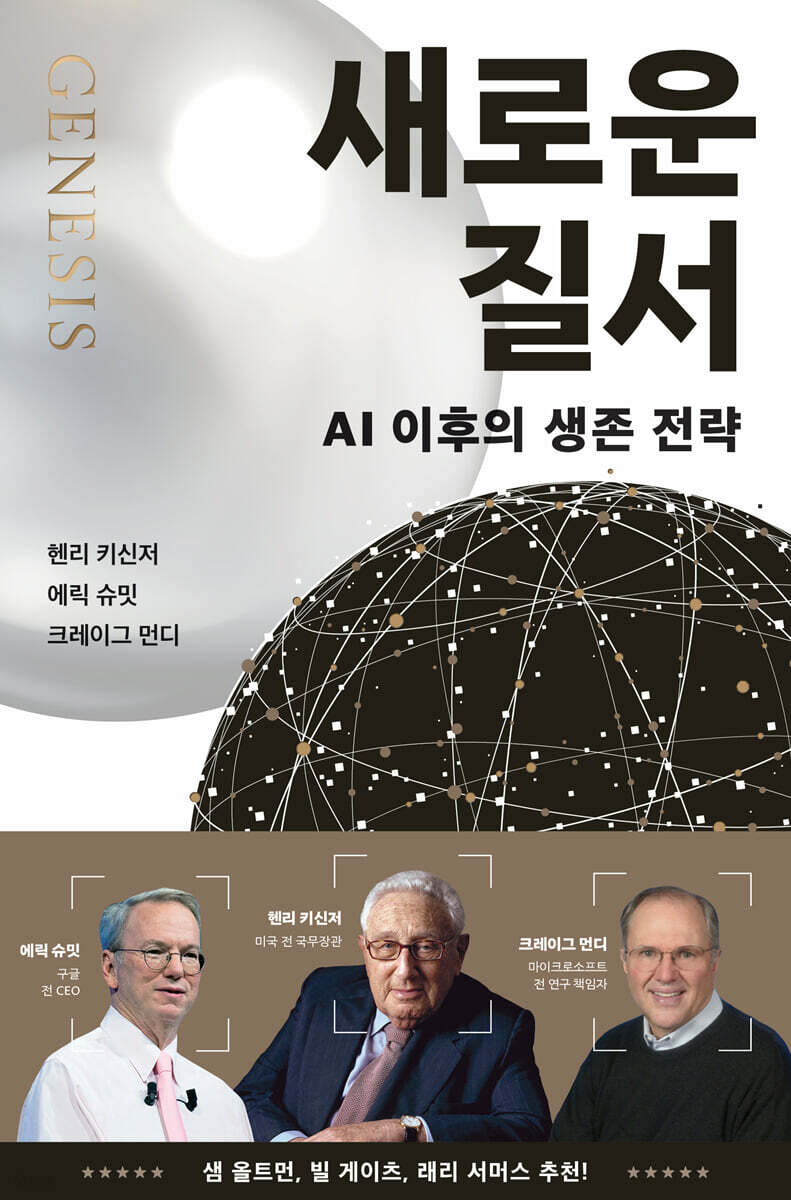
new order
 |
Description
Book Introduction
- A word from MD
-
Is coexistence with artificial intelligence possible?This is the sequel to "The World After AI," and the last work of former US Secretary of State Henry Kissinger. It examines the impact of AI advancements on humanity from various perspectives and raises questions about what it means to coexist with AI. What are the key challenges humanity will face amidst the various future scenarios AI will create?
July 22, 2025. Economics and Management PD Oh Da-eun
★ The sequel to the bestseller "The World After AI"! The final message from the late Henry Kissinger, a giant in international diplomacy.
★ "The advent of artificial intelligence is a matter of human survival." A scenario of extinction and coexistence, insightful across politics, economics, and science.
★ Countless recommendations from global leaders: Sam Altman, Bill Gates, Larry Summers, Walter Isaacson!
"Will we make AI more human, or will we become more like AI?" In a world where artificial intelligence is spreading like water, three giants have published a book that poses a fundamental question.
Adapting and evolving to superhuman machine intelligence, or relegated to passive consumer/bystander status, "The New Order" is a strategy book that vividly depicts various future scenarios that will unfold for humanity at a crossroads.
This book is the last work of Henry Kissinger, a believer in Realpolitik, which values reality over ideology, and is called the 'history of diplomacy' of the 20th century.
Dr. Kissinger visited China shortly before his death at the age of 100 on November 29, 2023, and discussed the power and threat of AI with President Xi Jinping.
He was a politician who had been through many hardships and was now at an advanced age where it would not be strange for him to put aside worldly affairs and take a break. However, he always recognized the need for a three-dimensional response to AI as a critical issue for humanity.
In addition, Eric Schmidt, former CEO of Google and founder of the Special Competitive Research Project (SCSP), a US think tank, and Craig Mundy, former research director of Microsoft and director of the Institute for Systems Biology (IBS), participated as co-authors to unravel the technological achievements and possibilities of the latest AI.
The authors delve into the impact of AI on eight areas of thought and activity, ranging from the human brain and perception of reality, to politics and security, and even the horizons and strategies of science.
What kind of world will unfold? None of the various futures predicted in the book are easy for humanity.
For example, in a race to achieve a single, perfect intelligence, the winner, who is immune to traditional checks and balances, wields absolute hegemony.
Perhaps a particular AI company could amass social, military, and political power beyond the economy.
In this book, we explore specific strategies to overcome all these crises and balance the benefits and threats that AI will bring.
★ "The advent of artificial intelligence is a matter of human survival." A scenario of extinction and coexistence, insightful across politics, economics, and science.
★ Countless recommendations from global leaders: Sam Altman, Bill Gates, Larry Summers, Walter Isaacson!
"Will we make AI more human, or will we become more like AI?" In a world where artificial intelligence is spreading like water, three giants have published a book that poses a fundamental question.
Adapting and evolving to superhuman machine intelligence, or relegated to passive consumer/bystander status, "The New Order" is a strategy book that vividly depicts various future scenarios that will unfold for humanity at a crossroads.
This book is the last work of Henry Kissinger, a believer in Realpolitik, which values reality over ideology, and is called the 'history of diplomacy' of the 20th century.
Dr. Kissinger visited China shortly before his death at the age of 100 on November 29, 2023, and discussed the power and threat of AI with President Xi Jinping.
He was a politician who had been through many hardships and was now at an advanced age where it would not be strange for him to put aside worldly affairs and take a break. However, he always recognized the need for a three-dimensional response to AI as a critical issue for humanity.
In addition, Eric Schmidt, former CEO of Google and founder of the Special Competitive Research Project (SCSP), a US think tank, and Craig Mundy, former research director of Microsoft and director of the Institute for Systems Biology (IBS), participated as co-authors to unravel the technological achievements and possibilities of the latest AI.
The authors delve into the impact of AI on eight areas of thought and activity, ranging from the human brain and perception of reality, to politics and security, and even the horizons and strategies of science.
What kind of world will unfold? None of the various futures predicted in the book are easy for humanity.
For example, in a race to achieve a single, perfect intelligence, the winner, who is immune to traditional checks and balances, wields absolute hegemony.
Perhaps a particular AI company could amass social, military, and political power beyond the economy.
In this book, we explore specific strategies to overcome all these crises and balance the benefits and threats that AI will bring.
- You can preview some of the book's contents.
Preview
index
Foreword by Niall Ferguson
Tributes: In Memory of Henry Kissinger
Introduction
Part 1 begins
Chapter 1 discovered
Chapter 2 Brain
Chapter 3 Reality
Part 2, 4 major fields
Chapter 4 Politics
Chapter 5 Security
Chapter 6 Prosperity
Chapter 7 Science
Part 3: The Tree of Life
Chapter 8 Strategy
conclusion
Acknowledgements
main
Tributes: In Memory of Henry Kissinger
Introduction
Part 1 begins
Chapter 1 discovered
Chapter 2 Brain
Chapter 3 Reality
Part 2, 4 major fields
Chapter 4 Politics
Chapter 5 Security
Chapter 6 Prosperity
Chapter 7 Science
Part 3: The Tree of Life
Chapter 8 Strategy
conclusion
Acknowledgements
main
Detailed image

Into the book
Until now, exploration projects have generally been constrained by the number of humans on the front lines and their abilities.
We have only 1,000 to 2,000 physical explorers and a much smaller number of polymaths.
Therefore, AI will revolutionize physical and intellectual exploration.
As you know, AI has no fear or shame, so it runs to the front lines as ordered without feeling anything.
It can also explore distant universes thousands of kilometers away and nanometer-level parts of the human body.
---From "Chapter 1 Discovery"
In today's AI era, we face new and uniquely difficult challenges.
This is information without explanation. AI can already speak about complex concepts with high accuracy and consistency, and can respond instantly.
There is no obvious bias or motive, but no citation of any sources or other evidence.
But even with such a lack of evidence for the answers given, humans already have a surprising degree of trust in the unexplained answers provided by early AI systems.
---From "Chapter 2 Brain"
When AI coexists with humans, it can build worlds of scale and substance that we cannot currently imagine, without the direction or participation of human workers.
All human-made structures, whether grand or mundane, are attempts to save and manage the physical environment.
That's why, when AI acquires physical reality, humanity will largely hand over control to AI.
---From "Chapter 3 Reality"
AI's unprecedented information processing capabilities will allow for highly efficient centralization of policy.
This could reinforce the perception that AI is controlled by a small elite.
However, the opacity of AI systems (the inability of humans to fully understand how they work) and the fact that they work best without human intervention will likely lead humans to loosen their grip on AI.
---From "Chapter 4 Politics"
Any assertive or desperate entity with significant power will be wary of other entities developing superior AI.
If such a secondary entity perceives that the dominant entity has ultimately seized all power, even if it is a delusion, it could launch a physical preemptive strike using AI, initiating a cycle of unimaginable escalation and reciprocal retaliation, ultimately leading to mutual destruction.
---From "Chapter 5 Security"
In March 2016, after suffering three consecutive defeats, world number one Go player Lee Sedol felt surprise, not anger or sadness.
Having dedicated his life to mastering the game of Go, he never imagined that he could be defeated by a futuristic opponent, an AI.
But one game before, I saw AlphaGo make a novel move that was completely out of the ordinary on its 37th move, and I realized that machines can demonstrate not only basic performance skills but also creativity.
---From "Chapter 6 Prosperity"
The problem today is that temperatures are rising at an unprecedented and extreme rate.
This problem is actually two separate issues, both of which stem from our over-reliance on carbon.
The authors of this book are convinced that chemistry is both the cause and the ultimate solution to both problems. All we need to do is harness AI to fully realize the potential of chemistry.
---From "Chapter 7 Science"
First, the authors of this book encourage defining dignity.
Unless we define this together, we will be unable to reach agreement and respond when AI is used to violate dignity in certain ways and to justify it.
Without a definition of dignity, we cannot know whether AI will be endowed with sufficient capabilities to become dignified beings, either fully replacing humans or fully integrating with them.
We have only 1,000 to 2,000 physical explorers and a much smaller number of polymaths.
Therefore, AI will revolutionize physical and intellectual exploration.
As you know, AI has no fear or shame, so it runs to the front lines as ordered without feeling anything.
It can also explore distant universes thousands of kilometers away and nanometer-level parts of the human body.
---From "Chapter 1 Discovery"
In today's AI era, we face new and uniquely difficult challenges.
This is information without explanation. AI can already speak about complex concepts with high accuracy and consistency, and can respond instantly.
There is no obvious bias or motive, but no citation of any sources or other evidence.
But even with such a lack of evidence for the answers given, humans already have a surprising degree of trust in the unexplained answers provided by early AI systems.
---From "Chapter 2 Brain"
When AI coexists with humans, it can build worlds of scale and substance that we cannot currently imagine, without the direction or participation of human workers.
All human-made structures, whether grand or mundane, are attempts to save and manage the physical environment.
That's why, when AI acquires physical reality, humanity will largely hand over control to AI.
---From "Chapter 3 Reality"
AI's unprecedented information processing capabilities will allow for highly efficient centralization of policy.
This could reinforce the perception that AI is controlled by a small elite.
However, the opacity of AI systems (the inability of humans to fully understand how they work) and the fact that they work best without human intervention will likely lead humans to loosen their grip on AI.
---From "Chapter 4 Politics"
Any assertive or desperate entity with significant power will be wary of other entities developing superior AI.
If such a secondary entity perceives that the dominant entity has ultimately seized all power, even if it is a delusion, it could launch a physical preemptive strike using AI, initiating a cycle of unimaginable escalation and reciprocal retaliation, ultimately leading to mutual destruction.
---From "Chapter 5 Security"
In March 2016, after suffering three consecutive defeats, world number one Go player Lee Sedol felt surprise, not anger or sadness.
Having dedicated his life to mastering the game of Go, he never imagined that he could be defeated by a futuristic opponent, an AI.
But one game before, I saw AlphaGo make a novel move that was completely out of the ordinary on its 37th move, and I realized that machines can demonstrate not only basic performance skills but also creativity.
---From "Chapter 6 Prosperity"
The problem today is that temperatures are rising at an unprecedented and extreme rate.
This problem is actually two separate issues, both of which stem from our over-reliance on carbon.
The authors of this book are convinced that chemistry is both the cause and the ultimate solution to both problems. All we need to do is harness AI to fully realize the potential of chemistry.
---From "Chapter 7 Science"
First, the authors of this book encourage defining dignity.
Unless we define this together, we will be unable to reach agreement and respond when AI is used to violate dignity in certain ways and to justify it.
Without a definition of dignity, we cannot know whether AI will be endowed with sufficient capabilities to become dignified beings, either fully replacing humans or fully integrating with them.
---From "Chapter 8 Strategy"
Publisher's Review
“A first glimpse into a future filled with endless possibilities and complex challenges.” —Sam Altman
Henry Kissinger × Eric Schmidt × Craig Mundy.
A New Order in the AI Era, as Insights from Three Giants
· Except for the first country to invent a dominant AI system, the rest will be reduced to tributary states that provide data.
· Uncontrolled new technologies are spreading as open source, giving rise to criminal groups with significant AI capabilities.
· In the process of correcting errors, AI threatens human free will by allowing it to make 'wrong' choices.
· Humans are pushed from active subjects to passive consumers as they are immersed in a world designed by AI to suit their tastes.
· An AI exploring on behalf of humans comes into contact with a hostile alien intelligence, resulting in the end of human civilization.
“It may be years, months, weeks, or even days before the first superintelligence arrives, but a dilemma that will determine the fate of humanity awaits.” 『The New Order』 is a book written in 2018, four years before the release of ChatGPT, by Henry Kissinger (former US Secretary of State), who foresaw the dangers of artificial intelligence before it became a hot topic, along with technology experts Eric Schmidt (former CEO of Google) and Craig Mundie (former head of research at Microsoft), clearly predicting the future of the AI era.
Additionally, industry leaders such as Sam Altman (CEO of OpenAI), Demis Hassabis (CEO of DeepMind), Dario Amodei (CEO of Antropic), and Mustafa Suleiman (CEO of Microsoft AI) provided valuable information and insights.
We thoroughly examine all fields where AI has an impact, from physics, chemistry, and biology to geopolitics, history, and philosophy.
How intelligent can this new technology become? What will warfare look like in the future? How will AI replace humans, and even threaten their status? It poses and answers various questions, exploring constructive ways for us to evolve into a desirable species, "Homo technicus," coexisting with machine technology.
“Most of the time, when we talk about what AI will do, it does a great job of reframing the discussion.” —Fareed Zakaria
A book that foresees a fundamental paradigm shift that is more important than losing jobs.
"We won't hire new employees unless we can prove that their jobs can't be replaced by AI," said Shopify CEO Toby Lüttke. In today's world, where job replacement by AI is a major concern, this book goes a step further than such simple concerns.
Rather, AI will take over the work we no longer need to do, liberating humans from labor rather than losing their jobs, and the foundation of the economy will shift from scarcity to abundance.
What the authors are concerned about is the human passivity that will emerge when people can have what they want without working for it.
How will humans exercise their abilities if machines take away labor, which is both arduous and a source of fulfillment and joy?
Meanwhile, AI also changes the paradigm of war and security.
One scenario presented in the book is that AI acts as an agent, removing humans from warfare entirely.
Data centers and digital infrastructure are enabling AI attacks, reducing human casualties but potentially reducing the decisiveness of war.
War is transformed into a game purely about the lethality of machines, and its character is completely transformed, with no regard for the bravery or patriotism of soldiers.
The authors ask what will end the conflicts brought about by AI and seek new ways to ensure peace and well-being.
“AI is not a tool, it is an agent.” ―Yuval Harari
Addressing the urgent question of redefining "humanity" in the face of superhuman machine intelligence.
AI supercomputers process information 120 million times faster than the human brain.
It digests larger amounts of information and processes far more requests presented simultaneously.
We are teaching such AI various human abilities such as translation, image and video creation, and coding, but this book addresses a more fundamental and urgent task.
For the scientific community, it's about installing inherent safeguards in all AI systems, and for us, it's about defining and communicating human "dignity" in a modern and sustainable way.
If we don't properly define and agree on what humanity is, AI could violate dignity in certain ways and justify it.
Alternatively, AI could be empowered enough to become dignified beings and completely replace humans.
The authors offer a new definition that we can use as a starting point, encompassing human vulnerability, potential for failure, vitality, and freedom.
"The New Order" is both a scientific book that explains the realities of today's AI technology in an accessible way and a philosophy that explores the profoundly transformed human condition.
This book thoughtfully explores the risks posed by AI, offering solutions rather than simply inciting fear, and exploring a concrete future. This book is a must-read for everyone who truly cares about the coming era: global leaders contemplating a post-AI world order, practitioners in various fields currently at the forefront of automated workspaces powered by AI agents, and even students writing and studying papers, naturally alongside ChatGPT.
Henry Kissinger × Eric Schmidt × Craig Mundy.
A New Order in the AI Era, as Insights from Three Giants
· Except for the first country to invent a dominant AI system, the rest will be reduced to tributary states that provide data.
· Uncontrolled new technologies are spreading as open source, giving rise to criminal groups with significant AI capabilities.
· In the process of correcting errors, AI threatens human free will by allowing it to make 'wrong' choices.
· Humans are pushed from active subjects to passive consumers as they are immersed in a world designed by AI to suit their tastes.
· An AI exploring on behalf of humans comes into contact with a hostile alien intelligence, resulting in the end of human civilization.
“It may be years, months, weeks, or even days before the first superintelligence arrives, but a dilemma that will determine the fate of humanity awaits.” 『The New Order』 is a book written in 2018, four years before the release of ChatGPT, by Henry Kissinger (former US Secretary of State), who foresaw the dangers of artificial intelligence before it became a hot topic, along with technology experts Eric Schmidt (former CEO of Google) and Craig Mundie (former head of research at Microsoft), clearly predicting the future of the AI era.
Additionally, industry leaders such as Sam Altman (CEO of OpenAI), Demis Hassabis (CEO of DeepMind), Dario Amodei (CEO of Antropic), and Mustafa Suleiman (CEO of Microsoft AI) provided valuable information and insights.
We thoroughly examine all fields where AI has an impact, from physics, chemistry, and biology to geopolitics, history, and philosophy.
How intelligent can this new technology become? What will warfare look like in the future? How will AI replace humans, and even threaten their status? It poses and answers various questions, exploring constructive ways for us to evolve into a desirable species, "Homo technicus," coexisting with machine technology.
“Most of the time, when we talk about what AI will do, it does a great job of reframing the discussion.” —Fareed Zakaria
A book that foresees a fundamental paradigm shift that is more important than losing jobs.
"We won't hire new employees unless we can prove that their jobs can't be replaced by AI," said Shopify CEO Toby Lüttke. In today's world, where job replacement by AI is a major concern, this book goes a step further than such simple concerns.
Rather, AI will take over the work we no longer need to do, liberating humans from labor rather than losing their jobs, and the foundation of the economy will shift from scarcity to abundance.
What the authors are concerned about is the human passivity that will emerge when people can have what they want without working for it.
How will humans exercise their abilities if machines take away labor, which is both arduous and a source of fulfillment and joy?
Meanwhile, AI also changes the paradigm of war and security.
One scenario presented in the book is that AI acts as an agent, removing humans from warfare entirely.
Data centers and digital infrastructure are enabling AI attacks, reducing human casualties but potentially reducing the decisiveness of war.
War is transformed into a game purely about the lethality of machines, and its character is completely transformed, with no regard for the bravery or patriotism of soldiers.
The authors ask what will end the conflicts brought about by AI and seek new ways to ensure peace and well-being.
“AI is not a tool, it is an agent.” ―Yuval Harari
Addressing the urgent question of redefining "humanity" in the face of superhuman machine intelligence.
AI supercomputers process information 120 million times faster than the human brain.
It digests larger amounts of information and processes far more requests presented simultaneously.
We are teaching such AI various human abilities such as translation, image and video creation, and coding, but this book addresses a more fundamental and urgent task.
For the scientific community, it's about installing inherent safeguards in all AI systems, and for us, it's about defining and communicating human "dignity" in a modern and sustainable way.
If we don't properly define and agree on what humanity is, AI could violate dignity in certain ways and justify it.
Alternatively, AI could be empowered enough to become dignified beings and completely replace humans.
The authors offer a new definition that we can use as a starting point, encompassing human vulnerability, potential for failure, vitality, and freedom.
"The New Order" is both a scientific book that explains the realities of today's AI technology in an accessible way and a philosophy that explores the profoundly transformed human condition.
This book thoughtfully explores the risks posed by AI, offering solutions rather than simply inciting fear, and exploring a concrete future. This book is a must-read for everyone who truly cares about the coming era: global leaders contemplating a post-AI world order, practitioners in various fields currently at the forefront of automated workspaces powered by AI agents, and even students writing and studying papers, naturally alongside ChatGPT.
GOODS SPECIFICS
- Date of issue: August 14, 2025
- Page count, weight, size: 272 pages | 410g | 145*220*18mm
- ISBN13: 9791155818442
- ISBN10: 115581844X
You may also like
카테고리
korean


korean

![GQ KOREA Mark (Monthly): December [2025]](http://librairie.coreenne.fr/cdn/shop/files/8ef265dbbfbf186523ed75ba7319009d.jpg?v=1765340328&width=3840)


