

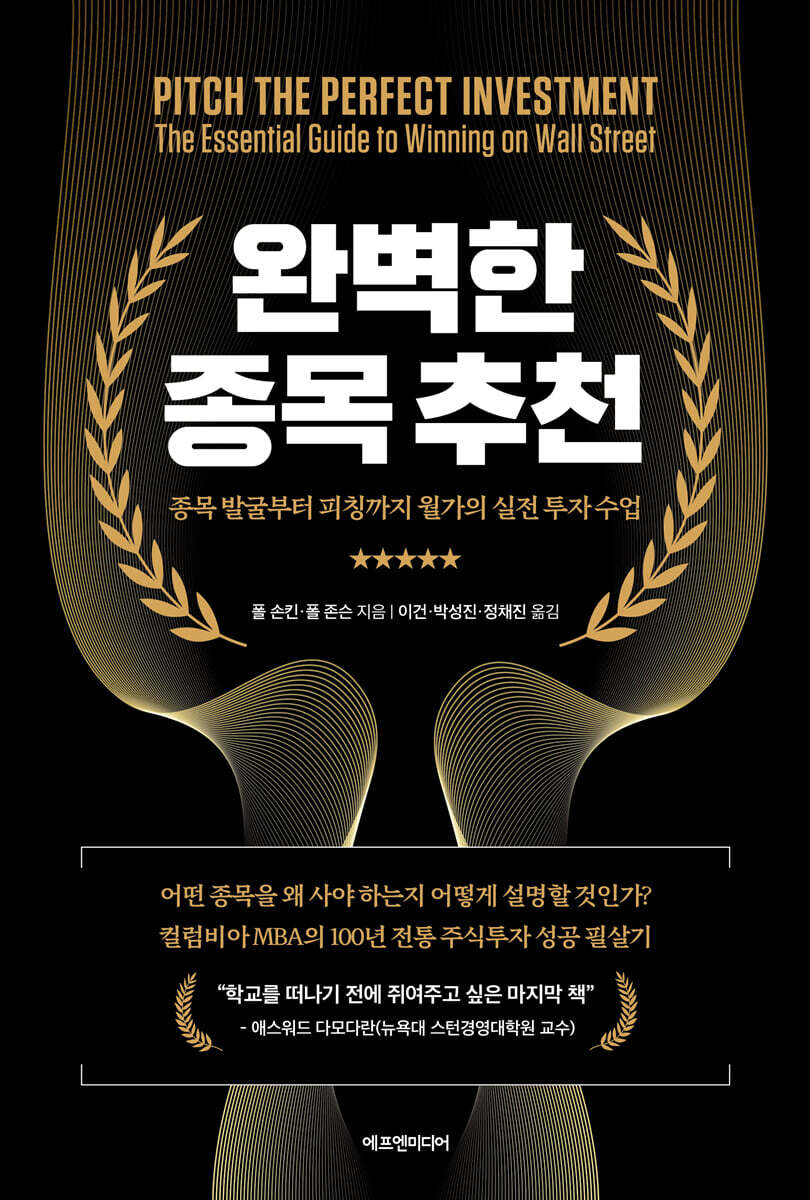
Perfect stock recommendation
 |
Description
Book Introduction
How do you convince someone why they should buy a certain stock?
Columbia MBA: 100 Years of Stock Investment Success Strategies
Stock investing begins with the question, "What stocks should I buy?"
This book provides an easy and systematic way to identify investment opportunities through valuation, competitive advantage analysis, and more.
Furthermore, it delves into how to structure and persuade investment ideas adopted in this process.
The two authors are professors of "Security Analysis" at Columbia Business School, which Warren Buffett called "the greatest investment class ever taught," and are current Wall Street investors.
Although this book was written to help students advance to Wall Street achieve success, it is also considered a "stock market survival guide" that provides valuable lessons to beginner investors.
Part 1, 'Perfect Stock Analysis', is about discovering good investment opportunities.
Calculate the intrinsic value of a stock, determine if there is a price error, and identify catalysts that will close the gap between value and price.
Part 2, "Perfect Stock Recommendations," covers the techniques analysts use to effectively persuade fund managers of investment ideas, fostering the insight and expressive power necessary for practical investing.
Professor Damodaran of New York University's Stern School of Business selected it as "the last book I want to give my students before they leave school," and Professor Seo Jun-sik of Soongsil University's Department of Economics introduced it as "a book that turns investment theory in the classroom into 'money-making skills.'"
It also received favorable reviews from authorities in academia and the investment community, such as “A book that teaches effective methods of persuading investors of investment ideas that will make you feel like your true intentions have been revealed as a fund manager” (Choi Jun-cheol, CEO of VIP Asset Management) and “A rare and valuable book that deals with the final gateway to market participation, which is idea communication” (Hong Jin-chae, CEO of Raccoon Asset Management).
Columbia MBA: 100 Years of Stock Investment Success Strategies
Stock investing begins with the question, "What stocks should I buy?"
This book provides an easy and systematic way to identify investment opportunities through valuation, competitive advantage analysis, and more.
Furthermore, it delves into how to structure and persuade investment ideas adopted in this process.
The two authors are professors of "Security Analysis" at Columbia Business School, which Warren Buffett called "the greatest investment class ever taught," and are current Wall Street investors.
Although this book was written to help students advance to Wall Street achieve success, it is also considered a "stock market survival guide" that provides valuable lessons to beginner investors.
Part 1, 'Perfect Stock Analysis', is about discovering good investment opportunities.
Calculate the intrinsic value of a stock, determine if there is a price error, and identify catalysts that will close the gap between value and price.
Part 2, "Perfect Stock Recommendations," covers the techniques analysts use to effectively persuade fund managers of investment ideas, fostering the insight and expressive power necessary for practical investing.
Professor Damodaran of New York University's Stern School of Business selected it as "the last book I want to give my students before they leave school," and Professor Seo Jun-sik of Soongsil University's Department of Economics introduced it as "a book that turns investment theory in the classroom into 'money-making skills.'"
It also received favorable reviews from authorities in academia and the investment community, such as “A book that teaches effective methods of persuading investors of investment ideas that will make you feel like your true intentions have been revealed as a fund manager” (Choi Jun-cheol, CEO of VIP Asset Management) and “A rare and valuable book that deals with the final gateway to market participation, which is idea communication” (Hong Jin-chae, CEO of Raccoon Asset Management).
- You can preview some of the book's contents.
Preview
index
Recommendation: The Secrets of a Successful Analyst Revealed _ Jiho Yoon
Translator's Note: The Core Ideas of Value Investing Passed Down by Graham's Descendants _ Lee Geon, Park Sung-jin, and Jeong Chae-jin
Introduction: Stock Analysis, Stock Recommendations, and the Secret to Success on Wall Street
Part 1.
Complete stock analysis
Chapter 1.
Valuation of assets and businesses
Three Key Elements of Asset Value | How to Define Cash Flow | Calculating Present Value Using DCF | Predicting the Future Isn't Easy | How to Calculate the Present Value of a Business | The Two-Step DCF Model: Calculating the Present Value of Growing Cash Flows | What is a Discount Rate?
Chapter 2.
Valuing Competitive Advantage and Growth
Cash Flow from Asset Sales | Cash Flow from Asset Operations | The Impact of Competitive Advantage on Business Valuation | The Impact of Growth on Business Valuation | Real-World Business Analysis: The Value of Competitive Advantage and Growth
Chapter 3.
Intrinsic value of securities
What is Intrinsic Value? | Thinking of Intrinsic Value as a Range of Values
Chapter 4.
A perspective on market efficiency
Market efficiency is a concept, not a law | Alpha creation is a zero-sum game | The definition of an efficient market | Conditions for an efficient market | Cases where the conditions of the efficient market hypothesis are perfectly satisfied | The mechanism by which the conditions of an efficient market are met
Chapter 5.
A perspective on the wisdom of the crowd
Guess the Oscar winner | The wisdom of crowds is the key to efficient markets | The process by which the wisdom of crowds satisfies the conditions of an efficient market | Condition 1: Information dissemination | Condition 2: Information processing | Condition 3: Reflection | Case study: The process by which the wisdom of crowds satisfies the conditions of an efficient market | Applying the wisdom of crowds to the stock market | In most situations, the crowd is wiser than experts | Bias can deceive the crowd
Chapter 6.
A Perspective on Behavioral Finance
The Fickle Mr. Market | When Crowd Wisdom Turns into Crowd Madness | Is Crowd Madness Irrational? | Are Fama and Shiller Both Right? | The Efficient Market Hypothesis and the Magnet | The Limits of Reflection: When Crowds Can't Act | The Efficient Market Hypothesis Still 'Ranks' | Why Care About Efficient Markets?
Chapter 7.
Effective research
Information Advantage | Analytical Advantage | Information Advantage + Analytical Advantage | Transactional Advantage | Catalyst
Chapter 8.
Risk Assessment
The Difference Between Uncertainty and Risk | Pricing Errors Occur When Uncertainty and Risk Are Confusing | When Uncertainty and Risk Are Confusing in the Wisdom of Crowds Analysis Framework | When Uncertainty Turns into Risk | Margin of Safety is About Risk | More Certain Businesses Can Be Riskier | Time is Crucial in Investing | The Impact of Improving the Accuracy and Precision of Intrinsic Value Estimates on Risk | The Impact of Improving the Accuracy and Precision of Investment Period Forecasts on Risk | Risk and Different Thinking: Making the Intrinsic Value Distribution Beneficial to Investors | Underperformance Risk
Part 2.
Perfect stock recommendation
Chapter 9.
Two criteria for selecting good stocks
A Fund Manager's Schema: A Critical Criteria | Checking Fund Managers' Fundamental Criteria | What Could Be Wrong? | Checking Fund Managers' Valuation Criteria | Obstacles to Idea Acceptance | How to Overcome Obstacles by Reading Fund Managers' Minds | Other Communication Considerations
Chapter 10.
Composing an attention-grabbing message
How to Grab a Fund Manager's Attention | Building a Case Using the Toulmin Model | Building a Strong Case
Chapter 11.
Capture attention in 30 seconds and persuade in 2 minutes.
30-Second Attention Grabber | 2-Minute Persuasion | Make Your Job Easy | Keep Your Slides Simple | Avoid Being Exploited in Q&A | Stock Recommendation Contest | Delivering Your Message: You Are the Envelope | The Structure of an Interview | Other Barriers to Communication | How to Stand on the Stage at Carnegie Hall
annotation
Translator's Note: The Core Ideas of Value Investing Passed Down by Graham's Descendants _ Lee Geon, Park Sung-jin, and Jeong Chae-jin
Introduction: Stock Analysis, Stock Recommendations, and the Secret to Success on Wall Street
Part 1.
Complete stock analysis
Chapter 1.
Valuation of assets and businesses
Three Key Elements of Asset Value | How to Define Cash Flow | Calculating Present Value Using DCF | Predicting the Future Isn't Easy | How to Calculate the Present Value of a Business | The Two-Step DCF Model: Calculating the Present Value of Growing Cash Flows | What is a Discount Rate?
Chapter 2.
Valuing Competitive Advantage and Growth
Cash Flow from Asset Sales | Cash Flow from Asset Operations | The Impact of Competitive Advantage on Business Valuation | The Impact of Growth on Business Valuation | Real-World Business Analysis: The Value of Competitive Advantage and Growth
Chapter 3.
Intrinsic value of securities
What is Intrinsic Value? | Thinking of Intrinsic Value as a Range of Values
Chapter 4.
A perspective on market efficiency
Market efficiency is a concept, not a law | Alpha creation is a zero-sum game | The definition of an efficient market | Conditions for an efficient market | Cases where the conditions of the efficient market hypothesis are perfectly satisfied | The mechanism by which the conditions of an efficient market are met
Chapter 5.
A perspective on the wisdom of the crowd
Guess the Oscar winner | The wisdom of crowds is the key to efficient markets | The process by which the wisdom of crowds satisfies the conditions of an efficient market | Condition 1: Information dissemination | Condition 2: Information processing | Condition 3: Reflection | Case study: The process by which the wisdom of crowds satisfies the conditions of an efficient market | Applying the wisdom of crowds to the stock market | In most situations, the crowd is wiser than experts | Bias can deceive the crowd
Chapter 6.
A Perspective on Behavioral Finance
The Fickle Mr. Market | When Crowd Wisdom Turns into Crowd Madness | Is Crowd Madness Irrational? | Are Fama and Shiller Both Right? | The Efficient Market Hypothesis and the Magnet | The Limits of Reflection: When Crowds Can't Act | The Efficient Market Hypothesis Still 'Ranks' | Why Care About Efficient Markets?
Chapter 7.
Effective research
Information Advantage | Analytical Advantage | Information Advantage + Analytical Advantage | Transactional Advantage | Catalyst
Chapter 8.
Risk Assessment
The Difference Between Uncertainty and Risk | Pricing Errors Occur When Uncertainty and Risk Are Confusing | When Uncertainty and Risk Are Confusing in the Wisdom of Crowds Analysis Framework | When Uncertainty Turns into Risk | Margin of Safety is About Risk | More Certain Businesses Can Be Riskier | Time is Crucial in Investing | The Impact of Improving the Accuracy and Precision of Intrinsic Value Estimates on Risk | The Impact of Improving the Accuracy and Precision of Investment Period Forecasts on Risk | Risk and Different Thinking: Making the Intrinsic Value Distribution Beneficial to Investors | Underperformance Risk
Part 2.
Perfect stock recommendation
Chapter 9.
Two criteria for selecting good stocks
A Fund Manager's Schema: A Critical Criteria | Checking Fund Managers' Fundamental Criteria | What Could Be Wrong? | Checking Fund Managers' Valuation Criteria | Obstacles to Idea Acceptance | How to Overcome Obstacles by Reading Fund Managers' Minds | Other Communication Considerations
Chapter 10.
Composing an attention-grabbing message
How to Grab a Fund Manager's Attention | Building a Case Using the Toulmin Model | Building a Strong Case
Chapter 11.
Capture attention in 30 seconds and persuade in 2 minutes.
30-Second Attention Grabber | 2-Minute Persuasion | Make Your Job Easy | Keep Your Slides Simple | Avoid Being Exploited in Q&A | Stock Recommendation Contest | Delivering Your Message: You Are the Envelope | The Structure of an Interview | Other Barriers to Communication | How to Stand on the Stage at Carnegie Hall
annotation
Into the book
Sonkin was interested in the process of recommending stocks that lead to the adoption of an investment idea, while Johnson was focused on finding good investment ideas.
It became clear that the two books were like two sides of the same coin, and we came to the conclusion that it would be better to write them together as one book.
That's how this book was born.
---From the "Preface"
The value of an asset can be defined as the discounted value of the cash flows from the asset over its useful life, taking into account the time value of money and the uncertainty of cash receipt.
---「Chapter 1.
From “Valuation of Assets and Businesses”
Not all growth increases value.
When owner profits grow, value increases only if that growth generates excess returns.
And all growth requires additional investment, and the true value can only be determined by deducting the capital costs of the additional capital invested to generate that growth from the additional owner's profits.
---「Chapter 2.
From “Valuing Competitive Advantage and Growth”
Investors dealing with an inherently uncertain future must consider a variety of scenarios when forecasting future cash flows and estimating intrinsic value.
Each scenario will have a different present value estimate, which can be used to map out a range of possible intrinsic values.
---「Chapter 3.
From “Evaluation of the Intrinsic Value of Securities”
The stock market is a fiercely competitive market among highly trained and intelligent investors, and because it is a zero-sum game (actually a negative-sum game), it is extremely difficult to achieve long-term excess returns.
The only way to achieve excess returns is to systematically and repeatedly identify situations where the market is mispricing.
To do that, we need to understand what this situation looks like.
---「Chapter 4.
From “A Perspective on Market Efficiency”
The public correctly chose Clarence as the fake member, even though most respondents (75%) had no knowledge of the Beatles at all.
This case illustrates that the crowd will give the correct answer even if there are not many knowledgeable respondents.
It may be hard to believe, but the public can figure out the answer even if no one has perfect knowledge.
---「Chapter 5.
From “A Perspective on the Wisdom of the Crowd”
Behavioral finance explains why inefficiencies arise by showing how these biases form and how they prevent all available information from being fully reflected in stock prices.
Behavioral finance is not an alternative to the efficient market hypothesis, but rather a part of it.
---「Chapter 6.
From “Perspectives on Behavioral Finance”
At this time, investors can gain an advantage by leveraging their professional analytical skills in research.
It's a different way of thinking than the consensus, combining non-critical, private information with completely disseminated public information in a unique way.
In other words, investors use their information advantage and analytical advantage together to develop unique ideas.
---「Chapter 7.
From “Effective Research”
Many people miss these opportunities because they confuse uncertainty with risk and misjudge stock prices accordingly.
On the other hand, smart investors see this situation as an opportunity because they know that the risks reflected in the consensus are exaggerated compared to reality.
---「Chapter 8.
From “Risk Assessment”
A common mistake novice analysts make is trying to convince fund managers with ideas they like.
This is usually not a good strategy.
Because it's like scratching someone else's leg.
Choosing an idea that the fund manager will like will make it much easier to persuade them.
---「Chapter 9.
Among the two criteria for selecting good stocks,
Once you've successfully captured their attention for 30 seconds, you can then make a two-minute pitch, followed by a deluge of follow-up questions from fund managers for another 5-10 minutes.
In this way, stock recommendations are composed of three main elements: 30 seconds to attract attention, 2 minutes to persuade, and Q&A.
A message composed of these three elements can be conveyed both verbally and in writing.
It became clear that the two books were like two sides of the same coin, and we came to the conclusion that it would be better to write them together as one book.
That's how this book was born.
---From the "Preface"
The value of an asset can be defined as the discounted value of the cash flows from the asset over its useful life, taking into account the time value of money and the uncertainty of cash receipt.
---「Chapter 1.
From “Valuation of Assets and Businesses”
Not all growth increases value.
When owner profits grow, value increases only if that growth generates excess returns.
And all growth requires additional investment, and the true value can only be determined by deducting the capital costs of the additional capital invested to generate that growth from the additional owner's profits.
---「Chapter 2.
From “Valuing Competitive Advantage and Growth”
Investors dealing with an inherently uncertain future must consider a variety of scenarios when forecasting future cash flows and estimating intrinsic value.
Each scenario will have a different present value estimate, which can be used to map out a range of possible intrinsic values.
---「Chapter 3.
From “Evaluation of the Intrinsic Value of Securities”
The stock market is a fiercely competitive market among highly trained and intelligent investors, and because it is a zero-sum game (actually a negative-sum game), it is extremely difficult to achieve long-term excess returns.
The only way to achieve excess returns is to systematically and repeatedly identify situations where the market is mispricing.
To do that, we need to understand what this situation looks like.
---「Chapter 4.
From “A Perspective on Market Efficiency”
The public correctly chose Clarence as the fake member, even though most respondents (75%) had no knowledge of the Beatles at all.
This case illustrates that the crowd will give the correct answer even if there are not many knowledgeable respondents.
It may be hard to believe, but the public can figure out the answer even if no one has perfect knowledge.
---「Chapter 5.
From “A Perspective on the Wisdom of the Crowd”
Behavioral finance explains why inefficiencies arise by showing how these biases form and how they prevent all available information from being fully reflected in stock prices.
Behavioral finance is not an alternative to the efficient market hypothesis, but rather a part of it.
---「Chapter 6.
From “Perspectives on Behavioral Finance”
At this time, investors can gain an advantage by leveraging their professional analytical skills in research.
It's a different way of thinking than the consensus, combining non-critical, private information with completely disseminated public information in a unique way.
In other words, investors use their information advantage and analytical advantage together to develop unique ideas.
---「Chapter 7.
From “Effective Research”
Many people miss these opportunities because they confuse uncertainty with risk and misjudge stock prices accordingly.
On the other hand, smart investors see this situation as an opportunity because they know that the risks reflected in the consensus are exaggerated compared to reality.
---「Chapter 8.
From “Risk Assessment”
A common mistake novice analysts make is trying to convince fund managers with ideas they like.
This is usually not a good strategy.
Because it's like scratching someone else's leg.
Choosing an idea that the fund manager will like will make it much easier to persuade them.
---「Chapter 9.
Among the two criteria for selecting good stocks,
Once you've successfully captured their attention for 30 seconds, you can then make a two-minute pitch, followed by a deluge of follow-up questions from fund managers for another 5-10 minutes.
In this way, stock recommendations are composed of three main elements: 30 seconds to attract attention, 2 minutes to persuade, and Q&A.
A message composed of these three elements can be conveyed both verbally and in writing.
---「Chapter 11.
From "Grab attention in 30 seconds and persuade in 2 minutes"
From "Grab attention in 30 seconds and persuade in 2 minutes"
Publisher's Review
The tradition of value investing lectures started by Benjamin Graham
Columbia MBA: 100 Years of Stock Investment Success Secrets
In 1928, Benjamin Graham, then in his mid-30s, opened a course called "Advanced Security Analysis" at his alma mater, Columbia University.
He taught for 28 years, training thousands of students until he retired from Wall Street in 1956.
The most famous disciple is Warren Buffett.
This lecture, which Buffett selected as the "greatest investment lesson," was passed on to Paul Johnson and Paul Sonkin, the authors of "The Perfect Stock Picks." Paul Johnson has been teaching security analysis and value investing for over 30 years since 1992, and Paul Sonkin has also been teaching value investing for 17 years.
Just as Graham was an accomplished practitioner before becoming a professor, the authors are also practitioners who have long worked as analysts and fund managers on Wall Street, analyzing various companies and managing portfolios.
These two authors, who know better than anyone what it takes to succeed in the investment world, wrote this book to help their students find success on Wall Street.
This book is like a survival guidebook that helps even inexperienced beginner investors survive in an extremely competitive environment.
Discover great investment opportunities with a "big difference between value and price."
Understanding Pricing Errors with the Efficient Market Hypothesis and Behavioral Finance
Part 1, "Perfect Stock Analysis," identifies good investment opportunities where the intrinsic value and stock price differ significantly.
Using a hypothetical lemonade stand business as an example, we demonstrate how to forecast cash flows and calculate intrinsic value in various situations, including monopoly, competitor entry, and additional investment.
The process by which stock prices are formed in the market is examined using the efficient market hypothesis and behavioral finance.
The process of demonstrating the wisdom of the crowd is interesting, such as Francis Galton's bull-weighing contest and finding a person who is not a member of the British rock group Beatles.
However, crowd wisdom can also turn into crowd madness, which can lead to pricing errors.
The authors also emphasize that to produce excellent research results, you need to have what Michael Steinhardt calls "out-of-the-box thinking."
Based on this, we systematically organized methods for identifying catalysts that can bridge the gap between stock prices and intrinsic value, and for assessing the level of risk associated with investments by distinguishing between uncertainty and risk.
30 seconds to grab attention, 2 minutes to persuade, Q&A
"A rare and valuable book that addresses the final hurdle to market participation."
Part 2, "Perfect Stock Recommendations," provides a detailed explanation of the "pitching" process, a topic not covered in other books.
Stock recommendation consists of three parts: stock selection, message content composition, and message delivery.
The importance of recommendations is vividly conveyed through a scene in the famous movie 'Wall Street' where the main character, an analyst, meets successful fund manager Gordon Gekko and recommends stocks.
Part 2 is written with analysts pitching to fund managers in mind, but it's relevant to all investors.
To become a successful investor, you need to connect with other great investors and attend investment meetings, because that's how you prove yourself as a great investor.
At this time, the ability to present the subject is essential.
Choi Jun-cheol, CEO of VIP Asset Management, praised the book, saying, “This book teaches effective methods of persuading investors to come up with investment ideas, to the point where I feel like my true intentions have been exposed as a fund manager.” Hong Jin-chae, CEO of Raccoon Asset Management, praised the book, saying, “This is a rare and valuable book that addresses the final gateway to market participation, which is idea delivery.”
Ji-ho Yoon, former head of LS Securities Research Center, who wrote the recommendation, said that he received great help from secretly reading the application while working at the research center, and introduced it as “a secret investment secret that I wanted to keep hidden.”
This is why three authorities, Park Sung-jin and Jeong Chae-jin, co-translated the book.
"A book that turns classroom investment theory into a money-making technique."
Why did investment expert translator Lee Geon, CEO and CIO of Ian Investment Consulting Park Sung-jin, and professional investor Jeong Chae-jin choose this book, six years after co-translating "Michael Mauboussin: The Success Equation of Luck and Skill" in 2019? Having listened to numerous investors' stock presentations and witnessed their successes and failures, they realized that stock analysis and stock presentations reinforce each other.
Professor Asward Damodaran of New York University's Stern School of Business selected it as "the last book I want to give my students before they leave school," and Professor Seo Jun-sik of Soongsil University's Department of Economics introduced it as "a book that turns investment theory in the classroom into 'money-making skills.'"
Other recommendations followed: “After reading this book, I feel more confident that I can more systematically create a one-page summary of the stocks I plan to invest in” (Sookhyang), and “I hope that by reading it over and over again, I can catch both a competent analyst and a fund manager” (Kim Cheolgwang).
Analysts, money managers, bankers, executives, marketers, students, and individual investors alike will find that by leveraging the soft skills presented in this book, they can achieve significant results not only in stock investing but also in real-life situations requiring persuasion and presentation skills.
Columbia MBA: 100 Years of Stock Investment Success Secrets
In 1928, Benjamin Graham, then in his mid-30s, opened a course called "Advanced Security Analysis" at his alma mater, Columbia University.
He taught for 28 years, training thousands of students until he retired from Wall Street in 1956.
The most famous disciple is Warren Buffett.
This lecture, which Buffett selected as the "greatest investment lesson," was passed on to Paul Johnson and Paul Sonkin, the authors of "The Perfect Stock Picks." Paul Johnson has been teaching security analysis and value investing for over 30 years since 1992, and Paul Sonkin has also been teaching value investing for 17 years.
Just as Graham was an accomplished practitioner before becoming a professor, the authors are also practitioners who have long worked as analysts and fund managers on Wall Street, analyzing various companies and managing portfolios.
These two authors, who know better than anyone what it takes to succeed in the investment world, wrote this book to help their students find success on Wall Street.
This book is like a survival guidebook that helps even inexperienced beginner investors survive in an extremely competitive environment.
Discover great investment opportunities with a "big difference between value and price."
Understanding Pricing Errors with the Efficient Market Hypothesis and Behavioral Finance
Part 1, "Perfect Stock Analysis," identifies good investment opportunities where the intrinsic value and stock price differ significantly.
Using a hypothetical lemonade stand business as an example, we demonstrate how to forecast cash flows and calculate intrinsic value in various situations, including monopoly, competitor entry, and additional investment.
The process by which stock prices are formed in the market is examined using the efficient market hypothesis and behavioral finance.
The process of demonstrating the wisdom of the crowd is interesting, such as Francis Galton's bull-weighing contest and finding a person who is not a member of the British rock group Beatles.
However, crowd wisdom can also turn into crowd madness, which can lead to pricing errors.
The authors also emphasize that to produce excellent research results, you need to have what Michael Steinhardt calls "out-of-the-box thinking."
Based on this, we systematically organized methods for identifying catalysts that can bridge the gap between stock prices and intrinsic value, and for assessing the level of risk associated with investments by distinguishing between uncertainty and risk.
30 seconds to grab attention, 2 minutes to persuade, Q&A
"A rare and valuable book that addresses the final hurdle to market participation."
Part 2, "Perfect Stock Recommendations," provides a detailed explanation of the "pitching" process, a topic not covered in other books.
Stock recommendation consists of three parts: stock selection, message content composition, and message delivery.
The importance of recommendations is vividly conveyed through a scene in the famous movie 'Wall Street' where the main character, an analyst, meets successful fund manager Gordon Gekko and recommends stocks.
Part 2 is written with analysts pitching to fund managers in mind, but it's relevant to all investors.
To become a successful investor, you need to connect with other great investors and attend investment meetings, because that's how you prove yourself as a great investor.
At this time, the ability to present the subject is essential.
Choi Jun-cheol, CEO of VIP Asset Management, praised the book, saying, “This book teaches effective methods of persuading investors to come up with investment ideas, to the point where I feel like my true intentions have been exposed as a fund manager.” Hong Jin-chae, CEO of Raccoon Asset Management, praised the book, saying, “This is a rare and valuable book that addresses the final gateway to market participation, which is idea delivery.”
Ji-ho Yoon, former head of LS Securities Research Center, who wrote the recommendation, said that he received great help from secretly reading the application while working at the research center, and introduced it as “a secret investment secret that I wanted to keep hidden.”
This is why three authorities, Park Sung-jin and Jeong Chae-jin, co-translated the book.
"A book that turns classroom investment theory into a money-making technique."
Why did investment expert translator Lee Geon, CEO and CIO of Ian Investment Consulting Park Sung-jin, and professional investor Jeong Chae-jin choose this book, six years after co-translating "Michael Mauboussin: The Success Equation of Luck and Skill" in 2019? Having listened to numerous investors' stock presentations and witnessed their successes and failures, they realized that stock analysis and stock presentations reinforce each other.
Professor Asward Damodaran of New York University's Stern School of Business selected it as "the last book I want to give my students before they leave school," and Professor Seo Jun-sik of Soongsil University's Department of Economics introduced it as "a book that turns investment theory in the classroom into 'money-making skills.'"
Other recommendations followed: “After reading this book, I feel more confident that I can more systematically create a one-page summary of the stocks I plan to invest in” (Sookhyang), and “I hope that by reading it over and over again, I can catch both a competent analyst and a fund manager” (Kim Cheolgwang).
Analysts, money managers, bankers, executives, marketers, students, and individual investors alike will find that by leveraging the soft skills presented in this book, they can achieve significant results not only in stock investing but also in real-life situations requiring persuasion and presentation skills.
GOODS SPECIFICS
- Date of issue: June 2, 2025
- Page count, weight, size: 496 pages | 850g | 154*225*31mm
- ISBN13: 9791194322092
- ISBN10: 1194322093
You may also like
카테고리
korean


korean

![GQ KOREA Mark (Monthly): December [2025]](http://librairie.coreenne.fr/cdn/shop/files/8ef265dbbfbf186523ed75ba7319009d.jpg?v=1765340328&width=3840)


