

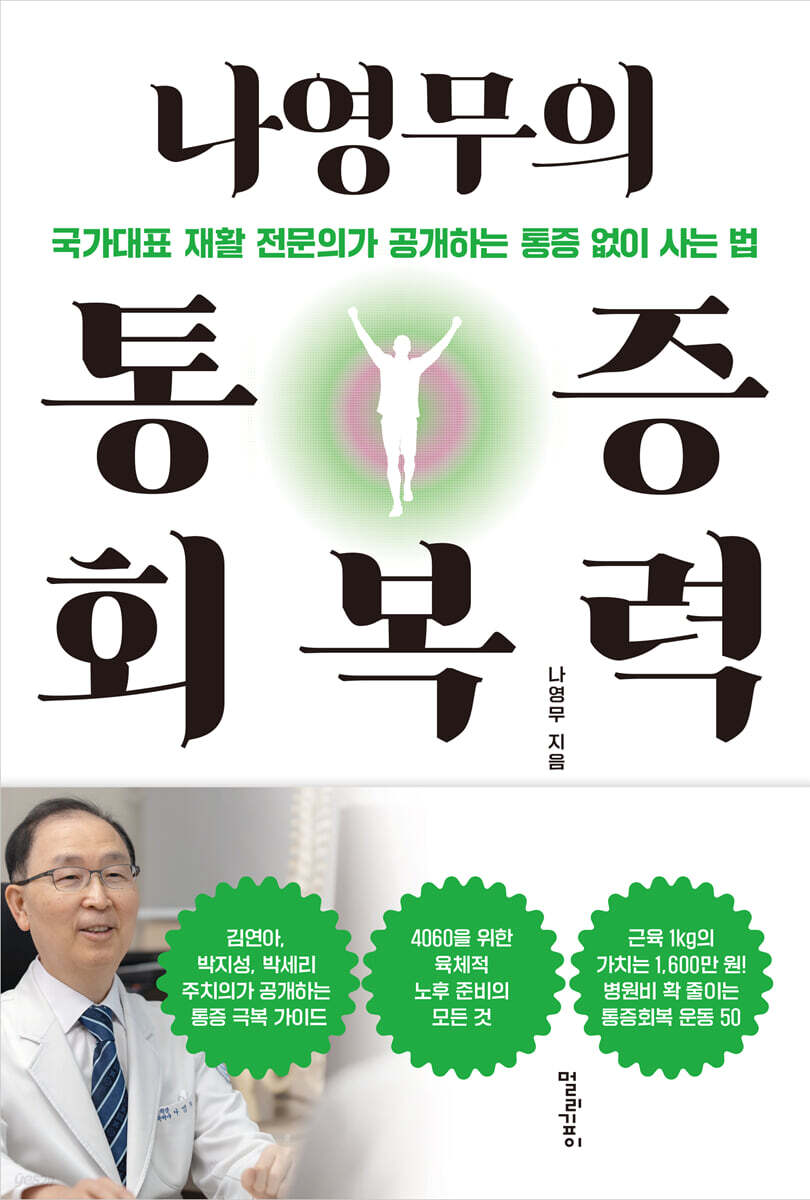
Nayoungmu's pain recovery power
 |
Description
Book Introduction
Director Na Young-moo, the personal physician of national athletes including Kim Yuna, Park Ji-sung, Pak Se-ri, Cha Jun-hwan, and Yun Seong-bin, conveys the message.
The ultimate pain management solution for middle-aged people who want to walk and run freely in their one and only life!
In your 40s, your back is ruined, in your 50s, your shoulders are ruined, and in your 60s, your knees are ruined.
Whether I lament my life in bed, dependent on my children, or live a healthy life, traveling until I'm in my 80s or 90s, depends on how well I manage my body's functions today.
This book encapsulates the 30 years of field know-how of Director Na Young-mu, a renowned rehabilitation medicine doctor. It is not a simple exercise method, but rather guides us on 'pain resilience' that maximizes our body's functions from a 'rehabilitation' perspective.
The ultimate pain management solution for middle-aged people who want to walk and run freely in their one and only life!
In your 40s, your back is ruined, in your 50s, your shoulders are ruined, and in your 60s, your knees are ruined.
Whether I lament my life in bed, dependent on my children, or live a healthy life, traveling until I'm in my 80s or 90s, depends on how well I manage my body's functions today.
This book encapsulates the 30 years of field know-how of Director Na Young-mu, a renowned rehabilitation medicine doctor. It is not a simple exercise method, but rather guides us on 'pain resilience' that maximizes our body's functions from a 'rehabilitation' perspective.
- You can preview some of the book's contents.
Preview
index
Pain resilience that leads to victory in the second half of life
Chapter 1.
The middle-aged man's body is collapsing with pain.
Things that come with aging
The wrong exercise method that causes bone disease while trying to be healthy
If your bones are weak, you will easily experience pain.
Chapter 2.
Five Pains That Ruin Middle Age
Body alignment determines lifespan
Pain 1.
If your back collapses, your whole body collapses.
Pain 2.
Shoulder pain that you put off for a lifetime, thinking, "It'll get better."
Pain 3.
Knees: You need to take care of them while you can walk.
Pain 4.
Neck: Small tension leads to big pain
Pain 5.
Hands and feet, which have small joints but do a lot of work
If you hear a 'thud' sound every time you move your body
Chapter 3.
Pain resilience for a brighter second half of life
Halftime for a brilliant second half of life
Pain Resilience for My Body
Athletes are smart about their pain
Why Rehabilitation Speeds Differ Between Athletes and the General Public
There are separate exercises for middle-aged people.
Ten Commandments for Exercise in Middle Age
Tips for Proper Midlife Exercise
Chapter 4.
50 Pain Relief Exercises That Director Na Young-moo Never Misses
Three Key Points of Pain Relief Exercise
Pain relief exercise 1.
Flexibility Routine
Pain recovery exercise 2.
Strength Routine
Pain relief exercise 3.
Balance and Cardiovascular Routine
Chapter 5.
You can't be happy with pain
Why I Chose a Rehabilitation Specialist
Things I learned from being sick
It takes a moment to break, a long time to recover
Prevention is always better than cure
Food is medicine
Stress is the 'enemy of happiness'
Live this moment, like a gift
As you live, you become alive
Trust clinical statistics more than the lady next door.
The key to rehabilitation is 'rest and movement'
Pain treatment is slow and positive
A healthy body is the safest way to prepare for old age.
Muscles responsible for health in old age
Chapter 6.
25 Most Common Pain Questions I Hear in the Clinic
Ask anything about pain
Q1.
I have a back problem. One hospital recommends surgery, while another recommends a procedure. What should I do?
Q2.
After light jogging or trekking, I have pain in my buttocks as well as my thighs.
Sometimes I have severe groin pain. What is the problem?
Q3.
Why do my sides ache and hurt after working on the computer for a long time or practicing golf?
Q4.
I feel like the pain started in the soles of my feet and went up to my lower back.
What is the reason?
Q5.
There are many times when I wake up startled by a cramp in my leg while I'm sleeping.
Why do I get cramps in my calf?
Q6.
My shoulder pain gets worse when I sleep on my side.
Why does my right shoulder hurt and my left shoulder, which was fine, also hurt?
Q7.
I have arthritis in my knees and the pain gets worse in the cold winter months.
What is the reason?
Q8.
As we move from middle age to old age, the number of falls increases. Why is that?
Q9.
My back and knee pain has gotten worse since I gained weight. Could this be related?
Q10.
What is first aid for severe muscle pain?
Q11.
If I get water in my knee, do I need to drain it?
Q12.
It hurts like my butt is going to fall out along with my lower back pain.
Why is the pain worse, especially when I sit down and then stand up?
Q13.
Are cervical disc and lumbar disc also related?
Q14.
I got a hamstring injury and rested for about a week, so I'm feeling a little better.
But when I went for a light jog, the pain came back and now it hurts even when I'm still. How long will it take to completely heal?
Q15.
I feel pain in my levator scapulae when I turn my neck.
I often feel like I'm stuck in a group. What's the reason?
Q16.
What causes stress fractures and how is it different from a 'fracture'?
Q17.
How much walking is appropriate when my knee joints hurt?
Q18.
How should I do rehabilitation exercises for osteoporosis?
Q19.
I have spinal stenosis. Can I still do sit-ups?
Q20.
Are hot springs and steam rooms effective for back pain?
Q21.
I have a rotator cuff tear. Can I still swim? I also enjoy racket sports. What about badminton and table tennis?
Q22.
I have high blood pressure and was diagnosed with spinal arthritis.
What is the best way to exercise?
Q23.
I have knee arthritis. Can I still do squats?
Q24.
Are a 'ligament' rupture and a 'tendon' rupture the same thing?
Q25.
My finger joints are swollen and painful. Why is this?
Chapter 1.
The middle-aged man's body is collapsing with pain.
Things that come with aging
The wrong exercise method that causes bone disease while trying to be healthy
If your bones are weak, you will easily experience pain.
Chapter 2.
Five Pains That Ruin Middle Age
Body alignment determines lifespan
Pain 1.
If your back collapses, your whole body collapses.
Pain 2.
Shoulder pain that you put off for a lifetime, thinking, "It'll get better."
Pain 3.
Knees: You need to take care of them while you can walk.
Pain 4.
Neck: Small tension leads to big pain
Pain 5.
Hands and feet, which have small joints but do a lot of work
If you hear a 'thud' sound every time you move your body
Chapter 3.
Pain resilience for a brighter second half of life
Halftime for a brilliant second half of life
Pain Resilience for My Body
Athletes are smart about their pain
Why Rehabilitation Speeds Differ Between Athletes and the General Public
There are separate exercises for middle-aged people.
Ten Commandments for Exercise in Middle Age
Tips for Proper Midlife Exercise
Chapter 4.
50 Pain Relief Exercises That Director Na Young-moo Never Misses
Three Key Points of Pain Relief Exercise
Pain relief exercise 1.
Flexibility Routine
Pain recovery exercise 2.
Strength Routine
Pain relief exercise 3.
Balance and Cardiovascular Routine
Chapter 5.
You can't be happy with pain
Why I Chose a Rehabilitation Specialist
Things I learned from being sick
It takes a moment to break, a long time to recover
Prevention is always better than cure
Food is medicine
Stress is the 'enemy of happiness'
Live this moment, like a gift
As you live, you become alive
Trust clinical statistics more than the lady next door.
The key to rehabilitation is 'rest and movement'
Pain treatment is slow and positive
A healthy body is the safest way to prepare for old age.
Muscles responsible for health in old age
Chapter 6.
25 Most Common Pain Questions I Hear in the Clinic
Ask anything about pain
Q1.
I have a back problem. One hospital recommends surgery, while another recommends a procedure. What should I do?
Q2.
After light jogging or trekking, I have pain in my buttocks as well as my thighs.
Sometimes I have severe groin pain. What is the problem?
Q3.
Why do my sides ache and hurt after working on the computer for a long time or practicing golf?
Q4.
I feel like the pain started in the soles of my feet and went up to my lower back.
What is the reason?
Q5.
There are many times when I wake up startled by a cramp in my leg while I'm sleeping.
Why do I get cramps in my calf?
Q6.
My shoulder pain gets worse when I sleep on my side.
Why does my right shoulder hurt and my left shoulder, which was fine, also hurt?
Q7.
I have arthritis in my knees and the pain gets worse in the cold winter months.
What is the reason?
Q8.
As we move from middle age to old age, the number of falls increases. Why is that?
Q9.
My back and knee pain has gotten worse since I gained weight. Could this be related?
Q10.
What is first aid for severe muscle pain?
Q11.
If I get water in my knee, do I need to drain it?
Q12.
It hurts like my butt is going to fall out along with my lower back pain.
Why is the pain worse, especially when I sit down and then stand up?
Q13.
Are cervical disc and lumbar disc also related?
Q14.
I got a hamstring injury and rested for about a week, so I'm feeling a little better.
But when I went for a light jog, the pain came back and now it hurts even when I'm still. How long will it take to completely heal?
Q15.
I feel pain in my levator scapulae when I turn my neck.
I often feel like I'm stuck in a group. What's the reason?
Q16.
What causes stress fractures and how is it different from a 'fracture'?
Q17.
How much walking is appropriate when my knee joints hurt?
Q18.
How should I do rehabilitation exercises for osteoporosis?
Q19.
I have spinal stenosis. Can I still do sit-ups?
Q20.
Are hot springs and steam rooms effective for back pain?
Q21.
I have a rotator cuff tear. Can I still swim? I also enjoy racket sports. What about badminton and table tennis?
Q22.
I have high blood pressure and was diagnosed with spinal arthritis.
What is the best way to exercise?
Q23.
I have knee arthritis. Can I still do squats?
Q24.
Are a 'ligament' rupture and a 'tendon' rupture the same thing?
Q25.
My finger joints are swollen and painful. Why is this?
Detailed image

Into the book
I took Professor Lee Il-young's lecture when I was a second-year student at Yonsei University.
It was truly a fateful time for me.
When I heard in that lecture that “Rehabilitation medicine helps us return to a normal life by maximizing the remaining functions of our bodies,” my heart raced.
I became more confident that I could get closer to patients' pain through rehabilitation medicine, and I felt hopeful that there would be more things I could do to alleviate that pain.
That's how my relationship with rehabilitation medicine began, and it led to sports rehabilitation.
--- p.9 From the introduction, “Pain Resilience that Leads to Victory in the Second Half of Life”
Mr. Choi, in his early 40s, was the type to exercise only on weekends.
I enjoyed a variety of sports, including tennis, table tennis, sports climbing, and futsal, and on some days, I even continued to exercise intensely for 3 to 4 hours.
(…) One day, I played three futsal games for over two hours, but I felt like I wasn’t getting enough exercise, so I played one more game.
The moment I changed direction while dribbling, I felt a sharp pain along with a 'pop' sound in the back of my thigh.
As a result, his hamstring ruptured due to overload and accumulated fatigue, and he had to take over four months off from sports.
--- p.31 From Chapter 1, “The Middle-Aged Man’s Body is Collapsing in Pain”
A good example that shows the importance of exercise selection is cycling.
Cycling is not good for people with disc problems.
This is because the posture of bending the back while sitting is maintained.
Bending over while cycling can increase the risk of a herniated or torn disc, which can worsen the pain.
Conversely, cycling can be helpful for people with stenosis.
This is because bending over widens the nerve passages between the vertebrae, relieving pain.
--- p.63 From Chapter 2, “The Five Pains That Destroy Middle Age”
Strong physique and solid muscles can suppress pain.
Pain comes from an inflammatory response, and having strong muscles and physical strength can help reduce pain by improving blood circulation and enhancing the body's natural healing ability.
For example, if the erector spinae muscles that support the spine are strong, the pressure on the discs is reduced, so there is less pain even with excessive exercise or external impact.
Conversely, if your muscles and ligaments are weak, you can easily get injured even with a small impact, and this can cause not only pain but also spinal problems.
--- p.158 From Chapter 3, “Pain Resilience for a Shining Second Half of Life”
The most important thing about exercise for middle-aged people is to focus on strengthening their 'pain resilience' in preparation for old age.
To do this, we need to remember three key elements:
These are flexibility, strength, and aerobic exercise.
Pain recovery is like 'farming', requiring sweat and sincerity.
Just as the first step in farming is to till the soil to make it soft, the first step in exercising is to be flexible.
Next, if you sow the seed of 'physical strength' and provide water and nutrients through 'aerobic exercise', you can bear fruit in the form of pain recovery.
--- p.195 From Chapter 4, “50 Pain Recovery Exercises That Director Na Young-moo Never Misses”
One day, an elementary school tennis player came to visit.
The player complained of pain from knee cartilage and elbow injuries, which were attributed to hypermobility.
His facial expression seemed dark, and he seemed to be very afraid that he might have to give up tennis, which he loved, because of his frequent injuries.
After explaining the cause of the pain, its condition, and future treatment, he briefly told the story of Se-ri Pak.
“Se-ri Pak also suffered from hypermobility like you.
But if you build up your strength, you can overcome anything.
“If you can just get over that wall, you can equip yourself with two wings: flexibility and good muscles.” At that moment, the young athlete’s stiff face brightened and he smiled brightly, saying, “Thank you, teacher.”
As I watched him leave the examination room, I thought, 'I'm so glad I became a rehabilitation medicine doctor.'
That day, my steps on the way home from work were unusually light.
--- pp.250-251 From Chapter 5, “You Can’t Be Happy While Carrying Pain”
Q01.
I have a back problem. One hospital recommends surgery, while another recommends a procedure. What should I do?
A.
This is one of the most concerning points for patients and one of the most frequently asked questions.
Surgery is a process of making an incision with a scalpel, finding the diseased area, and removing or suturing it.
Although it is accompanied by tissue damage and may cause bleeding, even if only a small amount, it can be effective in a short period of time because it can eliminate the diseased area.
But you may suffer more from the aftereffects later.
On the other hand, a procedure is similar to surgery, but it involves opening, expanding, or removing a blockage using an endoscope or catheter, rather than using a knife.
Although the immediate effect may be less than that of surgery, it has the advantage of causing little tissue damage and allowing treatment without aftereffects.
If symptoms persist, natural healing can be induced through rehabilitation.
It was truly a fateful time for me.
When I heard in that lecture that “Rehabilitation medicine helps us return to a normal life by maximizing the remaining functions of our bodies,” my heart raced.
I became more confident that I could get closer to patients' pain through rehabilitation medicine, and I felt hopeful that there would be more things I could do to alleviate that pain.
That's how my relationship with rehabilitation medicine began, and it led to sports rehabilitation.
--- p.9 From the introduction, “Pain Resilience that Leads to Victory in the Second Half of Life”
Mr. Choi, in his early 40s, was the type to exercise only on weekends.
I enjoyed a variety of sports, including tennis, table tennis, sports climbing, and futsal, and on some days, I even continued to exercise intensely for 3 to 4 hours.
(…) One day, I played three futsal games for over two hours, but I felt like I wasn’t getting enough exercise, so I played one more game.
The moment I changed direction while dribbling, I felt a sharp pain along with a 'pop' sound in the back of my thigh.
As a result, his hamstring ruptured due to overload and accumulated fatigue, and he had to take over four months off from sports.
--- p.31 From Chapter 1, “The Middle-Aged Man’s Body is Collapsing in Pain”
A good example that shows the importance of exercise selection is cycling.
Cycling is not good for people with disc problems.
This is because the posture of bending the back while sitting is maintained.
Bending over while cycling can increase the risk of a herniated or torn disc, which can worsen the pain.
Conversely, cycling can be helpful for people with stenosis.
This is because bending over widens the nerve passages between the vertebrae, relieving pain.
--- p.63 From Chapter 2, “The Five Pains That Destroy Middle Age”
Strong physique and solid muscles can suppress pain.
Pain comes from an inflammatory response, and having strong muscles and physical strength can help reduce pain by improving blood circulation and enhancing the body's natural healing ability.
For example, if the erector spinae muscles that support the spine are strong, the pressure on the discs is reduced, so there is less pain even with excessive exercise or external impact.
Conversely, if your muscles and ligaments are weak, you can easily get injured even with a small impact, and this can cause not only pain but also spinal problems.
--- p.158 From Chapter 3, “Pain Resilience for a Shining Second Half of Life”
The most important thing about exercise for middle-aged people is to focus on strengthening their 'pain resilience' in preparation for old age.
To do this, we need to remember three key elements:
These are flexibility, strength, and aerobic exercise.
Pain recovery is like 'farming', requiring sweat and sincerity.
Just as the first step in farming is to till the soil to make it soft, the first step in exercising is to be flexible.
Next, if you sow the seed of 'physical strength' and provide water and nutrients through 'aerobic exercise', you can bear fruit in the form of pain recovery.
--- p.195 From Chapter 4, “50 Pain Recovery Exercises That Director Na Young-moo Never Misses”
One day, an elementary school tennis player came to visit.
The player complained of pain from knee cartilage and elbow injuries, which were attributed to hypermobility.
His facial expression seemed dark, and he seemed to be very afraid that he might have to give up tennis, which he loved, because of his frequent injuries.
After explaining the cause of the pain, its condition, and future treatment, he briefly told the story of Se-ri Pak.
“Se-ri Pak also suffered from hypermobility like you.
But if you build up your strength, you can overcome anything.
“If you can just get over that wall, you can equip yourself with two wings: flexibility and good muscles.” At that moment, the young athlete’s stiff face brightened and he smiled brightly, saying, “Thank you, teacher.”
As I watched him leave the examination room, I thought, 'I'm so glad I became a rehabilitation medicine doctor.'
That day, my steps on the way home from work were unusually light.
--- pp.250-251 From Chapter 5, “You Can’t Be Happy While Carrying Pain”
Q01.
I have a back problem. One hospital recommends surgery, while another recommends a procedure. What should I do?
A.
This is one of the most concerning points for patients and one of the most frequently asked questions.
Surgery is a process of making an incision with a scalpel, finding the diseased area, and removing or suturing it.
Although it is accompanied by tissue damage and may cause bleeding, even if only a small amount, it can be effective in a short period of time because it can eliminate the diseased area.
But you may suffer more from the aftereffects later.
On the other hand, a procedure is similar to surgery, but it involves opening, expanding, or removing a blockage using an endoscope or catheter, rather than using a knife.
Although the immediate effect may be less than that of surgery, it has the advantage of causing little tissue damage and allowing treatment without aftereffects.
If symptoms persist, natural healing can be induced through rehabilitation.
--- p.304 From Chapter 6, “25 Most Frequently Asked Questions About Pain in the Clinic”
Publisher's Review
Manage your pain and enjoy life!
The topic of discussion raised by Director Na Young-moo, the architect of the 2002 Hiddink team's 'reversal stamina', is 'pain resilience'!
★★Everything about "rehabilitation-focused" exercises that restore your body's declining functions to their prime!★★
There are symbolic years that any adult born and raised in South Korea will recognize without needing to be explained.
1988 was the Olympics, 1997 was the IMF crisis, and 2002? Needless to say, it was the World Cup.
The reason the 2002 World Cup is remembered as such a powerful event for the Korean people is because of the incredible success of advancing to the semifinals.
Before 2002, Korean soccer had a chronic problem of easily conceding goals due to a rapid decline in stamina in the second half.
Coach Hiddink, through rigorous training that tested his physical strength to the limit, including shuttle runs and night-time weight training, has achieved a tenacious 'reverse stamina' that strengthens both concentration and stamina in the second half.
The success of the Hiddink team has great implications for middle-aged people preparing for the age of centenarians.
As we age, our bodies begin to show signs of abnormality, such as weakened muscles and poor blood circulation.
At this time, the functional gap between those who endure pain and those who exercise consistently to maintain peak physical strength is bound to widen.
Director Na Young-moo, a pioneer in sports rehabilitation in Korea and the head physician of the national soccer team in 2002, says in his new book, “Na Young-moo’s Pain Resilience” (published in April 2025 by Mulli-geum-i), that the most important health keyword for middle-aged people entering the second half of the game called life is “pain resilience.”
Pain resilience is not simply the ability to endure pain, but rather the ability to overcome pain and continue normal performance, or in other words, 'pain resistance.'
If the erector spinae muscles that support the spine are strong, you will feel less pain from external impact, but on the other hand, if the muscles and ligaments are weak, you can easily get injured even from small impacts.
Therefore, it is argued that the 'pain revolution' that will open a new era of old age is to strengthen muscle strength and physical strength through rehabilitation-focused exercise that restores the body's functions and improves pain recovery.
“If you are middle-aged, you must recover your body through ‘rehabilitation’!”
Before things break down everywhere, everything you need to know about physical aging for 4060!
The book covers six chapters, covering pain issues experienced by middle-aged people and providing guidance on pain recovery exercises as a form of rehabilitation to restore prime function.
Chapter 1, “The Middle-Aged Body is Collapsing from Pain,” sheds light on various problems of middle-aged aging that appear as bodily functions such as muscle strength, hormones, and basal metabolic rate decline, and particularly touches on the reality of middle-aged people enduring pain while continuing to exercise and working at high intensity.
This series covers the stories of middle-aged people who suffer from pain due to moving their bodies without proper information, from the story of Mr. Kim in his mid-50s who started playing tennis and golf for his health and ended up suffering from shoulder pain so severe that he couldn't sleep at night, to the story of Ms. Lee in her 50s who ended up suffering from a herniated disc after following the stretching exercises that were said to be good for the lower back.
Chapter 2, “The Five Pains That Ruin Middle Age,” traces the causes and symptoms of pain in the lower back, shoulders, knees, neck, hands, and feet that begin to collapse as the body’s alignment deteriorates.
The case of Ms. Yoo, a 40-year-old office worker who suffered a herniated disc due to an unintentional sneeze, is a good example of how easily the middle-aged body can be damaged.
Although everyone knows that sleeping on your back is good for you, it is also a significant problem that not many people consider it important and put it into practice.
Sleeping on your side can put pressure on your shoulder joint, causing it to become misaligned and stressing the surrounding tendons and ligaments, which can lead to inflammation in the rotator cuff.
It carefully guides us through how small habits can cause great harm to our bodies.
Chapter 3, “Pain Resilience for a Shining Second Half of Life,” specifically explains “pain resilience,” which can be considered the core message of this book.
As mentioned earlier, pain resilience refers to the muscle strength and stamina that helps our body to maintain its original function in a healthy manner by resisting pain.
Above all, Director Na Young-moo traces the secrets of professionals who quickly succeed in rehabilitation through the cases of athletes he met in his clinic - from Yuna Kim, who overcame pain and successfully rehabilitated with strong mental fortitude, to Heung-min Son, who excelled at muscle management, to Se-ri Pak, who became a Hall of Fame athlete by strengthening her muscles despite being overly flexible and at high risk of injury.
In Chapter 5, “You Can’t Be Happy with Pain,” you can encounter the deep insights of Director Na Young-moo, who has realized this through 30 years of clinical experience, and in Chapter 6, “25 Most Frequently Asked Questions About Pain in the Clinic,” specific answers to questions that you will inevitably think about at least once, such as “Is surgery better or is a procedure better?” are meticulously organized.
The miracle of 1kg of muscle!
It is not an exercise that makes you sick the more you do it.
50 Miraculous Exercises That Will Dramatically Reduce Senior Healthcare Costs
The greatest virtue of this book is that it provides, through specific images, easy but essential exercise methods that can significantly reduce elderly medical expenses in Chapter 4, “50 Pain Recovery Exercises That Director Na Young-moo Never Misses.”
According to data from the National Health Insurance Corporation, gaining 1 kg of muscle can save 14 to 16 million won in medical expenses.
If pension is the key to financial retirement, strength training is the key to physical retirement.
The 50 functional exercises introduced in this book are comprised of movements that can improve three major functions: flexibility, strength, balance, and cardiopulmonary endurance.
From simple chin-tuck movements that relieve turtle neck, to carioca steps that improve mobility with a quick change of direction, simply performing the exercises introduced every day can help keep your entire body in good shape.
It is also meaningful in that it helps smart-aleck exercise enthusiasts who suffer from all kinds of injuries by changing sports like golf, tennis, soccer, marathon, and cycling to follow trends to correct their wrong exercise methods and rehabilitate damaged body functions.
Above all, this exercise is even more trustworthy because it is based on the miraculous experience of Director Na Young-mu, who overcame terminal cancer through well-planned exercise and willpower.
The topic of discussion raised by Director Na Young-moo, the architect of the 2002 Hiddink team's 'reversal stamina', is 'pain resilience'!
★★Everything about "rehabilitation-focused" exercises that restore your body's declining functions to their prime!★★
There are symbolic years that any adult born and raised in South Korea will recognize without needing to be explained.
1988 was the Olympics, 1997 was the IMF crisis, and 2002? Needless to say, it was the World Cup.
The reason the 2002 World Cup is remembered as such a powerful event for the Korean people is because of the incredible success of advancing to the semifinals.
Before 2002, Korean soccer had a chronic problem of easily conceding goals due to a rapid decline in stamina in the second half.
Coach Hiddink, through rigorous training that tested his physical strength to the limit, including shuttle runs and night-time weight training, has achieved a tenacious 'reverse stamina' that strengthens both concentration and stamina in the second half.
The success of the Hiddink team has great implications for middle-aged people preparing for the age of centenarians.
As we age, our bodies begin to show signs of abnormality, such as weakened muscles and poor blood circulation.
At this time, the functional gap between those who endure pain and those who exercise consistently to maintain peak physical strength is bound to widen.
Director Na Young-moo, a pioneer in sports rehabilitation in Korea and the head physician of the national soccer team in 2002, says in his new book, “Na Young-moo’s Pain Resilience” (published in April 2025 by Mulli-geum-i), that the most important health keyword for middle-aged people entering the second half of the game called life is “pain resilience.”
Pain resilience is not simply the ability to endure pain, but rather the ability to overcome pain and continue normal performance, or in other words, 'pain resistance.'
If the erector spinae muscles that support the spine are strong, you will feel less pain from external impact, but on the other hand, if the muscles and ligaments are weak, you can easily get injured even from small impacts.
Therefore, it is argued that the 'pain revolution' that will open a new era of old age is to strengthen muscle strength and physical strength through rehabilitation-focused exercise that restores the body's functions and improves pain recovery.
“If you are middle-aged, you must recover your body through ‘rehabilitation’!”
Before things break down everywhere, everything you need to know about physical aging for 4060!
The book covers six chapters, covering pain issues experienced by middle-aged people and providing guidance on pain recovery exercises as a form of rehabilitation to restore prime function.
Chapter 1, “The Middle-Aged Body is Collapsing from Pain,” sheds light on various problems of middle-aged aging that appear as bodily functions such as muscle strength, hormones, and basal metabolic rate decline, and particularly touches on the reality of middle-aged people enduring pain while continuing to exercise and working at high intensity.
This series covers the stories of middle-aged people who suffer from pain due to moving their bodies without proper information, from the story of Mr. Kim in his mid-50s who started playing tennis and golf for his health and ended up suffering from shoulder pain so severe that he couldn't sleep at night, to the story of Ms. Lee in her 50s who ended up suffering from a herniated disc after following the stretching exercises that were said to be good for the lower back.
Chapter 2, “The Five Pains That Ruin Middle Age,” traces the causes and symptoms of pain in the lower back, shoulders, knees, neck, hands, and feet that begin to collapse as the body’s alignment deteriorates.
The case of Ms. Yoo, a 40-year-old office worker who suffered a herniated disc due to an unintentional sneeze, is a good example of how easily the middle-aged body can be damaged.
Although everyone knows that sleeping on your back is good for you, it is also a significant problem that not many people consider it important and put it into practice.
Sleeping on your side can put pressure on your shoulder joint, causing it to become misaligned and stressing the surrounding tendons and ligaments, which can lead to inflammation in the rotator cuff.
It carefully guides us through how small habits can cause great harm to our bodies.
Chapter 3, “Pain Resilience for a Shining Second Half of Life,” specifically explains “pain resilience,” which can be considered the core message of this book.
As mentioned earlier, pain resilience refers to the muscle strength and stamina that helps our body to maintain its original function in a healthy manner by resisting pain.
Above all, Director Na Young-moo traces the secrets of professionals who quickly succeed in rehabilitation through the cases of athletes he met in his clinic - from Yuna Kim, who overcame pain and successfully rehabilitated with strong mental fortitude, to Heung-min Son, who excelled at muscle management, to Se-ri Pak, who became a Hall of Fame athlete by strengthening her muscles despite being overly flexible and at high risk of injury.
In Chapter 5, “You Can’t Be Happy with Pain,” you can encounter the deep insights of Director Na Young-moo, who has realized this through 30 years of clinical experience, and in Chapter 6, “25 Most Frequently Asked Questions About Pain in the Clinic,” specific answers to questions that you will inevitably think about at least once, such as “Is surgery better or is a procedure better?” are meticulously organized.
The miracle of 1kg of muscle!
It is not an exercise that makes you sick the more you do it.
50 Miraculous Exercises That Will Dramatically Reduce Senior Healthcare Costs
The greatest virtue of this book is that it provides, through specific images, easy but essential exercise methods that can significantly reduce elderly medical expenses in Chapter 4, “50 Pain Recovery Exercises That Director Na Young-moo Never Misses.”
According to data from the National Health Insurance Corporation, gaining 1 kg of muscle can save 14 to 16 million won in medical expenses.
If pension is the key to financial retirement, strength training is the key to physical retirement.
The 50 functional exercises introduced in this book are comprised of movements that can improve three major functions: flexibility, strength, balance, and cardiopulmonary endurance.
From simple chin-tuck movements that relieve turtle neck, to carioca steps that improve mobility with a quick change of direction, simply performing the exercises introduced every day can help keep your entire body in good shape.
It is also meaningful in that it helps smart-aleck exercise enthusiasts who suffer from all kinds of injuries by changing sports like golf, tennis, soccer, marathon, and cycling to follow trends to correct their wrong exercise methods and rehabilitate damaged body functions.
Above all, this exercise is even more trustworthy because it is based on the miraculous experience of Director Na Young-mu, who overcame terminal cancer through well-planned exercise and willpower.
GOODS SPECIFICS
- Date of issue: April 30, 2025
- Page count, weight, size: 336 pages | 630g | 152*225*20mm
- ISBN13: 9791191439649
- ISBN10: 119143964X
You may also like
카테고리
korean


korean

![GQ KOREA Mark (Monthly): December [2025]](http://librairie.coreenne.fr/cdn/shop/files/8ef265dbbfbf186523ed75ba7319009d.jpg?v=1765340328&width=3840)


