

Good energy
 |
Description
Book Introduction
- A word from MD
-
Cellular Energy for Fundamental HealthModern medicine continues to advance, yet why do we become increasingly ill? Why do our bodies continue to break down? The answer lies in our cells.
The body can only be restored to balance by creating an environment in which cells can sufficiently produce energy.
With six out of ten adults suffering from chronic diseases, a 'health revolution' is urgently needed.
April 29, 2025. Health and Hobbies PD Ahn Hyun-jae
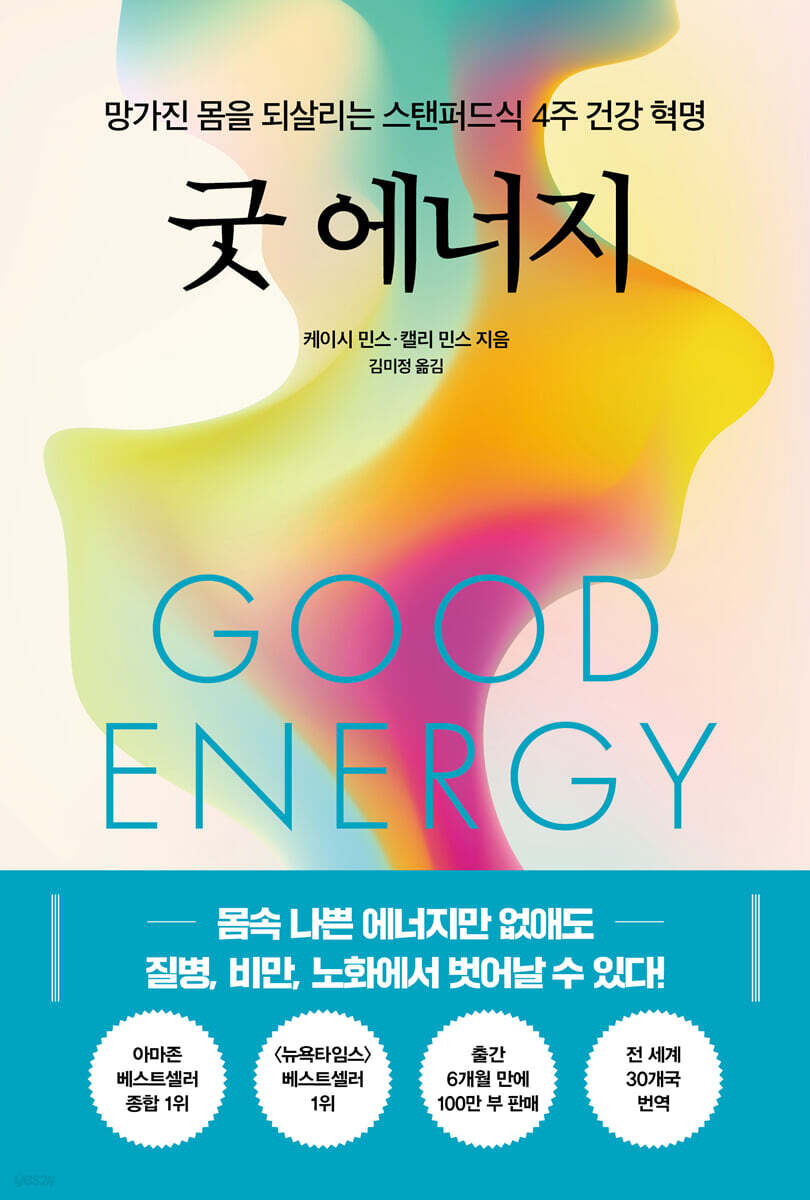
Stanford's health revolution to save your broken body!
One million copies sold in just six months
#1 on Amazon's overall ranking, #1 in the health category for 50 consecutive weeks
#1 New York Times bestseller
A popular health book published in 30 countries around the world!
“Disease and aging problems depend on cellular energy!”
The most innovative solution in an era of chronic illness
Modern medicine is becoming increasingly precise, and we are prescribed far more medications than ever before.
But our health is not improving, and we are relying on too frequent treatments.
The number of people with chronic diseases is increasing, and problems such as fatigue, anxiety, overweight, depression, and poor concentration have become commonplace.
This is the same not only in American society but also in Korean society.
Now, six out of ten adults have a chronic disease, and even children are diagnosed with obesity, fatty liver disease, and attention deficit disorder.
Every day, we take more supplements, visit hospitals, and consume more health content, but why does our body continue to break down?
“Good Energy” begins with this simple, yet uncomfortable question.
“The problem isn’t the disease itself, it’s that our body’s cells aren’t making energy properly,” says Dr. Casey Minns, a surgeon and Stanford University School of Medicine graduate and author of the book.
The author left the hospital to pursue research on cellular metabolism and bioenergy, seeking to fundamentally understand why patients return to the hospital with the same symptoms.
And based on years of clinical and practical experience, I have come to the strong conclusion that “most chronic diseases have one cause: cellular energy disorders.”
As soon as it was published, this book reached number one on Amazon's overall bestseller list and the New York Times bestseller list, captivating millions of readers around the world.
If you are someone who always feels tired, sick, and worn out, you will discover the cause and treatment in this book.
One million copies sold in just six months
#1 on Amazon's overall ranking, #1 in the health category for 50 consecutive weeks
#1 New York Times bestseller
A popular health book published in 30 countries around the world!
“Disease and aging problems depend on cellular energy!”
The most innovative solution in an era of chronic illness
Modern medicine is becoming increasingly precise, and we are prescribed far more medications than ever before.
But our health is not improving, and we are relying on too frequent treatments.
The number of people with chronic diseases is increasing, and problems such as fatigue, anxiety, overweight, depression, and poor concentration have become commonplace.
This is the same not only in American society but also in Korean society.
Now, six out of ten adults have a chronic disease, and even children are diagnosed with obesity, fatty liver disease, and attention deficit disorder.
Every day, we take more supplements, visit hospitals, and consume more health content, but why does our body continue to break down?
“Good Energy” begins with this simple, yet uncomfortable question.
“The problem isn’t the disease itself, it’s that our body’s cells aren’t making energy properly,” says Dr. Casey Minns, a surgeon and Stanford University School of Medicine graduate and author of the book.
The author left the hospital to pursue research on cellular metabolism and bioenergy, seeking to fundamentally understand why patients return to the hospital with the same symptoms.
And based on years of clinical and practical experience, I have come to the strong conclusion that “most chronic diseases have one cause: cellular energy disorders.”
As soon as it was published, this book reached number one on Amazon's overall bestseller list and the New York Times bestseller list, captivating millions of readers around the world.
If you are someone who always feels tired, sick, and worn out, you will discover the cause and treatment in this book.
- You can preview some of the book's contents.
Preview
index
Preface - The Sudden Death of a "Healthy" Mother
Part 1.
The Beginning of Disease - Signals from Bad Energy
Chapter 1.
An era in which disease has become a given
Medicine is not a magic solution.
What causes disease?
ATP, the energy currency we pay for life
Sources of chronic inflammation
Is my body functioning properly?
Chapter 2.
The source of disease that no one tells you about
My Patient Lucy's Story
My Mother Gail's Story
When I was a doctor, I suffered from depression and acne.
Symptoms of metabolic disorder
Our young children are getting sick
Higher blood sugar levels are associated with a higher risk of dementia.
The cruel price of missing the signal
Chapter 3.
Trust yourself, not the doctor
If I had listened to the doctor
Why Doctors Have a High Suicide Rate
Trust your doctor when it's an acute illness, ignore it when it's a chronic illness.
The surprising scale of the pharmaceutical lobby
The biggest lie in medicine
Part 2.
Recovering Your Body - Creating Good Energy
Chapter 4.
The answer lies in your body
Gaining Insights from Wearable Devices
Symptoms are a gift
Six additional tests
Identify before your body breaks down
continuous blood sugar
Measuring biomarkers is more valuable than a 15-minute consultation.
Chapter 5: We Are Made of Food
Food changes destiny
Principle 1.
Food determines the structure and function of cells and the microbiome.
Principle 2.
Eating is the process of matching what you eat with the needs of your cells.
Principle 3.
Food is how we communicate with our cells.
Principle 4.
Food cravings mean you're receiving confusing messages.
Principle 5.
Focus on unprocessed foods, whether vegetarian or meat-based.
Principle 6.
Eat mindfully, feeling awe at your food.
Chapter 6.
Foods that are medicine, foods that are poison
What to eat?
What should I not eat?
How to Eat Healthy on a Budget
Micronutrients and antioxidants for good energy
Omega-3 fatty acids and fiber for good energy
Fermented foods and protein for good energy
Bad energy foods, refined oils and refined grains
Managing Blood Sugar Through a Good Energy Diet
Chapter 7.
Respect your biological clock
Humans are not nocturnal animals
We are made of sunlight
If you want to kill someone, don't let them sleep.
sleep-deprived society
Dangerous late-night snack
Resetting your biological rhythm
Chapter 8.
Reclaiming the health that modern society has taken away
A little discomfort that is good for your health
Exercise only at the fitness center?
Marketing that beats science
Stress that is appropriate for the body
A world surrounded by environmental toxins
Chapter 9.
A bold mind for health
A life of anxiety, fear, and depression
The day I was freed from the fear of death
Our mind regulates our metabolism
Brain Training for Healing
When you believe in connection and circulation
Part 3: From Recovery to Habit - A 4-Week Energy Reset Plan
A 4-Week Plan to Get Positive Energy
Week 1 of Building Good Habits
Building Good Habits Week 2
Create three good habits of your own
Part 4: Health on the Table - Daily Recipes for Recharging Your Energy
Breakfast Recipes
Lunch Recipes
Dinner Recipes
Other Recipes
Part 1.
The Beginning of Disease - Signals from Bad Energy
Chapter 1.
An era in which disease has become a given
Medicine is not a magic solution.
What causes disease?
ATP, the energy currency we pay for life
Sources of chronic inflammation
Is my body functioning properly?
Chapter 2.
The source of disease that no one tells you about
My Patient Lucy's Story
My Mother Gail's Story
When I was a doctor, I suffered from depression and acne.
Symptoms of metabolic disorder
Our young children are getting sick
Higher blood sugar levels are associated with a higher risk of dementia.
The cruel price of missing the signal
Chapter 3.
Trust yourself, not the doctor
If I had listened to the doctor
Why Doctors Have a High Suicide Rate
Trust your doctor when it's an acute illness, ignore it when it's a chronic illness.
The surprising scale of the pharmaceutical lobby
The biggest lie in medicine
Part 2.
Recovering Your Body - Creating Good Energy
Chapter 4.
The answer lies in your body
Gaining Insights from Wearable Devices
Symptoms are a gift
Six additional tests
Identify before your body breaks down
continuous blood sugar
Measuring biomarkers is more valuable than a 15-minute consultation.
Chapter 5: We Are Made of Food
Food changes destiny
Principle 1.
Food determines the structure and function of cells and the microbiome.
Principle 2.
Eating is the process of matching what you eat with the needs of your cells.
Principle 3.
Food is how we communicate with our cells.
Principle 4.
Food cravings mean you're receiving confusing messages.
Principle 5.
Focus on unprocessed foods, whether vegetarian or meat-based.
Principle 6.
Eat mindfully, feeling awe at your food.
Chapter 6.
Foods that are medicine, foods that are poison
What to eat?
What should I not eat?
How to Eat Healthy on a Budget
Micronutrients and antioxidants for good energy
Omega-3 fatty acids and fiber for good energy
Fermented foods and protein for good energy
Bad energy foods, refined oils and refined grains
Managing Blood Sugar Through a Good Energy Diet
Chapter 7.
Respect your biological clock
Humans are not nocturnal animals
We are made of sunlight
If you want to kill someone, don't let them sleep.
sleep-deprived society
Dangerous late-night snack
Resetting your biological rhythm
Chapter 8.
Reclaiming the health that modern society has taken away
A little discomfort that is good for your health
Exercise only at the fitness center?
Marketing that beats science
Stress that is appropriate for the body
A world surrounded by environmental toxins
Chapter 9.
A bold mind for health
A life of anxiety, fear, and depression
The day I was freed from the fear of death
Our mind regulates our metabolism
Brain Training for Healing
When you believe in connection and circulation
Part 3: From Recovery to Habit - A 4-Week Energy Reset Plan
A 4-Week Plan to Get Positive Energy
Week 1 of Building Good Habits
Building Good Habits Week 2
Create three good habits of your own
Part 4: Health on the Table - Daily Recipes for Recharging Your Energy
Breakfast Recipes
Lunch Recipes
Dinner Recipes
Other Recipes
Detailed image

Into the book
I weighed 5.2 kilograms when I was born.
Doctors congratulated the mother for giving birth to the largest baby in the hospital's history.
The weight gained during pregnancy did not go away easily, and my mother continued to struggle to lose weight for several years afterward.
My mother's doctor said this was normal.
She just told me to eat 'healthier foods' because I had just had a baby and was getting older.
My mother was diagnosed with high blood pressure by a cardiologist in her 40s.
The doctor prescribed an angiotensin-converting enzyme inhibitor, which prevents arteries from constricting, saying that this was very common in women my mother's age.
My mother, now in her 50s, was told by her internist that she had hypercholesterolemia (more precisely, high triglycerides, low HDL cholesterol, and high LDL cholesterol).
My mother was told that being prescribed statins was almost a rite of passage at her age.
Statins are one of the most prescribed drugs in U.S. history, with 221 million prescriptions filled each year.
When I turned 60, I was told by an endocrinologist that I was pre-diabetic.
The doctor emphasized that this is also very common and not something to worry about.
In any case, it is still in the 'pre-diabetic' stage, and 50 percent of American adults are said to be in the pre-diabetic stage.
My mother left the doctor's office with a prescription for a drug prescribed more than 90 million times a year in the United States.
In January 2021, my 71-year-old mother was hiking with her father as they did every day near their home in Northern California.
Suddenly, I felt a severe stomachache and felt more tired than usual.
My mother was worried and went to her doctor, who told her to get a CT scan and other tests.
The next day, my mother received a text message informing her that she had stage 4 pancreatic cancer.
Thirteen days later, my mother passed away.
--- From "The sudden death of a 'healthy' mother"
Despite surgically treating inflamed tissue in the head and neck every day, I never learned about the causes of inflammation in the body or its connection to the chronic inflammatory diseases that so many people face today.
I was never asked to ask, 'Why is there so much inflammation?'
I had a gut feeling that all of Sophia's ailments might be related, but instead of delving into that curiosity, I always wrote prescriptions and held the scalpel within the guidelines of my specialty.
Immediately after meeting Sophia, I felt a strong sense that despite the sheer size and scope of our healthcare system, I couldn't operate on other patients until I understood why my patients and those around me were sick.
I wanted to understand why so many diseases were increasing exponentially and why they showed clear patterns indicating potential connections.
And it was considered of utmost importance to figure out what we could do as doctors to keep patients out of the operating room.
I became a doctor to help patients find basic health and live vibrant lives.
I didn't become a doctor to give medicine to as many patients as possible, perform surgeries, and charge hospital bills every day.
Although I was surrounded by doctors who had entered medicine to help patients, the reality became increasingly clear: every institution that affected health—from medical schools to insurance companies, hospitals, and pharmaceutical companies—made money from the "management" of disease, not from the treatment of patients.
It was clear that these incentives acted as an invisible hand that led good people to tolerate bad outcomes.
--- From "The sudden death of a 'healthy' mother"
After years of research into what causes inflammation in patients like Sarah, the answer was surprisingly simple.
In many cases, chronic inflammation is a response from the body's cells that feel threatened by persistent energy shortages due to poor energy metabolism.
Immune cells rush to the area of the body at risk, causing inflammation.
Energy-deficient cells, that is, cells with impaired metabolic function that makes it difficult to produce energy and perform other functions, sense that they are threatened and in danger.
These unstable cells send out chemical alarm signals, asking the immune system for help.
In the process of trying to help, immune cells cause tremendous collateral damage.
It literally starts a war to protect itself from itself, which leads to more serious symptoms.
This is the core cause of chronic inflammation with metabolic dysfunction and a wide range of symptoms.
Jumping into the world of cell biology can be a daunting undertaking.
But there is one simple measure that can effectively reframe how we understand health and disease.
It measures whether the mitochondria within the cell are producing energy well or poorly.
You may have heard the word 'mitochondria'.
You probably learned about it in high school biology class as the 'power plant of the cell.'
Mitochondria convert calories from food into cellular energy.
These tiny organelles are the converters that convert the breakdown products of the food we eat into energy that the cell can use to do various tasks.
The amount of mitochondria present in each cell type in our body, such as the liver, skin, brain, ovaries, and eyes, varies greatly.
Depending on the type of work the cell needs to do and the amount of energy it needs to do that work, some cells have hundreds of thousands of mitochondria, while others only have a few.
--- From "ATP, the energy currency we pay for life"
It is not a metaphor to say that we are made of sunlight.
Almost all the energy we consume through food comes directly from the sun.
For most of us, photosynthesis is a term we learned in middle school and quickly forgot.
But remember this miraculous fact:
The energy that comes from the sun and travels about 150 million kilometers through space is stored in the chemical bonds of glucose molecules produced by plants.
Even if we stick to a meat-based diet, many of the animals we eat are herbivores, so most of the energy we get from our food comes from the sun.
The sun is the source of our life.
Let's also not forget that photosynthesis creates the oxygen that every cell in our bodies needs to produce energy.
Life exists on Earth because of the sun.
It is a shameful blind spot in medicine that we have not learned about the three major pathways that are crucial to bodily function.
Since the emergence of the simplest forms of life, regular patterns of light and dark have been the consistent environmental stimuli driving human physiology.
Human cells are encoded with a 24-hour sleep-wake cycle, switching from an active and feeding mode when exposed to sunlight to a resting and fasting mode when in the dark.
The physiological functions of these two cycles, including gene expression, metabolism, and hormonal activity, are very different.
The amount of light exposure determines which cycle you fall into.
Inconsistent or irregular exposure to light and dark, which sends the body conflicting signals, can lead to dysfunction and disease.
Sunlight entering the eyes is like an activation switch for the body.
The amount of light received outdoors on a clear day is 100 times greater than the amount of light received indoors from artificial lighting.
Even sitting under a shady tree exposes you to more light than sitting indoors with artificial lighting.
Doctors congratulated the mother for giving birth to the largest baby in the hospital's history.
The weight gained during pregnancy did not go away easily, and my mother continued to struggle to lose weight for several years afterward.
My mother's doctor said this was normal.
She just told me to eat 'healthier foods' because I had just had a baby and was getting older.
My mother was diagnosed with high blood pressure by a cardiologist in her 40s.
The doctor prescribed an angiotensin-converting enzyme inhibitor, which prevents arteries from constricting, saying that this was very common in women my mother's age.
My mother, now in her 50s, was told by her internist that she had hypercholesterolemia (more precisely, high triglycerides, low HDL cholesterol, and high LDL cholesterol).
My mother was told that being prescribed statins was almost a rite of passage at her age.
Statins are one of the most prescribed drugs in U.S. history, with 221 million prescriptions filled each year.
When I turned 60, I was told by an endocrinologist that I was pre-diabetic.
The doctor emphasized that this is also very common and not something to worry about.
In any case, it is still in the 'pre-diabetic' stage, and 50 percent of American adults are said to be in the pre-diabetic stage.
My mother left the doctor's office with a prescription for a drug prescribed more than 90 million times a year in the United States.
In January 2021, my 71-year-old mother was hiking with her father as they did every day near their home in Northern California.
Suddenly, I felt a severe stomachache and felt more tired than usual.
My mother was worried and went to her doctor, who told her to get a CT scan and other tests.
The next day, my mother received a text message informing her that she had stage 4 pancreatic cancer.
Thirteen days later, my mother passed away.
--- From "The sudden death of a 'healthy' mother"
Despite surgically treating inflamed tissue in the head and neck every day, I never learned about the causes of inflammation in the body or its connection to the chronic inflammatory diseases that so many people face today.
I was never asked to ask, 'Why is there so much inflammation?'
I had a gut feeling that all of Sophia's ailments might be related, but instead of delving into that curiosity, I always wrote prescriptions and held the scalpel within the guidelines of my specialty.
Immediately after meeting Sophia, I felt a strong sense that despite the sheer size and scope of our healthcare system, I couldn't operate on other patients until I understood why my patients and those around me were sick.
I wanted to understand why so many diseases were increasing exponentially and why they showed clear patterns indicating potential connections.
And it was considered of utmost importance to figure out what we could do as doctors to keep patients out of the operating room.
I became a doctor to help patients find basic health and live vibrant lives.
I didn't become a doctor to give medicine to as many patients as possible, perform surgeries, and charge hospital bills every day.
Although I was surrounded by doctors who had entered medicine to help patients, the reality became increasingly clear: every institution that affected health—from medical schools to insurance companies, hospitals, and pharmaceutical companies—made money from the "management" of disease, not from the treatment of patients.
It was clear that these incentives acted as an invisible hand that led good people to tolerate bad outcomes.
--- From "The sudden death of a 'healthy' mother"
After years of research into what causes inflammation in patients like Sarah, the answer was surprisingly simple.
In many cases, chronic inflammation is a response from the body's cells that feel threatened by persistent energy shortages due to poor energy metabolism.
Immune cells rush to the area of the body at risk, causing inflammation.
Energy-deficient cells, that is, cells with impaired metabolic function that makes it difficult to produce energy and perform other functions, sense that they are threatened and in danger.
These unstable cells send out chemical alarm signals, asking the immune system for help.
In the process of trying to help, immune cells cause tremendous collateral damage.
It literally starts a war to protect itself from itself, which leads to more serious symptoms.
This is the core cause of chronic inflammation with metabolic dysfunction and a wide range of symptoms.
Jumping into the world of cell biology can be a daunting undertaking.
But there is one simple measure that can effectively reframe how we understand health and disease.
It measures whether the mitochondria within the cell are producing energy well or poorly.
You may have heard the word 'mitochondria'.
You probably learned about it in high school biology class as the 'power plant of the cell.'
Mitochondria convert calories from food into cellular energy.
These tiny organelles are the converters that convert the breakdown products of the food we eat into energy that the cell can use to do various tasks.
The amount of mitochondria present in each cell type in our body, such as the liver, skin, brain, ovaries, and eyes, varies greatly.
Depending on the type of work the cell needs to do and the amount of energy it needs to do that work, some cells have hundreds of thousands of mitochondria, while others only have a few.
--- From "ATP, the energy currency we pay for life"
It is not a metaphor to say that we are made of sunlight.
Almost all the energy we consume through food comes directly from the sun.
For most of us, photosynthesis is a term we learned in middle school and quickly forgot.
But remember this miraculous fact:
The energy that comes from the sun and travels about 150 million kilometers through space is stored in the chemical bonds of glucose molecules produced by plants.
Even if we stick to a meat-based diet, many of the animals we eat are herbivores, so most of the energy we get from our food comes from the sun.
The sun is the source of our life.
Let's also not forget that photosynthesis creates the oxygen that every cell in our bodies needs to produce energy.
Life exists on Earth because of the sun.
It is a shameful blind spot in medicine that we have not learned about the three major pathways that are crucial to bodily function.
Since the emergence of the simplest forms of life, regular patterns of light and dark have been the consistent environmental stimuli driving human physiology.
Human cells are encoded with a 24-hour sleep-wake cycle, switching from an active and feeding mode when exposed to sunlight to a resting and fasting mode when in the dark.
The physiological functions of these two cycles, including gene expression, metabolism, and hormonal activity, are very different.
The amount of light exposure determines which cycle you fall into.
Inconsistent or irregular exposure to light and dark, which sends the body conflicting signals, can lead to dysfunction and disease.
Sunlight entering the eyes is like an activation switch for the body.
The amount of light received outdoors on a clear day is 100 times greater than the amount of light received indoors from artificial lighting.
Even sitting under a shady tree exposes you to more light than sitting indoors with artificial lighting.
--- From "We Were Born from the Sun"
Publisher's Review
“Our aging and disease are not natural!”
Damage cells, destroy body organs,
Complete freedom from things that cause pain
Highly recommended by Dr. Lively, Dr. Cho Han-kyung, and diet scientist Choi Kyeom.
Praise from leading medical schools and major media outlets around the world!
Modern medicine is becoming increasingly precise, and we are prescribed far more medications than ever before.
But if you ask, 'Are our health conditions improving?', it's difficult to say yes.
We rely too heavily on frequent treatments, and once a disease has started, it is rarely cured.
The number of people with chronic diseases is increasing, and problems such as fatigue, anxiety, overweight, depression, and poor concentration have become commonplace.
According to American research, six out of ten adults now suffer from a chronic disease.
The same goes for Korean society.
Even growing children are being diagnosed with various conditions such as obesity, fatty liver disease, and attention deficit disorder.
Even though we take more supplements, visit our doctors more often, and consume more specialized health content, why does our body continue to break down?
The new book, Good Energy, begins with this simple but uncomfortable question.
“The problem isn’t the disease itself, it’s that our body’s cells aren’t making energy properly,” says Dr. Casey Minns, a surgeon and Stanford University School of Medicine graduate and author of the book.
While treating patients at a university hospital, the author wondered why they kept returning to the hospital with the same symptoms. To fundamentally understand this question, he devoted himself to research on cellular metabolism and bioenergy.
And based on years of clinical and practical experience, I have come to the strong conclusion that “most chronic diseases have one cause: cellular energy disorders.”
In the introduction to the book, the author shares stories of patients he treated during his surgical residency and how his mother died suddenly from the 'unlucky' pancreatic cancer at the age of 71.
As a doctor and a daughter, this shocking incident made me realize how many medications a person can be prescribed throughout their life and still have their health deteriorate.
The author's mother took medication for high blood pressure, cholesterol, and pre-diabetes as prescribed by the hospital, but all of this only temporarily improved the symptoms of the disease and did not provide a fundamental cure.
The author later realizes that the various symptoms occurring in his mother's body were actually signs that her cellular energy was collapsing.
But the modern medical system has turned a blind eye to this truth.
A Revolutionary 4-Week Plan for a Disease-Free Body
“We are trapped in a culture that says, ‘Disease is something that you can’t help but get when you get older,’” the author says.
And he emphasizes that there is something missing in this culture.
It is a metabolic disorder, that is, a breakdown in the ability to create energy itself.
If the brain cells do not produce energy properly, depression or dementia can occur, if there is a problem with the heart cells, high blood pressure or heart disease can occur, and if there is a problem with the ovarian cells, menstrual irregularities or infertility can occur.
Although the names of the diseases are different, the root cause is the same: the cells are no longer able to produce 'good energy'.
The pitfall of modern medicine is that it diagnoses symptoms separately and prescribes the appropriate medication.
While this approach may be effective in relieving symptoms, it does not address the underlying cellular problem that caused the symptoms.
The author points out that this is “a structure in which healthy people are forced to repeat imperfect treatments within a flawed system.”
This book, Good Energy, does not simply criticize the medical system.
The author presents actionable strategies focused on metabolic health and cellular energy restoration.
This includes a variety of methods, including monitoring blood sugar, aligning your body clock, food choices, sleep hygiene, stress management, and adapting to minor inconveniences in your life.
Part 2 of the book in particular states that “our bodies are much more honest than we think,” and teaches us how to listen to our bodies’ signals and intervene early to treat them.
As soon as the book was published in the United States, it reached number one on Amazon's bestseller list and attracted hundreds of thousands of readers.
What made this book so compelling to readers was that it not only provided medical insights, but also provided actionable strategies that readers could implement right away.
The '4-week plan' and nutrient-focused diet guide, which help your body generate good energy, are things that anyone can try in their daily life.
If you are someone who has been told that you are not sick, or if you are tired and anxious every day but cannot lose weight, or if you are taking medication regularly but do not see any improvement, or if you want to live a long life without illness, this book will provide excellent guidance for a healthy life.
[Recommended for these readers]
People who have various symptoms but often hear, “There is no particular disease.”
People who are tired every day, anxious, and stressed because they can't lose weight
A chronic disease patient who is taking medication regularly but shows no signs of improvement
People who feel skeptical and wonder, "Is this the end?" even after visiting the hospital
Anyone who wants to know how lifestyle habits such as eating, sleeping, and exercise affect their body
For everyone who wants to create a truly healthy life for themselves
Damage cells, destroy body organs,
Complete freedom from things that cause pain
Highly recommended by Dr. Lively, Dr. Cho Han-kyung, and diet scientist Choi Kyeom.
Praise from leading medical schools and major media outlets around the world!
Modern medicine is becoming increasingly precise, and we are prescribed far more medications than ever before.
But if you ask, 'Are our health conditions improving?', it's difficult to say yes.
We rely too heavily on frequent treatments, and once a disease has started, it is rarely cured.
The number of people with chronic diseases is increasing, and problems such as fatigue, anxiety, overweight, depression, and poor concentration have become commonplace.
According to American research, six out of ten adults now suffer from a chronic disease.
The same goes for Korean society.
Even growing children are being diagnosed with various conditions such as obesity, fatty liver disease, and attention deficit disorder.
Even though we take more supplements, visit our doctors more often, and consume more specialized health content, why does our body continue to break down?
The new book, Good Energy, begins with this simple but uncomfortable question.
“The problem isn’t the disease itself, it’s that our body’s cells aren’t making energy properly,” says Dr. Casey Minns, a surgeon and Stanford University School of Medicine graduate and author of the book.
While treating patients at a university hospital, the author wondered why they kept returning to the hospital with the same symptoms. To fundamentally understand this question, he devoted himself to research on cellular metabolism and bioenergy.
And based on years of clinical and practical experience, I have come to the strong conclusion that “most chronic diseases have one cause: cellular energy disorders.”
In the introduction to the book, the author shares stories of patients he treated during his surgical residency and how his mother died suddenly from the 'unlucky' pancreatic cancer at the age of 71.
As a doctor and a daughter, this shocking incident made me realize how many medications a person can be prescribed throughout their life and still have their health deteriorate.
The author's mother took medication for high blood pressure, cholesterol, and pre-diabetes as prescribed by the hospital, but all of this only temporarily improved the symptoms of the disease and did not provide a fundamental cure.
The author later realizes that the various symptoms occurring in his mother's body were actually signs that her cellular energy was collapsing.
But the modern medical system has turned a blind eye to this truth.
A Revolutionary 4-Week Plan for a Disease-Free Body
“We are trapped in a culture that says, ‘Disease is something that you can’t help but get when you get older,’” the author says.
And he emphasizes that there is something missing in this culture.
It is a metabolic disorder, that is, a breakdown in the ability to create energy itself.
If the brain cells do not produce energy properly, depression or dementia can occur, if there is a problem with the heart cells, high blood pressure or heart disease can occur, and if there is a problem with the ovarian cells, menstrual irregularities or infertility can occur.
Although the names of the diseases are different, the root cause is the same: the cells are no longer able to produce 'good energy'.
The pitfall of modern medicine is that it diagnoses symptoms separately and prescribes the appropriate medication.
While this approach may be effective in relieving symptoms, it does not address the underlying cellular problem that caused the symptoms.
The author points out that this is “a structure in which healthy people are forced to repeat imperfect treatments within a flawed system.”
This book, Good Energy, does not simply criticize the medical system.
The author presents actionable strategies focused on metabolic health and cellular energy restoration.
This includes a variety of methods, including monitoring blood sugar, aligning your body clock, food choices, sleep hygiene, stress management, and adapting to minor inconveniences in your life.
Part 2 of the book in particular states that “our bodies are much more honest than we think,” and teaches us how to listen to our bodies’ signals and intervene early to treat them.
As soon as the book was published in the United States, it reached number one on Amazon's bestseller list and attracted hundreds of thousands of readers.
What made this book so compelling to readers was that it not only provided medical insights, but also provided actionable strategies that readers could implement right away.
The '4-week plan' and nutrient-focused diet guide, which help your body generate good energy, are things that anyone can try in their daily life.
If you are someone who has been told that you are not sick, or if you are tired and anxious every day but cannot lose weight, or if you are taking medication regularly but do not see any improvement, or if you want to live a long life without illness, this book will provide excellent guidance for a healthy life.
[Recommended for these readers]
People who have various symptoms but often hear, “There is no particular disease.”
People who are tired every day, anxious, and stressed because they can't lose weight
A chronic disease patient who is taking medication regularly but shows no signs of improvement
People who feel skeptical and wonder, "Is this the end?" even after visiting the hospital
Anyone who wants to know how lifestyle habits such as eating, sleeping, and exercise affect their body
For everyone who wants to create a truly healthy life for themselves
GOODS SPECIFICS
- Date of issue: April 18, 2025
- Page count, weight, size: 508 pages | 764g | 153*225*30mm
- ISBN13: 9788947501545
- ISBN10: 8947501549
You may also like
카테고리
korean


korean

![GQ KOREA Mark (Monthly): December [2025]](http://librairie.coreenne.fr/cdn/shop/files/8ef265dbbfbf186523ed75ba7319009d.jpg?v=1765340328&width=3840)


