

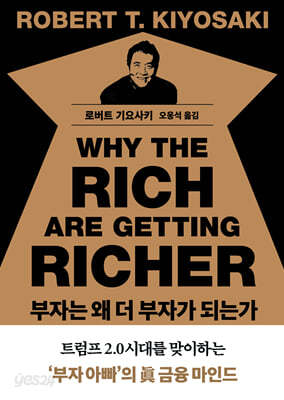
Why the Rich Get Richer
 |
Description
Book Introduction
- A word from MD
-
What is true financial education?A new way of thinking about finance, as told by Robert Kiyosaki in "Rich Dad, Poor Dad."
Emphasizes the importance of practical financial education that fosters financial literacy and financial IQ, which helps people understand the language of money.
Breaking the mold of conventional thinking, we present new concepts and innovative methods to increase wealth by leveraging assets.
February 14, 2025. Economics and Management PD Oh Da-eun
The True Financial Mindset of "Rich Dad" in the Trump 2.0 Era
“If ‘Rich Dad Poor Dad’ was an elementary school,
This book, “Why the Rich Get Richer,” is a graduate school!”
In an era of increasing uncertainty and widening disparities between the rich, middle class, and poor, the book "Why the Rich Get Richer," which contains the essence of "true financial education," has been published by Minumsa.
This book is part of the million-selling "Rich Dad Poor Dad" series, which has sold over 40 million copies worldwide. It reveals that the difference between the rich and the poor, who become even richer when the middle class and the poor are in crisis, lies in the financial mindset of the rich who actively utilize taxes, market crashes, and debt.
It also leads to practical financial education by awakening new financial thinking methods such as 'financial literacy', 'Porsche economics', and 'phantom income', which are reading and understanding the language of money.
Kiyosaki points out that the traditional formula for success—"go to a good school, get a job, work hard to pay off debt, and invest in the stock market for the long term"—is no longer valid today.
Due to globalization, manufacturing jobs have already moved to countries like China, India, and Mexico, and even office jobs are being threatened by the advancement of robotics technology.
The author diagnoses that the era of stimulating the economy through monetary policies that print money indefinitely is over, and emphasizes that in today's world where only the rich are getting richer, it is important to shift to a rich mindset that "doesn't work for money."
Throughout the book, the author mentions President Trump, who, like himself, achieved success by receiving practical financial education from a "rich father."
In fact, Kiyosaki and President Trump have written two books together, emphasizing the need for true financial education, with a philosophy that emphasizes the need to "teach a man to fish" rather than "give him a fish." They are deeply concerned about the current state of financial education.
The author argues that even President Trump cannot solve every individual's financial difficulties, so each individual must increase their financial literacy and financial IQ to take charge of their own lives.
As we enter the era of Trump 2.0, this book will serve as a clear guide for those who wish to view the current situation not as a crisis but as a new opportunity to cultivate a wealthy mindset.
“If ‘Rich Dad Poor Dad’ was an elementary school,
This book, “Why the Rich Get Richer,” is a graduate school!”
In an era of increasing uncertainty and widening disparities between the rich, middle class, and poor, the book "Why the Rich Get Richer," which contains the essence of "true financial education," has been published by Minumsa.
This book is part of the million-selling "Rich Dad Poor Dad" series, which has sold over 40 million copies worldwide. It reveals that the difference between the rich and the poor, who become even richer when the middle class and the poor are in crisis, lies in the financial mindset of the rich who actively utilize taxes, market crashes, and debt.
It also leads to practical financial education by awakening new financial thinking methods such as 'financial literacy', 'Porsche economics', and 'phantom income', which are reading and understanding the language of money.
Kiyosaki points out that the traditional formula for success—"go to a good school, get a job, work hard to pay off debt, and invest in the stock market for the long term"—is no longer valid today.
Due to globalization, manufacturing jobs have already moved to countries like China, India, and Mexico, and even office jobs are being threatened by the advancement of robotics technology.
The author diagnoses that the era of stimulating the economy through monetary policies that print money indefinitely is over, and emphasizes that in today's world where only the rich are getting richer, it is important to shift to a rich mindset that "doesn't work for money."
Throughout the book, the author mentions President Trump, who, like himself, achieved success by receiving practical financial education from a "rich father."
In fact, Kiyosaki and President Trump have written two books together, emphasizing the need for true financial education, with a philosophy that emphasizes the need to "teach a man to fish" rather than "give him a fish." They are deeply concerned about the current state of financial education.
The author argues that even President Trump cannot solve every individual's financial difficulties, so each individual must increase their financial literacy and financial IQ to take charge of their own lives.
As we enter the era of Trump 2.0, this book will serve as a clear guide for those who wish to view the current situation not as a crisis but as a new opportunity to cultivate a wealthy mindset.
- You can preview some of the book's contents.
Preview
index
Robert Kiyosaki on Why Tom Wheelwright?
Introduction - Market Crashes Are Opportunities to Get Rich
Entering
PART 1: Why the Rich Get Richer
Chapter 1 What Should I Do with My Money?
Chapter 2: Why Savers Are Losers
Chapter 3: Why the Rich Use Taxes to Get Richer
Chapter 4: Why Mistakes Make the Rich Richer
Chapter 5: Why Crashes Make the Rich Richer
Chapter 6: Why Debt Makes the Rich Richer
PART 2: Why Learn the Language of Money
Chapter 7 What Financial Education Isn't
Chapter 8 Are You Financially Literate?
PART 3: What is True Financial Education?
Chapter 9: Why Rich People Play Monopoly
Chapter 10 The Rich's Income is Phantom Income
Chapter 11 How to Become the Master of Money
Chapter 12 Is there a Plan B?
Chapter 13 How to Escape Poverty
PART 4 Porsche Economics
Chapter 14 How Porsche Makes You Richer
Coming out
Reviews
A Message to Millennials
Bonus Section
About the Author
About the Advisor
Introduction - Market Crashes Are Opportunities to Get Rich
Entering
PART 1: Why the Rich Get Richer
Chapter 1 What Should I Do with My Money?
Chapter 2: Why Savers Are Losers
Chapter 3: Why the Rich Use Taxes to Get Richer
Chapter 4: Why Mistakes Make the Rich Richer
Chapter 5: Why Crashes Make the Rich Richer
Chapter 6: Why Debt Makes the Rich Richer
PART 2: Why Learn the Language of Money
Chapter 7 What Financial Education Isn't
Chapter 8 Are You Financially Literate?
PART 3: What is True Financial Education?
Chapter 9: Why Rich People Play Monopoly
Chapter 10 The Rich's Income is Phantom Income
Chapter 11 How to Become the Master of Money
Chapter 12 Is there a Plan B?
Chapter 13 How to Escape Poverty
PART 4 Porsche Economics
Chapter 14 How Porsche Makes You Richer
Coming out
Reviews
A Message to Millennials
Bonus Section
About the Author
About the Advisor
Detailed image

Into the book
No one wants a market crash because a crash is fatal to the poor and the less educated.
But no one can stop the crash.
Crashes occur because the government props up the market.
A crash is caused by a number of events beyond the control of any one person.
Even the president can't stop the crash.
How we respond to and prepare for the coming crash will be crucial factors in determining our financial future in the coming years.
The choice is yours.
Would you like to prepare yourself through the financial education presented in this book?
--- p.41
This book is the graduate school version of Rich Dad Poor Dad.
This book explains what true financial education is and why the rich get richer.
The difference between the rich, the poor, and the middle class lies in education, but unfortunately, it is not the kind of education we learn in school.
True financial education must include some financial history.
This financial crisis is not a random event; it has been festering for over a century, since the Federal Reserve and the U.S. tax system were created in 1913.
--- p.48
“I have ten thousand dollars. What should I do with it?”
Countless people from all over the world ask me this question.
Everyone is looking for an easy answer, like a magic pill.
The amounts ranged from $1,000 to $2.5 million, but the questions I was asked were always the same.
“What should I do with my money?”
Then I answer like this.
“Please don’t say, ‘I don’t know anything about money.’
If you don't know what to do with your money, there are people all over the world who can tell you the answer.
Most of them would say something like this:
“Give me that money.”
--- pp.59-60
People who are not financially literate are unaware of what is happening in the global economy.
They tend to blame others for their money problems.
Most of them blame the rich for their money problems.
Most people in a financially literate society believe that they are victims of the tax system.
That's why people get angry when they hear that the rich pay almost no taxes.
Rather than finding ways for the rich to pay less in taxes (or to minimize the amount of taxes they have to pay), these people call the rich “thieves” and “scammers.”
--- p.194
Like many things in life, financial education is a process that involves the following steps:
· Financial education improves financial literacy.
· Financial literacy develops financial problem-solving skills.
· Solving financial problems makes you smarter about your finances.
· And people who are smarter about finance become richer.
Q: Does this mean that the more money problems I solve, the richer I become?
A: Yes.
The rich can often solve financial problems that the poor and middle class cannot.
Q: So, if we don't solve our money problems, we'll become poorer?
A: Yes.
If you don't address that problem, it will pile up like unpaid bills and cause big problems.
--- pp.196-197
Money is language.
Learning how to become rich is a lot like learning a foreign language.
Because it takes time, practice, and effort.
Poor people speak the same language.
They use the language of poverty.
They think and communicate in the language of the poor, and they use that language as well.
The phrases they use most often are “I can’t afford it” and “I can’t do it.”
Unless we change these words, little else will change.
--- p.212
Phantom income from debt is the time and money saved by borrowing money instead of working to earn it, paying taxes on it, and saving.
In the example we looked at earlier, we explained that the $20,000 deposit was actually $35,000 of ordinary income.
The difference of $15,000 is phantom income, and that much money and time has been saved.
If you know how to use debt as money, you can get rich faster.
--- pp.245-246
The cash flow generated from the assets will cover the monthly payments on the Porsche loan.
And after a few years, when the Porsche loan is paid off, Kim and I will own the Porsche, the assets, and the cash flows from those assets.
We also received phantom income from the appreciation, depreciation, and repayment of debt on our Porsche and other investment assets.
Kim understood my plan to purchase this Porsche and actually went through the deal with me.
But no one can stop the crash.
Crashes occur because the government props up the market.
A crash is caused by a number of events beyond the control of any one person.
Even the president can't stop the crash.
How we respond to and prepare for the coming crash will be crucial factors in determining our financial future in the coming years.
The choice is yours.
Would you like to prepare yourself through the financial education presented in this book?
--- p.41
This book is the graduate school version of Rich Dad Poor Dad.
This book explains what true financial education is and why the rich get richer.
The difference between the rich, the poor, and the middle class lies in education, but unfortunately, it is not the kind of education we learn in school.
True financial education must include some financial history.
This financial crisis is not a random event; it has been festering for over a century, since the Federal Reserve and the U.S. tax system were created in 1913.
--- p.48
“I have ten thousand dollars. What should I do with it?”
Countless people from all over the world ask me this question.
Everyone is looking for an easy answer, like a magic pill.
The amounts ranged from $1,000 to $2.5 million, but the questions I was asked were always the same.
“What should I do with my money?”
Then I answer like this.
“Please don’t say, ‘I don’t know anything about money.’
If you don't know what to do with your money, there are people all over the world who can tell you the answer.
Most of them would say something like this:
“Give me that money.”
--- pp.59-60
People who are not financially literate are unaware of what is happening in the global economy.
They tend to blame others for their money problems.
Most of them blame the rich for their money problems.
Most people in a financially literate society believe that they are victims of the tax system.
That's why people get angry when they hear that the rich pay almost no taxes.
Rather than finding ways for the rich to pay less in taxes (or to minimize the amount of taxes they have to pay), these people call the rich “thieves” and “scammers.”
--- p.194
Like many things in life, financial education is a process that involves the following steps:
· Financial education improves financial literacy.
· Financial literacy develops financial problem-solving skills.
· Solving financial problems makes you smarter about your finances.
· And people who are smarter about finance become richer.
Q: Does this mean that the more money problems I solve, the richer I become?
A: Yes.
The rich can often solve financial problems that the poor and middle class cannot.
Q: So, if we don't solve our money problems, we'll become poorer?
A: Yes.
If you don't address that problem, it will pile up like unpaid bills and cause big problems.
--- pp.196-197
Money is language.
Learning how to become rich is a lot like learning a foreign language.
Because it takes time, practice, and effort.
Poor people speak the same language.
They use the language of poverty.
They think and communicate in the language of the poor, and they use that language as well.
The phrases they use most often are “I can’t afford it” and “I can’t do it.”
Unless we change these words, little else will change.
--- p.212
Phantom income from debt is the time and money saved by borrowing money instead of working to earn it, paying taxes on it, and saving.
In the example we looked at earlier, we explained that the $20,000 deposit was actually $35,000 of ordinary income.
The difference of $15,000 is phantom income, and that much money and time has been saved.
If you know how to use debt as money, you can get rich faster.
--- pp.245-246
The cash flow generated from the assets will cover the monthly payments on the Porsche loan.
And after a few years, when the Porsche loan is paid off, Kim and I will own the Porsche, the assets, and the cash flows from those assets.
We also received phantom income from the appreciation, depreciation, and repayment of debt on our Porsche and other investment assets.
Kim understood my plan to purchase this Porsche and actually went through the deal with me.
--- p.334
Publisher's Review
Develop financial literacy skills you can't learn in school.
Kiyosaki warns that “the widening gap between the wealthy and the rest of the population today is a moral crisis and a social time bomb.”
This book asks the fundamental question, "What do schools teach us about money?" and traces what true financial education is, drawing on his own experiences with financial education, which he was unable to receive at school and from his poor father.
The author emphasizes financial literacy, the ability to read and understand the language of money, from the perspective that "money is another language." He explains the history of money and the operating principles of the banking system, and clearly shows the tax strategies and debt management methods actually used by the wealthy by contrasting them with general financial common sense.
The book also includes practical tax tips from Tom Wheelwright, a CPA who speaks at conferences around the world about his innovative approach to financial and tax management, and Kiyosaki's Q&A with frequently asked questions, providing readers with practical help navigating their educational and financial challenges.
New Financial Thinking: "Porsche Economics" and "Phantom Income"
Kiyosaki overturns the traditional way of thinking that views consumption as mere spending, and presents innovative approaches and new concepts that leverage assets to increase wealth.
The author shares an anecdote about how he actually increased his net worth by owning a Porsche without any debt, and explains how, instead of purchasing the item outright, he first secured an asset (a mini warehouse) and then used the cash flow (rental income) from that asset to pay off his debt (a car loan).
Additionally, it provides specific ways to save on taxes and accumulate wealth by taking advantage of debt and asset appreciation, depreciation benefits, and other benefits through the concept of "phantom income," which refers to income that is not visible.
Phantom income is an efficient way to maximize capital utilization, as it allows you to generate indirect income through low- or no-tax methods and secure capital without selling assets.
As the author himself emphasized, “If ‘Rich Dad Poor Dad’ was elementary school, then this book ‘Why the Rich Get Richer’ is graduate school,” this new financial thinking and advanced investment knowledge can be usefully utilized as a strategy to effectively increase wealth.
Kiyosaki warns that “the widening gap between the wealthy and the rest of the population today is a moral crisis and a social time bomb.”
This book asks the fundamental question, "What do schools teach us about money?" and traces what true financial education is, drawing on his own experiences with financial education, which he was unable to receive at school and from his poor father.
The author emphasizes financial literacy, the ability to read and understand the language of money, from the perspective that "money is another language." He explains the history of money and the operating principles of the banking system, and clearly shows the tax strategies and debt management methods actually used by the wealthy by contrasting them with general financial common sense.
The book also includes practical tax tips from Tom Wheelwright, a CPA who speaks at conferences around the world about his innovative approach to financial and tax management, and Kiyosaki's Q&A with frequently asked questions, providing readers with practical help navigating their educational and financial challenges.
New Financial Thinking: "Porsche Economics" and "Phantom Income"
Kiyosaki overturns the traditional way of thinking that views consumption as mere spending, and presents innovative approaches and new concepts that leverage assets to increase wealth.
The author shares an anecdote about how he actually increased his net worth by owning a Porsche without any debt, and explains how, instead of purchasing the item outright, he first secured an asset (a mini warehouse) and then used the cash flow (rental income) from that asset to pay off his debt (a car loan).
Additionally, it provides specific ways to save on taxes and accumulate wealth by taking advantage of debt and asset appreciation, depreciation benefits, and other benefits through the concept of "phantom income," which refers to income that is not visible.
Phantom income is an efficient way to maximize capital utilization, as it allows you to generate indirect income through low- or no-tax methods and secure capital without selling assets.
As the author himself emphasized, “If ‘Rich Dad Poor Dad’ was elementary school, then this book ‘Why the Rich Get Richer’ is graduate school,” this new financial thinking and advanced investment knowledge can be usefully utilized as a strategy to effectively increase wealth.
GOODS SPECIFICS
- Date of issue: February 5, 2025
- Format: Paperback book binding method guide
- Page count, weight, size: 388 pages | 466g | 148*210*20mm
- ISBN13: 9791170525516
- ISBN10: 1170525512
You may also like
카테고리
korean


korean

![GQ KOREA Mark (Monthly): December [2025]](http://librairie.coreenne.fr/cdn/shop/files/8ef265dbbfbf186523ed75ba7319009d.jpg?v=1765340328&width=3840)


