

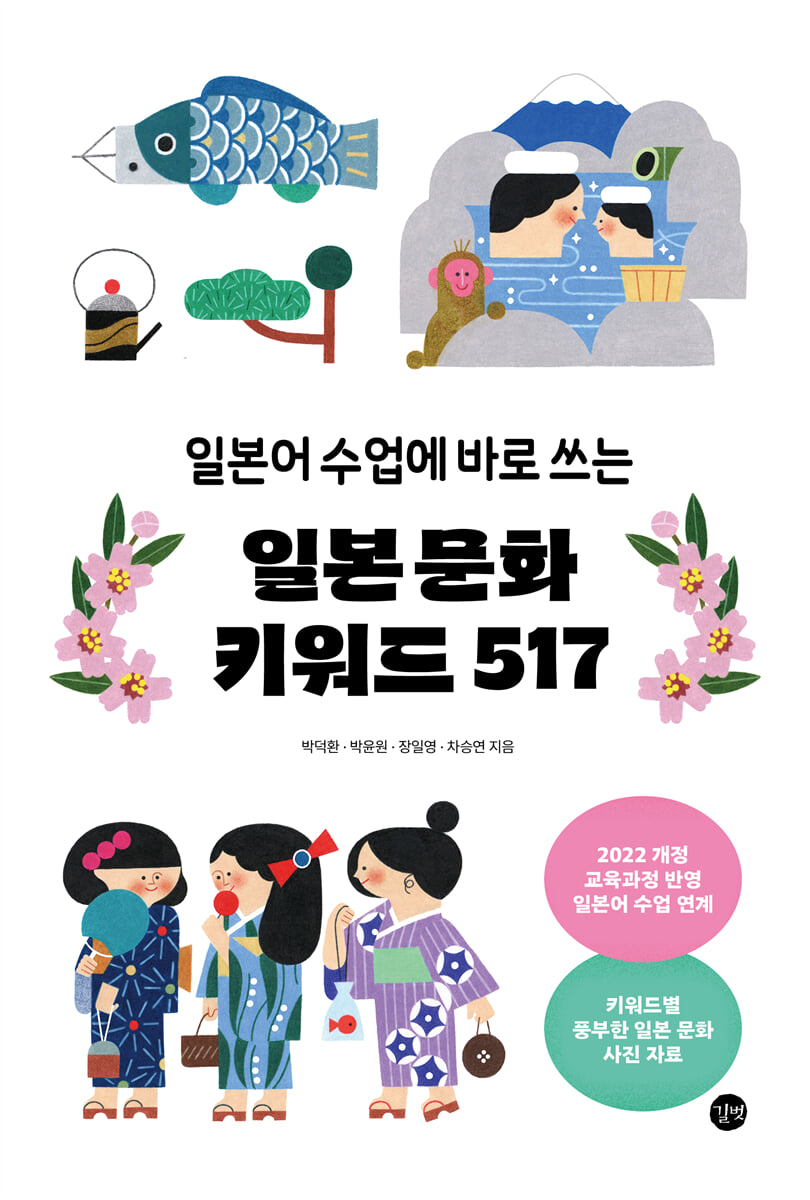
Japanese Culture Keywords 517
 |
Description
Book Introduction
Japanese Culture Adds Flavor to Classes
With the 2022 revised curriculum now fully implemented, an educational approach to "culture" is becoming increasingly important in Japanese language classes in middle and high schools.
In line with this, 『517 Japanese Culture Keywords』, written and reviewed by current Japanese language teachers, has been published.
This book is a cultural keyword commentary that vividly explains the core concepts and terms of the "Japanese Culture" textbook with photographs.
The book was written by four authors with extensive textbook writing experience, with 34 Japanese language teachers from across the country participating as reviewers to ensure that it contains content that can be immediately applied in actual classes.
In particular, it covers a wide range of topics from traditional Japanese culture to modern popular culture, and was designed with students' interests and understanding in mind.
"517 Japanese Culture Keywords" is different in that it is not a simple dictionary-style list, but rather a "classroom-style content" tailored to the flow of the class.
Each keyword is accompanied by a relevant photo and intuitive description, which can be useful for supplementing the teacher's explanation or for students to learn the cultural background on their own.
As the trend of teaching language and culture together in Japanese classes is strengthening, this book is expected to become an essential resource in educational settings.
With the 2022 revised curriculum now fully implemented, an educational approach to "culture" is becoming increasingly important in Japanese language classes in middle and high schools.
In line with this, 『517 Japanese Culture Keywords』, written and reviewed by current Japanese language teachers, has been published.
This book is a cultural keyword commentary that vividly explains the core concepts and terms of the "Japanese Culture" textbook with photographs.
The book was written by four authors with extensive textbook writing experience, with 34 Japanese language teachers from across the country participating as reviewers to ensure that it contains content that can be immediately applied in actual classes.
In particular, it covers a wide range of topics from traditional Japanese culture to modern popular culture, and was designed with students' interests and understanding in mind.
"517 Japanese Culture Keywords" is different in that it is not a simple dictionary-style list, but rather a "classroom-style content" tailored to the flow of the class.
Each keyword is accompanied by a relevant photo and intuitive description, which can be useful for supplementing the teacher's explanation or for students to learn the cultural background on their own.
As the trend of teaching language and culture together in Japanese classes is strengthening, this book is expected to become an essential resource in educational settings.
- You can preview some of the book's contents.
Preview
index
Chapter 1: Neighboring Japan
-Island nation Japan
-Administrative districts and tourist attractions
-Symbols and currency
Chapter 2: Japanese Words and Actions
-Japanese composition
-Japanese language and culture
-Japanese nonverbal culture
Chapter 3: A Japanese Life and a Year
-Rite of passage
- Annual events and public holidays
-Gift culture
Chapter 4: Japanese Food Culture
-Characteristics of Japanese food
- Representative Japanese food
-Japanese dining etiquette
Chapter 5: Japanese Clothing and Housing Culture
-Japanese clothing culture
-Japanese housing culture
-Living environment and visiting etiquette
Chapter 6: Japanese Daily Life - Japan's Education and Entrance Exam System
-Transportation in Japan
-Japan's environment
Chapter 7 Japanese Popular Culture
-Popular culture
-Japanese literature
- Popular sports
Chapter 8: Traditional Japanese Culture - Traditional Arts and Performing Arts
-Matsuri
-Traditional games and good luck and wishes
-Island nation Japan
-Administrative districts and tourist attractions
-Symbols and currency
Chapter 2: Japanese Words and Actions
-Japanese composition
-Japanese language and culture
-Japanese nonverbal culture
Chapter 3: A Japanese Life and a Year
-Rite of passage
- Annual events and public holidays
-Gift culture
Chapter 4: Japanese Food Culture
-Characteristics of Japanese food
- Representative Japanese food
-Japanese dining etiquette
Chapter 5: Japanese Clothing and Housing Culture
-Japanese clothing culture
-Japanese housing culture
-Living environment and visiting etiquette
Chapter 6: Japanese Daily Life - Japan's Education and Entrance Exam System
-Transportation in Japan
-Japan's environment
Chapter 7 Japanese Popular Culture
-Popular culture
-Japanese literature
- Popular sports
Chapter 8: Traditional Japanese Culture - Traditional Arts and Performing Arts
-Matsuri
-Traditional games and good luck and wishes
Detailed image

Publisher's Review
Written by current high school Japanese language teachers and reviewed by 34 current Japanese language teachers, "517 Keywords for Japanese Culture" was composed with consideration for students' level and interests.
This book, which explains key cultural terms from the "Japanese Culture" textbook with rich explanations and photographs, is highly recommended as a learning resource to aid understanding of Japanese culture classes.
-Features of this book-
one.
A composition that covers a wide range of topics, from traditional Japanese culture to modern culture.
two.
Easy and fun cultural learning with photos, illustrations, and descriptions by cultural keyword.
three.
Intuitive understanding differentiated from existing Japanese culture textbooks
four.
Increase student engagement with content tailored to their level!
This book was created by middle and high school teachers who teach Japanese in the field to improve their classes.
It will be a useful textbook for both teachers who teach Japanese and students who are learning Japanese.
How to get 200% out of this book
This book is not just a simple dictionary of common sense.
It can be the best Japanese culture lesson material to stimulate students' interest and encourage participation in class.
Use the tips below to create a lively class.
Oh, look.
First, we're going to be a Japan travel guide! (Topic presentation and research study)
● How do I do it?
Students choose one region from the book, such as 'Kanto', 'Kansai', or 'Kyushu', and plan and present their own travel itinerary.
Use the information about the attractions, food, and festivals (matsuri) of each region introduced in the book to create a specific itinerary, such as 'Day 1: Visit Asakusa Sensoji Temple, then admire the night view of Skytree!' or 'Day 2: Enjoy hot springs in Hakone!'
● Expected effects
You can develop self-directed learning skills and presentation skills.
You can feel a sense of accomplishment in the process of integrating scattered information into a single, complete result.
Second, Challenge! Japanese Culture Golden Bell (Quiz and Game)
● How do I do it?
As the teacher reads the descriptions of keywords in the book, students play a quiz game where they guess the keywords (e.g., 'sushi', 'kimono').
It's even more exciting when it's played as a team competition.
Adjust the difficulty and score of the questions by the number of stars (★) displayed in the book.
● Expected effects
You can learn Japanese cultural knowledge in a fun way through a game format, and increase concentration and participation in class.
You will learn core keywords naturally and repeatedly.
Third, a 'cultural map' made with associative words (mind map activity)
● How do I do it?
Pick a central keyword, like 'festival,' and find related words in the book and connect them into a mind map.
For example, it is a method of branching out from ‘Matsuri’ to ‘Yatai’, ‘Omikoshi’, and ‘Hanabi’.
● Expected effects
You can gain a three-dimensional understanding of how one culture organically connects with other cultural elements.
Creative thinking and conceptual organization skills are improved.
Fourth, Japanese cultural "speed games" (vocabulary expansion games)
● How do I do it?
A student looks at a keyword in a book (e.g., "okonomiyaki") and expresses it through gestures or a simple explanation without saying the word directly.
Other team members listen to the explanation and guess the keywords.
The team that guesses more words within the time limit wins.
● Expected effects
You can develop quick thinking and expressive skills, and learn difficult cultural concepts easily and enjoyably.
It is also effective in fostering cooperation among team members.
Fifth, I'm a Cartoonist, Too! Drawing a "4-Panel Cultural Comic" (Creative Activity)
● How do I do it?
Let's draw a 4-panel comic about cultural common sense or customs learned from books (e.g., "okaeshi" culture of returning a gift, "hatsumode" visiting a shrine on New Year's Day).
This activity reinterprets and expresses Japan's unique culture from the students' perspective.
● Expected effects
It provides opportunities to increase cultural understanding and unleash creativity.
By sharing your work with your friends, you will learn about different ideas and ways of expressing yourself.
◆ A word from teachers who have read this book in advance
The explanations are concise and easy to understand, along with the photos. The overall structure is clean and readable, so I think students will be able to learn about Japanese culture more enjoyably.
Additionally, the content is well-aligned with the Japanese culture of the 2022 revised curriculum, making it easy for students to understand Japan and its culture, and is expected to be highly useful as a learning aid in class.
- Jo Min-seo, Gwangyang High School, Seoul
Basic Japanese cultural terms are clearly organized, making them easy to access and comfortable.
I think it would be useful if you want to learn about Japanese culture or expand on related content.
- Incheon Inil Girls' High School, Ahn Young-seon
Thanks to the core keyword structure that incorporates field experience, you can draw a clearer picture of the flow of Japanese culture classes.
This is a must-have book for teachers, bridging the gap between textbooks and classroom instruction.
- Suncheon Palma High School, Oh Hyeon-tae
Because a wealth of Japanese cultural knowledge is categorized by keyword, much like a dictionary, you can quickly and easily find just the information you're interested in, and it's also great for viewing content covering a specific topic in general.
I think it would be useful to keep it next to me during Japanese culture classes, and use it like a dictionary so I can look up anything I'm curious about at any time.
- Seoul Seongam International Trade High School, Yoo Sang-in
It consists of a variety of materials, including Japanese lifestyle, culture, and regions, and presents various keywords that allow students to explore their career paths, academic advancement, and areas of interest, making it highly useful in Japanese culture classes.
- Gyeonggi Gyeongmin High School, An Ju-hyeon
This book provides a detailed introduction to all aspects of Japanese culture.
From traditional culture to modern culture, it covers everything from current Japanese social phenomena to common sense about daily life in Japan.
It can be said to be an encyclopedia of Japanese cultural knowledge that allows you to learn about Japanese history and culture, traditions and etiquette, and even modern times and trends.
- Gyeonggi Okjeong High School, Heo Myeong-hee
"517 Japanese Culture Keywords" is designed to provide an in-depth understanding of Japanese society and culture, including daily life, traditional culture, and popular culture, in line with the 2022 revised curriculum.
I recommend this textbook because it not only builds background knowledge about Japan, but also helps you learn and develop the ability to communicate with Japan from an intercultural perspective.
- Lee Yun-shin, Daeseong High School, Seoul
This book explains Japanese culture in general in an easy-to-understand way for students.
It connects the cultural and historical background of Japanese daily life, not covered in textbooks, at a glance, so it can be utilized in classroom lessons, club activities, and self-directed learning, and you can develop a sense of cultural comparison through discussions with friends.
This is a must-read book that provides a comprehensive overview of Japanese culture, past and present.
- Kim Su-nam, Samil High School, Gangwon
This book, which explains key cultural terms from the "Japanese Culture" textbook with rich explanations and photographs, is highly recommended as a learning resource to aid understanding of Japanese culture classes.
-Features of this book-
one.
A composition that covers a wide range of topics, from traditional Japanese culture to modern culture.
two.
Easy and fun cultural learning with photos, illustrations, and descriptions by cultural keyword.
three.
Intuitive understanding differentiated from existing Japanese culture textbooks
four.
Increase student engagement with content tailored to their level!
This book was created by middle and high school teachers who teach Japanese in the field to improve their classes.
It will be a useful textbook for both teachers who teach Japanese and students who are learning Japanese.
How to get 200% out of this book
This book is not just a simple dictionary of common sense.
It can be the best Japanese culture lesson material to stimulate students' interest and encourage participation in class.
Use the tips below to create a lively class.
Oh, look.
First, we're going to be a Japan travel guide! (Topic presentation and research study)
● How do I do it?
Students choose one region from the book, such as 'Kanto', 'Kansai', or 'Kyushu', and plan and present their own travel itinerary.
Use the information about the attractions, food, and festivals (matsuri) of each region introduced in the book to create a specific itinerary, such as 'Day 1: Visit Asakusa Sensoji Temple, then admire the night view of Skytree!' or 'Day 2: Enjoy hot springs in Hakone!'
● Expected effects
You can develop self-directed learning skills and presentation skills.
You can feel a sense of accomplishment in the process of integrating scattered information into a single, complete result.
Second, Challenge! Japanese Culture Golden Bell (Quiz and Game)
● How do I do it?
As the teacher reads the descriptions of keywords in the book, students play a quiz game where they guess the keywords (e.g., 'sushi', 'kimono').
It's even more exciting when it's played as a team competition.
Adjust the difficulty and score of the questions by the number of stars (★) displayed in the book.
● Expected effects
You can learn Japanese cultural knowledge in a fun way through a game format, and increase concentration and participation in class.
You will learn core keywords naturally and repeatedly.
Third, a 'cultural map' made with associative words (mind map activity)
● How do I do it?
Pick a central keyword, like 'festival,' and find related words in the book and connect them into a mind map.
For example, it is a method of branching out from ‘Matsuri’ to ‘Yatai’, ‘Omikoshi’, and ‘Hanabi’.
● Expected effects
You can gain a three-dimensional understanding of how one culture organically connects with other cultural elements.
Creative thinking and conceptual organization skills are improved.
Fourth, Japanese cultural "speed games" (vocabulary expansion games)
● How do I do it?
A student looks at a keyword in a book (e.g., "okonomiyaki") and expresses it through gestures or a simple explanation without saying the word directly.
Other team members listen to the explanation and guess the keywords.
The team that guesses more words within the time limit wins.
● Expected effects
You can develop quick thinking and expressive skills, and learn difficult cultural concepts easily and enjoyably.
It is also effective in fostering cooperation among team members.
Fifth, I'm a Cartoonist, Too! Drawing a "4-Panel Cultural Comic" (Creative Activity)
● How do I do it?
Let's draw a 4-panel comic about cultural common sense or customs learned from books (e.g., "okaeshi" culture of returning a gift, "hatsumode" visiting a shrine on New Year's Day).
This activity reinterprets and expresses Japan's unique culture from the students' perspective.
● Expected effects
It provides opportunities to increase cultural understanding and unleash creativity.
By sharing your work with your friends, you will learn about different ideas and ways of expressing yourself.
◆ A word from teachers who have read this book in advance
The explanations are concise and easy to understand, along with the photos. The overall structure is clean and readable, so I think students will be able to learn about Japanese culture more enjoyably.
Additionally, the content is well-aligned with the Japanese culture of the 2022 revised curriculum, making it easy for students to understand Japan and its culture, and is expected to be highly useful as a learning aid in class.
- Jo Min-seo, Gwangyang High School, Seoul
Basic Japanese cultural terms are clearly organized, making them easy to access and comfortable.
I think it would be useful if you want to learn about Japanese culture or expand on related content.
- Incheon Inil Girls' High School, Ahn Young-seon
Thanks to the core keyword structure that incorporates field experience, you can draw a clearer picture of the flow of Japanese culture classes.
This is a must-have book for teachers, bridging the gap between textbooks and classroom instruction.
- Suncheon Palma High School, Oh Hyeon-tae
Because a wealth of Japanese cultural knowledge is categorized by keyword, much like a dictionary, you can quickly and easily find just the information you're interested in, and it's also great for viewing content covering a specific topic in general.
I think it would be useful to keep it next to me during Japanese culture classes, and use it like a dictionary so I can look up anything I'm curious about at any time.
- Seoul Seongam International Trade High School, Yoo Sang-in
It consists of a variety of materials, including Japanese lifestyle, culture, and regions, and presents various keywords that allow students to explore their career paths, academic advancement, and areas of interest, making it highly useful in Japanese culture classes.
- Gyeonggi Gyeongmin High School, An Ju-hyeon
This book provides a detailed introduction to all aspects of Japanese culture.
From traditional culture to modern culture, it covers everything from current Japanese social phenomena to common sense about daily life in Japan.
It can be said to be an encyclopedia of Japanese cultural knowledge that allows you to learn about Japanese history and culture, traditions and etiquette, and even modern times and trends.
- Gyeonggi Okjeong High School, Heo Myeong-hee
"517 Japanese Culture Keywords" is designed to provide an in-depth understanding of Japanese society and culture, including daily life, traditional culture, and popular culture, in line with the 2022 revised curriculum.
I recommend this textbook because it not only builds background knowledge about Japan, but also helps you learn and develop the ability to communicate with Japan from an intercultural perspective.
- Lee Yun-shin, Daeseong High School, Seoul
This book explains Japanese culture in general in an easy-to-understand way for students.
It connects the cultural and historical background of Japanese daily life, not covered in textbooks, at a glance, so it can be utilized in classroom lessons, club activities, and self-directed learning, and you can develop a sense of cultural comparison through discussions with friends.
This is a must-read book that provides a comprehensive overview of Japanese culture, past and present.
- Kim Su-nam, Samil High School, Gangwon
GOODS SPECIFICS
- Date of issue: July 15, 2025
- Page count, weight, size: 320 pages | 588g | 152*225*19mm
- ISBN13: 9791140714858
You may also like
카테고리
korean


korean

![GQ KOREA Mark (Monthly): December [2025]](http://librairie.coreenne.fr/cdn/shop/files/8ef265dbbfbf186523ed75ba7319009d.jpg?v=1765340328&width=3840)


