

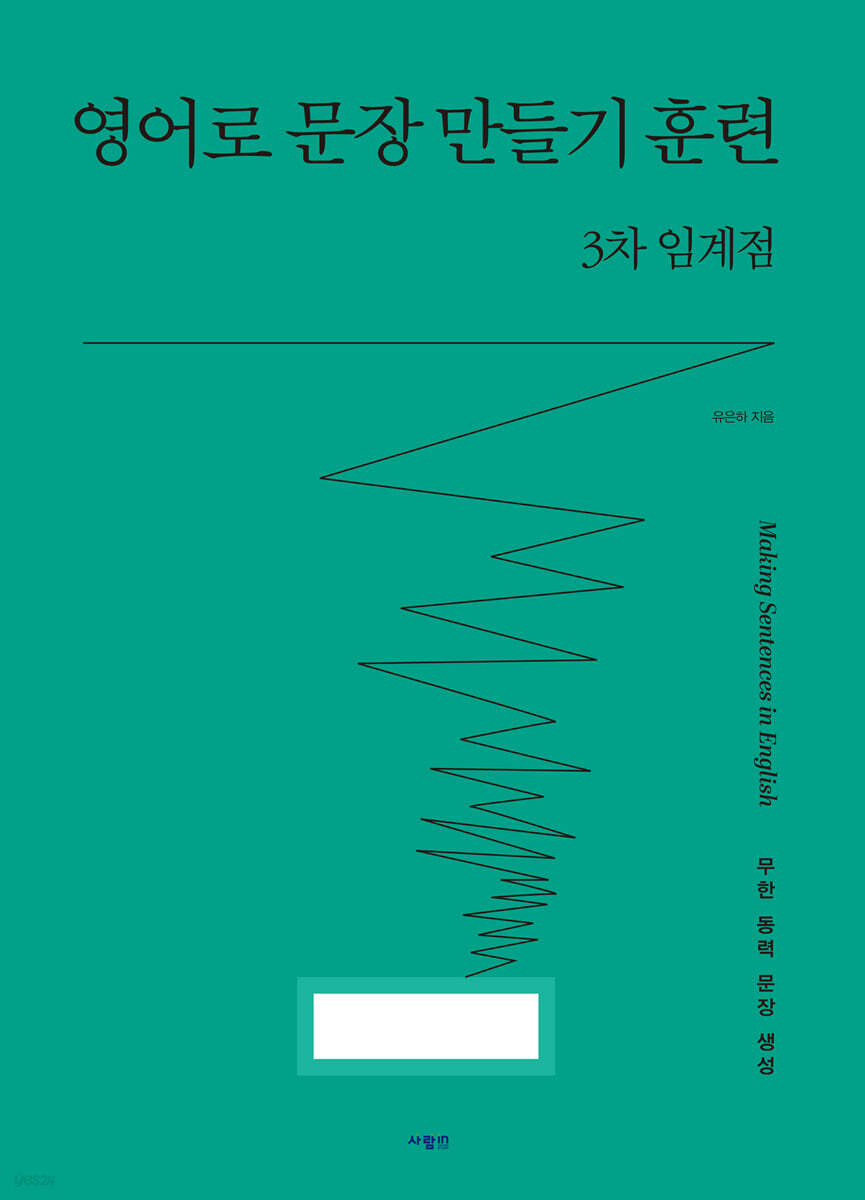
Third critical point of sentence-making training in English
 |
Description
Book Introduction
-You can make sentences in English, even using special phrases.
What learners need to do beyond the stage of constructing sentences using English sentence structure is to learn how native speakers express themselves in ways different from the existing structure according to their intentions.
In "Training to Create Sentences in English: The Third Critical Point," we focus on indirect questions that politely express what you want to say, participle phrases that increase sentence economy, and special phrases that are difficult for non-native speakers to use.
In particular, apposition, omission, insertion, origin sentence, inversion, parallelism, repetition, and preposition are things that we have encountered in grammar books, but have never written with a pen, and are essential for high-level conversation and reading comprehension.
Let's build your writing skills to a third critical point, unlike others.
What learners need to do beyond the stage of constructing sentences using English sentence structure is to learn how native speakers express themselves in ways different from the existing structure according to their intentions.
In "Training to Create Sentences in English: The Third Critical Point," we focus on indirect questions that politely express what you want to say, participle phrases that increase sentence economy, and special phrases that are difficult for non-native speakers to use.
In particular, apposition, omission, insertion, origin sentence, inversion, parallelism, repetition, and preposition are things that we have encountered in grammar books, but have never written with a pen, and are essential for high-level conversation and reading comprehension.
Let's build your writing skills to a third critical point, unlike others.
- You can preview some of the book's contents.
Preview
index
Making Sentences in English: Beginning is the Beginning
Features and structure of this book
WARM-UP: Two Principles That Make Any English Sentence Easier
CHAPTER 1 The nuances of a single difference expressed with auxiliary verbs
UNIT 1 Creating used to sentences expressing past habits and states
UNIT 2 Making would sentences with polite nuance
UNIT 3 Making would sentences using 'guess' and 'expect'
UNIT 4 'should have pp' expressing regret
Making sentences
UNIT 5 The Secretly Tricky Might/Could/Must Have pp
Making sentences
UNIT 6 Making sentences with different meanings of be able to and will be able to
STEP UP YOUR WRITING
CHAPTER 2 Enriching Your Sentences with Comparative and Superlative Degrees
UNIT 1 Making Comparative Sentences 1
UNIT 2 Making Comparative Sentences 2
UNIT 3 Making Comparative Sentences 3
UNIT 4 Making Comparative Sentences 4
UNIT 5 Making Comparative Sentences 5
UNIT 6 Making Comparative Sentences 6
STEP UP YOUR WRITING
CHAPTER 3 Asking/Requesting Politely
UNIT 1: Creating Polite Direct Questions
UNIT 2: Creating Polite Indirect Questions 1
UNIT 3: Creating Polite Indirect Questions 2
UNIT 4: Creating Polite Indirect Questions 3
UNIT 5: Creating Polite Indirect Questions 4
UNIT 6 Creating Additional Questions
STEP UP YOUR WRITING
CHAPTER 4 Expanding Sentences with Relative Clauses
UNIT 1 Relative Clauses 1 (Nominative and Objective Cases of Relative Pronouns)
UNIT 2 Relative Clauses 2 (When Only the Relative Pronoun "that" Must Be Used)
UNIT 3 Relative Clauses 3 (Possessive Case of Relative Pronouns)
UNIT 4 Relative Clauses 4 (Continuous Use)
UNIT 5 Relative Clauses 5 (which receives the entire sentence)
STEP UP YOUR WRITING
CHAPTER 5 Expanding Sentences with Complex Relatives
UNIT 1 Complex Relatives 1 (Making Noun Clauses with Whoever, Whatever, and Whichever)
UNIT 2 Complex Relatives 2 (Making Adverbial Clauses with Whoever, Whatever, and Whichever)
UNIT 3 Complex Relational Words 3 (Making Adverbial Clauses with Wherever, Whenever, and However)
UNIT 4 Complex Relational Words 4 (When the Verb is Omitted)
STEP UP YOUR WRITING
CHAPTER 6 Creating more concise and sophisticated sentences with participle phrases
UNIT 1 Participle Phrases 1 (Creating Various Participle Phrases)
UNIT 2 Participle Phrases 2 (Independent Participle Phrases)
UNIT 3 Participle Phrases 3 (with + noun + participle)
STEP UP YOUR WRITING
CHAPTER 7 Creating Conditional and Conditional Sentences
UNIT 1 Creating Conditional Clauses
UNIT 2 Making Conditional Sentences 1 (Assumptions that Oppose Present Facts)
UNIT 3 Making Conditional Sentences 2 (Conditions Opposed to Past Facts)
UNIT 4 Creating Conditional Sentences 3 (Mixed Conditional)
UNIT 5 I wish conditional sentences, as if conditional sentences
UNIT 6 Making conditional sentences with if only
UNIT 7 Making conditional sentences with if it were not for
UNIT 8 Creating Conditional Sentences Without If Clauses
WRAP IT UP
STEP UP YOUR WRITING
CHAPTER 8 Sentence Reconstruction
UNIT 1 Creating Exclamations
UNIT 2: Creating Sentences Using Fronting
UNIT 3: Creating Sentences Using Inversion
UNIT 4 Creating Emphasized Sentences with Cleft Sentences
UNIT 5 Creating Emphasized Sentences Through Repetition
UNIT 6 Creating Emphatic Sentences through Parallelism
UNIT 7: Creating More Concise and Natural Sentences by Omitting
UNIT 8 Creating Rich Sentences by Inserting Additional Information
UNIT 9: Creating concise and rhythmic sentences using apposition structures
UNIT 10: Creating English Sentences with Reversal
STEP UP YOUR WRITING
Third critical point of sentence-making training in English
ANSWERS
Features and structure of this book
WARM-UP: Two Principles That Make Any English Sentence Easier
CHAPTER 1 The nuances of a single difference expressed with auxiliary verbs
UNIT 1 Creating used to sentences expressing past habits and states
UNIT 2 Making would sentences with polite nuance
UNIT 3 Making would sentences using 'guess' and 'expect'
UNIT 4 'should have pp' expressing regret
Making sentences
UNIT 5 The Secretly Tricky Might/Could/Must Have pp
Making sentences
UNIT 6 Making sentences with different meanings of be able to and will be able to
STEP UP YOUR WRITING
CHAPTER 2 Enriching Your Sentences with Comparative and Superlative Degrees
UNIT 1 Making Comparative Sentences 1
UNIT 2 Making Comparative Sentences 2
UNIT 3 Making Comparative Sentences 3
UNIT 4 Making Comparative Sentences 4
UNIT 5 Making Comparative Sentences 5
UNIT 6 Making Comparative Sentences 6
STEP UP YOUR WRITING
CHAPTER 3 Asking/Requesting Politely
UNIT 1: Creating Polite Direct Questions
UNIT 2: Creating Polite Indirect Questions 1
UNIT 3: Creating Polite Indirect Questions 2
UNIT 4: Creating Polite Indirect Questions 3
UNIT 5: Creating Polite Indirect Questions 4
UNIT 6 Creating Additional Questions
STEP UP YOUR WRITING
CHAPTER 4 Expanding Sentences with Relative Clauses
UNIT 1 Relative Clauses 1 (Nominative and Objective Cases of Relative Pronouns)
UNIT 2 Relative Clauses 2 (When Only the Relative Pronoun "that" Must Be Used)
UNIT 3 Relative Clauses 3 (Possessive Case of Relative Pronouns)
UNIT 4 Relative Clauses 4 (Continuous Use)
UNIT 5 Relative Clauses 5 (which receives the entire sentence)
STEP UP YOUR WRITING
CHAPTER 5 Expanding Sentences with Complex Relatives
UNIT 1 Complex Relatives 1 (Making Noun Clauses with Whoever, Whatever, and Whichever)
UNIT 2 Complex Relatives 2 (Making Adverbial Clauses with Whoever, Whatever, and Whichever)
UNIT 3 Complex Relational Words 3 (Making Adverbial Clauses with Wherever, Whenever, and However)
UNIT 4 Complex Relational Words 4 (When the Verb is Omitted)
STEP UP YOUR WRITING
CHAPTER 6 Creating more concise and sophisticated sentences with participle phrases
UNIT 1 Participle Phrases 1 (Creating Various Participle Phrases)
UNIT 2 Participle Phrases 2 (Independent Participle Phrases)
UNIT 3 Participle Phrases 3 (with + noun + participle)
STEP UP YOUR WRITING
CHAPTER 7 Creating Conditional and Conditional Sentences
UNIT 1 Creating Conditional Clauses
UNIT 2 Making Conditional Sentences 1 (Assumptions that Oppose Present Facts)
UNIT 3 Making Conditional Sentences 2 (Conditions Opposed to Past Facts)
UNIT 4 Creating Conditional Sentences 3 (Mixed Conditional)
UNIT 5 I wish conditional sentences, as if conditional sentences
UNIT 6 Making conditional sentences with if only
UNIT 7 Making conditional sentences with if it were not for
UNIT 8 Creating Conditional Sentences Without If Clauses
WRAP IT UP
STEP UP YOUR WRITING
CHAPTER 8 Sentence Reconstruction
UNIT 1 Creating Exclamations
UNIT 2: Creating Sentences Using Fronting
UNIT 3: Creating Sentences Using Inversion
UNIT 4 Creating Emphasized Sentences with Cleft Sentences
UNIT 5 Creating Emphasized Sentences Through Repetition
UNIT 6 Creating Emphatic Sentences through Parallelism
UNIT 7: Creating More Concise and Natural Sentences by Omitting
UNIT 8 Creating Rich Sentences by Inserting Additional Information
UNIT 9: Creating concise and rhythmic sentences using apposition structures
UNIT 10: Creating English Sentences with Reversal
STEP UP YOUR WRITING
Third critical point of sentence-making training in English
ANSWERS
Detailed image

Publisher's Review
We will focus on training special sentence structures unique to English that you need but have never practiced before!
These are special English phrases that you've only seen in grammar books, but have never actually picked up a pen and used, yet they are essential for high-level conversation and reading comprehension.
This is important because it can indicate the speaker's and writer's intentions.
The ultimate goal of any English writing training book is to go beyond simply creating sentences and reveal the writer's intentions as he or she speaks.
As you use it, the structure becomes the structure - Diversifying sentence structure through training in special English grammar.
When you create sentences using a commonly used structure, it is not very suitable when you need to express emotions, emphasize something, or convey a clean and neat feeling without any unnecessary details.
What you need then is a special syntax.
In "English Sentence Creation Training: 3rd Critical Point," we focus on training these special phrases that native speakers use in a variety of situations.
These are unique English structures that you have never properly trained anywhere, and once you learn them, the structure of your English sentences will change.
English thinking doesn't work - all Korean sentences are presented in English sentence structure.
In fact, it is difficult for Koreans to think in English.
So, I have no choice but to try to write sentences that conform to the English sentence structure as much as possible.
To this end, all Korean sentences in this book have been arranged in English sentence order.
Just as you start to repeat after hearing something over and over again, and you start to get used to it over and over again, if you keep seeing Korean sentences arranged in English sentence order, when the Korean sentence comes to mind, you will unconsciously arrange it in English sentence order.
The rush to transition from Korean to English one-on-one - providing hints at the right time and place to ensure continuous training
When writing in English, we think of translating Korean into English one-to-one, but in reality, the sentences that come out of that are often awkward.
I need to change it to English expression, but it is not as easy as I thought.
In fact, this is also a big obstacle that hinders writing practice.
However, for learners who need just a little hint to move forward, hints are provided at the right place whenever they encounter an expression that might cause them to get stuck, so that they don't give up and move on.
Repetition is boring, so I don't have enough practice - I cleverly catch the point where I want to write more.
No one likes to write long sentences over and over again from the beginning.
You need to think, ‘This much is worth writing about.’ or ‘Oh, I could write more, but I’m done.’ This is the only way to continue learning.
With continuous training, you can create sentences in a short period of time.
By pinpointing these points precisely, you can keep writing without feeling bored even if you repeat them, and you can keep writing as if you were possessed.
There is no progress because only easy things are used - a gradual structure that gradually becomes more difficult to try.
The critical point can be reached and surpassed by proceeding in stages.
This book is structured as follows: STEP 1: Making English sentences very easily - Making sentences with a given subject - Making sentences using a given subject; STEP 2: Making sentences by combining what you learned in STEP 1 while looking at hint expressions; and filling in paragraph sentences at the end of each chapter, so that learners can feel a sense of accomplishment.
These are special English phrases that you've only seen in grammar books, but have never actually picked up a pen and used, yet they are essential for high-level conversation and reading comprehension.
This is important because it can indicate the speaker's and writer's intentions.
The ultimate goal of any English writing training book is to go beyond simply creating sentences and reveal the writer's intentions as he or she speaks.
As you use it, the structure becomes the structure - Diversifying sentence structure through training in special English grammar.
When you create sentences using a commonly used structure, it is not very suitable when you need to express emotions, emphasize something, or convey a clean and neat feeling without any unnecessary details.
What you need then is a special syntax.
In "English Sentence Creation Training: 3rd Critical Point," we focus on training these special phrases that native speakers use in a variety of situations.
These are unique English structures that you have never properly trained anywhere, and once you learn them, the structure of your English sentences will change.
English thinking doesn't work - all Korean sentences are presented in English sentence structure.
In fact, it is difficult for Koreans to think in English.
So, I have no choice but to try to write sentences that conform to the English sentence structure as much as possible.
To this end, all Korean sentences in this book have been arranged in English sentence order.
Just as you start to repeat after hearing something over and over again, and you start to get used to it over and over again, if you keep seeing Korean sentences arranged in English sentence order, when the Korean sentence comes to mind, you will unconsciously arrange it in English sentence order.
The rush to transition from Korean to English one-on-one - providing hints at the right time and place to ensure continuous training
When writing in English, we think of translating Korean into English one-to-one, but in reality, the sentences that come out of that are often awkward.
I need to change it to English expression, but it is not as easy as I thought.
In fact, this is also a big obstacle that hinders writing practice.
However, for learners who need just a little hint to move forward, hints are provided at the right place whenever they encounter an expression that might cause them to get stuck, so that they don't give up and move on.
Repetition is boring, so I don't have enough practice - I cleverly catch the point where I want to write more.
No one likes to write long sentences over and over again from the beginning.
You need to think, ‘This much is worth writing about.’ or ‘Oh, I could write more, but I’m done.’ This is the only way to continue learning.
With continuous training, you can create sentences in a short period of time.
By pinpointing these points precisely, you can keep writing without feeling bored even if you repeat them, and you can keep writing as if you were possessed.
There is no progress because only easy things are used - a gradual structure that gradually becomes more difficult to try.
The critical point can be reached and surpassed by proceeding in stages.
This book is structured as follows: STEP 1: Making English sentences very easily - Making sentences with a given subject - Making sentences using a given subject; STEP 2: Making sentences by combining what you learned in STEP 1 while looking at hint expressions; and filling in paragraph sentences at the end of each chapter, so that learners can feel a sense of accomplishment.
GOODS SPECIFICS
- Date of issue: September 1, 2025
- Page count, weight, size: 266 pages | 670g | 188*257*15mm
- ISBN13: 9791171011827
- ISBN10: 1171011822
You may also like
카테고리
korean


korean

![GQ KOREA Mark (Monthly): December [2025]](http://librairie.coreenne.fr/cdn/shop/files/8ef265dbbfbf186523ed75ba7319009d.jpg?v=1765340328&width=3840)


