

Genealogy of Perfume
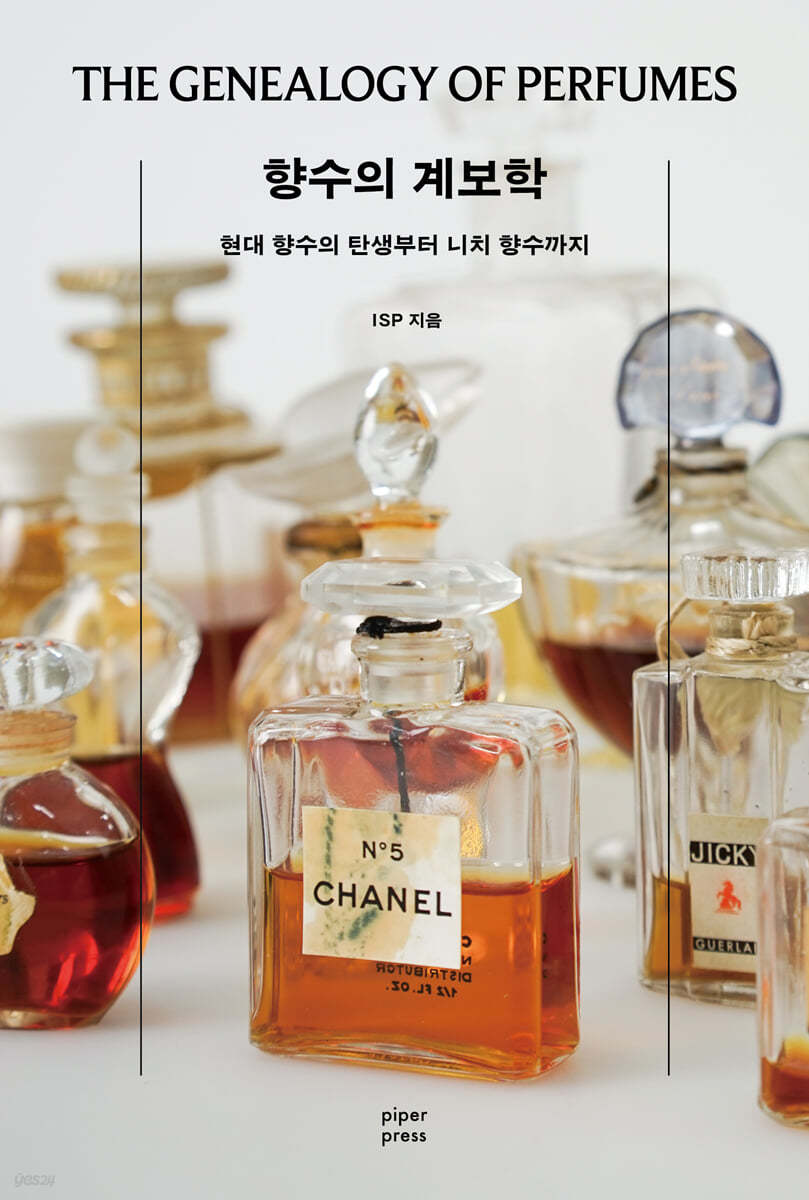 |
Description
Book Introduction
Meet the classic perfumes, the prototypes of the perfumes we love.
Korea's first comprehensive perfume genealogy book
Vintage perfume usually refers to perfumes produced before the 2000s.
Vintage perfumes have several characteristics.
First of all, it contains fragrances that are not used in modern perfumes.
In particular, natural fragrances are often banned for reasons such as endangered species, or are too expensive to be used commercially.
There are some fragrances that become more beautiful as they age.
As I collect vintage perfumes, I've noticed that perfumes from certain eras share a similar backbone.
In the 1920s and 1930s, many aldehydic floral perfumes were released under the influence of Chanel No. 5.
In the 1970s, there was a boom in green fragrances.
One perfume contains many different scents.
The feeling of a perfume changes depending on how the scents are combined and expressed.
An important factor that influences the way fragrance is expressed is the times.
As with everything in this world, the scents that are popular in a given era are influenced by the social context, culture, and technology of the time.
We guide you into the world of classic perfumes that have been popular throughout history.
Perfume was more than just a luxury item; it was an icon symbolizing contemporary culture.
By examining perfumes from different eras, we can understand cultural trends and the diverse ways in which scents are expressed that still influence the present day.
From beloved fragrances like Chanel No. 5 and Dior Diorissimo to those now hard to find, we explore how the expression of scent has changed with the emergence of iconic fragrances.
Korea's first comprehensive perfume genealogy book
Vintage perfume usually refers to perfumes produced before the 2000s.
Vintage perfumes have several characteristics.
First of all, it contains fragrances that are not used in modern perfumes.
In particular, natural fragrances are often banned for reasons such as endangered species, or are too expensive to be used commercially.
There are some fragrances that become more beautiful as they age.
As I collect vintage perfumes, I've noticed that perfumes from certain eras share a similar backbone.
In the 1920s and 1930s, many aldehydic floral perfumes were released under the influence of Chanel No. 5.
In the 1970s, there was a boom in green fragrances.
One perfume contains many different scents.
The feeling of a perfume changes depending on how the scents are combined and expressed.
An important factor that influences the way fragrance is expressed is the times.
As with everything in this world, the scents that are popular in a given era are influenced by the social context, culture, and technology of the time.
We guide you into the world of classic perfumes that have been popular throughout history.
Perfume was more than just a luxury item; it was an icon symbolizing contemporary culture.
By examining perfumes from different eras, we can understand cultural trends and the diverse ways in which scents are expressed that still influence the present day.
From beloved fragrances like Chanel No. 5 and Dior Diorissimo to those now hard to find, we explore how the expression of scent has changed with the emergence of iconic fragrances.
- You can preview some of the book's contents.
Preview
index
prolog.
A Guide to Deeper Exploration of Perfume
1900s and before
The birth of modern perfume
1910s
The birth of a soft fragrance and chypre
1920s
Legendary perfumes that express exotic scents and modernity.
1930s
Beauty that bloomed in dark times
1940s
Legendary classic perfumes born in war
1950s
Two Interpretations of Femininity and the Invention of Vetiver
1960s
Hippie, patchouli, musk, and incense
1970s
Green, herbs, and citrus emerged along with casual fashion and recreational sports.
1980s
Glamorous and hedonistic fashion
1990s
Clean, light scent with gourmand and fruity floral notes
2000s
The birth of a sweet celebrity fragrance, a refreshing floral.
2010s
The Rediscovery of Woody Scents and the Growth of the Global Perfume Market
2020s
Celebrity perfumes and local brands
Epilogue.
When looking at nostalgia and the times together
supplement
How to spray perfume
How to store perfume
How to Experience Fragrance
How to develop a taste for perfume
How to Break Free from Consumer Addiction
A Guide to Deeper Exploration of Perfume
1900s and before
The birth of modern perfume
1910s
The birth of a soft fragrance and chypre
1920s
Legendary perfumes that express exotic scents and modernity.
1930s
Beauty that bloomed in dark times
1940s
Legendary classic perfumes born in war
1950s
Two Interpretations of Femininity and the Invention of Vetiver
1960s
Hippie, patchouli, musk, and incense
1970s
Green, herbs, and citrus emerged along with casual fashion and recreational sports.
1980s
Glamorous and hedonistic fashion
1990s
Clean, light scent with gourmand and fruity floral notes
2000s
The birth of a sweet celebrity fragrance, a refreshing floral.
2010s
The Rediscovery of Woody Scents and the Growth of the Global Perfume Market
2020s
Celebrity perfumes and local brands
Epilogue.
When looking at nostalgia and the times together
supplement
How to spray perfume
How to store perfume
How to Experience Fragrance
How to develop a taste for perfume
How to Break Free from Consumer Addiction
Detailed image

Into the book
Most creations come about by adding or subtracting something from an existing framework, or by breaking the framework.
Perfume is no different.
In the 1980s, flashy and strong scents were popular, but in the 1990s, just after, neutral and clean scents were popular.
Knowing this lineage can help you explore your tastes in more detail.
If you really like a perfume, try to find out which perfumes from the past influenced it.
--- From the "Prologue"
It is the oldest perfume that has been continuously produced without being discontinued to this day.
There are several reasons why this perfume is considered the beginning of modern perfumery.
First of all, it is one of the first perfumes to contain coumarin, a synthetic fragrance extracted from the tonka bean.
It was also the first time synthetic vanillin was added.
The name does not refer to a flower, a natural object, an image, or a place.
It's just 'protection'.
--- From "1900 and Before - The Birth of Modern Perfume"
The perfume with the structure of bergamot-labdanum-oakmoss that we now refer to as chypre perfume was created by Coty.
All subsequent chypre fragrances owe a debt of gratitude to Coty's chypre.
Coty's Chypre, a post-1920s version of Eau de Toilette, contrasts white florals with powdery nuances and dark oakmoss, before revealing a fragrant green note of white florals and a hint of herbs, ending with a hint of oakmoss with a hint of powder.
--- From "1910s - The Birth of Soft Fragrance and Chypre"
The 2019 Shalimar Eau de Parfum is a combination of slightly weaker bergamot, leather, vanilla, incense and amber, as regulations do not allow the use of natural bergamot.
The 1970s version was a bit more intense and heavier with leather, vanilla, incense and amber.
The versions from the 1930s to the 1950s were truly special.
I didn't have high expectations because it was a perfume I often wore, but I could smell various floral scents in the middle notes.
It had a very rich scent of roses, jasmine and orange blossoms, making me feel like I was in a garden.
Powdery iris acts as a bridge between the floral notes and the base notes of leather and vanilla, while vetiver provides a slightly woody note, while the amber, leather, incense and vanilla notes are very rich.
I could smell patchouli, but it mixed with vanilla, giving a woody, chocolate-like feeling.
--- From "1920s - Legendary perfumes expressing exotic scents and modernity"
Women in the 1930s wanted a wider world.
A perfume that demonstrates this is Guerlain's Vol de Nuit (1933).
Vol de Nuit is named after the book 『Night Flight』 by Antoine de Saint-Exupéry, who was a friend of Jacques Guerlain.
As you can see from the advertising poster, it was sold in a box with exotic plants and zebra-like patterns.
The bottle design also resembles a propeller.
In 1932, American female aviator Amelia Earhart made headlines by becoming the first woman to fly solo across the Atlantic Ocean without stopping.
There was a growing interest in flying and exotic travel among women.
Although not everyone could fly and travel like Earhart, it was the last time people dreamed of such a dream.
--- From "1930s - Beauty Blossomed in a Dark Age"
The scent of Shocking starts off strong with herbal bitterness and honeyed sweetness, but over time it becomes rich and deep with spice, patchouli, and animalistic notes.
The aftertaste reveals oakmoss, woodiness, and traces of honey and spice.
A warm and sweet scent that doesn't lose its sensuality.
It's very interesting to compare Taboo and Shocking.
Although they are similar amber fragrances, one shows a man's objectification of a woman, while the other shows a woman's self-expression of sensuality.
--- From "1930s - Beauty Blossomed in a Dark Age"
Balmain's Vendée has left an indelible mark on perfume history for one thing alone:
From the green perfume craze of the 1970s to the various green perfumes that came out right after the coronavirus pandemic, the perfume that is the ancestor of all green perfumes is Van Ber.
As the first green perfume, all subsequent green perfumes owe a debt to Van Bert.
Bang Ber is a really well made perfume.
A very green galbanum gives off a scent reminiscent of mowed grass or broken stems, gradually giving way to clear, transparent notes of lily of the valley and hyacinth, ending with oakmoss.
It's a unique perfume that gives a refreshing feeling without feeling heavy, even with the relatively dark scent of oakmoss.
As the name suggests, it feels like a green breeze is blowing around.
It's so beautiful that it makes you wonder how such a modern perfume could come out in this day and age.
--- From "1940s - Legendary Classic Perfumes Born in the War"
Fracas's unique tuberose scent was so beautiful that it was later used in a similar way in various perfume products.
The Fracas method was also used to express white floral scents such as tuberose and gardenia.
The floral scent we sometimes smell from tissues is a similar expression.
It's a shame, though, for someone who knows the beauty of Pracas.
If you get to experience vintage Fracas, it will be interesting to get a feel for what the original Gap tissue scent was like.
--- From "1940s - Legendary Classic Perfumes Born in the War"
The reason we cannot help but discuss the social status and role of women in each era is because perfume is one of the few product categories that has historically consistently targeted women as its primary customers and reflected their tastes.
The world of perfumers has historically been dominated by men.
Born into the Guerlain family, Patricia de Nicolai was not considered as the successor to Jean Paul Guerlain because she was a woman and had difficulty finding a job.
But male perfumers ultimately had to create fragrances that women would like.
No matter how well-made a perfume was, if it didn't capture the hearts of women of the time, it wouldn't sell.
--- From "1950s - Two Interpretations of Femininity and the Invention of Vetiver"
Dior's Eau Sauvage (1966) is a masterpiece by perfumer Edmond Rudnicka, considered one of the greatest perfumers of the 20th century.
Eau Sauvage is a cologne-type perfume.
Oh Sauvage contains a synthetic fragrance called Hedione.
It is a fragrance extracted from jasmine, with a soft and clean floral scent.
It is a fragrance that is almost essential in women's perfumes, but it was a new attempt to include this scent as a main element in men's perfume.
Hedione was a fragrance discovered in the 1960s, so it was an innovative attempt to use new fragrances, such as Thierry Mugler's Angel (1992), which contained ethyl maltol, and Davidoff's Cool Water (1988), which contained Calonne.
--- From "1960s - Hippies, Patchouli, Musk, Incense"
As the feminist movement progressed, women began to prefer natural scents.
I started to question why women should have to wear artificial cosmetic scents.
Green scents that remind us of grass or leaves are a scent that suits both genders.
As if water has no gender.
For women who were forced to adopt stereotypical femininity by society and discriminated against in the workplace for being women, green fragrance was an option that allowed them to express themselves while also being free from discrimination and oppression.
That's why perfumes using green scents also borrowed the image of a stylish, modern, and glamorous career woman by the standards of the time.
A representative example is Chanel's No. 19, released in 1970.
--- From "1970s - Green, Herbs, and Citrus Appeared with Casual Fashion and Physical Education"
Yves Saint Laurent's Opium launch party was held on a ship named Peking, a word previously used to refer to Beijing.
The boat was decorated with a 450kg statue of Sakyamuni, thousands of white cattleya orchids, and oriental lanterns made of red paper, and was accompanied by fireworks, Chinese acrobats, dancers, and models wearing harem pants, Chinese-style tops, and bamboo hats.
It was a party filled with true pleasure and luxury.
The reason we were able to throw a party like this was because it was so popular.
Launched in France in the fall of 1977, Opium had already earned more than Chanel No. 5 in a year before Christmas.
The advertising posters were so popular that people were tearing them up as souvenirs.
--- From "1980s - Glamorous and Hedonistic Fashion"
Thierry Mugler's Angel was groundbreaking in every way.
The perfume bottle was like a star-shaped object, the blue color was unique for a women's perfume and the perfume itself, and above all, it had a unique scent that I had never smelled before.
Angel has a scent that most people are familiar with now: ethyl maltol, which has a cotton candy or sugar-like scent.
It's a sweet scent with a very strong sugary, fruity, and floral note.
What makes this perfume so great is that it's not just sweet, it balances it out with a bitterness and weight through woody patchouli.
The bitterness of patchouli and the sweetness of ethyl maltol mixed together to create a chocolate-like scent, making it even more appealing to people.
Angel strives for unique fragrance combinations and balance.
--- From "1990s - Clean, light scents and gourmand, fruity florals"
Diptyque's Do Son is a perfume released in 2005 that expresses the sweetness of tuberose and the richness of white florals, which can be felt as a bit heavy, in a soft and light way.
Some people may not think this scent is light.
Some people leave reviews saying that it is light and makes them feel shaky.
But once you smell Fracas, you realize that Diptyque's Do Son has expressed the unique scent of tuberose in a calm and watercolor-like clarity.
Because the previous tuberose was much more intense.
Additionally, Do Son added the then-popular pink pepper scent to create a balanced, spicy scent, while the lingering scent was soft musk and amber, giving a cozy and warm feeling.
--- From "2000s - Sweet Celebrity Perfume, the Birth of Fresh Florals"
Since Santal 33, the standard for sandalwood fragrance has become Australian sandalwood, not Indian sandalwood.
It would not be an exaggeration to say that this one perfume was so popular that it started the woody scent trend that lasted from the early to mid-to-late 2010s.
All the images we have of sandalwood today are derived from this perfume.
--- From "2010s - Rediscovery of Woody Scents and the Growth of the Global Perfume Market"
Acne Studios Parfum Frederic Malle has faithfully recreated the scent of fabric softener.
Yet, it still maintains its luxury.
The overall harmony of the scent is excellent, and the slightly strong feeling typical of fabric softeners is softened by floral and vanilla scents.
--- From "2020s - Celebrity Perfume and Local Brands"
I often think about how the 2020s trend toward light, neutral, and hygienic scents connects to the collective trauma and conservatism of society around the world post-pandemic.
It may seem surprising that social atmosphere can influence even perfume, but whether it's music, fashion, or perfume, they're all created by humans, so it's only natural that they're influenced by social atmosphere.
Perfume is no different.
In the 1980s, flashy and strong scents were popular, but in the 1990s, just after, neutral and clean scents were popular.
Knowing this lineage can help you explore your tastes in more detail.
If you really like a perfume, try to find out which perfumes from the past influenced it.
--- From the "Prologue"
It is the oldest perfume that has been continuously produced without being discontinued to this day.
There are several reasons why this perfume is considered the beginning of modern perfumery.
First of all, it is one of the first perfumes to contain coumarin, a synthetic fragrance extracted from the tonka bean.
It was also the first time synthetic vanillin was added.
The name does not refer to a flower, a natural object, an image, or a place.
It's just 'protection'.
--- From "1900 and Before - The Birth of Modern Perfume"
The perfume with the structure of bergamot-labdanum-oakmoss that we now refer to as chypre perfume was created by Coty.
All subsequent chypre fragrances owe a debt of gratitude to Coty's chypre.
Coty's Chypre, a post-1920s version of Eau de Toilette, contrasts white florals with powdery nuances and dark oakmoss, before revealing a fragrant green note of white florals and a hint of herbs, ending with a hint of oakmoss with a hint of powder.
--- From "1910s - The Birth of Soft Fragrance and Chypre"
The 2019 Shalimar Eau de Parfum is a combination of slightly weaker bergamot, leather, vanilla, incense and amber, as regulations do not allow the use of natural bergamot.
The 1970s version was a bit more intense and heavier with leather, vanilla, incense and amber.
The versions from the 1930s to the 1950s were truly special.
I didn't have high expectations because it was a perfume I often wore, but I could smell various floral scents in the middle notes.
It had a very rich scent of roses, jasmine and orange blossoms, making me feel like I was in a garden.
Powdery iris acts as a bridge between the floral notes and the base notes of leather and vanilla, while vetiver provides a slightly woody note, while the amber, leather, incense and vanilla notes are very rich.
I could smell patchouli, but it mixed with vanilla, giving a woody, chocolate-like feeling.
--- From "1920s - Legendary perfumes expressing exotic scents and modernity"
Women in the 1930s wanted a wider world.
A perfume that demonstrates this is Guerlain's Vol de Nuit (1933).
Vol de Nuit is named after the book 『Night Flight』 by Antoine de Saint-Exupéry, who was a friend of Jacques Guerlain.
As you can see from the advertising poster, it was sold in a box with exotic plants and zebra-like patterns.
The bottle design also resembles a propeller.
In 1932, American female aviator Amelia Earhart made headlines by becoming the first woman to fly solo across the Atlantic Ocean without stopping.
There was a growing interest in flying and exotic travel among women.
Although not everyone could fly and travel like Earhart, it was the last time people dreamed of such a dream.
--- From "1930s - Beauty Blossomed in a Dark Age"
The scent of Shocking starts off strong with herbal bitterness and honeyed sweetness, but over time it becomes rich and deep with spice, patchouli, and animalistic notes.
The aftertaste reveals oakmoss, woodiness, and traces of honey and spice.
A warm and sweet scent that doesn't lose its sensuality.
It's very interesting to compare Taboo and Shocking.
Although they are similar amber fragrances, one shows a man's objectification of a woman, while the other shows a woman's self-expression of sensuality.
--- From "1930s - Beauty Blossomed in a Dark Age"
Balmain's Vendée has left an indelible mark on perfume history for one thing alone:
From the green perfume craze of the 1970s to the various green perfumes that came out right after the coronavirus pandemic, the perfume that is the ancestor of all green perfumes is Van Ber.
As the first green perfume, all subsequent green perfumes owe a debt to Van Bert.
Bang Ber is a really well made perfume.
A very green galbanum gives off a scent reminiscent of mowed grass or broken stems, gradually giving way to clear, transparent notes of lily of the valley and hyacinth, ending with oakmoss.
It's a unique perfume that gives a refreshing feeling without feeling heavy, even with the relatively dark scent of oakmoss.
As the name suggests, it feels like a green breeze is blowing around.
It's so beautiful that it makes you wonder how such a modern perfume could come out in this day and age.
--- From "1940s - Legendary Classic Perfumes Born in the War"
Fracas's unique tuberose scent was so beautiful that it was later used in a similar way in various perfume products.
The Fracas method was also used to express white floral scents such as tuberose and gardenia.
The floral scent we sometimes smell from tissues is a similar expression.
It's a shame, though, for someone who knows the beauty of Pracas.
If you get to experience vintage Fracas, it will be interesting to get a feel for what the original Gap tissue scent was like.
--- From "1940s - Legendary Classic Perfumes Born in the War"
The reason we cannot help but discuss the social status and role of women in each era is because perfume is one of the few product categories that has historically consistently targeted women as its primary customers and reflected their tastes.
The world of perfumers has historically been dominated by men.
Born into the Guerlain family, Patricia de Nicolai was not considered as the successor to Jean Paul Guerlain because she was a woman and had difficulty finding a job.
But male perfumers ultimately had to create fragrances that women would like.
No matter how well-made a perfume was, if it didn't capture the hearts of women of the time, it wouldn't sell.
--- From "1950s - Two Interpretations of Femininity and the Invention of Vetiver"
Dior's Eau Sauvage (1966) is a masterpiece by perfumer Edmond Rudnicka, considered one of the greatest perfumers of the 20th century.
Eau Sauvage is a cologne-type perfume.
Oh Sauvage contains a synthetic fragrance called Hedione.
It is a fragrance extracted from jasmine, with a soft and clean floral scent.
It is a fragrance that is almost essential in women's perfumes, but it was a new attempt to include this scent as a main element in men's perfume.
Hedione was a fragrance discovered in the 1960s, so it was an innovative attempt to use new fragrances, such as Thierry Mugler's Angel (1992), which contained ethyl maltol, and Davidoff's Cool Water (1988), which contained Calonne.
--- From "1960s - Hippies, Patchouli, Musk, Incense"
As the feminist movement progressed, women began to prefer natural scents.
I started to question why women should have to wear artificial cosmetic scents.
Green scents that remind us of grass or leaves are a scent that suits both genders.
As if water has no gender.
For women who were forced to adopt stereotypical femininity by society and discriminated against in the workplace for being women, green fragrance was an option that allowed them to express themselves while also being free from discrimination and oppression.
That's why perfumes using green scents also borrowed the image of a stylish, modern, and glamorous career woman by the standards of the time.
A representative example is Chanel's No. 19, released in 1970.
--- From "1970s - Green, Herbs, and Citrus Appeared with Casual Fashion and Physical Education"
Yves Saint Laurent's Opium launch party was held on a ship named Peking, a word previously used to refer to Beijing.
The boat was decorated with a 450kg statue of Sakyamuni, thousands of white cattleya orchids, and oriental lanterns made of red paper, and was accompanied by fireworks, Chinese acrobats, dancers, and models wearing harem pants, Chinese-style tops, and bamboo hats.
It was a party filled with true pleasure and luxury.
The reason we were able to throw a party like this was because it was so popular.
Launched in France in the fall of 1977, Opium had already earned more than Chanel No. 5 in a year before Christmas.
The advertising posters were so popular that people were tearing them up as souvenirs.
--- From "1980s - Glamorous and Hedonistic Fashion"
Thierry Mugler's Angel was groundbreaking in every way.
The perfume bottle was like a star-shaped object, the blue color was unique for a women's perfume and the perfume itself, and above all, it had a unique scent that I had never smelled before.
Angel has a scent that most people are familiar with now: ethyl maltol, which has a cotton candy or sugar-like scent.
It's a sweet scent with a very strong sugary, fruity, and floral note.
What makes this perfume so great is that it's not just sweet, it balances it out with a bitterness and weight through woody patchouli.
The bitterness of patchouli and the sweetness of ethyl maltol mixed together to create a chocolate-like scent, making it even more appealing to people.
Angel strives for unique fragrance combinations and balance.
--- From "1990s - Clean, light scents and gourmand, fruity florals"
Diptyque's Do Son is a perfume released in 2005 that expresses the sweetness of tuberose and the richness of white florals, which can be felt as a bit heavy, in a soft and light way.
Some people may not think this scent is light.
Some people leave reviews saying that it is light and makes them feel shaky.
But once you smell Fracas, you realize that Diptyque's Do Son has expressed the unique scent of tuberose in a calm and watercolor-like clarity.
Because the previous tuberose was much more intense.
Additionally, Do Son added the then-popular pink pepper scent to create a balanced, spicy scent, while the lingering scent was soft musk and amber, giving a cozy and warm feeling.
--- From "2000s - Sweet Celebrity Perfume, the Birth of Fresh Florals"
Since Santal 33, the standard for sandalwood fragrance has become Australian sandalwood, not Indian sandalwood.
It would not be an exaggeration to say that this one perfume was so popular that it started the woody scent trend that lasted from the early to mid-to-late 2010s.
All the images we have of sandalwood today are derived from this perfume.
--- From "2010s - Rediscovery of Woody Scents and the Growth of the Global Perfume Market"
Acne Studios Parfum Frederic Malle has faithfully recreated the scent of fabric softener.
Yet, it still maintains its luxury.
The overall harmony of the scent is excellent, and the slightly strong feeling typical of fabric softeners is softened by floral and vanilla scents.
--- From "2020s - Celebrity Perfume and Local Brands"
I often think about how the 2020s trend toward light, neutral, and hygienic scents connects to the collective trauma and conservatism of society around the world post-pandemic.
It may seem surprising that social atmosphere can influence even perfume, but whether it's music, fashion, or perfume, they're all created by humans, so it's only natural that they're influenced by social atmosphere.
--- From "Epilogue"
Publisher's Review
Guerlain Shalimar, Ubigang Fougère Royale, Chanel No. 5…
The beautiful scent of legendary perfumes
It was created through the pain of war and depression, along with advances in technology and women's rights.
Perfume is one of the most representative luxury items we consume.
It is not a necessity that we cannot live without, nor is it an object of ‘small but certain happiness’ that we can easily buy because it is cheap.
It is also one of the rare products historically designed to target female consumers.
Covering 140 years of major perfumes from the 1880s to the 2020s and their historical backgrounds, this book explores the human nature of pursuing beauty even in times of war, the expansion of women's rights, and changes in consumer culture through the characteristics of perfume.
From the story of the birth of Rochas' Femme (1944), a perfume created by legendary perfumer Edmond Rudnicka in a building next to a Paris garbage dump during a bombing, to the explanation that it was only after divorce by mutual consent was legalized in the 1970s that perfume became a woman's choice rather than a gift from her husband, there are many interesting stories.
In particular, the author's description of the scent is so vivid that it feels like you are actually smelling it.
“It starts with bergamot and unfolds like a bouquet of various flowers: lily of the valley, orange blossom, lilac, jasmine, rose, violet, etc.
Sometimes lilac and rose, sometimes lilac and jasmine, sometimes lily of the valley, sometimes rose and jasmine, etc. As if seen through a kaleidoscope, various flowers reveal their presence and disappear, and eventually, they all blend together to create an abstract floral scent that is difficult to clearly describe.
Even the aftertaste ends with a floral feel mixed with a hint of oakmoss and soft vanilla.
“It’s a beautiful and romantic scent, like burying your face in a bouquet of flowers.”
- Ubi River, Fleur (1912)
After reading the book, you will realize that what the author has collected is not only vintage perfumes, but also historical materials on the development of culture, technology, and women's rights.
This book is worth collecting, as it features photos of 47 vintage perfumes collected by the author and perfume advertisement posters that show the spirit of the past.
The beautiful scent of legendary perfumes
It was created through the pain of war and depression, along with advances in technology and women's rights.
Perfume is one of the most representative luxury items we consume.
It is not a necessity that we cannot live without, nor is it an object of ‘small but certain happiness’ that we can easily buy because it is cheap.
It is also one of the rare products historically designed to target female consumers.
Covering 140 years of major perfumes from the 1880s to the 2020s and their historical backgrounds, this book explores the human nature of pursuing beauty even in times of war, the expansion of women's rights, and changes in consumer culture through the characteristics of perfume.
From the story of the birth of Rochas' Femme (1944), a perfume created by legendary perfumer Edmond Rudnicka in a building next to a Paris garbage dump during a bombing, to the explanation that it was only after divorce by mutual consent was legalized in the 1970s that perfume became a woman's choice rather than a gift from her husband, there are many interesting stories.
In particular, the author's description of the scent is so vivid that it feels like you are actually smelling it.
“It starts with bergamot and unfolds like a bouquet of various flowers: lily of the valley, orange blossom, lilac, jasmine, rose, violet, etc.
Sometimes lilac and rose, sometimes lilac and jasmine, sometimes lily of the valley, sometimes rose and jasmine, etc. As if seen through a kaleidoscope, various flowers reveal their presence and disappear, and eventually, they all blend together to create an abstract floral scent that is difficult to clearly describe.
Even the aftertaste ends with a floral feel mixed with a hint of oakmoss and soft vanilla.
“It’s a beautiful and romantic scent, like burying your face in a bouquet of flowers.”
- Ubi River, Fleur (1912)
After reading the book, you will realize that what the author has collected is not only vintage perfumes, but also historical materials on the development of culture, technology, and women's rights.
This book is worth collecting, as it features photos of 47 vintage perfumes collected by the author and perfume advertisement posters that show the spirit of the past.
GOODS SPECIFICS
- Date of issue: February 10, 2025
- Page count, weight, size: 316 pages | 145*215*19mm
- ISBN13: 9791194278085
- ISBN10: 1194278086
You may also like
카테고리
korean


korean

![ELLE 엘르 스페셜 에디션 A형 : 12월 [2025]](http://librairie.coreenne.fr/cdn/shop/files/b8e27a3de6c9538896439686c6b0e8fb.jpg?v=1766436872&width=3840)


