

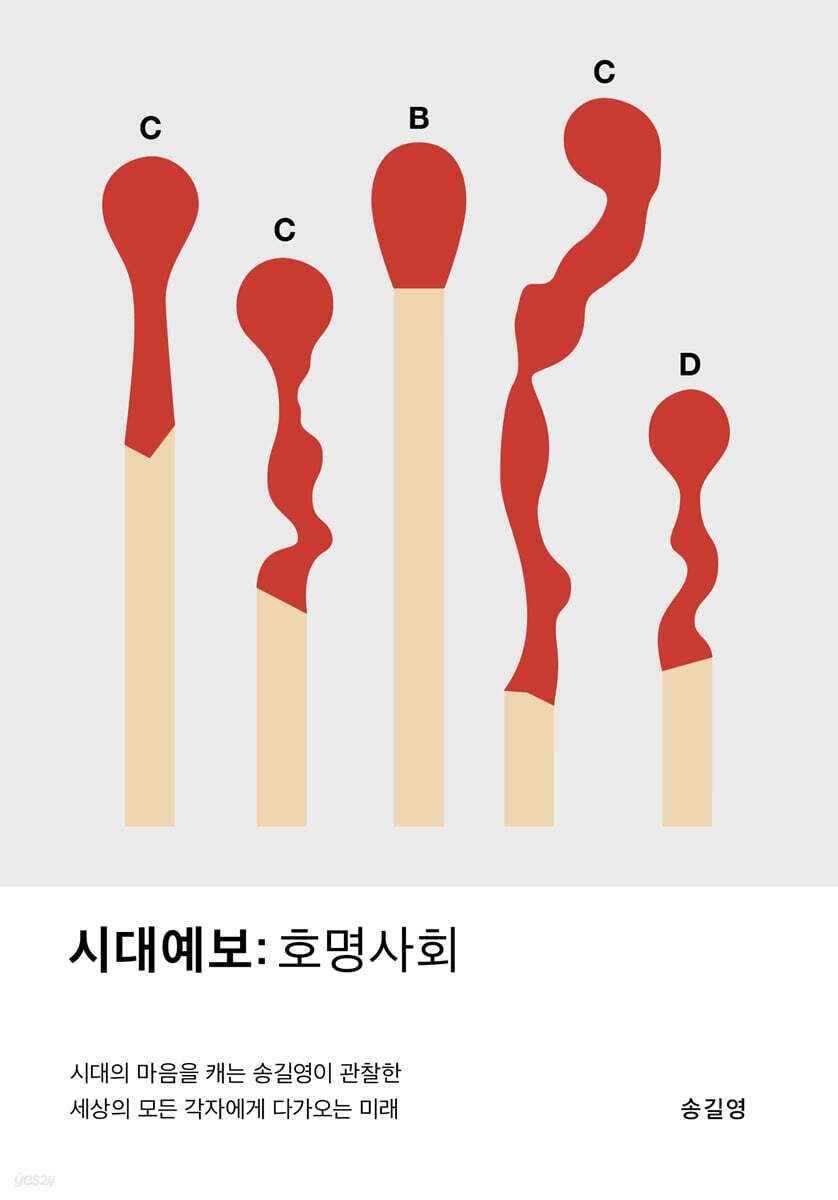
Forecast of the Times: Roll Call Society
 |
Description
Book Introduction
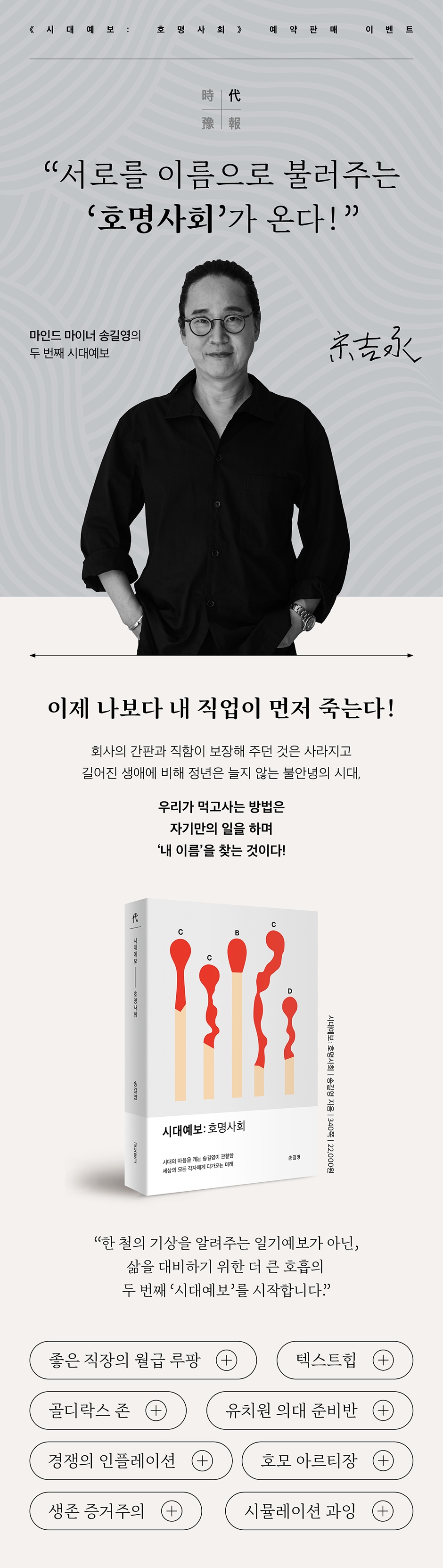
Mind Minor Song Gil-young's Second Forecast of the Age A society where people call each other by their names “Now my job will die before me!” Longer lifespans, stagnant retirement ages, and rapidly advancing technology… The way we make a living is by finding 'my name'. In 2023, Song Gil-young, who redefined the individual with the unprecedented term "nuclear individual," returned with his second forecast. Song Gil-young, with his ability to analyze data, his curiosity to explore people's daily lives, and his observational skills to spot the signs of great change, has been able to read the changing times faster than anyone else. He focuses on the new zeitgeist created by signals of change. His second prediction for the era, following the 'era of the nuclear individual', is the 'rolling society'. A society where individuals call each other by their first names is one where there is no need or possibility to hide behind the name of the organization. How far has the new, fair society of self-respect, where everyone takes responsibility for their actions and is fully compensated for them, come? What preparations and choices should we make to survive in this era? In "Forecast of the Times: The Calling Society," we first examine the current era of instability, including the inflation of competition, excessive simulation, the lupin of a good job's salary, kindergarten medical school preparatory classes, the plummeting value of passion, and the generation of perpetrators and victims. At the same time, it predicts an era of survival through self-reliance that we will face in the future, with jobs that will not disappear at the same time, survivalism, the Goldilocks Zone, N-jobbers, loose solidarity, text hips, and homo artisans. Climate change is increasingly breaking away from the weather mechanisms of the past millennium. In an age where weather forecasts, a constant presence on the news, change so rapidly that it's difficult to predict what's ahead, we still often listen to the forecasts, even if they're wrong, to prepare and be prepared. To put it metaphorically, this is not simply a preparation to avoid the rain. For some, it is so important that their livelihood and life depend on it. Now, rather than a weather forecast that tells you what to wear for the season, a second 'time forecast' begins, a bigger breath to prepare for my life. |
- You can preview some of the book's contents.
Preview
index
Forecast: Roll Call Society
Prologue: Nuclear Individuals Calling Each Other by Name
Chapter 1: Excessive Simulation
The Age of Anxiety: Over-Perception of Risk
The advent of simulation overload
The formula of the seniors is broken
Excel in my head
Wedding Preparation Checklist D-180
'Medical School Prep Class' that goes all the way down to kindergarten
Because we are not 'Doctor Strange'
Chapter 2: Inflation through Mutual Competition
The inflation of competition, the collapse of the value of passion
The fall of the starter
The "Salary Lupin" of "Good Job"
Tears of a retiree in his 50s
This dream wasn't mine.
The rush of desire, the burnout of will
Chapter 3: Finding Self-Reliance in Hoo
“I do this because I like alcohol.”
Jobs that won't disappear
Not 'escape' but 'deepening'
Tools for Self-Reliance
The loyalty of 'One Table' restaurants
Doban, people who read the same book
Chapter 4: The Age of Choice
From sit-in to solidarity
Mr. Sushi King vs. Air Conditioning Cleaning Academy
An alternative family gathered through dance
Everyday solidarity and affection
Distance, the key to kindness
Beyond likes to share a meal together
Chapter 5: The Advent of the Calling Society
Shrinking organizations, growing people
My Name at the Starting Line
Evidentialism for Survival
Doban M, 20 years of independence
Giant's Shoulders, Thousand Eyes
Roll-calling society: calling each other by name
Epilogue: We Are All Becoming Writers
Sources and References
Prologue: Nuclear Individuals Calling Each Other by Name
Chapter 1: Excessive Simulation
The Age of Anxiety: Over-Perception of Risk
The advent of simulation overload
The formula of the seniors is broken
Excel in my head
Wedding Preparation Checklist D-180
'Medical School Prep Class' that goes all the way down to kindergarten
Because we are not 'Doctor Strange'
Chapter 2: Inflation through Mutual Competition
The inflation of competition, the collapse of the value of passion
The fall of the starter
The "Salary Lupin" of "Good Job"
Tears of a retiree in his 50s
This dream wasn't mine.
The rush of desire, the burnout of will
Chapter 3: Finding Self-Reliance in Hoo
“I do this because I like alcohol.”
Jobs that won't disappear
Not 'escape' but 'deepening'
Tools for Self-Reliance
The loyalty of 'One Table' restaurants
Doban, people who read the same book
Chapter 4: The Age of Choice
From sit-in to solidarity
Mr. Sushi King vs. Air Conditioning Cleaning Academy
An alternative family gathered through dance
Everyday solidarity and affection
Distance, the key to kindness
Beyond likes to share a meal together
Chapter 5: The Advent of the Calling Society
Shrinking organizations, growing people
My Name at the Starting Line
Evidentialism for Survival
Doban M, 20 years of independence
Giant's Shoulders, Thousand Eyes
Roll-calling society: calling each other by name
Epilogue: We Are All Becoming Writers
Sources and References
Detailed image
Into the book
Until now, most organizations have operated solely through the collaboration of permanently employed members.
Now, thanks to digital transformation and business systems, real-time communication is possible, and the scope of collaboration has expanded beyond the organization.
Furthermore, with the integration of AI-based intelligence, completeness in each business area can be achieved even in small units.
The differentiation is so intense that it makes one-person businesses possible.
For example, traditional advertising agencies required personnel at every level, including customer service, creative directors, copywriters, administration, and staff.
Now, with generative AI and services that automate accounting and administrative tasks, individual creators can branch out and do it all.
---From "Forecast: Roll Call Society"
Each person makes their name known before the organization, and the solidarity of choice in which the self-proclaimed core individuals respect and interact with one another is completed as a 'calling society' in which each person calls the other by their full name.
We foresee a society where individuals, having entered their own respective territories, respect one another and cooperate equally.
In the current structure, people worry that new technologies will make humans less useful.
In a new society where people call each other by name, each person does not lose their self-respect and does not instrumentalize the other.
A society where people stand alone and are confident and independent, and where they are not lonely because they have colleagues, is creating an inclusive group where no one is excluded, something that was natural in the small group society of the past.
---From the "Prologue"
Each of us has a common resource: passion and time.
Some people invest those resources in the "performance evaluation" of their company life, voluntarily working overtime and taking care of their "bosses" to get higher scores.
However, there is also a growing number of people who give up on promotion early and invest in self-development with the mindset that "I'll change jobs someday."
This may not be a selfish choice for them, but a rational one.
These phenomena are partly due to the introduction of automation and the widespread adoption of work support software, which have increased the total amount of "results that can be achieved through independent work," and partly due to low growth and industrial problems, which have reduced the total amount of "results that can be achieved through dedication to the organization."
Just as a seesaw has both a force pushing down on one side and a force lifting up the other, when the dynamics of an existing system change, it inevitably tilts to one side.
---From Chapter 1, "Excessive Simulation"
The inflationary nature of competition can be explained in two ways.
As prices rise, the cost of the effort we have to put in to compete continues to increase.
The 'price' of success is becoming more expensive.
And just as the value of currency declines, the value of the time and passion we invest also declines.
He called this the intensification of mutual competition that 'makes the majority losers'.
---From Chapter 2, “Inflation of Mutual Competition”
The fact is that in order to become a N-jobber, you must first have a ‘main job’, which is your ‘job.’
The term 'home base' refers to a unique area where one's identity is established, rather than simply a means of earning a job or income.
Juggling N tasks like an acrobat without a base is like confessing that you have no foundation for your identity.
If you participate in public projects, write personally, connect with people, and do other things, but none of them become self-sustaining businesses, it's like assembling small parts to create a large robot that can't stand upright like a wet bundle of rice.
This is because the core that should be at the very center is unstable and the identity that one has is shaken.
Ultimately, this results in an unstable structure where no matter who you ask, you cannot explain what kind of person that person is.
---From Chapter 3, "Finding Independence in Ho-oh"
There are many different types of relationships we form.
Just as companies differentiate between future-oriented new businesses and stable, existing ones, it's important for individuals to diversify their relationship portfolios.
Because the variety of relationships plays as big a role as the depth of those relationships in an individual's happiness.
The nature of relationships and the frequency with which they are reciprocated vary from person to person.
Therefore, to avoid being swayed by temporary joy or sorrow, we need the kindness to reach out first, even if the reward seems uncertain.
From those relationships, you need to get more opportunities in the long run to increase the frequency with which results come back.
Finding the golden mean between affection and an appropriate distance is a necessary action for anyone who puts their name on the line and pursues their own work.
But no matter what kind of job you have or what genre you choose, what matters is the power of solidarity that starts from 'me' and spreads to the surrounding network.
It is not about suddenly pretending to be close to the other person and narrowing the distance between them, nor is it about being too busy with one's own work and neglecting consideration for the other person. This can be said to be the premise for solidarity that expands the Goldilocks zone of affection and appropriate distance.
---From Chapter 4, “The Age of Choice”
The intersection of the people I have interacted with is 'me'.
And the writing I left behind is 'me'.
The things I love and have poured my time and passion into are 'me'.
All the traces of myself that I leave behind are ‘me’.
It is necessary to go through the process of finding answers within ‘me’ through those materials.
When information overload prevents you from taking a step forward, the first thing to do is not to look far into the future, but to start with yourself.
When each of us, who had been exhausted from trying to do things in our heads and unable to take a single step, now tries to take the first step from a new starting line, we can see that the direction is not towards the outside, but towards 'ourselves'.
The next step is to decide, 'What is my name that the world will call me?'
'I' am not a representative, manager, or department head of any organization.
Not someone's child, not someone's parent, not someone's friend.
‘My Name’ is the starting point for defining who I am completely, outside of organizations and relationships.
Now, thanks to digital transformation and business systems, real-time communication is possible, and the scope of collaboration has expanded beyond the organization.
Furthermore, with the integration of AI-based intelligence, completeness in each business area can be achieved even in small units.
The differentiation is so intense that it makes one-person businesses possible.
For example, traditional advertising agencies required personnel at every level, including customer service, creative directors, copywriters, administration, and staff.
Now, with generative AI and services that automate accounting and administrative tasks, individual creators can branch out and do it all.
---From "Forecast: Roll Call Society"
Each person makes their name known before the organization, and the solidarity of choice in which the self-proclaimed core individuals respect and interact with one another is completed as a 'calling society' in which each person calls the other by their full name.
We foresee a society where individuals, having entered their own respective territories, respect one another and cooperate equally.
In the current structure, people worry that new technologies will make humans less useful.
In a new society where people call each other by name, each person does not lose their self-respect and does not instrumentalize the other.
A society where people stand alone and are confident and independent, and where they are not lonely because they have colleagues, is creating an inclusive group where no one is excluded, something that was natural in the small group society of the past.
---From the "Prologue"
Each of us has a common resource: passion and time.
Some people invest those resources in the "performance evaluation" of their company life, voluntarily working overtime and taking care of their "bosses" to get higher scores.
However, there is also a growing number of people who give up on promotion early and invest in self-development with the mindset that "I'll change jobs someday."
This may not be a selfish choice for them, but a rational one.
These phenomena are partly due to the introduction of automation and the widespread adoption of work support software, which have increased the total amount of "results that can be achieved through independent work," and partly due to low growth and industrial problems, which have reduced the total amount of "results that can be achieved through dedication to the organization."
Just as a seesaw has both a force pushing down on one side and a force lifting up the other, when the dynamics of an existing system change, it inevitably tilts to one side.
---From Chapter 1, "Excessive Simulation"
The inflationary nature of competition can be explained in two ways.
As prices rise, the cost of the effort we have to put in to compete continues to increase.
The 'price' of success is becoming more expensive.
And just as the value of currency declines, the value of the time and passion we invest also declines.
He called this the intensification of mutual competition that 'makes the majority losers'.
---From Chapter 2, “Inflation of Mutual Competition”
The fact is that in order to become a N-jobber, you must first have a ‘main job’, which is your ‘job.’
The term 'home base' refers to a unique area where one's identity is established, rather than simply a means of earning a job or income.
Juggling N tasks like an acrobat without a base is like confessing that you have no foundation for your identity.
If you participate in public projects, write personally, connect with people, and do other things, but none of them become self-sustaining businesses, it's like assembling small parts to create a large robot that can't stand upright like a wet bundle of rice.
This is because the core that should be at the very center is unstable and the identity that one has is shaken.
Ultimately, this results in an unstable structure where no matter who you ask, you cannot explain what kind of person that person is.
---From Chapter 3, "Finding Independence in Ho-oh"
There are many different types of relationships we form.
Just as companies differentiate between future-oriented new businesses and stable, existing ones, it's important for individuals to diversify their relationship portfolios.
Because the variety of relationships plays as big a role as the depth of those relationships in an individual's happiness.
The nature of relationships and the frequency with which they are reciprocated vary from person to person.
Therefore, to avoid being swayed by temporary joy or sorrow, we need the kindness to reach out first, even if the reward seems uncertain.
From those relationships, you need to get more opportunities in the long run to increase the frequency with which results come back.
Finding the golden mean between affection and an appropriate distance is a necessary action for anyone who puts their name on the line and pursues their own work.
But no matter what kind of job you have or what genre you choose, what matters is the power of solidarity that starts from 'me' and spreads to the surrounding network.
It is not about suddenly pretending to be close to the other person and narrowing the distance between them, nor is it about being too busy with one's own work and neglecting consideration for the other person. This can be said to be the premise for solidarity that expands the Goldilocks zone of affection and appropriate distance.
---From Chapter 4, “The Age of Choice”
The intersection of the people I have interacted with is 'me'.
And the writing I left behind is 'me'.
The things I love and have poured my time and passion into are 'me'.
All the traces of myself that I leave behind are ‘me’.
It is necessary to go through the process of finding answers within ‘me’ through those materials.
When information overload prevents you from taking a step forward, the first thing to do is not to look far into the future, but to start with yourself.
When each of us, who had been exhausted from trying to do things in our heads and unable to take a single step, now tries to take the first step from a new starting line, we can see that the direction is not towards the outside, but towards 'ourselves'.
The next step is to decide, 'What is my name that the world will call me?'
'I' am not a representative, manager, or department head of any organization.
Not someone's child, not someone's parent, not someone's friend.
‘My Name’ is the starting point for defining who I am completely, outside of organizations and relationships.
---From Chapter 5, “The Advent of the Calling Society”
Publisher's Review
Now we must face the 'calling society'!
A new era observed by Song Gil-young, an observer of the times
“The price of success is rising due to the inflation of competition,
The value of the time and passion we put into it plummets.
And the job I chose will disappear before me.”
In this age of uncertainty, why do we have to call each other by our names?
It's a time when it's difficult to keep up with trends and fads if you can't react quickly.
The world, which changes every moment, is constantly sending us signals of change.
Signals shot up from here and there create a new zeitgeist.
This can only be noticed by those who observe and explore.
Song Gil-young, who spoke of a change in society in the first era forecast, the birth of a 'nuclear individual' who is split, scattered, and stands alone, observed that the signal of a new change is a 'calling society' in which nuclear individuals find their own names and call each other by their names.
As the world grapples with periodic economic crises, more and more people are seeking job security, and competition for what are commonly called "good jobs" has become fierce.
The qualifications that were limited to academic background, grades, and TOEIC scores have expanded to include language training, competitions, second foreign languages, and volunteer work, and now we have an era where students prepare for medical school from kindergarten onwards.
This extreme inflation of competition means that the cost of the effort we must expend to compete continues to rise.
In short, the price of success is becoming more expensive.
At this point, the value of the time and passion we put in plummets.
The problem is that the sense of security that our jobs once provided is beginning to crack.
The extreme mismatch between the lengthening life cycle and the shortening of the life cycle of a job is spreading anxiety about not being able to stay in one job for one's entire life.
This is called 'liquidization'.
And as technology advances at an accelerating pace and connectivity becomes denser, the scale of work that used to be shared among multiple people is shrinking.
For example, traditional advertising agencies required personnel at every level, including customer service, creative directors, copywriters, administration, and staff. Now, with generative AI and various automated services, individual creators can handle everything.
This is called 'minimization'.
In this way, life expectancy is getting longer, but the actual retirement age has not changed, and we have entered an era where the life expectancy of jobs is actually getting shorter due to technological advancements.
Here, society is being driven by fluidity and miniaturization, with organizations becoming smaller and individuals becoming larger.
Now we are realizing that the company name and title we worked so hard to get into no longer protect us.
Even the advice of seniors who lived before me in an era where their jobs would disappear before mine is of little help.
The biggest change brought about by the rapidly changing social system and zeitgeist is the advent of a 'call-out society' where we find our own names and call each other by our names.
In the expanding organizations that followed the Industrial Revolution, we gradually lost our own names.
Now, in an era where organizational expansion has come to an end and we are entering a period of contraction, we must reclaim 'my name' that has been hidden by the organization.
"Forecast of the Times: The Calling Society" first examines the current era of instability, including the inflation of competition, excessive simulation, the lupin of a good job's salary, kindergarten medical school preparatory classes, the plummeting value of passion, and the generation of perpetrators and victims.
At the same time, occupations that will not disappear, survivalism, the Goldilocks zone, N-jobbers, loose solidarity, text hip, and homo artisan predict an era in which we will reclaim our own names and survive through independence.
Inflation of competition, over-simulation, preschool medical school prep classes, the collapse of passion…
An era that makes the majority losers,
What should we do to find ‘my name’?
The second era forecast following the 'era of the nuclear individual' is the 'rolling society'.
A society where individuals call each other by their first names is one where there is no need or possibility to hide behind the name of the organization.
How far has the nomination society come, a new era of fairness where everyone takes responsibility for their actions and is fully compensated for them? What preparations should we make and what choices should we make to survive in this era?
One, find your way in Hoo.
I need to find my likes and dislikes.
What we need is to realize that each of us, as we cultivate our own knowledge and tastes, can become opportunities for our own new foundation.
Because the time I spend working and accumulating experience in a field where my knowledge and tastes can be cultivated is itself an asset.
Second, create tools for self-reliance.
The benefits of longevity and the help of AI and intelligence are leading to the rise of multiple jobs, so-called N-jobbers.
In these changes, we must become self-reliant, do our own work, and reclaim our name.
The most necessary qualities at this time are openness to quickly accept intelligence and subjectivity to do everything on one's own.
Three, loose solidarity.
The world is now changing from a system of ties based on school ties, regional ties, and blood ties to an equal solidarity based on individual choice.
A relationship that is too close becomes overheated, and a relationship that is too distant becomes cold.
A loose but appropriate solidarity that finds the golden mean between affection and appropriate distance can be said to be a prerequisite for a society that calls out names.
Fourth, evidentialism for survival.
Nowadays, each person's work is produced and distributed step by step, and no one can hide their work.
In this era of real-time work streaming, where everything is shared, you must strive to gather evidence to prove yourself.
This is because the basis for those who can proudly stand up for themselves even after leaving their jobs comes from the collection of evidence.
Those who adapt to these changes earlier and compile records about themselves can gain an advantage by being called by a descriptive 'name' without any adjectives.
Five, craftsmanship, homo artisan.
Independence is born from the uniqueness of stubbornly continuing one's own work, and one can regain one's hidden name.
Now, Homo Faber, the human of tools, is being reborn as Homo Artisan, the human of craftsmanship, enhanced by AI and 3D printers.
When you reach this level, you ascend from working for money to earning the money you need to work.
At this point, your work becomes a task, and what you create becomes a work of art.
Work done together in an organization is exhausting, but work done alone leaves behind a work of art.
That work will remain with my name even after I disappear from this world.
A new era observed by Song Gil-young, an observer of the times
“The price of success is rising due to the inflation of competition,
The value of the time and passion we put into it plummets.
And the job I chose will disappear before me.”
In this age of uncertainty, why do we have to call each other by our names?
It's a time when it's difficult to keep up with trends and fads if you can't react quickly.
The world, which changes every moment, is constantly sending us signals of change.
Signals shot up from here and there create a new zeitgeist.
This can only be noticed by those who observe and explore.
Song Gil-young, who spoke of a change in society in the first era forecast, the birth of a 'nuclear individual' who is split, scattered, and stands alone, observed that the signal of a new change is a 'calling society' in which nuclear individuals find their own names and call each other by their names.
As the world grapples with periodic economic crises, more and more people are seeking job security, and competition for what are commonly called "good jobs" has become fierce.
The qualifications that were limited to academic background, grades, and TOEIC scores have expanded to include language training, competitions, second foreign languages, and volunteer work, and now we have an era where students prepare for medical school from kindergarten onwards.
This extreme inflation of competition means that the cost of the effort we must expend to compete continues to rise.
In short, the price of success is becoming more expensive.
At this point, the value of the time and passion we put in plummets.
The problem is that the sense of security that our jobs once provided is beginning to crack.
The extreme mismatch between the lengthening life cycle and the shortening of the life cycle of a job is spreading anxiety about not being able to stay in one job for one's entire life.
This is called 'liquidization'.
And as technology advances at an accelerating pace and connectivity becomes denser, the scale of work that used to be shared among multiple people is shrinking.
For example, traditional advertising agencies required personnel at every level, including customer service, creative directors, copywriters, administration, and staff. Now, with generative AI and various automated services, individual creators can handle everything.
This is called 'minimization'.
In this way, life expectancy is getting longer, but the actual retirement age has not changed, and we have entered an era where the life expectancy of jobs is actually getting shorter due to technological advancements.
Here, society is being driven by fluidity and miniaturization, with organizations becoming smaller and individuals becoming larger.
Now we are realizing that the company name and title we worked so hard to get into no longer protect us.
Even the advice of seniors who lived before me in an era where their jobs would disappear before mine is of little help.
The biggest change brought about by the rapidly changing social system and zeitgeist is the advent of a 'call-out society' where we find our own names and call each other by our names.
In the expanding organizations that followed the Industrial Revolution, we gradually lost our own names.
Now, in an era where organizational expansion has come to an end and we are entering a period of contraction, we must reclaim 'my name' that has been hidden by the organization.
"Forecast of the Times: The Calling Society" first examines the current era of instability, including the inflation of competition, excessive simulation, the lupin of a good job's salary, kindergarten medical school preparatory classes, the plummeting value of passion, and the generation of perpetrators and victims.
At the same time, occupations that will not disappear, survivalism, the Goldilocks zone, N-jobbers, loose solidarity, text hip, and homo artisan predict an era in which we will reclaim our own names and survive through independence.
Inflation of competition, over-simulation, preschool medical school prep classes, the collapse of passion…
An era that makes the majority losers,
What should we do to find ‘my name’?
The second era forecast following the 'era of the nuclear individual' is the 'rolling society'.
A society where individuals call each other by their first names is one where there is no need or possibility to hide behind the name of the organization.
How far has the nomination society come, a new era of fairness where everyone takes responsibility for their actions and is fully compensated for them? What preparations should we make and what choices should we make to survive in this era?
One, find your way in Hoo.
I need to find my likes and dislikes.
What we need is to realize that each of us, as we cultivate our own knowledge and tastes, can become opportunities for our own new foundation.
Because the time I spend working and accumulating experience in a field where my knowledge and tastes can be cultivated is itself an asset.
Second, create tools for self-reliance.
The benefits of longevity and the help of AI and intelligence are leading to the rise of multiple jobs, so-called N-jobbers.
In these changes, we must become self-reliant, do our own work, and reclaim our name.
The most necessary qualities at this time are openness to quickly accept intelligence and subjectivity to do everything on one's own.
Three, loose solidarity.
The world is now changing from a system of ties based on school ties, regional ties, and blood ties to an equal solidarity based on individual choice.
A relationship that is too close becomes overheated, and a relationship that is too distant becomes cold.
A loose but appropriate solidarity that finds the golden mean between affection and appropriate distance can be said to be a prerequisite for a society that calls out names.
Fourth, evidentialism for survival.
Nowadays, each person's work is produced and distributed step by step, and no one can hide their work.
In this era of real-time work streaming, where everything is shared, you must strive to gather evidence to prove yourself.
This is because the basis for those who can proudly stand up for themselves even after leaving their jobs comes from the collection of evidence.
Those who adapt to these changes earlier and compile records about themselves can gain an advantage by being called by a descriptive 'name' without any adjectives.
Five, craftsmanship, homo artisan.
Independence is born from the uniqueness of stubbornly continuing one's own work, and one can regain one's hidden name.
Now, Homo Faber, the human of tools, is being reborn as Homo Artisan, the human of craftsmanship, enhanced by AI and 3D printers.
When you reach this level, you ascend from working for money to earning the money you need to work.
At this point, your work becomes a task, and what you create becomes a work of art.
Work done together in an organization is exhausting, but work done alone leaves behind a work of art.
That work will remain with my name even after I disappear from this world.
GOODS SPECIFICS
- Date of issue: September 25, 2024
- Format: Hardcover book binding method guide
- Page count, weight, size: 340 pages | 414g | 130*188*20mm
- ISBN13: 9791170611875
- ISBN10: 1170611877
You may also like
카테고리
korean


korean

![GQ KOREA Mark (Monthly): December [2025]](http://librairie.coreenne.fr/cdn/shop/files/8ef265dbbfbf186523ed75ba7319009d.jpg?v=1765340328&width=3840)


