

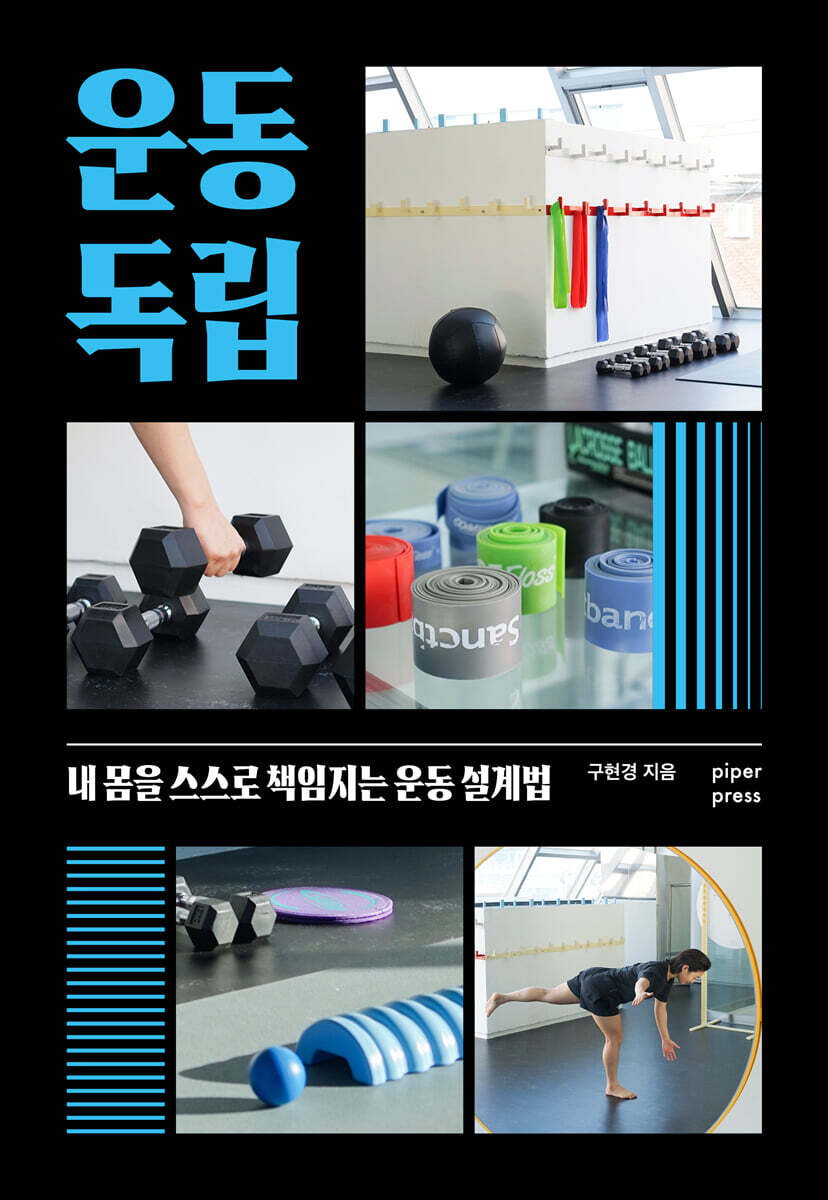
Exercise independence
 |
Description
Book Introduction
- A word from MD
-
Stay healthy for life with exercise that suits your body.What's most important in exercise? While frequency and intensity are important, there's something else that takes priority.
Finding the right exercise for your body is key! "Exercise independence"—understanding your body's characteristics and limitations, the principles of movement, and the components of physical strength—is the key to creating healthy exercise habits that last a lifetime.
February 25, 2025. Health and Hobbies PD Ahn Hyun-jae
An exercise that involves starting and stopping repeatedly.
The reason is because they were not able to become ‘independent’!
When you know the right exercise for your body and can plan it yourself
You can stay healthy for life by exercising regularly.
What does it mean to be "good" at exercise? Lifting heavy weights? Mastering difficult poses? The author, a trainer, defines it as "exercising in a way that suits me."
It's about understanding the weak points and physical limitations of my body, exercising accordingly, and strengthening the necessary areas.
As long as we live, injuries and pain are unavoidable.
This is why you need to exercise consistently and safely.
That's why 'exercise independence' is necessary.
You need to know what your body's characteristics are, how your muscles and bones are connected, and what exercises are right for the body problem you want to solve, so you can design them.
The author suggests ways to create a program that suits you by recognizing your body's characteristics and limitations, understanding the basic principles of anatomy and movement, and the components of physical fitness to achieve exercise independence.
In the process, you will also learn how to manage stress, eat healthily, and take care of your body.
The process of learning to exercise is important.
However, the goal of learning should be to have knowledge about the body and movement and to exercise on one's own.
Let's start 'exercise independence' by designing and executing our own exercise routines with the goal of lifelong health.
The reason is because they were not able to become ‘independent’!
When you know the right exercise for your body and can plan it yourself
You can stay healthy for life by exercising regularly.
What does it mean to be "good" at exercise? Lifting heavy weights? Mastering difficult poses? The author, a trainer, defines it as "exercising in a way that suits me."
It's about understanding the weak points and physical limitations of my body, exercising accordingly, and strengthening the necessary areas.
As long as we live, injuries and pain are unavoidable.
This is why you need to exercise consistently and safely.
That's why 'exercise independence' is necessary.
You need to know what your body's characteristics are, how your muscles and bones are connected, and what exercises are right for the body problem you want to solve, so you can design them.
The author suggests ways to create a program that suits you by recognizing your body's characteristics and limitations, understanding the basic principles of anatomy and movement, and the components of physical fitness to achieve exercise independence.
In the process, you will also learn how to manage stress, eat healthily, and take care of your body.
The process of learning to exercise is important.
However, the goal of learning should be to have knowledge about the body and movement and to exercise on one's own.
Let's start 'exercise independence' by designing and executing our own exercise routines with the goal of lifelong health.
- You can preview some of the book's contents.
Preview
index
prolog.
We need exercise independence
Part 1.
The first step toward independence
1.
Why Exercise Independence
The illusion that exercising will make you healthy
There is no perfect exercise
The real goal of exercise
Complex problems require complex solutions.
Exercise independence is not an option, it's a necessity.
To avoid getting lost in body language
2.
Why is exercise necessary?
We were born to run long distances
Connecting with lost primitivism
Expanding sense of belonging and identity
Blending into the city
Part 2.
My Exercise Independence
3.
Everyone has a beginning
Each person's reason for starting to exercise
Complex desires for the body
I started to like working out, and a lot of it.
4.
Accepting limitations and growing
Freedom found within the constraints of the body
Prejudice and entitlement
A justified distrust of trainers
Find a good exercise service
Part 3.
Understanding my body
5.
General Features: A strategy that suits my body
Being good at sports means
How to understand your body
key
weight
6.
Unique features: from posture changes to body usage patterns
Understanding the Complex Body
You know your body better than you think
Prior knowledge required for diagnosis
7.
Unique Features: Diagnostic Edition
Things to know for your body scan
Conducting virtual member audits
Comprehensive evaluation of movement
[Appendix 1] Checking Posture Deformity
[Appendix 2] Range of Motion Evaluation Chart
Part 4.
Exercise Literacy
8.
Liberal Arts Anatomy
To reduce trial and error regarding the body
The First Step to Exercise Literacy
Identifying the location, beginning, and end of muscles
Pushing and pulling muscles
The protagonist, villain, and supporting actor of the movement
9.
Archetype of Movement
Understanding the principles of movement
hip hinge
squats
Plank
Low
overhead press
Part 5.
Eat a balanced diet
10.
Strength and endurance
Betrayal of the Movement
Components of physical fitness
Am I the strong one or the persistent one?
Strength: A Must for Daily Life
Muscular Endurance: Posture and Stability
11.
Cardiorespiratory endurance
Stamina increases lifespan
Misconceptions About 'Aerobic' Training
Heart rate and exercise intensity
Setting up a training zone
Build cardiorespiratory endurance with high-intensity exercise
12.
Flexibility, mobility
If only I had known before I got hurt
Types of stretching
How much stretching should I do?
13.
Physical fitness related to body composition and function
body composition
Functional Fitness: Fitness for Sports
Break Time: Living with the Relentless Flow of Time
14.
Designing an Exercise Program
So, how do you exercise, sir?
Plan your workout for the week
Make sure to rest one day a week.
Scheduling Your Workout Sessions: Principles and Variations
Adjust the intensity with set composition
Part 6.
Exercise and Life
15.
Body and mind are connected
The body creates the mind
Exercise makes you more resistant to stress
“Stay Hard!”
The mind creates the body
Is stress only bad?
How to embrace stress
Exercise Placebo Effect
16.
Factors that affect health
Breathing, sleep, and diet
The problem of making a living
Avoiding ultra-processed foods is half the battle.
The sin of not taking care of my body
Epilogue.
Life is beyond exercise
Author's Note
We need exercise independence
Part 1.
The first step toward independence
1.
Why Exercise Independence
The illusion that exercising will make you healthy
There is no perfect exercise
The real goal of exercise
Complex problems require complex solutions.
Exercise independence is not an option, it's a necessity.
To avoid getting lost in body language
2.
Why is exercise necessary?
We were born to run long distances
Connecting with lost primitivism
Expanding sense of belonging and identity
Blending into the city
Part 2.
My Exercise Independence
3.
Everyone has a beginning
Each person's reason for starting to exercise
Complex desires for the body
I started to like working out, and a lot of it.
4.
Accepting limitations and growing
Freedom found within the constraints of the body
Prejudice and entitlement
A justified distrust of trainers
Find a good exercise service
Part 3.
Understanding my body
5.
General Features: A strategy that suits my body
Being good at sports means
How to understand your body
key
weight
6.
Unique features: from posture changes to body usage patterns
Understanding the Complex Body
You know your body better than you think
Prior knowledge required for diagnosis
7.
Unique Features: Diagnostic Edition
Things to know for your body scan
Conducting virtual member audits
Comprehensive evaluation of movement
[Appendix 1] Checking Posture Deformity
[Appendix 2] Range of Motion Evaluation Chart
Part 4.
Exercise Literacy
8.
Liberal Arts Anatomy
To reduce trial and error regarding the body
The First Step to Exercise Literacy
Identifying the location, beginning, and end of muscles
Pushing and pulling muscles
The protagonist, villain, and supporting actor of the movement
9.
Archetype of Movement
Understanding the principles of movement
hip hinge
squats
Plank
Low
overhead press
Part 5.
Eat a balanced diet
10.
Strength and endurance
Betrayal of the Movement
Components of physical fitness
Am I the strong one or the persistent one?
Strength: A Must for Daily Life
Muscular Endurance: Posture and Stability
11.
Cardiorespiratory endurance
Stamina increases lifespan
Misconceptions About 'Aerobic' Training
Heart rate and exercise intensity
Setting up a training zone
Build cardiorespiratory endurance with high-intensity exercise
12.
Flexibility, mobility
If only I had known before I got hurt
Types of stretching
How much stretching should I do?
13.
Physical fitness related to body composition and function
body composition
Functional Fitness: Fitness for Sports
Break Time: Living with the Relentless Flow of Time
14.
Designing an Exercise Program
So, how do you exercise, sir?
Plan your workout for the week
Make sure to rest one day a week.
Scheduling Your Workout Sessions: Principles and Variations
Adjust the intensity with set composition
Part 6.
Exercise and Life
15.
Body and mind are connected
The body creates the mind
Exercise makes you more resistant to stress
“Stay Hard!”
The mind creates the body
Is stress only bad?
How to embrace stress
Exercise Placebo Effect
16.
Factors that affect health
Breathing, sleep, and diet
The problem of making a living
Avoiding ultra-processed foods is half the battle.
The sin of not taking care of my body
Epilogue.
Life is beyond exercise
Author's Note
Detailed image

Into the book
In this book, I introduce the concept of 'exercise literacy' and discuss how to develop it.
Exercise literacy, narrowly defined, refers to the extent to which an individual has knowledge and understanding of exercise and physical activity.
More broadly, it encompasses the knowledge to understand the unique characteristics of one's own body and, based on that, to design various exercise programs based on the benefits and principles of exercise, safe exercise methods, and appropriate nutrition and rest methods.
The higher the exercise literacy, the more successfully individuals will embark on the lifelong learning process of “exercise independence” to choose and maintain a healthy lifestyle for themselves.
--- From the "Prologue"
Exercise independence goes beyond simply being able to exercise on your own; it means i) accurately understanding your own body condition, ii) having sufficient knowledge of the exercises, stretches, and comprehensive exercise plan design necessary to maintain and improve your body's balance, and iii) having the skills and practical ability to perform them correctly.
By meeting these conditions, individuals can plan the optimal exercise program for themselves and effectively manage their health and fitness throughout their lives.
--- 「1.
From "Why Exercise Independence"
Our bodies, adapted to modern times, are in a state of excessive dormancy, and the connection between mind and body is severed.
It is difficult to detect body signals in the first dimension.
Even when your body signals you're full, do you still keep eating? Even when your body signals you're feeling a little cold, do you dismiss it as "no big deal"? Sometimes, you find yourself in a state of tension, unable to feel comfortable within your body.
I feel trapped in my body, and I can't remember a time when I could breathe slowly and deeply without effort.
In times like these, physical problems must be solved with the body.
--- 「2.
From “Why is exercise necessary?”
I also started out exercising for dieting, but as I got more and more into fitness, I wanted to build bigger and more defined muscles. While doing CrossFit, I wanted to build a body that could lift fast, heavy, and competitively.
I worked out with the goal of building a strong heart, which is not visible from the outside, by swimming and running.
The multi-layered desire for the body is built up and then repeatedly unlearned.
Repeatedly unlearning what you have learned is a kind of self-liberation.
--- 「3.
From “Everyone has a beginning”
Many of the sports leaders I met while working as a trainer each had their own flaws.
A yogi with a straight neck, a group exercise coach with chronic ankle and knee pain, a swimmer with shoulder discomfort, a Pilates instructor with lumbar (lower back) lesions, etc.
When these people come to class, they are embarrassed to reveal that they are exercise instructors.
--- 「4.
From “Accepting Limitations and Growing”
Ultimately, exercising well means doing it at your own pace.
There is no need to be overwhelmed by absolute performance.
If so, the first thing you need to do is understand yourself.
There are various criteria for understanding your physical characteristics other than gender or weight class. When you understand these various criteria, you can reasonably adjust the level of exercise performance you expect from yourself.
--- 「5.
General Features: Exercise Strategy for My Body
If you experience pain or discomfort during a specific movement without any lesions, postural issues, or range of motion issues, it is considered a stability issue in that joint, which is caused by a combination of factors.
The main contributing cause is muscle imbalance, which is a genetic imbalance in the length of muscles and an imbalance in the strength of muscles involved during exercise, which prevents proper movement or support of the joint.
In addition, structural deformation and damage to the ligaments that play a role in fixing the joint, as well as direct damage due to trauma, also affect the stability of the joint.
--- 「6.
Unique Features: From Posture Changes to Body Usage Patterns
Knowing the starting and ending points of a muscle allows you to think specifically about the muscle and focus more on it when exercising.
There isn't a lot of research on the effects of this phenomenon, called the mind-muscle connection, but if you're an athlete, you'll likely agree that it's a really important concept.
When the body is perceived as a specific compartment rather than a mass, the magnitude of stimulation felt in a specific muscle also changes.
--- 「8.
From “Culture Anatomy”
Every action contains an archetype.
Archetype means the original form of a copy.
When learning an exercise, it's one thing to master each movement individually, but a more efficient learning path is to build on the circular movements that form the basis of each exercise and then expand upon them.
That is, most exercises have an archetype of that exercise.
To master and refine a modified movement, it is important to first properly understand and master the original form.
--- 「9.
From "Archetype of Movement"
Because I think that all ordinary people, including myself, are athletes in life, not athletes of a specific sport.
So, rather than focusing on just one exercise, you should develop your body in various ways and embrace the various challenges of life.
I study and impart knowledge to teach accordingly.
Life's many challenges include sarcopenia, weakened joints and ligaments, reduced range of motion, and decreased energy and metabolism.
If you can't overcome or prevent these challenges, you'll have to say goodbye to energetic trips with friends, the kind words and feelings that come from tireless energy, and the evenings when you walk home with a basket full of groceries.
--- 「10.
From "Strength and Endurance"
It is close to the definition of pure aerobic exercise if it is not difficult.
If you do aerobic exercise at an intensity that leaves you breathless and unable to speak, even if the movement is classified as aerobic exercise, it may not be considered 'aerobic' exercise because you are not metabolically using oxygen.
From a metabolic perspective, exercise that uses oxygen and generates energy is low-intensity aerobic exercise.
--- 「11.
From “Cardiopulmonary Endurance”
If we don't prepare, our body's range of motion declines by approximately 10% every decade between the ages of 20 and 49, and this decline isn't necessarily linear.
It's a scary story that the range of motion could be drastically reduced at any given time.
--- 「12.
Among “Flexibility and Mobility”
The most important skill that non-athletes should have is balance.
Balance has the strongest injury prevention properties compared to other functional fitness elements.
If your balance is poor, your ankles, knees, and hip joints will appear unstable, making you vulnerable to lower extremity injuries.
Especially for older adults, falls due to loss of balance can result in serious injuries.
--- 「13.
From “Body Composition and Functional Physical Fitness”
I also try to train with strength training by adjusting the ratio between muscular endurance, muscular strength, muscular hypertrophy, and power to suit my goals.
Cardio - I mainly run - is a mix of easy long runs and hard, fast speed work.
Also, if I feel like there is an element of exercise that I am lacking, I try to improve that aspect.
For example, even if you decide to do strength training 3-4 times a week, if you feel that your body is already strong enough that week and you feel that your balance elements are lagging behind, increase the proportion of exercises that include balance elements.
--- 「14.
From “Designing an Exercise Program”
The cross-stressor adaptation hypothesis states that repeatedly stressing and physiologically challenging the body through exercise causes the body to adapt to a generalized stress response, which subsequently reduces sensitivity to both homologous stress (exercise) and heterologous stress (non-exercise).
If you have adapted to the stress that comes with exercise, you will be able to better tolerate mental stress.
--- 「15.
From “Body and mind are connected”
While they market themselves as "zero" and "low-sugar" beverages, with a health-conscious aesthetic, are the sweeteners they contain truly free of harmful controversies? While some are simply labeled as "emulsifier," if the type of emulsifier is specifically labeled as an additive, it's possible to miss the emulsifier's presence.
It's unfortunate that landmines are everywhere, leaving consumers with no choice but to buy them. However, if you see an additive with an unfamiliar name listed, you should search for it online and determine for yourself whether it is harmful.
Don't be fooled by marketing and develop the habit of reading ingredient lists.
--- 「16.
Among the factors affecting health
Exercise is like brushing your teeth, not like traveling or intense love.
If you don't do it every day, you'll have health problems.
Sometimes when I'm tired it's really annoying, but most of the time I don't even think about whether I should do it or not, I just do it because it's a habit or an obligation.
And I always feel refreshed after doing it.
But that act doesn't eat away at my life.
Exercise literacy, narrowly defined, refers to the extent to which an individual has knowledge and understanding of exercise and physical activity.
More broadly, it encompasses the knowledge to understand the unique characteristics of one's own body and, based on that, to design various exercise programs based on the benefits and principles of exercise, safe exercise methods, and appropriate nutrition and rest methods.
The higher the exercise literacy, the more successfully individuals will embark on the lifelong learning process of “exercise independence” to choose and maintain a healthy lifestyle for themselves.
--- From the "Prologue"
Exercise independence goes beyond simply being able to exercise on your own; it means i) accurately understanding your own body condition, ii) having sufficient knowledge of the exercises, stretches, and comprehensive exercise plan design necessary to maintain and improve your body's balance, and iii) having the skills and practical ability to perform them correctly.
By meeting these conditions, individuals can plan the optimal exercise program for themselves and effectively manage their health and fitness throughout their lives.
--- 「1.
From "Why Exercise Independence"
Our bodies, adapted to modern times, are in a state of excessive dormancy, and the connection between mind and body is severed.
It is difficult to detect body signals in the first dimension.
Even when your body signals you're full, do you still keep eating? Even when your body signals you're feeling a little cold, do you dismiss it as "no big deal"? Sometimes, you find yourself in a state of tension, unable to feel comfortable within your body.
I feel trapped in my body, and I can't remember a time when I could breathe slowly and deeply without effort.
In times like these, physical problems must be solved with the body.
--- 「2.
From “Why is exercise necessary?”
I also started out exercising for dieting, but as I got more and more into fitness, I wanted to build bigger and more defined muscles. While doing CrossFit, I wanted to build a body that could lift fast, heavy, and competitively.
I worked out with the goal of building a strong heart, which is not visible from the outside, by swimming and running.
The multi-layered desire for the body is built up and then repeatedly unlearned.
Repeatedly unlearning what you have learned is a kind of self-liberation.
--- 「3.
From “Everyone has a beginning”
Many of the sports leaders I met while working as a trainer each had their own flaws.
A yogi with a straight neck, a group exercise coach with chronic ankle and knee pain, a swimmer with shoulder discomfort, a Pilates instructor with lumbar (lower back) lesions, etc.
When these people come to class, they are embarrassed to reveal that they are exercise instructors.
--- 「4.
From “Accepting Limitations and Growing”
Ultimately, exercising well means doing it at your own pace.
There is no need to be overwhelmed by absolute performance.
If so, the first thing you need to do is understand yourself.
There are various criteria for understanding your physical characteristics other than gender or weight class. When you understand these various criteria, you can reasonably adjust the level of exercise performance you expect from yourself.
--- 「5.
General Features: Exercise Strategy for My Body
If you experience pain or discomfort during a specific movement without any lesions, postural issues, or range of motion issues, it is considered a stability issue in that joint, which is caused by a combination of factors.
The main contributing cause is muscle imbalance, which is a genetic imbalance in the length of muscles and an imbalance in the strength of muscles involved during exercise, which prevents proper movement or support of the joint.
In addition, structural deformation and damage to the ligaments that play a role in fixing the joint, as well as direct damage due to trauma, also affect the stability of the joint.
--- 「6.
Unique Features: From Posture Changes to Body Usage Patterns
Knowing the starting and ending points of a muscle allows you to think specifically about the muscle and focus more on it when exercising.
There isn't a lot of research on the effects of this phenomenon, called the mind-muscle connection, but if you're an athlete, you'll likely agree that it's a really important concept.
When the body is perceived as a specific compartment rather than a mass, the magnitude of stimulation felt in a specific muscle also changes.
--- 「8.
From “Culture Anatomy”
Every action contains an archetype.
Archetype means the original form of a copy.
When learning an exercise, it's one thing to master each movement individually, but a more efficient learning path is to build on the circular movements that form the basis of each exercise and then expand upon them.
That is, most exercises have an archetype of that exercise.
To master and refine a modified movement, it is important to first properly understand and master the original form.
--- 「9.
From "Archetype of Movement"
Because I think that all ordinary people, including myself, are athletes in life, not athletes of a specific sport.
So, rather than focusing on just one exercise, you should develop your body in various ways and embrace the various challenges of life.
I study and impart knowledge to teach accordingly.
Life's many challenges include sarcopenia, weakened joints and ligaments, reduced range of motion, and decreased energy and metabolism.
If you can't overcome or prevent these challenges, you'll have to say goodbye to energetic trips with friends, the kind words and feelings that come from tireless energy, and the evenings when you walk home with a basket full of groceries.
--- 「10.
From "Strength and Endurance"
It is close to the definition of pure aerobic exercise if it is not difficult.
If you do aerobic exercise at an intensity that leaves you breathless and unable to speak, even if the movement is classified as aerobic exercise, it may not be considered 'aerobic' exercise because you are not metabolically using oxygen.
From a metabolic perspective, exercise that uses oxygen and generates energy is low-intensity aerobic exercise.
--- 「11.
From “Cardiopulmonary Endurance”
If we don't prepare, our body's range of motion declines by approximately 10% every decade between the ages of 20 and 49, and this decline isn't necessarily linear.
It's a scary story that the range of motion could be drastically reduced at any given time.
--- 「12.
Among “Flexibility and Mobility”
The most important skill that non-athletes should have is balance.
Balance has the strongest injury prevention properties compared to other functional fitness elements.
If your balance is poor, your ankles, knees, and hip joints will appear unstable, making you vulnerable to lower extremity injuries.
Especially for older adults, falls due to loss of balance can result in serious injuries.
--- 「13.
From “Body Composition and Functional Physical Fitness”
I also try to train with strength training by adjusting the ratio between muscular endurance, muscular strength, muscular hypertrophy, and power to suit my goals.
Cardio - I mainly run - is a mix of easy long runs and hard, fast speed work.
Also, if I feel like there is an element of exercise that I am lacking, I try to improve that aspect.
For example, even if you decide to do strength training 3-4 times a week, if you feel that your body is already strong enough that week and you feel that your balance elements are lagging behind, increase the proportion of exercises that include balance elements.
--- 「14.
From “Designing an Exercise Program”
The cross-stressor adaptation hypothesis states that repeatedly stressing and physiologically challenging the body through exercise causes the body to adapt to a generalized stress response, which subsequently reduces sensitivity to both homologous stress (exercise) and heterologous stress (non-exercise).
If you have adapted to the stress that comes with exercise, you will be able to better tolerate mental stress.
--- 「15.
From “Body and mind are connected”
While they market themselves as "zero" and "low-sugar" beverages, with a health-conscious aesthetic, are the sweeteners they contain truly free of harmful controversies? While some are simply labeled as "emulsifier," if the type of emulsifier is specifically labeled as an additive, it's possible to miss the emulsifier's presence.
It's unfortunate that landmines are everywhere, leaving consumers with no choice but to buy them. However, if you see an additive with an unfamiliar name listed, you should search for it online and determine for yourself whether it is harmful.
Don't be fooled by marketing and develop the habit of reading ingredient lists.
--- 「16.
Among the factors affecting health
Exercise is like brushing your teeth, not like traveling or intense love.
If you don't do it every day, you'll have health problems.
Sometimes when I'm tired it's really annoying, but most of the time I don't even think about whether I should do it or not, I just do it because it's a habit or an obligation.
And I always feel refreshed after doing it.
But that act doesn't eat away at my life.
--- From "Epilogue"
Publisher's Review
From attitudes to strategies and knowledge to take responsibility for your own body.
The one and only book for a comprehensive understanding of the body and movement.
Anyone can decide to exercise and start exercising.
The challenge is to keep exercising, make it a habit, and live a healthy life.
"Exercise Independence" emphasizes that exercise must be done "on one's own" and "safely" to make it a habit that becomes a part of one's life, like brushing one's teeth.
Rather than trying to fit each person's body into the center's classes or expert suggestions, you should design exercises that are right for your body and that you need.
For example, people with long femurs have difficulty performing squats properly.
Instead of forcing yourself to do squats or beating yourself up for not being able to, find alternatives, such as wearing weightlifting shoes that allow for a wider ankle range of motion, practicing single-leg squats, or using exercises with fewer repetitions.
Part 1 explains why you should exercise yourself.
The goal is not to choose a specific sport and stick to it, but to apply a variety of exercises according to your physical condition and needs.
In Part 2, I share my experience of becoming addicted to exercise and ruining my body, and explain the process of accepting my body's limitations and finding the right exercise for me.
Part 3 provides basic knowledge that can help you understand the different body characteristics of each person.
We provide a questionnaire that allows you to conduct your own 'Due Diligence' to help you find the exercise that is right for you.
Part 4 covers general anatomy at a level that allows you to design your own exercises, understanding the location and movement of muscles and explaining how to structure exercises into movement archetypes (archetypes).
Part 5 explains the strength, endurance, cardiorespiratory endurance, flexibility, and mobility required for a healthy life, and provides an exercise plan to build physical strength.
Part 6 discusses the importance of factors that affect the body, such as mental health, breathing, sleep, and diet.
"Exercise Independence" is a rare book that comprehensively covers the relationship between the body and exercise, going beyond anatomy to cover specific body parts, sports, and muscles.
We guide you through the entire process, from deciding to exercise, to putting it into practice, and making it a habit.
After reading this book, you will gain the confidence and strategies to take responsibility for your own body and life.
The one and only book for a comprehensive understanding of the body and movement.
Anyone can decide to exercise and start exercising.
The challenge is to keep exercising, make it a habit, and live a healthy life.
"Exercise Independence" emphasizes that exercise must be done "on one's own" and "safely" to make it a habit that becomes a part of one's life, like brushing one's teeth.
Rather than trying to fit each person's body into the center's classes or expert suggestions, you should design exercises that are right for your body and that you need.
For example, people with long femurs have difficulty performing squats properly.
Instead of forcing yourself to do squats or beating yourself up for not being able to, find alternatives, such as wearing weightlifting shoes that allow for a wider ankle range of motion, practicing single-leg squats, or using exercises with fewer repetitions.
Part 1 explains why you should exercise yourself.
The goal is not to choose a specific sport and stick to it, but to apply a variety of exercises according to your physical condition and needs.
In Part 2, I share my experience of becoming addicted to exercise and ruining my body, and explain the process of accepting my body's limitations and finding the right exercise for me.
Part 3 provides basic knowledge that can help you understand the different body characteristics of each person.
We provide a questionnaire that allows you to conduct your own 'Due Diligence' to help you find the exercise that is right for you.
Part 4 covers general anatomy at a level that allows you to design your own exercises, understanding the location and movement of muscles and explaining how to structure exercises into movement archetypes (archetypes).
Part 5 explains the strength, endurance, cardiorespiratory endurance, flexibility, and mobility required for a healthy life, and provides an exercise plan to build physical strength.
Part 6 discusses the importance of factors that affect the body, such as mental health, breathing, sleep, and diet.
"Exercise Independence" is a rare book that comprehensively covers the relationship between the body and exercise, going beyond anatomy to cover specific body parts, sports, and muscles.
We guide you through the entire process, from deciding to exercise, to putting it into practice, and making it a habit.
After reading this book, you will gain the confidence and strategies to take responsibility for your own body and life.
GOODS SPECIFICS
- Date of issue: March 6, 2025
- Page count, weight, size: 310 pages | 504g | 145*210*18mm
- ISBN13: 9791194278092
- ISBN10: 1194278094
You may also like
카테고리
korean


korean

![ELLE 엘르 스페셜 에디션 A형 : 12월 [2025]](http://librairie.coreenne.fr/cdn/shop/files/b8e27a3de6c9538896439686c6b0e8fb.jpg?v=1766436872&width=3840)


