

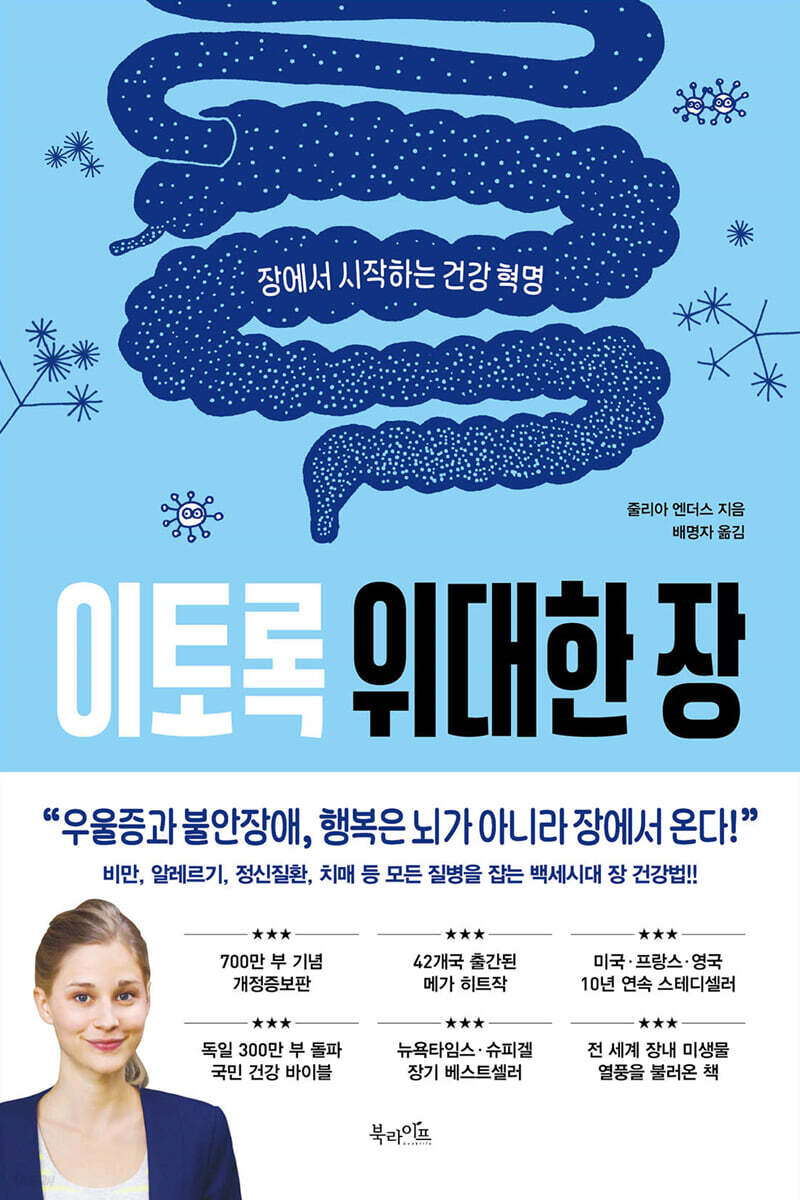
This Great Chapter (Revised and Expanded Edition to Commemorate 7 Million Copies)
 |
Description
Book Introduction
- A word from MD
- [The 'Gut' Bible Everyone Should Read] "Depression, anxiety, and happiness come from the gut, not the brain!" A revised and expanded edition of the book that sparked a global microbiome craze when it was published in 2014.
We corrected errors in the first edition and included research findings from the past.
It covers everything about gut health, which is closely connected to our overall health, beyond the digestive system, to our body, behavior, and emotions.
- Hyunjae Ahn, PD of Health Hobby
Cumulative global sales exceed 7 million copies
A health bestseller translated into 42 languages
The national 'Jang' bible that everyone in Germany knows just by hearing the title!
Why do I feel like throwing up when I'm stressed? Is my stomach growling really just because I'm hungry? "This Great Gut," first published in Germany in 2014 and sparking a global gut microbiome craze, has been republished in a revised and expanded edition to commemorate its 7 millionth copy sale.
The content has been completely revised to correct errors from the first edition, and the connection between gut health and the brain and emotions, as well as the content on making fermented foods with bacteria, have been updated.
The book uses witty metaphors and illustrations to introduce the intestines, previously known only as organs for digesting food and processing body waste, in a fun way, showing just how complex and powerful the organ is.
It provides a wealth of fascinating medical knowledge, covering the process of food digestion and excretion from the mouth to the intestines, and even the functions of the brain, digestive system, and bacteria that work closely with the intestines.
You'll also find answers to your questions about your gut, including how gut bacteria lower cholesterol levels, why taking care of your small intestine is crucial for treating chronic allergies, and how gut hormones affect memory and learning ability.
By understanding the role of the digestive system, including the intestines, and the bacteria in the body, let's discover ways to maintain gut health and prevent diseases such as obesity, allergies, depression, and dementia in the 100-year lifespan.
A health bestseller translated into 42 languages
The national 'Jang' bible that everyone in Germany knows just by hearing the title!
Why do I feel like throwing up when I'm stressed? Is my stomach growling really just because I'm hungry? "This Great Gut," first published in Germany in 2014 and sparking a global gut microbiome craze, has been republished in a revised and expanded edition to commemorate its 7 millionth copy sale.
The content has been completely revised to correct errors from the first edition, and the connection between gut health and the brain and emotions, as well as the content on making fermented foods with bacteria, have been updated.
The book uses witty metaphors and illustrations to introduce the intestines, previously known only as organs for digesting food and processing body waste, in a fun way, showing just how complex and powerful the organ is.
It provides a wealth of fascinating medical knowledge, covering the process of food digestion and excretion from the mouth to the intestines, and even the functions of the brain, digestive system, and bacteria that work closely with the intestines.
You'll also find answers to your questions about your gut, including how gut bacteria lower cholesterol levels, why taking care of your small intestine is crucial for treating chronic allergies, and how gut hormones affect memory and learning ability.
By understanding the role of the digestive system, including the intestines, and the bacteria in the body, let's discover ways to maintain gut health and prevent diseases such as obesity, allergies, depression, and dementia in the 100-year lifespan.
- You can preview some of the book's contents.
Preview
index
Preface to the Revised Edition
prolog
Chapter 1: My Body's Health Monitoring Agency: The Digestive System
- How does poop come out?
Toilet Business Rules | Proper Posture for Easier Pooping
- What happens at the entrance to the digestive tract
Acupuncture Pain Reliever | Tongue Root and Tonsils as Immune Training Centers
- Internal structure of the digestive system
A squirming esophagus | A tilted stomach | A hairy small intestine | A thorough inspector general
- The reality of food
Carbohydrates (sugar) | Fat | Protein (amino acids)
- Allergies, sensitivities, intolerances
Celiac Disease and Gluten Sensitivity | Lactose Intolerance and Fructose Intolerance
- [Column] Let’s learn about poop.
Chapter 2: All Disease Begins in the Gut
- Food transport process
Eyes | Nose | Mouth | Throat | Esophagus | Stomach | Small Intestine | Large Intestine
- Acid reflux
- Vomiting
Why Do We Vomit? | 5 Ways to Reduce Vomiting
- Constipation
"Not My Bathroom" Syndrome | Laxatives to Help You Get Rid of Bowel Fatigue | The 3-Day Rule to Empty and Fill Your Colon
- Brain and intestines
How Your Gut Affects Your Brain | Irritable Bowel Syndrome: Anxiety and Depression | Your Stomach Self
- Jang and emotions
Mood | Stress | Depression
Chapter 3: Longevity is Determined by Gut Bacteria
- Bacteria, the production managers in our bodies
- Immune system and bacteria
Bacteria that train immune cells | Gut bacteria that change your body
- Growth of intestinal microflora
The Golden Time for Microbial Initial Settlement | Intestinal Bacteria Collected Through the Oral
- Characteristics of intestinal bacteria
90 percent of gut microbes are bacteria | The genes of gut bacteria | The three types of gut bacteria
- The role of intestinal bacteria
Nutrients Produced by Bacteria | Obesity and Gut Bacteria | Cholesterol and Gut Bacteria
- Bad bacteria and parasites
Chicken and Salmonella | Gastroenteritis and Helicobacter pylori | Cats and Toxoplasma | Pinworms
- Good bacteria and hygiene
Hygiene Driven by Fear | Dangerous Weapon Antibiotics | Antibiotic Resistance | Probiotics | Live to the Gut
| Probiotic Effects | Lactic Acid Bacteria | Prebiotics | Galactooligosaccharides and Inulin
- Smart sour love
Fermenting vegetables with bacteria
Acknowledgements
References
prolog
Chapter 1: My Body's Health Monitoring Agency: The Digestive System
- How does poop come out?
Toilet Business Rules | Proper Posture for Easier Pooping
- What happens at the entrance to the digestive tract
Acupuncture Pain Reliever | Tongue Root and Tonsils as Immune Training Centers
- Internal structure of the digestive system
A squirming esophagus | A tilted stomach | A hairy small intestine | A thorough inspector general
- The reality of food
Carbohydrates (sugar) | Fat | Protein (amino acids)
- Allergies, sensitivities, intolerances
Celiac Disease and Gluten Sensitivity | Lactose Intolerance and Fructose Intolerance
- [Column] Let’s learn about poop.
Chapter 2: All Disease Begins in the Gut
- Food transport process
Eyes | Nose | Mouth | Throat | Esophagus | Stomach | Small Intestine | Large Intestine
- Acid reflux
- Vomiting
Why Do We Vomit? | 5 Ways to Reduce Vomiting
- Constipation
"Not My Bathroom" Syndrome | Laxatives to Help You Get Rid of Bowel Fatigue | The 3-Day Rule to Empty and Fill Your Colon
- Brain and intestines
How Your Gut Affects Your Brain | Irritable Bowel Syndrome: Anxiety and Depression | Your Stomach Self
- Jang and emotions
Mood | Stress | Depression
Chapter 3: Longevity is Determined by Gut Bacteria
- Bacteria, the production managers in our bodies
- Immune system and bacteria
Bacteria that train immune cells | Gut bacteria that change your body
- Growth of intestinal microflora
The Golden Time for Microbial Initial Settlement | Intestinal Bacteria Collected Through the Oral
- Characteristics of intestinal bacteria
90 percent of gut microbes are bacteria | The genes of gut bacteria | The three types of gut bacteria
- The role of intestinal bacteria
Nutrients Produced by Bacteria | Obesity and Gut Bacteria | Cholesterol and Gut Bacteria
- Bad bacteria and parasites
Chicken and Salmonella | Gastroenteritis and Helicobacter pylori | Cats and Toxoplasma | Pinworms
- Good bacteria and hygiene
Hygiene Driven by Fear | Dangerous Weapon Antibiotics | Antibiotic Resistance | Probiotics | Live to the Gut
| Probiotic Effects | Lactic Acid Bacteria | Prebiotics | Galactooligosaccharides and Inulin
- Smart sour love
Fermenting vegetables with bacteria
Acknowledgements
References
Detailed image

Into the book
A lot of things are constantly happening inside our bodies.
Every moment flows, pumps, sucks, crushes, shreds, tears, and builds anew.
As a result of all the workers in our exquisitely designed organs working together perfectly and efficiently, the metabolic energy consumption of an adult per hour is equivalent to that of a 100-watt incandescent light bulb.
Your kidneys work tirelessly throughout your life, filtering your blood more thoroughly than a coffee filter every second.
---p.21
We've all heard the sound of the manager cleaning the house.
That's the rumbling sound that comes from the stomach, and it comes from the small intestine as well.
In other words, your stomach growls not because you're hungry, but because digestion is finished and it's finally time to clean up.
The door opens and cleaning begins only when the stomach and intestines are empty.
---p.107
I suspect that one of the important stimuli that causes communication between the brain and the gut is stress.
When we feel a serious problem, like time pressure or anger, our brain tries to solve it, and this requires energy.
The brain borrows the energy it needs primarily from the gut.
In an emergency, a message is sent to the intestines via the sympathetic nerves telling them that they must exceptionally obey the brain.
The intestines work together to conserve energy during digestion, produce less mucus, and temporarily block nutrients from being absorbed into the bloodstream.
---p.156
Have you ever posted a photo of your dinner on Facebook and been disappointed when your friends didn't comment on it with admiration? You picked the wrong person.
If this were a microbial Facebook, the moment you posted a photo, it would get over a million likes, and beyond admiration and applause, there would be thrilling comments.
The friends who 'like' me change every day.
Sometimes, our milk-digesting enzymes admire cheesecake, and sometimes, our salmonella army cheers for a delicious tiramisu.
Sometimes we change microbes, and sometimes microbes change us.
We are the seasons and the weather to our gut microbes.
---p.206-207
Prebiotics and probiotics support good bacteria.
Probiotics, which means 'for life', are live bacteria that we can eat to stay healthy.
Prebiotics, which means 'before life', are a type of nutrient that helps good bacteria grow well by providing healthy food for good bacteria in the large intestine.
Antibiotics, which means 'to kill life', save us by killing bad bacteria when we are attacked by them.
Every moment flows, pumps, sucks, crushes, shreds, tears, and builds anew.
As a result of all the workers in our exquisitely designed organs working together perfectly and efficiently, the metabolic energy consumption of an adult per hour is equivalent to that of a 100-watt incandescent light bulb.
Your kidneys work tirelessly throughout your life, filtering your blood more thoroughly than a coffee filter every second.
---p.21
We've all heard the sound of the manager cleaning the house.
That's the rumbling sound that comes from the stomach, and it comes from the small intestine as well.
In other words, your stomach growls not because you're hungry, but because digestion is finished and it's finally time to clean up.
The door opens and cleaning begins only when the stomach and intestines are empty.
---p.107
I suspect that one of the important stimuli that causes communication between the brain and the gut is stress.
When we feel a serious problem, like time pressure or anger, our brain tries to solve it, and this requires energy.
The brain borrows the energy it needs primarily from the gut.
In an emergency, a message is sent to the intestines via the sympathetic nerves telling them that they must exceptionally obey the brain.
The intestines work together to conserve energy during digestion, produce less mucus, and temporarily block nutrients from being absorbed into the bloodstream.
---p.156
Have you ever posted a photo of your dinner on Facebook and been disappointed when your friends didn't comment on it with admiration? You picked the wrong person.
If this were a microbial Facebook, the moment you posted a photo, it would get over a million likes, and beyond admiration and applause, there would be thrilling comments.
The friends who 'like' me change every day.
Sometimes, our milk-digesting enzymes admire cheesecake, and sometimes, our salmonella army cheers for a delicious tiramisu.
Sometimes we change microbes, and sometimes microbes change us.
We are the seasons and the weather to our gut microbes.
---p.206-207
Prebiotics and probiotics support good bacteria.
Probiotics, which means 'for life', are live bacteria that we can eat to stay healthy.
Prebiotics, which means 'before life', are a type of nutrient that helps good bacteria grow well by providing healthy food for good bacteria in the large intestine.
Antibiotics, which means 'to kill life', save us by killing bad bacteria when we are attacked by them.
---p.276
Publisher's Review
The power to live to be 100 years old lies in the gut, not the brain!
Everything you need to know about gut health to revitalize your ailing body and mind.
The intestines in our body are an organ as smart as the brain.
It is the body's second most developed nervous system after the brain, producing over 20 types of hormones and overseeing 80 percent of the immune system, making it a "health surveillance agency."
The intestines communicate with the brain from the central and busiest part of the body.
It analyzes food coming in from the outside, curiously observes hormones circulating here and there, captures blood, inquires about the well-being of immune cells, and suspiciously eavesdrops on the murmurs of gut bacteria.
The gut tells the brain what's happening in the body and controls our health.
The reason the author focused on the role of the intestines is because he also suffered from lactose intolerance and atopic dermatitis of unknown cause as a child.
The author entered medical school after learning that the cause of diseases was in the intestines.
The author said at a family gathering, “I go to medical school.
When I said, "I'm going to be a doctor!" everyone was excited and happy, but when I mentioned my major, an awkward silence immediately fell.
“I’m fascinated by intestines and anuses!”
Despite this humiliation, the author delved into the field and wrote a book because the surprising research results on the field mentioned in the medical world were only discussed at academic conferences and recorded in academic papers.
A healthy gut doesn't cure all diseases.
Nevertheless, the author confidently states that new discoveries about the intestines will improve our lives, saying, “The intestines are as promising as stem cells.”
The book became an instant bestseller in Germany upon its publication in 2014, selling over 3 million copies in Germany alone.
It has maintained its position as a long-term bestseller for 10 consecutive years.
What's happening in the digestive system?
Just a little bit of knowledge about gut health that you can put into practice right away
How does poop come out? Why do poops have similar colors? This book begins with a story about poop.
Because the very ordinary 'toilet business' is done in a much more ingenious and clever way than you might think.
It turns out that the feeling of being completely relieved when doing one's business in a crouching or squatting position was not just a feeling.
In this way, Chapter 1, 'My Body's Health Surveillance Agency: The Digestive System', traces the process of food digestion and excretion from the mouth to the end of the intestines, introducing interesting knowledge about the digestive system that we did not know before.
It explains potentially difficult medical knowledge, including topics such as the tongue root, tonsils, esophagus, stomach, small intestine, large intestine, and even feces, in an easy-to-understand way using novel analogies.
The witty illustrations in the book add clarity and fun to the content.
If you're feeling depressed and uneasy, is it because of your intestines?!
Chapter 2, “All Disease Begins in the Gut,” explores everything from the pain experienced by the body due to problems with the enteric nervous system, such as acid reflux, vomiting, constipation, and irritable bowel syndrome, to brain and mental illnesses such as anxiety, depression, and stress.
When the balance of the gut microbiome is disrupted, it doesn't just lead to intestinal problems like indigestion, constipation, and severe gas.
It increases the risk of developing common chronic diseases such as obesity, allergies, lactose intolerance, skin problems, and depression.
Ultimately, the intestines are a key organ that serves as a barometer of physical and mental health.
For example, there are many expressions related to the intestines when talking about mood or physical condition in daily life.
Just looking at expressions like, "I wet my pants" when I'm scared, "I get upset" when things don't go my way, "I feel sick" when I'm criticized, and "I feel a ticklish feeling in my stomach" when I'm in love, we can see how closely our ego is connected to our intestines.
The author says, “Depression, anxiety, and happiness come from the stomach, not the brain.”
This is because intestinal cells produce 95 percent of serotonin, the happiness hormone.
This means that if you want to live a long, healthy, and happy life without getting sick for 100 years, you need to take care of your intestines.
From the types of intestinal bacteria to their various functions
Gut microbes you must know for a healthy 100-year life!
Chapter 3, "Gut Bacteria Determine Longevity," delves into how gut bacteria colonize our bodies, train immune cells, and manage health and the immune system, as well as what good and bad bacteria are.
It also teaches you how to ferment foods with bacteria so you can incorporate gut health habits into your daily life.
Each person's gut bacteria composition is different, and bacterial genes are incredibly complex.
Just as healthy food doesn't work for everyone, even if the same bacteria live in the intestines, the effects vary from person to person.
For example, more than 50 percent of Asians benefit from eating soybean paste, but only 25 to 30 percent of Westerners benefit.
This difference is not due to differences in human genes, but rather differences in bacterial genes.
Additionally, different types of gut bacteria can have both good and bad effects on the body.
While some bacteria aid digestion, produce vitamins, and provide us with beneficial substances, others contribute to belly fat and thigh fat, and cause chronic inflammation and immune system disruption.
If you have been taking probiotics that are said to be good for the intestines but have not seen much effect or have even felt uncomfortable, this book will give you hope.
Everything you need to know about gut health to revitalize your ailing body and mind.
The intestines in our body are an organ as smart as the brain.
It is the body's second most developed nervous system after the brain, producing over 20 types of hormones and overseeing 80 percent of the immune system, making it a "health surveillance agency."
The intestines communicate with the brain from the central and busiest part of the body.
It analyzes food coming in from the outside, curiously observes hormones circulating here and there, captures blood, inquires about the well-being of immune cells, and suspiciously eavesdrops on the murmurs of gut bacteria.
The gut tells the brain what's happening in the body and controls our health.
The reason the author focused on the role of the intestines is because he also suffered from lactose intolerance and atopic dermatitis of unknown cause as a child.
The author entered medical school after learning that the cause of diseases was in the intestines.
The author said at a family gathering, “I go to medical school.
When I said, "I'm going to be a doctor!" everyone was excited and happy, but when I mentioned my major, an awkward silence immediately fell.
“I’m fascinated by intestines and anuses!”
Despite this humiliation, the author delved into the field and wrote a book because the surprising research results on the field mentioned in the medical world were only discussed at academic conferences and recorded in academic papers.
A healthy gut doesn't cure all diseases.
Nevertheless, the author confidently states that new discoveries about the intestines will improve our lives, saying, “The intestines are as promising as stem cells.”
The book became an instant bestseller in Germany upon its publication in 2014, selling over 3 million copies in Germany alone.
It has maintained its position as a long-term bestseller for 10 consecutive years.
What's happening in the digestive system?
Just a little bit of knowledge about gut health that you can put into practice right away
How does poop come out? Why do poops have similar colors? This book begins with a story about poop.
Because the very ordinary 'toilet business' is done in a much more ingenious and clever way than you might think.
It turns out that the feeling of being completely relieved when doing one's business in a crouching or squatting position was not just a feeling.
In this way, Chapter 1, 'My Body's Health Surveillance Agency: The Digestive System', traces the process of food digestion and excretion from the mouth to the end of the intestines, introducing interesting knowledge about the digestive system that we did not know before.
It explains potentially difficult medical knowledge, including topics such as the tongue root, tonsils, esophagus, stomach, small intestine, large intestine, and even feces, in an easy-to-understand way using novel analogies.
The witty illustrations in the book add clarity and fun to the content.
If you're feeling depressed and uneasy, is it because of your intestines?!
Chapter 2, “All Disease Begins in the Gut,” explores everything from the pain experienced by the body due to problems with the enteric nervous system, such as acid reflux, vomiting, constipation, and irritable bowel syndrome, to brain and mental illnesses such as anxiety, depression, and stress.
When the balance of the gut microbiome is disrupted, it doesn't just lead to intestinal problems like indigestion, constipation, and severe gas.
It increases the risk of developing common chronic diseases such as obesity, allergies, lactose intolerance, skin problems, and depression.
Ultimately, the intestines are a key organ that serves as a barometer of physical and mental health.
For example, there are many expressions related to the intestines when talking about mood or physical condition in daily life.
Just looking at expressions like, "I wet my pants" when I'm scared, "I get upset" when things don't go my way, "I feel sick" when I'm criticized, and "I feel a ticklish feeling in my stomach" when I'm in love, we can see how closely our ego is connected to our intestines.
The author says, “Depression, anxiety, and happiness come from the stomach, not the brain.”
This is because intestinal cells produce 95 percent of serotonin, the happiness hormone.
This means that if you want to live a long, healthy, and happy life without getting sick for 100 years, you need to take care of your intestines.
From the types of intestinal bacteria to their various functions
Gut microbes you must know for a healthy 100-year life!
Chapter 3, "Gut Bacteria Determine Longevity," delves into how gut bacteria colonize our bodies, train immune cells, and manage health and the immune system, as well as what good and bad bacteria are.
It also teaches you how to ferment foods with bacteria so you can incorporate gut health habits into your daily life.
Each person's gut bacteria composition is different, and bacterial genes are incredibly complex.
Just as healthy food doesn't work for everyone, even if the same bacteria live in the intestines, the effects vary from person to person.
For example, more than 50 percent of Asians benefit from eating soybean paste, but only 25 to 30 percent of Westerners benefit.
This difference is not due to differences in human genes, but rather differences in bacterial genes.
Additionally, different types of gut bacteria can have both good and bad effects on the body.
While some bacteria aid digestion, produce vitamins, and provide us with beneficial substances, others contribute to belly fat and thigh fat, and cause chronic inflammation and immune system disruption.
If you have been taking probiotics that are said to be good for the intestines but have not seen much effect or have even felt uncomfortable, this book will give you hope.
GOODS SPECIFICS
- Date of issue: January 21, 2025
- Page count, weight, size: 344 pages | 512g | 140*210*18mm
- ISBN13: 9791191013832
- ISBN10: 1191013839
You may also like
카테고리
korean


korean

![GQ KOREA Mark (Monthly): December [2025]](http://librairie.coreenne.fr/cdn/shop/files/8ef265dbbfbf186523ed75ba7319009d.jpg?v=1765340328&width=3840)


