

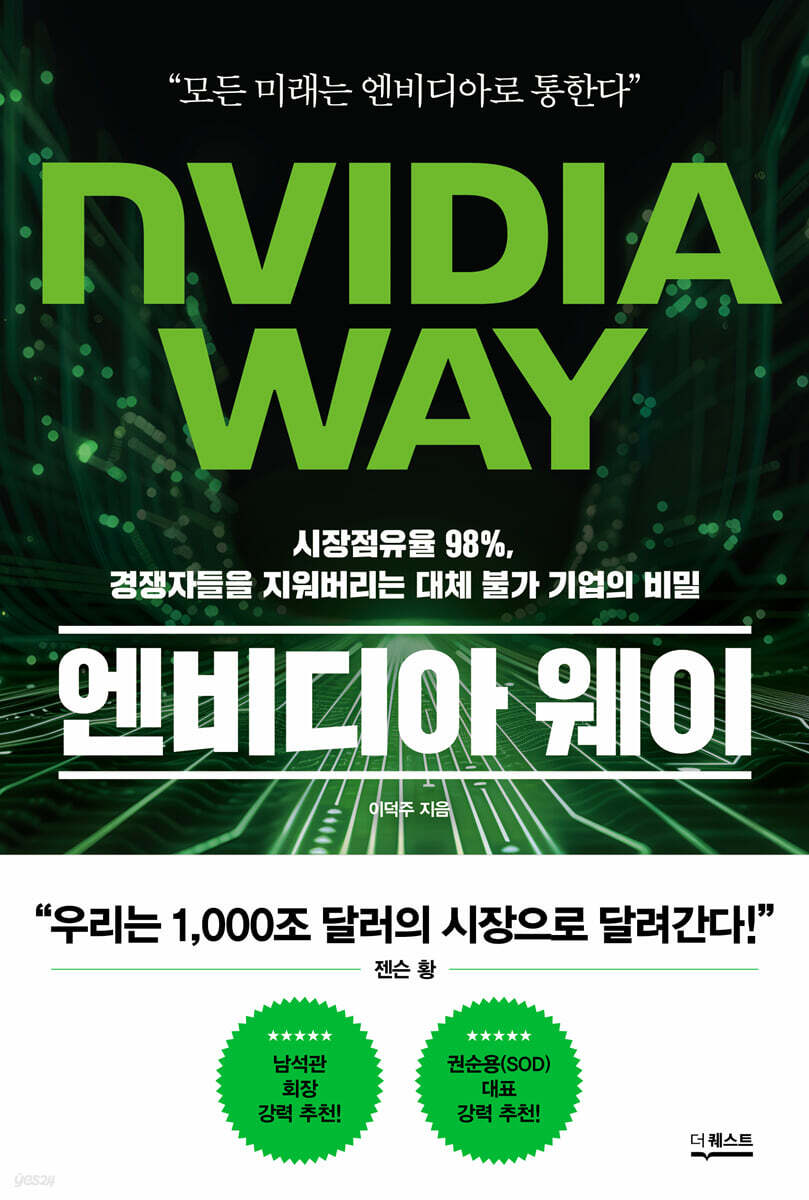
NVIDIA Way
 |
Description
Book Introduction
NVIDIA, up 210,000% since its IPO! It's become "the most important stock on the planet." Can the era of 'King Vidia' continue in the future? A must-read if you're investing in NVIDIA right now! Nvidia is the world's most valuable company today and one of the most important stocks in existence. Nvidia's growth since 2023 has been so overwhelming that it's hard to describe it as explosive. By 2024 alone, it had soared by a staggering 170 percent, making it the most dramatic growth company in modern corporate history, fueled by the rise of the generative AI industry. How did this company, which wasn't even in the top 20 in market capitalization five years ago, and only broke into the top 10 two years ago, become the world's largest company? Based on vivid reporting by a Silicon Valley correspondent, this book examines in detail the birth and growth of NVIDIA, a company that transformed from a small graphics card manufacturer into the "chip king" dominating the AI era. You can see the technological prowess of these individuals, who were able to become the top predator in the semiconductor industry from a company that was 30 days away from bankruptcy, and the secrets to locking developers into their CUDA ecosystem. Beyond the data center business, we will also be able to see what industries they are focusing on as future growth engines, and what Nvidia's future strategy is in relation to the growing "Chip War." |
- You can preview some of the book's contents.
Preview
index
Recommendation
Starting with the future brought forward by 'Nvidia'
Part 1.
The Emergence of Nvidia, a Disruptor of the Semiconductor Ecosystem
A small Silicon Valley company that rose to the top in market capitalization with a single semiconductor.
Why couldn't Samsung Electronics become Nvidia?
The Diverging Fates of SK Hynix and Samsung Electronics
Why the World Wants NVIDIA
The Secret to Nvidia's Becoming a Super-Gap Company
Part 2.
From Startup to AI Semiconductor Giant
A boy from Taiwan dreams of the American dream.
A promising start, a miserable failure
We only have 30 days left to die
The rise of deep learning presents a golden opportunity.
Behind every AI revolution, there's NVIDIA.
Part 3.
What Makes Them 'Irreplaceable'?
The company that dominates Silicon Valley with just four businesses
Data centers, the core engine of the new industrial revolution
The Metaverse and Digital Twin: The "Second Food"
Robotics and autonomous driving solutions that improve human life
Becoming a leader in the AI industry and a key player in the bio industry
Transformation from a hardware manufacturer to a service provider
[Further Reading] The Evolution of NVIDIA's AI Semiconductor
Part 4.
NVIDIA's corporate culture of never losing its original intentions
A forward-looking headquarters for a company creating the future
A Flexible Combination of East Asia and Silicon Valley
The Blessing of Suffering and Resilience
People at the forefront of AI innovation
Dreaming of a sustainable future through startup collaboration and investment.
Part 5.
The ongoing battle between chipmakers: What is the future of Nvidia?
Will Nvidia follow in Cisco's footsteps?
Longtime rival AMD and the advancing Intel
Customers and Competitors: Amazon, Microsoft, and Google
The company at the top of the AI pyramid: OpenAI
Apple's Challenges with a Powerful Ecosystem and On-Device AI
Why it's difficult to produce Korean-made AI semiconductors
Investment outlook from overseas experts
Investment Outlook from Domestic Analysts (Kwak Min-jeong, Hyundai Motor Securities Analyst)
In conclusion: What NVIDIA's growth has taught us
Starting with the future brought forward by 'Nvidia'
Part 1.
The Emergence of Nvidia, a Disruptor of the Semiconductor Ecosystem
A small Silicon Valley company that rose to the top in market capitalization with a single semiconductor.
Why couldn't Samsung Electronics become Nvidia?
The Diverging Fates of SK Hynix and Samsung Electronics
Why the World Wants NVIDIA
The Secret to Nvidia's Becoming a Super-Gap Company
Part 2.
From Startup to AI Semiconductor Giant
A boy from Taiwan dreams of the American dream.
A promising start, a miserable failure
We only have 30 days left to die
The rise of deep learning presents a golden opportunity.
Behind every AI revolution, there's NVIDIA.
Part 3.
What Makes Them 'Irreplaceable'?
The company that dominates Silicon Valley with just four businesses
Data centers, the core engine of the new industrial revolution
The Metaverse and Digital Twin: The "Second Food"
Robotics and autonomous driving solutions that improve human life
Becoming a leader in the AI industry and a key player in the bio industry
Transformation from a hardware manufacturer to a service provider
[Further Reading] The Evolution of NVIDIA's AI Semiconductor
Part 4.
NVIDIA's corporate culture of never losing its original intentions
A forward-looking headquarters for a company creating the future
A Flexible Combination of East Asia and Silicon Valley
The Blessing of Suffering and Resilience
People at the forefront of AI innovation
Dreaming of a sustainable future through startup collaboration and investment.
Part 5.
The ongoing battle between chipmakers: What is the future of Nvidia?
Will Nvidia follow in Cisco's footsteps?
Longtime rival AMD and the advancing Intel
Customers and Competitors: Amazon, Microsoft, and Google
The company at the top of the AI pyramid: OpenAI
Apple's Challenges with a Powerful Ecosystem and On-Device AI
Why it's difficult to produce Korean-made AI semiconductors
Investment outlook from overseas experts
Investment Outlook from Domestic Analysts (Kwak Min-jeong, Hyundai Motor Securities Analyst)
In conclusion: What NVIDIA's growth has taught us
Detailed image

Into the book
The business structure is also extremely simple.
Nvidia designs semiconductors and supports them with software.
They do not manufacture semiconductors themselves, and their B2C products used by general consumers are limited to gamers.
We only serve four types of customers: data centers, gaming, autonomous driving, and graphics professionals.
Unlike Microsoft, which has massive data centers and research facilities, Nvidia doesn't have many tangible assets.
Just how valuable is their $3 trillion enterprise value? The combined market capitalization of all companies listed on Korea's KOSPI and KOSDAQ falls short of NVIDIA's alone.
To put it more simply, as of the end of February 2024, Samsung Electronics' market capitalization was $378 billion.
This means that eight companies, such as Samsung Electronics, which manufactures everything from home appliances to mobile phones and memory semiconductors, would have to come together to have the same value as Nvidia.
--- 「Part 1.
From "The Emergence of Nvidia, the Destroyer of the Semiconductor Ecosystem"
In a February 2024 article, The New York Times commented that “NVIDIA’s unique AI-related intellectual property, rooted in decades of pioneering investments, sets it apart in the semiconductor league.”
It is really difficult to break the economic moat of Nvidia GPUs thanks to their overwhelming performance and ecosystem dominance that makes them 'unavoidable to use even if they are expensive'.
It is not easy to change the semiconductors used unless there is a major change that will change the industrial landscape.
As it becomes harder to find alternatives to Nvidia GPUs, Nvidia will only strengthen its moat.
This is why we should continue to pay attention to NVIDIA now and in the future.
--- 「Part 1.
From "The Emergence of Nvidia, the Destroyer of the Semiconductor Ecosystem"
Nvidia saw potential for GPUs in these supercomputers, and in the early 2000s, it introduced what it called the GPGPU (General Purpose GPU). They believed that GPUs could play a complementary role in supercomputers that primarily relied on CPUs.
Starting with the 'Nvidia Tesla' launched in 2007 targeting the supercomputer market, Nvidia entered the supercomputer market in earnest.
And this challenge led to Nvidia, which dominates the AI era today.
It could be said that the AI era we are experiencing now was started by Nvidia in 2007.
The know-how and network accumulated through entering the supercomputer market in this way led to an absolute market share in the AI semiconductor market over a decade later.
--- 「Part 2.
From “From a Startup to an AI Semiconductor Dinosaur”
What's even more surprising is the profitability.
The operating profit margin reached 65%, and the gross margin ratio was 78.4%, overwhelming other tech companies.
Sales increased by 262% and operating profit increased by 690% compared to the same period last year.
In one year, the company's sales increased 3.6 times and operating profit increased 7 times.
This means that a whopping 65% of sales remain as company profits, which is an unimaginably high operating profit rate for a manufacturing company.
In this way, Nvidia has announced earnings surprises that far exceed market expectations every quarter, and its stock price has also surged each time.
Nvidia, which was not even in the top 20 in terms of market capitalization among US companies until 2020, temporarily surpassed Microsoft in June 2024 to become the most valuable US company.
The status of a company called Nvidia in Silicon Valley has also completely changed.
Before jumping into data centers, Nvidia was perceived as a B2C-focused gaming company.
However, it is currently a representative AI company and is recognized as a company leading the future of computing.
--- 「Part 3.
What made them an 'irreplaceable' company?
Some say that Nvidia best combines the culture of Silicon Valley and East Asian companies.
Horizontal corporate culture, horizontal information exchange, honesty, and autonomy are typical Silicon Valley-style corporate cultures.
On the other hand, it is typical of East Asian companies to not fire people easily and to keep them employed for a long time.
The only time Nvidia underwent a Silicon Valley-style mass layoff was during the 2008 financial crisis (when it laid off 350 people, or 6.5% of its global workforce).
In Silicon Valley, where job changes and layoffs are frequent, Nvidia is considered one of the companies with the most stable employment.
Even employees prefer to stay at NVIDIA rather than leave.
This is true not only in Silicon Valley but also at Nvidia's Korean branch, where it is said that there are many employees who have worked there for over 10 years.
--- 「Part 4.
From "NVIDIA's corporate culture that never loses its original intention"
Can CSPs' proprietary AI semiconductors truly take over the market dominated by NVIDIA? The prevailing view in the industry is that it won't be easy.
Even though Nvidia's GPUs are expensive, their performance is far superior to that of other competitors, which is something that even competitors acknowledge.
Beyond performance issues, customers' preference for NVIDIA GPUs is also a barrier to entry for competitors. While CSPs use AI semiconductors for their own purposes, they also provide them to customers.
If customers want to use NVIDIA's GPUs rather than AI semiconductors designed by CSPs, they have to provide it.
For this reason, considering that CSPs must maintain a certain percentage of Nvidia GPU usage, the current outlook is that Nvidia's market share will remain at least 50%.
Nvidia designs semiconductors and supports them with software.
They do not manufacture semiconductors themselves, and their B2C products used by general consumers are limited to gamers.
We only serve four types of customers: data centers, gaming, autonomous driving, and graphics professionals.
Unlike Microsoft, which has massive data centers and research facilities, Nvidia doesn't have many tangible assets.
Just how valuable is their $3 trillion enterprise value? The combined market capitalization of all companies listed on Korea's KOSPI and KOSDAQ falls short of NVIDIA's alone.
To put it more simply, as of the end of February 2024, Samsung Electronics' market capitalization was $378 billion.
This means that eight companies, such as Samsung Electronics, which manufactures everything from home appliances to mobile phones and memory semiconductors, would have to come together to have the same value as Nvidia.
--- 「Part 1.
From "The Emergence of Nvidia, the Destroyer of the Semiconductor Ecosystem"
In a February 2024 article, The New York Times commented that “NVIDIA’s unique AI-related intellectual property, rooted in decades of pioneering investments, sets it apart in the semiconductor league.”
It is really difficult to break the economic moat of Nvidia GPUs thanks to their overwhelming performance and ecosystem dominance that makes them 'unavoidable to use even if they are expensive'.
It is not easy to change the semiconductors used unless there is a major change that will change the industrial landscape.
As it becomes harder to find alternatives to Nvidia GPUs, Nvidia will only strengthen its moat.
This is why we should continue to pay attention to NVIDIA now and in the future.
--- 「Part 1.
From "The Emergence of Nvidia, the Destroyer of the Semiconductor Ecosystem"
Nvidia saw potential for GPUs in these supercomputers, and in the early 2000s, it introduced what it called the GPGPU (General Purpose GPU). They believed that GPUs could play a complementary role in supercomputers that primarily relied on CPUs.
Starting with the 'Nvidia Tesla' launched in 2007 targeting the supercomputer market, Nvidia entered the supercomputer market in earnest.
And this challenge led to Nvidia, which dominates the AI era today.
It could be said that the AI era we are experiencing now was started by Nvidia in 2007.
The know-how and network accumulated through entering the supercomputer market in this way led to an absolute market share in the AI semiconductor market over a decade later.
--- 「Part 2.
From “From a Startup to an AI Semiconductor Dinosaur”
What's even more surprising is the profitability.
The operating profit margin reached 65%, and the gross margin ratio was 78.4%, overwhelming other tech companies.
Sales increased by 262% and operating profit increased by 690% compared to the same period last year.
In one year, the company's sales increased 3.6 times and operating profit increased 7 times.
This means that a whopping 65% of sales remain as company profits, which is an unimaginably high operating profit rate for a manufacturing company.
In this way, Nvidia has announced earnings surprises that far exceed market expectations every quarter, and its stock price has also surged each time.
Nvidia, which was not even in the top 20 in terms of market capitalization among US companies until 2020, temporarily surpassed Microsoft in June 2024 to become the most valuable US company.
The status of a company called Nvidia in Silicon Valley has also completely changed.
Before jumping into data centers, Nvidia was perceived as a B2C-focused gaming company.
However, it is currently a representative AI company and is recognized as a company leading the future of computing.
--- 「Part 3.
What made them an 'irreplaceable' company?
Some say that Nvidia best combines the culture of Silicon Valley and East Asian companies.
Horizontal corporate culture, horizontal information exchange, honesty, and autonomy are typical Silicon Valley-style corporate cultures.
On the other hand, it is typical of East Asian companies to not fire people easily and to keep them employed for a long time.
The only time Nvidia underwent a Silicon Valley-style mass layoff was during the 2008 financial crisis (when it laid off 350 people, or 6.5% of its global workforce).
In Silicon Valley, where job changes and layoffs are frequent, Nvidia is considered one of the companies with the most stable employment.
Even employees prefer to stay at NVIDIA rather than leave.
This is true not only in Silicon Valley but also at Nvidia's Korean branch, where it is said that there are many employees who have worked there for over 10 years.
--- 「Part 4.
From "NVIDIA's corporate culture that never loses its original intention"
Can CSPs' proprietary AI semiconductors truly take over the market dominated by NVIDIA? The prevailing view in the industry is that it won't be easy.
Even though Nvidia's GPUs are expensive, their performance is far superior to that of other competitors, which is something that even competitors acknowledge.
Beyond performance issues, customers' preference for NVIDIA GPUs is also a barrier to entry for competitors. While CSPs use AI semiconductors for their own purposes, they also provide them to customers.
If customers want to use NVIDIA's GPUs rather than AI semiconductors designed by CSPs, they have to provide it.
For this reason, considering that CSPs must maintain a certain percentage of Nvidia GPU usage, the current outlook is that Nvidia's market share will remain at least 50%.
--- 「Part 5.
From "The ongoing war between chipmakers, what is the future of Nvidia?"
From "The ongoing war between chipmakers, what is the future of Nvidia?"
Publisher's Review
[Goldman Sachs] “NVIDIA is the most important stock on the planet right now.”
[The New York Times] “Nvidia’s unrivaled AI intellectual property is unmatched by any other company.”
[Wall Street Journal] “The future of the semiconductor market will be determined by Nvidia.”
A startup that was 30 days away from bankruptcy,
Becoming the world's most valuable company with the largest market capitalization!
The Secret Behind NVIDIA: The Company Defining the Speed of the Future
A company with a 90% market share in AI accelerators, a 98% market share in AI accelerators for data centers, a stock price increase of 210,000% since going public, a company that will single-handedly raise the S&P 500 index by more than 30% in 2024, a company that went from a market cap of $2 trillion to $3 trillion in just 96 days, a company that rose from 10th to 1st in market cap in just 2 years, a company that recorded a market cap more than 10 times that of Samsung Electronics with only 30,000 employees on a global basis, etc.
This is a phrase that describes Nvidia, one of the most notable and important companies today.
How did a small Silicon Valley company that made GPUs for consoles and PCs, founded in 1993, become the world's No. 1 AI company with a 98% market share, a position that today's tech giants rely on?
This book is the first to delve into the success story of NVIDIA and its CEO Jensen Huang, a company that is leading the future with its remarkable technological prowess and market dominance.
The author, who is the fastest to report on tech companies in Silicon Valley, focused on Nvidia, a company that emerged as a new powerhouse in the US tech industry a few years ago and has risen to the top spot in market capitalization with unprecedented growth.
In this book, he begins with CEO Jensen Huang's founding story, closely analyzes the influence they currently wield in the AI industry, the unique economic moat that enabled their near-monopoly in the market, and whether such advantages will continue to make Nvidia a winner in the upcoming semiconductor war.
In addition, we will examine the anti-NVIDIA coalition movements currently sweeping the tech industry and examine how these changes will impact future semiconductor and NVIDIA investments.
Now, the company with the most powerful chip in the world becomes the most powerful company!
The Future of AI: NVIDIA, Leading the New Industrial Revolution
The question that many people are most curious about right now is, “Will the era of ‘King Vidia’ continue like this in the future?”
This book, which is like an answer to that question, analyzes the NVIDIA WAY—the way they transformed the industry and shaped the future of computing.
Part 1 explores how a company that made graphics cards transformed the industry, dethroning its rivals who had held the throne for nearly half a century, and what technological advantages and economic moats made Nvidia GPUs the only choice for Big Tech companies around the world.
Part 2 describes the strategic shift that transformed the company from a graphics card manufacturer to an "AI company."
By following the development of NVIDIA, which is at the forefront of a new industrial revolution by taking a path no one has walked before, we can predict what kind of future they are envisioning.
In Part 3, we explore the data center industry, which has driven Nvidia's rapid growth, and the markets in which they are currently seeking future growth.
Generative AI, led by ChatGPT, has become the defining technology of our time.
And NVIDIA's latest offering, the Blackwell GPU, is taking this generative AI to the next level.
We also examine the strategies of those seeking to dominate a market worth over $1,000 trillion, and their new vision for transforming from a hardware company to a service provider through AI foundries.
This chapter will demonstrate how far their technology has come and how widely NVIDIA GPUs are being used across industries beyond data centers.
Part 4 discusses the unique leadership of Jensen Huang, who has held the position of CEO for over 30 years since the company's founding, and NVIDIA's organizational culture.
We examine the impact of this organizational culture—a CEO who actively communicates with customers, a Silicon Valley-style culture that demands horizontal information sharing, rapid development, and voluntary innovation—on the stability of a company. This culture combines long-term employment and the East Asian culture of not easily firing employees.
In the final Part 5, we'll delve into whether NVIDIA can maintain its current market dominance and which tech companies, including promising startups that are hot on its heels, are worth keeping an eye on.
Many experts predict that the race for a $4 trillion market cap will be a three-way battle between Microsoft, Apple, and Nvidia. How accurate will this prediction be? We'll also hear from domestic and international investment experts, and consider Nvidia's future investment strategy.
Nvidia's GPUs are the new goldmine in technology,
The era of 'King Vidia' will continue!
Nvidia, which has been soaring to record highs every day, then undergoing corrections and then recovering again, constantly changing its target stock price, is still boiling like a furnace.
With AI technology being applied across all industries, Nvidia's GPUs are being called the new gold and oil of the technology field, and are rewriting the future of AI and the future of computers.
A company poised to shape the semiconductor market, a company poised to become the most powerful player in AI data centers within the next decade, and a company poised to become the AI industry itself, examining the secrets of Nvidia's growth will be key to predicting future trends in the semiconductor market and, by extension, global technological advancement.
Here's why you need to know the NVIDIA Way now to see how they're accelerating the future.
[The New York Times] “Nvidia’s unrivaled AI intellectual property is unmatched by any other company.”
[Wall Street Journal] “The future of the semiconductor market will be determined by Nvidia.”
A startup that was 30 days away from bankruptcy,
Becoming the world's most valuable company with the largest market capitalization!
The Secret Behind NVIDIA: The Company Defining the Speed of the Future
A company with a 90% market share in AI accelerators, a 98% market share in AI accelerators for data centers, a stock price increase of 210,000% since going public, a company that will single-handedly raise the S&P 500 index by more than 30% in 2024, a company that went from a market cap of $2 trillion to $3 trillion in just 96 days, a company that rose from 10th to 1st in market cap in just 2 years, a company that recorded a market cap more than 10 times that of Samsung Electronics with only 30,000 employees on a global basis, etc.
This is a phrase that describes Nvidia, one of the most notable and important companies today.
How did a small Silicon Valley company that made GPUs for consoles and PCs, founded in 1993, become the world's No. 1 AI company with a 98% market share, a position that today's tech giants rely on?
This book is the first to delve into the success story of NVIDIA and its CEO Jensen Huang, a company that is leading the future with its remarkable technological prowess and market dominance.
The author, who is the fastest to report on tech companies in Silicon Valley, focused on Nvidia, a company that emerged as a new powerhouse in the US tech industry a few years ago and has risen to the top spot in market capitalization with unprecedented growth.
In this book, he begins with CEO Jensen Huang's founding story, closely analyzes the influence they currently wield in the AI industry, the unique economic moat that enabled their near-monopoly in the market, and whether such advantages will continue to make Nvidia a winner in the upcoming semiconductor war.
In addition, we will examine the anti-NVIDIA coalition movements currently sweeping the tech industry and examine how these changes will impact future semiconductor and NVIDIA investments.
Now, the company with the most powerful chip in the world becomes the most powerful company!
The Future of AI: NVIDIA, Leading the New Industrial Revolution
The question that many people are most curious about right now is, “Will the era of ‘King Vidia’ continue like this in the future?”
This book, which is like an answer to that question, analyzes the NVIDIA WAY—the way they transformed the industry and shaped the future of computing.
Part 1 explores how a company that made graphics cards transformed the industry, dethroning its rivals who had held the throne for nearly half a century, and what technological advantages and economic moats made Nvidia GPUs the only choice for Big Tech companies around the world.
Part 2 describes the strategic shift that transformed the company from a graphics card manufacturer to an "AI company."
By following the development of NVIDIA, which is at the forefront of a new industrial revolution by taking a path no one has walked before, we can predict what kind of future they are envisioning.
In Part 3, we explore the data center industry, which has driven Nvidia's rapid growth, and the markets in which they are currently seeking future growth.
Generative AI, led by ChatGPT, has become the defining technology of our time.
And NVIDIA's latest offering, the Blackwell GPU, is taking this generative AI to the next level.
We also examine the strategies of those seeking to dominate a market worth over $1,000 trillion, and their new vision for transforming from a hardware company to a service provider through AI foundries.
This chapter will demonstrate how far their technology has come and how widely NVIDIA GPUs are being used across industries beyond data centers.
Part 4 discusses the unique leadership of Jensen Huang, who has held the position of CEO for over 30 years since the company's founding, and NVIDIA's organizational culture.
We examine the impact of this organizational culture—a CEO who actively communicates with customers, a Silicon Valley-style culture that demands horizontal information sharing, rapid development, and voluntary innovation—on the stability of a company. This culture combines long-term employment and the East Asian culture of not easily firing employees.
In the final Part 5, we'll delve into whether NVIDIA can maintain its current market dominance and which tech companies, including promising startups that are hot on its heels, are worth keeping an eye on.
Many experts predict that the race for a $4 trillion market cap will be a three-way battle between Microsoft, Apple, and Nvidia. How accurate will this prediction be? We'll also hear from domestic and international investment experts, and consider Nvidia's future investment strategy.
Nvidia's GPUs are the new goldmine in technology,
The era of 'King Vidia' will continue!
Nvidia, which has been soaring to record highs every day, then undergoing corrections and then recovering again, constantly changing its target stock price, is still boiling like a furnace.
With AI technology being applied across all industries, Nvidia's GPUs are being called the new gold and oil of the technology field, and are rewriting the future of AI and the future of computers.
A company poised to shape the semiconductor market, a company poised to become the most powerful player in AI data centers within the next decade, and a company poised to become the AI industry itself, examining the secrets of Nvidia's growth will be key to predicting future trends in the semiconductor market and, by extension, global technological advancement.
Here's why you need to know the NVIDIA Way now to see how they're accelerating the future.
GOODS SPECIFICS
- Date of issue: July 25, 2024
- Page count, weight, size: 276 pages | 478g | 145*215*17mm
- ISBN13: 9791140709908
- ISBN10: 1140709909
You may also like
카테고리
korean


korean

![GQ KOREA Mark (Monthly): December [2025]](http://librairie.coreenne.fr/cdn/shop/files/8ef265dbbfbf186523ed75ba7319009d.jpg?v=1765340328&width=3840)


