

Buy it, mayo
 |
Description
Book Introduction
- A word from MD
-
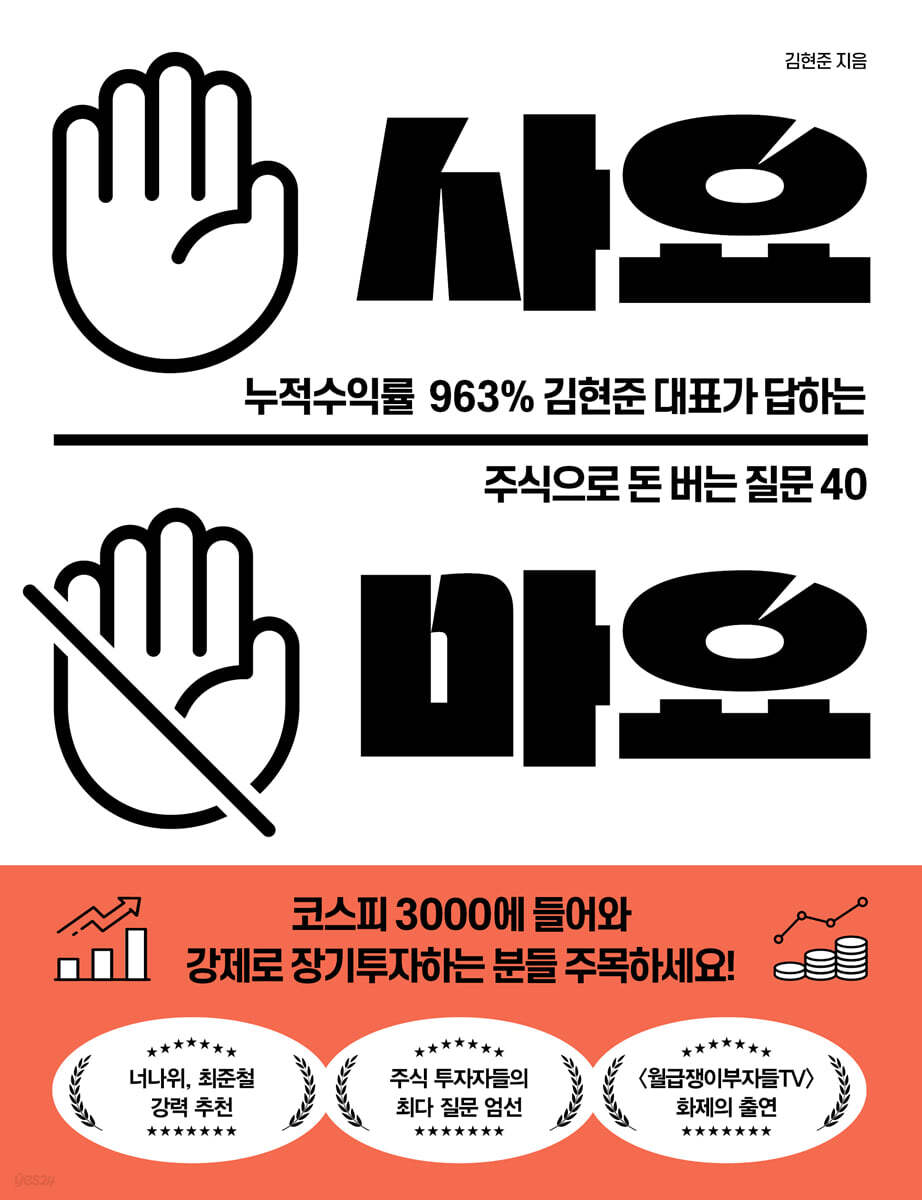
If you buy blindly, you will fail!This book contains answers to 40 questions that novice investors have, as if in a one-on-one conversation, from professional stock investor Kim Hyeon-jun.
It contains essential information for investors, from stock selection and buying and selling methods to how to make money with stocks.
It will serve as a guide for novice investors to make the right investments.
February 29, 2024. Economics and Management PD Kim Sang-geun
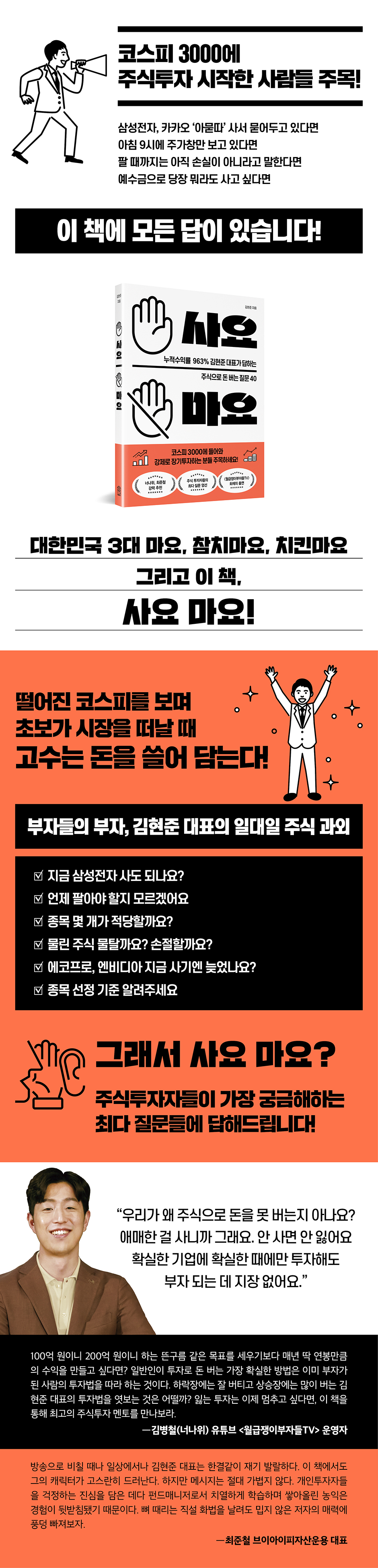
As beginners leave the market, experts are raking in the money as the KOSPI falls!
“Do you still check the stock price at 9 am?”
Stop the daily ups and downs! Stock prices won't rise just by looking at them!
- You and Choi Jun-cheol strongly recommend
When investing in stocks, in the end, only one question remains.
So, should I buy this stock? Or not? I understand that blue-chip stocks like Samsung Electronics are good, but I can't buy stocks that are already too expensive and relatively cheap because I feel like there must be a reason they're cheap.
So what on earth should I buy? This book has all the answers to that question.
“Do you still check the stock price at 9 am?”
Stop the daily ups and downs! Stock prices won't rise just by looking at them!
- You and Choi Jun-cheol strongly recommend
When investing in stocks, in the end, only one question remains.
So, should I buy this stock? Or not? I understand that blue-chip stocks like Samsung Electronics are good, but I can't buy stocks that are already too expensive and relatively cheap because I feel like there must be a reason they're cheap.
So what on earth should I buy? This book has all the answers to that question.
- You can preview some of the book's contents.
Preview
index
Prologue: Anyone Can Get Rich Through Stocks
PART 1: You have to make money to invest.
Should I buy Samsung Electronics now? I know when to buy, but I don't know when to sell. How many stocks would be appropriate? If you had to choose just one most important investment indicator, what would it be? If I had 10 million won, how would I structure my portfolio? Are there any commonalities among the stocks that have generated the most profit? How is my current asset portfolio structured? What exactly is value investing? Please tell me what people who became wealthy through stocks have in common.
PART 2: Those who are forced to invest long-term in the KOSPI 3000, pay attention.
It's hard to keep your composure when stock prices are falling. Should I buy the stocks I've lost, or cut my losses? Do I need to know anything about charts? Do I not even consider macroeconomic indicators? Should I buy individual stocks or indices? Should I invest in stocks or real estate? Do professional investors also lose money? Please recommend some must-read investment books. I'm afraid of interest rate hikes.
PART 3 Don't buy something just because others say it's good.
I only want to buy when others say it's good. What's an appropriate cash ratio? Should I invest in Bitcoin right now? Should I invest in domestic or foreign stocks? Is there a way to find investment ideas in everyday life? What if I'm afraid of investing in stocks? I like Elon Musk, so I want to invest in Tesla.
I want to pick good stocks in the AI theme. Can't individuals beat institutions? Can the Korea discount be resolved?
PART 4 If you want to make money with stocks, here's what you need to do
Is there a specific order to studying stocks? I want to study financial statements thoroughly. Do you have any investment principles that you absolutely adhere to? What sectors are promising this year? If you were 30 years old, what stocks would you buy? Is leveraged investing acceptable? Please tell me your criteria for stock selection. Do you really not care about stock prices? How do you calculate a fair stock price? Is there a specific place to find company-related information? What are the next megatrends? Is there a way to select the best stocks among promising industries?
Epilogue: We Are Already Rich
PART 1: You have to make money to invest.
Should I buy Samsung Electronics now? I know when to buy, but I don't know when to sell. How many stocks would be appropriate? If you had to choose just one most important investment indicator, what would it be? If I had 10 million won, how would I structure my portfolio? Are there any commonalities among the stocks that have generated the most profit? How is my current asset portfolio structured? What exactly is value investing? Please tell me what people who became wealthy through stocks have in common.
PART 2: Those who are forced to invest long-term in the KOSPI 3000, pay attention.
It's hard to keep your composure when stock prices are falling. Should I buy the stocks I've lost, or cut my losses? Do I need to know anything about charts? Do I not even consider macroeconomic indicators? Should I buy individual stocks or indices? Should I invest in stocks or real estate? Do professional investors also lose money? Please recommend some must-read investment books. I'm afraid of interest rate hikes.
PART 3 Don't buy something just because others say it's good.
I only want to buy when others say it's good. What's an appropriate cash ratio? Should I invest in Bitcoin right now? Should I invest in domestic or foreign stocks? Is there a way to find investment ideas in everyday life? What if I'm afraid of investing in stocks? I like Elon Musk, so I want to invest in Tesla.
I want to pick good stocks in the AI theme. Can't individuals beat institutions? Can the Korea discount be resolved?
PART 4 If you want to make money with stocks, here's what you need to do
Is there a specific order to studying stocks? I want to study financial statements thoroughly. Do you have any investment principles that you absolutely adhere to? What sectors are promising this year? If you were 30 years old, what stocks would you buy? Is leveraged investing acceptable? Please tell me your criteria for stock selection. Do you really not care about stock prices? How do you calculate a fair stock price? Is there a specific place to find company-related information? What are the next megatrends? Is there a way to select the best stocks among promising industries?
Epilogue: We Are Already Rich
Detailed image
Into the book
I have only said what I wanted to say, with the slight pride of being a true investor.
It didn't matter whether it was broadcast, newspaper, book, or social media.
To most of the questions I get asked, I answer with “I don’t know” or “Study more and then ask.”
However, I felt that I could no longer afford to leave ordinary investors struggling alone in the cold world of investment.
Everyone has a first time, right? Looking back now, I realize the concerns and questions I had when I first started investing in stocks were different from what I have now.
Just as getting started is half the battle and tying your shoelaces is the key to running, I'm going to teach you how to survive in the stock market without giving up.
This is the sense of mission of someone who says, “Anyone can become rich through stock investment” and “Stocks have historically been the most profitable of all asset classes.”
--- p.5
It doesn't matter whether it's a leading domestic company, a world leader in the semiconductor industry, or whether the industry has a promising future.
I need to compare how much profit this company is giving me compared to the price I am investing in it.
Investment price and profit, of these, you already know the price.
Because it appears on Naver Pay Securities and is also printed on your MTS.
Then, I guess all you need to know is profit.
As a Samsung Electronics shareholder, do you know how much profit Samsung Electronics generates? Profit is profit.
The money you spend on a sandwich and cola goes to the sandwich shop owner.
This is called sales.
But not all of this money belongs to the boss.
The owner has to buy sandwich ingredients, pay rent, and pay his employees.
The money left after deducting this and that is called operating profit.
It literally means the money left over from doing business.
When you first open a store here, after paying off the interest on the money you borrowed from the bank and paying taxes stipulated by the government, only then will you have a net profit that you can use as you wish.
This net profit is the 'profit' that Samsung Electronics gives you, as mentioned earlier.
--- p.14
If you buy stocks because they seem like really good companies and they seem too cheap, write down why you bought them.
Be as specific as possible.
Rather than saying, "It has good marketability," say, "Currently, only 1 in 10 Koreans are using this service, but it seems that half of the population will be using it within 10 years," or rather than saying, "It is very undervalued," say, "It is a product that consumers will purchase repeatedly, so the current net profit of 10 billion won is likely to be maintained, but the market capitalization is only 50 billion won, so the expected rate of return is 20% (net profit of 10 billion won ÷ market capitalization of 50 billion won), which is much higher than the current deposit interest rate of 3%."
And we review and update the content at least once every three months, which is the period in which our country's listed companies announce their quarterly performance.
If the company's situation has changed for the worse since you first bought it or checked it last quarter and there are no signs of recovery, don't be foolish and sell your stock.
I do this again when the target price I roughly set when I first bought it is exceeded.
The company may grow much faster than I expected.
In this case, it would be okay to raise the target price and hold on to it longer.
--- p.21~22
Also, do I really need to recover my principal solely through Kakao, the stock I invested in? Or is there any evidence that Kakao will recover the fastest among all stocks, or indeed all investment assets in the world? If so, then I should definitely take a chance.
But money has no labels.
You won't even know you invested in that stock.
There is a stock market adage that goes like this:
"If I were to make a new investment today, would I buy this stock? If the answer is 'no,' sell all my current holdings immediately." We need to break free from the so-called anchoring effect, which obsesses us with the fact that we bought this stock in the past.
This refers to a psychological state in which a person is unable to make new decisions because he or she is stuck in his or her past behavior, just like a large ship that has dropped anchor and is stuck in that spot.
--- p.73
I would advise you to focus on something more concrete.
It's a company.
And the consumer's wallet.
Even if knowing the current state of the macroeconomy and identifying the industries that will lead the stock market in the future determines returns, this is merely a conclusion.
The fact that the National Statistical Office announces the peak and trough of our country's economy is like saying, "Looking back, that was the bottom," or "Looking back, that was the peak," long after the actual peak and trough have occurred.
Therefore, we need to find companies that will capture consumers and generate consistent profits regardless of the economic cycle, companies that will inevitably ride the cycle but will survive until the next expansion and, at the next peak, earn more than they did at the previous peak, thereby recouping the opportunity cost to us who waited.
--- p.83
EcoPro, that stock was hot for a while, wasn't it? If you've heard stories of people making a lot of money with EcoPro, you might suddenly feel a sense of impatience.
Investing in stocks is a task that requires a fight with oneself.
When I hear stories of people around me making a lot of money through stock investment, I get jealous and anxious.
It makes you wonder where and why he invested.
Then, you want to just blindly invest your money in stocks that others say are good, without really studying investment, while looking here and there.
It didn't matter whether it was broadcast, newspaper, book, or social media.
To most of the questions I get asked, I answer with “I don’t know” or “Study more and then ask.”
However, I felt that I could no longer afford to leave ordinary investors struggling alone in the cold world of investment.
Everyone has a first time, right? Looking back now, I realize the concerns and questions I had when I first started investing in stocks were different from what I have now.
Just as getting started is half the battle and tying your shoelaces is the key to running, I'm going to teach you how to survive in the stock market without giving up.
This is the sense of mission of someone who says, “Anyone can become rich through stock investment” and “Stocks have historically been the most profitable of all asset classes.”
--- p.5
It doesn't matter whether it's a leading domestic company, a world leader in the semiconductor industry, or whether the industry has a promising future.
I need to compare how much profit this company is giving me compared to the price I am investing in it.
Investment price and profit, of these, you already know the price.
Because it appears on Naver Pay Securities and is also printed on your MTS.
Then, I guess all you need to know is profit.
As a Samsung Electronics shareholder, do you know how much profit Samsung Electronics generates? Profit is profit.
The money you spend on a sandwich and cola goes to the sandwich shop owner.
This is called sales.
But not all of this money belongs to the boss.
The owner has to buy sandwich ingredients, pay rent, and pay his employees.
The money left after deducting this and that is called operating profit.
It literally means the money left over from doing business.
When you first open a store here, after paying off the interest on the money you borrowed from the bank and paying taxes stipulated by the government, only then will you have a net profit that you can use as you wish.
This net profit is the 'profit' that Samsung Electronics gives you, as mentioned earlier.
--- p.14
If you buy stocks because they seem like really good companies and they seem too cheap, write down why you bought them.
Be as specific as possible.
Rather than saying, "It has good marketability," say, "Currently, only 1 in 10 Koreans are using this service, but it seems that half of the population will be using it within 10 years," or rather than saying, "It is very undervalued," say, "It is a product that consumers will purchase repeatedly, so the current net profit of 10 billion won is likely to be maintained, but the market capitalization is only 50 billion won, so the expected rate of return is 20% (net profit of 10 billion won ÷ market capitalization of 50 billion won), which is much higher than the current deposit interest rate of 3%."
And we review and update the content at least once every three months, which is the period in which our country's listed companies announce their quarterly performance.
If the company's situation has changed for the worse since you first bought it or checked it last quarter and there are no signs of recovery, don't be foolish and sell your stock.
I do this again when the target price I roughly set when I first bought it is exceeded.
The company may grow much faster than I expected.
In this case, it would be okay to raise the target price and hold on to it longer.
--- p.21~22
Also, do I really need to recover my principal solely through Kakao, the stock I invested in? Or is there any evidence that Kakao will recover the fastest among all stocks, or indeed all investment assets in the world? If so, then I should definitely take a chance.
But money has no labels.
You won't even know you invested in that stock.
There is a stock market adage that goes like this:
"If I were to make a new investment today, would I buy this stock? If the answer is 'no,' sell all my current holdings immediately." We need to break free from the so-called anchoring effect, which obsesses us with the fact that we bought this stock in the past.
This refers to a psychological state in which a person is unable to make new decisions because he or she is stuck in his or her past behavior, just like a large ship that has dropped anchor and is stuck in that spot.
--- p.73
I would advise you to focus on something more concrete.
It's a company.
And the consumer's wallet.
Even if knowing the current state of the macroeconomy and identifying the industries that will lead the stock market in the future determines returns, this is merely a conclusion.
The fact that the National Statistical Office announces the peak and trough of our country's economy is like saying, "Looking back, that was the bottom," or "Looking back, that was the peak," long after the actual peak and trough have occurred.
Therefore, we need to find companies that will capture consumers and generate consistent profits regardless of the economic cycle, companies that will inevitably ride the cycle but will survive until the next expansion and, at the next peak, earn more than they did at the previous peak, thereby recouping the opportunity cost to us who waited.
--- p.83
EcoPro, that stock was hot for a while, wasn't it? If you've heard stories of people making a lot of money with EcoPro, you might suddenly feel a sense of impatience.
Investing in stocks is a task that requires a fight with oneself.
When I hear stories of people around me making a lot of money through stock investment, I get jealous and anxious.
It makes you wonder where and why he invested.
Then, you want to just blindly invest your money in stocks that others say are good, without really studying investment, while looking here and there.
--- p.119~120
Publisher's Review
Anyone can become rich through stocks! But only if you find a good mentor!
Open the book and get one-on-one stock tutoring
To survive in any chapter, learn good questions and their answers!
It is said that 30-40% of stock investors in Korea have first encountered stocks since COVID-19.
The joy of entering the KOSPI 3000 stock market was short-lived, but it was followed by two years of tedious and difficult bear markets.
This book was written for those who bought Samsung Electronics during the Corona 3000 crisis and still hold onto it.
Anyone can become rich through stocks.
That is, if you don't give up and survive in the stock market.
To do that, you need to find a proper mentor.
"Sayo Mayo" contains the questions and answers that stock investors are most curious about.
Over the past four years, the author has collected questions from not only stock investors but also newspaper reporters, broadcasting station producers, writers, and YouTubers, taking into account their frequency and weight, and has included the most realistic and reliable answers.
Unlike existing stock books, such as “Samsung Electronics, should I buy it or not?” and “Ecopro, is it too late to buy it now?”, we have carefully selected only the content that stock investors are truly curious about.
Rather than giving vague answers like, "This stock is good because of this," or "That stock is good because of that," we clearly reveal which stocks are good, what the megatrends of 2024 are, and when to buy good stocks.
Author Kim Hyeon-jun is a regular on the YouTube channel “Salaryman Rich TV,” and has earned the trust and support of many subscribers for his refreshing wit and solid skills.
The author says, “Anyone can become rich through stocks.”
If you memorize the questions and answers in this book with the mindset of receiving one-on-one stock tutoring from CEO Kim Hyun-jun, you'll soon experience the joy of seeing your stock account light up in the red.
Attention to those who are forced to make long-term investments after entering the KOSPI 3000 range.
Is Samsung Electronics stock worth kimchi? Don't keep burying it!
When buying stocks, you should consider cost-effectiveness.
Even when buying a single item, we agonize over the price to get the lowest possible price. Why don't we do the same when buying stocks? When buying stocks, the most important thing is to determine whether the stock is priced appropriately.
You should buy undervalued stocks based on their cost-effectiveness.
That is, you have to buy when it is cheap and sell when it is expensive.
To do that, you have to go against what others are doing.
When people want to buy, the price usually goes up, so they end up selling when the price is high, and when people want to sell, the price goes down, so they end up buying when the price is low.
It's easier said than done, but how can you invest against the crowd and make money? Here are some easy tips you can apply starting tomorrow.
1.
Long-term outlook, don't be afraid of interest rate hikes (don't be overly excited or depressed by the news).
2.
Find fair value and buy undervalued stocks (don't just search for the lowest price, calculate the fair price).
3.
When others say it's a crisis, that's the time to buy (when people are complaining, that's an opportunity).
4.
I don't check stock prices every day (for my mental health, that's right).
“EcoPro, do you buy Nvidia or not?”
“Samsung Electronics, buy it or not?”
With a cumulative return of 963%, CEO Kim Hyun-jun will give you a clear answer!
In these times when the desire for money has been boiling over and then cooling off after COVID-19, true experts always make money regardless of market conditions.
This is why you need to lay a solid foundation to become a master.
Do you know why we lose money in stocks? The author states firmly.
“That’s because I bought something ambiguous.”
There is absolutely no problem in becoming rich by investing only in reliable companies at reliable times.
But when I have a deposit, I feel unnecessarily anxious.
If I don't buy something, I feel like I'm incurring an opportunity cost. If I don't buy something that everyone else is buying, I feel like I'm missing out on an opportunity. If I buy something, I feel like it's better than paying with cash.
But stocks bought that way will inevitably fall.
Don't blindly buy something just because everyone else says it's good! Whenever your heart wavers or your ears twitch, turn to this book.
No matter what your current market situation or the state of your account, this book will immediately help your finances and soothe your anxious mind.
Questions that will immediately raise a red light on your account
√ Can I buy Samsung Electronics now?
√ I don't know when to sell
√ How many stocks would be appropriate?
√ Should I buy the stock that I bought? Should I cut my losses?
√ Do you not refer to macroeconomic indicators at all?
√ I only want to buy something when other people say it's good.
√ Should I invest in Bitcoin now?
√ EcoPro, is it too late to buy Nvidia now?
√ Please tell me the criteria for selecting items
√ Do I need to check the stock price every day?
√ How is the fair stock price calculated?
√ What is the next megatrend?
Open the book and get one-on-one stock tutoring
To survive in any chapter, learn good questions and their answers!
It is said that 30-40% of stock investors in Korea have first encountered stocks since COVID-19.
The joy of entering the KOSPI 3000 stock market was short-lived, but it was followed by two years of tedious and difficult bear markets.
This book was written for those who bought Samsung Electronics during the Corona 3000 crisis and still hold onto it.
Anyone can become rich through stocks.
That is, if you don't give up and survive in the stock market.
To do that, you need to find a proper mentor.
"Sayo Mayo" contains the questions and answers that stock investors are most curious about.
Over the past four years, the author has collected questions from not only stock investors but also newspaper reporters, broadcasting station producers, writers, and YouTubers, taking into account their frequency and weight, and has included the most realistic and reliable answers.
Unlike existing stock books, such as “Samsung Electronics, should I buy it or not?” and “Ecopro, is it too late to buy it now?”, we have carefully selected only the content that stock investors are truly curious about.
Rather than giving vague answers like, "This stock is good because of this," or "That stock is good because of that," we clearly reveal which stocks are good, what the megatrends of 2024 are, and when to buy good stocks.
Author Kim Hyeon-jun is a regular on the YouTube channel “Salaryman Rich TV,” and has earned the trust and support of many subscribers for his refreshing wit and solid skills.
The author says, “Anyone can become rich through stocks.”
If you memorize the questions and answers in this book with the mindset of receiving one-on-one stock tutoring from CEO Kim Hyun-jun, you'll soon experience the joy of seeing your stock account light up in the red.
Attention to those who are forced to make long-term investments after entering the KOSPI 3000 range.
Is Samsung Electronics stock worth kimchi? Don't keep burying it!
When buying stocks, you should consider cost-effectiveness.
Even when buying a single item, we agonize over the price to get the lowest possible price. Why don't we do the same when buying stocks? When buying stocks, the most important thing is to determine whether the stock is priced appropriately.
You should buy undervalued stocks based on their cost-effectiveness.
That is, you have to buy when it is cheap and sell when it is expensive.
To do that, you have to go against what others are doing.
When people want to buy, the price usually goes up, so they end up selling when the price is high, and when people want to sell, the price goes down, so they end up buying when the price is low.
It's easier said than done, but how can you invest against the crowd and make money? Here are some easy tips you can apply starting tomorrow.
1.
Long-term outlook, don't be afraid of interest rate hikes (don't be overly excited or depressed by the news).
2.
Find fair value and buy undervalued stocks (don't just search for the lowest price, calculate the fair price).
3.
When others say it's a crisis, that's the time to buy (when people are complaining, that's an opportunity).
4.
I don't check stock prices every day (for my mental health, that's right).
“EcoPro, do you buy Nvidia or not?”
“Samsung Electronics, buy it or not?”
With a cumulative return of 963%, CEO Kim Hyun-jun will give you a clear answer!
In these times when the desire for money has been boiling over and then cooling off after COVID-19, true experts always make money regardless of market conditions.
This is why you need to lay a solid foundation to become a master.
Do you know why we lose money in stocks? The author states firmly.
“That’s because I bought something ambiguous.”
There is absolutely no problem in becoming rich by investing only in reliable companies at reliable times.
But when I have a deposit, I feel unnecessarily anxious.
If I don't buy something, I feel like I'm incurring an opportunity cost. If I don't buy something that everyone else is buying, I feel like I'm missing out on an opportunity. If I buy something, I feel like it's better than paying with cash.
But stocks bought that way will inevitably fall.
Don't blindly buy something just because everyone else says it's good! Whenever your heart wavers or your ears twitch, turn to this book.
No matter what your current market situation or the state of your account, this book will immediately help your finances and soothe your anxious mind.
Questions that will immediately raise a red light on your account
√ Can I buy Samsung Electronics now?
√ I don't know when to sell
√ How many stocks would be appropriate?
√ Should I buy the stock that I bought? Should I cut my losses?
√ Do you not refer to macroeconomic indicators at all?
√ I only want to buy something when other people say it's good.
√ Should I invest in Bitcoin now?
√ EcoPro, is it too late to buy Nvidia now?
√ Please tell me the criteria for selecting items
√ Do I need to check the stock price every day?
√ How is the fair stock price calculated?
√ What is the next megatrend?
GOODS SPECIFICS
- Date of issue: February 21, 2024
- Page count, weight, size: 252 pages | 466g | 165*215*15mm
- ISBN13: 9791171711468
- ISBN10: 1171711468
You may also like
카테고리
korean


korean

![GQ KOREA Mark (Monthly): December [2025]](http://librairie.coreenne.fr/cdn/shop/files/8ef265dbbfbf186523ed75ba7319009d.jpg?v=1765340328&width=3840)


