

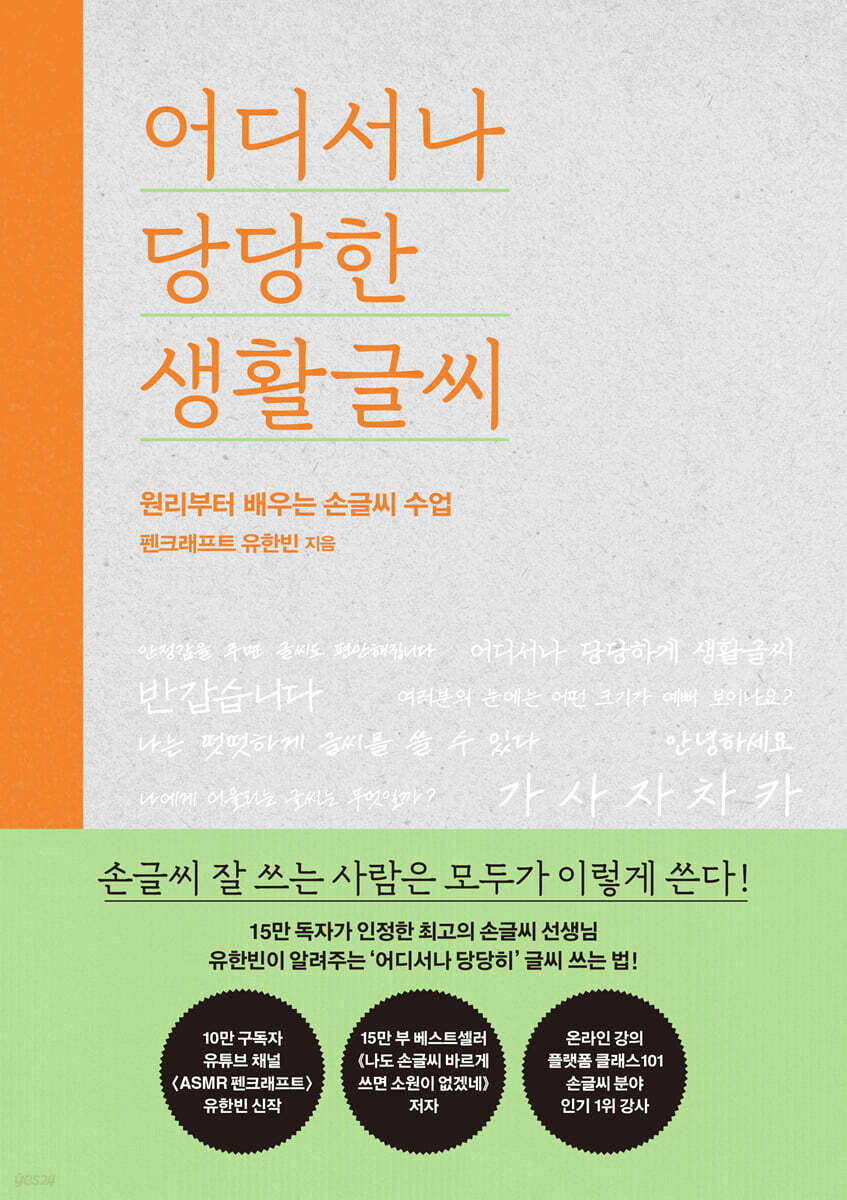
Confident writing anywhere
 |
Description
Book Introduction
“Everyone with good handwriting writes like this!”
Class 101's undisputed #1 handwriting instructor
Bestselling author of "If I Had Better Handwriting, I Would Have No More Wishes"
The best handwriting teacher chosen by 150,000 readers
Yoo Han-bin reveals how to write beautifully and confidently anywhere in your life!
Author Yoo Han-bin, also known by his YouTube channel name “Pencraft,” is the author of the best-selling book “If I Could Write Correctly, I Would Have No Wishes,” which has sold over 100,000 copies, and is the undisputed number one handwriting instructor on the online lecture platform Class101.
As a leading handwriting teacher, he has been greatly loved for his dedication to researching and spreading correct handwriting for the past 10 years.
This new book, "Confident Handwriting Anywhere," is a book that organizes the know-how the author has accumulated through lectures, step by step, from the principles, and teaches practical handwriting that can be used quickly and comfortably in any environment.
《Confident Handwriting Anywhere》 is meticulously structured to help you examine and develop the characteristics of your own handwriting, rather than blindly copying specific handwriting styles.
There are three changes that readers of this book will experience:
(1) You will have a wonderful ‘my handwriting’.
(2) You will open new eyes to see the letters.
(3) You come to realize that writing is done with your head, not your hands.
《Confident Handwriting Anywhere》 will provide the most effective and vivid teachings not only to readers who are trying to improve their handwriting for the first time, but also to all readers who have repeatedly failed at correcting their handwriting.
Now is the time to shake off your shame and get confident, stylish handwriting.
Class 101's undisputed #1 handwriting instructor
Bestselling author of "If I Had Better Handwriting, I Would Have No More Wishes"
The best handwriting teacher chosen by 150,000 readers
Yoo Han-bin reveals how to write beautifully and confidently anywhere in your life!
Author Yoo Han-bin, also known by his YouTube channel name “Pencraft,” is the author of the best-selling book “If I Could Write Correctly, I Would Have No Wishes,” which has sold over 100,000 copies, and is the undisputed number one handwriting instructor on the online lecture platform Class101.
As a leading handwriting teacher, he has been greatly loved for his dedication to researching and spreading correct handwriting for the past 10 years.
This new book, "Confident Handwriting Anywhere," is a book that organizes the know-how the author has accumulated through lectures, step by step, from the principles, and teaches practical handwriting that can be used quickly and comfortably in any environment.
《Confident Handwriting Anywhere》 is meticulously structured to help you examine and develop the characteristics of your own handwriting, rather than blindly copying specific handwriting styles.
There are three changes that readers of this book will experience:
(1) You will have a wonderful ‘my handwriting’.
(2) You will open new eyes to see the letters.
(3) You come to realize that writing is done with your head, not your hands.
《Confident Handwriting Anywhere》 will provide the most effective and vivid teachings not only to readers who are trying to improve their handwriting for the first time, but also to all readers who have repeatedly failed at correcting their handwriting.
Now is the time to shake off your shame and get confident, stylish handwriting.
- You can preview some of the book's contents.
Preview
index
Prologue - How to Change Your Handwriting Without Copying
Chapter 1 - 'Looking' at My Handwriting
① How to ‘see’ the text
② How to draw letters in your head
③ The first thing to do
④ The change with the best cost-effectiveness
Handwriting Tip 1 - What do you think makes for good handwriting?
Handwriting Tip 2 - There is no such thing as incorrect handwriting.
Lifestyle Tip 3 - Candles didn't disappear even after the light bulb was invented.
Chapter 2 - Changing without Changing
① Where are you writing?
② If possible, write it on a line note.
③ Let's match the virtual lines
④ About spacing 1 - Line spacing
⑤ About spacing 2 - Letter spacing
⑥ The biggest disadvantage of continuous writing
⑦ It is basic that the strokes do not shake
Handwriting Tip 4: Finding a Writing Instrument That Fits Your Handwriting Size
Handwriting Tip 5 - How to Write Vertically
Chapter 3 - Creating the "Feel" You Want
① The feeling of the letters changes depending on the size of the initial/medial/final consonants
② The feeling of letters changes depending on the presence or absence of curves
③ Awkward decorations are worse than no decorations at all.
Lifestyle Writing Tip 6 - Can you write like that even if you write quickly?
Lifestyle Handwriting Tip 7 - Create the Image You Want Through Your Handwriting
Chapter 4 - Case Studies
① Letters to think about together 1 - 'ㄱ' and 'ㅋ'
② Letters to think about together 2 - 'ㄴ' 'ㄷ' 'ㄹ'
③ Letters to think about together 3 - 'ㅅ' 'ㅈ' 'ㅊ'
④ Letters to think about together 4 - Vowels
Case 1 - Blocking the space for the consonant 'ㄴ'
Case 2 - Simplifying
Case 3 - Preventing the horizontal consonant from exceeding the initial consonant
Case 4 - Do not forcefully connect the stems of 'ㅅ', 'ㅈ', and 'ㅊ' to write them in one stroke.
Case 5 - Draw 'ㅇ' without distorting it as much as possible.
Case 6 - Do not write initial consonants too large
Case 7 - Close the closing consonants 'ㅁ', 'ㅂ', and 'ㅇ' firmly.
Case 8 - Do not raise the vowel too high above the initial consonant of a horizontal consonant
Case 9 - Be careful not to dynamically change the size of the letters.
Case 10 - Be careful not to let the vertical stroke of the 'ㅣ' series fall below the initial consonant.
Case 11 - Adding an angle to 'ㅁ' to clearly distinguish 'ㅁ' and 'ㅇ'
Case 12 - 'ㅔ' 'ㅐ' written with the vertical stroke on the right longer or pointing upwards
Case 13 - Place the horizontal support so that it is positioned toward the neutral center.
Case 14 - Lengthening the vertical strokes of the 'ㅜ' and 'ㅠ' consonants
Case 15 - 'ㅎ' Do not make the distance between your eyes and eyebrows too wide.
Daily Writing Tip 8 - Do it every day, even if it's just one line.
Handwriting Tip 9 - The Best Way to Develop Your Eye for Writing
Handwriting Tips 10 - Why do you want to write well?
Epilogue - Time to See the Change
Chapter 1 - 'Looking' at My Handwriting
① How to ‘see’ the text
② How to draw letters in your head
③ The first thing to do
④ The change with the best cost-effectiveness
Handwriting Tip 1 - What do you think makes for good handwriting?
Handwriting Tip 2 - There is no such thing as incorrect handwriting.
Lifestyle Tip 3 - Candles didn't disappear even after the light bulb was invented.
Chapter 2 - Changing without Changing
① Where are you writing?
② If possible, write it on a line note.
③ Let's match the virtual lines
④ About spacing 1 - Line spacing
⑤ About spacing 2 - Letter spacing
⑥ The biggest disadvantage of continuous writing
⑦ It is basic that the strokes do not shake
Handwriting Tip 4: Finding a Writing Instrument That Fits Your Handwriting Size
Handwriting Tip 5 - How to Write Vertically
Chapter 3 - Creating the "Feel" You Want
① The feeling of the letters changes depending on the size of the initial/medial/final consonants
② The feeling of letters changes depending on the presence or absence of curves
③ Awkward decorations are worse than no decorations at all.
Lifestyle Writing Tip 6 - Can you write like that even if you write quickly?
Lifestyle Handwriting Tip 7 - Create the Image You Want Through Your Handwriting
Chapter 4 - Case Studies
① Letters to think about together 1 - 'ㄱ' and 'ㅋ'
② Letters to think about together 2 - 'ㄴ' 'ㄷ' 'ㄹ'
③ Letters to think about together 3 - 'ㅅ' 'ㅈ' 'ㅊ'
④ Letters to think about together 4 - Vowels
Case 1 - Blocking the space for the consonant 'ㄴ'
Case 2 - Simplifying
Case 3 - Preventing the horizontal consonant from exceeding the initial consonant
Case 4 - Do not forcefully connect the stems of 'ㅅ', 'ㅈ', and 'ㅊ' to write them in one stroke.
Case 5 - Draw 'ㅇ' without distorting it as much as possible.
Case 6 - Do not write initial consonants too large
Case 7 - Close the closing consonants 'ㅁ', 'ㅂ', and 'ㅇ' firmly.
Case 8 - Do not raise the vowel too high above the initial consonant of a horizontal consonant
Case 9 - Be careful not to dynamically change the size of the letters.
Case 10 - Be careful not to let the vertical stroke of the 'ㅣ' series fall below the initial consonant.
Case 11 - Adding an angle to 'ㅁ' to clearly distinguish 'ㅁ' and 'ㅇ'
Case 12 - 'ㅔ' 'ㅐ' written with the vertical stroke on the right longer or pointing upwards
Case 13 - Place the horizontal support so that it is positioned toward the neutral center.
Case 14 - Lengthening the vertical strokes of the 'ㅜ' and 'ㅠ' consonants
Case 15 - 'ㅎ' Do not make the distance between your eyes and eyebrows too wide.
Daily Writing Tip 8 - Do it every day, even if it's just one line.
Handwriting Tip 9 - The Best Way to Develop Your Eye for Writing
Handwriting Tips 10 - Why do you want to write well?
Epilogue - Time to See the Change
Detailed image

Into the book
I really want to tell you this.
Your handwriting can improve significantly without having to learn new letters or completely overhaul your form.
You just don't know how.
I'll point out some things you might have overlooked while writing.
It's not a difficult method at all.
We've compiled practical methods that anyone can easily learn.
If you just learn these methods, you can write beautifully.
---From the "Prologue"
Good handwriting may not lead to good ideas, but at least good handwriting makes you write more.
It makes you think more.
If you polish your handwriting, even people who don't usually keep notes will want to write anything.
With that record, we go one step further.
So, I'll definitely take this opportunity to polish my handwriting.
If you have good handwriting, you can use it for a lifetime, no matter what pen you use or what paper you use to write.
How cost-effective is it to trim it once and use it for a lifetime?
---From "Good writing creates good thoughts"
When we see someone jaywalking or a car running a red light, we say, "Go faster, what are you doing?" The handwriting is the same.
Just because you keep writing like that doesn't mean your writing speed will increase by leaps and bounds.
If you just keep writing the letters you were using, your handwriting will improve right away.
Try writing each letter separately.
It is also very helpful in understanding the original form of letters.
---From "What's More Important Than Speed"
I think this way.
It's not that I no longer have the opportunity to write, it's that I've lost the confidence to write.
Take a look around you.
There is no place where there is no writing.
Most of them will be digitally printed characters.
Like a courier address, like a relief envelope.
But these are things that can easily be replaced with handwriting.
Digital is fast and convenient, but it's difficult to express your heart as much as analog.
Everyone knows it.
Whether you are good at handwriting or not, everyone writes letters by hand instead of printing them out for that reason.
So, if you write well, you will be able to convey your feelings more effectively.
---From "Why do you want to write well?"
I truly hope that you will become someone who can confidently approach writing without hesitation.
I believe this book will live on your bookshelf and serve as a long-lasting guide to writing.
Your handwriting can improve significantly without having to learn new letters or completely overhaul your form.
You just don't know how.
I'll point out some things you might have overlooked while writing.
It's not a difficult method at all.
We've compiled practical methods that anyone can easily learn.
If you just learn these methods, you can write beautifully.
---From the "Prologue"
Good handwriting may not lead to good ideas, but at least good handwriting makes you write more.
It makes you think more.
If you polish your handwriting, even people who don't usually keep notes will want to write anything.
With that record, we go one step further.
So, I'll definitely take this opportunity to polish my handwriting.
If you have good handwriting, you can use it for a lifetime, no matter what pen you use or what paper you use to write.
How cost-effective is it to trim it once and use it for a lifetime?
---From "Good writing creates good thoughts"
When we see someone jaywalking or a car running a red light, we say, "Go faster, what are you doing?" The handwriting is the same.
Just because you keep writing like that doesn't mean your writing speed will increase by leaps and bounds.
If you just keep writing the letters you were using, your handwriting will improve right away.
Try writing each letter separately.
It is also very helpful in understanding the original form of letters.
---From "What's More Important Than Speed"
I think this way.
It's not that I no longer have the opportunity to write, it's that I've lost the confidence to write.
Take a look around you.
There is no place where there is no writing.
Most of them will be digitally printed characters.
Like a courier address, like a relief envelope.
But these are things that can easily be replaced with handwriting.
Digital is fast and convenient, but it's difficult to express your heart as much as analog.
Everyone knows it.
Whether you are good at handwriting or not, everyone writes letters by hand instead of printing them out for that reason.
So, if you write well, you will be able to convey your feelings more effectively.
---From "Why do you want to write well?"
I truly hope that you will become someone who can confidently approach writing without hesitation.
I believe this book will live on your bookshelf and serve as a long-lasting guide to writing.
---From the "Epilogue"
Publisher's Review
Just blindly copying will never improve your handwriting.
Writing is done with the head, not the hand!
This book identifies the core causes of not being able to write correctly.
It gives you the confidence to take out your pen anywhere.
'What is good handwriting?' Most people think of neat, computer-written handwriting.
However, it is difficult to use the Jeongja font in real life, which requires focusing on each stroke.
So how can we achieve good handwriting in real life? The answer is here.
Yoo Han-bin's new book, "Confident Handwriting Anywhere," guides you through how to quickly and easily write good handwriting in real life.
After extensive research, the author has meticulously compiled the know-how he has accumulated over the past five years, meeting with over 6,000 students and 150,000 readers.
The fundamental reason why you can't write well is because you don't have the form of good handwriting in your head.
So, unlike other books that start by 'writing' by following the letters, 'Confident Handwriting Anywhere' starts by 'seeing' the letters.
If you have a good handwriting shape clearly in your head, you can write good handwriting even with your other hand.
In other words, writing is done with the head, not the hand.
Based on this, the author proceeds with the class so that readers can understand the principles of good handwriting, rather than simply encouraging them to write along.
1.
How to read text
2.
How to balance your writing
3.
How to bring out the feel of your writing
4.
Case study
Consisting of four chapters, “Confident Writing Anywhere” gives readers the feeling of having a one-on-one lecture with the author.
The author continually poses questions to the reader and demands appropriate writing.
There is no column to just follow along.
Unlike regular writing, everyday writing must reflect each individual's individuality.
After reading this book, readers will experience, as the author says, “the most cost-effective change.”
With your own beautiful handwriting in hand, you'll be able to confidently take out your pen anywhere.
“Good handwriting creates good thoughts.”
Writing is done with the head, not the hand!
This book identifies the core causes of not being able to write correctly.
It gives you the confidence to take out your pen anywhere.
'What is good handwriting?' Most people think of neat, computer-written handwriting.
However, it is difficult to use the Jeongja font in real life, which requires focusing on each stroke.
So how can we achieve good handwriting in real life? The answer is here.
Yoo Han-bin's new book, "Confident Handwriting Anywhere," guides you through how to quickly and easily write good handwriting in real life.
After extensive research, the author has meticulously compiled the know-how he has accumulated over the past five years, meeting with over 6,000 students and 150,000 readers.
The fundamental reason why you can't write well is because you don't have the form of good handwriting in your head.
So, unlike other books that start by 'writing' by following the letters, 'Confident Handwriting Anywhere' starts by 'seeing' the letters.
If you have a good handwriting shape clearly in your head, you can write good handwriting even with your other hand.
In other words, writing is done with the head, not the hand.
Based on this, the author proceeds with the class so that readers can understand the principles of good handwriting, rather than simply encouraging them to write along.
1.
How to read text
2.
How to balance your writing
3.
How to bring out the feel of your writing
4.
Case study
Consisting of four chapters, “Confident Writing Anywhere” gives readers the feeling of having a one-on-one lecture with the author.
The author continually poses questions to the reader and demands appropriate writing.
There is no column to just follow along.
Unlike regular writing, everyday writing must reflect each individual's individuality.
After reading this book, readers will experience, as the author says, “the most cost-effective change.”
With your own beautiful handwriting in hand, you'll be able to confidently take out your pen anywhere.
“Good handwriting creates good thoughts.”
GOODS SPECIFICS
- Date of issue: July 30, 2024
- Page count, weight, size: 144 pages | 466g | 180*255*11mm
- ISBN13: 9791172540104
You may also like
카테고리
korean


korean

![GQ KOREA Mark (Monthly): December [2025]](http://librairie.coreenne.fr/cdn/shop/files/8ef265dbbfbf186523ed75ba7319009d.jpg?v=1765340328&width=3840)


