

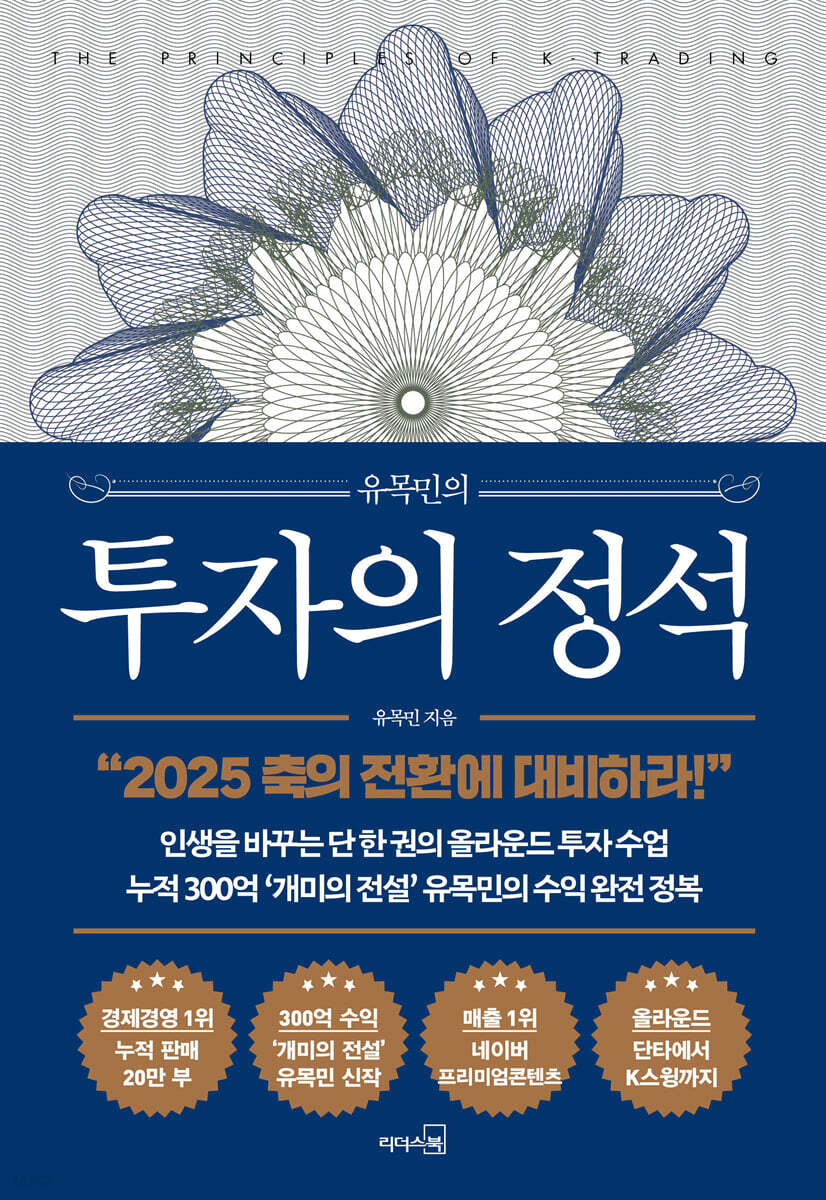
The Nomad's Guide to Investment
 |
Description
Book Introduction
- A word from MD
-
Stock Investment BibleThis book is a compilation of the author's know-how, from the basics of stocks to practical application, by the legendary Nomad investor.
We will help you build a solid foundation in stocks through the perspectives of 'materials, charts, trading volume, and market conditions.'
This is a must-read for those who want to develop their own investment perspective through proper stock study.
January 19, 2024. Economics and Management PD Kim Sang-geun
“Investing isn't like that.”
From beginners just starting out to investors who are lost and wandering
The One-Stop, Life-Changing All-Round Investment Lesson
- Completely conquering the profits of the nomads in the "Ant Legend" with a cumulative 30 billion won
- New work by the author of the best-selling book, #1 in economics and management, with 200,000 copies sold
From the basics of stocks to the know-how of trading themed stocks, the "Stock Essentials" is born!
From HTS usage guides to charts and materials, and how to read market conditions,
A tight-knit filter perspective for selecting stocks and trading know-how,
It even contains insights into the upcoming market trend, the '2025 Axis Shift'!
The most realistic investment guide for every single investor in Korea.
Author of "My Salary Independence Project" and "My Investment Starts at 4 AM," which are considered must-reads for office workers and the most realistic stock investment guides.
The new work of Nomad, author of "The Legend of Ants," which caused a stir by publicly verifying his account history of starting with 5 million won and accumulating 30 billion won in profits over 7 years, has been published.
From the bull market of 2020 to the post-COVID-19 bear market, South Korean retail investors have experienced a roller coaster of market conditions, realizing that proper study is essential to consistently generate decent profits.
"The Nomad's Investment Principles" is a book that meets that need exactly.
The author asserts that now is the time to boldly invest time and effort in studying stocks to prepare for the upcoming "American tech renaissance" of 2025.
As the title suggests, the author poured all of his investment know-how and insight into writing a 'standard book' for all individual investors.
From "basic knowledge" about stocks and the market to "profitability sense" honed through practical experience, this comprehensive book provides the foundation needed to help beginner investors advance to intermediate level.
From beginners just starting out to investors who are lost and wandering, this is the ultimate investment course to help you establish your own perspective and build a solid foundation for your life in the stock market.
From beginners just starting out to investors who are lost and wandering
The One-Stop, Life-Changing All-Round Investment Lesson
- Completely conquering the profits of the nomads in the "Ant Legend" with a cumulative 30 billion won
- New work by the author of the best-selling book, #1 in economics and management, with 200,000 copies sold
From the basics of stocks to the know-how of trading themed stocks, the "Stock Essentials" is born!
From HTS usage guides to charts and materials, and how to read market conditions,
A tight-knit filter perspective for selecting stocks and trading know-how,
It even contains insights into the upcoming market trend, the '2025 Axis Shift'!
The most realistic investment guide for every single investor in Korea.
Author of "My Salary Independence Project" and "My Investment Starts at 4 AM," which are considered must-reads for office workers and the most realistic stock investment guides.
The new work of Nomad, author of "The Legend of Ants," which caused a stir by publicly verifying his account history of starting with 5 million won and accumulating 30 billion won in profits over 7 years, has been published.
From the bull market of 2020 to the post-COVID-19 bear market, South Korean retail investors have experienced a roller coaster of market conditions, realizing that proper study is essential to consistently generate decent profits.
"The Nomad's Investment Principles" is a book that meets that need exactly.
The author asserts that now is the time to boldly invest time and effort in studying stocks to prepare for the upcoming "American tech renaissance" of 2025.
As the title suggests, the author poured all of his investment know-how and insight into writing a 'standard book' for all individual investors.
From "basic knowledge" about stocks and the market to "profitability sense" honed through practical experience, this comprehensive book provides the foundation needed to help beginner investors advance to intermediate level.
From beginners just starting out to investors who are lost and wandering, this is the ultimate investment course to help you establish your own perspective and build a solid foundation for your life in the stock market.
- You can preview some of the book's contents.
Preview
index
Prologue | For all beginning investors
[PART 1: Investing for Growth: Getting Started]
CHAPTER 1 Metacognition about Stock Investment
01 The Force That Moves the Stock Market
What is a stock? / Stocks are expectations. / Two factors that drive up stock prices. / Beware when liquidity and performance are acting separately. / Expectations are multiplied.
02 Basic Stock Market Terms
Stock indices · Stock types · Investor trends · Traders · D+2 system · Upper and lower price limits · Volatility mitigation devices · Trading intensity · Fundamental and technical analysis · Short selling
03 Types of Investment Strategies
Short-term investment, long-term investment, value investment, growth investment, concentrated investment, diversified investment, quantitative investment, momentum investment, factor investment
04 Am I a Trader or an Investor?
Trader · Investor · Volatility and Time Value
CHAPTER 2: Connecting Signals to Profits
01 Investment Mechanisms and Signals
Principles of stock price increase and investment mechanism/ Step 1.
The core of investment: 'knowledge' / Step 2.
Trigger 'Signal' that awakens knowledge / Step 3.
There is no right answer to 'investment strategy' / Step 4.
'Observe' whether things are going as planned/ Step 5.
Variables are default, 'detect' changes / Step 6.
'Response' is mechanical/ 7 steps.
‘Reflection’ is the foundation of growth/ 8 steps.
'Repetition' of all these efforts
02 Something that appeared out of nothing, something that existed and then disappeared
If You Could Only Buy One Stock? / History Repeats Itself / How to Be Good at Stocks: "Observe Every Day"
03 Distinguish between uncertainty and risk
Defining uncertainty and risk / Upside risk requires 'empathy' / When risk is confirmed, it is the bottom
04 Criteria for selecting items
The Three Principles of Materials, Charts, and Volume / What Makes Materials, Charts, and Volume "Present" / Market Conditions, Today's Themes / The Fusion of Fundamental and Technical Analysis
05 The Courage to Cut Losses, the Wisdom to Cut Profits
Cutting losses and taking profits are human assets/ Let's establish principles/ Traders must always take action/ Cutting losses is merely a process
CHAPTER 3 The Beginning Investor's Mindset
01 Five Traps Beginner Investors Easily Fall Into
The most common behavior of beginners is 'brainless trading'. The thing beginners regret the most is 'cutting losses without hesitation'. The most common question beginners ask is 'When should I buy (sell)?'. The most troubling problem for beginners is 'What should I buy?'. The thing beginners are worst at is 'making money'.
02 The Investable Mind's Promise
[PART 2: Building the Basics]
CHAPTER 4: Getting Started with HTS
01 Opening a securities account
MTS is an unfavorable battlefield/Criteria for choosing a securities firm/How to open a securities account/The cost of ignoring it is a big deal
02 Setting up HTS for the first time
Look at the stock charts in both daily and minute form/ Look at the current price on the screen for ordering/ Filter out promotional news/ Stick to the basics when ordering/ Stocks of interest are always worth more
03 Menus that are helpful to know
X-Ray instantaneous transaction volume · Real-time stock search ranking · Mini-transaction · Company overview · Short selling trend by stock · Financial trend · Daily program trading trend by stock · Investor trading trend by stock · Top fluctuation rate compared to the previous day · Real-time conditional search · Status of stocks with volatility mitigation device activated
04 Let's try trading
Mindset for your first trade / Try placing an order / Stop-loss, an essential feature for office workers / Avoid credit and receivables trading / Be careful with 'after-hours single price' trading
CHAPTER 5 Corporate Analysis: The Fundamentals of Investment
01 Corporate and Stock Terms
Number of shares · Distribution ratio · Par value · Issue price · Capital impairment · Capital increase · Stock subscription rights · Ex-rights · Capital reduction · IPO
02 Fundamental Analysis 1 Reading Financial Statements
Financial Statement Basics/Investment Fundamentals, Financial Statement Review/Audit Reports and Review Opinions on Which a Listed Company's Fate Depends
03 Fundamental Analysis Reading the Q2 Report
The beginning and end of the material 'quarterly report'
1) Company overview · 2) Business details · 3) Financial matters · 4) Auditor's opinion · 5) Matters regarding executives and employees · 6) Matters regarding shareholders · 7) Status of investments in subsidiaries, affiliates, and other corporations subject to consolidation
04 Good news, bad news, and ambiguity in corporate analysis
Good news/bad news/ambiguous cases/stock history repeats itself
05 There is a separate corporate analysis for short-term investment.
Step 1.
Check the debt ratio and reserve ratio/ Step 2.
Check the stake ratio/ Step 3.
Sales and operating profit confirmation / Case study · Woorim PTS
CHAPTER 6: Beginner Escape 100-Day Challenge
01 100-Day Homework: Recording the Upper Limit & Ten Million Shares
Step 1 of daily study.
Upper limit & 10 million share stocks organized and causes investigated / Daily study step 2.
Select key news and find related stocks after the market closes / Useful HTS menu for homework
02 Create a list of stocks of interest
Stocks of interest are a basic requirement for investors. / They should be my interests, not someone else's. / Finding my own stocks of interest.
[PART 3: Absolute Perspectives for Practical Investing]
CHAPTER 7 What is a Material?
01 Transformation of materials
If you look for 'materials' before the rise, the prominence of materials is determined by the market situation. At first, it is a skill, but later it spreads as a theme.
02 Interpretation of the theme
COVID-19 Theme (2020) / Nuclear Power Theme (2021) / UAM Theme (2022)
03 Precautions when trading theme stocks
Distinguish between leading themes, second-tier themes, and derivative themes. · Trade primarily among leading stocks and second-tier stocks, similar to the leading stocks. · Determine the sustainability of the theme. · Check supply and demand. · Finally, check financial soundness.
04 Memorize thematic stock trading tips
Biotech stocks, inter-Korean economic cooperation stocks, gaming stocks, infectious disease themes, anti-Japanese themes, presidential election themes, foot-and-mouth disease themes
CHAPTER 8 Good Materials, Bad Materials, and Weird Materials
01 Good material to increase stock price
Positive facts that 'came out of nowhere' · Positive news that 'came out of nowhere' · New product launches · Establishment or increase in dividends · Patent acquisitions · Signing of large-scale supply contracts · Announcement of treasury stock repurchase plans
02 Bad ingredients that lower stock prices
Announcement of contract termination, sale of stock by major shareholders or management, paid-in capital increase, capital reduction, and sale of treasury stock
03 A strange material that requires a different judgment every time
Resolving risk factors · Bad news reported in exclusive articles · Management changes · Exchange rate fluctuations · Raw material price fluctuations · Changes in economic indicators · Free capital increase, third-party allocation paid-in capital increase
04 How to find materials
Search for new articles, check past cases, search for featured stocks, check electronic disclosures, visit the website, and check the final facts in the company's IR.
CHAPTER 9: A First Look at the Chart World
01 What is a chart?
A compilation of social phenomena/ The chart is 5%/ The chart is also interpreted as 'liquidity, performance, and expectations'
02 How to read the chart
Types of charts/How to read candlestick charts/Support and resistance
03 Creating a Perspective
CHAPTER 10 The Power of Reading Trend Reversals
01 What is a moving average?
Moving Averages/The Key to Moving Averages is Trends/Setting Moving Averages
02 Psychological Perspective of Moving Averages
Interpreting Basic Moving Averages (5, 20, 60, and 120-Day Lines) / Interpreting Derived Moving Averages (3, 8, 15, 33, 45, 100, and 224-Day Lines) / Moving Averages are 'Lagging Indicators'
03 Catch the moment when the reverse arrangement changes to a regular arrangement.
04 Reading Support and Resistance Correctly
Horizontal support and resistance / Diagonal support and resistance / Support and resistance at moving averages / Downside risk signals / Demark, confirming support and resistance for the day / Adding technical indicators such as Demark, trading volume, and RSI
CHAPTER 11 The Moment When Trading Volume Explodes
01 Trade stocks with sufficient trading volume.
Trading perspectives related to trading volume and trading value/asking price/trading volume
02 The moment when buying power is concentrated, 15 billion and 50 billion won
The significance of 15 billion and 50 billion bars / Utilizing 15 billion and 50 billion bars / Active trading signals / Setting 15 billion and 50 billion bars
03 RSI indicating the strength of the trend
[PART 4 Connecting the Dots]
CHAPTER 12 Reading the Market
01 How to view the market situation
What is market conditions in short-term investing? / What creates market conditions? / When the significance of market conditions is amplified.
02 Why read macros?
Macro is 'Insurance' / Reading domestic and international economic indicators
CHAPTER 13: A Deep Dive into Economic News
01 Start of the investment scenario
Idea Flow · Who Will Benefit? · The core of the article is in the title and lead.
02 Read expectations about liquidity and performance.
News directly released by companies/Industry trends affecting companies/Government policies affecting companies/Keywords that increase expectations
03 Global News That Moves Korean Stocks
US-China hegemony war/China/Europe/Japan/Middle East including Saudi Arabia/Russia
04 Beware of K-cell On
05 When 'Samsung' does it, it's different
CHAPTER 14 Let's start investing on your own
01 The Nomad's Trading Bible
10 Commandments for Selling and 13 Commandments for Buying
02 Start your own investment scenario
Trading Scenario Checklist · Case 1.
Starting from the materials · Case 2.
Start with a chart
03 If I Knew Then What I Know Now; Lessons from the Scout
Brain trading committed when you know you can't buy, the "scout" who stands between cutting losses and making profits, and the wisdom of "cutting profits" learned from the scout.
04 Tips for the K-Swing
Swing in Boxpi · Split buy/sell in K-Swing Port · K-Swing Port in Intops chart
Nomad Insights | Prepare for the 2025 Axis Shift
[PART 1: Investing for Growth: Getting Started]
CHAPTER 1 Metacognition about Stock Investment
01 The Force That Moves the Stock Market
What is a stock? / Stocks are expectations. / Two factors that drive up stock prices. / Beware when liquidity and performance are acting separately. / Expectations are multiplied.
02 Basic Stock Market Terms
Stock indices · Stock types · Investor trends · Traders · D+2 system · Upper and lower price limits · Volatility mitigation devices · Trading intensity · Fundamental and technical analysis · Short selling
03 Types of Investment Strategies
Short-term investment, long-term investment, value investment, growth investment, concentrated investment, diversified investment, quantitative investment, momentum investment, factor investment
04 Am I a Trader or an Investor?
Trader · Investor · Volatility and Time Value
CHAPTER 2: Connecting Signals to Profits
01 Investment Mechanisms and Signals
Principles of stock price increase and investment mechanism/ Step 1.
The core of investment: 'knowledge' / Step 2.
Trigger 'Signal' that awakens knowledge / Step 3.
There is no right answer to 'investment strategy' / Step 4.
'Observe' whether things are going as planned/ Step 5.
Variables are default, 'detect' changes / Step 6.
'Response' is mechanical/ 7 steps.
‘Reflection’ is the foundation of growth/ 8 steps.
'Repetition' of all these efforts
02 Something that appeared out of nothing, something that existed and then disappeared
If You Could Only Buy One Stock? / History Repeats Itself / How to Be Good at Stocks: "Observe Every Day"
03 Distinguish between uncertainty and risk
Defining uncertainty and risk / Upside risk requires 'empathy' / When risk is confirmed, it is the bottom
04 Criteria for selecting items
The Three Principles of Materials, Charts, and Volume / What Makes Materials, Charts, and Volume "Present" / Market Conditions, Today's Themes / The Fusion of Fundamental and Technical Analysis
05 The Courage to Cut Losses, the Wisdom to Cut Profits
Cutting losses and taking profits are human assets/ Let's establish principles/ Traders must always take action/ Cutting losses is merely a process
CHAPTER 3 The Beginning Investor's Mindset
01 Five Traps Beginner Investors Easily Fall Into
The most common behavior of beginners is 'brainless trading'. The thing beginners regret the most is 'cutting losses without hesitation'. The most common question beginners ask is 'When should I buy (sell)?'. The most troubling problem for beginners is 'What should I buy?'. The thing beginners are worst at is 'making money'.
02 The Investable Mind's Promise
[PART 2: Building the Basics]
CHAPTER 4: Getting Started with HTS
01 Opening a securities account
MTS is an unfavorable battlefield/Criteria for choosing a securities firm/How to open a securities account/The cost of ignoring it is a big deal
02 Setting up HTS for the first time
Look at the stock charts in both daily and minute form/ Look at the current price on the screen for ordering/ Filter out promotional news/ Stick to the basics when ordering/ Stocks of interest are always worth more
03 Menus that are helpful to know
X-Ray instantaneous transaction volume · Real-time stock search ranking · Mini-transaction · Company overview · Short selling trend by stock · Financial trend · Daily program trading trend by stock · Investor trading trend by stock · Top fluctuation rate compared to the previous day · Real-time conditional search · Status of stocks with volatility mitigation device activated
04 Let's try trading
Mindset for your first trade / Try placing an order / Stop-loss, an essential feature for office workers / Avoid credit and receivables trading / Be careful with 'after-hours single price' trading
CHAPTER 5 Corporate Analysis: The Fundamentals of Investment
01 Corporate and Stock Terms
Number of shares · Distribution ratio · Par value · Issue price · Capital impairment · Capital increase · Stock subscription rights · Ex-rights · Capital reduction · IPO
02 Fundamental Analysis 1 Reading Financial Statements
Financial Statement Basics/Investment Fundamentals, Financial Statement Review/Audit Reports and Review Opinions on Which a Listed Company's Fate Depends
03 Fundamental Analysis Reading the Q2 Report
The beginning and end of the material 'quarterly report'
1) Company overview · 2) Business details · 3) Financial matters · 4) Auditor's opinion · 5) Matters regarding executives and employees · 6) Matters regarding shareholders · 7) Status of investments in subsidiaries, affiliates, and other corporations subject to consolidation
04 Good news, bad news, and ambiguity in corporate analysis
Good news/bad news/ambiguous cases/stock history repeats itself
05 There is a separate corporate analysis for short-term investment.
Step 1.
Check the debt ratio and reserve ratio/ Step 2.
Check the stake ratio/ Step 3.
Sales and operating profit confirmation / Case study · Woorim PTS
CHAPTER 6: Beginner Escape 100-Day Challenge
01 100-Day Homework: Recording the Upper Limit & Ten Million Shares
Step 1 of daily study.
Upper limit & 10 million share stocks organized and causes investigated / Daily study step 2.
Select key news and find related stocks after the market closes / Useful HTS menu for homework
02 Create a list of stocks of interest
Stocks of interest are a basic requirement for investors. / They should be my interests, not someone else's. / Finding my own stocks of interest.
[PART 3: Absolute Perspectives for Practical Investing]
CHAPTER 7 What is a Material?
01 Transformation of materials
If you look for 'materials' before the rise, the prominence of materials is determined by the market situation. At first, it is a skill, but later it spreads as a theme.
02 Interpretation of the theme
COVID-19 Theme (2020) / Nuclear Power Theme (2021) / UAM Theme (2022)
03 Precautions when trading theme stocks
Distinguish between leading themes, second-tier themes, and derivative themes. · Trade primarily among leading stocks and second-tier stocks, similar to the leading stocks. · Determine the sustainability of the theme. · Check supply and demand. · Finally, check financial soundness.
04 Memorize thematic stock trading tips
Biotech stocks, inter-Korean economic cooperation stocks, gaming stocks, infectious disease themes, anti-Japanese themes, presidential election themes, foot-and-mouth disease themes
CHAPTER 8 Good Materials, Bad Materials, and Weird Materials
01 Good material to increase stock price
Positive facts that 'came out of nowhere' · Positive news that 'came out of nowhere' · New product launches · Establishment or increase in dividends · Patent acquisitions · Signing of large-scale supply contracts · Announcement of treasury stock repurchase plans
02 Bad ingredients that lower stock prices
Announcement of contract termination, sale of stock by major shareholders or management, paid-in capital increase, capital reduction, and sale of treasury stock
03 A strange material that requires a different judgment every time
Resolving risk factors · Bad news reported in exclusive articles · Management changes · Exchange rate fluctuations · Raw material price fluctuations · Changes in economic indicators · Free capital increase, third-party allocation paid-in capital increase
04 How to find materials
Search for new articles, check past cases, search for featured stocks, check electronic disclosures, visit the website, and check the final facts in the company's IR.
CHAPTER 9: A First Look at the Chart World
01 What is a chart?
A compilation of social phenomena/ The chart is 5%/ The chart is also interpreted as 'liquidity, performance, and expectations'
02 How to read the chart
Types of charts/How to read candlestick charts/Support and resistance
03 Creating a Perspective
CHAPTER 10 The Power of Reading Trend Reversals
01 What is a moving average?
Moving Averages/The Key to Moving Averages is Trends/Setting Moving Averages
02 Psychological Perspective of Moving Averages
Interpreting Basic Moving Averages (5, 20, 60, and 120-Day Lines) / Interpreting Derived Moving Averages (3, 8, 15, 33, 45, 100, and 224-Day Lines) / Moving Averages are 'Lagging Indicators'
03 Catch the moment when the reverse arrangement changes to a regular arrangement.
04 Reading Support and Resistance Correctly
Horizontal support and resistance / Diagonal support and resistance / Support and resistance at moving averages / Downside risk signals / Demark, confirming support and resistance for the day / Adding technical indicators such as Demark, trading volume, and RSI
CHAPTER 11 The Moment When Trading Volume Explodes
01 Trade stocks with sufficient trading volume.
Trading perspectives related to trading volume and trading value/asking price/trading volume
02 The moment when buying power is concentrated, 15 billion and 50 billion won
The significance of 15 billion and 50 billion bars / Utilizing 15 billion and 50 billion bars / Active trading signals / Setting 15 billion and 50 billion bars
03 RSI indicating the strength of the trend
[PART 4 Connecting the Dots]
CHAPTER 12 Reading the Market
01 How to view the market situation
What is market conditions in short-term investing? / What creates market conditions? / When the significance of market conditions is amplified.
02 Why read macros?
Macro is 'Insurance' / Reading domestic and international economic indicators
CHAPTER 13: A Deep Dive into Economic News
01 Start of the investment scenario
Idea Flow · Who Will Benefit? · The core of the article is in the title and lead.
02 Read expectations about liquidity and performance.
News directly released by companies/Industry trends affecting companies/Government policies affecting companies/Keywords that increase expectations
03 Global News That Moves Korean Stocks
US-China hegemony war/China/Europe/Japan/Middle East including Saudi Arabia/Russia
04 Beware of K-cell On
05 When 'Samsung' does it, it's different
CHAPTER 14 Let's start investing on your own
01 The Nomad's Trading Bible
10 Commandments for Selling and 13 Commandments for Buying
02 Start your own investment scenario
Trading Scenario Checklist · Case 1.
Starting from the materials · Case 2.
Start with a chart
03 If I Knew Then What I Know Now; Lessons from the Scout
Brain trading committed when you know you can't buy, the "scout" who stands between cutting losses and making profits, and the wisdom of "cutting profits" learned from the scout.
04 Tips for the K-Swing
Swing in Boxpi · Split buy/sell in K-Swing Port · K-Swing Port in Intops chart
Nomad Insights | Prepare for the 2025 Axis Shift
Detailed image

Into the book
This book contains the fundamental principles of investment that Nomad, an ordinary office worker who started out with 5 million won, learned through numerous failures and frustrations.
Some people might read it in a couple of hours and say they've "read it all."
But that doesn't even understand 1% of the author's intention.
Will reading a book truly make the knowledge it contains your own? Will simply reading "The Essentials of Mathematics" over and over again improve your math skills? Skills develop as you understand the theory and develop the ability to apply it to solve problems.
--- p.8
If you are a beginner, it will take you at least six months just to understand this book.
And if you read this book again in six months, you'll see something new.
Don't let your guard down.
Don't be proud.
It takes confidence that you can do it, but if one book can change your life, the whole world can.
You should use this as an opportunity and work hard with the mindset of studying for the rest of your life.
Only then will the possibilities finally open up.
--- p.9
Ultimately, what drives stock prices are liquidity, performance, and expectations.
In formal terms, it is determined by multiplying expectations by the sum of liquidity and performance.
When liquidity and performance are good, stock prices rise honestly.
However, the magnification is different.
It is the expectation that determines this ratio.
Of course, liquidity and performance are key factors driving expectations.
However, the 'amplification rate' of expectations varies depending on the item and market conditions (theme).
If it's a stock or sector that's usually brimming with talent, or if it's a market trend (theme) that's currently sucking up the most funds in the market, it creates even greater expectations.
--- p.30
Investment guru Benjamin Graham once said:
“Investing isn’t about beating other people.
“It is about controlling yourself in a game with yourself.” When investing, it is very important to objectively understand your own tendencies, skills, strengths and weaknesses, psychological and physical habits, etc.
As an investor, increasing your metacognition will not only increase your returns but also lead to a more stable investment lifestyle.
--- p.56
Short-term investments are not investments that expect high returns.
This is a type of trading that aims to make short (small) profits multiple times by taking advantage of high volatility.
Long-term investment is a transaction that aims for high returns through the long-term growth of a company.
Many beginners mistakenly believe that short-term trading is a method of trading that can bring 'high' returns multiple times.
Likewise, novice long-term investors fall into the trap of thinking that 'long-term holding and growth' is the default, so they just buy at a high price and wait for a long time to get hurt.
Short-term investments require analysis of companies and markets, as they can be subject to high volatility.
While long-term investors may only analyze a few stocks a year, short-term investors must analyze several companies a day.
Because you are aiming for more frequent profits in a short period of time, you need to study regularly.
Many people think that short-term trading will make them money more easily and quickly, but I think that idea itself is a prelude to failure.
There is no faster or easier way to make money in this world.
--- p.58
The point is that watching the market and actually managing your own assets are two completely different things.
If you want to go beyond simply avoiding losses and achieve greater profits, there are steps you must take.
It's about connecting signals and profits.
It's not a concept of connecting signals to profits.
It's about connecting signals and profits.
Someone in the market is clearly already making a profit.
The original profit is what exists.
Many people fail to connect the dots and view signals and profits separately.
Some people might read it in a couple of hours and say they've "read it all."
But that doesn't even understand 1% of the author's intention.
Will reading a book truly make the knowledge it contains your own? Will simply reading "The Essentials of Mathematics" over and over again improve your math skills? Skills develop as you understand the theory and develop the ability to apply it to solve problems.
--- p.8
If you are a beginner, it will take you at least six months just to understand this book.
And if you read this book again in six months, you'll see something new.
Don't let your guard down.
Don't be proud.
It takes confidence that you can do it, but if one book can change your life, the whole world can.
You should use this as an opportunity and work hard with the mindset of studying for the rest of your life.
Only then will the possibilities finally open up.
--- p.9
Ultimately, what drives stock prices are liquidity, performance, and expectations.
In formal terms, it is determined by multiplying expectations by the sum of liquidity and performance.
When liquidity and performance are good, stock prices rise honestly.
However, the magnification is different.
It is the expectation that determines this ratio.
Of course, liquidity and performance are key factors driving expectations.
However, the 'amplification rate' of expectations varies depending on the item and market conditions (theme).
If it's a stock or sector that's usually brimming with talent, or if it's a market trend (theme) that's currently sucking up the most funds in the market, it creates even greater expectations.
--- p.30
Investment guru Benjamin Graham once said:
“Investing isn’t about beating other people.
“It is about controlling yourself in a game with yourself.” When investing, it is very important to objectively understand your own tendencies, skills, strengths and weaknesses, psychological and physical habits, etc.
As an investor, increasing your metacognition will not only increase your returns but also lead to a more stable investment lifestyle.
--- p.56
Short-term investments are not investments that expect high returns.
This is a type of trading that aims to make short (small) profits multiple times by taking advantage of high volatility.
Long-term investment is a transaction that aims for high returns through the long-term growth of a company.
Many beginners mistakenly believe that short-term trading is a method of trading that can bring 'high' returns multiple times.
Likewise, novice long-term investors fall into the trap of thinking that 'long-term holding and growth' is the default, so they just buy at a high price and wait for a long time to get hurt.
Short-term investments require analysis of companies and markets, as they can be subject to high volatility.
While long-term investors may only analyze a few stocks a year, short-term investors must analyze several companies a day.
Because you are aiming for more frequent profits in a short period of time, you need to study regularly.
Many people think that short-term trading will make them money more easily and quickly, but I think that idea itself is a prelude to failure.
There is no faster or easier way to make money in this world.
--- p.58
The point is that watching the market and actually managing your own assets are two completely different things.
If you want to go beyond simply avoiding losses and achieve greater profits, there are steps you must take.
It's about connecting signals and profits.
It's not a concept of connecting signals to profits.
It's about connecting signals and profits.
Someone in the market is clearly already making a profit.
The original profit is what exists.
Many people fail to connect the dots and view signals and profits separately.
--- p.61~2
Publisher's Review
“Investing isn't like that.”
Take a perspective that connects signals and profits.
The One-Stop, Life-Changing All-Round Investment Lesson
Author of "My Salary Independence Project" and "My Investment Starts at 4 AM," which are considered must-reads for office workers and the most realistic stock investment guides.
The new work of Nomad, author of "The Legend of the Ants," which caused a stir by publicly verifying his account history for accumulated profits of 30 billion won, has been published.
The author began investing in stocks in earnest in 2015, and achieved accumulated profits of 3 billion won in 2017, just three years later.
"My Salary Independence Project" contains the author's vivid story of how he achieved salary independence while working 12 hours a day.
Published in 2019, it immediately garnered significant attention and became a bestseller, and has since become a must-read for office workers starting out in investing.
In the three years since publishing my first book, I have diversified my investment approach and portfolio, and my assets have surpassed 30 billion won.
His second book, "My Investment Starts at 4 AM," which covers the next stage of his journey as an investor, encompassing swing, unlisted, funds, and mezzanine, was published in 2022 and was also a popular choice for readers.
Following the two books that sold over 200,000 copies, the third book, "The Nomad's Investment Principles," is the definitive investment guide written with the utmost care by a nomad who has transformed from an investor to a businessman.
Based on his accumulated experience and data, the author founded Signal Report, an investment education startup that helps individual investors study properly. Through "Nomad's Signal Report," he provides domestic and international investment information every morning.
The Nomad Channel, which served as the starting point for this book, has achieved the top spot in Naver Premium Content sales for two consecutive years.
“Actually, I started writing this book out of necessity while running Signal Report.
Signal Report was initially a limited service for a small number of subscribers, but it launched its public service in April 2022. Signups from beginners exceeded expectations.
That's a good thing.
The problem was that beginners had a hard time adapting to the vast amount of content provided every day.
Looking back on the reason I started this business, I felt I needed to organize and provide these people with the "materials, charts, trading volume, and market conditions" I'd experienced and learned, in the most accessible and user-friendly way possible.
“Investing is a lifelong pursuit, but I hope this will help get you started in the right direction.”
Prepare for the 2025 Axis Shift
A golden time to prepare for the upcoming tech renaissance of 2025.
From the bull market of 2020 to the post-COVID-19 bear market, South Korean retail investors have experienced a roller coaster of market conditions, realizing that proper study is essential to consistently generate decent profits.
"The Nomad's Investment Principles" is a book that meets that need exactly.
The author, who has emphasized in his previous works that one should not try to find techniques but rather continue studying throughout one's life, asserts that now is the time to boldly invest time and effort in studying stocks, if only to prepare for the upcoming "American Tech Renaissance" of 2025, the great market that will come.
"What if everyone could buy whatever they wanted, in quantity, at the price they wanted? Inflation would be reduced.
I would love to live in a country like this.
It is produced in this country.
America is preparing for such times.
The IRA, the Semiconductor Act, and others all point to 2025.
This is the era of the 'American tech renaissance'.
At its core will be robotics, semiconductors, and artificial intelligence.
It's an American-developed robot equipped with American-produced semiconductors, driven by American AI.
To counter this, China is preparing for ‘Made in China 2025’.
So, we need to prepare our investments for the coming era, but also prepare for the recession in the first half of 2024.
Even if you invest in stocks, at some point you need to find something that can prevent a downturn during a market downturn.
If you're an investor who's already been through the months of January to March 2020, you know how to prepare.
“We need to prepare diligently and respond with a diverse investment portfolio.”
"The Sense of Profit Only Those Who Earned It Can Understand"
From basic concepts to practical tips, the birth of a truly invaluable "orthodox book."
As the title suggests, "Investment Essentials," the author poured all of his investment know-how and insight into writing a "fundamental book" for all individual investors.
From "basic knowledge" about stocks and the market to "profitability sense" honed through practical experience, this comprehensive book provides the foundation needed for beginner investors to advance to the intermediate level.
We are re-establishing the concepts of short-term investment and thematic stock investment, which are often dismissed as “gambling.”
To profit from the domestic stock market, which frequently exhibits box-like trends, one must begin by breaking stereotypes about long-term and short-term investments, thematic stocks, and value stocks.
It is important to accurately understand the nature of each investment and use it solely as a tool for responding strategically.
“Short-term investments are not investments that expect high returns.
This is a type of trading that aims to make short (small) profits multiple times by taking advantage of high volatility.
Long-term investment is a transaction that aims for high returns through the long-term growth of a company.
Short-term investments require analysis of companies and markets, as they can be subject to high volatility.
Because you are aiming for more frequent profits in a short period of time, you need to study regularly.
Many people think that short-term trading will make them money more easily and quickly, but I think that idea itself is a prelude to failure.
“There is no faster or easier way to make money in this world.”
“Thematic investing is often misunderstood as a way to pursue short-term profits.
However, the essence of thematic stock investing is a strategy to select promising stocks in response to specific changes or events in the market.
It can be a smart approach to respond to long-term market changes by encompassing stocks from various industries.
Therefore, when trading theme stocks, it's important to remember that it's not a matter of simply following trends or making short-term judgments, but rather one based on in-depth market analysis and outlook."
From a guide to using HTS to charts, materials, trading volume, and how to read the market, a detailed perspective on selecting stocks and practical trading know-how, tips on investing in K-swing and theme stocks, and insights into the upcoming major market's "2025 Axis Shift," this book will be the best investment lesson to help everyone, from beginners just starting out to investors who have lost their way, establish their own perspective and build a solid foundation for their stock investing life.
Take a perspective that connects signals and profits.
The One-Stop, Life-Changing All-Round Investment Lesson
Author of "My Salary Independence Project" and "My Investment Starts at 4 AM," which are considered must-reads for office workers and the most realistic stock investment guides.
The new work of Nomad, author of "The Legend of the Ants," which caused a stir by publicly verifying his account history for accumulated profits of 30 billion won, has been published.
The author began investing in stocks in earnest in 2015, and achieved accumulated profits of 3 billion won in 2017, just three years later.
"My Salary Independence Project" contains the author's vivid story of how he achieved salary independence while working 12 hours a day.
Published in 2019, it immediately garnered significant attention and became a bestseller, and has since become a must-read for office workers starting out in investing.
In the three years since publishing my first book, I have diversified my investment approach and portfolio, and my assets have surpassed 30 billion won.
His second book, "My Investment Starts at 4 AM," which covers the next stage of his journey as an investor, encompassing swing, unlisted, funds, and mezzanine, was published in 2022 and was also a popular choice for readers.
Following the two books that sold over 200,000 copies, the third book, "The Nomad's Investment Principles," is the definitive investment guide written with the utmost care by a nomad who has transformed from an investor to a businessman.
Based on his accumulated experience and data, the author founded Signal Report, an investment education startup that helps individual investors study properly. Through "Nomad's Signal Report," he provides domestic and international investment information every morning.
The Nomad Channel, which served as the starting point for this book, has achieved the top spot in Naver Premium Content sales for two consecutive years.
“Actually, I started writing this book out of necessity while running Signal Report.
Signal Report was initially a limited service for a small number of subscribers, but it launched its public service in April 2022. Signups from beginners exceeded expectations.
That's a good thing.
The problem was that beginners had a hard time adapting to the vast amount of content provided every day.
Looking back on the reason I started this business, I felt I needed to organize and provide these people with the "materials, charts, trading volume, and market conditions" I'd experienced and learned, in the most accessible and user-friendly way possible.
“Investing is a lifelong pursuit, but I hope this will help get you started in the right direction.”
Prepare for the 2025 Axis Shift
A golden time to prepare for the upcoming tech renaissance of 2025.
From the bull market of 2020 to the post-COVID-19 bear market, South Korean retail investors have experienced a roller coaster of market conditions, realizing that proper study is essential to consistently generate decent profits.
"The Nomad's Investment Principles" is a book that meets that need exactly.
The author, who has emphasized in his previous works that one should not try to find techniques but rather continue studying throughout one's life, asserts that now is the time to boldly invest time and effort in studying stocks, if only to prepare for the upcoming "American Tech Renaissance" of 2025, the great market that will come.
"What if everyone could buy whatever they wanted, in quantity, at the price they wanted? Inflation would be reduced.
I would love to live in a country like this.
It is produced in this country.
America is preparing for such times.
The IRA, the Semiconductor Act, and others all point to 2025.
This is the era of the 'American tech renaissance'.
At its core will be robotics, semiconductors, and artificial intelligence.
It's an American-developed robot equipped with American-produced semiconductors, driven by American AI.
To counter this, China is preparing for ‘Made in China 2025’.
So, we need to prepare our investments for the coming era, but also prepare for the recession in the first half of 2024.
Even if you invest in stocks, at some point you need to find something that can prevent a downturn during a market downturn.
If you're an investor who's already been through the months of January to March 2020, you know how to prepare.
“We need to prepare diligently and respond with a diverse investment portfolio.”
"The Sense of Profit Only Those Who Earned It Can Understand"
From basic concepts to practical tips, the birth of a truly invaluable "orthodox book."
As the title suggests, "Investment Essentials," the author poured all of his investment know-how and insight into writing a "fundamental book" for all individual investors.
From "basic knowledge" about stocks and the market to "profitability sense" honed through practical experience, this comprehensive book provides the foundation needed for beginner investors to advance to the intermediate level.
We are re-establishing the concepts of short-term investment and thematic stock investment, which are often dismissed as “gambling.”
To profit from the domestic stock market, which frequently exhibits box-like trends, one must begin by breaking stereotypes about long-term and short-term investments, thematic stocks, and value stocks.
It is important to accurately understand the nature of each investment and use it solely as a tool for responding strategically.
“Short-term investments are not investments that expect high returns.
This is a type of trading that aims to make short (small) profits multiple times by taking advantage of high volatility.
Long-term investment is a transaction that aims for high returns through the long-term growth of a company.
Short-term investments require analysis of companies and markets, as they can be subject to high volatility.
Because you are aiming for more frequent profits in a short period of time, you need to study regularly.
Many people think that short-term trading will make them money more easily and quickly, but I think that idea itself is a prelude to failure.
“There is no faster or easier way to make money in this world.”
“Thematic investing is often misunderstood as a way to pursue short-term profits.
However, the essence of thematic stock investing is a strategy to select promising stocks in response to specific changes or events in the market.
It can be a smart approach to respond to long-term market changes by encompassing stocks from various industries.
Therefore, when trading theme stocks, it's important to remember that it's not a matter of simply following trends or making short-term judgments, but rather one based on in-depth market analysis and outlook."
From a guide to using HTS to charts, materials, trading volume, and how to read the market, a detailed perspective on selecting stocks and practical trading know-how, tips on investing in K-swing and theme stocks, and insights into the upcoming major market's "2025 Axis Shift," this book will be the best investment lesson to help everyone, from beginners just starting out to investors who have lost their way, establish their own perspective and build a solid foundation for their stock investing life.
GOODS SPECIFICS
- Date of issue: January 17, 2024
- Page count, weight, size: 552 pages | 1,112g | 162*235*35mm
- ISBN13: 9788901279282
- ISBN10: 8901279282
You may also like
카테고리
korean


korean

![GQ KOREA Mark (Monthly): December [2025]](http://librairie.coreenne.fr/cdn/shop/files/8ef265dbbfbf186523ed75ba7319009d.jpg?v=1765340328&width=3840)


