

The Future of Food in Korea
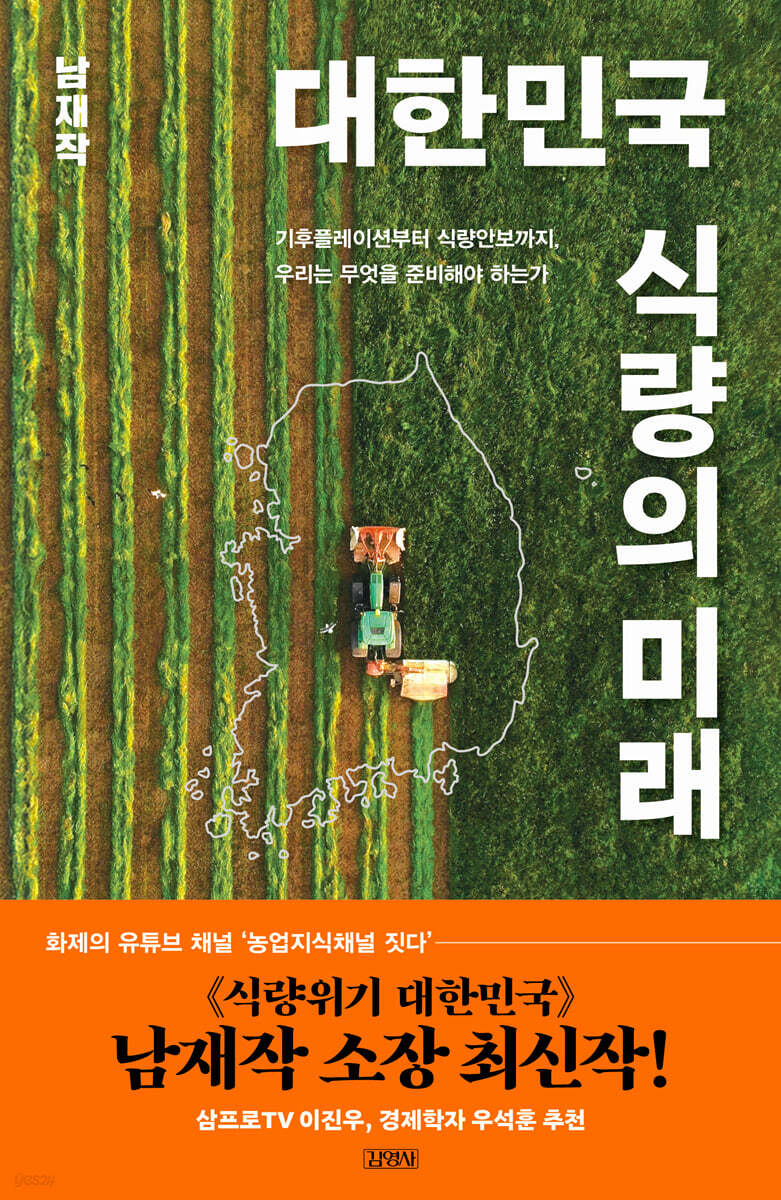 |
Description
Book Introduction
《Food Crisis in Korea》 Proposed by Director Nam Jae-jak
Food Security Strategy and the Future of Sustainable Agriculture
“Food must now be redefined as an industry and a security issue, as well as a climate and welfare issue.” Nam Jae-jak, a leading agricultural policy expert in Korea and director of the Korea Institute of Precision Agriculture, addressed the global issue of “food security” by focusing on Korean agriculture.
From the history of agriculture to the biodiversity crisis, from Korea's agricultural land system to the food policies of advanced countries, this book provides the most comprehensive and multi-dimensional look at the food issues of our time.
While the previous work, "Food Crisis in Korea," closely linked climate change and food shortages and raised the topic of "food security" in our society, this book presents new data on the worsening climate and food insecurity while specifically asking, "What should we prepare for?"
The author emphasizes that our food security cannot be secured solely through policies such as increasing the "food self-sufficiency rate" or blocking rice imports, as is currently the case, and that we must initiate structural reforms to enhance the competitiveness of agriculture, the foundation of our food production.
In particular, the current agricultural policy centered on small farmers has reached its limits, and it is diagnosed that without the expansion and concentration of farmland, it will be difficult to attract young farmers or introduce innovative technologies.
Therefore, he emphasizes that we must prepare food security policies to adapt to emergency situations, considering the constants of climate disasters that have become part of our daily lives and the super-aging and population decline that our rural areas are facing.
Food Security Strategy and the Future of Sustainable Agriculture
“Food must now be redefined as an industry and a security issue, as well as a climate and welfare issue.” Nam Jae-jak, a leading agricultural policy expert in Korea and director of the Korea Institute of Precision Agriculture, addressed the global issue of “food security” by focusing on Korean agriculture.
From the history of agriculture to the biodiversity crisis, from Korea's agricultural land system to the food policies of advanced countries, this book provides the most comprehensive and multi-dimensional look at the food issues of our time.
While the previous work, "Food Crisis in Korea," closely linked climate change and food shortages and raised the topic of "food security" in our society, this book presents new data on the worsening climate and food insecurity while specifically asking, "What should we prepare for?"
The author emphasizes that our food security cannot be secured solely through policies such as increasing the "food self-sufficiency rate" or blocking rice imports, as is currently the case, and that we must initiate structural reforms to enhance the competitiveness of agriculture, the foundation of our food production.
In particular, the current agricultural policy centered on small farmers has reached its limits, and it is diagnosed that without the expansion and concentration of farmland, it will be difficult to attract young farmers or introduce innovative technologies.
Therefore, he emphasizes that we must prepare food security policies to adapt to emergency situations, considering the constants of climate disasters that have become part of our daily lives and the super-aging and population decline that our rural areas are facing.
- You can preview some of the book's contents.
Preview
index
preface
Prologue: Questions Begin at the Table
Part 1: The Beginning of the Food Crisis
1 From the limits of growth to the planetary boundaries
The Origins of Agriculture | The Light and Shadow of the Green Revolution | Silent Spring | The Limits to Growth | Accelerating Civilization | Small Changes, Big Collapses: The Tipping Point
2 The intensifying climate crisis
Climate insensitivity│Changes faster than expected│New normal│Earth's warning sound│The era of water crisis│The dawn of a water war│The prisoner's dilemma: Cross-border water disputes│Wildfires, heavy rain, drought│Is it too late to respond to the climate crisis?
3 Biodiversity Crisis
Biodiversity and Food Production│Monarch Butterflies, a Warning Light for the Ecosystem│Disappearing Bees, a Vanishing World│When the Rhythms of the Ecosystem Are Disrupted│A Precarious Balance│Consumers and Biodiversity│The Diversity Challenge of Native Species│Biodiversity Disclosure│The World is Connected
Part 2: Food Security at Risk
4. Climate inflation
The New Face of the Food Crisis│Summer Cabbage│Will Apples Be Imported?│British Sparkling Wine│Climate and Prices
Climate's Impact on Crops | Dietary Changes and Health | Diets for Sustainability | Agriculture Needs Cartels
5 The Growing Food Crisis
Understanding Food Systems | Global Food Crisis | Worsening Food Insecurity Indicators | How Much More Food Will We Need in 2050? | The Philippines' Rice Crisis | Japan's Reiwa Rice Disturbance | The Four Strategic Pillars of Food Security
6 The Geopolitics of Food
Soil shaped by climate, agriculture determined by soil│Soil and civilization│Food imbalance│China's food dilemma│Mexico: The complexity of food security│Singapore's food industry│The transformation of Japanese agriculture│Where is Korea?
Part 3: Food Security in Korea
7 The Shadow of the Food Crisis
The Green Revolution and Rice Surplus│Food Self-Sufficiency Cannot Be Increased│Collapsed Rural Areas│Supply Chains Reveal Vulnerability│The Complexity of the Food Crisis
8 Land and Farmland System
The Era and Limits of Agricultural Land Expansion│Enclosure Movement and Modernization of Agriculture│From Over-fields to the Constitution of 'Free Farmers'│Agricultural Land Reform in East Asia│Agricultural Land Expansion in Japan│Agricultural Land Integration in Europe│Agricultural Land Size and Productivity│The History of Korean Agricultural Scale-Up Policy│[Brief Reading_The History of Korean Agriculture]│The World's Most Expensive Agricultural Land│Innovation Blocked by Agricultural Land
Part 4: Korea's Food Industry and the Future
9 Food Security in South Korea
Apples are just the beginning│The rice dilemma│[Brief reading_The inconvenient truth about beekeeping]│The cost of food self-sufficiency and food security│Statistical distortion│Distribution is just a result!│Korean agriculture gone backwards│There is no such thing as smart agriculture│Good intentions do not produce good results│Statistics without a future, agriculture without direction
10 Agriculture is the industry of the future
70 Years of Structure, the Illusion of K-Agriculture│Seed Industry: Seeds of the Future of Agriculture│Diversity and Strategy of Rice Varieties│Koshihikari, the Secret of its 80-Year Throne│Shin Dong-jin Asks About the Future of Korean Rice│The Seed Industry Stuck in Royalty-Free Mode│Cases of Global Agricultural Innovation│Farmer Integration Organizations: Possibilities and Limitations│The Future of Korean Agriculture?│Will Korean Agriculture Grow?
11 The Future of Food
Can Korean agriculture grow again? │ Challenges of agricultural innovation │ To increase intergenerational sustainability │ Food security requires new legislation │ The third wave, exports │ Moonshot thinking: A new turning point in the food industry │ Farmers' agriculture, agriculture as industry │ Small-scale farmers, a bridge between urban and rural areas │ What kind of future will we create? │ The final question
Epilogue
Words of gratitude
main
Pictorial source
Search
Prologue: Questions Begin at the Table
Part 1: The Beginning of the Food Crisis
1 From the limits of growth to the planetary boundaries
The Origins of Agriculture | The Light and Shadow of the Green Revolution | Silent Spring | The Limits to Growth | Accelerating Civilization | Small Changes, Big Collapses: The Tipping Point
2 The intensifying climate crisis
Climate insensitivity│Changes faster than expected│New normal│Earth's warning sound│The era of water crisis│The dawn of a water war│The prisoner's dilemma: Cross-border water disputes│Wildfires, heavy rain, drought│Is it too late to respond to the climate crisis?
3 Biodiversity Crisis
Biodiversity and Food Production│Monarch Butterflies, a Warning Light for the Ecosystem│Disappearing Bees, a Vanishing World│When the Rhythms of the Ecosystem Are Disrupted│A Precarious Balance│Consumers and Biodiversity│The Diversity Challenge of Native Species│Biodiversity Disclosure│The World is Connected
Part 2: Food Security at Risk
4. Climate inflation
The New Face of the Food Crisis│Summer Cabbage│Will Apples Be Imported?│British Sparkling Wine│Climate and Prices
Climate's Impact on Crops | Dietary Changes and Health | Diets for Sustainability | Agriculture Needs Cartels
5 The Growing Food Crisis
Understanding Food Systems | Global Food Crisis | Worsening Food Insecurity Indicators | How Much More Food Will We Need in 2050? | The Philippines' Rice Crisis | Japan's Reiwa Rice Disturbance | The Four Strategic Pillars of Food Security
6 The Geopolitics of Food
Soil shaped by climate, agriculture determined by soil│Soil and civilization│Food imbalance│China's food dilemma│Mexico: The complexity of food security│Singapore's food industry│The transformation of Japanese agriculture│Where is Korea?
Part 3: Food Security in Korea
7 The Shadow of the Food Crisis
The Green Revolution and Rice Surplus│Food Self-Sufficiency Cannot Be Increased│Collapsed Rural Areas│Supply Chains Reveal Vulnerability│The Complexity of the Food Crisis
8 Land and Farmland System
The Era and Limits of Agricultural Land Expansion│Enclosure Movement and Modernization of Agriculture│From Over-fields to the Constitution of 'Free Farmers'│Agricultural Land Reform in East Asia│Agricultural Land Expansion in Japan│Agricultural Land Integration in Europe│Agricultural Land Size and Productivity│The History of Korean Agricultural Scale-Up Policy│[Brief Reading_The History of Korean Agriculture]│The World's Most Expensive Agricultural Land│Innovation Blocked by Agricultural Land
Part 4: Korea's Food Industry and the Future
9 Food Security in South Korea
Apples are just the beginning│The rice dilemma│[Brief reading_The inconvenient truth about beekeeping]│The cost of food self-sufficiency and food security│Statistical distortion│Distribution is just a result!│Korean agriculture gone backwards│There is no such thing as smart agriculture│Good intentions do not produce good results│Statistics without a future, agriculture without direction
10 Agriculture is the industry of the future
70 Years of Structure, the Illusion of K-Agriculture│Seed Industry: Seeds of the Future of Agriculture│Diversity and Strategy of Rice Varieties│Koshihikari, the Secret of its 80-Year Throne│Shin Dong-jin Asks About the Future of Korean Rice│The Seed Industry Stuck in Royalty-Free Mode│Cases of Global Agricultural Innovation│Farmer Integration Organizations: Possibilities and Limitations│The Future of Korean Agriculture?│Will Korean Agriculture Grow?
11 The Future of Food
Can Korean agriculture grow again? │ Challenges of agricultural innovation │ To increase intergenerational sustainability │ Food security requires new legislation │ The third wave, exports │ Moonshot thinking: A new turning point in the food industry │ Farmers' agriculture, agriculture as industry │ Small-scale farmers, a bridge between urban and rural areas │ What kind of future will we create? │ The final question
Epilogue
Words of gratitude
main
Pictorial source
Search
Detailed image

Into the book
As of 2022, Korea's food security score was 70.2, ranking 39th out of 113 countries.
It ranked 11th in availability.
It means that the food itself is sufficient.
The issues are economic feasibility (51st) and quality and safety (50th).
This means that while food is not scarce, its prices are high and national policies on nutrition and food safety are inadequate.
--- p.15
We often say, “To strengthen food security, we must increase self-sufficiency.”
As if we believe that making everything at home is safe.
However, a high self-sufficiency rate concentrated on specific crops can actually increase risks.
Korea's self-sufficiency rate for rice is high, but even one instance of abnormal weather could disrupt the entire supply.
--- p.24
The 11 dams China has built on the upper Mekong River have threatened the lives of 60 million people downstream since 2019.
In 2019, despite ample rainfall upstream, the downstream region experienced a severe drought.
The reason was simple.
This is because China opened dams and released large amounts of water to generate electricity in the first half of the year, but closed the sluice gates during the rainy season.
--- p.71
Oranges from California are imported without any special heat treatment because they are free from fruit flies, which are banned in our country.
On the other hand, oranges from other countries, such as South Africa, are classified as fruit fly-infested areas and must be heat treated before import.
During this process, the taste and texture of the fruit are greatly reduced.
That's why, in our market, we can easily find only American oranges, which are much more competitive in taste and texture.
--- p.129
As of early 2025, Korea's comprehensive cost of living is relatively high, ranking 25th among 146 countries.
However, if we limit it to the food sector, it rises to 6th place in the world.
By product, apples, bananas, oranges, and potatoes ranked first in the world, beef and onions ranked second, and tomatoes ranked third.
Most agricultural and livestock products are among the highest in the world, with only eggs (35th) and imported beer (32nd) being exceptions, remaining in the middle ranks.
--- p.142
About 50% of the world's arable land is used for agriculture, of which 77% is used for growing feed and grazing for livestock.
However, the total calories supplied by the livestock industry only account for 18% of the total calories consumed by humanity.
41% of agricultural water is also used to produce feed crops.
--- p.148
The biggest advantage of an open food system is efficiency.
International trade allows for the import of food products from various countries, increasing dietary diversity and improving agricultural productivity by allowing countries to focus their production resources on competitive crops.
--- p.161
China has the largest grain reserves in the world.
As of 2022, it holds 69% of the world's reserves of corn, 60% of rice, 51% of wheat, and 37% of soybeans.
In 2023, it signed an agreement with Russia to build a $159 million grain logistics hub near the Jewish Autonomous Oblast, and in October of the same year, it signed a long-term contract worth $26 billion to import 70 million tons of grain over the next 12 years.
--- p.212
Singapore, which relies on imports for 90% of its food, has minimized its dependence on any one country by building a diversified food supply chain that spans over 170 countries.
At the same time, the government has provided various incentives, including tax breaks, financial support, infrastructure, and policy support for overseas mergers and acquisitions, to attract and grow global food companies like Wilmar and Olam.
--- p.220~221
Niigata's approach was not simply quarantine.
They did not try to completely eradicate the disease.
Rather, it left room for the disease to spread 'moderately'.
The strategy was to allow the disease to spread moderately, while preventing the pathogen from evolving into a "super blast."
--- p.335
Since the 2000s, each local government has focused on branding its own representative rice varieties.
In this situation, the change from ‘Shindongjin’ to ‘Chamdongjin’ does not mean a simple replacement, but rather a severance of the brand.
The appearance and taste are almost the same, but the name is different.
The resulting confusion affects not only farmers, but also distributors and consumers.
--- p.338
In the 1990s, Korean agriculture began to receive unprecedented national investment.
It started with the ‘Rural and Fishing Village Structural Improvement Plan’ in 1992.
At the time, the entire budget of the Ministry of Agriculture, Food and Rural Affairs was about 5 trillion won, but a whopping 42 trillion won was allocated for this measure over 10 years.
Soon after, with the conclusion of the Uruguay Round negotiations, the opening of agricultural markets became inevitable, and the government poured in another response budget of over 100 trillion won to appease the farmers' strong opposition.
It ranked 11th in availability.
It means that the food itself is sufficient.
The issues are economic feasibility (51st) and quality and safety (50th).
This means that while food is not scarce, its prices are high and national policies on nutrition and food safety are inadequate.
--- p.15
We often say, “To strengthen food security, we must increase self-sufficiency.”
As if we believe that making everything at home is safe.
However, a high self-sufficiency rate concentrated on specific crops can actually increase risks.
Korea's self-sufficiency rate for rice is high, but even one instance of abnormal weather could disrupt the entire supply.
--- p.24
The 11 dams China has built on the upper Mekong River have threatened the lives of 60 million people downstream since 2019.
In 2019, despite ample rainfall upstream, the downstream region experienced a severe drought.
The reason was simple.
This is because China opened dams and released large amounts of water to generate electricity in the first half of the year, but closed the sluice gates during the rainy season.
--- p.71
Oranges from California are imported without any special heat treatment because they are free from fruit flies, which are banned in our country.
On the other hand, oranges from other countries, such as South Africa, are classified as fruit fly-infested areas and must be heat treated before import.
During this process, the taste and texture of the fruit are greatly reduced.
That's why, in our market, we can easily find only American oranges, which are much more competitive in taste and texture.
--- p.129
As of early 2025, Korea's comprehensive cost of living is relatively high, ranking 25th among 146 countries.
However, if we limit it to the food sector, it rises to 6th place in the world.
By product, apples, bananas, oranges, and potatoes ranked first in the world, beef and onions ranked second, and tomatoes ranked third.
Most agricultural and livestock products are among the highest in the world, with only eggs (35th) and imported beer (32nd) being exceptions, remaining in the middle ranks.
--- p.142
About 50% of the world's arable land is used for agriculture, of which 77% is used for growing feed and grazing for livestock.
However, the total calories supplied by the livestock industry only account for 18% of the total calories consumed by humanity.
41% of agricultural water is also used to produce feed crops.
--- p.148
The biggest advantage of an open food system is efficiency.
International trade allows for the import of food products from various countries, increasing dietary diversity and improving agricultural productivity by allowing countries to focus their production resources on competitive crops.
--- p.161
China has the largest grain reserves in the world.
As of 2022, it holds 69% of the world's reserves of corn, 60% of rice, 51% of wheat, and 37% of soybeans.
In 2023, it signed an agreement with Russia to build a $159 million grain logistics hub near the Jewish Autonomous Oblast, and in October of the same year, it signed a long-term contract worth $26 billion to import 70 million tons of grain over the next 12 years.
--- p.212
Singapore, which relies on imports for 90% of its food, has minimized its dependence on any one country by building a diversified food supply chain that spans over 170 countries.
At the same time, the government has provided various incentives, including tax breaks, financial support, infrastructure, and policy support for overseas mergers and acquisitions, to attract and grow global food companies like Wilmar and Olam.
--- p.220~221
Niigata's approach was not simply quarantine.
They did not try to completely eradicate the disease.
Rather, it left room for the disease to spread 'moderately'.
The strategy was to allow the disease to spread moderately, while preventing the pathogen from evolving into a "super blast."
--- p.335
Since the 2000s, each local government has focused on branding its own representative rice varieties.
In this situation, the change from ‘Shindongjin’ to ‘Chamdongjin’ does not mean a simple replacement, but rather a severance of the brand.
The appearance and taste are almost the same, but the name is different.
The resulting confusion affects not only farmers, but also distributors and consumers.
--- p.338
In the 1990s, Korean agriculture began to receive unprecedented national investment.
It started with the ‘Rural and Fishing Village Structural Improvement Plan’ in 1992.
At the time, the entire budget of the Ministry of Agriculture, Food and Rural Affairs was about 5 trillion won, but a whopping 42 trillion won was allocated for this measure over 10 years.
Soon after, with the conclusion of the Uruguay Round negotiations, the opening of agricultural markets became inevitable, and the government poured in another response budget of over 100 trillion won to appease the farmers' strong opposition.
--- p.364
Publisher's Review
Soaring prices, a rapidly aging population, and a declining agricultural population…
Can we protect our food tables with the current agricultural system?
《Food Crisis in Korea》 Proposed by Director Nam Jae-jak
Food Security Strategy and the Future of Sustainable Agriculture
The Future of Food in Korea
“Food must now be redefined as an industry and a security issue, as well as a climate and welfare issue.” Nam Jae-jak, a leading agricultural policy expert in Korea and director of the Korea Institute of Precision Agriculture, addressed the global issue of “food security” by focusing on Korean agriculture.
From the history of agriculture to the biodiversity crisis, from Korea's agricultural land system to the food policies of advanced countries, this book provides the most comprehensive and multi-dimensional look at the food issues of our time.
While the previous work, "Food Crisis in Korea," closely linked climate change and food shortages and raised the topic of "food security" in our society, this book presents new data on the worsening climate and food insecurity while specifically asking, "What should we prepare for?"
The author points out that our food security cannot be secured solely through policies such as increasing the "food self-sufficiency rate" or blocking rice imports, as is currently the case, and that we must initiate structural reforms to enhance the competitiveness of agriculture, the foundation of our food production.
In particular, the current agricultural policy centered on small farmers has reached its limits, and it is diagnosed that without the expansion and concentration of farmland, it will be difficult to attract young farmers or introduce innovative technologies.
Therefore, he emphasizes that we must prepare food security policies to adapt to emergency situations, considering the constants of climate disasters that have become part of our daily lives and the super-aging and population decline that our rural areas are facing.
This book is divided into four parts, including a prologue (10 questions that correct common misconceptions about food issues).
Part 1 covers the history of agriculture and the development of civilization, the climate crisis following the Green Revolution, water conflicts between countries sharing the same watershed, and the collapse of biodiversity.
Part 2 analyzes climate inflation, the rice crisis in the Philippines and Japan, and the geopolitics of food, confirming the precarious state of our agriculture.
Part 3 explains the unique nature of Korea's food crisis and critically examines Korea's agricultural land system, distribution issues, and distorted statistical structures.
Part 4 covers topics such as the importance of the seed industry, including Korean rice varieties, global agricultural innovation cases, and the legislation of food security, and presents policy tasks for the revitalization of Korean agriculture.
Why are grocery prices so expensive in Korea?
Some readers might ask, "Food security?" We're not in a state of war, and the streets aren't overflowing with starving people. Why do we need to know about this?
However, if our country's food security index is the lowest in the OECD and one of the reasons for this low index is 'high prices', then the story is different.
The Food Security Index (GFSI), published by The Economist, evaluates the food situation of each country based on four criteria: availability (amount of food), affordability (price of food), quality and stability, and sustainability.
As of 2022, Korea ranks 11th in availability and 50th in economy, quality, and safety (see page 15).
There is no shortage of food itself, but the price is very high and the quality is low.
The announcement from Nembeo, a platform that provides cost of living data by country, is even more shocking: as of early 2025, Korea's food prices are ranked 6th in the world.
We now eat the world's most expensive bananas, apples and potatoes, and buy the second most expensive beef and onions.
If these high food prices persist, the burden on the economy will increase, forcing low-income households to consume unbalanced diets and low-quality food.
“For some, it’s a question of whether or not to buy a bag of apples, while for others, school lunches may be their only meal of the day.”
Of course, high food prices are largely due to the climate inflation that the world is experiencing.
Due to climate conditions that make crops unstable, such as drought, floods, heat waves, and increased pests and diseases, even cabbage and apple farms in highland areas of our country are facing a threat to their survival.
However, Korea's high agricultural product prices cannot be explained simply by the impact of climate change, and the author finds the cause in the structural characteristics of Korean agriculture.
The small size of farms, low mechanization rate, and policies focused on protecting small farmers ultimately raise agricultural product prices and reduce the competitiveness of our agriculture.
So, while this book deals with 'food security,' it begins with the reform of Korean agriculture and unfolds the story.
Why farmland expansion and intensification are necessary
The author emphasizes that the top priority for our agriculture is the expansion and intensification of farmland.
Research shows that most productivity gains in agriculture worldwide since the mid-20th century have come from concentrated and large-scale land use.
This is because, in order to increase agricultural productivity, “a structure that allows technology to enter, room for tractors to turn, and continuous space for robots to move” are necessary.
Brazil has achieved remarkable productivity gains since the 1960s, “49% of which is due to the expansion of business scale and the introduction of technology.”
Looking at the major European countries, which are agricultural powerhouses today, the average cultivated area per farm (2020-2022) is incomparable to that of Korea.
The Netherlands had 41.4 hectares, Germany 61 hectares, Denmark 83 hectares, and France 45 hectares. These countries increased the size of their farmland by two to five times through the Common Agricultural Policy (CAP) in 1962 after the end of World War II.
Japan, which has a similar agricultural structure to ours, also belatedly reorganized its agricultural land, which was dispersed among management entities, and increased it from 1.6 hectares in 2000 to 3.6 hectares as of 2024.
This project is currently in progress.
In contrast, the cultivated area per farm household in Korea only increased from 1 hectare in 1980 to 1.5 hectares in 2023.
70% of farms have less than 1 hectare, and their agricultural product sales are less than 10 million won per year.
There are loud calls to introduce cutting-edge technologies into the field to increase productivity, but as the author points out, "smart agriculture, self-driving farm machinery, agricultural robots, AI—all these technologies don't work without a scale that ensures economic viability."
Meanwhile, Korea's distribution structure is often pointed out as the main culprit behind the rising prices of agricultural products, but the author believes that this too is a phenomenon that has emerged due to the lack of large-scale farms.
The point is that "harvesting, packaging, and transporting agricultural products from numerous small-scale farms inevitably increases distribution costs and necessitates complex distribution processes."
Therefore, the author emphasizes that Korea's agriculture should implement policies to scale up, including measures such as "incentivizing management entities that integrate adjacent farmland and introducing a land exchange/adjustment system," and "tracking management entities with 10 hectares or more and their concentration, and building a digital farmland map."
Can agriculture become the industry of the future?
Another key task for our agriculture is to create a structure that can “survive in the global market.”
The author criticizes that our agriculture has been “government-led, income-preserving agriculture” so far.
This is a sharp criticism that agriculture, which should be the bulwark of food security, has lost its growth momentum by relying solely on government support.
The author defines the past 30 years of Korean agriculture as an 'era of agricultural loss.'
In fact, starting with the "Rural and Fishing Village Structural Improvement Plan" in 1992, 42 trillion won was invested in the agricultural sector over 10 years, and after the conclusion of the Uruguay Round negotiations, a response budget of over 100 trillion won was added, leading to a flood of support policies.
However, during that period, the gap between farm income and urban income widened, the food self-sufficiency rate fell, and the aging and exodus of farmers worsened.
Farmland prices have also risen to the highest levels in the world, making it difficult for young farmers to enter the market.
Many farmers are “building their farming plans around government subsidies and support programs” as if it were a given, and the private business model has been weakened as public institutions provide seeds, microbial preparations, agricultural machinery, and technology free of charge.
Meanwhile, agricultural and food companies in each country grew in size and expanded globally through private initiatives, quality standardization, long-term investment, and brand strategies.
Agrovision, an American berry specialty agrifood company, has secured production sites in several countries in the Northern and Southern Hemispheres, produces berries year-round, and has established a vertically integrated model from farm to distribution. Zespri, a cooperative corporation established directly by New Zealand farmers, has taken over the global kiwifruit market by integrating variety development, branding, and marketing.
Sales in 2023-2024 are expected to reach $2.5 billion, equivalent to 25% of Korea's total agricultural and food product exports.
The author criticizes that the driving force behind agricultural growth comes not from subsidies, but from autonomy in management and innovation.
The argument is that only when the government steps back as a "coordinator" promoting innovation and an environment is created where the private sector can experiment and even fail can competitive agricultural and food companies emerge.
Meanwhile, the author urges that we should no longer view agriculture as a traditional industry of “growing crops on small plots of land,” but rather focus on its potential as a future industry.
Today, agriculture is evolving into a complex industry encompassing biotechnology, alternative foods, smart farming, advanced logistics, and international cooperation.
He believes that, “Just as semiconductors are designed in the U.S. and manufactured by foundries in Asia, it would also be possible for food technology to be developed in advanced countries and production to be handled by fermentation and plant powerhouses like Korea.”
This is a bold idea: "If Korea establishes a Northeast Asian grain hub and utilizes that grain to create a biofoundry complex, it can go beyond being an agricultural and food powerhouse and become the center of a new future industry."
The author also emphasizes the need to consider how to create a “sustainable agricultural management entity.”
For example, one option could be a model where corporate group management bodies hire young farmers.
“Rather than young people borrowing money to become small farmers, they first get hired by a corporate group to gain skills and experience, and then gradually become independent.”
This support policy “provides young people with stable jobs, helps them develop their skills in the process, and enables them to become independent by providing access to farmland and financial support when needed.”
If this policy is successfully implemented, local agriculture will be revitalized and generational change will occur naturally.
What should we prepare?
Today, the world faces food security instability due to climate change, water depletion, soil erosion, and geopolitical crises.
Developed countries are already moving quickly to prepare for food security through overseas agricultural investment, securing new food transport hubs (China), attracting global food company headquarters (Singapore's Olam Group and Wilmar International), and various legislative initiatives.
The next crisis “is likely to come from an unprepared system.”
The author examines overseas cases and suggests four food security strategies we need.
First, rice alone is not enough.
A multi-layered stockpiling system is needed, including flour, cooking oil, and feed.
We must manage key crops such as rice, wheat, and soybeans as security assets, and prepare an integrated monitoring system capable of monitoring not only public stockpiles but also private stockpiles.
Second, we must strengthen our food information network and forecasting capabilities, integrating satellite, AI, and logistics data, to detect global trends in real time.
“We need a ‘sensory organ’ that can monitor global food flows in real time, including estimates of global crop production, import and export trends, policy changes in major countries, and even bottlenecks in maritime logistics.” Third, food must be managed as a public good through price guarantees, public meals, local food, and food vouchers.
Food is a matter of security and welfare.
Fourth, it is dangerous to leave all income to a few countries.
We must pursue international cooperation and import diversification by securing diverse supply routes and expanding agricultural ODA and cooperation with international organizations.
We must begin investing with a vision for the future, from seeds and agricultural machinery to food processing, distribution, and smart farming technologies.
(Pages 187-192)
To enhance the implementation of this food security strategy, ‘law’ is essential.
The author emphasizes the need to establish a legal framework that encompasses everything from supply and demand stabilization in peacetime to crisis response and welfare linkages.
Japan separated its response systems for peacetime and emergency situations through the "Basic Law on Food, Agriculture, and Rural Areas" and the "Food Supply Emergency Measures Act," while France integrated its climate and food policies by including a food self-sufficiency goal in its "Climate and Resilience Act."
China will enact the "Food Security Law" in 2024 to manage the entire food cycle from production, distribution, storage, and welfare.
In many countries today, food security is no longer a policy statement, but rather a legal obligation to be maintained on an ongoing basis.
Climate crisis, hyper-aging population, declining agricultural population… Can our current agriculture truly sustain our food supply? The author accurately portrays the reality facing our community and argues that Korean agriculture must find a path to self-reliance.
Although he sometimes harshly criticizes the paternalistic view of agriculture, his views are based on a sincere desire to protect the sustainability of our agriculture.
Food security entails a huge social cost.
We also need to consider whether to use those costs to maintain the current agricultural structure or to transition to a sustainable agricultural structure.
If things continue as they are now, South Korea will inevitably fall behind in the global food security competition.
Before it's too late, it would be a good idea to begin a "dialogue toward a better agricultural future" to discuss what our society needs to prepare for and what efforts and policies are needed.
Can we protect our food tables with the current agricultural system?
《Food Crisis in Korea》 Proposed by Director Nam Jae-jak
Food Security Strategy and the Future of Sustainable Agriculture
The Future of Food in Korea
“Food must now be redefined as an industry and a security issue, as well as a climate and welfare issue.” Nam Jae-jak, a leading agricultural policy expert in Korea and director of the Korea Institute of Precision Agriculture, addressed the global issue of “food security” by focusing on Korean agriculture.
From the history of agriculture to the biodiversity crisis, from Korea's agricultural land system to the food policies of advanced countries, this book provides the most comprehensive and multi-dimensional look at the food issues of our time.
While the previous work, "Food Crisis in Korea," closely linked climate change and food shortages and raised the topic of "food security" in our society, this book presents new data on the worsening climate and food insecurity while specifically asking, "What should we prepare for?"
The author points out that our food security cannot be secured solely through policies such as increasing the "food self-sufficiency rate" or blocking rice imports, as is currently the case, and that we must initiate structural reforms to enhance the competitiveness of agriculture, the foundation of our food production.
In particular, the current agricultural policy centered on small farmers has reached its limits, and it is diagnosed that without the expansion and concentration of farmland, it will be difficult to attract young farmers or introduce innovative technologies.
Therefore, he emphasizes that we must prepare food security policies to adapt to emergency situations, considering the constants of climate disasters that have become part of our daily lives and the super-aging and population decline that our rural areas are facing.
This book is divided into four parts, including a prologue (10 questions that correct common misconceptions about food issues).
Part 1 covers the history of agriculture and the development of civilization, the climate crisis following the Green Revolution, water conflicts between countries sharing the same watershed, and the collapse of biodiversity.
Part 2 analyzes climate inflation, the rice crisis in the Philippines and Japan, and the geopolitics of food, confirming the precarious state of our agriculture.
Part 3 explains the unique nature of Korea's food crisis and critically examines Korea's agricultural land system, distribution issues, and distorted statistical structures.
Part 4 covers topics such as the importance of the seed industry, including Korean rice varieties, global agricultural innovation cases, and the legislation of food security, and presents policy tasks for the revitalization of Korean agriculture.
Why are grocery prices so expensive in Korea?
Some readers might ask, "Food security?" We're not in a state of war, and the streets aren't overflowing with starving people. Why do we need to know about this?
However, if our country's food security index is the lowest in the OECD and one of the reasons for this low index is 'high prices', then the story is different.
The Food Security Index (GFSI), published by The Economist, evaluates the food situation of each country based on four criteria: availability (amount of food), affordability (price of food), quality and stability, and sustainability.
As of 2022, Korea ranks 11th in availability and 50th in economy, quality, and safety (see page 15).
There is no shortage of food itself, but the price is very high and the quality is low.
The announcement from Nembeo, a platform that provides cost of living data by country, is even more shocking: as of early 2025, Korea's food prices are ranked 6th in the world.
We now eat the world's most expensive bananas, apples and potatoes, and buy the second most expensive beef and onions.
If these high food prices persist, the burden on the economy will increase, forcing low-income households to consume unbalanced diets and low-quality food.
“For some, it’s a question of whether or not to buy a bag of apples, while for others, school lunches may be their only meal of the day.”
Of course, high food prices are largely due to the climate inflation that the world is experiencing.
Due to climate conditions that make crops unstable, such as drought, floods, heat waves, and increased pests and diseases, even cabbage and apple farms in highland areas of our country are facing a threat to their survival.
However, Korea's high agricultural product prices cannot be explained simply by the impact of climate change, and the author finds the cause in the structural characteristics of Korean agriculture.
The small size of farms, low mechanization rate, and policies focused on protecting small farmers ultimately raise agricultural product prices and reduce the competitiveness of our agriculture.
So, while this book deals with 'food security,' it begins with the reform of Korean agriculture and unfolds the story.
Why farmland expansion and intensification are necessary
The author emphasizes that the top priority for our agriculture is the expansion and intensification of farmland.
Research shows that most productivity gains in agriculture worldwide since the mid-20th century have come from concentrated and large-scale land use.
This is because, in order to increase agricultural productivity, “a structure that allows technology to enter, room for tractors to turn, and continuous space for robots to move” are necessary.
Brazil has achieved remarkable productivity gains since the 1960s, “49% of which is due to the expansion of business scale and the introduction of technology.”
Looking at the major European countries, which are agricultural powerhouses today, the average cultivated area per farm (2020-2022) is incomparable to that of Korea.
The Netherlands had 41.4 hectares, Germany 61 hectares, Denmark 83 hectares, and France 45 hectares. These countries increased the size of their farmland by two to five times through the Common Agricultural Policy (CAP) in 1962 after the end of World War II.
Japan, which has a similar agricultural structure to ours, also belatedly reorganized its agricultural land, which was dispersed among management entities, and increased it from 1.6 hectares in 2000 to 3.6 hectares as of 2024.
This project is currently in progress.
In contrast, the cultivated area per farm household in Korea only increased from 1 hectare in 1980 to 1.5 hectares in 2023.
70% of farms have less than 1 hectare, and their agricultural product sales are less than 10 million won per year.
There are loud calls to introduce cutting-edge technologies into the field to increase productivity, but as the author points out, "smart agriculture, self-driving farm machinery, agricultural robots, AI—all these technologies don't work without a scale that ensures economic viability."
Meanwhile, Korea's distribution structure is often pointed out as the main culprit behind the rising prices of agricultural products, but the author believes that this too is a phenomenon that has emerged due to the lack of large-scale farms.
The point is that "harvesting, packaging, and transporting agricultural products from numerous small-scale farms inevitably increases distribution costs and necessitates complex distribution processes."
Therefore, the author emphasizes that Korea's agriculture should implement policies to scale up, including measures such as "incentivizing management entities that integrate adjacent farmland and introducing a land exchange/adjustment system," and "tracking management entities with 10 hectares or more and their concentration, and building a digital farmland map."
Can agriculture become the industry of the future?
Another key task for our agriculture is to create a structure that can “survive in the global market.”
The author criticizes that our agriculture has been “government-led, income-preserving agriculture” so far.
This is a sharp criticism that agriculture, which should be the bulwark of food security, has lost its growth momentum by relying solely on government support.
The author defines the past 30 years of Korean agriculture as an 'era of agricultural loss.'
In fact, starting with the "Rural and Fishing Village Structural Improvement Plan" in 1992, 42 trillion won was invested in the agricultural sector over 10 years, and after the conclusion of the Uruguay Round negotiations, a response budget of over 100 trillion won was added, leading to a flood of support policies.
However, during that period, the gap between farm income and urban income widened, the food self-sufficiency rate fell, and the aging and exodus of farmers worsened.
Farmland prices have also risen to the highest levels in the world, making it difficult for young farmers to enter the market.
Many farmers are “building their farming plans around government subsidies and support programs” as if it were a given, and the private business model has been weakened as public institutions provide seeds, microbial preparations, agricultural machinery, and technology free of charge.
Meanwhile, agricultural and food companies in each country grew in size and expanded globally through private initiatives, quality standardization, long-term investment, and brand strategies.
Agrovision, an American berry specialty agrifood company, has secured production sites in several countries in the Northern and Southern Hemispheres, produces berries year-round, and has established a vertically integrated model from farm to distribution. Zespri, a cooperative corporation established directly by New Zealand farmers, has taken over the global kiwifruit market by integrating variety development, branding, and marketing.
Sales in 2023-2024 are expected to reach $2.5 billion, equivalent to 25% of Korea's total agricultural and food product exports.
The author criticizes that the driving force behind agricultural growth comes not from subsidies, but from autonomy in management and innovation.
The argument is that only when the government steps back as a "coordinator" promoting innovation and an environment is created where the private sector can experiment and even fail can competitive agricultural and food companies emerge.
Meanwhile, the author urges that we should no longer view agriculture as a traditional industry of “growing crops on small plots of land,” but rather focus on its potential as a future industry.
Today, agriculture is evolving into a complex industry encompassing biotechnology, alternative foods, smart farming, advanced logistics, and international cooperation.
He believes that, “Just as semiconductors are designed in the U.S. and manufactured by foundries in Asia, it would also be possible for food technology to be developed in advanced countries and production to be handled by fermentation and plant powerhouses like Korea.”
This is a bold idea: "If Korea establishes a Northeast Asian grain hub and utilizes that grain to create a biofoundry complex, it can go beyond being an agricultural and food powerhouse and become the center of a new future industry."
The author also emphasizes the need to consider how to create a “sustainable agricultural management entity.”
For example, one option could be a model where corporate group management bodies hire young farmers.
“Rather than young people borrowing money to become small farmers, they first get hired by a corporate group to gain skills and experience, and then gradually become independent.”
This support policy “provides young people with stable jobs, helps them develop their skills in the process, and enables them to become independent by providing access to farmland and financial support when needed.”
If this policy is successfully implemented, local agriculture will be revitalized and generational change will occur naturally.
What should we prepare?
Today, the world faces food security instability due to climate change, water depletion, soil erosion, and geopolitical crises.
Developed countries are already moving quickly to prepare for food security through overseas agricultural investment, securing new food transport hubs (China), attracting global food company headquarters (Singapore's Olam Group and Wilmar International), and various legislative initiatives.
The next crisis “is likely to come from an unprepared system.”
The author examines overseas cases and suggests four food security strategies we need.
First, rice alone is not enough.
A multi-layered stockpiling system is needed, including flour, cooking oil, and feed.
We must manage key crops such as rice, wheat, and soybeans as security assets, and prepare an integrated monitoring system capable of monitoring not only public stockpiles but also private stockpiles.
Second, we must strengthen our food information network and forecasting capabilities, integrating satellite, AI, and logistics data, to detect global trends in real time.
“We need a ‘sensory organ’ that can monitor global food flows in real time, including estimates of global crop production, import and export trends, policy changes in major countries, and even bottlenecks in maritime logistics.” Third, food must be managed as a public good through price guarantees, public meals, local food, and food vouchers.
Food is a matter of security and welfare.
Fourth, it is dangerous to leave all income to a few countries.
We must pursue international cooperation and import diversification by securing diverse supply routes and expanding agricultural ODA and cooperation with international organizations.
We must begin investing with a vision for the future, from seeds and agricultural machinery to food processing, distribution, and smart farming technologies.
(Pages 187-192)
To enhance the implementation of this food security strategy, ‘law’ is essential.
The author emphasizes the need to establish a legal framework that encompasses everything from supply and demand stabilization in peacetime to crisis response and welfare linkages.
Japan separated its response systems for peacetime and emergency situations through the "Basic Law on Food, Agriculture, and Rural Areas" and the "Food Supply Emergency Measures Act," while France integrated its climate and food policies by including a food self-sufficiency goal in its "Climate and Resilience Act."
China will enact the "Food Security Law" in 2024 to manage the entire food cycle from production, distribution, storage, and welfare.
In many countries today, food security is no longer a policy statement, but rather a legal obligation to be maintained on an ongoing basis.
Climate crisis, hyper-aging population, declining agricultural population… Can our current agriculture truly sustain our food supply? The author accurately portrays the reality facing our community and argues that Korean agriculture must find a path to self-reliance.
Although he sometimes harshly criticizes the paternalistic view of agriculture, his views are based on a sincere desire to protect the sustainability of our agriculture.
Food security entails a huge social cost.
We also need to consider whether to use those costs to maintain the current agricultural structure or to transition to a sustainable agricultural structure.
If things continue as they are now, South Korea will inevitably fall behind in the global food security competition.
Before it's too late, it would be a good idea to begin a "dialogue toward a better agricultural future" to discuss what our society needs to prepare for and what efforts and policies are needed.
GOODS SPECIFICS
- Date of issue: October 28, 2025
- Page count, weight, size: 476 pages | 614g | 141*215*23mm
- ISBN13: 9791173323348
- ISBN10: 1173323341
You may also like
카테고리
korean


korean

![GQ KOREA Mark (Monthly): December [2025]](http://librairie.coreenne.fr/cdn/shop/files/8ef265dbbfbf186523ed75ba7319009d.jpg?v=1765340328&width=3840)


