

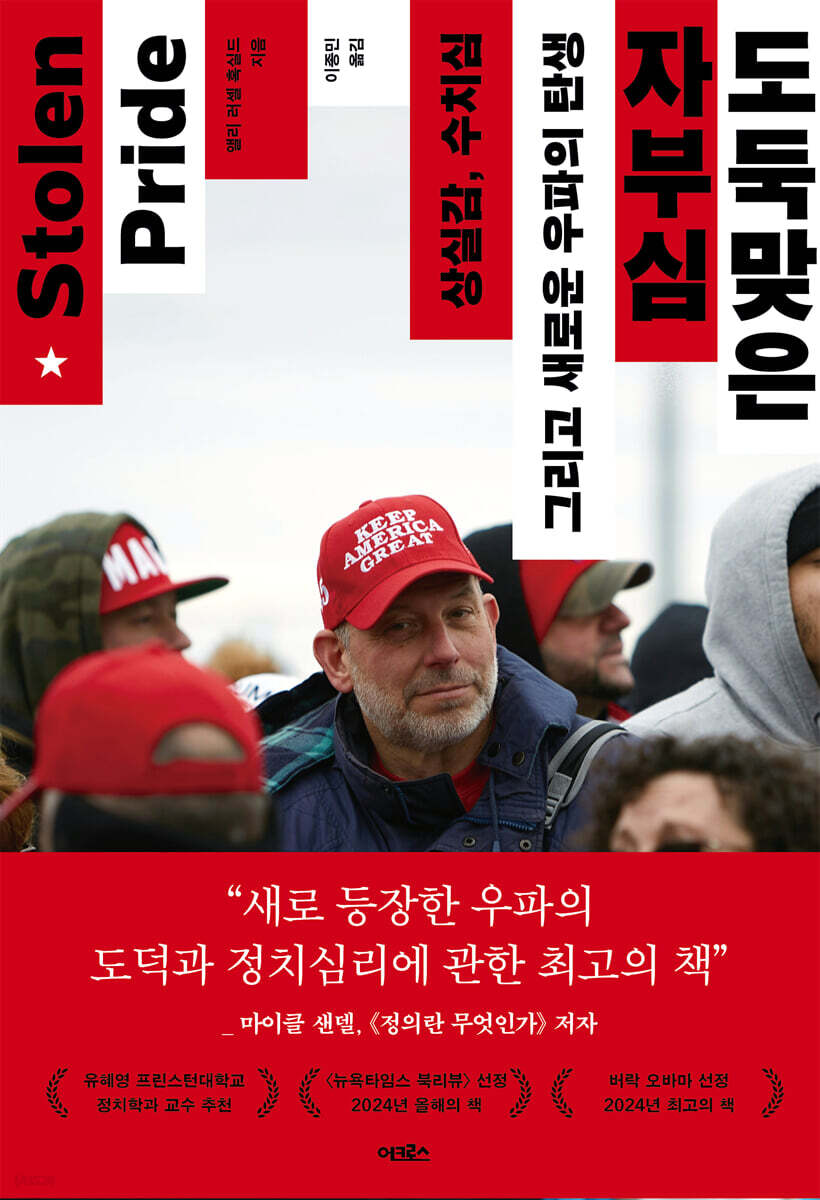
Stolen pride
 |
Description
Book Introduction
★ Recommended by Michael Sandel: Justice: What's the Right Thing to Do?
★ Recommended by Professor Yoo Hye-young of the Department of Political Science at Princeton University
★ Barack Obama's Best Books of 2024
★ Selected as a Book of the Year for 2024 by The New York Times Book Review
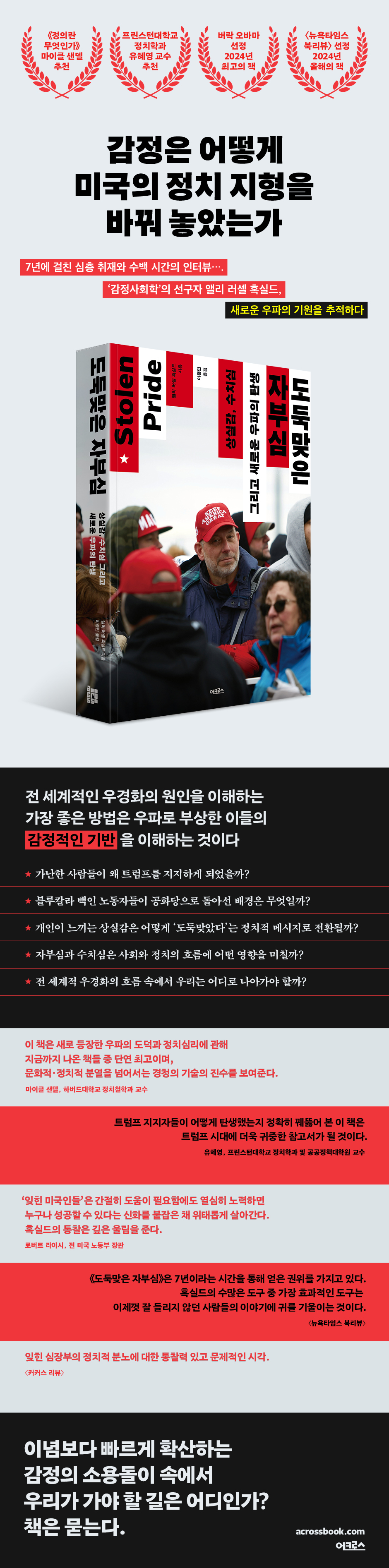
How Emotions Shaped America's Political Landscape
Arlie Russell Hochschild, a pioneer in the 'sociology of emotions',
Tracing the Origins of the New Right
Arlie Russell Hochschild, who has illuminated the long-overlooked social significance of emotions through the concept of "emotional labor," now explores how the emotions of pride and shame have shaken American politics.
The author asks:
“What happens when proud people in areas hardest hit by the changing times experience a profound sense of loss and interpret it as a political message that ‘something has been stolen’?” Hochschild conducted hundreds of hours of in-depth interviews over seven years in Pikeville, Kentucky, meticulously tracking the moral and political psychology of the emerging right.
The resulting book, "Stolen Pride," was recommended by Michael Sandel, author of "Justice: What's the Right Thing to Do?", and Professor Hye-Young Yoo of Princeton University's School of Political Science and Public Policy, and received significant attention, being named one of the "Best Books of 2024" by former US President Barack Obama and one of the "Books of the Year 2024" by the New York Times Book Review.
★ Recommended by Professor Yoo Hye-young of the Department of Political Science at Princeton University
★ Barack Obama's Best Books of 2024
★ Selected as a Book of the Year for 2024 by The New York Times Book Review
How Emotions Shaped America's Political Landscape
Arlie Russell Hochschild, a pioneer in the 'sociology of emotions',
Tracing the Origins of the New Right
Arlie Russell Hochschild, who has illuminated the long-overlooked social significance of emotions through the concept of "emotional labor," now explores how the emotions of pride and shame have shaken American politics.
The author asks:
“What happens when proud people in areas hardest hit by the changing times experience a profound sense of loss and interpret it as a political message that ‘something has been stolen’?” Hochschild conducted hundreds of hours of in-depth interviews over seven years in Pikeville, Kentucky, meticulously tracking the moral and political psychology of the emerging right.
The resulting book, "Stolen Pride," was recommended by Michael Sandel, author of "Justice: What's the Right Thing to Do?", and Professor Hye-Young Yoo of Princeton University's School of Political Science and Public Policy, and received significant attention, being named one of the "Best Books of 2024" by former US President Barack Obama and one of the "Books of the Year 2024" by the New York Times Book Review.
- You can preview some of the book's contents.
Preview
index
Part 1.
The right-wing march
Chapter 1.
polite voice
Chapter 2.
perfect storm
Chapter 3.
The paradox of pride
Chapter 4.
white nationalist
Chapter 5.
People who locked the door
Part 2.
Faces in the Crowd
Chapter 6.
The Path to Self-Made Success
Chapter 7.
Pride in being a bad guy
Chapter 8.
I am a fake racist
Chapter 9.
Stand on the bottom
Chapter 10.
Breaking free from addiction
Part 3.
turbulent politics
Chapter 11.
The Battle of Pride and Shame
Chapter 12.
converted far-right leader
Chapter 13.
The emotions that move politics
Chapter 14.
Gunshots rang out at the Capitol
Chapter 15.
Bridge of Empathy
Chapter 16.
People who were pushed out
Leaving Pikeville
Reviews
Acknowledgements
Appendix 1: Study Overview
Appendix 2: Crossing the Bridge of Empathy
main
index
The right-wing march
Chapter 1.
polite voice
Chapter 2.
perfect storm
Chapter 3.
The paradox of pride
Chapter 4.
white nationalist
Chapter 5.
People who locked the door
Part 2.
Faces in the Crowd
Chapter 6.
The Path to Self-Made Success
Chapter 7.
Pride in being a bad guy
Chapter 8.
I am a fake racist
Chapter 9.
Stand on the bottom
Chapter 10.
Breaking free from addiction
Part 3.
turbulent politics
Chapter 11.
The Battle of Pride and Shame
Chapter 12.
converted far-right leader
Chapter 13.
The emotions that move politics
Chapter 14.
Gunshots rang out at the Capitol
Chapter 15.
Bridge of Empathy
Chapter 16.
People who were pushed out
Leaving Pikeville
Reviews
Acknowledgements
Appendix 1: Study Overview
Appendix 2: Crossing the Bridge of Empathy
main
index
Detailed image
Into the book
One claim, like a powerful current, has captured the hearts of the American right and divided the country in two: the claim that the 2020 presidential election was “stolen.”
Sixty percent of Americans (90 percent of Democrats and 23 percent of Republicans) believed the election was fair, but Trump declared it “stolen” and vowed revenge.
--- p.21~22
You've lost your pride in your community, you've lost your well-paying jobs, and what little you have has been devalued.
I've had enough now.
We, the violent right, will erase your shame and completely replace it with resentment against Jews, Muslims, Blacks, immigrants, progressives, and Democrats.
What happened to the American dream you dreamed of? They took it away from you! Everything that hurt you is their fault.
Our guns are fully loaded.
_82~83
"The stabbing was caused by a strange drunken man on a Saturday night in the 1990s.
It was a terrible thing.
But losing my job was even more devastating.
It changed me more than anything else.
The shock of unemployment is something you can never overcome."
--- p.143
Alex paused for a moment, then opened his mouth again.
“In science fiction, there are people with tentacles on the back of their heads.
But why is it that in reality, we can't even tolerate slightly different skin colors?"
--- p.147
“One day at a dinner party with all my cousins and uncles...” Ashley said.
“When I brought up the term ‘white privilege,’ almost everyone at the table got upset.
They were upset by the word privilege.
“They took that as an insult,” Ashley recalled.
“My father burst out laughing and immediately kicked me out of the house.
And then he said that.
'I started working when I was fifteen, and I haven't taken a break since.
“It wasn’t until I was sixteen that I got my first toothbrush.”
--- p.255
“(…) ‘There is one bad guy among the pickpockets.
He roughly pushes people around him, forces his friends to cut in front of him, and becomes violent if anyone complains.
He is a bad bully who harasses us.
The man standing in line then sees another man.
He is also a narcissistic and somewhat mean-spirited delinquent.
He certainly has flaws, but people forgive him.
Because he's a good bad boy.
He is strong enough to subdue bad guys.
He is our bad boy who protects us.
So even when other people criticize him, we take his side.
“Not because he’s perfect, but because he’s our bad boy.”
Sixty percent of Americans (90 percent of Democrats and 23 percent of Republicans) believed the election was fair, but Trump declared it “stolen” and vowed revenge.
--- p.21~22
You've lost your pride in your community, you've lost your well-paying jobs, and what little you have has been devalued.
I've had enough now.
We, the violent right, will erase your shame and completely replace it with resentment against Jews, Muslims, Blacks, immigrants, progressives, and Democrats.
What happened to the American dream you dreamed of? They took it away from you! Everything that hurt you is their fault.
Our guns are fully loaded.
_82~83
"The stabbing was caused by a strange drunken man on a Saturday night in the 1990s.
It was a terrible thing.
But losing my job was even more devastating.
It changed me more than anything else.
The shock of unemployment is something you can never overcome."
--- p.143
Alex paused for a moment, then opened his mouth again.
“In science fiction, there are people with tentacles on the back of their heads.
But why is it that in reality, we can't even tolerate slightly different skin colors?"
--- p.147
“One day at a dinner party with all my cousins and uncles...” Ashley said.
“When I brought up the term ‘white privilege,’ almost everyone at the table got upset.
They were upset by the word privilege.
“They took that as an insult,” Ashley recalled.
“My father burst out laughing and immediately kicked me out of the house.
And then he said that.
'I started working when I was fifteen, and I haven't taken a break since.
“It wasn’t until I was sixteen that I got my first toothbrush.”
--- p.255
“(…) ‘There is one bad guy among the pickpockets.
He roughly pushes people around him, forces his friends to cut in front of him, and becomes violent if anyone complains.
He is a bad bully who harasses us.
The man standing in line then sees another man.
He is also a narcissistic and somewhat mean-spirited delinquent.
He certainly has flaws, but people forgive him.
Because he's a good bad boy.
He is strong enough to subdue bad guys.
He is our bad boy who protects us.
So even when other people criticize him, we take his side.
“Not because he’s perfect, but because he’s our bad boy.”
--- p.312
Publisher's Review
Why They Went Right: A Political Shift Driven by Poverty and Shame
Why are poor people crazy about Trump?
Why did blue-collar white workers, long a staunch supporter of the Democratic Party, turn to the Republican Party?
To find answers to this question, sociologist of emotion Arlie Russell Hochschild headed to Appalachia, specifically to Pikeville, Kentucky.
This district, one of the whitest and second-poorest in the United States, was once a wealthy neighborhood and a center of centrist politics, with high school students driving Mercedes-Benzes, until 30 years ago.
In this area, where the mining industry was developed, the miners' union served as a link to the Democratic Party and drove its approval ratings.
However, with more than 80 percent of residents in the area supporting Trump in the 2016 and 2020 presidential elections, it has become a prominent conservative area.
It was not ideology but emotion that drove their choices.
As coal mining declined and mining jobs disappeared over time, extreme poverty ensued.
The pride that once chanted, “We lit up America!” has been eroded, and the region has been engulfed by a deadly opioid crisis fueled by Big Pharma.
Add to this a culture that blames all suffering on individuals, and the residents are left with a deep sense of shame.
“They stole your pride.”
: Stolen Pride Reconstructed as a Political Narrative
Right-wing politicians, including Trump, have given this shame a new narrative.
“None of this is your fault.
“Democrats, immigrants, Muslims, minorities have taken away your pride.”
Hosschild says this narrative fits into the right-wing's "deep narrative."
A 'deep story' is a story that captures the core emotions of the right wing, a story that 'feels natural' rather than being a matter of judgment or fact.
The story begins from the perspective of a tired white man lining up for the American dream.
When his turn never comes no matter how long he waits, the man notices cut-ins cutting in front of him.
They are women, immigrants, Muslims, and minorities.
And in the distance you see a left-wing politician tolerating these thieves.
Then, when he sees a thug attacking these left-wing politicians and thieves, the man finds himself rooting for the thug.
“When Trump said he would revive the coal industry, I knew he was lying.
But he seemed to see the real me.” (p. 99) The people of Pikeville knew that Trump was a lying, thug.
But to them, Trump was just a "good" thug who attacked the cutthroats who tried to get in the way of the American dream.
“To break down a wall, you have to go inside.”
: Crossing the Bridge of Empathy
To trace this political narrative, a tangled web of pride and anger, Hochschild traveled throughout Pikeville, listening to people's stories.
In 2017, Hochschild began to analyze the inner workings of a divided and wounded community, tracing the shock and reaction of Pikeville's community to the unexpected march of white nationalists that descended upon the city.
He did not simply record events, but focused on the marks they left on people's pride, identity, and everyday emotions.
To understand those with different political views, Hochschild took the most arduous path.
It's about meeting them directly and having deep conversations.
We visit small churches, hillside stalls, restaurants, trailer parks, and even drug rehabilitation meetings to hear the inner thoughts of residents.
Through this conversation, Hochschild seeks to break down the wall of empathy that divides 'us' and 'them.'
Through these encounters, Hochschild reveals the "politics of emotion" that cannot be explained by simple statistics or election results.
His goal is clear.
It is about crossing the bridge of empathy that divides ‘us’ and ‘them.’
By listening to their stories, embracing their shame, anger, and yearning for healing, Hochschild illuminates the emotional roots of the political divide facing American society.
In this way, he seeks to discover the possibility of human understanding that remains even in the language of division.
Echoes of "Stolen Pride" Reverberate Around the World
: In the midst of a global right-wing shift driven by emotions
Hochschild's analysis of pride, shame, and the rise of the new right is not limited to the United States.
Around the world, people experiencing economic deprivation and identity crises are turning to right-wing politics.
Residents of economically declining areas, generations that have struggled to adapt to a rapidly changing culture, and those who feel alienated by the feeling that they have been forgotten easily resonate with the narrative of "stolen pride."
Right-wing politicians respond by inciting shame in the name of "fairness" and "reverse discrimination," and by bolstering their supporters with narratives of strong leaders and a unified national identity.
Where should we go in this whirlwind of emotions that spreads faster than ideology? The book asks.
Why are poor people crazy about Trump?
Why did blue-collar white workers, long a staunch supporter of the Democratic Party, turn to the Republican Party?
To find answers to this question, sociologist of emotion Arlie Russell Hochschild headed to Appalachia, specifically to Pikeville, Kentucky.
This district, one of the whitest and second-poorest in the United States, was once a wealthy neighborhood and a center of centrist politics, with high school students driving Mercedes-Benzes, until 30 years ago.
In this area, where the mining industry was developed, the miners' union served as a link to the Democratic Party and drove its approval ratings.
However, with more than 80 percent of residents in the area supporting Trump in the 2016 and 2020 presidential elections, it has become a prominent conservative area.
It was not ideology but emotion that drove their choices.
As coal mining declined and mining jobs disappeared over time, extreme poverty ensued.
The pride that once chanted, “We lit up America!” has been eroded, and the region has been engulfed by a deadly opioid crisis fueled by Big Pharma.
Add to this a culture that blames all suffering on individuals, and the residents are left with a deep sense of shame.
“They stole your pride.”
: Stolen Pride Reconstructed as a Political Narrative
Right-wing politicians, including Trump, have given this shame a new narrative.
“None of this is your fault.
“Democrats, immigrants, Muslims, minorities have taken away your pride.”
Hosschild says this narrative fits into the right-wing's "deep narrative."
A 'deep story' is a story that captures the core emotions of the right wing, a story that 'feels natural' rather than being a matter of judgment or fact.
The story begins from the perspective of a tired white man lining up for the American dream.
When his turn never comes no matter how long he waits, the man notices cut-ins cutting in front of him.
They are women, immigrants, Muslims, and minorities.
And in the distance you see a left-wing politician tolerating these thieves.
Then, when he sees a thug attacking these left-wing politicians and thieves, the man finds himself rooting for the thug.
“When Trump said he would revive the coal industry, I knew he was lying.
But he seemed to see the real me.” (p. 99) The people of Pikeville knew that Trump was a lying, thug.
But to them, Trump was just a "good" thug who attacked the cutthroats who tried to get in the way of the American dream.
“To break down a wall, you have to go inside.”
: Crossing the Bridge of Empathy
To trace this political narrative, a tangled web of pride and anger, Hochschild traveled throughout Pikeville, listening to people's stories.
In 2017, Hochschild began to analyze the inner workings of a divided and wounded community, tracing the shock and reaction of Pikeville's community to the unexpected march of white nationalists that descended upon the city.
He did not simply record events, but focused on the marks they left on people's pride, identity, and everyday emotions.
To understand those with different political views, Hochschild took the most arduous path.
It's about meeting them directly and having deep conversations.
We visit small churches, hillside stalls, restaurants, trailer parks, and even drug rehabilitation meetings to hear the inner thoughts of residents.
Through this conversation, Hochschild seeks to break down the wall of empathy that divides 'us' and 'them.'
Through these encounters, Hochschild reveals the "politics of emotion" that cannot be explained by simple statistics or election results.
His goal is clear.
It is about crossing the bridge of empathy that divides ‘us’ and ‘them.’
By listening to their stories, embracing their shame, anger, and yearning for healing, Hochschild illuminates the emotional roots of the political divide facing American society.
In this way, he seeks to discover the possibility of human understanding that remains even in the language of division.
Echoes of "Stolen Pride" Reverberate Around the World
: In the midst of a global right-wing shift driven by emotions
Hochschild's analysis of pride, shame, and the rise of the new right is not limited to the United States.
Around the world, people experiencing economic deprivation and identity crises are turning to right-wing politics.
Residents of economically declining areas, generations that have struggled to adapt to a rapidly changing culture, and those who feel alienated by the feeling that they have been forgotten easily resonate with the narrative of "stolen pride."
Right-wing politicians respond by inciting shame in the name of "fairness" and "reverse discrimination," and by bolstering their supporters with narratives of strong leaders and a unified national identity.
Where should we go in this whirlwind of emotions that spreads faster than ideology? The book asks.
GOODS SPECIFICS
- Date of issue: August 22, 2025
- Page count, weight, size: 484 pages | 652g | 147*215*25mm
- ISBN13: 9791167742278
You may also like
카테고리
korean


korean

![GQ KOREA Mark (Monthly): December [2025]](http://librairie.coreenne.fr/cdn/shop/files/8ef265dbbfbf186523ed75ba7319009d.jpg?v=1765340328&width=3840)


