

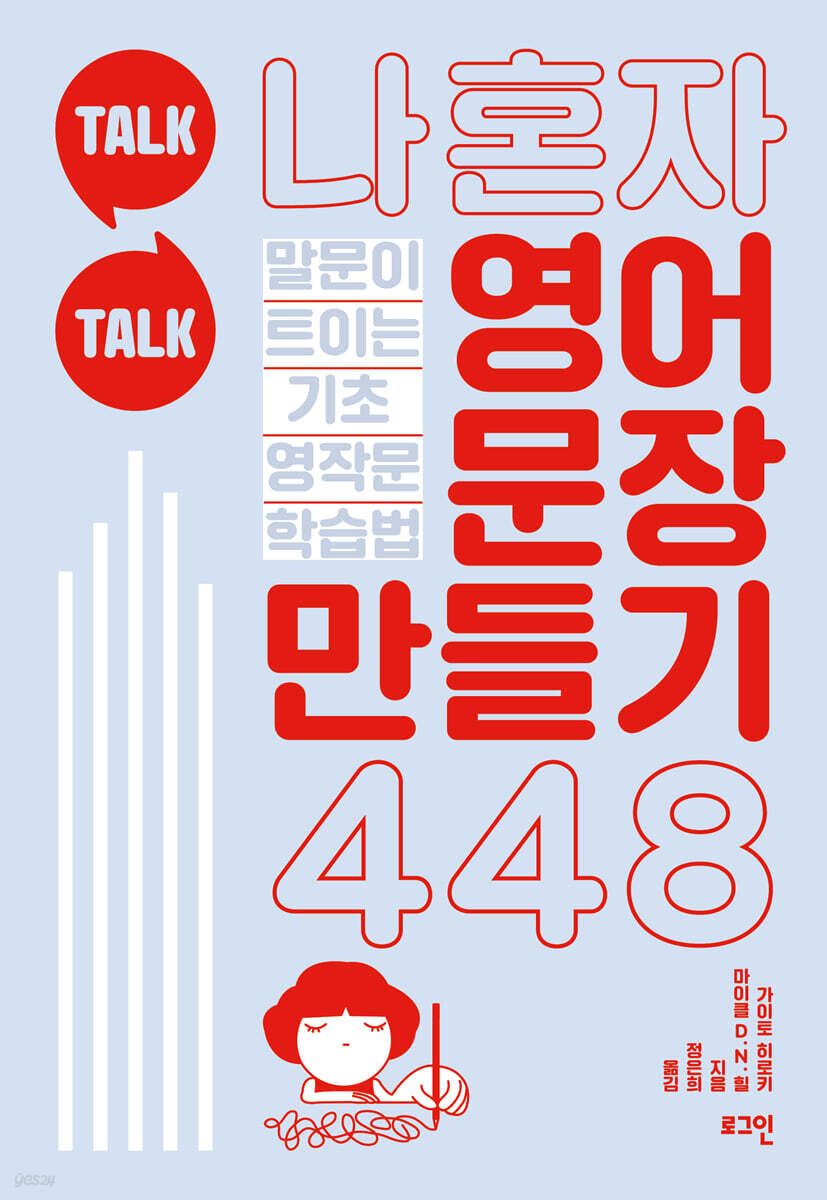
Talk Talk: Making English Sentences Alone 448
 |
Description
Book Introduction
“It’s a sentence we all know, but I can’t say it.”
The key is the power to change our own language into English.
Where should I start studying English?
When many people decide to study, their first goal is to be able to communicate fluently in English.
However, it is by no means easy to speak English fluently without hesitation.
There are many cases where people who have studied English consistently, have certifications, and have decent test scores become paralyzed and shut their mouths when they stand in front of a native speaker.
The cause is clear.
There is a lack of 'output' learning in English, that is, practice in 'writing' and 'speaking' to convert Korean into English.
This is also the biggest reason why studying English writing must come first in order to improve English conversation skills.
This book is designed to help you understand sentence structures with 64 basic English grammar points necessary for speaking English well, and to train you to convert Korean words that come to your mind into English more easily and quickly by repeatedly learning 448 frequently used sentences for each situation.
Because it goes through the most basic steps step by step, even those who are not confident in their English grammar can easily follow along.
The key is the power to change our own language into English.
Where should I start studying English?
When many people decide to study, their first goal is to be able to communicate fluently in English.
However, it is by no means easy to speak English fluently without hesitation.
There are many cases where people who have studied English consistently, have certifications, and have decent test scores become paralyzed and shut their mouths when they stand in front of a native speaker.
The cause is clear.
There is a lack of 'output' learning in English, that is, practice in 'writing' and 'speaking' to convert Korean into English.
This is also the biggest reason why studying English writing must come first in order to improve English conversation skills.
This book is designed to help you understand sentence structures with 64 basic English grammar points necessary for speaking English well, and to train you to convert Korean words that come to your mind into English more easily and quickly by repeatedly learning 448 frequently used sentences for each situation.
Because it goes through the most basic steps step by step, even those who are not confident in their English grammar can easily follow along.
- You can preview some of the book's contents.
Preview
index
preface
Purpose and Use of This Book
Chapter 1
Review basic English grammar
No.
1 · SV
No.
2 · SVC (verb to be)
No.
3 · SVC (regular verb)
No.
4 · SVO
No.
5 · SVOO
No.
6 · SVOC
No.
7 · There+be verb
No.
8 · this/that
No.
9 · these/those
No.
10 · Past tense
No.
11 · Present progressive tense
No.
12 · Past progressive tense
No.
13 · Present Perfect (Continued)
No.
14 · Present Perfect (Complete)
No.
15 · Present Perfect (Experience)
No.
16 · Present perfect progressive tense
No.
17 · be going to
No.
18 · will (will future)
No.
19 · will (simple future)
No.
20 · be verb + preposition
No.
21 · can
No.
22 · should
No.
23 · may
No.
24 · have to
No.
25 · would
No.
26 · Subject it
No.
27 · It indicates time, weather, and distance
No.
28 · Possessive
No.
29 · Auxiliary verbs expressing possibility or guess
No.
30 · Gerund
No.
31 · Do ~?
No.
32 · What is/are ~?
No.
33 · Interrogative word what
No.
34 · Interrogative pronoun when
No.
35 · Interrogative word where
No.
36 · Interrogative word which
No.
37 · Interrogative pronoun who
No.
38 · Interrogative pronoun whose
No.
39 · What time ~?
No.
40 · Interrogative + to-infinitive
No.
41 · Conjunctions
No.
42 · that clause
No.
43 · When clause
No.
44 · used to
No.
45 · Let's
No.
46 · Let me
No.
47 · Passive voice
No.
48 · Past participle modifier
No.
49 · how
No.
50 · How+adjective/adverb ~?
No.
51 · Command
No.
52 · to-infinitive (adverbial use)
No.
53 · to-infinitive (adjectival use)
No.
54 · to-infinitive (nominal use)
No.
55 · Indirect questions
No.
56 · Top-notch
No.
57 · Comparative
No.
58 · Nominative relative pronouns
No.
59 · Objective relative pronouns
No.
60 · Relative pronoun what
No.
61 · Relative adverbs
No.
62 · too ~ to …
No.
63 · so ~ that … 80
No.
64 · ~ enough to …
Coffee Break · Best Topics for Beginner Conversation Practice
Chapter 2
Conversation training based on situation
Talking about yourself
Talking about yourself · Self-introduction (1)
Talking about yourself · Self-introduction (2)
Talking about yourself · Self-introduction (3)
Talking about yourself · Hobbies (1)
Talking about yourself · Hobbies (2)
Talking about yourself · Hobbies (3)
Talking about yourself · Sports (1)
Talking about yourself · Sports (2)
Talking about yourself · Sports (3)
Talking About Yourself · Music (1)
Talking About Yourself · Music (2)
Talking About Yourself · Weekend Schedule (1)
Talking About Yourself · Weekend Schedule (2)
Talking About Yourself · Vacation Planning (1)
Talking About Yourself · Vacation Planning (2)
Talking about yourself · Description of the area (1)
Talking about yourself · Describing the area (2)
Talking About Yourself · Travel (1)
Talking About Yourself · Travel (2)
Talking about yourself · Goals (1)
Talking about yourself · Goals (2)
Daily conversation
Daily Conversation · First Encounter (1)
Daily Conversation · First Encounter (2)
Daily Conversation · Daily Expressions (1)
Daily Conversation · Daily Expressions (2)
Daily Conversation · Daily Expressions (3)
Daily Conversation · Useful Expressions
Daily conversation and shopping
Daily conversation and tourism
Daily Conversation · Finding Directions (1)
Daily Conversation · Finding Directions (2)
Daily Conversation · Finding Directions (3)
Daily Conversation · Finding Directions (4)
Daily Conversation · Meals (1)
Daily Conversation · Meals (2)
Daily Conversation · Meals (3)
Daily Conversation · Meals (4)
Work
Work/Business/Meeting (1)
Work/Business/Meeting (2)
Work/Business/Meeting (3)
Work/Business/Presentation (1)
Work/Business/Presentation (2)
Work/Business/Phone Calls (1)
Work/Business/Phone Calls (2)
Work/Task/Schedule Management (1)
Work/Task/Schedule Management (2)
Work/Business/Company Introduction (1)
Work/Business/Company Introduction (2)
Work/Work/Discussion (1)
Work/Work/Discussion (2)
Work/Tasks/Questions
Work/Business/Light Conversation (1)
Work/Business/Light Conversation (2)
Work/Business/Light Conversation (3)
Work, Business, Conversations with Colleagues and Bosses (1)
Work, Business, Conversations with Colleagues and Bosses (2)
Work, Business, Conversations with Colleagues and Bosses (3)
Work, Business, Conversations with Colleagues and Bosses (4)
Work, business, conversations with subordinates and juniors
Work, Business, Requests and Requests (1)
Work, Business, Requests and Requests (2)
Work/Business/Apology
Useful tips for problem situations
Useful tips for problem situations · When you can't hear what the other person is saying
Useful tips for problem situations · When you don't know what to say
Coffee Break · On the Importance of Output
INDEX
Special Thanks
Purpose and Use of This Book
Chapter 1
Review basic English grammar
No.
1 · SV
No.
2 · SVC (verb to be)
No.
3 · SVC (regular verb)
No.
4 · SVO
No.
5 · SVOO
No.
6 · SVOC
No.
7 · There+be verb
No.
8 · this/that
No.
9 · these/those
No.
10 · Past tense
No.
11 · Present progressive tense
No.
12 · Past progressive tense
No.
13 · Present Perfect (Continued)
No.
14 · Present Perfect (Complete)
No.
15 · Present Perfect (Experience)
No.
16 · Present perfect progressive tense
No.
17 · be going to
No.
18 · will (will future)
No.
19 · will (simple future)
No.
20 · be verb + preposition
No.
21 · can
No.
22 · should
No.
23 · may
No.
24 · have to
No.
25 · would
No.
26 · Subject it
No.
27 · It indicates time, weather, and distance
No.
28 · Possessive
No.
29 · Auxiliary verbs expressing possibility or guess
No.
30 · Gerund
No.
31 · Do ~?
No.
32 · What is/are ~?
No.
33 · Interrogative word what
No.
34 · Interrogative pronoun when
No.
35 · Interrogative word where
No.
36 · Interrogative word which
No.
37 · Interrogative pronoun who
No.
38 · Interrogative pronoun whose
No.
39 · What time ~?
No.
40 · Interrogative + to-infinitive
No.
41 · Conjunctions
No.
42 · that clause
No.
43 · When clause
No.
44 · used to
No.
45 · Let's
No.
46 · Let me
No.
47 · Passive voice
No.
48 · Past participle modifier
No.
49 · how
No.
50 · How+adjective/adverb ~?
No.
51 · Command
No.
52 · to-infinitive (adverbial use)
No.
53 · to-infinitive (adjectival use)
No.
54 · to-infinitive (nominal use)
No.
55 · Indirect questions
No.
56 · Top-notch
No.
57 · Comparative
No.
58 · Nominative relative pronouns
No.
59 · Objective relative pronouns
No.
60 · Relative pronoun what
No.
61 · Relative adverbs
No.
62 · too ~ to …
No.
63 · so ~ that … 80
No.
64 · ~ enough to …
Coffee Break · Best Topics for Beginner Conversation Practice
Chapter 2
Conversation training based on situation
Talking about yourself
Talking about yourself · Self-introduction (1)
Talking about yourself · Self-introduction (2)
Talking about yourself · Self-introduction (3)
Talking about yourself · Hobbies (1)
Talking about yourself · Hobbies (2)
Talking about yourself · Hobbies (3)
Talking about yourself · Sports (1)
Talking about yourself · Sports (2)
Talking about yourself · Sports (3)
Talking About Yourself · Music (1)
Talking About Yourself · Music (2)
Talking About Yourself · Weekend Schedule (1)
Talking About Yourself · Weekend Schedule (2)
Talking About Yourself · Vacation Planning (1)
Talking About Yourself · Vacation Planning (2)
Talking about yourself · Description of the area (1)
Talking about yourself · Describing the area (2)
Talking About Yourself · Travel (1)
Talking About Yourself · Travel (2)
Talking about yourself · Goals (1)
Talking about yourself · Goals (2)
Daily conversation
Daily Conversation · First Encounter (1)
Daily Conversation · First Encounter (2)
Daily Conversation · Daily Expressions (1)
Daily Conversation · Daily Expressions (2)
Daily Conversation · Daily Expressions (3)
Daily Conversation · Useful Expressions
Daily conversation and shopping
Daily conversation and tourism
Daily Conversation · Finding Directions (1)
Daily Conversation · Finding Directions (2)
Daily Conversation · Finding Directions (3)
Daily Conversation · Finding Directions (4)
Daily Conversation · Meals (1)
Daily Conversation · Meals (2)
Daily Conversation · Meals (3)
Daily Conversation · Meals (4)
Work
Work/Business/Meeting (1)
Work/Business/Meeting (2)
Work/Business/Meeting (3)
Work/Business/Presentation (1)
Work/Business/Presentation (2)
Work/Business/Phone Calls (1)
Work/Business/Phone Calls (2)
Work/Task/Schedule Management (1)
Work/Task/Schedule Management (2)
Work/Business/Company Introduction (1)
Work/Business/Company Introduction (2)
Work/Work/Discussion (1)
Work/Work/Discussion (2)
Work/Tasks/Questions
Work/Business/Light Conversation (1)
Work/Business/Light Conversation (2)
Work/Business/Light Conversation (3)
Work, Business, Conversations with Colleagues and Bosses (1)
Work, Business, Conversations with Colleagues and Bosses (2)
Work, Business, Conversations with Colleagues and Bosses (3)
Work, Business, Conversations with Colleagues and Bosses (4)
Work, business, conversations with subordinates and juniors
Work, Business, Requests and Requests (1)
Work, Business, Requests and Requests (2)
Work/Business/Apology
Useful tips for problem situations
Useful tips for problem situations · When you can't hear what the other person is saying
Useful tips for problem situations · When you don't know what to say
Coffee Break · On the Importance of Output
INDEX
Special Thanks
Detailed image

Publisher's Review
64 basic English grammar points and 448 frequently used examples
The easiest way to create English sentences from scratch
First, in Chapter 1, we will study 64 concisely organized grammar points and look at four example sentences for each grammar item.
The ultimate goal of this book is to improve your English conversation skills by training you to translate frequently used expressions into English, but this goal cannot be achieved simply by memorizing sentences.
The important thing is to learn the word order and the roles of grammatical elements that make up sentences, according to the basic grammatical forms.
Once you have mastered the basic structure of a sentence, you can later create as many new expressions as you want by changing words to fit that structure.
You need to lay a solid foundation in English, understanding the most basic sentence structures, so that you can speak complex sentences smoothly and without unnecessary details.
The grammar explained in this book is easy and simple.
Even if you don't fully understand 100% and only accept 50-70% of the material, it's not a problem at all.
Most of the examples in Chapter 1 reappear in Chapter 2, so if you study as the book guides, you will naturally review them over and over again.
After you memorize the entire example sentence and internalize it, and then look at the parts you didn't understand well again, you will have the experience of having the grammar that was difficult suddenly feel easy, as if it were a lie.
And the sentences you study in this way become completely your own and can be used more effectively in real life.
English that I clearly know, but just keeps on coming out of my mouth
When things don't work out, go back to basics!
Chapter 2 covers 64 situations, categorized into 'Talking about yourself', 'Daily conversation', 'Work/tasks', and 'Useful tips for problem situations', with a total of 448 examples.
It's not easy to instantly convert the Korean words that pop into your head into correct English, so we've carefully selected expressions frequently used in everyday life to ensure efficient learning.
If you master the sentences in this section, you will be able to naturally use English expressions that native speakers actually use in various fields.
If you repeatedly practice translating Korean into English, you will learn the same sentences multiple times, which can help you remember them for a longer time.
Let's assume we are living abroad now.
You will probably repeat phrases that are frequently used in daily life or at work several times a day.
And as days like that repeat, the number of sentences you memorize will naturally increase one by one.
Once you learn the sentence itself as an expression, sentences that you had to consciously write to say at first will start to come out of your mouth unconsciously.
It becomes possible to speak English without the intervention of one's native language.
The more you practice, the more sentences you can respond to immediately like this.
So, it is important not to be discouraged if you forget what you have learned, but to study consistently and continuously.
If you need to improve your English conversation skills right away, I recommend first identifying situations where you will find it useful and then focusing on training in areas where you can apply them immediately.
Key points of this book
1.
Basic English grammar that builds a solid foundation in English
In any field, you need to have the basics built up from the ground up to be able to apply them.
If you don't build a solid foundation, the more in-depth your studies become, the more difficult it will be.
『Talk Talk: Making English Sentences on My Own 448』 focuses on the core grammar points that form the backbone of English sentences, helping you build a solid foundation in English.
2.
Sentences carefully selected from expressions frequently used in each situation
There are countless words and phrases in the world, but only a few of them are frequently used in everyday life.
Therefore, what you focus on studying directly affects your effective English learning.
In this book, Hiroki Kaito, a lecturer and entrepreneur who has taught English conversation for over 20 years and developed educational programs, and Michael Hill, who majored in English and linguistics and has worked as an English teacher for over 12 years, have selected everyday sentences that native English speakers frequently use.
3.
Practical training to create English sentences on your own
Even if you already know something, it is quite difficult to use it to translate it into English.
However, according to Second Language Acquisition (SLA), simply thinking to yourself, "How would I say this in English?" can be a form of output practice.
Therefore, if you use this book smartly to learn the same sentences repeatedly, the time it takes to translate what you want to say into English will gradually decrease, and words will come to mind unconsciously, improving your English conversation skills.
Whether you're a beginner with only basic English knowledge or a skilled English learner who's been studying for a long time, if you're worried that your English skills are stalling and you're stuck in a rut, try developing the ability to construct sentences on your own through the learning methods suggested in this book.
The easiest way to create English sentences from scratch
First, in Chapter 1, we will study 64 concisely organized grammar points and look at four example sentences for each grammar item.
The ultimate goal of this book is to improve your English conversation skills by training you to translate frequently used expressions into English, but this goal cannot be achieved simply by memorizing sentences.
The important thing is to learn the word order and the roles of grammatical elements that make up sentences, according to the basic grammatical forms.
Once you have mastered the basic structure of a sentence, you can later create as many new expressions as you want by changing words to fit that structure.
You need to lay a solid foundation in English, understanding the most basic sentence structures, so that you can speak complex sentences smoothly and without unnecessary details.
The grammar explained in this book is easy and simple.
Even if you don't fully understand 100% and only accept 50-70% of the material, it's not a problem at all.
Most of the examples in Chapter 1 reappear in Chapter 2, so if you study as the book guides, you will naturally review them over and over again.
After you memorize the entire example sentence and internalize it, and then look at the parts you didn't understand well again, you will have the experience of having the grammar that was difficult suddenly feel easy, as if it were a lie.
And the sentences you study in this way become completely your own and can be used more effectively in real life.
English that I clearly know, but just keeps on coming out of my mouth
When things don't work out, go back to basics!
Chapter 2 covers 64 situations, categorized into 'Talking about yourself', 'Daily conversation', 'Work/tasks', and 'Useful tips for problem situations', with a total of 448 examples.
It's not easy to instantly convert the Korean words that pop into your head into correct English, so we've carefully selected expressions frequently used in everyday life to ensure efficient learning.
If you master the sentences in this section, you will be able to naturally use English expressions that native speakers actually use in various fields.
If you repeatedly practice translating Korean into English, you will learn the same sentences multiple times, which can help you remember them for a longer time.
Let's assume we are living abroad now.
You will probably repeat phrases that are frequently used in daily life or at work several times a day.
And as days like that repeat, the number of sentences you memorize will naturally increase one by one.
Once you learn the sentence itself as an expression, sentences that you had to consciously write to say at first will start to come out of your mouth unconsciously.
It becomes possible to speak English without the intervention of one's native language.
The more you practice, the more sentences you can respond to immediately like this.
So, it is important not to be discouraged if you forget what you have learned, but to study consistently and continuously.
If you need to improve your English conversation skills right away, I recommend first identifying situations where you will find it useful and then focusing on training in areas where you can apply them immediately.
Key points of this book
1.
Basic English grammar that builds a solid foundation in English
In any field, you need to have the basics built up from the ground up to be able to apply them.
If you don't build a solid foundation, the more in-depth your studies become, the more difficult it will be.
『Talk Talk: Making English Sentences on My Own 448』 focuses on the core grammar points that form the backbone of English sentences, helping you build a solid foundation in English.
2.
Sentences carefully selected from expressions frequently used in each situation
There are countless words and phrases in the world, but only a few of them are frequently used in everyday life.
Therefore, what you focus on studying directly affects your effective English learning.
In this book, Hiroki Kaito, a lecturer and entrepreneur who has taught English conversation for over 20 years and developed educational programs, and Michael Hill, who majored in English and linguistics and has worked as an English teacher for over 12 years, have selected everyday sentences that native English speakers frequently use.
3.
Practical training to create English sentences on your own
Even if you already know something, it is quite difficult to use it to translate it into English.
However, according to Second Language Acquisition (SLA), simply thinking to yourself, "How would I say this in English?" can be a form of output practice.
Therefore, if you use this book smartly to learn the same sentences repeatedly, the time it takes to translate what you want to say into English will gradually decrease, and words will come to mind unconsciously, improving your English conversation skills.
Whether you're a beginner with only basic English knowledge or a skilled English learner who's been studying for a long time, if you're worried that your English skills are stalling and you're stuck in a rut, try developing the ability to construct sentences on your own through the learning methods suggested in this book.
GOODS SPECIFICS
- Date of issue: March 18, 2025
- Page count, weight, size: 224 pages | 316g | 145*210*15mm
- ISBN13: 9791169518963
- ISBN10: 1169518966
You may also like
카테고리
korean


korean

![GQ KOREA Mark (Monthly): December [2025]](http://librairie.coreenne.fr/cdn/shop/files/8ef265dbbfbf186523ed75ba7319009d.jpg?v=1765340328&width=3840)


