

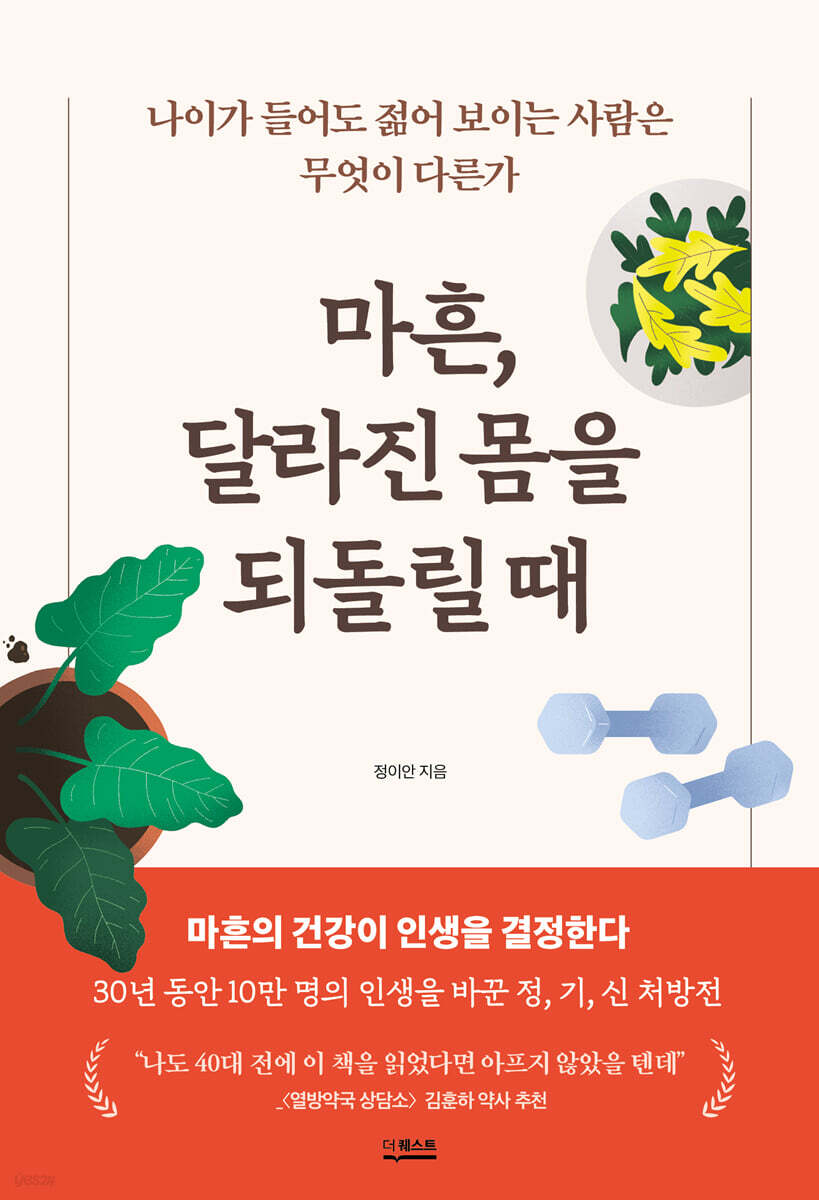
Forty, when the body changes again
 |
Description
Book Introduction
- A word from MD
- [Habits Beat Age] A book by Dr. Jeong Ian, who prescribes habits.
As we approach our forties, when the real aging begins, if our bodies are sending us signals that are different from before, we need to start working to turn our bodies around.
If you make an effort to stay healthy through exercise, diet, and lifestyle habits, your body won't get in the way of living the rest of your life the way you want.
- Hyunjae Ahn, PD of Health Hobby
If you have poor digestion and feel tired every day, unlike before
Now is the time to take care of your body differently
Habits conquer age.
As I get closer to forty, I find myself feeling more and more like my body is different from before.
Your feeling was not wrong.
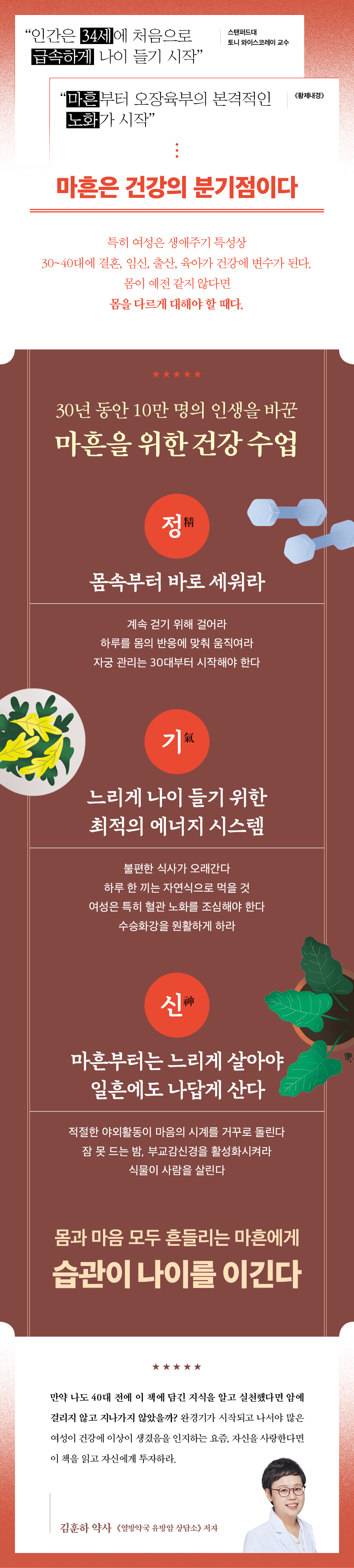
According to Stanford University neuroscientist Professor Tony Wiscorrey, people first begin to age rapidly at age 34.
In Oriental medicine, it is said that the full-scale aging of the five internal organs and six bowels begins from the age of forty.
At this time, the same management as in the past cannot prevent changes in the body.
Diet methods that worked until your 20s or early 30s no longer help you lose weight, and you can no longer digest the spicy foods you used to be able to eat, and you start to feel pain all over your body.
Unlike the past when you could stay up late and still feel energized the next day with a cup of coffee, there are days when you can't shake off the fatigue even after drinking three or four cups of coffee in a row.
If you are unable to reverse the changes in your body at this time, you will not only look older, but you will also suffer from various chronic pains and diseases.
Dr. Jeong-i Ahn, a Korean medicine doctor who has met with over 100,000 people over 30 years, from successful businessmen to ordinary housewives, realized that no matter how much money a patient has, if they do not realize the importance of health and do not make an effort, it is difficult for them to recover from illness.
In particular, women, who face numerous variables in life such as marriage, pregnancy, and childbirth due to the nature of the life cycle, are having a difficult time in the latter half of their lives if they do not develop the habit of taking care of themselves.
If your body is sending you different signals than before, such as feeling out of breath when climbing stairs or having trouble digesting flour or spicy foods, start working to get your body back on track.
Even if you're over 40, if you make an effort to maintain healthy lifestyle habits, your body won't get in the way of living the rest of your life the way you want.
Effort never betrays the body.
Now is the time to take care of your body differently
Habits conquer age.
As I get closer to forty, I find myself feeling more and more like my body is different from before.
Your feeling was not wrong.
According to Stanford University neuroscientist Professor Tony Wiscorrey, people first begin to age rapidly at age 34.
In Oriental medicine, it is said that the full-scale aging of the five internal organs and six bowels begins from the age of forty.
At this time, the same management as in the past cannot prevent changes in the body.
Diet methods that worked until your 20s or early 30s no longer help you lose weight, and you can no longer digest the spicy foods you used to be able to eat, and you start to feel pain all over your body.
Unlike the past when you could stay up late and still feel energized the next day with a cup of coffee, there are days when you can't shake off the fatigue even after drinking three or four cups of coffee in a row.
If you are unable to reverse the changes in your body at this time, you will not only look older, but you will also suffer from various chronic pains and diseases.
Dr. Jeong-i Ahn, a Korean medicine doctor who has met with over 100,000 people over 30 years, from successful businessmen to ordinary housewives, realized that no matter how much money a patient has, if they do not realize the importance of health and do not make an effort, it is difficult for them to recover from illness.
In particular, women, who face numerous variables in life such as marriage, pregnancy, and childbirth due to the nature of the life cycle, are having a difficult time in the latter half of their lives if they do not develop the habit of taking care of themselves.
If your body is sending you different signals than before, such as feeling out of breath when climbing stairs or having trouble digesting flour or spicy foods, start working to get your body back on track.
Even if you're over 40, if you make an effort to maintain healthy lifestyle habits, your body won't get in the way of living the rest of your life the way you want.
Effort never betrays the body.
- You can preview some of the book's contents.
Preview
index
Introduction: What Makes People Look Younger Even As They Age?
Getting Old Isn't About Getting Sick | Your Health at Forty Determines Your Life | A Health Class from a Korean Medicine Doctor Who Prescribes Habits
1.
Forty: Health Principles for Improving Your Quality of Life
1.
The moment you feel your body has changed from before
What signals does your body send when it's changed from before? Fundamental efforts to restore your body.
2.
Take care of your health at forty, a turning point
Women in the Health Blind Spot | The Rate of Aging in Women Is Determined Before Forty | Life Continues After Menopause | What to Prioritize Over Supplements
3.
3 Principles for Reversing a Changed Body
Eat less, move more, and maintain a healthy body temperature.
4.
New Health Habits in the Age of Climate Crisis
How Harmful Is It to the Human Body? The More Discomfort We Experience, the Healthier We Become
Protect Yourself with Spring Vegetables: A Seasonal Table for Health
2.
Jeong _ Set your body straight from the inside out
5.
The Real Cause of Pain as You Age
Depression 58 | Recovering your body and mind
6.
Aging in the stomach that occurs without you knowing
Uterine Fibroids Are a Part of Aging | Managing Your Uterine Tissue Makes a Crucial Difference in Your Life
7.
The answer is revealed in everyday life.
A Day with Your Body's Reactions | Sunshine is Heaven's Medicine | Harness the Power of Nature
8.
What kind of exercise do people in their forties need?
Slow Muscle Loss | Walk to Keep Walking | Changes That Happen the Moment You Step Barefoot on the Soil
Seasonal Foods for Health: Seasonal Ingredients to Beat the Summer Heat
3.
Qi_The optimal energy system for slow aging
9.
Cold air goes up, hot air goes down
People with a malfunctioning thermal energy system | Symptoms that are difficult to diagnose, what are the causes? | Promote smooth sublimation.
10.
An uncomfortable meal lasts a long time
Developing the habit of moderating sweets|Modern new food for the mind|People who don't eat what they really need|What and how to eat|One meal a day is natural food
11.
Pay attention to your blood vessels, the pathways of energy circulation.
Women Should Be Careful About Vascular Aging | What You Eat Is the Most Important Thing | Foods That Slow Vascular Aging
12.
Before the illness of the mind destroys the body
Family-Created Mental Illnesses|Understanding the Cause is the Beginning of Treatment
Seasonal Food for Health: Protect Your Health During the Fall Seasonal Transition with Root Vegetables
4.
God_Slowly from forty, still true to myself at seventy
13.
The habit of turning back the clock of the mind
Alzheimer's Disease: Lifestyle Matters | Two Benefits of Appropriate Outdoor Activities | The Multifaceted Effects of Meditation
14.
You have to live slowly from the age of forty.
Sleepless nights, your tension remains unsettled | Slow habits that activate the parasympathetic nervous system | Plants save lives
15.
Look back at yourself at a turning point in life.
Forty, My Time of Shakenness|Now is the Time to Prepare for the Second Half of Life
Seasonal meals for health: To maintain immunity even during the harsh winter cold wave
Getting Old Isn't About Getting Sick | Your Health at Forty Determines Your Life | A Health Class from a Korean Medicine Doctor Who Prescribes Habits
1.
Forty: Health Principles for Improving Your Quality of Life
1.
The moment you feel your body has changed from before
What signals does your body send when it's changed from before? Fundamental efforts to restore your body.
2.
Take care of your health at forty, a turning point
Women in the Health Blind Spot | The Rate of Aging in Women Is Determined Before Forty | Life Continues After Menopause | What to Prioritize Over Supplements
3.
3 Principles for Reversing a Changed Body
Eat less, move more, and maintain a healthy body temperature.
4.
New Health Habits in the Age of Climate Crisis
How Harmful Is It to the Human Body? The More Discomfort We Experience, the Healthier We Become
Protect Yourself with Spring Vegetables: A Seasonal Table for Health
2.
Jeong _ Set your body straight from the inside out
5.
The Real Cause of Pain as You Age
Depression 58 | Recovering your body and mind
6.
Aging in the stomach that occurs without you knowing
Uterine Fibroids Are a Part of Aging | Managing Your Uterine Tissue Makes a Crucial Difference in Your Life
7.
The answer is revealed in everyday life.
A Day with Your Body's Reactions | Sunshine is Heaven's Medicine | Harness the Power of Nature
8.
What kind of exercise do people in their forties need?
Slow Muscle Loss | Walk to Keep Walking | Changes That Happen the Moment You Step Barefoot on the Soil
Seasonal Foods for Health: Seasonal Ingredients to Beat the Summer Heat
3.
Qi_The optimal energy system for slow aging
9.
Cold air goes up, hot air goes down
People with a malfunctioning thermal energy system | Symptoms that are difficult to diagnose, what are the causes? | Promote smooth sublimation.
10.
An uncomfortable meal lasts a long time
Developing the habit of moderating sweets|Modern new food for the mind|People who don't eat what they really need|What and how to eat|One meal a day is natural food
11.
Pay attention to your blood vessels, the pathways of energy circulation.
Women Should Be Careful About Vascular Aging | What You Eat Is the Most Important Thing | Foods That Slow Vascular Aging
12.
Before the illness of the mind destroys the body
Family-Created Mental Illnesses|Understanding the Cause is the Beginning of Treatment
Seasonal Food for Health: Protect Your Health During the Fall Seasonal Transition with Root Vegetables
4.
God_Slowly from forty, still true to myself at seventy
13.
The habit of turning back the clock of the mind
Alzheimer's Disease: Lifestyle Matters | Two Benefits of Appropriate Outdoor Activities | The Multifaceted Effects of Meditation
14.
You have to live slowly from the age of forty.
Sleepless nights, your tension remains unsettled | Slow habits that activate the parasympathetic nervous system | Plants save lives
15.
Look back at yourself at a turning point in life.
Forty, My Time of Shakenness|Now is the Time to Prepare for the Second Half of Life
Seasonal meals for health: To maintain immunity even during the harsh winter cold wave
Detailed image
Into the book
Most people who come to me say that they didn't realize the importance of health when they were young, but as they got older, health problems arose and their quality of life declined, making life very difficult.
It's a cliché to say that health determines quality of life, but nothing is more true.
If we want to spend the second half of our lives without regrets, rather than the second half with regrets, we must turn back the clock on our changed bodies now.
Now is the best time to take care of your health.
--- From "Entering, What's Different About People Who Look Young Even As They Age"
In Oriental medicine, the water, mucus, nutrients, and immune substances in the body are called 'Jin-Aek'.
It is said that as the body loses moisture due to aging, the mucus that stays in the cells decreases, causing the body to become dry and wrinkled.
Depletion of body fluids is a major factor that accelerates biological aging.
When the balance of essence, energy, and spirit is disrupted, the rate at which body fluids are depleted increases.
--- p.1 From “The moment you feel your body has changed from before”
It's not much different for single women or women living alone.
Most people are exhausted from their busy work lives, and even on their days off, they spend a lot of time lying around, constantly exposed to stimuli like YouTube and OTT. The WHO recommends at least 150 minutes of moderate-intensity physical activity or 75 minutes of vigorous-intensity physical activity per week for adults, but as of 2021, only 47.9 percent of Koreans are doing so.
This figure stands in stark contrast to the global average of 72 percent.
--- p.2 From “The turning point of health, take care of your forties”
While we might be reassured that ingesting microplastics poses no risk, the seriousness of the research findings reported so far from around the world is worrisome.
First, microplastics contain environmental hormones and harmful substances such as bisphenol A and phthalates.
These substances cause various hormonal disorders and adversely affect the development of reproductive organs.
In fact, the reason why various diseases caused by autonomic nervous system disorders have increased significantly over the past 10 to 20 years is likely related to environmental issues.
--- p.4 From “New Health Habits in the Climate Crisis Era”
In winter, there aren't many fruits, so it's easy to become deficient in vitamins, and when spring comes and it gets warmer, the body can't adapt quickly, so spring fever occurs.
In times like these, you can quickly overcome spring fever by supplementing your vitamins with spring vegetables that are rich in vitamins.
Sweet potatoes are rich in various vitamins, including vitamins A, B1, and C, which help prevent spring fever.
--- From "A seasonal meal for health, protect your body with spring vegetables"
From a traditional Korean medicine perspective, to delay aging, you should exercise as follows:
First, you need to move your whole body at the same time.
If there is a problem with blood circulation or lymphatic circulation, you become vulnerable not only to aging but also to metabolic diseases.
Second, low-intensity exercise that can be done for a long time is good.
Third, your muscle strength must improve.
The exercise that satisfies all of these conditions is ‘walking.’
--- p.8 From “What kind of exercise do people in their forties need?”
To restore a broken thermal energy system, the treatment is based on the basic principle of sublimation: lowering the heat that has risen to the upper limit and raising the cold that has sunk to the lower limit.
You also need to manage your overall lifestyle.
In particular, cold and hot water baths for the feet are a simple yet very effective method.
Alternating between immersing your hands and feet in hot and cold water five times for about three minutes each time, and stimulating your hands and feet alternately with hot and cold water, can help promote blood circulation and metabolic function.
If you have cold all over your body, you should alternate between cold and hot water, starting and ending with cold water.
--- p.9 From “Cold air goes up, hot air goes down”
A natural diet doesn't just mean a vegetarian diet.
It means consuming grains or plants as they grow.
When you consume grains and plants in their raw form, you avoid losing any of their nutrients and instead consume the phytochemicals they contain – the plant chemicals that plants produce to protect themselves from threats.
For example, eating brown rice that has been lightly polished and cooked with minimal processing is a natural diet.
It is natural to eat vegetables and fruits with the skin if possible.
--- p.10 From “Uncomfortable Meals Last a Long Time”
Long-term vitamin D deficiency also increases the risk of Alzheimer's disease.
Vitamin D helps you sleep well by inducing the secretion of melatonin, a sleep hormone, in the brain.
It also prevents the buildup of amyloid beta and tau proteins, which cause neurodegeneration in the brain.
Vitamin D levels in the body are normal at 30 nanograms per milliliter or more, but the average vitamin D level in South Korea is 16.1 nanograms per milliliter, which is a dangerous level.
--- p.13 From “The Habit of Turning Back the Clock of the Mind”
In modern society, where we live in a constant state of tension, there are many cases where the sympathetic nervous system becomes overactive due to excessive stress, causing problems in the body and mind.
In particular, to get a good night's sleep, you need to fundamentally activate the parasympathetic nervous system, and to do this, you need to first cleanse your emotions.
When you are stressed, cortisol is secreted directly from the adrenal cortex, causing you to feel emotions such as worry, anxiety, nervousness, and anger.
Unresolved emotional residue that remains unconsciously stimulates the sympathetic nerves and causes illness.
--- p.14 From “You Must Live Slowly After Forty”
You've probably heard of the neurotransmitter receptor called gamma-aminobutyric acid (GABA), which calms nerve activity. GABA promotes brain metabolism, helping to enhance concentration and memory, and prevents stress signals like anxiety, depression, and anger from reaching the brain.
When symptoms persist due to increased sympathetic nervous system activity and prolonged brain arousal, resulting in poor sleep quality, eating foods containing GABA can increase energy and vitality, alleviate tension and anxiety, and improve sleep quality. GABA is abundant in brown rice (with the germ still intact), soybean paste, kimchi, potatoes, eggplant, and pumpkin.
It's a cliché to say that health determines quality of life, but nothing is more true.
If we want to spend the second half of our lives without regrets, rather than the second half with regrets, we must turn back the clock on our changed bodies now.
Now is the best time to take care of your health.
--- From "Entering, What's Different About People Who Look Young Even As They Age"
In Oriental medicine, the water, mucus, nutrients, and immune substances in the body are called 'Jin-Aek'.
It is said that as the body loses moisture due to aging, the mucus that stays in the cells decreases, causing the body to become dry and wrinkled.
Depletion of body fluids is a major factor that accelerates biological aging.
When the balance of essence, energy, and spirit is disrupted, the rate at which body fluids are depleted increases.
--- p.1 From “The moment you feel your body has changed from before”
It's not much different for single women or women living alone.
Most people are exhausted from their busy work lives, and even on their days off, they spend a lot of time lying around, constantly exposed to stimuli like YouTube and OTT. The WHO recommends at least 150 minutes of moderate-intensity physical activity or 75 minutes of vigorous-intensity physical activity per week for adults, but as of 2021, only 47.9 percent of Koreans are doing so.
This figure stands in stark contrast to the global average of 72 percent.
--- p.2 From “The turning point of health, take care of your forties”
While we might be reassured that ingesting microplastics poses no risk, the seriousness of the research findings reported so far from around the world is worrisome.
First, microplastics contain environmental hormones and harmful substances such as bisphenol A and phthalates.
These substances cause various hormonal disorders and adversely affect the development of reproductive organs.
In fact, the reason why various diseases caused by autonomic nervous system disorders have increased significantly over the past 10 to 20 years is likely related to environmental issues.
--- p.4 From “New Health Habits in the Climate Crisis Era”
In winter, there aren't many fruits, so it's easy to become deficient in vitamins, and when spring comes and it gets warmer, the body can't adapt quickly, so spring fever occurs.
In times like these, you can quickly overcome spring fever by supplementing your vitamins with spring vegetables that are rich in vitamins.
Sweet potatoes are rich in various vitamins, including vitamins A, B1, and C, which help prevent spring fever.
--- From "A seasonal meal for health, protect your body with spring vegetables"
From a traditional Korean medicine perspective, to delay aging, you should exercise as follows:
First, you need to move your whole body at the same time.
If there is a problem with blood circulation or lymphatic circulation, you become vulnerable not only to aging but also to metabolic diseases.
Second, low-intensity exercise that can be done for a long time is good.
Third, your muscle strength must improve.
The exercise that satisfies all of these conditions is ‘walking.’
--- p.8 From “What kind of exercise do people in their forties need?”
To restore a broken thermal energy system, the treatment is based on the basic principle of sublimation: lowering the heat that has risen to the upper limit and raising the cold that has sunk to the lower limit.
You also need to manage your overall lifestyle.
In particular, cold and hot water baths for the feet are a simple yet very effective method.
Alternating between immersing your hands and feet in hot and cold water five times for about three minutes each time, and stimulating your hands and feet alternately with hot and cold water, can help promote blood circulation and metabolic function.
If you have cold all over your body, you should alternate between cold and hot water, starting and ending with cold water.
--- p.9 From “Cold air goes up, hot air goes down”
A natural diet doesn't just mean a vegetarian diet.
It means consuming grains or plants as they grow.
When you consume grains and plants in their raw form, you avoid losing any of their nutrients and instead consume the phytochemicals they contain – the plant chemicals that plants produce to protect themselves from threats.
For example, eating brown rice that has been lightly polished and cooked with minimal processing is a natural diet.
It is natural to eat vegetables and fruits with the skin if possible.
--- p.10 From “Uncomfortable Meals Last a Long Time”
Long-term vitamin D deficiency also increases the risk of Alzheimer's disease.
Vitamin D helps you sleep well by inducing the secretion of melatonin, a sleep hormone, in the brain.
It also prevents the buildup of amyloid beta and tau proteins, which cause neurodegeneration in the brain.
Vitamin D levels in the body are normal at 30 nanograms per milliliter or more, but the average vitamin D level in South Korea is 16.1 nanograms per milliliter, which is a dangerous level.
--- p.13 From “The Habit of Turning Back the Clock of the Mind”
In modern society, where we live in a constant state of tension, there are many cases where the sympathetic nervous system becomes overactive due to excessive stress, causing problems in the body and mind.
In particular, to get a good night's sleep, you need to fundamentally activate the parasympathetic nervous system, and to do this, you need to first cleanse your emotions.
When you are stressed, cortisol is secreted directly from the adrenal cortex, causing you to feel emotions such as worry, anxiety, nervousness, and anger.
Unresolved emotional residue that remains unconsciously stimulates the sympathetic nerves and causes illness.
--- p.14 From “You Must Live Slowly After Forty”
You've probably heard of the neurotransmitter receptor called gamma-aminobutyric acid (GABA), which calms nerve activity. GABA promotes brain metabolism, helping to enhance concentration and memory, and prevents stress signals like anxiety, depression, and anger from reaching the brain.
When symptoms persist due to increased sympathetic nervous system activity and prolonged brain arousal, resulting in poor sleep quality, eating foods containing GABA can increase energy and vitality, alleviate tension and anxiety, and improve sleep quality. GABA is abundant in brown rice (with the germ still intact), soybean paste, kimchi, potatoes, eggplant, and pumpkin.
--- p.15 From “Looking Back at Myself at a Turning Point in Life”
Publisher's Review
If you have poor digestion and feel tired every day, unlike before
Now is the time to take care of your body differently
Habit conquers age
As I get closer to forty, I find myself feeling more and more like my body is different from before.
Your feeling was not wrong.
According to Stanford University neuroscientist Professor Tony Wiscorrey, people first begin to age rapidly at age 34.
In Oriental medicine, it is said that the full-scale aging of the five internal organs and six bowels begins from the age of forty.
At this time, the same management as in the past cannot prevent changes in the body.
Diet methods that worked until your 20s or early 30s no longer help you lose weight, and you can no longer digest the spicy foods you used to be able to eat, and you start to feel pain all over your body.
Unlike the past when you could stay up late and still feel energized the next day with a cup of coffee, there are days when you can't shake off the fatigue even after drinking three or four cups of coffee in a row.
If you are unable to reverse the changes in your body at this time, you will not only look older, but you will also suffer from various chronic pains and diseases.
Dr. Jeong-i Ahn, a Korean medicine doctor who has met with over 100,000 people over 30 years, from successful businessmen to ordinary housewives, realized that no matter how much money a patient has, if they do not realize the importance of health and do not make an effort, it is difficult for them to recover from illness.
In particular, women, who face numerous variables in life such as marriage, pregnancy, and childbirth due to the nature of the life cycle, are having a difficult time in the latter half of their lives if they do not develop the habit of taking care of themselves.
If your body is sending you different signals than before, such as feeling out of breath when climbing stairs or having trouble digesting flour or spicy foods, start working to get your body back on track.
Even if you're over 40, if you make an effort to maintain healthy lifestyle habits, your body won't get in the way of living the rest of your life the way you want.
Effort never betrays the body.
The first period of rapid aging, unlike before, is at age '34'
Get your changed body back
“Your health at forty determines your life.”
Stanford University neuroscientist Professor Tony Wiskoley said that people age rapidly at ages 34, 60, and 78, based on the age of 80.
At the first stage, at age 34, the level of proteins related to aging suddenly increases, and proteins that are associated with weight gain and metabolic diseases such as diabetes, high blood pressure, and hyperlipidemia are expressed in large numbers.
This is evidenced by the fact that both men and women lose muscle mass and digestive power as they approach their forties.
Especially for women, the 30s are a time when marriage, pregnancy, and childbirth become variables in their health due to the nature of the life cycle.
This, coupled with the physical and mental changes that come with decreased hormone secretion, leads to a decline in immunity and psychological decline.
Forty is a turning point in health.
Vascular aging, osteoporosis, and cancer
Women are more shaken by the changes of their forties.
Contrary to popular belief, many women only begin to notice health problems after menopause begins, the transition to menopause actually begins much earlier.
The average woman goes through a transition period of five years, during which time her female hormone secretion decreases, exposing her to the risk of various diseases.
Women's risk of developing cardiovascular disease increases, especially with osteoporosis, which is known to occur with menopause.
According to an 18-year follow-up study conducted by the Korea Disease Control and Prevention Agency's National Institute of Health on 1,436 men and women aged 40 or older, women's blood lipid concentrations were found to be high even before menopause.
Blood lipid concentration refers to the concentration of cholesterol or triglycerides in the blood, and if this concentration is high, the risk of developing cardiovascular disease increases.
The age of forty, when menopause begins, is a turning point in life.
As life's unexpected variables such as children becoming independent, one's position at work, and changes in marital relationships arise, many changes occur not only in the body but also in the mind in the age of forty. During this time, stress builds up over a long period of time, and when the person becomes mentally and physically weak and can no longer suppress it, illness appears.
Illness is not simply a disease of the mind.
It not only causes chest tightness, but also causes physical pain such as hyperventilation, insomnia, high blood pressure, indigestion, numbness, and chronic pain of unknown cause.
Just as a daughter shares the same illness as her mother, a woman's health is directly linked to the health of the family community.
Changed 100,000 lives in 30 years!
A health class for those in their forties that will help you get back on track from the inside out.
There are people who don't get sick even as they get older.
The hospital run by Dr. Jeong Ian, author of "Forty, When Your Body Changes Back," is often visited by patients in their 60s and 70s who are in excellent health. These patients usually quickly resolve the reasons for their visit and recover their health faster than other patients.
What is the difference between people who live a healthy second half of their lives and those who suffer from chronic fatigue, digestive problems, etc. starting in their 20s and 30s?
Dr. Jeong Ian, who has been running a hospital for 30 years, found the answer in ‘healthy habits.’
No matter how expensive the herbal medicine and the best acupuncture are, if healthy habits are not the foundation, the body cannot recover.
This book covers the basic habits to get your body back on track after turning 40.
It focuses on how to move your body as it changes in your forties, what to eat to adjust to the decreasing hormone secretion, how to relieve brain fatigue, and how to deal with mental illnesses that can occur in your forties.
We think that we get sick as we get older, but that is a mistake.
As we age, we become less active and fail to correct the inertia formed by bad eating habits.
So, whenever Dr. Jeong Ian meets a patient, there is a question he asks first.
“What do you usually eat?” Now is the time to turn your life around.
The days we have to live healthily are getting longer.
Now is the time to take care of your body differently
Habit conquers age
As I get closer to forty, I find myself feeling more and more like my body is different from before.
Your feeling was not wrong.
According to Stanford University neuroscientist Professor Tony Wiscorrey, people first begin to age rapidly at age 34.
In Oriental medicine, it is said that the full-scale aging of the five internal organs and six bowels begins from the age of forty.
At this time, the same management as in the past cannot prevent changes in the body.
Diet methods that worked until your 20s or early 30s no longer help you lose weight, and you can no longer digest the spicy foods you used to be able to eat, and you start to feel pain all over your body.
Unlike the past when you could stay up late and still feel energized the next day with a cup of coffee, there are days when you can't shake off the fatigue even after drinking three or four cups of coffee in a row.
If you are unable to reverse the changes in your body at this time, you will not only look older, but you will also suffer from various chronic pains and diseases.
Dr. Jeong-i Ahn, a Korean medicine doctor who has met with over 100,000 people over 30 years, from successful businessmen to ordinary housewives, realized that no matter how much money a patient has, if they do not realize the importance of health and do not make an effort, it is difficult for them to recover from illness.
In particular, women, who face numerous variables in life such as marriage, pregnancy, and childbirth due to the nature of the life cycle, are having a difficult time in the latter half of their lives if they do not develop the habit of taking care of themselves.
If your body is sending you different signals than before, such as feeling out of breath when climbing stairs or having trouble digesting flour or spicy foods, start working to get your body back on track.
Even if you're over 40, if you make an effort to maintain healthy lifestyle habits, your body won't get in the way of living the rest of your life the way you want.
Effort never betrays the body.
The first period of rapid aging, unlike before, is at age '34'
Get your changed body back
“Your health at forty determines your life.”
Stanford University neuroscientist Professor Tony Wiskoley said that people age rapidly at ages 34, 60, and 78, based on the age of 80.
At the first stage, at age 34, the level of proteins related to aging suddenly increases, and proteins that are associated with weight gain and metabolic diseases such as diabetes, high blood pressure, and hyperlipidemia are expressed in large numbers.
This is evidenced by the fact that both men and women lose muscle mass and digestive power as they approach their forties.
Especially for women, the 30s are a time when marriage, pregnancy, and childbirth become variables in their health due to the nature of the life cycle.
This, coupled with the physical and mental changes that come with decreased hormone secretion, leads to a decline in immunity and psychological decline.
Forty is a turning point in health.
Vascular aging, osteoporosis, and cancer
Women are more shaken by the changes of their forties.
Contrary to popular belief, many women only begin to notice health problems after menopause begins, the transition to menopause actually begins much earlier.
The average woman goes through a transition period of five years, during which time her female hormone secretion decreases, exposing her to the risk of various diseases.
Women's risk of developing cardiovascular disease increases, especially with osteoporosis, which is known to occur with menopause.
According to an 18-year follow-up study conducted by the Korea Disease Control and Prevention Agency's National Institute of Health on 1,436 men and women aged 40 or older, women's blood lipid concentrations were found to be high even before menopause.
Blood lipid concentration refers to the concentration of cholesterol or triglycerides in the blood, and if this concentration is high, the risk of developing cardiovascular disease increases.
The age of forty, when menopause begins, is a turning point in life.
As life's unexpected variables such as children becoming independent, one's position at work, and changes in marital relationships arise, many changes occur not only in the body but also in the mind in the age of forty. During this time, stress builds up over a long period of time, and when the person becomes mentally and physically weak and can no longer suppress it, illness appears.
Illness is not simply a disease of the mind.
It not only causes chest tightness, but also causes physical pain such as hyperventilation, insomnia, high blood pressure, indigestion, numbness, and chronic pain of unknown cause.
Just as a daughter shares the same illness as her mother, a woman's health is directly linked to the health of the family community.
Changed 100,000 lives in 30 years!
A health class for those in their forties that will help you get back on track from the inside out.
There are people who don't get sick even as they get older.
The hospital run by Dr. Jeong Ian, author of "Forty, When Your Body Changes Back," is often visited by patients in their 60s and 70s who are in excellent health. These patients usually quickly resolve the reasons for their visit and recover their health faster than other patients.
What is the difference between people who live a healthy second half of their lives and those who suffer from chronic fatigue, digestive problems, etc. starting in their 20s and 30s?
Dr. Jeong Ian, who has been running a hospital for 30 years, found the answer in ‘healthy habits.’
No matter how expensive the herbal medicine and the best acupuncture are, if healthy habits are not the foundation, the body cannot recover.
This book covers the basic habits to get your body back on track after turning 40.
It focuses on how to move your body as it changes in your forties, what to eat to adjust to the decreasing hormone secretion, how to relieve brain fatigue, and how to deal with mental illnesses that can occur in your forties.
We think that we get sick as we get older, but that is a mistake.
As we age, we become less active and fail to correct the inertia formed by bad eating habits.
So, whenever Dr. Jeong Ian meets a patient, there is a question he asks first.
“What do you usually eat?” Now is the time to turn your life around.
The days we have to live healthily are getting longer.
GOODS SPECIFICS
- Date of issue: April 30, 2024
- Page count, weight, size: 208 pages | 274g | 140*205*13mm
- ISBN13: 9791140709243
You may also like
카테고리
korean


korean

![ELLE 엘르 스페셜 에디션 A형 : 12월 [2025]](http://librairie.coreenne.fr/cdn/shop/files/b8e27a3de6c9538896439686c6b0e8fb.jpg?v=1766436872&width=3840)


