

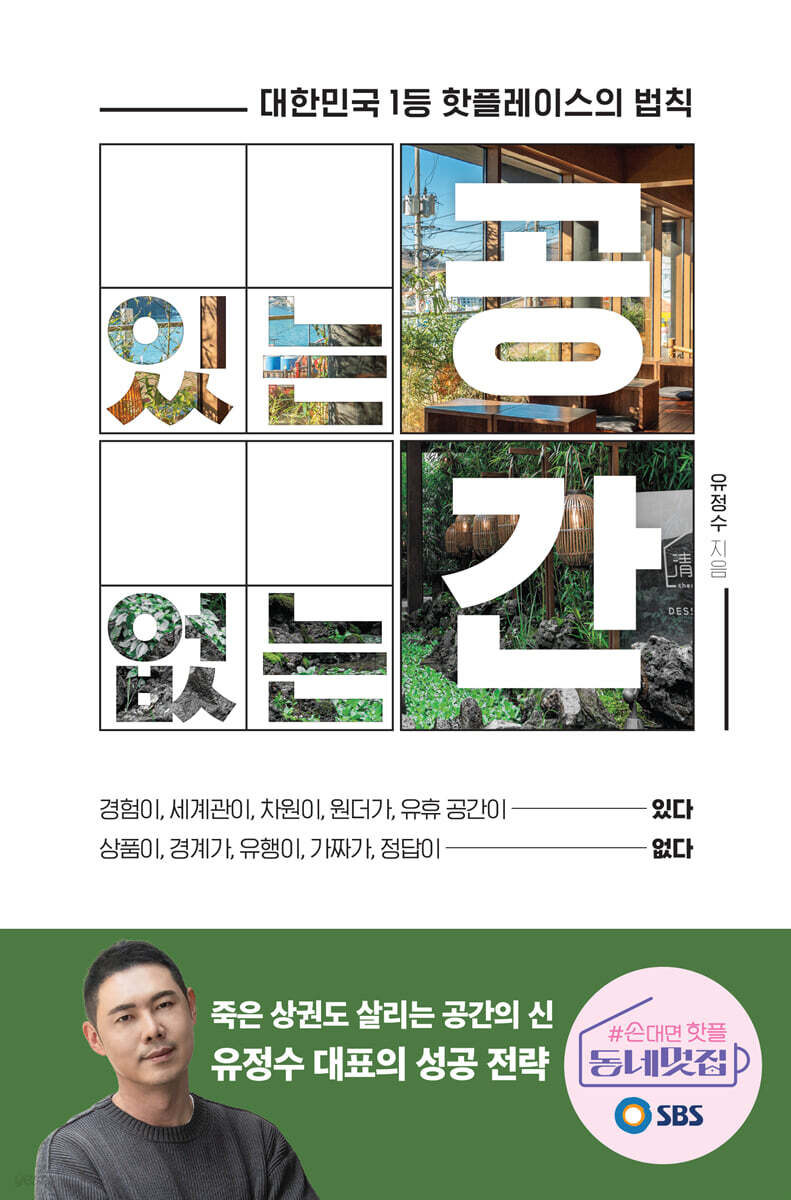
Space that exists, space that does not exist
 |
Description
Book Introduction
- A word from MD
-
Space strategy to surviveIt contains the know-how of Glow Seoul CEO Yoo Jeong-su, who breathes life into aging city centers and commercial districts with unique stores and creates new hot places.
It reveals the secrets of trend-setting spaces and the secrets to success through six strategies, including the 6:4 rule that emphasizes the importance of idle space.
June 13, 2023. Economics and Management PD Kim Sang-geun
Spaces that chase trends fail.
Only spaces that create trends will survive.
Will it disappear or will it survive?
* Appeared on Channel A's [The Rich Man], SBS's [Hands-On Hot Place! Neighborhood Cool House], and MBC's [Let's Live in an Empty House 3] *
* The 'Hand of Midas' that revives even dead businesses, Korea's best 'hot place maker' *
* 30 billion won in annual sales? 50 brands: Success strategies revealed by the heroes of the myth *
This is truly the era of 'hot places'.
On holidays, people flock to the 'hot spots'.
I don't mind waiting for hours.
The fact that 'many people go there' spreads through word of mouth, bringing in more people.
If it becomes a hot place, it will succeed, and if it doesn't become a hot place, it will disappear.
With online shopping dominating the distribution market and trends changing daily, stores that offer "good value for money and reasonable prices" can no longer survive.
So how does one become a "hot spot"? What are the rules for where people gather? Yoo Jeong-su, the spatial strategist who transformed Ikseon-dong, a run-down downtown area, into a premier commercial district and known as the "Midas Touch" for his success in every venture, answers that hot stores have a few distinct characteristics in common.
And this is explained from the perspective of ‘evolution of space’.
The six core strategies for space planning and branding presented in this book guide you to understand and apply the clear direction and flow of future commercial spaces, rather than chasing the tail of fleeting trends.
Through this, we can create spaces that will continue to survive and become successful hot spots even in times of fierce competition and crisis.
Only spaces that create trends will survive.
Will it disappear or will it survive?
* Appeared on Channel A's [The Rich Man], SBS's [Hands-On Hot Place! Neighborhood Cool House], and MBC's [Let's Live in an Empty House 3] *
* The 'Hand of Midas' that revives even dead businesses, Korea's best 'hot place maker' *
* 30 billion won in annual sales? 50 brands: Success strategies revealed by the heroes of the myth *
This is truly the era of 'hot places'.
On holidays, people flock to the 'hot spots'.
I don't mind waiting for hours.
The fact that 'many people go there' spreads through word of mouth, bringing in more people.
If it becomes a hot place, it will succeed, and if it doesn't become a hot place, it will disappear.
With online shopping dominating the distribution market and trends changing daily, stores that offer "good value for money and reasonable prices" can no longer survive.
So how does one become a "hot spot"? What are the rules for where people gather? Yoo Jeong-su, the spatial strategist who transformed Ikseon-dong, a run-down downtown area, into a premier commercial district and known as the "Midas Touch" for his success in every venture, answers that hot stores have a few distinct characteristics in common.
And this is explained from the perspective of ‘evolution of space’.
The six core strategies for space planning and branding presented in this book guide you to understand and apply the clear direction and flow of future commercial spaces, rather than chasing the tail of fleeting trends.
Through this, we can create spaces that will continue to survive and become successful hot spots even in times of fierce competition and crisis.
- You can preview some of the book's contents.
Preview
index
Introduction | What's Behind Popular Hip Places?
Chapter 1: The 6-4 Rule | Stores with Idle Space Survive
In the online age, will offline become obsolete?
6 to 4, the ratio of commercial space to idle space
Why Outdoor Spaces and Planteriors Are in the Spotlight
Chapter 2: The Law of Selection and Focus | You Need Something to Make People Come
Why Exposed Concrete Became a Hip Place Icon
What to invest in space
The reason the information desk staff helps you with your luggage is
Wonder, the principle that brings us into space
What's different about commercial spaces?
Chapter 3: The Law of Dimensional Evolution | The higher the dimension of space, the higher its value.
The Difference Between Photo Spots and Wonder Zoning
Why do objects become hipper the further they are from the wall?
From efficient space to luxurious space
The principle of fire and water, the four-dimensional space-time
Things that evolve beyond trends
Chapter 4: The Law of Maximum Volume | Tall, large spaces fascinate people.
The Difference Between Photo Spots and Wonder Zoning
Why do objects become hipper the further they are from the wall?
From efficient space to luxurious space
The principle of fire and water, the four-dimensional space-time
Chapter 5: The Law of Erasing Boundaries | When boundaries are erased, space becomes natural.
Naturalness, a prerequisite for survival
Blurring the boundaries between architecture, interior design, and landscape architecture
Clearing the boundaries of the design phase
Limitations of a Separate Design
Blurring the lines between analog and digital
Chapter 6: The Law of Worldview Implementation | Spaces Pushed to the End Gain Competitiveness
Planning required for short-term stays
The concept you choose will be pushed through to the end.
Simple repetition of materials and branding of space
Maximizing the experience and realizing a perfect worldview
The value of time and the cost-effectiveness of offline spaces
Chapter 1: The 6-4 Rule | Stores with Idle Space Survive
In the online age, will offline become obsolete?
6 to 4, the ratio of commercial space to idle space
Why Outdoor Spaces and Planteriors Are in the Spotlight
Chapter 2: The Law of Selection and Focus | You Need Something to Make People Come
Why Exposed Concrete Became a Hip Place Icon
What to invest in space
The reason the information desk staff helps you with your luggage is
Wonder, the principle that brings us into space
What's different about commercial spaces?
Chapter 3: The Law of Dimensional Evolution | The higher the dimension of space, the higher its value.
The Difference Between Photo Spots and Wonder Zoning
Why do objects become hipper the further they are from the wall?
From efficient space to luxurious space
The principle of fire and water, the four-dimensional space-time
Things that evolve beyond trends
Chapter 4: The Law of Maximum Volume | Tall, large spaces fascinate people.
The Difference Between Photo Spots and Wonder Zoning
Why do objects become hipper the further they are from the wall?
From efficient space to luxurious space
The principle of fire and water, the four-dimensional space-time
Chapter 5: The Law of Erasing Boundaries | When boundaries are erased, space becomes natural.
Naturalness, a prerequisite for survival
Blurring the boundaries between architecture, interior design, and landscape architecture
Clearing the boundaries of the design phase
Limitations of a Separate Design
Blurring the lines between analog and digital
Chapter 6: The Law of Worldview Implementation | Spaces Pushed to the End Gain Competitiveness
Planning required for short-term stays
The concept you choose will be pushed through to the end.
Simple repetition of materials and branding of space
Maximizing the experience and realizing a perfect worldview
The value of time and the cost-effectiveness of offline spaces
Detailed image

Into the book
'Glow Seoul' is a company that focuses on the future of space, creating spaces, creating solutions, and planning brands.
As the CEO of that company, I have seen many offline spaces succeed and fail.
As someone who has thankfully made many of these spaces into places of choice, I would like to talk about which spaces have survived so far, which ones will survive in the future, and what these surviving spaces have in common.
--- p.5 From the “Introductory Note”
If a restaurant competes solely on the quality of its service and price competitiveness, rather than providing other elements that will attract people to its space, such as selling cost-effective menus to attract customers, the chances of such a store succeeding are extremely slim.
To begin with, today is not a world where people seek out certain products or services just because they are cheap.
To get people to go that far, you need something that goes beyond cost-effectiveness.
--- p.31 From “Chapter 1_The 6 to 4 Law”
Where should idle space be placed in an offline commercial space? If idle space exists primarily to attract customers—to gather them and capture their attention—then it's best to place it in the center of the space, where everyone who enters can see it.
If you work hard to split up your sales space to secure idle space, but end up putting it in a corner where customers can't easily reach it, it will be difficult to achieve the intended effect.
The reason such failures often occur is usually due to the desire to place more stores in places where customers can easily see them.
But as I've emphasized before, increased sales fundamentally come when more people come into a space.
If the key is to get people to come to the store, then it is a misreading of the order of things to think that placing a sales-oriented store in a place where there should be idle space to attract people will bring more people to that store.
--- p.35-36 From “Chapter 1_The 6 to 4 Law”
If every single element of a space seems like a main character, then it becomes a space where there are actually no main characters.
Aesthetically, it is also an important choice to decide which element of a space to focus on and highlight.
Therefore, rather than the properties of the exposed concrete itself being important, what is important is how other things in the space stand out functionally and aesthetically against the background of the exposed concrete.
And this isn't limited to exposed concrete interiors.
--- p.62 From “Chapter 2_The Law of Selection and Concentration”
In commercial spaces, the presence of a central wonder goes beyond mere appearance and serves a practical purpose for those who actually use the space.
Because people who stop by that space only stay there for a short time.
Even from the user's perspective, there is no obligation to come to a specific commercial space.
Residential and office spaces are places where people live and work, so whether they like it or not, they have to stay there for a long time, but commercial spaces are places where people come to play and have fun, and if they don't like it, they can leave at any time or not come back, and even if they like it, their stay there is only for a short time.
That's why we need specific devices that can captivate the people who come there for that short time.
--- p.92-93 From “Chapter 2_The Law of Selection and Concentration”
In general, any object tends to look hip the further it is from the wall.
On the contrary, the moment you stick it on the wall, it becomes boring and obvious, and the space becomes less interesting.
In space planning, the inertia of trying to stick something on the wall is a bad habit that makes the space unattractive.
To create a special space that appeals to as many people as possible, and to make the wonders you've worked so hard to create function within that space, the most basic and important first step is to remove everything from the walls, and it's a way to use a three-dimensional space in a three-dimensional way.
--- p.110-111 From “Chapter 3_The Law of Dimensional Evolution”
When people perceive a space as large, what spatial elements contribute to that sense of spaciousness? While a large horizontal surface area is certainly a factor, it doesn't necessarily elicit a sense of "bigness"; it reinforces the sense of "spaciousness."
To feel big, the volume, not the area, must be big, and to feel big, the height of the space, that is, the height of the building's floors, must be high.
In other words, for the view inside the building to be open, not only the horizontal area must be large, but the vertical height must also be open.
This ceiling height is one of the important factors that makes a space feel larger.
--- p.153 From “Chapter 4_Law of Maximum Volume”
When Glow Seoul brings nature into commercial spaces, it often does so not by placing flower pots on concrete floors or creating flower beds with trees, but by actually digging up the floor inside the building and planting plants there.
This is because the boundary between the planted area and the artificial concrete space is erased, creating a natural atmosphere.
In reality, trees planted in holes dug in buildings and filled with soil, and trees planted in flower beds and pots, bring about vastly different spatial experiences.
--- p.214 From “Chapter 5_The Law of Erasing Boundaries”
In commercial spaces where users spend short periods of time and thus have a high threshold for stimulation, the space should be planned to a level that feels somewhat excessive.
Therefore, when planning a space, if you have decided on a concept, it is necessary to push it as far as possible.
Whether the concept of the space is maximal or minimal, if you are going to fill the space maximally, it must be extremely maximal, and if you are going to go minimal, it must be extremely minimal.
And, as mentioned earlier, the standard should be set from the perspective of the user, not the space planner or producer.
As the CEO of that company, I have seen many offline spaces succeed and fail.
As someone who has thankfully made many of these spaces into places of choice, I would like to talk about which spaces have survived so far, which ones will survive in the future, and what these surviving spaces have in common.
--- p.5 From the “Introductory Note”
If a restaurant competes solely on the quality of its service and price competitiveness, rather than providing other elements that will attract people to its space, such as selling cost-effective menus to attract customers, the chances of such a store succeeding are extremely slim.
To begin with, today is not a world where people seek out certain products or services just because they are cheap.
To get people to go that far, you need something that goes beyond cost-effectiveness.
--- p.31 From “Chapter 1_The 6 to 4 Law”
Where should idle space be placed in an offline commercial space? If idle space exists primarily to attract customers—to gather them and capture their attention—then it's best to place it in the center of the space, where everyone who enters can see it.
If you work hard to split up your sales space to secure idle space, but end up putting it in a corner where customers can't easily reach it, it will be difficult to achieve the intended effect.
The reason such failures often occur is usually due to the desire to place more stores in places where customers can easily see them.
But as I've emphasized before, increased sales fundamentally come when more people come into a space.
If the key is to get people to come to the store, then it is a misreading of the order of things to think that placing a sales-oriented store in a place where there should be idle space to attract people will bring more people to that store.
--- p.35-36 From “Chapter 1_The 6 to 4 Law”
If every single element of a space seems like a main character, then it becomes a space where there are actually no main characters.
Aesthetically, it is also an important choice to decide which element of a space to focus on and highlight.
Therefore, rather than the properties of the exposed concrete itself being important, what is important is how other things in the space stand out functionally and aesthetically against the background of the exposed concrete.
And this isn't limited to exposed concrete interiors.
--- p.62 From “Chapter 2_The Law of Selection and Concentration”
In commercial spaces, the presence of a central wonder goes beyond mere appearance and serves a practical purpose for those who actually use the space.
Because people who stop by that space only stay there for a short time.
Even from the user's perspective, there is no obligation to come to a specific commercial space.
Residential and office spaces are places where people live and work, so whether they like it or not, they have to stay there for a long time, but commercial spaces are places where people come to play and have fun, and if they don't like it, they can leave at any time or not come back, and even if they like it, their stay there is only for a short time.
That's why we need specific devices that can captivate the people who come there for that short time.
--- p.92-93 From “Chapter 2_The Law of Selection and Concentration”
In general, any object tends to look hip the further it is from the wall.
On the contrary, the moment you stick it on the wall, it becomes boring and obvious, and the space becomes less interesting.
In space planning, the inertia of trying to stick something on the wall is a bad habit that makes the space unattractive.
To create a special space that appeals to as many people as possible, and to make the wonders you've worked so hard to create function within that space, the most basic and important first step is to remove everything from the walls, and it's a way to use a three-dimensional space in a three-dimensional way.
--- p.110-111 From “Chapter 3_The Law of Dimensional Evolution”
When people perceive a space as large, what spatial elements contribute to that sense of spaciousness? While a large horizontal surface area is certainly a factor, it doesn't necessarily elicit a sense of "bigness"; it reinforces the sense of "spaciousness."
To feel big, the volume, not the area, must be big, and to feel big, the height of the space, that is, the height of the building's floors, must be high.
In other words, for the view inside the building to be open, not only the horizontal area must be large, but the vertical height must also be open.
This ceiling height is one of the important factors that makes a space feel larger.
--- p.153 From “Chapter 4_Law of Maximum Volume”
When Glow Seoul brings nature into commercial spaces, it often does so not by placing flower pots on concrete floors or creating flower beds with trees, but by actually digging up the floor inside the building and planting plants there.
This is because the boundary between the planted area and the artificial concrete space is erased, creating a natural atmosphere.
In reality, trees planted in holes dug in buildings and filled with soil, and trees planted in flower beds and pots, bring about vastly different spatial experiences.
--- p.214 From “Chapter 5_The Law of Erasing Boundaries”
In commercial spaces where users spend short periods of time and thus have a high threshold for stimulation, the space should be planned to a level that feels somewhat excessive.
Therefore, when planning a space, if you have decided on a concept, it is necessary to push it as far as possible.
Whether the concept of the space is maximal or minimal, if you are going to fill the space maximally, it must be extremely maximal, and if you are going to go minimal, it must be extremely minimal.
And, as mentioned earlier, the standard should be set from the perspective of the user, not the space planner or producer.
--- p.250 From “Chapter 6_The Law of Implementing a Worldview”
Publisher's Review
The "Midas Touch" that revives even dead businesses, turning them into hot spots at a glance.
The principles of space planning as explained by CEO Yoo Jeong-su
It's the weekend, so I want to go out and spend some time.
Where do you go and what do you do to feel like you've had a fulfilling day? A large shopping mall nearby? A trendy cafe? Or a pop-up store that's only open this week? The options for leisure time are endless.
This also means that there are a lot of commercial spaces that people want to visit.
The offline market is currently engaged in a fiercer survival game than ever before.
As many stores open, many more disappear.
Yet, there are still 'hot places' where people line up and take over social media.
Some places disappear, but some survive and succeed.
What determines the success or failure of a space?
Glow Seoul CEO Yoo Jeong-su, who has many nicknames such as 'the protagonist of Ikseon-dong's revival', 'the hand of Midas', and 'neighborhood revitalization expert', says, 'There is a secret to spaces that survive.'
This is the know-how acquired through directly developing and operating attractions with differentiated concepts such as 'Cheongsu-dang', 'Oncheonjip', and 'Welljip', and it is also the insight derived from analyzing the success factors of various places such as unique stores, hotels, and shopping malls.
Glow Seoul, led by CEO Yoo Jeong-soo, achieved outstanding results in a short period of time, reaching 30 billion won in annual sales and 50 brands, and successfully completed large-scale projects in partnership with major distributors such as Lotte and Shinsegae, all thanks to this insight and strategy.
In this book, CEO Yoo Jeong-su presents six core rules that today's commercial spaces must keep in mind, based on the unshakeable premise that "space evolves."
Through this, readers can understand and apply the success factors of popular stores and the principles that future commercial spaces should have.
“Create a space that people come to on their own!”
6 Strategies That Separate Success from Failure
The fundamental principle that offline spaces must keep in mind going forward is that the priority of commercial spaces is no longer 'a place to sell products.'
Consumers are increasingly visiting stores solely to purchase products.
Nowadays, people go out not just to buy things, eat food, or sleep overnight, but also to relax, enjoy themselves, and have a good time.
Therefore, you must first attract people with something that catches their attention before you can lead them to the ultimate goal of consumption.
In fact, if you look at stores that have recently emerged through word of mouth, there are a few common rules that can be found regardless of the industry.
1.
The 6-4 Rule: Stores with Idle Space Survive
2.
The Law of Selection and Focus: You Need Something That Will Make People Come
3.
The Law of Dimensional Evolution: The higher the dimension of space, the higher its value.
4.
The Law of Maximum Volume: Tall, large spaces attract people.
5.
The Law of Erasing Boundaries: When boundaries are erased, space becomes natural.
6.
The Law of Worldview Implementation: Spaces Pushed to the End Gain Competitiveness
The core that runs through these laws of spatial planning is clear.
The point is that we should not look at stores from a purely functional perspective, but from a playful perspective.
Instead of filling up the space, it is boldly left empty, and the power of a special 'wonder' that cannot be found anywhere else, the value of 'dimension' that allows you to feel space and time together and a high and large 'sense of space', and the competitiveness of a 'worldview' that can erase boundaries and push the concept to the end, etc. A space that has something more than just a commercial space can attract people's attention.
“Understand the paradigm, not the trend!”
Spatial Evolution in an Era of Fading Trends
These are the times when trends fade away.
Trends come and go so quickly.
It's rare for a single trend to create a nationwide craze like it used to.
That is, recent trends are sporadic and their lifespans are becoming shorter.
So, it is difficult to keep up with the ever-changing trends.
CEO Yoo Jeong-soo asserts that many people ask what the next trend will be and what will be popular next year, but it is impossible to predict.
While it may seem like all trends come and go in circles, and even spatial planning and design have their moments, a closer look reveals that they actually evolve in a spiral.
Therefore, it is much more important to understand the bigger picture rather than chasing short-term trends.
The author presents various examples to support this phenomenon, emphasizing that the six laws taught in this book are based on human instinctive aesthetics and values, and thus never go against the grain.
In other words, these laws are not a passing trend, but a paradigm that will continue to evolve.
In these rapidly changing times, a forward-looking perspective is extremely important.
Those who can read and utilize the flow of change can create trends rather than chase them.
This book is full of interesting and useful knowledge and information for anyone with even the slightest interest in commercial space, from those curious about the principles of spaces people like, to those who want their spaces to be chosen by customers, to those who even dream of creating a wonderful space.
This will allow us to predict the future and discover perspectives beyond trends.
The principles of space planning as explained by CEO Yoo Jeong-su
It's the weekend, so I want to go out and spend some time.
Where do you go and what do you do to feel like you've had a fulfilling day? A large shopping mall nearby? A trendy cafe? Or a pop-up store that's only open this week? The options for leisure time are endless.
This also means that there are a lot of commercial spaces that people want to visit.
The offline market is currently engaged in a fiercer survival game than ever before.
As many stores open, many more disappear.
Yet, there are still 'hot places' where people line up and take over social media.
Some places disappear, but some survive and succeed.
What determines the success or failure of a space?
Glow Seoul CEO Yoo Jeong-su, who has many nicknames such as 'the protagonist of Ikseon-dong's revival', 'the hand of Midas', and 'neighborhood revitalization expert', says, 'There is a secret to spaces that survive.'
This is the know-how acquired through directly developing and operating attractions with differentiated concepts such as 'Cheongsu-dang', 'Oncheonjip', and 'Welljip', and it is also the insight derived from analyzing the success factors of various places such as unique stores, hotels, and shopping malls.
Glow Seoul, led by CEO Yoo Jeong-soo, achieved outstanding results in a short period of time, reaching 30 billion won in annual sales and 50 brands, and successfully completed large-scale projects in partnership with major distributors such as Lotte and Shinsegae, all thanks to this insight and strategy.
In this book, CEO Yoo Jeong-su presents six core rules that today's commercial spaces must keep in mind, based on the unshakeable premise that "space evolves."
Through this, readers can understand and apply the success factors of popular stores and the principles that future commercial spaces should have.
“Create a space that people come to on their own!”
6 Strategies That Separate Success from Failure
The fundamental principle that offline spaces must keep in mind going forward is that the priority of commercial spaces is no longer 'a place to sell products.'
Consumers are increasingly visiting stores solely to purchase products.
Nowadays, people go out not just to buy things, eat food, or sleep overnight, but also to relax, enjoy themselves, and have a good time.
Therefore, you must first attract people with something that catches their attention before you can lead them to the ultimate goal of consumption.
In fact, if you look at stores that have recently emerged through word of mouth, there are a few common rules that can be found regardless of the industry.
1.
The 6-4 Rule: Stores with Idle Space Survive
2.
The Law of Selection and Focus: You Need Something That Will Make People Come
3.
The Law of Dimensional Evolution: The higher the dimension of space, the higher its value.
4.
The Law of Maximum Volume: Tall, large spaces attract people.
5.
The Law of Erasing Boundaries: When boundaries are erased, space becomes natural.
6.
The Law of Worldview Implementation: Spaces Pushed to the End Gain Competitiveness
The core that runs through these laws of spatial planning is clear.
The point is that we should not look at stores from a purely functional perspective, but from a playful perspective.
Instead of filling up the space, it is boldly left empty, and the power of a special 'wonder' that cannot be found anywhere else, the value of 'dimension' that allows you to feel space and time together and a high and large 'sense of space', and the competitiveness of a 'worldview' that can erase boundaries and push the concept to the end, etc. A space that has something more than just a commercial space can attract people's attention.
“Understand the paradigm, not the trend!”
Spatial Evolution in an Era of Fading Trends
These are the times when trends fade away.
Trends come and go so quickly.
It's rare for a single trend to create a nationwide craze like it used to.
That is, recent trends are sporadic and their lifespans are becoming shorter.
So, it is difficult to keep up with the ever-changing trends.
CEO Yoo Jeong-soo asserts that many people ask what the next trend will be and what will be popular next year, but it is impossible to predict.
While it may seem like all trends come and go in circles, and even spatial planning and design have their moments, a closer look reveals that they actually evolve in a spiral.
Therefore, it is much more important to understand the bigger picture rather than chasing short-term trends.
The author presents various examples to support this phenomenon, emphasizing that the six laws taught in this book are based on human instinctive aesthetics and values, and thus never go against the grain.
In other words, these laws are not a passing trend, but a paradigm that will continue to evolve.
In these rapidly changing times, a forward-looking perspective is extremely important.
Those who can read and utilize the flow of change can create trends rather than chase them.
This book is full of interesting and useful knowledge and information for anyone with even the slightest interest in commercial space, from those curious about the principles of spaces people like, to those who want their spaces to be chosen by customers, to those who even dream of creating a wonderful space.
This will allow us to predict the future and discover perspectives beyond trends.
GOODS SPECIFICS
- Date of issue: June 20, 2023
- Page count, weight, size: 228 pages | 496g | 145*220*17mm
- ISBN13: 9791165347482
- ISBN10: 1165347482
You may also like
카테고리
korean


korean

![ELLE 엘르 스페셜 에디션 A형 : 12월 [2025]](http://librairie.coreenne.fr/cdn/shop/files/b8e27a3de6c9538896439686c6b0e8fb.jpg?v=1766436872&width=3840)


