

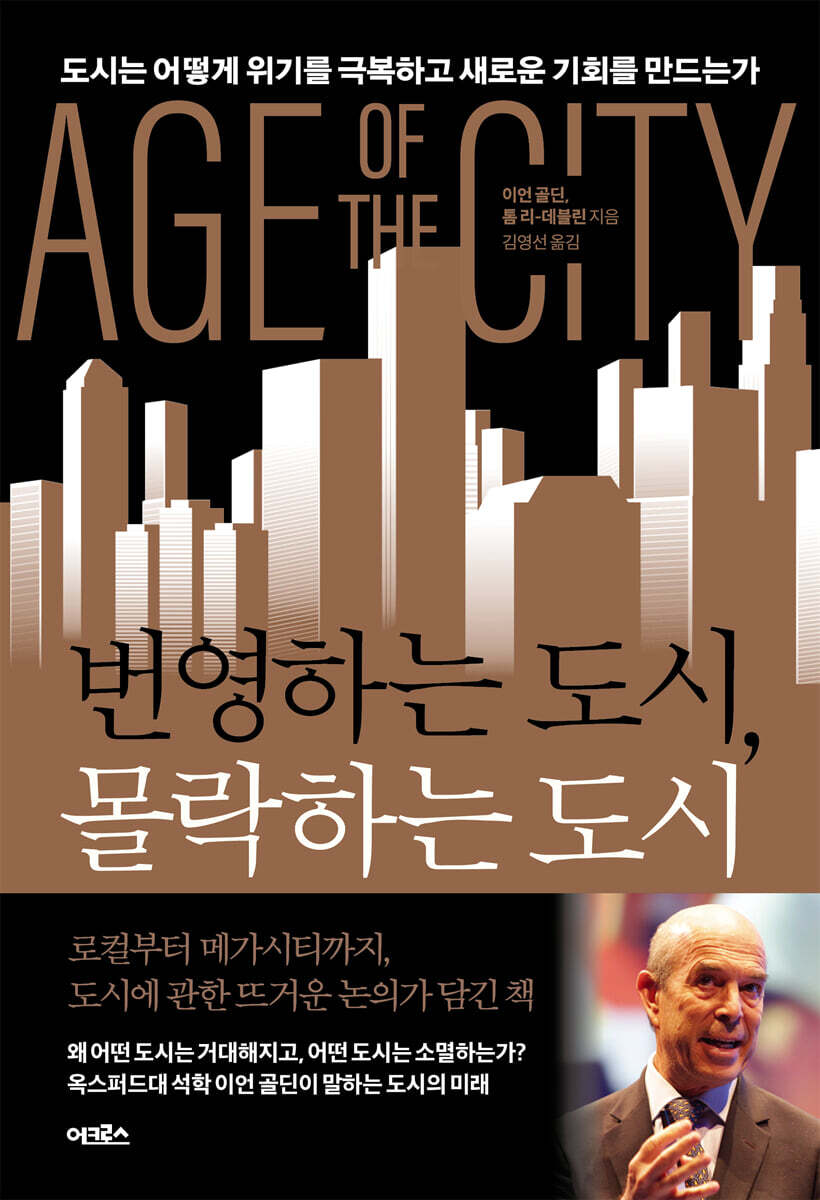
Prosperous City, Declining City
 |
Description
Book Introduction
- A word from MD
- Whether or not one is born in the metropolitan area determines one's life.
This isn't just a problem in South Korea.
The fate of a city, which determines the quality of jobs, transportation, and education, has a profound impact on the people who live there.
Is megacity Seoul the future of South Korea? We explore the future of sustainable cities.
- Son Min-gyu, Social and Political PD
A book filled with heated discussions about cities, from local to megacities, that are attracting the world's attention.
Oxford University scholar Ian Goldin and Economist writer Tom Lee-Devlin take a fascinating journey through the city's past, present, and future, drawing on insights from a wide range of fields including history, economics, geography, and sociology.
This book persuasively explores the problems cities face and their solutions, drawing on historical examples and abundant data, such as why some cities grow and others disappear, how cities around the world have responded to the various problems caused by urbanization, and what a city fit for the 21st-century knowledge economy should look like.
In today's world, where the fate of cities is directly linked to the fate of humanity, this book will serve as a reliable guide to unleashing the potential of cities.
Oxford University scholar Ian Goldin and Economist writer Tom Lee-Devlin take a fascinating journey through the city's past, present, and future, drawing on insights from a wide range of fields including history, economics, geography, and sociology.
This book persuasively explores the problems cities face and their solutions, drawing on historical examples and abundant data, such as why some cities grow and others disappear, how cities around the world have responded to the various problems caused by urbanization, and what a city fit for the 21st-century knowledge economy should look like.
In today's world, where the fate of cities is directly linked to the fate of humanity, this book will serve as a reliable guide to unleashing the potential of cities.
- You can preview some of the book's contents.
Preview
index
introduction
1 Introduction: The Great and Dangerous City
The Uncontrollable Sprawl of Cities / The Flat Lie / The Anthropocene in Peril / A Guide to Understanding Cities / Can a City Be Defined in One Word?
2 The three engines that shaped human history
Cooperation: Achieving a Common Goal / Division of Labor: The Foundation for Prosperity / Invention: The Results of Urban Interaction
3. The city you are born in determines your destiny.
The Cycle of Growth and Decline / Cities Losing Jobs / The Rise of Superstar Cities / Why We Can't Move to Better Places / Strategies for Revitalizing Declining Cities
4.
City of the Rich, City of the Poor
The Divisions Caused by Industrialization / Henry Ford and Deurbanization / People Trapped in Disadvantage / The Great Reversal That Changed the Destiny of the City Center / The Impact of Generational Change on Cities / Gentrification and the Commuting Poor / Three Pillars of a Fair City
5.
Is remote work a threat or an opportunity?
The Hidden Costs of Convenience / The Link Between Commuting and Urban Finance / Reimagining Cities for Jobs
6.
Cyberspace and the Fate of the Personalized City
New Technologies and Social Integration / Cyber Balkanization / Can the Metaverse Save Communities / Cities at the Crossroads of Isolation and Unity
7.
Cities that have grown large without development
Urbanization and Economic Development in Japan, China, and Korea / Urbanization Without Development / Is Population the Problem? / How to Climb the Ladder of Economic Development
8.
Which cities are safe from the pandemic?
Why Cities Have Higher Mortality Rates from Epidemics / London's Cholera Map / The Age of Epidemics Is Coming / Lessons from COVID-19 / Measures to Prevent Pandemics
9.
Climate disaster, a crisis for every city
Cities Collapsed by Climate Change / From Cradle of Civilization to Flood Zone / The Impact of the Climate Crisis on International Relations / Urban Solutions / No Time to Lose
10.
Conclusion: Prosperity doesn't come easily.
Redesigning Cities / Rebuilding Around the Knowledge Economy / Sustainability as a Top Priority / Collaborative Systems for Local, National, and Global
Acknowledgements
main
References
1 Introduction: The Great and Dangerous City
The Uncontrollable Sprawl of Cities / The Flat Lie / The Anthropocene in Peril / A Guide to Understanding Cities / Can a City Be Defined in One Word?
2 The three engines that shaped human history
Cooperation: Achieving a Common Goal / Division of Labor: The Foundation for Prosperity / Invention: The Results of Urban Interaction
3. The city you are born in determines your destiny.
The Cycle of Growth and Decline / Cities Losing Jobs / The Rise of Superstar Cities / Why We Can't Move to Better Places / Strategies for Revitalizing Declining Cities
4.
City of the Rich, City of the Poor
The Divisions Caused by Industrialization / Henry Ford and Deurbanization / People Trapped in Disadvantage / The Great Reversal That Changed the Destiny of the City Center / The Impact of Generational Change on Cities / Gentrification and the Commuting Poor / Three Pillars of a Fair City
5.
Is remote work a threat or an opportunity?
The Hidden Costs of Convenience / The Link Between Commuting and Urban Finance / Reimagining Cities for Jobs
6.
Cyberspace and the Fate of the Personalized City
New Technologies and Social Integration / Cyber Balkanization / Can the Metaverse Save Communities / Cities at the Crossroads of Isolation and Unity
7.
Cities that have grown large without development
Urbanization and Economic Development in Japan, China, and Korea / Urbanization Without Development / Is Population the Problem? / How to Climb the Ladder of Economic Development
8.
Which cities are safe from the pandemic?
Why Cities Have Higher Mortality Rates from Epidemics / London's Cholera Map / The Age of Epidemics Is Coming / Lessons from COVID-19 / Measures to Prevent Pandemics
9.
Climate disaster, a crisis for every city
Cities Collapsed by Climate Change / From Cradle of Civilization to Flood Zone / The Impact of the Climate Crisis on International Relations / Urban Solutions / No Time to Lose
10.
Conclusion: Prosperity doesn't come easily.
Redesigning Cities / Rebuilding Around the Knowledge Economy / Sustainability as a Top Priority / Collaborative Systems for Local, National, and Global
Acknowledgements
main
References
Detailed image

Into the book
In a world where the internet forces us into echo chambers filled with like-minded people, diminishing our ability to connect with those who think differently, cities are crucial for fostering solidarity.
The cities of our ancestors brought together people from all walks of life and bound them together into a cohesive whole.
We must rediscover this potential of cities in a divided world.
For that to happen, cities must evolve.
--- p.26
The birth of an empire has significant implications for the story we tell in this book.
Along with it, a new city of much larger scale was created, the capital of the empire.
The Roman Empire was so large that one city could not rule the entire empire.
As a result, power was delegated to provincial capitals such as Alexandria and Corinth, which in turn ruled smaller cities under them.
However, Rome remained the center of political, economic, and cultural life, and its inhabitants enjoyed a standard of living unparalleled elsewhere in the empire.
--- p.51
The fact that larger, more developed cities generally grow much larger and more successful speaks to the spillover effects of having businesses and workers close to major cities.
It's no coincidence that today's thriving cities are often leaders in multiple sectors.
San Francisco is renowned as a hub for digital technology, but it's also a leading city in biomedical research and a hub for financial and professional services on the West Coast.
New York is not only the home of Wall Street, but also the center of the American fashion industry.
London and Paris are home to the headquarters of major British and French companies respectively.
--- p.82
Canary Wharf in London is not considered a very good place to spend time.
High-rise buildings housing banks and other financial institutions dominate the landscape.
Before the COVID-19 pandemic, crowds of people in suits would swarm out and in subway stations every day.
So the area is pretty quiet after about 7pm and you won't see a single person on the weekends.
This is a classic example of what urban planners call a single-use area.
Canary Wharf stands in stark contrast to the more vibrant Shoreditch, about five kilometres away.
Shoreditch is what city planners call a mixed-use area, where residential living, a vibrant nightlife, and a thriving tech cluster coexist.
--- p.144
In the coming decades, humanity will become increasingly interconnected in cities, which will become catalysts for new diseases that will emerge as our ecological footprint expands.
As a result, it is unlikely that a global pandemic like COVID-19 will be a once-in-a-century or once-in-a-generation event.
In fact, one study found that there is about a 50 percent chance that a deadly pandemic will occur within the next 25 years.
There is a possibility that a more deadly virus will emerge.
--- p.214
So, the city's growth is still far from over.
And there are still many questions we need to find answers to.
How will cities accommodate this growing population? Where will they find jobs? How will we protect ourselves from threats like climate change and pandemics? It's naive to think that we can find answers to these questions solely through market forces and individual choices.
To successfully navigate these changes, we must create our own destiny, not leave it to chance.
The cities of our ancestors brought together people from all walks of life and bound them together into a cohesive whole.
We must rediscover this potential of cities in a divided world.
For that to happen, cities must evolve.
--- p.26
The birth of an empire has significant implications for the story we tell in this book.
Along with it, a new city of much larger scale was created, the capital of the empire.
The Roman Empire was so large that one city could not rule the entire empire.
As a result, power was delegated to provincial capitals such as Alexandria and Corinth, which in turn ruled smaller cities under them.
However, Rome remained the center of political, economic, and cultural life, and its inhabitants enjoyed a standard of living unparalleled elsewhere in the empire.
--- p.51
The fact that larger, more developed cities generally grow much larger and more successful speaks to the spillover effects of having businesses and workers close to major cities.
It's no coincidence that today's thriving cities are often leaders in multiple sectors.
San Francisco is renowned as a hub for digital technology, but it's also a leading city in biomedical research and a hub for financial and professional services on the West Coast.
New York is not only the home of Wall Street, but also the center of the American fashion industry.
London and Paris are home to the headquarters of major British and French companies respectively.
--- p.82
Canary Wharf in London is not considered a very good place to spend time.
High-rise buildings housing banks and other financial institutions dominate the landscape.
Before the COVID-19 pandemic, crowds of people in suits would swarm out and in subway stations every day.
So the area is pretty quiet after about 7pm and you won't see a single person on the weekends.
This is a classic example of what urban planners call a single-use area.
Canary Wharf stands in stark contrast to the more vibrant Shoreditch, about five kilometres away.
Shoreditch is what city planners call a mixed-use area, where residential living, a vibrant nightlife, and a thriving tech cluster coexist.
--- p.144
In the coming decades, humanity will become increasingly interconnected in cities, which will become catalysts for new diseases that will emerge as our ecological footprint expands.
As a result, it is unlikely that a global pandemic like COVID-19 will be a once-in-a-century or once-in-a-generation event.
In fact, one study found that there is about a 50 percent chance that a deadly pandemic will occur within the next 25 years.
There is a possibility that a more deadly virus will emerge.
--- p.214
So, the city's growth is still far from over.
And there are still many questions we need to find answers to.
How will cities accommodate this growing population? Where will they find jobs? How will we protect ourselves from threats like climate change and pandemics? It's naive to think that we can find answers to these questions solely through market forces and individual choices.
To successfully navigate these changes, we must create our own destiny, not leave it to chance.
--- p.256
Publisher's Review
2023 Financial Times Book of the Year
Why do some cities grow larger and larger, while others disappear?
Former World Bank Vice President and Oxford scholar Ian Goldin on the Future of Cities
The keyword that has been at the center of attention recently is definitely 'city'.
From regional urban development to the megacity debate, attention is focused on cities.
This is a phenomenon that occurs not only domestically but also globally.
In a connected world where more than half the world's population lives in cities, the fate of cities is directly linked to the fate of all humanity.
Since the first cities emerged in Mesopotamia around 3500 BC, cities have attracted people and driven progress through cooperation, division of labor, and invention.
In particular, innovations in food production, storage, and transportation, as well as advances in public health, sanitation, and social infrastructure, have led to rapid urban growth in recent centuries.
At the beginning of the 18th century, only 5 percent of the world's population lived in cities; today that figure is 55 percent.
It is predicted that by 2050, more than two-thirds of the world's population will live in cities.
From the cradle of human civilization, through ancient Rome and Athens, to modern metropolises like New York and Shanghai, cities have always been the engines of human progress.
But in the 21st century, its reputation is being shaken.
As the scale grows, the inhabitants become poorer, and the virtual space, which is an agglomeration of cutting-edge technology, divides people.
Adding insult to injury, infectious diseases and climate change threaten cities.
Cities around the world are at a crossroads.
Will it stall or continue to thrive? "Cities That Thrive, Cities That Decline" examines why cities deserve renewed attention in turbulent times and what cities in crisis must do to achieve sustainable development.
In this book, Ian Goldin, founder of Oxford University's Martin School and a leading scholar of globalization and development, and Economist writer Tom Lee-Devlin bring together insights from a wide range of fields, including history, economics, geography, sociology, and urban engineering, to take readers on a fascinating journey that explores the past, present, and future of cities.
This book explores the problems and solutions facing cities, drawing on historical examples and abundant data, such as how cities in Korea, Japan, and China achieved intensive growth; why such development is difficult to achieve in other developing countries; how cities in each country responded to problems caused by urbanization such as urban concentration, suburbanization, deindustrialization, and gentrification; how the Internet and remote work affect urban growth; and what path cities, which experienced the rise and fall of manufacturing in the 20th century following the 19th century Industrial Revolution, should choose in the 21st century knowledge economy.
Martin Wolf, senior columnist for the Financial Times, called the book “a fascinating look at the challenges cities face and what we can do to make them better for all their residents,” and named it one of the Financial Times Books of the Year 2023.
Are huge cities a blessing or a curse?
From Manchester during the Industrial Revolution to the cities of the developing world in the 21st century,
The rise and fall of cities, seen from past to present
As the world's wealth and population flock to cities, concerns and controversies follow.
This is because the economic and cultural gap between thriving megacities like New York, London, and Paris and other places is growing, and the gap within cities is also growing increasingly wide.
Furthermore, unlike in the past when the size of cities was accompanied by qualitative growth, there are cases where cities in developing countries grow without development, and there is a constant debate over whether urban growth is a desirable direction for development.
Even amidst these debates, Ian Goldin emphasizes that we must not forget the power of cities.
The reason human civilization was able to develop was because people gathered in cities cooperated, divided labor, and made creative inventions.
It is true that today's cities have many problems, but the solutions to those problems must also be found within the cities.
So, what compass should we use to guide our cities as they navigate their way forward? This book begins by retracing the history of major cities around the world, experiencing their rise and fall during the industrialization process.
Why did Britain's wealth and population, which had been dispersed during the Industrial Revolution, become concentrated in London again? What happened as industrialization, which began in the northeastern cities of the United States in the mid-19th century, spread to the Midwest and the South? What is the current situation of cities like St. Louis, which prospered the most during the heyday of manufacturing? How did the surge in demand for highly skilled knowledge workers and changes in jobs give rise to "superstar cities"? These are topics that many cities in Korea, which have struggled to find opportunities for recovery after the decline of labor-intensive manufacturing, should pay attention to.
The book also explores the turning point that led Seattle, which entered an irreversible decline with soaring unemployment in the early 1970s, to become one of the wealthiest cities in the United States today, and why the average income in the Tokyo metropolitan area, which accounts for 45 percent of Japan's urban population, has remained similar to that of other Japanese cities. The examples of cities discussed in this book will provide hints on what efforts declining industrial cities in rich countries should make to seize the opportunity for prosperity again.
Is the spread of remote work a crisis or an opportunity?
Suggesting the direction cities should take in the knowledge economy era.
As COVID-19 forced cities around the world into lockdown and many companies transitioned to remote work, commuting disappeared.
As the number of people commuting to work decreased, commercial facilities in the city center faced a major crisis.
The idea that work must be done by going to the office has been shattered, and this shift in perspective continues to have a significant impact on business operations and urban commercial districts, even after the recovery from COVID-19.
Until the 20th century, the general philosophy of urban planning was to divide different areas of a city into different functional uses.
This approach is now increasingly being shown to be uncompetitive.
The author cites Canary Wharf in London as an example.
This area, which is home to many financial institutions such as banks, is a typical office-dense space that becomes quiet after 7 p.m. and is rarely crowded on weekends.
In contrast, Shoreditch, five kilometres from Canary Wharf, is a mixed-use area with residential, leisure and technology clusters.
The authors argue that cities need to be redesigned to fit the jobs of a knowledge economy.
While remote work has many advantages, it has a fatal flaw: it fails to fully utilize the immense potential of cities, where people collaborate, divide their labor, and unleash their creativity.
Therefore, experts predict that in the future, a hybrid work system that combines the advantages of both remote work and office work will become the norm.
The authors say that future cities must be reconfigured as mixed-use spaces to accommodate these trends.
Canary Wharf is planning to establish a massive research institute and is building thousands of apartments to transform it into a mixed-use area.
America's financial districts are also converting office buildings into apartments.
This is a case worth noting in our reality where the demand for proximity to work is increasing.
He also emphasizes that similar efforts should be made in the suburbs to disperse the densely populated city centers.
It's about enabling young knowledge workers to enjoy the attractive lifestyle and vibrant communities they crave in the city, but in the suburbs.
The book cites notable examples such as Arlington (a suburb of Washington, D.C.), which has emerged as a key regional economic hub by establishing itself as a knowledge hub for cloud computing, artificial intelligence, and cybersecurity, and Lakewood (a suburb of Denver), which has re-attracted people by redeveloping a closed shopping mall site into a mixed-use development.
This is a must-read for readers interested in balanced development between urban and regional areas.
Urban prosperity is possible when cities realize their potential.
Inequality, job losses, pandemics, climate disasters…
How to overcome crises and create sustainable cities
In recent decades, most population growth has occurred in cities in developing countries.
In the past, Korea, China, and Japan achieved both urbanization and economic development simultaneously, but today, many cities in developing countries are struggling to keep up with that process.
Residents of large, overcrowded cities without development are living in poor conditions.
Moreover, common crises such as pandemics and climate change have a greater impact on cities in developing countries than on other global cities.
Cities face challenging challenges: how will they accommodate their growing populations, where will they find jobs, and how will they protect us from climate change and pandemics?
Can cities, once the engines of human progress, continue to play that role? The authors of this book assert that a city's prosperity and decline depend on how it harnesses its power.
It highlights that the cooperation and solidarity that have driven human progress are more necessary than ever to overcome the crises facing cities and to ensure economic opportunity for all, rather than wealth and opportunity being concentrated in a lucky few cities and within those cities.
This book will serve as a reliable guide to understanding the past of the city we live in, unlocking its potential to shape the future, and achieving shared prosperity.
Why do some cities grow larger and larger, while others disappear?
Former World Bank Vice President and Oxford scholar Ian Goldin on the Future of Cities
The keyword that has been at the center of attention recently is definitely 'city'.
From regional urban development to the megacity debate, attention is focused on cities.
This is a phenomenon that occurs not only domestically but also globally.
In a connected world where more than half the world's population lives in cities, the fate of cities is directly linked to the fate of all humanity.
Since the first cities emerged in Mesopotamia around 3500 BC, cities have attracted people and driven progress through cooperation, division of labor, and invention.
In particular, innovations in food production, storage, and transportation, as well as advances in public health, sanitation, and social infrastructure, have led to rapid urban growth in recent centuries.
At the beginning of the 18th century, only 5 percent of the world's population lived in cities; today that figure is 55 percent.
It is predicted that by 2050, more than two-thirds of the world's population will live in cities.
From the cradle of human civilization, through ancient Rome and Athens, to modern metropolises like New York and Shanghai, cities have always been the engines of human progress.
But in the 21st century, its reputation is being shaken.
As the scale grows, the inhabitants become poorer, and the virtual space, which is an agglomeration of cutting-edge technology, divides people.
Adding insult to injury, infectious diseases and climate change threaten cities.
Cities around the world are at a crossroads.
Will it stall or continue to thrive? "Cities That Thrive, Cities That Decline" examines why cities deserve renewed attention in turbulent times and what cities in crisis must do to achieve sustainable development.
In this book, Ian Goldin, founder of Oxford University's Martin School and a leading scholar of globalization and development, and Economist writer Tom Lee-Devlin bring together insights from a wide range of fields, including history, economics, geography, sociology, and urban engineering, to take readers on a fascinating journey that explores the past, present, and future of cities.
This book explores the problems and solutions facing cities, drawing on historical examples and abundant data, such as how cities in Korea, Japan, and China achieved intensive growth; why such development is difficult to achieve in other developing countries; how cities in each country responded to problems caused by urbanization such as urban concentration, suburbanization, deindustrialization, and gentrification; how the Internet and remote work affect urban growth; and what path cities, which experienced the rise and fall of manufacturing in the 20th century following the 19th century Industrial Revolution, should choose in the 21st century knowledge economy.
Martin Wolf, senior columnist for the Financial Times, called the book “a fascinating look at the challenges cities face and what we can do to make them better for all their residents,” and named it one of the Financial Times Books of the Year 2023.
Are huge cities a blessing or a curse?
From Manchester during the Industrial Revolution to the cities of the developing world in the 21st century,
The rise and fall of cities, seen from past to present
As the world's wealth and population flock to cities, concerns and controversies follow.
This is because the economic and cultural gap between thriving megacities like New York, London, and Paris and other places is growing, and the gap within cities is also growing increasingly wide.
Furthermore, unlike in the past when the size of cities was accompanied by qualitative growth, there are cases where cities in developing countries grow without development, and there is a constant debate over whether urban growth is a desirable direction for development.
Even amidst these debates, Ian Goldin emphasizes that we must not forget the power of cities.
The reason human civilization was able to develop was because people gathered in cities cooperated, divided labor, and made creative inventions.
It is true that today's cities have many problems, but the solutions to those problems must also be found within the cities.
So, what compass should we use to guide our cities as they navigate their way forward? This book begins by retracing the history of major cities around the world, experiencing their rise and fall during the industrialization process.
Why did Britain's wealth and population, which had been dispersed during the Industrial Revolution, become concentrated in London again? What happened as industrialization, which began in the northeastern cities of the United States in the mid-19th century, spread to the Midwest and the South? What is the current situation of cities like St. Louis, which prospered the most during the heyday of manufacturing? How did the surge in demand for highly skilled knowledge workers and changes in jobs give rise to "superstar cities"? These are topics that many cities in Korea, which have struggled to find opportunities for recovery after the decline of labor-intensive manufacturing, should pay attention to.
The book also explores the turning point that led Seattle, which entered an irreversible decline with soaring unemployment in the early 1970s, to become one of the wealthiest cities in the United States today, and why the average income in the Tokyo metropolitan area, which accounts for 45 percent of Japan's urban population, has remained similar to that of other Japanese cities. The examples of cities discussed in this book will provide hints on what efforts declining industrial cities in rich countries should make to seize the opportunity for prosperity again.
Is the spread of remote work a crisis or an opportunity?
Suggesting the direction cities should take in the knowledge economy era.
As COVID-19 forced cities around the world into lockdown and many companies transitioned to remote work, commuting disappeared.
As the number of people commuting to work decreased, commercial facilities in the city center faced a major crisis.
The idea that work must be done by going to the office has been shattered, and this shift in perspective continues to have a significant impact on business operations and urban commercial districts, even after the recovery from COVID-19.
Until the 20th century, the general philosophy of urban planning was to divide different areas of a city into different functional uses.
This approach is now increasingly being shown to be uncompetitive.
The author cites Canary Wharf in London as an example.
This area, which is home to many financial institutions such as banks, is a typical office-dense space that becomes quiet after 7 p.m. and is rarely crowded on weekends.
In contrast, Shoreditch, five kilometres from Canary Wharf, is a mixed-use area with residential, leisure and technology clusters.
The authors argue that cities need to be redesigned to fit the jobs of a knowledge economy.
While remote work has many advantages, it has a fatal flaw: it fails to fully utilize the immense potential of cities, where people collaborate, divide their labor, and unleash their creativity.
Therefore, experts predict that in the future, a hybrid work system that combines the advantages of both remote work and office work will become the norm.
The authors say that future cities must be reconfigured as mixed-use spaces to accommodate these trends.
Canary Wharf is planning to establish a massive research institute and is building thousands of apartments to transform it into a mixed-use area.
America's financial districts are also converting office buildings into apartments.
This is a case worth noting in our reality where the demand for proximity to work is increasing.
He also emphasizes that similar efforts should be made in the suburbs to disperse the densely populated city centers.
It's about enabling young knowledge workers to enjoy the attractive lifestyle and vibrant communities they crave in the city, but in the suburbs.
The book cites notable examples such as Arlington (a suburb of Washington, D.C.), which has emerged as a key regional economic hub by establishing itself as a knowledge hub for cloud computing, artificial intelligence, and cybersecurity, and Lakewood (a suburb of Denver), which has re-attracted people by redeveloping a closed shopping mall site into a mixed-use development.
This is a must-read for readers interested in balanced development between urban and regional areas.
Urban prosperity is possible when cities realize their potential.
Inequality, job losses, pandemics, climate disasters…
How to overcome crises and create sustainable cities
In recent decades, most population growth has occurred in cities in developing countries.
In the past, Korea, China, and Japan achieved both urbanization and economic development simultaneously, but today, many cities in developing countries are struggling to keep up with that process.
Residents of large, overcrowded cities without development are living in poor conditions.
Moreover, common crises such as pandemics and climate change have a greater impact on cities in developing countries than on other global cities.
Cities face challenging challenges: how will they accommodate their growing populations, where will they find jobs, and how will they protect us from climate change and pandemics?
Can cities, once the engines of human progress, continue to play that role? The authors of this book assert that a city's prosperity and decline depend on how it harnesses its power.
It highlights that the cooperation and solidarity that have driven human progress are more necessary than ever to overcome the crises facing cities and to ensure economic opportunity for all, rather than wealth and opportunity being concentrated in a lucky few cities and within those cities.
This book will serve as a reliable guide to understanding the past of the city we live in, unlocking its potential to shape the future, and achieving shared prosperity.
GOODS SPECIFICS
- Date of issue: December 7, 2023
- Page count, weight, size: 320 pages | 516g | 147*215*18mm
- ISBN13: 9791167741257
You may also like
카테고리
korean


korean

![GQ KOREA Mark (Monthly): December [2025]](http://librairie.coreenne.fr/cdn/shop/files/8ef265dbbfbf186523ed75ba7319009d.jpg?v=1765340328&width=3840)


