

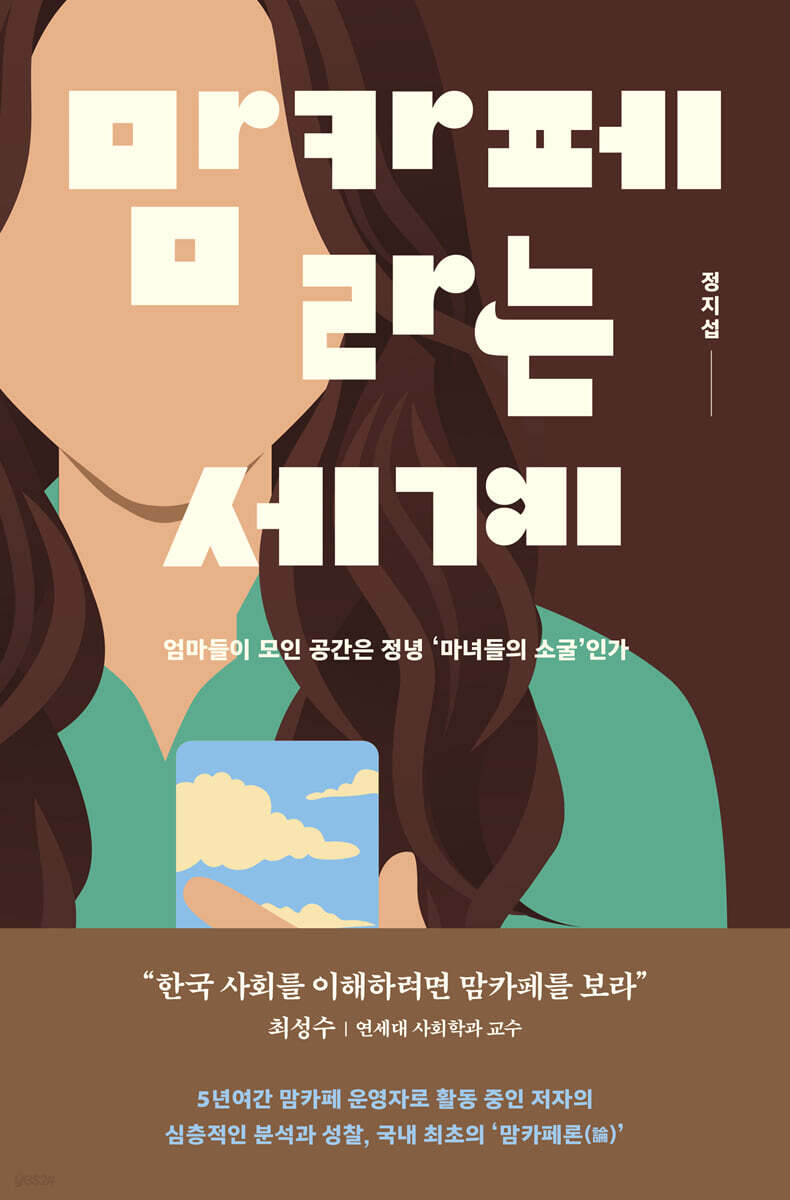
The world of Mom Cafe
 |
Description
Book Introduction
- A word from MD
-
Mom Cafe, a microcosm of South KoreaKorea's first Mom Cafe Ron.
Why should we pay attention to Mom Cafes now? Because the discourse and phenomena occurring there reflect South Korea's desires.
The author has been running a mom cafe for five years and has taken a deep look into motherhood, private education, real estate, and politics in Korea.
If you go to a mom cafe, you can see the reasons for the low birth rate.
November 14, 2023. Social and Political PD Son Min-gyu
What exactly is a mom's community, Mom Cafe?
How did this community become so hated?
In Korean society, where mothers are driven to become 'mom-chung',
Why should we take a closer look inside Mom Cafe?
People's interest in 'Mom Cafe', an internet community for mothers, is as hot as an active volcano.
Mom Cafe, where women raising children share their various emotions and experiences, including parenting, life, education, and local information, has at one point become one of the most problematic and controversial spaces in South Korea.
Since the emergence of Mom Cafes in this society in the mid-2000s, has there been another community that has become a source of national scorn? Even today, stories of Mom Cafes' "misdeeds" are circulated everywhere, in news reports, newspapers, and online, drawing merciless condemnation from countless people.
Bullying and group egoism, infringement of teachers' rights and closure of pediatric clinics, incitement and fake news, a hotbed of hatred, a collection of selfish mothers...
In our society, it has become natural to think of these words when looking at mom cafes.
People criticize Mom Cafe for being overly "politicized," accuse it of being steeped in "mercantile practices," and sometimes even call for its closure, claiming it is the "root of all evil."
Are mom cafes really such strange places? What kind of community are they? In Korean society, where no one truly examines these spaces, and where provocative posts and screenshots of them circulating online often degrade them, Ji-seop Jeong, author of "The World of Mom Cafes," has launched a precise, vivid, and three-dimensional analysis of mom cafes.
Having lived both as a working mom and a stay-at-home mom, and raising two children, the author, through her experience running a mom cafe for over five years, has embarked on a serious reflection on this group for the first time in our society.
His story, which begins with his participation in creating a mom café in the late 2010s, is layered with the essence and characteristics of the space called mom café, the specific operating principles and operating methods of this community, the controversy over the politicization and commercialization of mom cafés, the reasons why many mothers are drawn to and rely on mom cafés, the social context in which this place is increasingly becoming like an 'isolated castle', and the numerous commotions and turbulent events that unfold within it.
Furthermore, the author persuasively explains how the hatred toward mom cafes is connected to hatred toward women and mothers, hatred toward motherhood and childbirth, and the unfortunate realities of this society.
It can literally be called 'Korea's first Mom Cafe theory'.
Everyone laments the extreme low birth rate in South Korea, but now even mothers are saying, “Never have children.”
There is a clear trend of everyone talking as if they know everything about parenting, easily pointing fingers at mothers and calling them "mom-chungs," and feeling increasingly uncomfortable with the very existence of children.
Jeong Ji-seop confronts the ignorance, prejudice, and hatred towards mom cafes head-on, and does not blindly defend or take sides with this space. Instead, he examines mom cafes, which have now clearly become a “space of power,” with a cool and fierce gaze.
The author examines the multifaceted nature of motherhood, recalls the paradoxical nature and side effects of trust and empathy in this space, and criticizes the atmosphere in which one always assumes oneself to be the "weak" of this world while desperately hoping for the sympathy of "one's own."
In short, women who become 'mothers' are never perfect, and the same goes for Mom Cafe.
However, regarding mothers raising children as 'beings who live in luxury with the money their husbands earn', obsessively demanding perfect parenting from them, resorting to scheming in some cases, and treating Mom Cafes as 'a den of witches' clearly exposes the most fatal limitations and ills of Korean society today.
Because in such an atmosphere of total hatred, it is absurd to expect a woman to become a 'mother'.
This is why the saying, “If you want to understand Korean society, look at Mom Cafes” (Choi Seong-su, Professor of Sociology at Yonsei University) is so accurate, and why we need to fundamentally reexamine the values of motherhood, childcare, and family in Korean society.
Because everything about Korea is compressed into a space called Mom Cafe.
Mom cafes are steeped in comparison and dependence on the gaze of others, the anxiety and loneliness of living as a member of this society, bullying and group egoism, the chameleon-like diversity of the persona of "mother," the phenomenon of identification between children and parents, ignorance and lack of understanding about childcare, and the cultural system of families obsessed with external values.
At the same time, it is imbued with a sense of trust and gratitude toward others, a warm concern for neighbors, a sense of responsibility and devotion to family members, the altruistic value of motherhood, and serious concern for the future of this society.
Mom cafes are not as simple and harmful a place as people think.
The world of 'Mom Cafe' is an important black box that we all must look into.
How did this community become so hated?
In Korean society, where mothers are driven to become 'mom-chung',
Why should we take a closer look inside Mom Cafe?
People's interest in 'Mom Cafe', an internet community for mothers, is as hot as an active volcano.
Mom Cafe, where women raising children share their various emotions and experiences, including parenting, life, education, and local information, has at one point become one of the most problematic and controversial spaces in South Korea.
Since the emergence of Mom Cafes in this society in the mid-2000s, has there been another community that has become a source of national scorn? Even today, stories of Mom Cafes' "misdeeds" are circulated everywhere, in news reports, newspapers, and online, drawing merciless condemnation from countless people.
Bullying and group egoism, infringement of teachers' rights and closure of pediatric clinics, incitement and fake news, a hotbed of hatred, a collection of selfish mothers...
In our society, it has become natural to think of these words when looking at mom cafes.
People criticize Mom Cafe for being overly "politicized," accuse it of being steeped in "mercantile practices," and sometimes even call for its closure, claiming it is the "root of all evil."
Are mom cafes really such strange places? What kind of community are they? In Korean society, where no one truly examines these spaces, and where provocative posts and screenshots of them circulating online often degrade them, Ji-seop Jeong, author of "The World of Mom Cafes," has launched a precise, vivid, and three-dimensional analysis of mom cafes.
Having lived both as a working mom and a stay-at-home mom, and raising two children, the author, through her experience running a mom cafe for over five years, has embarked on a serious reflection on this group for the first time in our society.
His story, which begins with his participation in creating a mom café in the late 2010s, is layered with the essence and characteristics of the space called mom café, the specific operating principles and operating methods of this community, the controversy over the politicization and commercialization of mom cafés, the reasons why many mothers are drawn to and rely on mom cafés, the social context in which this place is increasingly becoming like an 'isolated castle', and the numerous commotions and turbulent events that unfold within it.
Furthermore, the author persuasively explains how the hatred toward mom cafes is connected to hatred toward women and mothers, hatred toward motherhood and childbirth, and the unfortunate realities of this society.
It can literally be called 'Korea's first Mom Cafe theory'.
Everyone laments the extreme low birth rate in South Korea, but now even mothers are saying, “Never have children.”
There is a clear trend of everyone talking as if they know everything about parenting, easily pointing fingers at mothers and calling them "mom-chungs," and feeling increasingly uncomfortable with the very existence of children.
Jeong Ji-seop confronts the ignorance, prejudice, and hatred towards mom cafes head-on, and does not blindly defend or take sides with this space. Instead, he examines mom cafes, which have now clearly become a “space of power,” with a cool and fierce gaze.
The author examines the multifaceted nature of motherhood, recalls the paradoxical nature and side effects of trust and empathy in this space, and criticizes the atmosphere in which one always assumes oneself to be the "weak" of this world while desperately hoping for the sympathy of "one's own."
In short, women who become 'mothers' are never perfect, and the same goes for Mom Cafe.
However, regarding mothers raising children as 'beings who live in luxury with the money their husbands earn', obsessively demanding perfect parenting from them, resorting to scheming in some cases, and treating Mom Cafes as 'a den of witches' clearly exposes the most fatal limitations and ills of Korean society today.
Because in such an atmosphere of total hatred, it is absurd to expect a woman to become a 'mother'.
This is why the saying, “If you want to understand Korean society, look at Mom Cafes” (Choi Seong-su, Professor of Sociology at Yonsei University) is so accurate, and why we need to fundamentally reexamine the values of motherhood, childcare, and family in Korean society.
Because everything about Korea is compressed into a space called Mom Cafe.
Mom cafes are steeped in comparison and dependence on the gaze of others, the anxiety and loneliness of living as a member of this society, bullying and group egoism, the chameleon-like diversity of the persona of "mother," the phenomenon of identification between children and parents, ignorance and lack of understanding about childcare, and the cultural system of families obsessed with external values.
At the same time, it is imbued with a sense of trust and gratitude toward others, a warm concern for neighbors, a sense of responsibility and devotion to family members, the altruistic value of motherhood, and serious concern for the future of this society.
Mom cafes are not as simple and harmful a place as people think.
The world of 'Mom Cafe' is an important black box that we all must look into.
- You can preview some of the book's contents.
Preview
index
prolog
Part 1: How I Became the Operator of Mom's Cafe
1.
Introduction: The Beginning of All Secrets
2.
How I Became a Mom Cafe Addict
3.
The betrayal of Mom Cafe, which was like a real sister to me
4.
The beginning of a long and arduous journey
Part 2: A deep look inside Mom's Cafe
1.
The necessity of a mom cafe and the process of creating one
2.
Overcoming the world's negative views
3.
The trap of homogeneity
4.
Why do people fall for mom cafes?
Part 3: The Round World
1.
What does being kicked out of Mom Cafe mean?
2.
The most important unwritten rule of this space
3.
The emergence of the 'professional inconveniencer'
4.
A Clash of Round Desires: On Private Education
5.
The light and shade of putting yourself in someone else's shoes
Part 4 Political Too Political?
1.
“United we are strong.”
2.
Does political part-time work really exist?
3.
The moment when public opinion on the bulletin board turns into a megaphone
4.
Why has the trend of banning political posts become a trend in Mom Cafes?
5.
The trap of “If you feel uncomfortable, please pass”
Part 5: The Isolated Castle
1.
A gloomy place where only witches remain
2.
The weapon 'I am powerless'
3.
Regarding the view that Mom Cafes are profitable
4.
The painful issue of being a mother-to-be
5.
The battlefield in our hearts
Part 6: The Spread of All-Out Hatred
1.
A Thought on the Hatred of Mom Cafes
2.
How did my mother become an object of hatred?
3.
Expansion into child hatred
4.
Unhappy Pregnancy, Cursed Parenting
5.
Again, I think about motherhood.
Part 7: The Door to Happiness
1.
Self-esteem as a mother
2.
What is family in our society?
3.
I hope Papa Cafe opens too.
4.
Going Out: My Values Changed While Raising Children
Part 1: How I Became the Operator of Mom's Cafe
1.
Introduction: The Beginning of All Secrets
2.
How I Became a Mom Cafe Addict
3.
The betrayal of Mom Cafe, which was like a real sister to me
4.
The beginning of a long and arduous journey
Part 2: A deep look inside Mom's Cafe
1.
The necessity of a mom cafe and the process of creating one
2.
Overcoming the world's negative views
3.
The trap of homogeneity
4.
Why do people fall for mom cafes?
Part 3: The Round World
1.
What does being kicked out of Mom Cafe mean?
2.
The most important unwritten rule of this space
3.
The emergence of the 'professional inconveniencer'
4.
A Clash of Round Desires: On Private Education
5.
The light and shade of putting yourself in someone else's shoes
Part 4 Political Too Political?
1.
“United we are strong.”
2.
Does political part-time work really exist?
3.
The moment when public opinion on the bulletin board turns into a megaphone
4.
Why has the trend of banning political posts become a trend in Mom Cafes?
5.
The trap of “If you feel uncomfortable, please pass”
Part 5: The Isolated Castle
1.
A gloomy place where only witches remain
2.
The weapon 'I am powerless'
3.
Regarding the view that Mom Cafes are profitable
4.
The painful issue of being a mother-to-be
5.
The battlefield in our hearts
Part 6: The Spread of All-Out Hatred
1.
A Thought on the Hatred of Mom Cafes
2.
How did my mother become an object of hatred?
3.
Expansion into child hatred
4.
Unhappy Pregnancy, Cursed Parenting
5.
Again, I think about motherhood.
Part 7: The Door to Happiness
1.
Self-esteem as a mother
2.
What is family in our society?
3.
I hope Papa Cafe opens too.
4.
Going Out: My Values Changed While Raising Children
Detailed image

Into the book
There is only one thing I wish for.
Through this book, I hope to help our society more accurately recognize the group called Mom Cafe, which has been viewed superficially so far, and to share that awareness and reflection with others.
Hatred and stigmatization stemming from ignorance and lack of understanding are serious problems that permeate our society, and this is no exception when it comes to Mom Cafes.
--- From the "Prologue"
But on the news, there is a strange story that comes up once a year, and in that article, the most provocative sentence appears on the captured screen.
Provocative words such as ‘gapjil’, ‘witch hunt’, ‘manipulation’, and ‘collective egoism’ appear in conjunction with the word ‘mom cafe’ and with devilish editing.
Then, there are concerns about the ‘politicized’ Mom Cafe, saying that it is not pure, and there are also comments that the Mom Cafe is blinded by ‘business’.
The media even kindly shed light on a petition posted on the National Petition website that calls for the closure of Mom Cafe itself, which is drifting away from its original purpose of sharing parenting information, as the “root of all evil.”
--- From "Part 1, Chapter 1 | Introduction: The Beginning of All Secrets"
In parenting, mistakes are not tolerated, and for a child who is infinitely weak, the most perfect method is inevitably pursued.
For that reason, most people would find it easier to research, verify, and judge for themselves rather than seek advice from others about their parenting.
So, when I was having trouble with parenting, I think I relied on Mom Cafe rather than calling my mom to ask.
At least there were people there who were most sensitive to the latest information and willing to listen to contemporary experts.
--- From "Part 1, Chapter 2 | How I Became a Mom Cafe Addict"
There are several small meeting rooms in Mom Cafe.
They come together by finding common ground, such as “Moms of Tiger Year Babies” or “Moms of 1990s.”
And sometimes, their common and main daily routine, parenting, expands to include sharing every detail of life and even the joys and sorrows.
We empathize together, get angry, cry together, and laugh together.
So, some people praised Mom Cafe as a panacea for postpartum depression.
--- From "Part 1, Chapter 3 | Betrayal at Mom's Cafe, Which Was Like an Older Sister"
The reason I continued to visit Mom's Cafe was probably because I was working and didn't have time to socialize with my neighbors or other mothers.
Fortunately, there was a space called Mom Cafe, so I could learn about what was happening in my neighborhood even while at work.
For example, why did an ambulance come to our apartment last night?
In that way, Mom's Cafe was a place that fulfilled a small sense of belonging to the local community where I lived.
--- From "Part 1, Chapter 4 | The Beginning of a Long and Arduous Journey"
For Mom Cafe members, there is almost no gap between the world of Mom Cafe and the real world.
The collapse of trust in Mom Cafe is directly linked to the anxiety of not being able to trust the real world.
The rules are a joint promise among Mom Cafe members to maintain mutual trust.
This leads to the legitimacy of the Mom Cafe rules and also acts to make the members comply with the rules.
In short, mutual trust is an essential value in Mom Cafe, and the tight regulations exist to ensure that.
--- From "Part 2, Chapter 1 | The Necessity of Mom Cafe and the Process of Creating It"
Our society believes that 'mothers must be strong to raise children.'
Because of this, people tend to believe that the depression will just pass and try to overcome it on their own rather than relying on medical treatment.
So, if we include relatively mild symptoms, it is inevitable that many more women will experience postpartum depression.
Anyone who has experienced parenting would agree that, while the joy of parenting comes with it, there is also a certain gloomy and depressing feeling that comes from isolation.
--- From "Part 2, Chapter 4 | Why Do People Fall for Mom Cafes?"
Here, I would like to talk about the most important unwritten rule that characterizes the space called Mom Cafe.
It is ‘roundness’.
Because Mom's Cafe is supposed to be a round space, members themselves cannot break the rules or tolerate uncomfortable situations.
So, there are many requests from members to either immediately apply penalties to members who break the rules, or to create new rules because they contain content that is inconvenient to read.
Thanks to these users' sense of belonging and interest in Mom Cafe, Mom Cafe can be operated in a more positive and constructive manner.
--- From "Part 3, Chapter 2 | The Most Important Unwritten Rule of This Space"
If we think about this fact the other way around, it is like this.
In most cases, the expression of discomfort is imbued with a directional purpose of 'be on my side'.
In a mom cafe, it is essential to not go against the 'common sentiment', so it is essential to have a process to check whether my discomfort is due to my own fault or selfishness.
Therefore, the motivation for posting articles that begin with “Am I the only one who feels uncomfortable?” or have a similar nuance can be said to be basically a desire to gain the sympathy of the members of Mom’s Cafe.
--- From "Part 3, Chapter 3 | The Rise of the 'Pro-Inconvenienced'"
Mothers want to know which academies other mothers send their children to and whether those academies have good or bad reviews.
In some mom cafes in areas called "school districts" where people with a lot of interest in their children's education are concentrated, sharing information about private education such as academies or educational institutions is mandatory to raise your rank and gain the right to view posts (information).
However, sharing private education information in a purely meaningful way at local mom cafes has its limitations.
Here, the rounded characteristics of Mom Cafe reach a turning point once again.
--- From "Part 3, Chapter 4 | The Clash of Round Desires: On Private Education"
Participating in such collective movements becomes a means of realizing one's social self.
That is, it enhances the self-efficacy of individuals who consider themselves weak.
When I see people who share my views coming together one by one, I can see that my thoughts are not just mine.
Also, seeing the number of comments and likes increase and the intuitive numerical results of more and more people joining and cohesion can be a sufficient incentive for active action.
--- From "Part 4, Chapter 1 | "United We Become Strength"
But even in political issues and group movements, the essential characteristics of Mom Cafe, its rounded culture that avoids psychologically uncomfortable situations among its members, do not stray away.
As we saw in the previous chapter, because we as members of Mom Cafe must maintain a sense of belonging and uniformity within the group on any sensitive issue, we rarely express opinions that go against the prevailing opinion.
In this space, it is better to choose silence than to risk being marginalized by becoming a troublemaker.
--- From "Part 4, Chapter 3 | The Moment When Public Opinion on the Bulletin Board Turns into a Megaphone"
Are women less interested in politics than men? No.
Politics is an issue that directly affects our lives.
The most active members of Mom Cafe are women in their 30s to 50s, a generation that is actively socially active and at the forefront of life.
That's why I can't help but be interested in politics.
Even today, strong political posts are being posted on Mom Cafe, which allows political postings.
--- From "Part 4, Chapter 4 | Why has the trend of banning political posts become a trend in Mom Cafes?"
There is another, more shocking, 'slander operation' that happened in our cafe.
Surprisingly, the culprit was a teenager.
A high school student accessed our Mom Cafe using his mother's cell phone, captured the text, and posted it on Nate Pan.
When I went to the 'Teen Bulletin Board' on Nate Pan, I was shocked to see the swear words 'Mom Cafe' and 'Mom Chung' running wild.
(The most absurd part was, “My mom won’t open a mom cafe.
(The article said, “Just thinking about running a mom cafe is disgusting.”) The reality is that even for young children, the concept of mom cafes and mothers is distorted into hatred.
I was deeply concerned to see how hate has spread like a poisonous mushroom in our society.
--- From "Part 5, Chapter 1 | A Gloomy Place Where Only Witches Remain"
In this way, 'a happy family in our society' is determined by 'whether these social goals have been achieved' rather than by the bonds and harmony within the family.
In other words, achieving the ultimate goal of the family becomes the mother's primary mission, and failure to achieve that goal is attributed to the mother for raising the child poorly.
So, for mothers, the information they need to get from Mom Cafe is the information they need for the success of their children and their families.
--- From "Part 5, Chapter 3 | On the Perception That Mom Cafes Make Money"
Especially these days, when most people only have one child, becoming a mother is the first and last experience.
It's already difficult to establish strong parenting values, but parenting theory and practice often differ, so real-life situations can inevitably lead to a series of confusion and frustration.
That's why mothers feel like they want to rely on something for childcare.
--- From "Part 5, Chapter 5 | The Battlefield in Our Hearts"
But why shouldn't mothers eat brunch? There are two perspectives at play here.
There is aversion to women who are economically isolated from others living in luxury and a devaluation of childcare and housework.
In particular, there is a strong underlying view that views housewives as economically incompetent and aversion to such incompetence.
In other words, such women live comfortably and happily with their children and the money their husbands earn.
--- From "Part 6, Chapter 2 | How Did Mom Become an Object of Hatred?"
However, what is concerning is the social climate in which it is becoming increasingly common for children to not be present in any space.
The child's immaturity, mistakes, and noise are becoming increasingly unacceptable and uncomfortable.
It is difficult to hear children practicing instruments in the apartment complex, and it is not easy to play ball in the playground within the complex.
Due to complaints about the noise, people now have to go to private educational institutions such as music academies or physical education academies.
But the discomfort doesn't end with emotions.
We often see in the social section of newspapers articles how excessive emotional outbursts against children can ultimately lead to hate crimes.
--- From "Part 6, Chapter 3 | Expansion into Child Hatred"
Ultimately, the fundamental reflection on motherhood in our society must be initiated more fiercely by mothers than anyone else.
I hope so.
Somewhat sadly, but also happily, mothers are personas who are supposed to be good, kind, and role models for their children.
Even in the face of the painful truth that there were too many mothers who failed to maintain such a persona, and in this contradictory society where everyone is busy pointing fingers at the existence of "mothers" while worrying about the collapse of the entire society due to low birth rates, it is the "fate of mothers" to keep their children alive and raise them safely.
--- From "Part 6, Chapter 5 | Thinking of Motherhood Again"
Creating anxiety and fear is a powerful mechanism that even suppresses the biological and fundamental reproductive instincts of humans.
Is it really that difficult to first raise awareness about the social atmosphere that hates parents and children and then to create an atmosphere that is friendly to childcare?
--- From "Part 7, Chapter 1 | Self-Esteem as a Mother"
In short, the behavior that most clearly shows our country's familial group consciousness is the phenomenon of excessive identification with children, thinking that they are my alter ego and myself.
Ironically, the recent reluctance of people to get married and have children can ultimately be seen as an extension of the psychology of identifying with oneself and children.
People who make that choice often confess that they don't have children because they "don't want to pass on to my children the pain of this world that I've experienced."
They are already assuming the pain of an unborn child as their own pain.
--- From "Part 7, Chapter 2 | What is Family in Our Society?"
Also, the biggest side effect of this gender-segregated atmosphere is that men feel more comfortable when they are with other men, and women feel more comfortable when they are with other women.
When this situation becomes familiar, the opposite sex becomes incomprehensible, fearful, and ultimately repulsive, becoming a 'hateful' entity.
So, even on the internet where gender is unknown, male and female communities were divided, and mom cafes, which are comprised only of women, were also born in this atmosphere.
What if Mom Cafe hadn't been comprised solely of women in the first place, if it had been a parenting cafe where men and women coexisted? I believe Mom Cafe wouldn't have become the socially isolated and attacked group it is today.
Through this book, I hope to help our society more accurately recognize the group called Mom Cafe, which has been viewed superficially so far, and to share that awareness and reflection with others.
Hatred and stigmatization stemming from ignorance and lack of understanding are serious problems that permeate our society, and this is no exception when it comes to Mom Cafes.
--- From the "Prologue"
But on the news, there is a strange story that comes up once a year, and in that article, the most provocative sentence appears on the captured screen.
Provocative words such as ‘gapjil’, ‘witch hunt’, ‘manipulation’, and ‘collective egoism’ appear in conjunction with the word ‘mom cafe’ and with devilish editing.
Then, there are concerns about the ‘politicized’ Mom Cafe, saying that it is not pure, and there are also comments that the Mom Cafe is blinded by ‘business’.
The media even kindly shed light on a petition posted on the National Petition website that calls for the closure of Mom Cafe itself, which is drifting away from its original purpose of sharing parenting information, as the “root of all evil.”
--- From "Part 1, Chapter 1 | Introduction: The Beginning of All Secrets"
In parenting, mistakes are not tolerated, and for a child who is infinitely weak, the most perfect method is inevitably pursued.
For that reason, most people would find it easier to research, verify, and judge for themselves rather than seek advice from others about their parenting.
So, when I was having trouble with parenting, I think I relied on Mom Cafe rather than calling my mom to ask.
At least there were people there who were most sensitive to the latest information and willing to listen to contemporary experts.
--- From "Part 1, Chapter 2 | How I Became a Mom Cafe Addict"
There are several small meeting rooms in Mom Cafe.
They come together by finding common ground, such as “Moms of Tiger Year Babies” or “Moms of 1990s.”
And sometimes, their common and main daily routine, parenting, expands to include sharing every detail of life and even the joys and sorrows.
We empathize together, get angry, cry together, and laugh together.
So, some people praised Mom Cafe as a panacea for postpartum depression.
--- From "Part 1, Chapter 3 | Betrayal at Mom's Cafe, Which Was Like an Older Sister"
The reason I continued to visit Mom's Cafe was probably because I was working and didn't have time to socialize with my neighbors or other mothers.
Fortunately, there was a space called Mom Cafe, so I could learn about what was happening in my neighborhood even while at work.
For example, why did an ambulance come to our apartment last night?
In that way, Mom's Cafe was a place that fulfilled a small sense of belonging to the local community where I lived.
--- From "Part 1, Chapter 4 | The Beginning of a Long and Arduous Journey"
For Mom Cafe members, there is almost no gap between the world of Mom Cafe and the real world.
The collapse of trust in Mom Cafe is directly linked to the anxiety of not being able to trust the real world.
The rules are a joint promise among Mom Cafe members to maintain mutual trust.
This leads to the legitimacy of the Mom Cafe rules and also acts to make the members comply with the rules.
In short, mutual trust is an essential value in Mom Cafe, and the tight regulations exist to ensure that.
--- From "Part 2, Chapter 1 | The Necessity of Mom Cafe and the Process of Creating It"
Our society believes that 'mothers must be strong to raise children.'
Because of this, people tend to believe that the depression will just pass and try to overcome it on their own rather than relying on medical treatment.
So, if we include relatively mild symptoms, it is inevitable that many more women will experience postpartum depression.
Anyone who has experienced parenting would agree that, while the joy of parenting comes with it, there is also a certain gloomy and depressing feeling that comes from isolation.
--- From "Part 2, Chapter 4 | Why Do People Fall for Mom Cafes?"
Here, I would like to talk about the most important unwritten rule that characterizes the space called Mom Cafe.
It is ‘roundness’.
Because Mom's Cafe is supposed to be a round space, members themselves cannot break the rules or tolerate uncomfortable situations.
So, there are many requests from members to either immediately apply penalties to members who break the rules, or to create new rules because they contain content that is inconvenient to read.
Thanks to these users' sense of belonging and interest in Mom Cafe, Mom Cafe can be operated in a more positive and constructive manner.
--- From "Part 3, Chapter 2 | The Most Important Unwritten Rule of This Space"
If we think about this fact the other way around, it is like this.
In most cases, the expression of discomfort is imbued with a directional purpose of 'be on my side'.
In a mom cafe, it is essential to not go against the 'common sentiment', so it is essential to have a process to check whether my discomfort is due to my own fault or selfishness.
Therefore, the motivation for posting articles that begin with “Am I the only one who feels uncomfortable?” or have a similar nuance can be said to be basically a desire to gain the sympathy of the members of Mom’s Cafe.
--- From "Part 3, Chapter 3 | The Rise of the 'Pro-Inconvenienced'"
Mothers want to know which academies other mothers send their children to and whether those academies have good or bad reviews.
In some mom cafes in areas called "school districts" where people with a lot of interest in their children's education are concentrated, sharing information about private education such as academies or educational institutions is mandatory to raise your rank and gain the right to view posts (information).
However, sharing private education information in a purely meaningful way at local mom cafes has its limitations.
Here, the rounded characteristics of Mom Cafe reach a turning point once again.
--- From "Part 3, Chapter 4 | The Clash of Round Desires: On Private Education"
Participating in such collective movements becomes a means of realizing one's social self.
That is, it enhances the self-efficacy of individuals who consider themselves weak.
When I see people who share my views coming together one by one, I can see that my thoughts are not just mine.
Also, seeing the number of comments and likes increase and the intuitive numerical results of more and more people joining and cohesion can be a sufficient incentive for active action.
--- From "Part 4, Chapter 1 | "United We Become Strength"
But even in political issues and group movements, the essential characteristics of Mom Cafe, its rounded culture that avoids psychologically uncomfortable situations among its members, do not stray away.
As we saw in the previous chapter, because we as members of Mom Cafe must maintain a sense of belonging and uniformity within the group on any sensitive issue, we rarely express opinions that go against the prevailing opinion.
In this space, it is better to choose silence than to risk being marginalized by becoming a troublemaker.
--- From "Part 4, Chapter 3 | The Moment When Public Opinion on the Bulletin Board Turns into a Megaphone"
Are women less interested in politics than men? No.
Politics is an issue that directly affects our lives.
The most active members of Mom Cafe are women in their 30s to 50s, a generation that is actively socially active and at the forefront of life.
That's why I can't help but be interested in politics.
Even today, strong political posts are being posted on Mom Cafe, which allows political postings.
--- From "Part 4, Chapter 4 | Why has the trend of banning political posts become a trend in Mom Cafes?"
There is another, more shocking, 'slander operation' that happened in our cafe.
Surprisingly, the culprit was a teenager.
A high school student accessed our Mom Cafe using his mother's cell phone, captured the text, and posted it on Nate Pan.
When I went to the 'Teen Bulletin Board' on Nate Pan, I was shocked to see the swear words 'Mom Cafe' and 'Mom Chung' running wild.
(The most absurd part was, “My mom won’t open a mom cafe.
(The article said, “Just thinking about running a mom cafe is disgusting.”) The reality is that even for young children, the concept of mom cafes and mothers is distorted into hatred.
I was deeply concerned to see how hate has spread like a poisonous mushroom in our society.
--- From "Part 5, Chapter 1 | A Gloomy Place Where Only Witches Remain"
In this way, 'a happy family in our society' is determined by 'whether these social goals have been achieved' rather than by the bonds and harmony within the family.
In other words, achieving the ultimate goal of the family becomes the mother's primary mission, and failure to achieve that goal is attributed to the mother for raising the child poorly.
So, for mothers, the information they need to get from Mom Cafe is the information they need for the success of their children and their families.
--- From "Part 5, Chapter 3 | On the Perception That Mom Cafes Make Money"
Especially these days, when most people only have one child, becoming a mother is the first and last experience.
It's already difficult to establish strong parenting values, but parenting theory and practice often differ, so real-life situations can inevitably lead to a series of confusion and frustration.
That's why mothers feel like they want to rely on something for childcare.
--- From "Part 5, Chapter 5 | The Battlefield in Our Hearts"
But why shouldn't mothers eat brunch? There are two perspectives at play here.
There is aversion to women who are economically isolated from others living in luxury and a devaluation of childcare and housework.
In particular, there is a strong underlying view that views housewives as economically incompetent and aversion to such incompetence.
In other words, such women live comfortably and happily with their children and the money their husbands earn.
--- From "Part 6, Chapter 2 | How Did Mom Become an Object of Hatred?"
However, what is concerning is the social climate in which it is becoming increasingly common for children to not be present in any space.
The child's immaturity, mistakes, and noise are becoming increasingly unacceptable and uncomfortable.
It is difficult to hear children practicing instruments in the apartment complex, and it is not easy to play ball in the playground within the complex.
Due to complaints about the noise, people now have to go to private educational institutions such as music academies or physical education academies.
But the discomfort doesn't end with emotions.
We often see in the social section of newspapers articles how excessive emotional outbursts against children can ultimately lead to hate crimes.
--- From "Part 6, Chapter 3 | Expansion into Child Hatred"
Ultimately, the fundamental reflection on motherhood in our society must be initiated more fiercely by mothers than anyone else.
I hope so.
Somewhat sadly, but also happily, mothers are personas who are supposed to be good, kind, and role models for their children.
Even in the face of the painful truth that there were too many mothers who failed to maintain such a persona, and in this contradictory society where everyone is busy pointing fingers at the existence of "mothers" while worrying about the collapse of the entire society due to low birth rates, it is the "fate of mothers" to keep their children alive and raise them safely.
--- From "Part 6, Chapter 5 | Thinking of Motherhood Again"
Creating anxiety and fear is a powerful mechanism that even suppresses the biological and fundamental reproductive instincts of humans.
Is it really that difficult to first raise awareness about the social atmosphere that hates parents and children and then to create an atmosphere that is friendly to childcare?
--- From "Part 7, Chapter 1 | Self-Esteem as a Mother"
In short, the behavior that most clearly shows our country's familial group consciousness is the phenomenon of excessive identification with children, thinking that they are my alter ego and myself.
Ironically, the recent reluctance of people to get married and have children can ultimately be seen as an extension of the psychology of identifying with oneself and children.
People who make that choice often confess that they don't have children because they "don't want to pass on to my children the pain of this world that I've experienced."
They are already assuming the pain of an unborn child as their own pain.
--- From "Part 7, Chapter 2 | What is Family in Our Society?"
Also, the biggest side effect of this gender-segregated atmosphere is that men feel more comfortable when they are with other men, and women feel more comfortable when they are with other women.
When this situation becomes familiar, the opposite sex becomes incomprehensible, fearful, and ultimately repulsive, becoming a 'hateful' entity.
So, even on the internet where gender is unknown, male and female communities were divided, and mom cafes, which are comprised only of women, were also born in this atmosphere.
What if Mom Cafe hadn't been comprised solely of women in the first place, if it had been a parenting cafe where men and women coexisted? I believe Mom Cafe wouldn't have become the socially isolated and attacked group it is today.
--- From "Part 7, Chapter 3 | I hope Papa Cafe will open up too"
Publisher's Review
The author has been running a mom cafe for over 5 years.
In-depth analysis and reflection: Korea's first "Mom Cafe Theory"
In the mid-2000s, an important community emerged on the South Korean Internet.
It is a 'Mom Cafe' created by mothers with children to share information on childcare, education, local area, and household affairs.
This internet community, which has a history of about 20 years, currently has over 12,000 members on Naver alone as of 2023.
Many women become members of mom cafes as they go through the process of marriage and childbirth, and in this space, they share their experiences and emotions with other women without reservation.
In this way, Mom Cafe has become a group with enormous influence in our society.
During that period, large mom cafes with millions of members, such as [Momsholic Baby] and [Lemon Terrace], were created, and there were also many mom cafes that maintained their non-commercial nature and served as local leaders.
Various regional mom cafes with various purposes have been created and are gaining popularity, and many mom cafes have become more commercial in nature, and some have even collapsed due to the controversy over commercialization.
What is clear is that, even amidst these dynamic trends, Mom Cafe continues to serve as an important window for mothers living in Korean society.
Over the past decade, this space has become a 'huge forum encompassing all topics in mothers' lives.'
At the same time, it is also clear that at some point, Mom Cafe became the most problematic and controversial space in our society.
For years, the media has consistently highlighted incidents posted on Mom Cafes along with the word "Momchung," and it has been common for provocative words like "gapjil," "witch hunt," "manipulation," and "collective egoism" to be used in conjunction with the word "Mom Cafe," whether on TV, in newspapers, or online.
People have criticized Mom Cafe for being overly "politicized," accusing it of being steeped in "mercantile pursuits," and sometimes even calling for its closure, claiming it is the "root of all evil."
So what exactly is a Mom's Cafe? How did this community become so relied on by mothers, yet simultaneously become the target of national outrage and criticism? Writer Ji-seop Jeong, who has lived both as a working mom and a stay-at-home mom, and now raises two children, has drawn on her experience running a Mom's Cafe for over five years to embark on a thorough, in-depth exploration of this group, a first in our society.
We have begun to analyze this space, which no one has paid much attention to and which has only been met with superficial hatred, in an accurate, vivid, and three-dimensional way.
Korea's first 'Mom Cafe Theory', 'The World of Mom Cafe', is now out in the world and ready to meet readers.
What kind of space is Mom Cafe, and what happens inside it?
A thorough exploration of the three-dimensional and multi-layered nature of this space
In Part 1 of this book, "How I Became the Operator of a Mom Cafe," the author first talks about how he became immersed in Mom Cafe, participated in creating this space, and became the operator who manages the Mom Cafe.
He first meticulously recounts his past, which began about 10 years ago, when he was in his 30s, got married, gave birth, and became a mother.
Jeong Ji-seop calmly tells us how becoming a mother and taking on the identity of a mother can have a profound and fundamental impact on women, and what this "major life event" means to women in modern society.
Unlike the era of large families, now that mothers are solely responsible for raising their children, the presence of Mom Cafe users who can be called their own "parenting comrades" is bound to be a source of deep support for mothers.
The same goes for the author.
After giving birth to her first child, Jeong Ji-seop treats this space like a gathering place for her older sisters, and becomes addicted to Mom Cafe. However, she encounters for the first time the shallow commercial tactics and mechanical advertising that exploit the strong trust built within this place.
And then he burned with the will to protect the original purpose of this community.
Jeong Ji-seop explains why Mom Cafe became 'a part of my life' and adds that it is probably the same reason why mothers are looking for Mom Cafe now.
So now it's time to look at that space, Mom Cafe, specifically and accurately.
How was a space called a Mom Cafe created and how does it operate? What kind of posts are posted there every day, and what kind of conversations do people gather there to share? The author examines the numerous incidents and accidents experienced there over the five years since its establishment, taking a close look at this space.
This is exactly what unfolds in Part 2, ‘A Deep Look into Mom’s Cafe.’
According to the author, the strong and meticulous regulations and membership levels, the sense of trust and gratitude stemming from the members' strong sense of solidarity, and the members' active identity, which inevitably connects deeply with the real world, are all crucial elements that maintain and sustain this space.
So, what are the "unique characteristics" of Mom Cafe, which clearly distinguish it from other online communities, stemming from these aspects? While the previous chapters have focused on objectively conveying the space, Part 3, "The Round World," is where the author showcases Mom Cafe's unique and distinctive characteristics. Therefore, it can be considered the most crucial part of "The World of Mom Cafe."
The author says:
Based on my experience managing a Mom Cafe for a long time, I can say that the most important unwritten rule of this space can be called 'roundness', and it is clear that the various three-dimensional aspects of the Mom Cafe are derived from this characteristic.
Roundness refers to the fact that Mom Cafe users do not express their discomfort towards each other, avoid sharp and aggressive language, and aim for a 'gentle' space where they sympathize with each other as much as possible.
Why is this? According to Jeong Ji-seop, it's because Mom Cafe members have adopted the persona of "mother" and internalized the "femininity" of this society.
The author persuasively demonstrates that the so-called "pro-inconvenience" or "paradoxical aspect of excessive empathy" is revealed within this roundabout culture of mom cafes.
A space that aims for a round world and chooses 'silence' over 'dislike'.
A space where 'professional inconveniencers' and 'bullies' emerged, while 'weakness' and 'goodness' were promoted.
In Mom Cafe, there is a strong atmosphere of mutual sympathy and empathy among the members.
They avoid psychologically uncomfortable situations and feel great pressure to maintain a sense of belonging and uniformity in the group.
In this space, it is better to choose silence than to risk being marginalized by becoming a troublemaker.
This cohesive energy is perfectly suited to transform into a collective influence that is sharply aimed outside of Mom Cafe.
In Part 4, "Political, Too Political?", Jeong Ji-seop addresses one of the many negative views on Mom Cafe: the criticism that this space has become overly "politicized."
Mom Cafe, a gathering of mothers, has strived to raise socially meaningful voices, and such movements have sometimes played a positive role in our society.
While the author shows the positive aspects of Mom Cafe's political energy, he also points out that it is true that sometimes, Mom Cafe members, riding on the back of public opinion, showed indiscriminate aggression toward 'people who had different political opinions from me.'
Or, it could be said that it is a unique characteristic of Mom Cafe to widely use the phrase “If you are uncomfortable, please pass” in order to selectively hear only the words they want to hear.
The public's critical perception of Mom Cafes, which have become 'politicized' in this way, has made Mom Cafes increasingly viewed as alien and closed places.
Here, the author asks about the reality of mom cafes in this society.
In Part 5, "The Isolated Castle," he analyzes why the world views mom cafes so negatively, and why mom cafes fall into a vicious cycle of building higher and stronger walls to avoid such gaze.
To discuss the isolation of mom cafes, we must first point out the widespread 'mom hatred' in this society.
It is no longer unusual for provocative posts on Mom Cafe to be maliciously edited and spread with the intention of inciting hatred.
The commercialization frenzy and the proliferation of fake mom cafes, in which anyone seeks to use this space for profit, are also serious problems.
At the same time, the fact that members of Mom Cafe are overly preoccupied with the identity of the "weak" and that mothers in our society, whether working moms or stay-at-home moms, are overburdened with the various roles required of women and mothers and are experiencing confusion is also fueling the isolation of Mom Cafes.
But perhaps, not only in Mom Cafes, but in our entire society, everyone is finding their own niche, settling in there, and building high walls? Everyone is anxious, growing ignorant of one another, and isn't this ignorance and lack of understanding quickly turning into hatred? Therefore, in Part 6 of the book, "The Spread of All-Out Hatred," Jeong Ji-seop argues that the isolation of Mom Cafes and the all-out hatred in this society can never be considered separately.
The author points out that it is impossible to separate the two facts that the birth rate in South Korea has been plummeting even more sharply since 2015, when the term "Momchung" (mom-chung) began to spread rapidly in society, and traces the origins and nature of the hatred directed at "moms" and the space called "Mom Cafe."
The author says that our society's mother-hatred is nothing more than "aversion to women who are economically isolated from their families living a life of luxury," and that this ultimately stems from the devaluation of childcare and housework, and the premise that "childcare is work that cannot be treated with respect, either materially or mentally."
Jeong Ji-seop asks us:
With concerns about South Korea's population decline, our society wants women to become mothers and have children quickly, but in this climate of widespread hatred, who would choose the identity of being a mother?
Now, even mothers say, “Never have children,” and the reality of this society is that motherly self-esteem has been completely shattered.
The power of small trust and goodwill, the joy and happiness of parenting…
Mom Cafe, the most important black box in Korea
So is there hope? Is pregnancy truly considered unfortunate in Korean society, and childcare a curse? Is motherhood simply a selfish and ignorant nature, and will mom cafes, where mothers gather, continue to be criticized as "communities of abuse"? Will the twin forces of extreme hatred and low birth rates in this society continue to worsen? Jeong Ji-seop explores ways to overcome these issues, writing the final part of the book, Part 7, "The Door to Happiness."
The author ponders our future by meticulously examining the policy aspects that have neglected 'the happiness of becoming a mother for women' at the national level, the cultural aspects that have regarded childbirth and childcare as 'visible achievements' or 'means to achieve goals' of the family community rather than from the perspective of inner emotional joy and happiness, and the conscious aspects such as the Korean stereotype that 'mothers must be the primary caregivers' and the gender-segregated view that 'it's okay for men and women to grow up separated by gender.'
The author hopes that childcare will not be dismissed as a matter of male and female roles, and urges the creation of a social atmosphere in which individuals can find happiness in raising children and in emotional relationships within the home.
At the end of this book, “The World Called Mom Cafe,” Jeong Ji-seop reminisces about her time as a newlywed.
She says that on the first day she went out with her first child, about 50 days after giving birth, she really hated the grandmothers who nagged and scolded her while she was pushing the stroller. She said that she was raising her child on her own, and she wondered why these grandmothers, who she didn't know, were meddling.
However, the author confesses that it was only after raising a child for several years that she finally came to understand their hearts.
The grandmothers' 'small kindness' is similar to the reason why we show kindness to others at Mom Cafe, and it is also similar to the trust and goodwill shown as neighbors who do not pass up small questions and leave comments out of concern for each other.
Have we been undervaluing this precious virtue of trust? In this era of extreme low birth rates, when no one wants to become a mother or have children, why should we look into Mom Cafes? What aspects of Korea can we discern from the dynamics within Mom Cafes and the way society outside of them perceives them? So, why Mom Cafes now? Jeong Ji-seop writes that if he could give advice to his self ten years ago, when he was confused about the choices between marriage and childbirth, he would confidently say that parenting was the happiest experience of his life.
And it is also true that in this space, there are countless mothers who, like the author, do not want to give up the happiness and joy of raising children even in difficult circumstances.
Supporting and encouraging each other.
Doing a small favor.
The world of 'Mom Cafe' is undoubtedly an important black box that we cannot just pass by.
In-depth analysis and reflection: Korea's first "Mom Cafe Theory"
In the mid-2000s, an important community emerged on the South Korean Internet.
It is a 'Mom Cafe' created by mothers with children to share information on childcare, education, local area, and household affairs.
This internet community, which has a history of about 20 years, currently has over 12,000 members on Naver alone as of 2023.
Many women become members of mom cafes as they go through the process of marriage and childbirth, and in this space, they share their experiences and emotions with other women without reservation.
In this way, Mom Cafe has become a group with enormous influence in our society.
During that period, large mom cafes with millions of members, such as [Momsholic Baby] and [Lemon Terrace], were created, and there were also many mom cafes that maintained their non-commercial nature and served as local leaders.
Various regional mom cafes with various purposes have been created and are gaining popularity, and many mom cafes have become more commercial in nature, and some have even collapsed due to the controversy over commercialization.
What is clear is that, even amidst these dynamic trends, Mom Cafe continues to serve as an important window for mothers living in Korean society.
Over the past decade, this space has become a 'huge forum encompassing all topics in mothers' lives.'
At the same time, it is also clear that at some point, Mom Cafe became the most problematic and controversial space in our society.
For years, the media has consistently highlighted incidents posted on Mom Cafes along with the word "Momchung," and it has been common for provocative words like "gapjil," "witch hunt," "manipulation," and "collective egoism" to be used in conjunction with the word "Mom Cafe," whether on TV, in newspapers, or online.
People have criticized Mom Cafe for being overly "politicized," accusing it of being steeped in "mercantile pursuits," and sometimes even calling for its closure, claiming it is the "root of all evil."
So what exactly is a Mom's Cafe? How did this community become so relied on by mothers, yet simultaneously become the target of national outrage and criticism? Writer Ji-seop Jeong, who has lived both as a working mom and a stay-at-home mom, and now raises two children, has drawn on her experience running a Mom's Cafe for over five years to embark on a thorough, in-depth exploration of this group, a first in our society.
We have begun to analyze this space, which no one has paid much attention to and which has only been met with superficial hatred, in an accurate, vivid, and three-dimensional way.
Korea's first 'Mom Cafe Theory', 'The World of Mom Cafe', is now out in the world and ready to meet readers.
What kind of space is Mom Cafe, and what happens inside it?
A thorough exploration of the three-dimensional and multi-layered nature of this space
In Part 1 of this book, "How I Became the Operator of a Mom Cafe," the author first talks about how he became immersed in Mom Cafe, participated in creating this space, and became the operator who manages the Mom Cafe.
He first meticulously recounts his past, which began about 10 years ago, when he was in his 30s, got married, gave birth, and became a mother.
Jeong Ji-seop calmly tells us how becoming a mother and taking on the identity of a mother can have a profound and fundamental impact on women, and what this "major life event" means to women in modern society.
Unlike the era of large families, now that mothers are solely responsible for raising their children, the presence of Mom Cafe users who can be called their own "parenting comrades" is bound to be a source of deep support for mothers.
The same goes for the author.
After giving birth to her first child, Jeong Ji-seop treats this space like a gathering place for her older sisters, and becomes addicted to Mom Cafe. However, she encounters for the first time the shallow commercial tactics and mechanical advertising that exploit the strong trust built within this place.
And then he burned with the will to protect the original purpose of this community.
Jeong Ji-seop explains why Mom Cafe became 'a part of my life' and adds that it is probably the same reason why mothers are looking for Mom Cafe now.
So now it's time to look at that space, Mom Cafe, specifically and accurately.
How was a space called a Mom Cafe created and how does it operate? What kind of posts are posted there every day, and what kind of conversations do people gather there to share? The author examines the numerous incidents and accidents experienced there over the five years since its establishment, taking a close look at this space.
This is exactly what unfolds in Part 2, ‘A Deep Look into Mom’s Cafe.’
According to the author, the strong and meticulous regulations and membership levels, the sense of trust and gratitude stemming from the members' strong sense of solidarity, and the members' active identity, which inevitably connects deeply with the real world, are all crucial elements that maintain and sustain this space.
So, what are the "unique characteristics" of Mom Cafe, which clearly distinguish it from other online communities, stemming from these aspects? While the previous chapters have focused on objectively conveying the space, Part 3, "The Round World," is where the author showcases Mom Cafe's unique and distinctive characteristics. Therefore, it can be considered the most crucial part of "The World of Mom Cafe."
The author says:
Based on my experience managing a Mom Cafe for a long time, I can say that the most important unwritten rule of this space can be called 'roundness', and it is clear that the various three-dimensional aspects of the Mom Cafe are derived from this characteristic.
Roundness refers to the fact that Mom Cafe users do not express their discomfort towards each other, avoid sharp and aggressive language, and aim for a 'gentle' space where they sympathize with each other as much as possible.
Why is this? According to Jeong Ji-seop, it's because Mom Cafe members have adopted the persona of "mother" and internalized the "femininity" of this society.
The author persuasively demonstrates that the so-called "pro-inconvenience" or "paradoxical aspect of excessive empathy" is revealed within this roundabout culture of mom cafes.
A space that aims for a round world and chooses 'silence' over 'dislike'.
A space where 'professional inconveniencers' and 'bullies' emerged, while 'weakness' and 'goodness' were promoted.
In Mom Cafe, there is a strong atmosphere of mutual sympathy and empathy among the members.
They avoid psychologically uncomfortable situations and feel great pressure to maintain a sense of belonging and uniformity in the group.
In this space, it is better to choose silence than to risk being marginalized by becoming a troublemaker.
This cohesive energy is perfectly suited to transform into a collective influence that is sharply aimed outside of Mom Cafe.
In Part 4, "Political, Too Political?", Jeong Ji-seop addresses one of the many negative views on Mom Cafe: the criticism that this space has become overly "politicized."
Mom Cafe, a gathering of mothers, has strived to raise socially meaningful voices, and such movements have sometimes played a positive role in our society.
While the author shows the positive aspects of Mom Cafe's political energy, he also points out that it is true that sometimes, Mom Cafe members, riding on the back of public opinion, showed indiscriminate aggression toward 'people who had different political opinions from me.'
Or, it could be said that it is a unique characteristic of Mom Cafe to widely use the phrase “If you are uncomfortable, please pass” in order to selectively hear only the words they want to hear.
The public's critical perception of Mom Cafes, which have become 'politicized' in this way, has made Mom Cafes increasingly viewed as alien and closed places.
Here, the author asks about the reality of mom cafes in this society.
In Part 5, "The Isolated Castle," he analyzes why the world views mom cafes so negatively, and why mom cafes fall into a vicious cycle of building higher and stronger walls to avoid such gaze.
To discuss the isolation of mom cafes, we must first point out the widespread 'mom hatred' in this society.
It is no longer unusual for provocative posts on Mom Cafe to be maliciously edited and spread with the intention of inciting hatred.
The commercialization frenzy and the proliferation of fake mom cafes, in which anyone seeks to use this space for profit, are also serious problems.
At the same time, the fact that members of Mom Cafe are overly preoccupied with the identity of the "weak" and that mothers in our society, whether working moms or stay-at-home moms, are overburdened with the various roles required of women and mothers and are experiencing confusion is also fueling the isolation of Mom Cafes.
But perhaps, not only in Mom Cafes, but in our entire society, everyone is finding their own niche, settling in there, and building high walls? Everyone is anxious, growing ignorant of one another, and isn't this ignorance and lack of understanding quickly turning into hatred? Therefore, in Part 6 of the book, "The Spread of All-Out Hatred," Jeong Ji-seop argues that the isolation of Mom Cafes and the all-out hatred in this society can never be considered separately.
The author points out that it is impossible to separate the two facts that the birth rate in South Korea has been plummeting even more sharply since 2015, when the term "Momchung" (mom-chung) began to spread rapidly in society, and traces the origins and nature of the hatred directed at "moms" and the space called "Mom Cafe."
The author says that our society's mother-hatred is nothing more than "aversion to women who are economically isolated from their families living a life of luxury," and that this ultimately stems from the devaluation of childcare and housework, and the premise that "childcare is work that cannot be treated with respect, either materially or mentally."
Jeong Ji-seop asks us:
With concerns about South Korea's population decline, our society wants women to become mothers and have children quickly, but in this climate of widespread hatred, who would choose the identity of being a mother?
Now, even mothers say, “Never have children,” and the reality of this society is that motherly self-esteem has been completely shattered.
The power of small trust and goodwill, the joy and happiness of parenting…
Mom Cafe, the most important black box in Korea
So is there hope? Is pregnancy truly considered unfortunate in Korean society, and childcare a curse? Is motherhood simply a selfish and ignorant nature, and will mom cafes, where mothers gather, continue to be criticized as "communities of abuse"? Will the twin forces of extreme hatred and low birth rates in this society continue to worsen? Jeong Ji-seop explores ways to overcome these issues, writing the final part of the book, Part 7, "The Door to Happiness."
The author ponders our future by meticulously examining the policy aspects that have neglected 'the happiness of becoming a mother for women' at the national level, the cultural aspects that have regarded childbirth and childcare as 'visible achievements' or 'means to achieve goals' of the family community rather than from the perspective of inner emotional joy and happiness, and the conscious aspects such as the Korean stereotype that 'mothers must be the primary caregivers' and the gender-segregated view that 'it's okay for men and women to grow up separated by gender.'
The author hopes that childcare will not be dismissed as a matter of male and female roles, and urges the creation of a social atmosphere in which individuals can find happiness in raising children and in emotional relationships within the home.
At the end of this book, “The World Called Mom Cafe,” Jeong Ji-seop reminisces about her time as a newlywed.
She says that on the first day she went out with her first child, about 50 days after giving birth, she really hated the grandmothers who nagged and scolded her while she was pushing the stroller. She said that she was raising her child on her own, and she wondered why these grandmothers, who she didn't know, were meddling.
However, the author confesses that it was only after raising a child for several years that she finally came to understand their hearts.
The grandmothers' 'small kindness' is similar to the reason why we show kindness to others at Mom Cafe, and it is also similar to the trust and goodwill shown as neighbors who do not pass up small questions and leave comments out of concern for each other.
Have we been undervaluing this precious virtue of trust? In this era of extreme low birth rates, when no one wants to become a mother or have children, why should we look into Mom Cafes? What aspects of Korea can we discern from the dynamics within Mom Cafes and the way society outside of them perceives them? So, why Mom Cafes now? Jeong Ji-seop writes that if he could give advice to his self ten years ago, when he was confused about the choices between marriage and childbirth, he would confidently say that parenting was the happiest experience of his life.
And it is also true that in this space, there are countless mothers who, like the author, do not want to give up the happiness and joy of raising children even in difficult circumstances.
Supporting and encouraging each other.
Doing a small favor.
The world of 'Mom Cafe' is undoubtedly an important black box that we cannot just pass by.
GOODS SPECIFICS
- Date of issue: November 8, 2023
- Page count, weight, size: 324 pages | 145*220*30mm
- ISBN13: 9791191998238
- ISBN10: 1191998231
You may also like
카테고리
korean


korean

![GQ KOREA Mark (Monthly): December [2025]](http://librairie.coreenne.fr/cdn/shop/files/8ef265dbbfbf186523ed75ba7319009d.jpg?v=1765340328&width=3840)


