

Drifting World
 |
Description
Book Introduction
Forbes' Best Technology Books of 2022 · New York Times and Amazon Bestseller
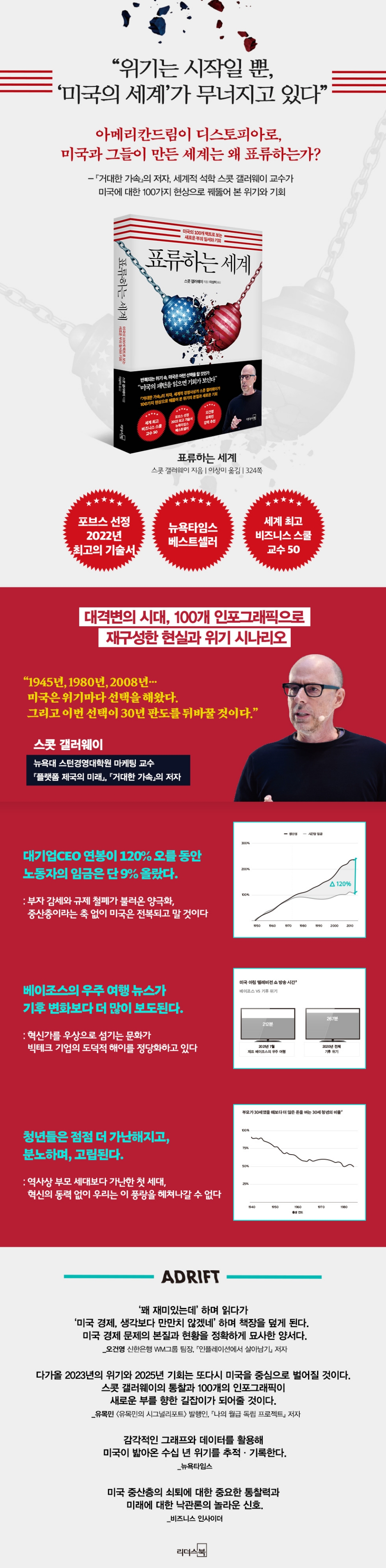
The author of "The Great Acceleration" has a new book, "The World's Top 50 Business School Professors" (Points & Quants). Oh Geon-young strongly recommends Nomad "The crisis is just beginning; 'American World' is adrift." America's choices now will shape the landscape for the next 30 years and determine our destiny! Scott Galloway, professor of marketing at New York University's Stern School of Business The Essence of the Crisis and New Opportunities Seen Through 100 Phenomena in America The 'American world' is adrift. Amid accelerating geopolitical conflict, hegemonic crises, polarization, and internal divisions, what choices will the United States make? Scott Galloway, professor at New York University and author of "The Great Acceleration" and "The Future of Platform Empires," is one of the most influential business thinkers. He meets Korean readers with his new book, ADRIFT, which contains chilling insights into the adrift United States and the crumbling world order. The author asserts that at every turning point in history over the past 100 years, the United States has made clear choices, and that this choice will determine the course of the next 30 years. This book vividly reveals the nature of the crisis facing the United States and the international community, as well as the urgent political and economic issues, through 100 infographics. The reality of America, vividly depicted in data in this book, is not just their story. In this age of cataclysmic change, where history as we know it is being rewritten overnight, will you be swept away by the storm, or will you embark on a new path to wealth? This book has a clue. |
- You can preview some of the book's contents.
Preview
index
CHAPTER 1: The Emerging Religion of Shareholder Value
Tax cuts for the wealthy fueled debt
The government's presence has diminished.
No infrastructure investment
America's mental health is collapsing.
There is no place for workers
Leveraged buyouts only benefit corporate raiders.
Rising productivity, stagnant wages
The 99 to 1 social and class mobility has disappeared.
The National Tax Service is not functioning properly.
Half of corporate profits are transferred overseas.
Half of Americans are shareholders
CHAPTER 2 The Order Created by America
The most prosperous era in history
Humanity liberated from poverty
Life expectancy has increased
Democracy has become competitive
Immigrants drive innovation
Consumerism built on containers
The Birth of the Hyperconnected Era
Technological advancements are accelerating
American institutions = genius incubators
The world's largest donor, the United States
CHAPTER 3: The Innovator Who Became an Idol
The community is collapsing
1 in 10 people drink contaminated water
Corporations monopolized R&D
Only highly educated people can get jobs
Worship the innovator
The founder had unprecedented power.
Money is more precious than sweat
Entry into the 1 trillion club has accelerated.
There is no boundary between vision and nonsense.
Tech companies dominate government
Bezos News Beats the Climate Crisis
CHAPTER 4 THE HUNGER GAMES
Protect only the interests of the company
CEOs earn 350 times the average salary.
From tilted playground to dystopia
COVID-19 has boosted big tech.
The minimum wage is decades behind.
What are our priorities?
The real economy and the financial economy are disconnected.
Wealth flows from youth to old age.
Skyrocketing student debt is hitting the middle class.
The education gap cannot be narrowed.
Unbearable over-administration of medical care
Young people becoming poor and angry
CHAPTER 5 Economics in the Hyperconnected Era
The entire nation is addicted to smartphones.
Digital advertising dominates the industry
Journalism is collapsing
Shock and outrage consume the media.
Fake news spreads six times faster than the truth.
The problem isn't censorship, it's the algorithms.
I'm increasingly distrustful of the news.
Crime rates are falling, but crime news is skyrocketing.
There is no such thing as a 'natural encounter'
CHAPTER 6 House of Cards
The number of poor and sick singles is increasing.
Men's obligation to support has not decreased.
Men's college enrollment rate is falling.
Dating apps have become a breeding ground for inequality.
Political divisions persist for generations.
The number of kangaroo tribes is increasing
The population growth rate is slowing to Great Depression levels.
It is unequal for both men and women
The number of lonely and violent men is increasing.
I don't trust the government anymore
The racial gap has widened.
Venture Capital = White + Male + Ivy League
CHAPTER 7 Crisis or Opportunity
The position of the strongest country is solid
The reserve currency premium is being challenged.
It's been a long time since we lost our position as the largest trading nation.
The value of military equipment falls
The more you use, the more often you lose
Chinese drone war
We were completely defeated in the war against disease.
America's greatest brand is rusting.
R&D competitiveness is at risk
There is no clean energy without China.
Competition between companies and China has intensified.
CHAPTER 8 The Wind of Innovation
Crisis spurred growth
Values are reorganized in a recession.
We need a whirlwind of innovation.
No opportunity without immigrants
The American Dream is not over.
Embrace the Financially Excluded
CHAPTER 9 POSSIBLE FUTURES
Will America's money game continue?
The specter of hyperinflation
Both the left and the right seek answers in the social safety net.
Beware of Bureaucratic Zombies
A world created by metaverse natives
A world without physical constraints
Loneliness Becomes the New Disease
CHAPTER 10 A New Order
Simplify the tax law
We need to rebuild our regulatory system.
We can't leave these illegal companies alone.
Stop the Social Media Companies from Running Wild
Get rid of the stigma of having the highest incarceration rate
A one-time wealth tax is unavoidable.
Nuclear power plants need a facelift.
Supporting children in poverty cannot be delayed.
Open the door to college students
Technical education is another ladder of success.
Expand national public services
conclusion
Acknowledgements
main
A fresh narrative about the icon that is America.
Recommendation
Tax cuts for the wealthy fueled debt
The government's presence has diminished.
No infrastructure investment
America's mental health is collapsing.
There is no place for workers
Leveraged buyouts only benefit corporate raiders.
Rising productivity, stagnant wages
The 99 to 1 social and class mobility has disappeared.
The National Tax Service is not functioning properly.
Half of corporate profits are transferred overseas.
Half of Americans are shareholders
CHAPTER 2 The Order Created by America
The most prosperous era in history
Humanity liberated from poverty
Life expectancy has increased
Democracy has become competitive
Immigrants drive innovation
Consumerism built on containers
The Birth of the Hyperconnected Era
Technological advancements are accelerating
American institutions = genius incubators
The world's largest donor, the United States
CHAPTER 3: The Innovator Who Became an Idol
The community is collapsing
1 in 10 people drink contaminated water
Corporations monopolized R&D
Only highly educated people can get jobs
Worship the innovator
The founder had unprecedented power.
Money is more precious than sweat
Entry into the 1 trillion club has accelerated.
There is no boundary between vision and nonsense.
Tech companies dominate government
Bezos News Beats the Climate Crisis
CHAPTER 4 THE HUNGER GAMES
Protect only the interests of the company
CEOs earn 350 times the average salary.
From tilted playground to dystopia
COVID-19 has boosted big tech.
The minimum wage is decades behind.
What are our priorities?
The real economy and the financial economy are disconnected.
Wealth flows from youth to old age.
Skyrocketing student debt is hitting the middle class.
The education gap cannot be narrowed.
Unbearable over-administration of medical care
Young people becoming poor and angry
CHAPTER 5 Economics in the Hyperconnected Era
The entire nation is addicted to smartphones.
Digital advertising dominates the industry
Journalism is collapsing
Shock and outrage consume the media.
Fake news spreads six times faster than the truth.
The problem isn't censorship, it's the algorithms.
I'm increasingly distrustful of the news.
Crime rates are falling, but crime news is skyrocketing.
There is no such thing as a 'natural encounter'
CHAPTER 6 House of Cards
The number of poor and sick singles is increasing.
Men's obligation to support has not decreased.
Men's college enrollment rate is falling.
Dating apps have become a breeding ground for inequality.
Political divisions persist for generations.
The number of kangaroo tribes is increasing
The population growth rate is slowing to Great Depression levels.
It is unequal for both men and women
The number of lonely and violent men is increasing.
I don't trust the government anymore
The racial gap has widened.
Venture Capital = White + Male + Ivy League
CHAPTER 7 Crisis or Opportunity
The position of the strongest country is solid
The reserve currency premium is being challenged.
It's been a long time since we lost our position as the largest trading nation.
The value of military equipment falls
The more you use, the more often you lose
Chinese drone war
We were completely defeated in the war against disease.
America's greatest brand is rusting.
R&D competitiveness is at risk
There is no clean energy without China.
Competition between companies and China has intensified.
CHAPTER 8 The Wind of Innovation
Crisis spurred growth
Values are reorganized in a recession.
We need a whirlwind of innovation.
No opportunity without immigrants
The American Dream is not over.
Embrace the Financially Excluded
CHAPTER 9 POSSIBLE FUTURES
Will America's money game continue?
The specter of hyperinflation
Both the left and the right seek answers in the social safety net.
Beware of Bureaucratic Zombies
A world created by metaverse natives
A world without physical constraints
Loneliness Becomes the New Disease
CHAPTER 10 A New Order
Simplify the tax law
We need to rebuild our regulatory system.
We can't leave these illegal companies alone.
Stop the Social Media Companies from Running Wild
Get rid of the stigma of having the highest incarceration rate
A one-time wealth tax is unavoidable.
Nuclear power plants need a facelift.
Supporting children in poverty cannot be delayed.
Open the door to college students
Technical education is another ladder of success.
Expand national public services
conclusion
Acknowledgements
main
A fresh narrative about the icon that is America.
Recommendation
Detailed image
Into the book
America is adrift.
It is not because there is no wind or sails, nor because there is no captain or equipment.
The mighty ship that is America is floundering in a sea of political conflict, corruption, and selfishness.
The debates surrounding society are violent, young people are having trouble forming relationships, and the smartest people are pursuing personal glory at the expense of the nation.
The community is in decline.
The connective tissue of society has been damaged beyond repair.
Darkness gathers over the horizon and thunder cracks.
Across the Pacific, China is rising, and across the Atlantic, Europe is declining.
What does it take to turn a ship from the windswept waters and sail toward a path of peace and prosperity? I can't tell the difference between ships and sails, but I know how to read a chart.
There is something powerful about charts that visually represent data.
---From "Entering"
In 1980, as in 1945, fearful predictions of the nation's demise sparked a fierce debate about the future course of the American experiment.
Just as America's response to the challenges it faced in the postwar era was significant, our response to the national crisis of 1980 shaped the America we know today, 40 years later.
(Omitted) The 100 data points covered in this book tell the story of how America got to where it is and where it is headed.
To be clear, we did not use data and infographics because they guarantee objectivity or have fewer errors.
We chose it because it intuitively shows the America we understand.
Pictures and graphs have a clarity that words cannot match.
The mission of this book is simple.
It's about moving hearts and driving action through clear visuals.
---From "Entering"
One thing is certain: the Reagan administration's tax cuts have pushed the federal deficit to its highest level since World War II.
When Reagan took office, the national debt was $930 billion, but by the end of his term it had reached $2.7 trillion.
No president has ever tripled the size of the national debt without even a war.
The greater harm was that Reagan brought about a "lack of long-term thinking" in America.
---From "01 Tax cuts for the rich increased debt"
Since the mid-1970s, productivity and wages have begun to move separately.
The value of output continued to rise, but the wages workers received did not.
Between 1973 and 2014, net productivity increased by 72 percent, but workers' hourly wages increased by only 9 percent.
Workers' wages were less than half of what they would have been if productivity had kept pace.
In other words, the US continued to win the game, but workers only received half of the chips they won in cash.
The money started going elsewhere.
---From "07 Rising Productivity, Stagnant Wages"
The rise of the American economy after World War II, coupled with technological advancements, brought unprecedented prosperity to all of humanity.
No one can properly understand America and the world today without recognizing that the United States has benefited enormously, even if the costs involved obscure the meaning of prosperity.
---From "CHAPTER 2: The Order Created by America"
When Adam Neumann's company WeWork filed for an IPO in 2019, "Adam" appeared 169 times in the prospectus.
Many of these references described the complex private financial arrangements Adam had concocted to secure as much funding as possible from investors.
Just over a month after filing its S-1, WeWork's initial public offering fell through and Neumann was fired.
Neumann's example is extreme, but the cult of innovators is evident throughout recent IPO filings.
---From "26 Worshiping Innovators"
In 1990, the top 1 percent of Americans controlled more than their fair share.
The lopsided distribution of wealth gave birth to a dystopia 31 years later.
In 2021, 50 percent of Americans owned just 2 percent of the nation's wealth, while the richest 1 percent owned nearly a third.
Wealth inequality has also worsened globally.
(Omitted) America's secret was the balance between free market policies and anti-competitive regulations.
But as regulation became demonized and the CEOs of the big tech companies people loved became tycoons, America softened its stance and the middle class was left devastated.
---From "35 From a Tilted Playground to Dystopia"
An MIT study examined a data set of 126,000 tweets across categories including science, terrorism, and finance, and ranked them by factual accuracy.
The research team found that it took six times longer for a lie to reach 1,500 people than it did for the truth to reach them.
Meanwhile, it is said that 7 out of 10 adult Twitter users in the United States get their news from Twitter.
And 80 percent of all tweets come from 10 percent of users.
---From "49 Fake news spreads 6 times faster than the truth"
Bored young people with no way to find financial stability or meaningful relationships are a danger not only to themselves but also to society.
According to a 2019 Secret Service report, only one in three perpetrators of mass violence exhibited signs of mental illness.
In contrast, 92 percent of perpetrators of violence were male, and more than two-thirds were under 35 years old.
(Omitted) The loss of economic direction among young people is a serious problem for women as well, but it appears to be relatively less dangerous compared to men.
When young women feel shame and anger, they don't resort to semi-automatic weapons.
It is not because there is no wind or sails, nor because there is no captain or equipment.
The mighty ship that is America is floundering in a sea of political conflict, corruption, and selfishness.
The debates surrounding society are violent, young people are having trouble forming relationships, and the smartest people are pursuing personal glory at the expense of the nation.
The community is in decline.
The connective tissue of society has been damaged beyond repair.
Darkness gathers over the horizon and thunder cracks.
Across the Pacific, China is rising, and across the Atlantic, Europe is declining.
What does it take to turn a ship from the windswept waters and sail toward a path of peace and prosperity? I can't tell the difference between ships and sails, but I know how to read a chart.
There is something powerful about charts that visually represent data.
---From "Entering"
In 1980, as in 1945, fearful predictions of the nation's demise sparked a fierce debate about the future course of the American experiment.
Just as America's response to the challenges it faced in the postwar era was significant, our response to the national crisis of 1980 shaped the America we know today, 40 years later.
(Omitted) The 100 data points covered in this book tell the story of how America got to where it is and where it is headed.
To be clear, we did not use data and infographics because they guarantee objectivity or have fewer errors.
We chose it because it intuitively shows the America we understand.
Pictures and graphs have a clarity that words cannot match.
The mission of this book is simple.
It's about moving hearts and driving action through clear visuals.
---From "Entering"
One thing is certain: the Reagan administration's tax cuts have pushed the federal deficit to its highest level since World War II.
When Reagan took office, the national debt was $930 billion, but by the end of his term it had reached $2.7 trillion.
No president has ever tripled the size of the national debt without even a war.
The greater harm was that Reagan brought about a "lack of long-term thinking" in America.
---From "01 Tax cuts for the rich increased debt"
Since the mid-1970s, productivity and wages have begun to move separately.
The value of output continued to rise, but the wages workers received did not.
Between 1973 and 2014, net productivity increased by 72 percent, but workers' hourly wages increased by only 9 percent.
Workers' wages were less than half of what they would have been if productivity had kept pace.
In other words, the US continued to win the game, but workers only received half of the chips they won in cash.
The money started going elsewhere.
---From "07 Rising Productivity, Stagnant Wages"
The rise of the American economy after World War II, coupled with technological advancements, brought unprecedented prosperity to all of humanity.
No one can properly understand America and the world today without recognizing that the United States has benefited enormously, even if the costs involved obscure the meaning of prosperity.
---From "CHAPTER 2: The Order Created by America"
When Adam Neumann's company WeWork filed for an IPO in 2019, "Adam" appeared 169 times in the prospectus.
Many of these references described the complex private financial arrangements Adam had concocted to secure as much funding as possible from investors.
Just over a month after filing its S-1, WeWork's initial public offering fell through and Neumann was fired.
Neumann's example is extreme, but the cult of innovators is evident throughout recent IPO filings.
---From "26 Worshiping Innovators"
In 1990, the top 1 percent of Americans controlled more than their fair share.
The lopsided distribution of wealth gave birth to a dystopia 31 years later.
In 2021, 50 percent of Americans owned just 2 percent of the nation's wealth, while the richest 1 percent owned nearly a third.
Wealth inequality has also worsened globally.
(Omitted) America's secret was the balance between free market policies and anti-competitive regulations.
But as regulation became demonized and the CEOs of the big tech companies people loved became tycoons, America softened its stance and the middle class was left devastated.
---From "35 From a Tilted Playground to Dystopia"
An MIT study examined a data set of 126,000 tweets across categories including science, terrorism, and finance, and ranked them by factual accuracy.
The research team found that it took six times longer for a lie to reach 1,500 people than it did for the truth to reach them.
Meanwhile, it is said that 7 out of 10 adult Twitter users in the United States get their news from Twitter.
And 80 percent of all tweets come from 10 percent of users.
---From "49 Fake news spreads 6 times faster than the truth"
Bored young people with no way to find financial stability or meaningful relationships are a danger not only to themselves but also to society.
According to a 2019 Secret Service report, only one in three perpetrators of mass violence exhibited signs of mental illness.
In contrast, 92 percent of perpetrators of violence were male, and more than two-thirds were under 35 years old.
(Omitted) The loss of economic direction among young people is a serious problem for women as well, but it appears to be relatively less dangerous compared to men.
When young women feel shame and anger, they don't resort to semi-automatic weapons.
---From "62 The number of lonely and violent men is increasing"
Publisher's Review
■ "America Drifting, World Order Collapsing... Where Are We Now?"
- Professor Scott Galloway's crisis scenario reconstructed from 100 facts about the United States.
America is adrift.
The United States, the wealthiest nation in human history, is floundering in a sea of political strife, corruption, economic headwinds, and selfishness, and is struggling to navigate the challenges of China and the decline of its European allies.
Where does the fate of hegemony lie, and how will we respond to stagflation and the debt crisis? Scott Galloway, author of "The Great Acceleration" and a world-renowned management thinker and professor at New York University's Stern School of Business, turns his gaze to the structure of recurring crises and seeks answers in the path the United States has traversed over the past century.
"The Drifting World" vividly illustrates the nature of the crisis facing the United States and the international community, as well as the urgent political and economic issues, through 100 charts.
We examine the major political and economic events that shaped the United States today, including World War II, Reaganomics in the 1980s, and the 2008 financial crisis. We also examine the causes that have turned America into a dystopia today, including the collapse of the middle class and the social safety net, economic polarization and the strengthening dominance of Big Tech, social divisions exacerbated by polarization and social media, and low trust in government and journalism.
Faced with a perfect storm of shaky hegemony and a new order, what will the United States choose? Instead of lengthy explanations, the author presents data-visualized charts, forcing us to accept this situation.
Scott Galloway's unique interpretation of America's current direction and future isn't just for America.
This book is a prophetic book itself, showing the fate of the Republic of Korea, which has been entrusted to the United States.
South Korea will be able to prepare for the future by learning from the path the United States has taken.
Urgent advice from world-renowned scholars on the collapse of the American world order and the enormous threat it poses.
"This choice will shape the next 30 years. Find new opportunities in America's patterns."
In "The World on the Drift," Galloway focuses not on future prospects but on patterns in America's responses to crises over the past century.
Just as the choices America made in the past shaped the America it is today, the choices we make today will change the landscape for the next 30 years.
The United States, which was able to escape from a deep depression during World War II by using the military industry as a keynote addressing the "arsenal of democracy," was completely transformed into a capitalist engine with the end of the war in 1945.
The next three decades were a period of innovation, driven by record-low unemployment, sustained economic growth, and extensive infrastructure investment and research and development that led to global prosperity (from Chapter 1, The Emerging Religion of Shareholder Value).
In the crisis and upheaval of the 1960s and 1970s, America's success began to falter.
Not only corporate operations, but the entire society was measured by a single metric called shareholder value, and “Wall Street became a church, and the NASDAQ became a worship service.” In the 1980s, the Reagan administration accelerated change by abolishing various government regulations and emphasizing individualism.
That was the choice that made America prosperous today.
But America is once again at a crossroads.
The author asserts that the brand of the United States as a defender of democracy, market capitalism and globalization, driven by innovation and investment, and the prosperity of the middle class were the driving forces behind today's America, but that "world" is now collapsing.
Great prosperity has gone to a few, trust in government has plummeted, and technological advancements have brought further marginalization.
There is no denying that the United States is the embodiment of the crisis the world, and we, are currently experiencing.
The question that remains for us, who are following their success model, is this:
“So where are we now?”
■ A stark denunciation of the collapse of the middle class and polarization, and the reality of America on the brink of collapse.
From a Tilt Playground to Dystopia: Reality Visualized in 100 Infographics
Galloway diagnoses the collapse of the middle class as the core cause of America's drift.
The American middle class served as the stable weight and ballast of the massive capitalist nation of the United States, the industrial force that made the United States an economic powerhouse and achieved the American Dream in the 1930s and 1940s.
The cultural and economic narrative of a middle class built on a combination of active labor unions, rising wages, public education, economic mobility, and abundant manufactured goods began to crumble in the 1980s due to tax cuts for the wealthy, deregulation, and economic policies centered on large corporations.
The debt, which was $930 billion during the Reagan administration, tripled to $2.7 trillion by the end of his term, leading to a deficit and poor infrastructure (p. 27).
As a result of that choice, 40 years later, one in two Americans lacks access to public transportation, one in ten drinks contaminated tap water, and over half a million homeless people and chronic drug addicts without access to health insurance threaten public safety.
The biggest change resulting from this is polarization and the disappearance of the class ladder.
As the value of labor has dwindled, the top 1 percent of entrepreneurs have found it much easier than ever to amass astronomical wealth through tax evasion and exploitation.
While productivity has increased by 72% over the past 40 years (1973-2014), while CEOs of large corporations have seen hourly wages increase by 120%, wage earners have only received a mere 9% increase (p. 40). While half of large American corporations are shifting their profits overseas (2016, Share of Profits of U.S. Multinational Corporations Registered in Offshore Tax Havens, p. 47), wealth concentration has reached a peak, with the richest 1% expected to own one-third of the nation's wealth by 2021 (p. 110).
Never before has the disconnect between America's real and financial economies been so profound.
Total financial assets rose from a ratio of 2:1 to GDP in the 1980s to a peak of 5.9:1 at the start of the pandemic (p. 118). It's no coincidence that the massive $50 billion in COVID-19 relief funds went to Delta Airlines, not to low-income households.
Since COVID-19, the wage gap has widened, and soaring student loans and asset inflation have shattered the social ladder.
There is a wealth of data showing that the American Dream has long been shattered.
■ The idolization of Big Tech and the disappearance of innovation created by an individualistic culture, and the United States moving toward a hate society.
"The American Dream Has Collapsed. Is There Hope in a Society Where Creativity and Fair Competition Have Collapsed?"
So what about Silicon Valley, the forefront of innovation? While the dire climate crisis received just 267 minutes of coverage in 2020, news about Jeff Bezos' space travel received a staggering 212 minutes in July 2021 alone (p. 98). The author asks, "If this isn't a cult of reverence for Silicon Valley innovators, what is?"
Galloway, who is considered the most feared expert by Silicon Valley CEOs for his sharp criticism of Big Tech companies, closely analyzes the negative effects of America's deep-rooted individualism and obsession with technology in this book.
According to the author, Yogababble (the meaningless language found in the mission statements of tech unicorns) filled with exaggerated visions and fancy manifestos created a culture that made it easy for Tesla, with a mere $32 billion in revenue, to enter the "four-comma club" (a term for companies valued in the trillions).
America's deeply ingrained individualistic culture, where success is seen as the fruit of individual achievement and genius, naturally shifts credit for economic growth away from the working masses and toward opportunistic and lucky "innovators." While tech companies' political and economic dominance grows, communities and social cohesion are rapidly disintegrating.
The internet connects the world, but social media algorithms further isolate and divide us.
Fake news spreads six times faster on Twitter than the truth, and YouTube videos featuring disturbing content get 70% more views than regular videos.
Social media algorithms have exacerbated political divisions for generations, and two in five Biden supporters say it's time to divide the country along party lines (p. 155). The imbalance between white, mainstream males and the rest of the population, measured by education, economics, and socialization, is already irreversible.
Skyrocketing tuition costs have narrowed the gates to higher education, reducing opportunities for social mobility. Declining birth rates and reduced immigration have slowed population growth to levels comparable to the Great Depression, and anger is seething among the lonely, poor, and marginalized.
Internal division has been a hallmark of America since its founding, but now the very name "United States of America" seems paradoxical.
■ Read America's Path: A New Order and Opportunity Born from Crisis
“The best way to predict the future is to create it.”
While the United States 'heals' its internal problems, challengers are vying for America's leadership.
The US government's helplessness in the face of the pandemic, while faltering before a challenger like China in not only the arms race but also in R&D investment and corporate growth rates, has tarnished the US's reputation as a superpower.
The most serious threat is climate change.
American companies are investing heavily in the potential clean energy market, but all this innovation would be impossible without China.
The author emphasizes that decarbonization is a crucial opportunity for the United States, a "fully accessible market" for humanity, that it must not miss.
Will there ever be an end to this crisis? If this story seems solely American, this dystopian crisis will engulf us all.
The author urges us to take decisive action, saying we need a "storm of innovation" to pull our drifting ship back on track.
The best way to predict the future is to create it.
The author remains hopeful that a recession can be an opportunity to create greater market value, and that challenges driven by immigrants and diversity will spark a whirlwind of innovation.
It presents a diverse range of futures we can create through the lenses of technology, economy, and policy, including risk-taking innovation and the restoration of diversity, strengthening the social safety net and eradicating corruption, and new communication.
In this age of upheaval, this book, filled with Galloway's insights, will serve as the first step toward seizing the new order of wealth and opportunities.
A message of hope for a bleak future that is difficult to fathom. _Amazon Reader Review
- Professor Scott Galloway's crisis scenario reconstructed from 100 facts about the United States.
America is adrift.
The United States, the wealthiest nation in human history, is floundering in a sea of political strife, corruption, economic headwinds, and selfishness, and is struggling to navigate the challenges of China and the decline of its European allies.
Where does the fate of hegemony lie, and how will we respond to stagflation and the debt crisis? Scott Galloway, author of "The Great Acceleration" and a world-renowned management thinker and professor at New York University's Stern School of Business, turns his gaze to the structure of recurring crises and seeks answers in the path the United States has traversed over the past century.
"The Drifting World" vividly illustrates the nature of the crisis facing the United States and the international community, as well as the urgent political and economic issues, through 100 charts.
We examine the major political and economic events that shaped the United States today, including World War II, Reaganomics in the 1980s, and the 2008 financial crisis. We also examine the causes that have turned America into a dystopia today, including the collapse of the middle class and the social safety net, economic polarization and the strengthening dominance of Big Tech, social divisions exacerbated by polarization and social media, and low trust in government and journalism.
Faced with a perfect storm of shaky hegemony and a new order, what will the United States choose? Instead of lengthy explanations, the author presents data-visualized charts, forcing us to accept this situation.
Scott Galloway's unique interpretation of America's current direction and future isn't just for America.
This book is a prophetic book itself, showing the fate of the Republic of Korea, which has been entrusted to the United States.
South Korea will be able to prepare for the future by learning from the path the United States has taken.
Urgent advice from world-renowned scholars on the collapse of the American world order and the enormous threat it poses.
"This choice will shape the next 30 years. Find new opportunities in America's patterns."
In "The World on the Drift," Galloway focuses not on future prospects but on patterns in America's responses to crises over the past century.
Just as the choices America made in the past shaped the America it is today, the choices we make today will change the landscape for the next 30 years.
The United States, which was able to escape from a deep depression during World War II by using the military industry as a keynote addressing the "arsenal of democracy," was completely transformed into a capitalist engine with the end of the war in 1945.
The next three decades were a period of innovation, driven by record-low unemployment, sustained economic growth, and extensive infrastructure investment and research and development that led to global prosperity (from Chapter 1, The Emerging Religion of Shareholder Value).
In the crisis and upheaval of the 1960s and 1970s, America's success began to falter.
Not only corporate operations, but the entire society was measured by a single metric called shareholder value, and “Wall Street became a church, and the NASDAQ became a worship service.” In the 1980s, the Reagan administration accelerated change by abolishing various government regulations and emphasizing individualism.
That was the choice that made America prosperous today.
But America is once again at a crossroads.
The author asserts that the brand of the United States as a defender of democracy, market capitalism and globalization, driven by innovation and investment, and the prosperity of the middle class were the driving forces behind today's America, but that "world" is now collapsing.
Great prosperity has gone to a few, trust in government has plummeted, and technological advancements have brought further marginalization.
There is no denying that the United States is the embodiment of the crisis the world, and we, are currently experiencing.
The question that remains for us, who are following their success model, is this:
“So where are we now?”
■ A stark denunciation of the collapse of the middle class and polarization, and the reality of America on the brink of collapse.
From a Tilt Playground to Dystopia: Reality Visualized in 100 Infographics
Galloway diagnoses the collapse of the middle class as the core cause of America's drift.
The American middle class served as the stable weight and ballast of the massive capitalist nation of the United States, the industrial force that made the United States an economic powerhouse and achieved the American Dream in the 1930s and 1940s.
The cultural and economic narrative of a middle class built on a combination of active labor unions, rising wages, public education, economic mobility, and abundant manufactured goods began to crumble in the 1980s due to tax cuts for the wealthy, deregulation, and economic policies centered on large corporations.
The debt, which was $930 billion during the Reagan administration, tripled to $2.7 trillion by the end of his term, leading to a deficit and poor infrastructure (p. 27).
As a result of that choice, 40 years later, one in two Americans lacks access to public transportation, one in ten drinks contaminated tap water, and over half a million homeless people and chronic drug addicts without access to health insurance threaten public safety.
The biggest change resulting from this is polarization and the disappearance of the class ladder.
As the value of labor has dwindled, the top 1 percent of entrepreneurs have found it much easier than ever to amass astronomical wealth through tax evasion and exploitation.
While productivity has increased by 72% over the past 40 years (1973-2014), while CEOs of large corporations have seen hourly wages increase by 120%, wage earners have only received a mere 9% increase (p. 40). While half of large American corporations are shifting their profits overseas (2016, Share of Profits of U.S. Multinational Corporations Registered in Offshore Tax Havens, p. 47), wealth concentration has reached a peak, with the richest 1% expected to own one-third of the nation's wealth by 2021 (p. 110).
Never before has the disconnect between America's real and financial economies been so profound.
Total financial assets rose from a ratio of 2:1 to GDP in the 1980s to a peak of 5.9:1 at the start of the pandemic (p. 118). It's no coincidence that the massive $50 billion in COVID-19 relief funds went to Delta Airlines, not to low-income households.
Since COVID-19, the wage gap has widened, and soaring student loans and asset inflation have shattered the social ladder.
There is a wealth of data showing that the American Dream has long been shattered.
■ The idolization of Big Tech and the disappearance of innovation created by an individualistic culture, and the United States moving toward a hate society.
"The American Dream Has Collapsed. Is There Hope in a Society Where Creativity and Fair Competition Have Collapsed?"
So what about Silicon Valley, the forefront of innovation? While the dire climate crisis received just 267 minutes of coverage in 2020, news about Jeff Bezos' space travel received a staggering 212 minutes in July 2021 alone (p. 98). The author asks, "If this isn't a cult of reverence for Silicon Valley innovators, what is?"
Galloway, who is considered the most feared expert by Silicon Valley CEOs for his sharp criticism of Big Tech companies, closely analyzes the negative effects of America's deep-rooted individualism and obsession with technology in this book.
According to the author, Yogababble (the meaningless language found in the mission statements of tech unicorns) filled with exaggerated visions and fancy manifestos created a culture that made it easy for Tesla, with a mere $32 billion in revenue, to enter the "four-comma club" (a term for companies valued in the trillions).
America's deeply ingrained individualistic culture, where success is seen as the fruit of individual achievement and genius, naturally shifts credit for economic growth away from the working masses and toward opportunistic and lucky "innovators." While tech companies' political and economic dominance grows, communities and social cohesion are rapidly disintegrating.
The internet connects the world, but social media algorithms further isolate and divide us.
Fake news spreads six times faster on Twitter than the truth, and YouTube videos featuring disturbing content get 70% more views than regular videos.
Social media algorithms have exacerbated political divisions for generations, and two in five Biden supporters say it's time to divide the country along party lines (p. 155). The imbalance between white, mainstream males and the rest of the population, measured by education, economics, and socialization, is already irreversible.
Skyrocketing tuition costs have narrowed the gates to higher education, reducing opportunities for social mobility. Declining birth rates and reduced immigration have slowed population growth to levels comparable to the Great Depression, and anger is seething among the lonely, poor, and marginalized.
Internal division has been a hallmark of America since its founding, but now the very name "United States of America" seems paradoxical.
■ Read America's Path: A New Order and Opportunity Born from Crisis
“The best way to predict the future is to create it.”
While the United States 'heals' its internal problems, challengers are vying for America's leadership.
The US government's helplessness in the face of the pandemic, while faltering before a challenger like China in not only the arms race but also in R&D investment and corporate growth rates, has tarnished the US's reputation as a superpower.
The most serious threat is climate change.
American companies are investing heavily in the potential clean energy market, but all this innovation would be impossible without China.
The author emphasizes that decarbonization is a crucial opportunity for the United States, a "fully accessible market" for humanity, that it must not miss.
Will there ever be an end to this crisis? If this story seems solely American, this dystopian crisis will engulf us all.
The author urges us to take decisive action, saying we need a "storm of innovation" to pull our drifting ship back on track.
The best way to predict the future is to create it.
The author remains hopeful that a recession can be an opportunity to create greater market value, and that challenges driven by immigrants and diversity will spark a whirlwind of innovation.
It presents a diverse range of futures we can create through the lenses of technology, economy, and policy, including risk-taking innovation and the restoration of diversity, strengthening the social safety net and eradicating corruption, and new communication.
In this age of upheaval, this book, filled with Galloway's insights, will serve as the first step toward seizing the new order of wealth and opportunities.
A message of hope for a bleak future that is difficult to fathom. _Amazon Reader Review
GOODS SPECIFICS
- Date of issue: April 1, 2023
- Page count, weight, size: 324 pages | 460g | 150*210*18mm
- ISBN13: 9788901270234
- ISBN10: 8901270234
You may also like
카테고리
korean


korean

![ELLE 엘르 스페셜 에디션 A형 : 12월 [2025]](http://librairie.coreenne.fr/cdn/shop/files/b8e27a3de6c9538896439686c6b0e8fb.jpg?v=1766436872&width=3840)


