

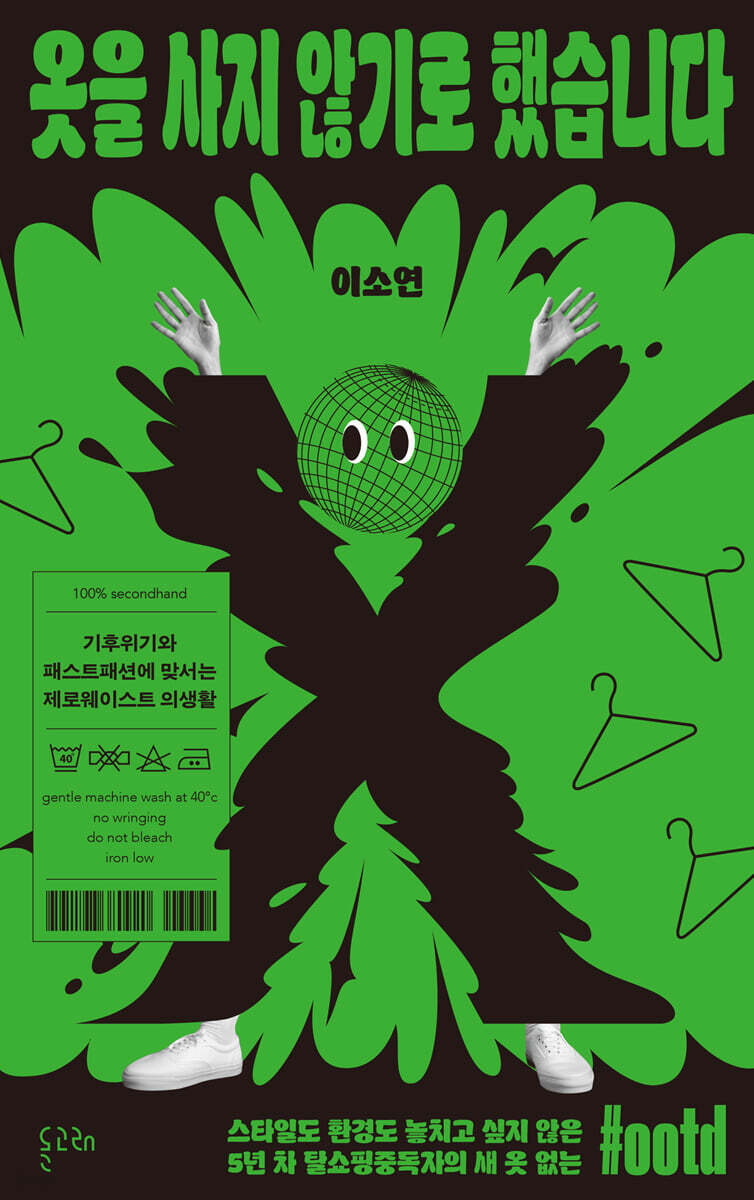
I decided not to buy clothes
 |
Description
Book Introduction
- A word from MD
- [A Life of Style and the Environment] A book written by author Soyeon Lee, who has not bought new clothes for five years.
Why did I decide not to buy clothes? For humanity and the environment.
This book is one individual's effort to challenge the fashion industry's practices that encourage overproduction and consumption.
I was looking for ways to express myself and be happy without having to buy new clothes.
- Son Min-gyu, Social and Political PD
A place that takes care of both style and environment,
How can we have style without exploitation?
The author, who had been buying clothes almost obsessively every day throughout his 20s, was shocked and puzzled one day when he visited a fast fashion store overseas.
“I found a padding that I really like.
Padding filled with soft down and feathers.
I flipped over the price tag and checked, it was $1.50.
It cost less than 2,000 won in our currency.
[… … ] How did you get here for less than the subway fare? Is that even possible?” This incident triggered his decision to stop buying new clothes and began exploring the exploitative realities happening around the world in the name of fashion.
The author, who has been practicing a zero-waste lifestyle for five years and is also active in the marine environmental group Sea Shepherd Korea, exposes the various negative impacts that occur during the production, distribution, and disposal of clothing without filtering.
However, she admits that even if she doesn't buy new clothes on her own, she won't be able to solve the countless problems that arise due to clothes, and confesses that she is still often distracted by pretty clothes.
In this way, "I Decided Not to Buy Clothes" not only exposes the realities inside and outside the fashion industry, but also contains the author's dilemmas and expertise. It is full of stories that readers who pursue both style and environmental protection can relate to and read without needing to make grand resolutions or have any background knowledge.
As the number of people interested in animal rights and the environment has increased, information and know-how on vegan diets and zero-waste lifestyles are being actively shared.
However, despite the negative impact on the actual environment being just as great, the story of our clothing lifestyle has not been discussed very often.
"I Decided Not to Buy Clothes" is a helpful guide for readers who feel a similar thirst and are looking for ways to put it into practice.
How can we have style without exploitation?
The author, who had been buying clothes almost obsessively every day throughout his 20s, was shocked and puzzled one day when he visited a fast fashion store overseas.
“I found a padding that I really like.
Padding filled with soft down and feathers.
I flipped over the price tag and checked, it was $1.50.
It cost less than 2,000 won in our currency.
[… … ] How did you get here for less than the subway fare? Is that even possible?” This incident triggered his decision to stop buying new clothes and began exploring the exploitative realities happening around the world in the name of fashion.
The author, who has been practicing a zero-waste lifestyle for five years and is also active in the marine environmental group Sea Shepherd Korea, exposes the various negative impacts that occur during the production, distribution, and disposal of clothing without filtering.
However, she admits that even if she doesn't buy new clothes on her own, she won't be able to solve the countless problems that arise due to clothes, and confesses that she is still often distracted by pretty clothes.
In this way, "I Decided Not to Buy Clothes" not only exposes the realities inside and outside the fashion industry, but also contains the author's dilemmas and expertise. It is full of stories that readers who pursue both style and environmental protection can relate to and read without needing to make grand resolutions or have any background knowledge.
As the number of people interested in animal rights and the environment has increased, information and know-how on vegan diets and zero-waste lifestyles are being actively shared.
However, despite the negative impact on the actual environment being just as great, the story of our clothing lifestyle has not been discussed very often.
"I Decided Not to Buy Clothes" is a helpful guide for readers who feel a similar thirst and are looking for ways to put it into practice.
- You can preview some of the book's contents.
Preview
index
· Prologue: Wings Called Clothes
Chapter 1: The Real Meaning of Buying Clothes
Chapter 2: You've Never Spent Rationally
Chapter 3: How Trends Are Made
Chapter 4: There's a Person in the Closet
· Chapter 5: If we don't buy clothes, our economy will collapse?
· Chapter 6: It's not that I'm dying, it's just that I'm not buying clothes.
Chapter 7: Things That Look Eco-Friendly But Aren't
· Chapter 8: Nevertheless
Chapter 9: How to Wear New Clothes Without Buying New Clothes
· Epilogue: Your Own Style
· Appendix: Recommended content to help you practice a zero-waste wardrobe
Chapter 1: The Real Meaning of Buying Clothes
Chapter 2: You've Never Spent Rationally
Chapter 3: How Trends Are Made
Chapter 4: There's a Person in the Closet
· Chapter 5: If we don't buy clothes, our economy will collapse?
· Chapter 6: It's not that I'm dying, it's just that I'm not buying clothes.
Chapter 7: Things That Look Eco-Friendly But Aren't
· Chapter 8: Nevertheless
Chapter 9: How to Wear New Clothes Without Buying New Clothes
· Epilogue: Your Own Style
· Appendix: Recommended content to help you practice a zero-waste wardrobe
Into the book
Stopping shopping alone won't change a world plagued by climate crisis and disaster.
Instead, if we all reduced the number of clothes we buy by just one, instead of the ten we used to buy, and discovered the joy of finding our own items in secondhand stores instead of receiving them online, I'm confident we'll be able to create unprecedented change without even realizing it.
--- p.23
Being unable to wear clothes is mostly a matter of time.
It's a matter of time, not a metaphor.
Because fashion trends change so quickly.
Who are the leaders of this speed war? If you thought of H&M, Zara, and Uniqlo, the brands still synonymous with fast fashion in Korea, even those are now a thing of the past.
Zara releases new products twice a week, but ASOS, a British shopping mall that pioneered 'ultra-fast fashion' and has grown into a global company since 2013, releases around 4,500 new products every week.
Chinese online shopping mall Shein launched up to 10,000 new designs in the second half of 2021 alone.
--- p.27
When I was sad, I bought clothes because I was sad, and when I was happy, I bought clothes because I was happy.
But even when I came home from the mall with new clothes, I always felt small, anxious, and unhappy when I stood in front of my wardrobe.
Even as I stood in front of the mirror looking at myself in new clothes, trends were constantly changing.
The shelf life of satisfaction with new clothes was extremely short.
Maybe the more clothes I had, the angrier I got.
So many clothes, but nothing to wear? Shopping has become a daily, universal way of isolating my life.
--- p.26~27
Let's look at the case of Kenya.
Kenya is one of the world's top five importers of used clothing.
Used clothes are pouring into Gikomba Market in the capital city of Nairobi.
About half of them are unusable or have no market value.
The name 'resource' is meaningless.
It's closer to trash that's difficult to process.
About 150 to 200 tons of textile waste (60 to 75 truckloads) are sent to landfills every day.
--- p.49
One day, I had a drink with a friend who works at a textile company for the first time in a long time.
My friend asked me.
"Aren't you a sea shepherd or something? If you want to protect the ocean environment, you should start by changing your group's colors.
“How much wastewater is produced in making black clothes?” he added jokingly.
“Guys, if the prices are the same, buy the black ones.
It costs a lot of money to make it black.
“It’s eight times more expensive, so it’s eight times more profitable.” It was a miraculous logic that since dyeing fabric black was much more expensive and took longer than dyeing other colors, it was more profitable to buy black clothes that were expensive to produce.
--- p.59
Twenty percent of industrial wastewater generated worldwide comes from direct current treatment and dyeing processes.
In Southeast Asia and China, where there are many clothing dyeing factories, there are even stories that the river water near the factories is dyed with the colors that are popular that year, showing how serious the wastewater problem is.
--- p.61
Rational shopping may be a concept that never existed in the first place, like a unicorn that exists only in our imagination.
Think back to the time when you looked at the hot deal or time deal menu just because it was cheap, even though you didn't need it right away.
Have you ever been tempted to buy things indiscriminately by the 10,000 to 50,000 won new sign-up coupons that are about to expire and the frantically blinking "Deadline Imminent" icons?
--- p.95
“If you think that every season’s clothes are made with the pain of creation that every brand puts into them, you are very mistaken,” said one designer.
[… … ] The story shared by J, a second-year designer, over the phone was similar.
He said that while he does consider which customer segment to target and how to maintain or change the brand philosophy and style, his main task is to create something new by mixing various elements within the company's existing design framework.
It seemed far removed from my imagination of drawing a completely creative design on a blank sheet of paper.
Unless they create their own brand, most designers working for companies are unable to pursue their own design dreams.
--- p.110~111
“Oh, it’s Valentino.” “It’s Max Mara.” “These shoes are Prada.” These aren’t the words that came out while strolling through a luxury goods store.
This is what YouTuber Milanonna, the first Korean to study in Milan and a fashion consultant with 40 years of experience, said when she first visited a Zara store. Imagine two people walking down the street wearing a Comme des Garçons short-sleeved T-shirt and a Zara short-sleeved T-shirt.
Can you guess which of these two is a Comme des Garçons product? I'm not a brand savvy, so let's say I am.
But what if even Alexandra Shulman, Vogue's longest-serving editor-in-chief, can't tell the difference? Wait, even the editor-in-chief of Vogue can't tell the difference? Then why are we so desperate to buy luxury goods? What's the real difference between the two?
--- p.119
During the day, they run the factory to produce new designs and colors, plan fashion magazines and various pictorials, and at night, they burn unsold products in the incinerator.
This is a long-standing practice among so-called luxury brands.
Should we accept the symbolism of making shoes by peeling calfskin and then burning it again under the pretext of protecting brand value as individuality and art?
--- p.123
D, a fashion platform manager, confessed that issuing coupons and running marketing campaigns to promote sales often ends up with the bottom line growing bigger than the bottom line.
The more clothes are sold through brokerage, the more it is detrimental to the platform.
The platform is no longer making money from clothes.
Instead, they make a profit by selling good accounts to sellers at high prices.
Consumers who see advertisements for expensive, prominently displayed clothing fall into the cycle of consumption again.
A platform that brings together consumers and sellers, and brings together sellers to consume.
In it, supply and demand circulate endlessly, without beginning or end.
Again, it is not that things exist because they are consumed, but rather that a structure is established in which things exist because they are consumed.
--- p.135
Let's take a moment to imagine what I was doing around April 2013.
I was a freshman in college, excited about everything.
[… … ] If you vaguely remember that time when cherry blossoms were fluttering in the wind, imagine what you were wearing back then.
Clothes you probably wouldn't even think of, or clothes you most likely don't own yet.
For those very clothes, someone had to work locked in a factory that was on the verge of collapse. On April 24, 2013, the eight-story Rana Plaza building on the outskirts of Dhaka, the capital of Bangladesh, collapsed in an instant.
At least 1,138 people were killed and over 2,500 were injured.
--- p.141~142
The global apparel trade is worth a total of $1.3 trillion.
If a country called 'clothing country' exists, it would be the 15th largest economy in the world.
With our country's economy at $1.6309 trillion, it ranks 10th in the world, meaning that if clothing sales were just a little better, it would gain enough capital power to threaten Korea.
Under the power of this enormous capital, the chronic tragedy of the clothing industry does not disappear.
It just hides in an invisible place.
--- p.149
Ducks used in the production of padded jackets have their chest feathers plucked out from 10 weeks of age throughout their lives before they are killed.
The pain and shock of having their hair pulled out can cause them to die before they even reach their full potential.
Unlike ducks, raccoons used to make hat decorations are not considered 'edible' animals, so they are subject to less stringent controls during their farming and slaughtering, and spend their lives in harsher environments.
But even the life of the coat, born at the end of the cruel lives of these animals, is temporary.
Out-of-style padded jumpers are headed to the incinerator, like unsold Burberry coats and Hermes bags.
--- p.152
There are also projections that East Asia will account for more than half of global luxury consumption by 2025.
But is it fair to blame the luxury fever sweeping Asia on the vanity of individual Asian consumers? No.
Behind this phenomenon lies a luxury brand company's market expansion strategy.
Since the 1990s, European luxury brands have been steadily attempting major changes to survive and expand.
Rather than focusing on a small number of top-tier customers, they are trying to 'grow the pie' through popularization.
So, while expanding its stores around the world, it also attempted to revamp its traditional brand image to attract new and younger customers.
--- p.188
The amount of waste PET bottles collected in our country each year amounts to approximately 300,000 tons.
While it might sound encouraging to think that this vast amount of waste is being recycled into clothing, the reality is not so encouraging.
The recycling rate of waste PET bottles collected by recycling companies was already at 80 percent.
[… … ] However, recently, as the fast fashion industry began to utilize waste PET bottles, the demand and price of waste PET bottles have skyrocketed.
[… … ] Meanwhile, more than 100 billion pieces of clothing are produced each year, and 33 billion pieces are thrown away.
It is absurd for the fast fashion industry to ignore this problem and talk about being "eco-friendly," given that so many clothes are produced and thrown away as soon as they are released.
--- p.217~218
More than 100 billion pieces of clothing are produced each year, but 33 billion are thrown away.
It is absurd for the fast fashion industry to ignore this problem and talk about being "eco-friendly," given that so many clothes are produced and thrown away as soon as they are released.
Just changing the fabric during the production process doesn't change the life of the clothes made that way.
The sad journey of clothes is the same: they are sold cheaply, stay in our closets, and are quickly thrown away after a season, ending up in incinerators or piling up in the mountains of developing countries.
--- p.218
Unlike the conventional method where products made with inputs of resources are discarded as waste after their lifespan ends without being used for further production, the circular economy establishes a virtuous cycle of resources so that products that have reached the end of their usefulness are reused and recycled to make the same items.
While individuals can make an effort to avoid buying clothes or to be more mindful of their purchases, companies can also approach circular economy models like this.
Simply put, it means that the beginning and the end of the clothes must be connected.
--- p.263~264
Saying we shouldn't buy new clothes doesn't mean we shouldn't be stylish, quite the opposite.
It means that we should respect and regard clothes as more than just objects, but as the most intimate and intuitive means of expressing ourselves.
Clothing is a major medium that brings life to our daily lives and conveys messages to others.
Therefore, we should definitely wear clothes that fit us better.
Instead, if we all reduced the number of clothes we buy by just one, instead of the ten we used to buy, and discovered the joy of finding our own items in secondhand stores instead of receiving them online, I'm confident we'll be able to create unprecedented change without even realizing it.
--- p.23
Being unable to wear clothes is mostly a matter of time.
It's a matter of time, not a metaphor.
Because fashion trends change so quickly.
Who are the leaders of this speed war? If you thought of H&M, Zara, and Uniqlo, the brands still synonymous with fast fashion in Korea, even those are now a thing of the past.
Zara releases new products twice a week, but ASOS, a British shopping mall that pioneered 'ultra-fast fashion' and has grown into a global company since 2013, releases around 4,500 new products every week.
Chinese online shopping mall Shein launched up to 10,000 new designs in the second half of 2021 alone.
--- p.27
When I was sad, I bought clothes because I was sad, and when I was happy, I bought clothes because I was happy.
But even when I came home from the mall with new clothes, I always felt small, anxious, and unhappy when I stood in front of my wardrobe.
Even as I stood in front of the mirror looking at myself in new clothes, trends were constantly changing.
The shelf life of satisfaction with new clothes was extremely short.
Maybe the more clothes I had, the angrier I got.
So many clothes, but nothing to wear? Shopping has become a daily, universal way of isolating my life.
--- p.26~27
Let's look at the case of Kenya.
Kenya is one of the world's top five importers of used clothing.
Used clothes are pouring into Gikomba Market in the capital city of Nairobi.
About half of them are unusable or have no market value.
The name 'resource' is meaningless.
It's closer to trash that's difficult to process.
About 150 to 200 tons of textile waste (60 to 75 truckloads) are sent to landfills every day.
--- p.49
One day, I had a drink with a friend who works at a textile company for the first time in a long time.
My friend asked me.
"Aren't you a sea shepherd or something? If you want to protect the ocean environment, you should start by changing your group's colors.
“How much wastewater is produced in making black clothes?” he added jokingly.
“Guys, if the prices are the same, buy the black ones.
It costs a lot of money to make it black.
“It’s eight times more expensive, so it’s eight times more profitable.” It was a miraculous logic that since dyeing fabric black was much more expensive and took longer than dyeing other colors, it was more profitable to buy black clothes that were expensive to produce.
--- p.59
Twenty percent of industrial wastewater generated worldwide comes from direct current treatment and dyeing processes.
In Southeast Asia and China, where there are many clothing dyeing factories, there are even stories that the river water near the factories is dyed with the colors that are popular that year, showing how serious the wastewater problem is.
--- p.61
Rational shopping may be a concept that never existed in the first place, like a unicorn that exists only in our imagination.
Think back to the time when you looked at the hot deal or time deal menu just because it was cheap, even though you didn't need it right away.
Have you ever been tempted to buy things indiscriminately by the 10,000 to 50,000 won new sign-up coupons that are about to expire and the frantically blinking "Deadline Imminent" icons?
--- p.95
“If you think that every season’s clothes are made with the pain of creation that every brand puts into them, you are very mistaken,” said one designer.
[… … ] The story shared by J, a second-year designer, over the phone was similar.
He said that while he does consider which customer segment to target and how to maintain or change the brand philosophy and style, his main task is to create something new by mixing various elements within the company's existing design framework.
It seemed far removed from my imagination of drawing a completely creative design on a blank sheet of paper.
Unless they create their own brand, most designers working for companies are unable to pursue their own design dreams.
--- p.110~111
“Oh, it’s Valentino.” “It’s Max Mara.” “These shoes are Prada.” These aren’t the words that came out while strolling through a luxury goods store.
This is what YouTuber Milanonna, the first Korean to study in Milan and a fashion consultant with 40 years of experience, said when she first visited a Zara store. Imagine two people walking down the street wearing a Comme des Garçons short-sleeved T-shirt and a Zara short-sleeved T-shirt.
Can you guess which of these two is a Comme des Garçons product? I'm not a brand savvy, so let's say I am.
But what if even Alexandra Shulman, Vogue's longest-serving editor-in-chief, can't tell the difference? Wait, even the editor-in-chief of Vogue can't tell the difference? Then why are we so desperate to buy luxury goods? What's the real difference between the two?
--- p.119
During the day, they run the factory to produce new designs and colors, plan fashion magazines and various pictorials, and at night, they burn unsold products in the incinerator.
This is a long-standing practice among so-called luxury brands.
Should we accept the symbolism of making shoes by peeling calfskin and then burning it again under the pretext of protecting brand value as individuality and art?
--- p.123
D, a fashion platform manager, confessed that issuing coupons and running marketing campaigns to promote sales often ends up with the bottom line growing bigger than the bottom line.
The more clothes are sold through brokerage, the more it is detrimental to the platform.
The platform is no longer making money from clothes.
Instead, they make a profit by selling good accounts to sellers at high prices.
Consumers who see advertisements for expensive, prominently displayed clothing fall into the cycle of consumption again.
A platform that brings together consumers and sellers, and brings together sellers to consume.
In it, supply and demand circulate endlessly, without beginning or end.
Again, it is not that things exist because they are consumed, but rather that a structure is established in which things exist because they are consumed.
--- p.135
Let's take a moment to imagine what I was doing around April 2013.
I was a freshman in college, excited about everything.
[… … ] If you vaguely remember that time when cherry blossoms were fluttering in the wind, imagine what you were wearing back then.
Clothes you probably wouldn't even think of, or clothes you most likely don't own yet.
For those very clothes, someone had to work locked in a factory that was on the verge of collapse. On April 24, 2013, the eight-story Rana Plaza building on the outskirts of Dhaka, the capital of Bangladesh, collapsed in an instant.
At least 1,138 people were killed and over 2,500 were injured.
--- p.141~142
The global apparel trade is worth a total of $1.3 trillion.
If a country called 'clothing country' exists, it would be the 15th largest economy in the world.
With our country's economy at $1.6309 trillion, it ranks 10th in the world, meaning that if clothing sales were just a little better, it would gain enough capital power to threaten Korea.
Under the power of this enormous capital, the chronic tragedy of the clothing industry does not disappear.
It just hides in an invisible place.
--- p.149
Ducks used in the production of padded jackets have their chest feathers plucked out from 10 weeks of age throughout their lives before they are killed.
The pain and shock of having their hair pulled out can cause them to die before they even reach their full potential.
Unlike ducks, raccoons used to make hat decorations are not considered 'edible' animals, so they are subject to less stringent controls during their farming and slaughtering, and spend their lives in harsher environments.
But even the life of the coat, born at the end of the cruel lives of these animals, is temporary.
Out-of-style padded jumpers are headed to the incinerator, like unsold Burberry coats and Hermes bags.
--- p.152
There are also projections that East Asia will account for more than half of global luxury consumption by 2025.
But is it fair to blame the luxury fever sweeping Asia on the vanity of individual Asian consumers? No.
Behind this phenomenon lies a luxury brand company's market expansion strategy.
Since the 1990s, European luxury brands have been steadily attempting major changes to survive and expand.
Rather than focusing on a small number of top-tier customers, they are trying to 'grow the pie' through popularization.
So, while expanding its stores around the world, it also attempted to revamp its traditional brand image to attract new and younger customers.
--- p.188
The amount of waste PET bottles collected in our country each year amounts to approximately 300,000 tons.
While it might sound encouraging to think that this vast amount of waste is being recycled into clothing, the reality is not so encouraging.
The recycling rate of waste PET bottles collected by recycling companies was already at 80 percent.
[… … ] However, recently, as the fast fashion industry began to utilize waste PET bottles, the demand and price of waste PET bottles have skyrocketed.
[… … ] Meanwhile, more than 100 billion pieces of clothing are produced each year, and 33 billion pieces are thrown away.
It is absurd for the fast fashion industry to ignore this problem and talk about being "eco-friendly," given that so many clothes are produced and thrown away as soon as they are released.
--- p.217~218
More than 100 billion pieces of clothing are produced each year, but 33 billion are thrown away.
It is absurd for the fast fashion industry to ignore this problem and talk about being "eco-friendly," given that so many clothes are produced and thrown away as soon as they are released.
Just changing the fabric during the production process doesn't change the life of the clothes made that way.
The sad journey of clothes is the same: they are sold cheaply, stay in our closets, and are quickly thrown away after a season, ending up in incinerators or piling up in the mountains of developing countries.
--- p.218
Unlike the conventional method where products made with inputs of resources are discarded as waste after their lifespan ends without being used for further production, the circular economy establishes a virtuous cycle of resources so that products that have reached the end of their usefulness are reused and recycled to make the same items.
While individuals can make an effort to avoid buying clothes or to be more mindful of their purchases, companies can also approach circular economy models like this.
Simply put, it means that the beginning and the end of the clothes must be connected.
--- p.263~264
Saying we shouldn't buy new clothes doesn't mean we shouldn't be stylish, quite the opposite.
It means that we should respect and regard clothes as more than just objects, but as the most intimate and intuitive means of expressing ourselves.
Clothing is a major medium that brings life to our daily lives and conveys messages to others.
Therefore, we should definitely wear clothes that fit us better.
--- p.273
Publisher's Review
From luxury brands to fast fashion,
From design theft to incinerator waste
A Comprehensive Report on the Ecology and Economy of Clothing
"I Decided Not to Buy Clothes" unfolds before readers the various harmful effects that occur in clothing production, from the raw material manufacturing stage onward.
The author spent five years extensively researching the fashion industry, both inside and outside of it, interviewing people working in it, analyzing various data and reports published by companies and organizations, and reading reference books on zero waste and reuse.
This book comprehensively explains the author's research on how to practice a zero-waste clothing lifestyle, including why the fashion industry cannot help but be obsessed with speed and volume competition, how the fashion and logistics industries pass the buck, how clothing waste transferred to non-Western developing countries destroys the environment and society there, and how fashion platforms cannot help but take this abnormal production and distribution to the extreme.
For example, cotton, which accounts for 85 percent of the world's textile production, is often considered an eco-friendly fiber because it is grown directly from plants. However, 10 percent of the world's pesticide use is abused in cotton production, which causes significant damage.
In this way, the author conveys the cruel reality of the fashion industry point by point so that readers can intuitively understand it.
But it goes beyond mere exposure to reveal the hidden ambitions of large capital and the exploitative structure of the industry as a whole.
For example, in India, 200,000 cotton farmers committed suicide over a period of 20 years starting in the 1990s, and the truth behind this problem is linked to the tyranny perpetrated by the multinational corporation Monsanto.
Monsanto sold new genetically modified cotton seeds to Indian farmers, claiming they did not need pesticides. However, pests did not decrease, but rather developed resistance to the seeds, and they became more prevalent.
Ultimately, farmers had no choice but to use pesticides (even more powerful ones than before), and the company selling these chemicals was none other than Monsanto.
Eventually, Indian farmers, unable to bear the debt of buying seeds and pesticides every year, chose death one after another.
Meanwhile, recently, more and more companies, conscious of criticism, have shown interest in animal ethics and promoted eco-friendly practices. However, the problem is that these measures are often not eco-friendly at all.
For example, the story of ducks being plucked for their down from 10 weeks old and then killed for the production of padded jackets became known, and the 'responsible down standard (RDS)' product gained attention. However, 80 percent of the world's duck down production comes from China, which lacks animal protection laws, so the certification system is ineffective.
Major fast-fashion brands are also trying to improve their image by promoting policies that collect customers' unworn clothes and donate them to developing countries.
But this often amounts to nothing more than dumping textile waste onto non-Western countries.
In this way, the author exposes the hidden problems behind the superficial changes in fashion companies one by one, ultimately emphasizing the necessity of a circular economy.
This multifaceted discussion allows readers to understand the reality of environmental pollution and human rights violations caused by clothing within the macro context of the global fashion industry.
The fashion industry's constant ploy to stimulate our consumer psychology
How to avoid that trap and achieve self-expression and happiness without new clothes
So why do fashion platforms often give us freebies and even offer free returns? Do we truly understand why we buy clothes? "I Decided Not to Buy Clothes" delves into questions so closely tied to our clothing lives that we've often neglected to ask.
Using an approach that encompasses consumer psychology, the author provides a multi-faceted analysis of how today's fashion industry's management strategies enslave individual consumers and how such behavior fuels environmental destruction.
For example, once people own an item, they tend to place greater value on it than before. Fashion companies use this "endowment effect" and free return benefits to encourage consumption.
Why do young consumers in their 20s and 30s continue to indulge in clothing spending? The author recalls his own struggles with shopping addiction and offers an honest and in-depth exploration of the psychological mechanisms behind it.
“I always buy clothes.
Buying clothes was as easy as buying a pack of gum while walking down the street.
But in the end, I couldn't be happy.
[… … ] I was just barely able to collect cheap items from the shopping mall that was updated every day like mayflies.
“While I was constantly trying to keep up with the ever-faster fashion, my happiness was buried somewhere in my closet, gasping for breath and losing its life.” He reminds us of the truth that buying clothes does not make us happy and not buying clothes does not mean suppressing self-expression, and presents readers with a new option that we have overlooked, namely the possibility of a zero-waste clothing lifestyle.
A Five-Year-Old "Shopping-Free Life" and a Changing World
The author reveals his personal collection of zero-waste fashion tips.
"I Decided Not to Buy Clothes" is practical, above all, because it suggests zero-waste fashion tips that each reader can try and challenge in their daily lives, based on the author's own experiences.
In a society where the distinction between the four seasons, the temptation of various fashion apps and same-day delivery, and the pressure of trends are firmly established, the author, who has been living without buying new clothes for five years, has faithfully included in this book the tips and cautions he has personally accumulated through trial and error.
For example, it contains specific ways to change up your wardrobe without buying new products, organizing tips to prevent unnecessary spending, and truly eco-friendly ways to organize clothes you no longer use, so readers can directly refer to and apply them in their daily lives.
We've also compiled information on spaces and stores that help exchange used clothing, as well as helpful content related to zero-waste lifestyles, along with this book.
The author also mentions positive changes taking place at the corporate level.
It's been over 20 years since the harmful effects of fast fashion began to be pointed out, so it's clear that not only individuals but also fashion companies that truly practice eco-friendliness are emerging.
Furthermore, platforms specializing in reducing carbon emissions through second-hand transactions and clothing rentals, as well as fashion companies striving to implement circular economy models, are emerging.
By presenting a variety of examples of individuals transforming people's lifestyles in a sustainable way, the author encourages readers to envision a positive future together.
From design theft to incinerator waste
A Comprehensive Report on the Ecology and Economy of Clothing
"I Decided Not to Buy Clothes" unfolds before readers the various harmful effects that occur in clothing production, from the raw material manufacturing stage onward.
The author spent five years extensively researching the fashion industry, both inside and outside of it, interviewing people working in it, analyzing various data and reports published by companies and organizations, and reading reference books on zero waste and reuse.
This book comprehensively explains the author's research on how to practice a zero-waste clothing lifestyle, including why the fashion industry cannot help but be obsessed with speed and volume competition, how the fashion and logistics industries pass the buck, how clothing waste transferred to non-Western developing countries destroys the environment and society there, and how fashion platforms cannot help but take this abnormal production and distribution to the extreme.
For example, cotton, which accounts for 85 percent of the world's textile production, is often considered an eco-friendly fiber because it is grown directly from plants. However, 10 percent of the world's pesticide use is abused in cotton production, which causes significant damage.
In this way, the author conveys the cruel reality of the fashion industry point by point so that readers can intuitively understand it.
But it goes beyond mere exposure to reveal the hidden ambitions of large capital and the exploitative structure of the industry as a whole.
For example, in India, 200,000 cotton farmers committed suicide over a period of 20 years starting in the 1990s, and the truth behind this problem is linked to the tyranny perpetrated by the multinational corporation Monsanto.
Monsanto sold new genetically modified cotton seeds to Indian farmers, claiming they did not need pesticides. However, pests did not decrease, but rather developed resistance to the seeds, and they became more prevalent.
Ultimately, farmers had no choice but to use pesticides (even more powerful ones than before), and the company selling these chemicals was none other than Monsanto.
Eventually, Indian farmers, unable to bear the debt of buying seeds and pesticides every year, chose death one after another.
Meanwhile, recently, more and more companies, conscious of criticism, have shown interest in animal ethics and promoted eco-friendly practices. However, the problem is that these measures are often not eco-friendly at all.
For example, the story of ducks being plucked for their down from 10 weeks old and then killed for the production of padded jackets became known, and the 'responsible down standard (RDS)' product gained attention. However, 80 percent of the world's duck down production comes from China, which lacks animal protection laws, so the certification system is ineffective.
Major fast-fashion brands are also trying to improve their image by promoting policies that collect customers' unworn clothes and donate them to developing countries.
But this often amounts to nothing more than dumping textile waste onto non-Western countries.
In this way, the author exposes the hidden problems behind the superficial changes in fashion companies one by one, ultimately emphasizing the necessity of a circular economy.
This multifaceted discussion allows readers to understand the reality of environmental pollution and human rights violations caused by clothing within the macro context of the global fashion industry.
The fashion industry's constant ploy to stimulate our consumer psychology
How to avoid that trap and achieve self-expression and happiness without new clothes
So why do fashion platforms often give us freebies and even offer free returns? Do we truly understand why we buy clothes? "I Decided Not to Buy Clothes" delves into questions so closely tied to our clothing lives that we've often neglected to ask.
Using an approach that encompasses consumer psychology, the author provides a multi-faceted analysis of how today's fashion industry's management strategies enslave individual consumers and how such behavior fuels environmental destruction.
For example, once people own an item, they tend to place greater value on it than before. Fashion companies use this "endowment effect" and free return benefits to encourage consumption.
Why do young consumers in their 20s and 30s continue to indulge in clothing spending? The author recalls his own struggles with shopping addiction and offers an honest and in-depth exploration of the psychological mechanisms behind it.
“I always buy clothes.
Buying clothes was as easy as buying a pack of gum while walking down the street.
But in the end, I couldn't be happy.
[… … ] I was just barely able to collect cheap items from the shopping mall that was updated every day like mayflies.
“While I was constantly trying to keep up with the ever-faster fashion, my happiness was buried somewhere in my closet, gasping for breath and losing its life.” He reminds us of the truth that buying clothes does not make us happy and not buying clothes does not mean suppressing self-expression, and presents readers with a new option that we have overlooked, namely the possibility of a zero-waste clothing lifestyle.
A Five-Year-Old "Shopping-Free Life" and a Changing World
The author reveals his personal collection of zero-waste fashion tips.
"I Decided Not to Buy Clothes" is practical, above all, because it suggests zero-waste fashion tips that each reader can try and challenge in their daily lives, based on the author's own experiences.
In a society where the distinction between the four seasons, the temptation of various fashion apps and same-day delivery, and the pressure of trends are firmly established, the author, who has been living without buying new clothes for five years, has faithfully included in this book the tips and cautions he has personally accumulated through trial and error.
For example, it contains specific ways to change up your wardrobe without buying new products, organizing tips to prevent unnecessary spending, and truly eco-friendly ways to organize clothes you no longer use, so readers can directly refer to and apply them in their daily lives.
We've also compiled information on spaces and stores that help exchange used clothing, as well as helpful content related to zero-waste lifestyles, along with this book.
The author also mentions positive changes taking place at the corporate level.
It's been over 20 years since the harmful effects of fast fashion began to be pointed out, so it's clear that not only individuals but also fashion companies that truly practice eco-friendliness are emerging.
Furthermore, platforms specializing in reducing carbon emissions through second-hand transactions and clothing rentals, as well as fashion companies striving to implement circular economy models, are emerging.
By presenting a variety of examples of individuals transforming people's lifestyles in a sustainable way, the author encourages readers to envision a positive future together.
GOODS SPECIFICS
- Date of issue: November 1, 2023
- Format: Paperback book binding method guide
- Page count, weight, size: 324 pages | 410g | 132*210*21mm
- ISBN13: 9791198380920
- ISBN10: 1198380926
You may also like
카테고리
korean


korean

![GQ KOREA Mark (Monthly): December [2025]](http://librairie.coreenne.fr/cdn/shop/files/8ef265dbbfbf186523ed75ba7319009d.jpg?v=1765340328&width=3840)


