

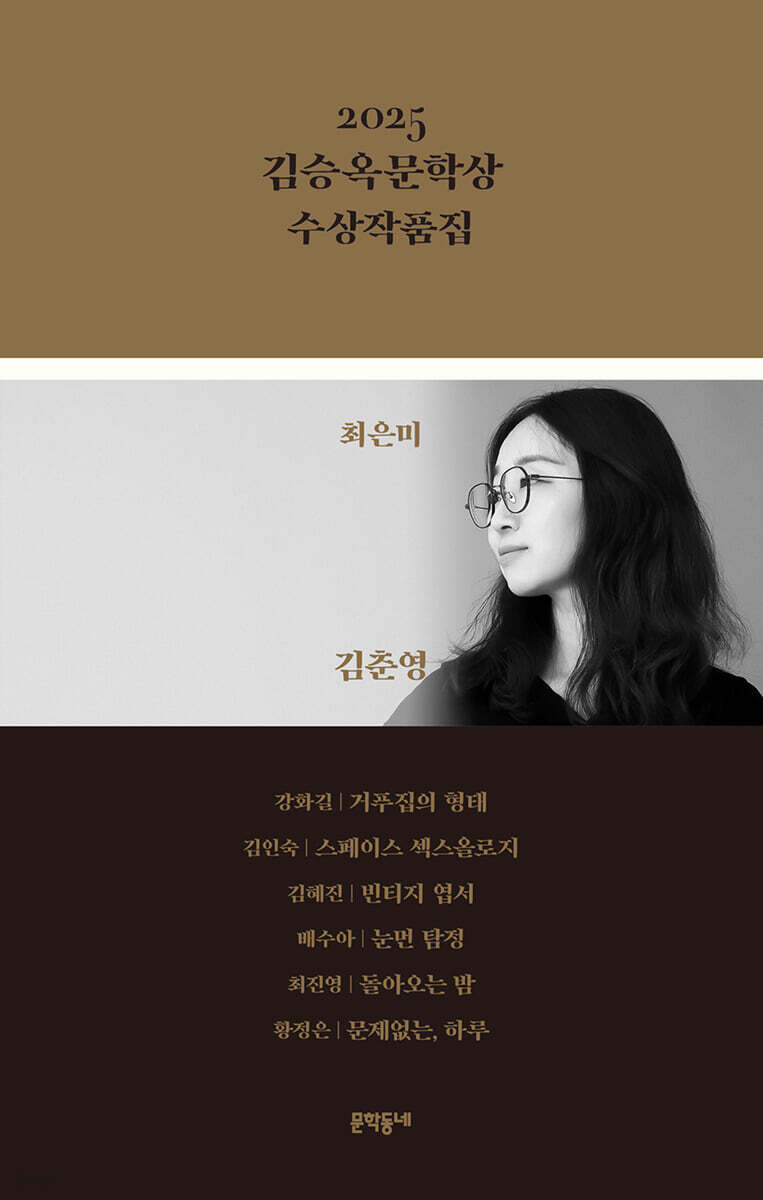
2025 Kim Seung-ok Literary Award Winners' Collection
 |
Description
Book Introduction
- A word from MD
-
The Best and Most Literary Short Stories of 2025The Kim Seung-ok Literary Award, held every fall, selects and presents the most unique short stories published by writers who have been active for more than 10 years since their debut.
This year, a total of seven works were published, including “Kim Chun-young” by Choi Eun-mi.
October 31, 2025. Novel/Poetry PD Kim Yu-ri
The most excellent, the most literary
The pinnacle of Korean short film aesthetics, in name and reality.
The Brilliant Journey of the 10th Kim Seung-ok Literary Award
The Kim Seung-ok Literary Award, which selects one grand prize winner and six excellence prize winners from short stories published over the past year by writers who have been in the literary world for more than ten years, is now in its 10th year.
Thanks to the love and trust readers have shown for this award, the Kim Seung-ok Literary Award has become an indispensable part of Korean literature.
The Kim Seung-ok Literary Award was established in 2013 to commemorate the 50th anniversary of the debut of novelist Kim Seung-ok, who wrote “Mujin Gihaeng” and “Seoul, Winter 1964.” Since 2019, the award has been continued by Munhakdongne with the support of Suncheon City.
The winner will receive a grand prize of 50 million won, and each of the excellence awards will receive 5 million won, for a total of 80 million won, the highest prize money in the short film category in Korea.
The works eligible for judging are broadly categorized into major literary magazines, webzines, regional literary magazines, and independent literary magazines, encompassing almost all short stories published in Korea.
Above all, what is noteworthy is the special blind judging that only the Kim Seung-ok Literary Award can offer.
This clearly demonstrates the purpose and intent to select only the best short stories, regardless of author, publication venue, etc.
This judging process, which aims to capture the completeness of a work in a completely unfamiliar way while eliminating preconceptions as much as possible, more than satisfies readers' expectations of a literary award and its anthology.
Why do we look for award-winning works?
It can be thought of as an attempt to read carefully selected works by focusing solely on the works themselves without relying on authority or fame.
The purpose of examining the current state of Korean literature through these works is also natural.
As the phrase “the judging process was more uncompromising than ever” (judging process and judging comments) suggests, the seven works that arrived at our doorstep after a fierce and fair process clearly show the current trends in Korean literature and give us a positive outlook on the future of the Korean literary world.
The most outstanding and most literary short stories of 2025 shine here, in the 『2025 Kim Seung-ok Literary Award Collection』.
This year's Kim Seung-ok Literary Award selected 131 novels by 104 authors published in 24 literary magazines, including major literary journals and webzines, from July 2024 to June 2025.
After thorough blind judging and heated discussions, Eunmi Choi, Kang Hwagil, Insook Kim, Hyejin Kim, Bae Suah, Jinyoung Choi, and Jeongeun Hwang were named as winners, and Eunmi Choi received the grand prize.
Eunmi Choi, who is nominated for the Kim Seung-ok Literary Award for the fourth time, proved her ability by winning the grand prize.
Choi Jin-young and Hwang Jeong-eun have solidified their positions by reappearing in the Kim Seung-ok Literary Award, while newly added authors Kang Hwa-gil, Kim In-sook, Kim Hye-jin, and Bae Su-ah have left a distinct impression on readers with their unique styles.
As if responding to the readers' warm welcome of 'Young Writer Award in spring, Kim Seung-ok in fall', this year we have come back with another splendid lineup of award winners.
This collection is filled with stories that permeate our lives here and now.
Short stories that actively address current issues, such as Chatjipti, the December 3rd Martial Law Incident, Israel's massacre of Palestinians, and the Jeongseon Sabuk Uprising, actively reveal social problems that we might otherwise overlook, and make us question the role of literature.
Another notable aspect of this collection of award-winning works is the design.
The existing framework will remain the same, but the 10th edition will be commemorated by using black and gold, colors rarely seen in previous Kim Seung-ok Literary Award collections.
This is a congratulatory message for the '10th', a trophy dedicated to past award-winning writers, and above all, a thank you to the readers who have steadfastly supported Korean literature.
The award-winning work, "Kim Chun-young," is based on the Sabuk Uprising, which was sparked by a labor dispute among miners in Sabuk, Jeongseon in 1980.
Park Jeong-yoon, a member of the 'Region and Women's Memory' archive research team, regularly visits the house of Kim Chun-young to conduct a life history project focusing on women from coal mining villages.
One day in April, he was caught in a heavy snowstorm while heading to the house in Hwaunryeong where Kim Chun-young lives for the last round of interviews.
As the snow piles up without end, Park Jeong-yoon ends up staying at Kim Chun-young's house for a night, and he is filled with anticipation that this night might be the night when he can finally get the "story he has never told anyone."
However, Kim Chun-young begins to feel greatly shaken when an unexpected snowstorm brings a traveling couple and two soldiers who came to help the public but ended up getting snowed in instead, joining the two on their night out.
The novel focuses on Kim Chun-young, the owner of a bar, rather than the miners or their families in the coal mining village.
This characterization shatters the expectations of the couple (and the readers) and shatters “the attitude of idolizing and mystifying the witness” (Choi Yoon review).
Eunmi Choi leads the novel in a state where “the sense of presence of historical events is vividly recreated, and the circumstances are guessed, but nothing can be clearly confirmed” (evaluation process and evaluation).
The moment when Kim Chun-young's fear, which she had been hiding, wets Park Jeong-yoon's knees with urine, and after spending that confusing night, Park Jeong-yoon walks out alone and discovers the person inside the tent, Hwaunryeong finally becomes Park Jeong-yoon's "my scene" and Choi Eun-mi's "novel."
“In this strange place where exploitation and victimization intersect, Kim Chun-young endures a quiet and eerie sadness, which is only briefly tactilely felt through the sordid materiality of urine.
This was also a step further than the problem awareness or density of any existing work or research.
The power to vividly portray the restless gasp of a survivor's life by building sentences with steady breathing and to throw the reader into a point where desire and ethics are intertwined is a power that only Eunmi Choi can display.
So, the grand prize of this year’s Kim Seung-ok Literary Award had to be given to this work.”_Judging Process and Jury Comments
The pinnacle of Korean short film aesthetics, in name and reality.
The Brilliant Journey of the 10th Kim Seung-ok Literary Award
The Kim Seung-ok Literary Award, which selects one grand prize winner and six excellence prize winners from short stories published over the past year by writers who have been in the literary world for more than ten years, is now in its 10th year.
Thanks to the love and trust readers have shown for this award, the Kim Seung-ok Literary Award has become an indispensable part of Korean literature.
The Kim Seung-ok Literary Award was established in 2013 to commemorate the 50th anniversary of the debut of novelist Kim Seung-ok, who wrote “Mujin Gihaeng” and “Seoul, Winter 1964.” Since 2019, the award has been continued by Munhakdongne with the support of Suncheon City.
The winner will receive a grand prize of 50 million won, and each of the excellence awards will receive 5 million won, for a total of 80 million won, the highest prize money in the short film category in Korea.
The works eligible for judging are broadly categorized into major literary magazines, webzines, regional literary magazines, and independent literary magazines, encompassing almost all short stories published in Korea.
Above all, what is noteworthy is the special blind judging that only the Kim Seung-ok Literary Award can offer.
This clearly demonstrates the purpose and intent to select only the best short stories, regardless of author, publication venue, etc.
This judging process, which aims to capture the completeness of a work in a completely unfamiliar way while eliminating preconceptions as much as possible, more than satisfies readers' expectations of a literary award and its anthology.
Why do we look for award-winning works?
It can be thought of as an attempt to read carefully selected works by focusing solely on the works themselves without relying on authority or fame.
The purpose of examining the current state of Korean literature through these works is also natural.
As the phrase “the judging process was more uncompromising than ever” (judging process and judging comments) suggests, the seven works that arrived at our doorstep after a fierce and fair process clearly show the current trends in Korean literature and give us a positive outlook on the future of the Korean literary world.
The most outstanding and most literary short stories of 2025 shine here, in the 『2025 Kim Seung-ok Literary Award Collection』.
This year's Kim Seung-ok Literary Award selected 131 novels by 104 authors published in 24 literary magazines, including major literary journals and webzines, from July 2024 to June 2025.
After thorough blind judging and heated discussions, Eunmi Choi, Kang Hwagil, Insook Kim, Hyejin Kim, Bae Suah, Jinyoung Choi, and Jeongeun Hwang were named as winners, and Eunmi Choi received the grand prize.
Eunmi Choi, who is nominated for the Kim Seung-ok Literary Award for the fourth time, proved her ability by winning the grand prize.
Choi Jin-young and Hwang Jeong-eun have solidified their positions by reappearing in the Kim Seung-ok Literary Award, while newly added authors Kang Hwa-gil, Kim In-sook, Kim Hye-jin, and Bae Su-ah have left a distinct impression on readers with their unique styles.
As if responding to the readers' warm welcome of 'Young Writer Award in spring, Kim Seung-ok in fall', this year we have come back with another splendid lineup of award winners.
This collection is filled with stories that permeate our lives here and now.
Short stories that actively address current issues, such as Chatjipti, the December 3rd Martial Law Incident, Israel's massacre of Palestinians, and the Jeongseon Sabuk Uprising, actively reveal social problems that we might otherwise overlook, and make us question the role of literature.
Another notable aspect of this collection of award-winning works is the design.
The existing framework will remain the same, but the 10th edition will be commemorated by using black and gold, colors rarely seen in previous Kim Seung-ok Literary Award collections.
This is a congratulatory message for the '10th', a trophy dedicated to past award-winning writers, and above all, a thank you to the readers who have steadfastly supported Korean literature.
The award-winning work, "Kim Chun-young," is based on the Sabuk Uprising, which was sparked by a labor dispute among miners in Sabuk, Jeongseon in 1980.
Park Jeong-yoon, a member of the 'Region and Women's Memory' archive research team, regularly visits the house of Kim Chun-young to conduct a life history project focusing on women from coal mining villages.
One day in April, he was caught in a heavy snowstorm while heading to the house in Hwaunryeong where Kim Chun-young lives for the last round of interviews.
As the snow piles up without end, Park Jeong-yoon ends up staying at Kim Chun-young's house for a night, and he is filled with anticipation that this night might be the night when he can finally get the "story he has never told anyone."
However, Kim Chun-young begins to feel greatly shaken when an unexpected snowstorm brings a traveling couple and two soldiers who came to help the public but ended up getting snowed in instead, joining the two on their night out.
The novel focuses on Kim Chun-young, the owner of a bar, rather than the miners or their families in the coal mining village.
This characterization shatters the expectations of the couple (and the readers) and shatters “the attitude of idolizing and mystifying the witness” (Choi Yoon review).
Eunmi Choi leads the novel in a state where “the sense of presence of historical events is vividly recreated, and the circumstances are guessed, but nothing can be clearly confirmed” (evaluation process and evaluation).
The moment when Kim Chun-young's fear, which she had been hiding, wets Park Jeong-yoon's knees with urine, and after spending that confusing night, Park Jeong-yoon walks out alone and discovers the person inside the tent, Hwaunryeong finally becomes Park Jeong-yoon's "my scene" and Choi Eun-mi's "novel."
“In this strange place where exploitation and victimization intersect, Kim Chun-young endures a quiet and eerie sadness, which is only briefly tactilely felt through the sordid materiality of urine.
This was also a step further than the problem awareness or density of any existing work or research.
The power to vividly portray the restless gasp of a survivor's life by building sentences with steady breathing and to throw the reader into a point where desire and ethics are intertwined is a power that only Eunmi Choi can display.
So, the grand prize of this year’s Kim Seung-ok Literary Award had to be given to this work.”_Judging Process and Jury Comments
- You can preview some of the book's contents.
Preview
index
Choi Eun-mi and Kim Chun-young
Author's Note | Park Jeong-yoon
Review | Choi Yoon: The Strange Pathways Through which Humanity Reveals
The formwork of Gangwha-gil
Author's Note | A Time for Deep Sleep
Review | Kang Ji-hee's Light of Formwork Sculpted by Pain and Hunger
Kim In-sook's Space Sexology
Author's Note | Space and Universe
Review | Gu Hyo-seo's Mangcheok - Incalculable
Kim Hye-jin's vintage postcard
Author's Note | A Work Exploring Life
Review | Interpretation and Explanation of Kyungran Cho
Bae Soo-ah, the blind detective
Author's Note | The Road to Emmaus
Review | Notes on Kim Mi-jung's "A Moment of Sudden Sparkle"
Choi Jin-young's Return Night
Author's Note | And Start Again
Review | Kim Hwa-young's Adventures in Returning to the Subject
Hwang Jeong-eun, no problem, one day
Author's Note | Postscript
Review | Living with Negativity by So Young-hyun
Author's Note | Park Jeong-yoon
Review | Choi Yoon: The Strange Pathways Through which Humanity Reveals
The formwork of Gangwha-gil
Author's Note | A Time for Deep Sleep
Review | Kang Ji-hee's Light of Formwork Sculpted by Pain and Hunger
Kim In-sook's Space Sexology
Author's Note | Space and Universe
Review | Gu Hyo-seo's Mangcheok - Incalculable
Kim Hye-jin's vintage postcard
Author's Note | A Work Exploring Life
Review | Interpretation and Explanation of Kyungran Cho
Bae Soo-ah, the blind detective
Author's Note | The Road to Emmaus
Review | Notes on Kim Mi-jung's "A Moment of Sudden Sparkle"
Choi Jin-young's Return Night
Author's Note | And Start Again
Review | Kim Hwa-young's Adventures in Returning to the Subject
Hwang Jeong-eun, no problem, one day
Author's Note | Postscript
Review | Living with Negativity by So Young-hyun
Into the book
Choi Eun-mi "Kim Chun-young"
I think this work might be a meaningful turning point for novelist Choi Eun-mi.
I remember that several works were dedicated to the evil nature and destiny of human beings, and to the mystery of homogeneity that cannot be fully revealed through human words.
However, with this work, the author seems to have moved beyond fixed nature and tragic humanism, entering a more nuanced and profound theory of difference, a theory of human nature that is recreated through each individual's unique relationship with the world through their own differences. _Choi Yun (novelist)
“I thought he might have said something, but there was a moment of silence, and then Kim Chun-young looked at me.
The moment I saw Kim Chun-young looking at me, I knew that even after I left Kim Chun-young's house, I would still be in the aftermath of that short period of time.
I knew it, but there was no way to immediately fix what I had unknowingly revealed for a few seconds.”
□ Debuted in 2008 when his short story “I Cry and Go” was selected for the New Writer Recommendation in 『Modern Literature』.
Winner of the Daesan Literary Award, Contemporary Literature Award, Hankook Ilbo Literary Award, Contemporary Buddhist Literature Award, Heo Gyun Literary Award, Yusim Award, and Young Writer Award in 2014, 2015, and 2017.
Kang Hwa-gil's "Formwork"
A love indistinguishable from the self-loathing of the exhausted and isolated.
A love that loves as much as it longs, hates as much as it loves, and explodes.
Kang Hwa-gil's "The Formwork" embraces this love and enters the uncharted territory of Jeongdong, a place our novels have never before explored.
Trembling with terrible fear and joy. — Kang Ji-hee (literary critic)
“I couldn't understand.
Who the hell are you? Twenty? Thirty? Do you know what that T-shirt is? Do you know who Extreme is? Hey, you.
Do you know what kind of person my aunt was? What she loved, what she hated, what she couldn't forget, what foolish desires she lived with? Do you still act like this, knowing all that?
□ Debuted in 2012 when his short story “Room” was selected for the Kyunghyang Shinmun New Year’s Literary Contest.
Winner of the Hankyoreh Literary Award, Gusan Literary Award for Young Writers, Baek Shin-ae Literary Award, 2017 Young Writers Award, and 2020 Young Writers Award Grand Prize.
Kim In-sook's "Space Sexology"
If you don't know the absurdity and fear, wouldn't it be even more absurd and sad?
This is why I want to see "Space Sexology" as a sublime rediscovery of the absurd.
"Space Sexology" crushes the fatigue of sharp values, fragmented and competing in detail, into a "lump of life of unparalleled vividness." _Koo Hyo-seo (novelist)
“Yuja wasn’t dating the conman Choi.
But then I started to wonder if it really wasn't that, and if not, what it was, and then I felt so ashamed that I could die.
My heart, which had been throbbing with anger as if my whole body was being fried in a hot frying pan, was now boiling with shame and pain.
But what words can express what is more shameful than shame?
“Is there anything more embarrassing than being embarrassed, so I keep trying to explain?”
□ Debuted in 1983 when his short story “Season of Loss” was selected for the Chosun Ilbo New Year’s Literary Contest.
Winner of the Hankook Ilbo Literary Award, Contemporary Literary Award, Yi Sang Literary Award, Lee Su Literary Award, Daesan Literary Award, Dong-in Literary Award, Hwang Sun-won Literary Award, Oh Young-su Literary Award, etc.
Kim Hye-jin's "Vintage Postcard"
The novel begins with the difficulty of sharing kindness and goodness, then moves on to the difficulty of maintaining familiar routines, and so on.
From simply reading a postcard to looking into your heart.
'She', who reads vintage postcards, returns to the story of 'me', who holds onto dreams that may have faded or been lost, and is now placed here.
The author's focus on the novel, the meticulous selection of sentences, and the anticipation of another interpretation. _Jo Kyung-ran (novelist)
“Where did you get that? Why do you have something like this that you can’t even read?
The drawers are complicated too.
He spoke and she answered.
Why can't you read it? You can read it as much as you want.
Read it to me?
Then he looked down at the postcard and read the sentence.
No, I pretended to read.
The reason we live the way we do now is because we lacked a little courage.
“You need to know that.”
□ Debuted in 2012 when his short story “Chicken Run” was selected for the Dong-A Ilbo New Year’s Literary Contest.
Winner of the Joongang Long-form Literary Award, Shin Dong-yup Literary Award, Lee Ho-cheol Unification Road Literary Award Special Award, Daesan Literary Award, Kim Yu-jeong Literary Award, and Young Writer Award in 2021 and 2022.
Bae Soo-ah's "The Blind Detective"
If I were to retell it, leaning on that sparkling moment when, as a reader, all these entanglements seemed to make sense at once, this is undoubtedly a novel about encounters and partings.
A story about meeting on the road, going together, parting ways, writing letters, and meeting again.
A story about a path we create ourselves as we wander together. _Kim Mi-jeong (literary critic)
“He also said that he felt that unfortunate events or deaths do not necessarily have to be murders, and that, strangely enough, they are caused by causes that seem to have nothing to do with malice or carelessness.
In other words, sudden or seemingly sudden misfortunes, like other types of misfortunes, are in fact everyday occurrences that happen around us.
We just cut it like white tofu and divide it into pieces at random.
“That’s called life.”
□ Debuted in 1993 with the publication of the short story “The Dark Room of 1988” in the Novel and Thought journal.
Winner of the Hankook Ilbo Literary Award, Dongseo Literary Award, Today's Writer Award, and Kim Yu-jeong Literary Award.
Choi Jin-young's "Returning Night"
The new humanity will now “continue to use” a world it does not understand.
Can this "use" and the restoration of true subjectivity truly coexist? This may be the first question confronted by the narrator, who directly rejects the absurd sensibility of "The Stranger" by asserting, "Death is not the element that makes life meaningful," yet who "pursues" that his "silver" will become true life through the color and shape of the aurora and the "scent" of his dead friend, and by us, who have returned to being subjects. _Kim Hwa-young (French literature scholar and literary critic)
“Death is not what makes life meaningful.
Life is complete in itself.
Death would be the same.
So, dear Jo Eunbit, don't look for meaning and just start.
Start again.
Start again.
Start again.
And then start again.”
□ Debuted in 2006 when his short story “Top” won the New Writer’s Award in the Silcheon Literature journal.
Winner of the Hankyoreh Literary Award, Shin Dong-yup Literary Award, Baek Shin-ae Literary Award, Manhae Literary Award, and Yi Sang Literary Award.
Hwang Jeong-eun, "A Day Without Problems"
There is no safe place, for human or non-human.
What can be done.
What should I do?
"A Day Without Problems" is a futuristic novel that critically challenges our insensitivity to perceiving an era of great disaster as a "day without problems," while also dreaming of a "day without problems." _So Young-hyun (literary critic)
“How much do you think about evil?
well.
These days I think a lot about evil.
What evil.
Just evil, just plain evil.
Yeong-in looked down at the apple in her hand.
The place where I had eaten had already turned brown.
I often think about the evil people you mentioned, the evil they commit.
But when I kept thinking about it, it became difficult.”
□ Debuted in 2005 when “Mother” was selected for the Kyunghyang Shinmun New Year’s Literary Contest.
He has received numerous awards, including the Hankook Ilbo Literary Award, Shin Dong-yup Literary Award, Lee Hyo-seok Literary Award, Daesan Literary Award, Kim Yu-jeong Literary Award, Today's Young Artist Award, May 18 Literary Award, Manhae Literary Award, Kim Man-jung Literary Award, Young Writer Award in 2012 and 2013, and Grand Prize in the Young Writer Award in 2014.
I think this work might be a meaningful turning point for novelist Choi Eun-mi.
I remember that several works were dedicated to the evil nature and destiny of human beings, and to the mystery of homogeneity that cannot be fully revealed through human words.
However, with this work, the author seems to have moved beyond fixed nature and tragic humanism, entering a more nuanced and profound theory of difference, a theory of human nature that is recreated through each individual's unique relationship with the world through their own differences. _Choi Yun (novelist)
“I thought he might have said something, but there was a moment of silence, and then Kim Chun-young looked at me.
The moment I saw Kim Chun-young looking at me, I knew that even after I left Kim Chun-young's house, I would still be in the aftermath of that short period of time.
I knew it, but there was no way to immediately fix what I had unknowingly revealed for a few seconds.”
□ Debuted in 2008 when his short story “I Cry and Go” was selected for the New Writer Recommendation in 『Modern Literature』.
Winner of the Daesan Literary Award, Contemporary Literature Award, Hankook Ilbo Literary Award, Contemporary Buddhist Literature Award, Heo Gyun Literary Award, Yusim Award, and Young Writer Award in 2014, 2015, and 2017.
Kang Hwa-gil's "Formwork"
A love indistinguishable from the self-loathing of the exhausted and isolated.
A love that loves as much as it longs, hates as much as it loves, and explodes.
Kang Hwa-gil's "The Formwork" embraces this love and enters the uncharted territory of Jeongdong, a place our novels have never before explored.
Trembling with terrible fear and joy. — Kang Ji-hee (literary critic)
“I couldn't understand.
Who the hell are you? Twenty? Thirty? Do you know what that T-shirt is? Do you know who Extreme is? Hey, you.
Do you know what kind of person my aunt was? What she loved, what she hated, what she couldn't forget, what foolish desires she lived with? Do you still act like this, knowing all that?
□ Debuted in 2012 when his short story “Room” was selected for the Kyunghyang Shinmun New Year’s Literary Contest.
Winner of the Hankyoreh Literary Award, Gusan Literary Award for Young Writers, Baek Shin-ae Literary Award, 2017 Young Writers Award, and 2020 Young Writers Award Grand Prize.
Kim In-sook's "Space Sexology"
If you don't know the absurdity and fear, wouldn't it be even more absurd and sad?
This is why I want to see "Space Sexology" as a sublime rediscovery of the absurd.
"Space Sexology" crushes the fatigue of sharp values, fragmented and competing in detail, into a "lump of life of unparalleled vividness." _Koo Hyo-seo (novelist)
“Yuja wasn’t dating the conman Choi.
But then I started to wonder if it really wasn't that, and if not, what it was, and then I felt so ashamed that I could die.
My heart, which had been throbbing with anger as if my whole body was being fried in a hot frying pan, was now boiling with shame and pain.
But what words can express what is more shameful than shame?
“Is there anything more embarrassing than being embarrassed, so I keep trying to explain?”
□ Debuted in 1983 when his short story “Season of Loss” was selected for the Chosun Ilbo New Year’s Literary Contest.
Winner of the Hankook Ilbo Literary Award, Contemporary Literary Award, Yi Sang Literary Award, Lee Su Literary Award, Daesan Literary Award, Dong-in Literary Award, Hwang Sun-won Literary Award, Oh Young-su Literary Award, etc.
Kim Hye-jin's "Vintage Postcard"
The novel begins with the difficulty of sharing kindness and goodness, then moves on to the difficulty of maintaining familiar routines, and so on.
From simply reading a postcard to looking into your heart.
'She', who reads vintage postcards, returns to the story of 'me', who holds onto dreams that may have faded or been lost, and is now placed here.
The author's focus on the novel, the meticulous selection of sentences, and the anticipation of another interpretation. _Jo Kyung-ran (novelist)
“Where did you get that? Why do you have something like this that you can’t even read?
The drawers are complicated too.
He spoke and she answered.
Why can't you read it? You can read it as much as you want.
Read it to me?
Then he looked down at the postcard and read the sentence.
No, I pretended to read.
The reason we live the way we do now is because we lacked a little courage.
“You need to know that.”
□ Debuted in 2012 when his short story “Chicken Run” was selected for the Dong-A Ilbo New Year’s Literary Contest.
Winner of the Joongang Long-form Literary Award, Shin Dong-yup Literary Award, Lee Ho-cheol Unification Road Literary Award Special Award, Daesan Literary Award, Kim Yu-jeong Literary Award, and Young Writer Award in 2021 and 2022.
Bae Soo-ah's "The Blind Detective"
If I were to retell it, leaning on that sparkling moment when, as a reader, all these entanglements seemed to make sense at once, this is undoubtedly a novel about encounters and partings.
A story about meeting on the road, going together, parting ways, writing letters, and meeting again.
A story about a path we create ourselves as we wander together. _Kim Mi-jeong (literary critic)
“He also said that he felt that unfortunate events or deaths do not necessarily have to be murders, and that, strangely enough, they are caused by causes that seem to have nothing to do with malice or carelessness.
In other words, sudden or seemingly sudden misfortunes, like other types of misfortunes, are in fact everyday occurrences that happen around us.
We just cut it like white tofu and divide it into pieces at random.
“That’s called life.”
□ Debuted in 1993 with the publication of the short story “The Dark Room of 1988” in the Novel and Thought journal.
Winner of the Hankook Ilbo Literary Award, Dongseo Literary Award, Today's Writer Award, and Kim Yu-jeong Literary Award.
Choi Jin-young's "Returning Night"
The new humanity will now “continue to use” a world it does not understand.
Can this "use" and the restoration of true subjectivity truly coexist? This may be the first question confronted by the narrator, who directly rejects the absurd sensibility of "The Stranger" by asserting, "Death is not the element that makes life meaningful," yet who "pursues" that his "silver" will become true life through the color and shape of the aurora and the "scent" of his dead friend, and by us, who have returned to being subjects. _Kim Hwa-young (French literature scholar and literary critic)
“Death is not what makes life meaningful.
Life is complete in itself.
Death would be the same.
So, dear Jo Eunbit, don't look for meaning and just start.
Start again.
Start again.
Start again.
And then start again.”
□ Debuted in 2006 when his short story “Top” won the New Writer’s Award in the Silcheon Literature journal.
Winner of the Hankyoreh Literary Award, Shin Dong-yup Literary Award, Baek Shin-ae Literary Award, Manhae Literary Award, and Yi Sang Literary Award.
Hwang Jeong-eun, "A Day Without Problems"
There is no safe place, for human or non-human.
What can be done.
What should I do?
"A Day Without Problems" is a futuristic novel that critically challenges our insensitivity to perceiving an era of great disaster as a "day without problems," while also dreaming of a "day without problems." _So Young-hyun (literary critic)
“How much do you think about evil?
well.
These days I think a lot about evil.
What evil.
Just evil, just plain evil.
Yeong-in looked down at the apple in her hand.
The place where I had eaten had already turned brown.
I often think about the evil people you mentioned, the evil they commit.
But when I kept thinking about it, it became difficult.”
□ Debuted in 2005 when “Mother” was selected for the Kyunghyang Shinmun New Year’s Literary Contest.
He has received numerous awards, including the Hankook Ilbo Literary Award, Shin Dong-yup Literary Award, Lee Hyo-seok Literary Award, Daesan Literary Award, Kim Yu-jeong Literary Award, Today's Young Artist Award, May 18 Literary Award, Manhae Literary Award, Kim Man-jung Literary Award, Young Writer Award in 2012 and 2013, and Grand Prize in the Young Writer Award in 2014.
--- From the text
Publisher's Review
The 2025 Kim Seung-ok Literary Award Collection is filled with stories that highlight the difficulties of living everyday life or actively bring social issues to the forefront of the novel.
"The Form of the Formwork" is a gothic narrative that is driven by the collateral blood relatives, an aunt and nephew.
The story of a great aunt, maternal grandmother, mother, aunt, and niece is intertwined with love and hate, revealing that “women are the only ones who struggle in the swamp of care work and emotional labor and end up becoming poisoned” (review by Kang Ji-hee). This is compounded by self-loathing and the desperation to be loved, creating a powerful resonance.
Through this work, we confidently demonstrate what kind of novel only Kang Hwa-gil can write.
"Space Sexology" features a somewhat shameless and love-loving mother, a rarity in Korean novels.
This mother, who feels guilty about being scammed and living off her daughter's money, but at the same time wants to escape from that house, talks about the absurdity and fear of life throughout the novel.
Kim In-sook skillfully and sensibly unfolds this flowing narrative, which begins with a mother-daughter story and continues with the story of “living while enduring the fear of life” (judge’s comment).
"Vintage Postcard" begins by asking whether 'goodwill' and 'kindness' are possible in this society.
Two people who met at the gym exchanged kindness through health training and reading postcards, but as speculation and misunderstandings arise between them, they decide to end their relationship.
As the novel progresses, reading postcards expands beyond simply interpreting the text to an act of peering into one's own mind, something one had not yet realized.
Kim Hye-jin quietly moves between “the desire to return to the ideal and the desire to preserve everyday life” (review by Jo Kyung-ran), leaving a heavy aftertaste and making us ask ourselves what “courage” is.
"The Blind Detective" has a truly unique color.
This time, Bae Soo-ah once again draws us into her own intense novel world, showcasing her unique characteristics.
The novel instantly captivates the reader with its overlapping similar scenes and motifs, repetitive phrases, and the delicate and sensitive emotions that blossom from them.
Thus, we are invited to a new and mysterious experience of accepting the novel as “an event that allows us to feel a bit of anxiety and excitement while tracing the outlines of an unfamiliar world” (review by Kim Mi-jeong).
"The Night of Return" brings to the forefront the December 3 martial law incident, which was the most problematic for us in the winter of 2024.
The speaker, who is trapped in an empty street from the night of martial law until dawn the next day and suffers mental and physical violence, reminds us of the citizens who were directly exposed to fear that night.
Left alone with a dead cell phone and nowhere to turn for help, the narrator is under the heavy influence of death that has been hovering over him from the very beginning of the novel.
However, it makes the speaker, who had been alienated from the situation, “return to being a subject” (review by Kim Hwa-young) and look forward to the future by making him pursue life.
This is also likely a message of comfort from Choi Jin-young to those who have experienced the same night.
"A Day Without Problems" also places the most recent social issues throughout the novel, focusing on Israel's massacre of Palestinians.
The narrator, who dismisses massacres and other incidents as irrelevant and tries to maintain a normal daily life, begins to realize that violence in this world is already deeply rooted and connected as climate issues begin to affect his work.
It's easy to fall into a sense of helplessness, believing that global problems cannot be solved through individual efforts alone, but the novel shifts its focus to a direction that is neither positive nor negative.
Hwang Jeong-eun's hope, which cautiously suggests that "just declaring that we will live with negativity is not the beginning of moving toward a different direction" (reviewed by So Young-hyun), establishes this work as a novel absolutely necessary for the times.
"The Form of the Formwork" is a gothic narrative that is driven by the collateral blood relatives, an aunt and nephew.
The story of a great aunt, maternal grandmother, mother, aunt, and niece is intertwined with love and hate, revealing that “women are the only ones who struggle in the swamp of care work and emotional labor and end up becoming poisoned” (review by Kang Ji-hee). This is compounded by self-loathing and the desperation to be loved, creating a powerful resonance.
Through this work, we confidently demonstrate what kind of novel only Kang Hwa-gil can write.
"Space Sexology" features a somewhat shameless and love-loving mother, a rarity in Korean novels.
This mother, who feels guilty about being scammed and living off her daughter's money, but at the same time wants to escape from that house, talks about the absurdity and fear of life throughout the novel.
Kim In-sook skillfully and sensibly unfolds this flowing narrative, which begins with a mother-daughter story and continues with the story of “living while enduring the fear of life” (judge’s comment).
"Vintage Postcard" begins by asking whether 'goodwill' and 'kindness' are possible in this society.
Two people who met at the gym exchanged kindness through health training and reading postcards, but as speculation and misunderstandings arise between them, they decide to end their relationship.
As the novel progresses, reading postcards expands beyond simply interpreting the text to an act of peering into one's own mind, something one had not yet realized.
Kim Hye-jin quietly moves between “the desire to return to the ideal and the desire to preserve everyday life” (review by Jo Kyung-ran), leaving a heavy aftertaste and making us ask ourselves what “courage” is.
"The Blind Detective" has a truly unique color.
This time, Bae Soo-ah once again draws us into her own intense novel world, showcasing her unique characteristics.
The novel instantly captivates the reader with its overlapping similar scenes and motifs, repetitive phrases, and the delicate and sensitive emotions that blossom from them.
Thus, we are invited to a new and mysterious experience of accepting the novel as “an event that allows us to feel a bit of anxiety and excitement while tracing the outlines of an unfamiliar world” (review by Kim Mi-jeong).
"The Night of Return" brings to the forefront the December 3 martial law incident, which was the most problematic for us in the winter of 2024.
The speaker, who is trapped in an empty street from the night of martial law until dawn the next day and suffers mental and physical violence, reminds us of the citizens who were directly exposed to fear that night.
Left alone with a dead cell phone and nowhere to turn for help, the narrator is under the heavy influence of death that has been hovering over him from the very beginning of the novel.
However, it makes the speaker, who had been alienated from the situation, “return to being a subject” (review by Kim Hwa-young) and look forward to the future by making him pursue life.
This is also likely a message of comfort from Choi Jin-young to those who have experienced the same night.
"A Day Without Problems" also places the most recent social issues throughout the novel, focusing on Israel's massacre of Palestinians.
The narrator, who dismisses massacres and other incidents as irrelevant and tries to maintain a normal daily life, begins to realize that violence in this world is already deeply rooted and connected as climate issues begin to affect his work.
It's easy to fall into a sense of helplessness, believing that global problems cannot be solved through individual efforts alone, but the novel shifts its focus to a direction that is neither positive nor negative.
Hwang Jeong-eun's hope, which cautiously suggests that "just declaring that we will live with negativity is not the beginning of moving toward a different direction" (reviewed by So Young-hyun), establishes this work as a novel absolutely necessary for the times.
GOODS SPECIFICS
- Date of issue: October 21, 2025
- Page count, weight, size: 340 pages | 408g | 130*205*20mm
- ISBN13: 9791141602642
- ISBN10: 1141602644
You may also like
카테고리
korean


korean

![GQ KOREA Mark (Monthly): December [2025]](http://librairie.coreenne.fr/cdn/shop/files/8ef265dbbfbf186523ed75ba7319009d.jpg?v=1765340328&width=3840)


