

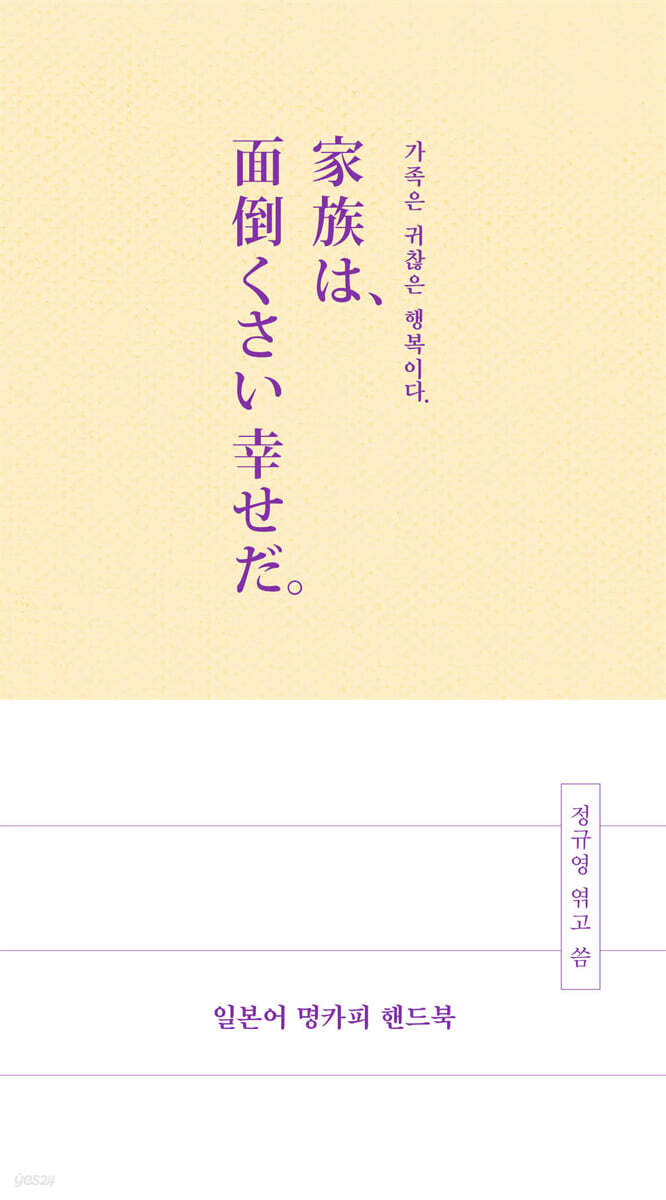
Japanese Copy Handbook
 |
Description
Book Introduction
Life, Love, Dreams, Work, Relationships
200 famous Japanese phrases organized into five themes!
The world of Japanese copy, explained in an easy and in-depth way by a current advertising director.
Can you learn Japanese through advertising copy? The recently published "Japanese Copy Handbook" is receiving an enthusiastic response from readers.
This book is a selection of 200 masterpieces from around 30 volumes of the best copy selected annually by the Tokyo Copywriters Club (TCC).
The commentary written by a current advertising creative director stands out.
It helps readers understand by easily explaining the background and intention behind each copy, as well as the subtle nuances of Japanese expressions.
Advertising copy is short but powerful, written in everyday language that anyone can understand.
This characteristic makes it a useful resource for learning Japanese.
Even readers who do not know Japanese well can fully experience the emotion and message of the original text without the language barrier through the Japanese commentary.
In addition, it includes cultural context and advertising information that may be difficult to understand by just looking at the copy, allowing you to gain a deeper understanding of the Japanese language and culture.
Author Jeong Gyu-yeong said, “I am happy to be able to share these treasured masterpieces with many people,” and expressed his hope that this book will not only allow readers to experience the charm of Japanese, but also provide them with the joy of discovering their own “favorite sentences.”
200 famous Japanese phrases organized into five themes!
The world of Japanese copy, explained in an easy and in-depth way by a current advertising director.
Can you learn Japanese through advertising copy? The recently published "Japanese Copy Handbook" is receiving an enthusiastic response from readers.
This book is a selection of 200 masterpieces from around 30 volumes of the best copy selected annually by the Tokyo Copywriters Club (TCC).
The commentary written by a current advertising creative director stands out.
It helps readers understand by easily explaining the background and intention behind each copy, as well as the subtle nuances of Japanese expressions.
Advertising copy is short but powerful, written in everyday language that anyone can understand.
This characteristic makes it a useful resource for learning Japanese.
Even readers who do not know Japanese well can fully experience the emotion and message of the original text without the language barrier through the Japanese commentary.
In addition, it includes cultural context and advertising information that may be difficult to understand by just looking at the copy, allowing you to gain a deeper understanding of the Japanese language and culture.
Author Jeong Gyu-yeong said, “I am happy to be able to share these treasured masterpieces with many people,” and expressed his hope that this book will not only allow readers to experience the charm of Japanese, but also provide them with the joy of discovering their own “favorite sentences.”
- You can preview some of the book's contents.
Preview
index
Part 1.
life
Part 2.
daily
Part 3.
dream
Part 4.
Day
Part 5.
relationship
life
Part 2.
daily
Part 3.
dream
Part 4.
Day
Part 5.
relationship
Detailed image
.jpg)
Into the book
No.
15
Only what was not in your life can change your life.
What is it like to live like a human being? What is human life?
Honda TV commercial (2011)
What can change with unchanging thoughts and unchanging actions? Bold ideas you've never considered before and challenges you've never attempted before open new paths and open up new lives.
Honda, the automobile company, has an impressive insight that what was missing in life begins with me.
~しか~ない is a sentence structure that conveys a strong message and means 'there is nothing but ~'.
A direct translation of this copy would be, 'You can't change your life without changing what you didn't have before.'
--- From "Part 1_Life"
No.
42
A day spent dressed as usual becomes life.
ふだん着の日が? People live and live?
Uniqlo Poster (2021)
Life feels like a series of special moments that we remember.
But when we look back, most of our lives are just piles of ordinary days.
It may not be that special, but isn't it a story that can be told because it's a brand that accompanies our precious daily lives?
This is a copy of Uniqlo, which offers simple and comfortable clothes at reasonable prices with the concept of LifeWear.
Fudan-ki (ぎ) refers to everyday clothes.
It feels more natural to change 'casual clothes day' to 'day to dress as usual'.
--- From "Part 2_Daily Life"
No.
103
Don't give up.
It becomes a habit.
あきらめるな?クセになる?
JT Roots poster (2011)
The opposite of success is not failure, it's giving up.
The phrase 'winning habit' has been popping up a lot lately.
This means not taking defeat for granted, but rather developing a winner's mindset through success.
And that habit is only formed when you don't give up in the face of everyday challenges and frustrations.
クセ, written in katakana for emphasis, means 'habit'.
In the Korean baseball world, where traces of Japanese still remain, it is also used to refer to a player's unconscious habits.
--- From "Part 3_Dream"
No. 160
It's good to be able to carry some weight without being shaken.
Is it possible to change the weight?
Otsuka Ion Water Poster (2019)
Carrying something on your back is a burden.
But paradoxically, that weight also supports us.
Responsibility, sense of mission, duty...
These weights actually serve as supports that give our lives a sense of balance.
Ion Water is a beverage from the same company as Pocari Sweat, but since it is a product aimed at adult consumers, the copy is also heavy.
重(おも)荷(に) means 'heavy load' or 'burden'.
Compared to 荷(に)物(もつ), which simply means 'baggage', it reflects a more burdensome mentality.
--- From "Part 4_Life"
No. 169
Family is a troublesome happiness.
Are you living in a family?
Shinano Mainichi Shimbun web advertisement (2014)
While most commercials only highlight the warm and positive aspects of family, this copy truly shows the duality of family.
Where in the world is there a family that is 100% happy?
It would be difficult to find a definition of family that is as clear and insightful as this.
Family in reality has its negative aspects.
Maybe that annoyance is part of the happiness.
The combination of negative 面(めん)倒(どう)くさい (annoying) and positive 幸(しあわ)せ (happiness) creates a strong impact.
15
Only what was not in your life can change your life.
What is it like to live like a human being? What is human life?
Honda TV commercial (2011)
What can change with unchanging thoughts and unchanging actions? Bold ideas you've never considered before and challenges you've never attempted before open new paths and open up new lives.
Honda, the automobile company, has an impressive insight that what was missing in life begins with me.
~しか~ない is a sentence structure that conveys a strong message and means 'there is nothing but ~'.
A direct translation of this copy would be, 'You can't change your life without changing what you didn't have before.'
--- From "Part 1_Life"
No.
42
A day spent dressed as usual becomes life.
ふだん着の日が? People live and live?
Uniqlo Poster (2021)
Life feels like a series of special moments that we remember.
But when we look back, most of our lives are just piles of ordinary days.
It may not be that special, but isn't it a story that can be told because it's a brand that accompanies our precious daily lives?
This is a copy of Uniqlo, which offers simple and comfortable clothes at reasonable prices with the concept of LifeWear.
Fudan-ki (ぎ) refers to everyday clothes.
It feels more natural to change 'casual clothes day' to 'day to dress as usual'.
--- From "Part 2_Daily Life"
No.
103
Don't give up.
It becomes a habit.
あきらめるな?クセになる?
JT Roots poster (2011)
The opposite of success is not failure, it's giving up.
The phrase 'winning habit' has been popping up a lot lately.
This means not taking defeat for granted, but rather developing a winner's mindset through success.
And that habit is only formed when you don't give up in the face of everyday challenges and frustrations.
クセ, written in katakana for emphasis, means 'habit'.
In the Korean baseball world, where traces of Japanese still remain, it is also used to refer to a player's unconscious habits.
--- From "Part 3_Dream"
No. 160
It's good to be able to carry some weight without being shaken.
Is it possible to change the weight?
Otsuka Ion Water Poster (2019)
Carrying something on your back is a burden.
But paradoxically, that weight also supports us.
Responsibility, sense of mission, duty...
These weights actually serve as supports that give our lives a sense of balance.
Ion Water is a beverage from the same company as Pocari Sweat, but since it is a product aimed at adult consumers, the copy is also heavy.
重(おも)荷(に) means 'heavy load' or 'burden'.
Compared to 荷(に)物(もつ), which simply means 'baggage', it reflects a more burdensome mentality.
--- From "Part 4_Life"
No. 169
Family is a troublesome happiness.
Are you living in a family?
Shinano Mainichi Shimbun web advertisement (2014)
While most commercials only highlight the warm and positive aspects of family, this copy truly shows the duality of family.
Where in the world is there a family that is 100% happy?
It would be difficult to find a definition of family that is as clear and insightful as this.
Family in reality has its negative aspects.
Maybe that annoyance is part of the happiness.
The combination of negative 面(めん)倒(どう)くさい (annoying) and positive 幸(しあわ)せ (happiness) creates a strong impact.
--- From "Part 5_Relationships"
GOODS SPECIFICS
- Date of issue: January 20, 2025
- Format: Hardcover book binding method guide
- Page count, weight, size: 220 pages | 280g | 107*186*19mm
- ISBN13: 9791140714261
You may also like
카테고리
korean


korean

![GQ KOREA Mark (Monthly): December [2025]](http://librairie.coreenne.fr/cdn/shop/files/8ef265dbbfbf186523ed75ba7319009d.jpg?v=1765340328&width=3840)


